Hodges' Model: Welcome to the QUAD: sustainability

Hodges' model is a conceptual framework to support reflection and critical thinking. Situated, the model can help integrate all disciplines (academic and professional). Amid news items, are posts that illustrate the scope and application of the model. A bibliography and A4 template are provided in the sidebar. Welcome to the QUAD ...

Showing posts with label sustainability. Show all posts

Monday, May 18, 2026

Call for Abstracts: Prototypes for Humanity - Submission Deadline 22 May 2026

Dear Colleagues, 

I am pleased to invite the submission of abstracts to the Prototypes for Humanity 2026 Short Papers Platform. 

Abstract Submission Deadline: 22nd May 2026
Invitations to Successful Authors: 8th July 2026
Conference Dates: 15th - 19th November, Dubai, UAE 

** Description **

The Short Papers Platform provides a forum for professors to share their research and engage in interdisciplinary dialogue, fostering global collaboration and knowledge exchange, with a focus on driving real-world impact through academic research.

For 2026, Prototypes for Humanity is delighted to announce the launch of a strategic partnership with the Investment Corporation of Dubai (ICD), for the Short Papers Platform. This joint effort reinforces the programme’s commitment to advancing impactful innovation through collaboration between academia and industry, focusing on the key sectors and themes that reflect international research priorities and that are relevant to the city and to the fund. 

Themes 
  • Wellbeing and Human Performance
  • Infrastructures and Cities
  • Autonomous Systems and Advanced Manufacturing
  • Environment, Sustainability and Energy
  • Mobility and Logistics
  • Socio-Economic Empowerment, Digital Economies and Future Markets
  • Open and Speculative
Awards

As part of the programme’s ongoing commitment to research translation, ICD will award a $50,000 prize to one of the short papers presented at the conference. The award recognises academic work with strong potential for practical application, identified through engagement with ICD industry experts, and will support the winning project’s next stage of development towards implementation.

Submissions

Full details can be found at: https://www.prototypesforhumanity.com/press-releases/stories/Call_For_Abstracts_2026

Apply here: https://form.jotform.com/260705028532451?source=https://www.jisc.ac.uk

Deadline for abstract submission: 22 May, 2026

We strongly encourage you to apply where your interests and research aligns with the programme’s thematic areas.

If you have any questions, please contact us at professors AT prototypesforhumanity.com

Sarah Ward
University Relations Manager
Prototypes for Humanity

E: sarah.ward AT prototypesforhumanity.com

My source: Email - https://www.bcs-sgai.org/

Friday, May 15, 2026

Tanzania Health Summit (THS)

Hello Peter Jones,

Warm greetings from the Tanzania Health Summit (THS).

As we prepare for the 13th Tanzania Health Summit, scheduled for 5th–7th October 2026 at Mlimani City Conference Center, Dar es Salaam, we are excited to share key opportunities and updates for your participation.

Abstracts Submission is underway, submit before 1st June.

We invite researchers, innovators, and professionals to submit abstracts aligned with this year’s theme:

“Building Health Sovereignty and Strengthening
Health Systems in a Changing Global Order.”

This is your opportunity to showcase impactful work and contribute to national and global health conversations.

Elizabeth & her Colleagues story about their wish to present at THS: 

SUBMIT YOUR ABSTRACT NOW!!!

Early Bird Registration is Still Open

Secure your spot at a discounted rate by registering early. Take advantage of this limited-time offer and be part of Tanzania’s largest healthcare gathering.

My source: Email - THS

Tuesday, January 06, 2026

KU Leuven - LCHH2 Health Humanities Lecture Series 2025-2026

Dear all,

The Leuven Centre for Health Humanities organises a yearly lecture series and we would love to invite you!

This year’s lecture series explores the entangled relations between nature and health. Bringing together perspectives from medical history, psychology, disability studies, colonial studies, and environmental humanities, the talks examine how ideas of nature have shaped — and have been shaped by — practices of care, control, and coexistence. Topics range from the rise of disposable medical technologies and their environmental costs, to colonial disease management at the cattle frontier, and from the ambivalent role of “nature” in the lives of people with disabilities to contemporary debates on the restorative effects of natural environments. The series also turns to the microbial world, challenging human exceptionalism and rethinking health as multispecies interdependence rather than biological mastery. Together, these lectures invite critical reflection on sustainability, vulnerability, and care, and offer new ways of imagining health in a world where human and nonhuman lives are profoundly interconnected.

Join us online and on campus, at KU Leuven, for a series of inspiring health humanities talks.

You can find more information about the lectures and how to register here:

Health Humanities Lecture Series 2025-2026 — 
Leuven Centre for Health Humanities (LCH²)

Best wishes,

Lore Delahaye (she/her)
Administrative Support

KU Leuven
Doctoral School for Humanities and Social Sciences
Blijde Inkomstraat 5, box 3000
3000 Leuven


https://ghum.kuleuven.be/phd

Friday, January 02, 2026

Nothing new under the Sun ...

 ... unless you're a 'health' service, or gathering dust on a shelf

January. Is the time of Janus: we look forward and back.

In April, this blog 'Hodges' model: Welcome to the QUAD - W2tQ' will be twenty years young. A blog post will follow with some metrics and statistics, although the 'analytics' that accompany many websites is not the main objective here. Preceding W2tQ and that first post, was the now archived website:

https://web.archive.org/web/20150316193042/http://www.p-jones.demon.co.uk/index.htm

Running from 1998-2015, the site's emergence ran as per:

Taught and applied Hodges' model on
 Community Psychiatric Nursing Certificate course 1987-1988.
Using the model in my practice and sharing with colleagues.
Gaining online access 1997.

Finding the Nursing Theory Development Site - NTDS 
(no longer available)
which was at https://www.ualberta.ca/en/index.html 
Meeting Brian Hodges at Manchester Met. University in May 1997.
Publishing the website in 1998.

Listed at the NTDS was a broad range of models of nursing and nursing theories. Brian's model, as anticipated was missing. I asked about Brian Hodges's model being added as a resource. Back then I thought, and still do, that Brian's work deserves recognition and more importantly, actually being used by practitioners and learners. It was a shame I thought, that such a person-centered and integrative model should be sat on a shelf (like other great ideas) gathering dust?

Still limping along in theme, functionality and accessibility, at least W2tQ has outlived the original website.

Academia and professional bodies across healthcare disciplines stress the need for research in practice. As a consequence, I've wondered about the pool of research questions that a healthcare, nursing, community nurse might have in mind? Ready and waiting, for those instances when specific funding materialises for a project. How many of these questions might feature as recurring characters? Once articulated, there for a new team member, are several starter-questions, a primer, to encourage exploration and critical thought. (Of course, a researcher needs to frame the question themselves; even if they do not 'own' them - public, patient engagement in research?).

With sustainability still on the political agenda (whatever the media suggests), is there a plan gathering dust, for the redesign, no less, of the National Health Service? Having squandered the demographic dividend of the 1950-1980s, how do we create concurrent health caring and preventive/educational services and systems?

Now, there is a project that Hodges' model could assist with! Better check the shelves (floppy disks!) and blow the dust-off real quick!

Monday, December 08, 2025

Remember (if you can) in each care domain ...

... there is an elephant in the 'room'!


individual
|
INTERPERSONAL : SCIENCES
humanistic -------------------------------------------  mechanistic
SOCIOLOGY : POLITICAL
|
group-population
'If there is one product that symbolises the absurdities of the EU's single market in goods, it might be a cuddly elephant. The Djungelskog toy from Ikea may only be 12cm tall and cost less than €2, but it has a 20cm-long label protruding from its behind.

Environmental rules from France and EU textile legislation account for much of the length. But the elongated label reflects a strategic even a philosophical, problem for Europe as its companies battle to compete globally.

The single market in goods should be the EU's crowning achievement. Compared with free movement of people, services or capital, it is the area that has come furthest in more than 30 years since the common market was established.

Yet there remain small, often invisible barriers to trade that, taken together, amount to what the IMF estimates is a drag on Europe's economy equivalent to a tariff of 44 per cent.'


RICHARD MILNE - OSLO and SAM JOINER - LONDON, Elephant in the room hampers frictionless EU trade, FTWeekend, 6-7 December 2025, p.6.

Related?

Jones, P. (1996) Nursing Technology and Elephants - Part 1: Technology as a beast of burden. IT in Nursing. 8,1,4-6.

Jones, P. (1996) Nursing Technology and Elephants - Part 2: Technology as a serpent. IT in Nursing. 8,2,5-7.

Jones, P. (1996) Nursing Technology and Elephants - Part 3: Technology rope to save humanity and health care, IT in Nursing. 8,3,5-7.

Saturday, December 06, 2025

The critical pathway leads to ...?

I missed the most salient information on this book's cover - at least for me. My copy is secondhand, but I picked the copy up recalling Dr Walsh's many publications on models of nursing.

The critical pathway for me is plural. It would include, the CPN(Cert.) course when I first encountered Hodges' model in 1987-8. Plus the fact that the pathway is not unidirectional, with some backward steps and reviews, but is multifold. Running the axes of Hodges' model to - pre-op, surgery, post-op, rehab ... we can add the whole corpus of nursing, social, self, and global health care.

The cover is of course illustrative, intended to support the title and suggest an explicit critical pathway. Apart from possibly pointing to collaboration "Mr Jones ... Let us discuss your critical pathway!" what has changed? Since the book's publication in 1997, we need health care services and systems to be sustainable. We are bit late here. Mr Jones is already a 'patient', bedecked in dressing gown and slippers.


This critical pathway needs to be replaced by one informed and oriented towards Mr Jones as self-caring citizen. This is of course easier said than done in policy terms. While governments globally and institutions stress the need for health literacy, informed life style choices, self-care, health promotion and prevention how much progress is being made? Nutrition remains a profound issue.*

The environmental challenges of climate change, pollution and waste disposal are seemingly contested even as the effects and cost of non-action are increasingly obvious.

The policy of 'care in the community' even while incomplete in the community, has provided me with a stimulating, challenging and rewarding career 1985 ... In the 21st century though, we have to ask of the assessment of mobility to follow and effort of the up-hill walk to 'home' begs the critical pathway that is now Planetary Health.

<>

Several points from Walsh (1997):
'Introducing a model to a clinical area is not an easy task to be undertaken lightly, as it involves fundamental changes in the way staff think and work. Luker (1988) has suggested that each nurse carries around their own informal model of nursing which guides their practice. It is probable that a formal model will be significantly different, although these differences can be minimized by full consultation and involvement with staff to ensure that the model chosen reflects their views of nursing as far as possible.' p.36.
Hodges' model can be 'carried around'. In truth it not strictly a model of nursing. Its scope extends beyond nursing and yet the model can incorporate thought about the patient, nurse, environment and what health, illness, recovery and self-care entail. Hodges' model is meta-cognitive and meta-conceptual, and (very) capable of mapping the terrain (p.26) of nursing from these and other perspectives. A nurse's 'views of nursing' will be dictated by the situation presented to them. Hodges' model can be retrospective, prospective and operate in the here-and-now: situated.
'There is a further point, however, that follows on from Luker's observation for expert nurses have an internalized model of care which is unique to them, it is possible that they may have internalized some practices which are outdated, taken for granted or inappropriate (Paley, 1996) but which are never made explicit as their care is not based upon a commonly understood model of nursing. This notion of every nurse having their own model therefore can lead to the situation where outdated rituals can be propagated under the guise of expert practice. Having a series of explicit models whose aims and ideas are common knowledge, shared by all, opens up care to critical scrutiny in a way that is not possible if each nurse has their own private internal model.' p.37.

Hodges' model can be used with other models, conceptual frameworks and systems across disiplines. Hodges' model is not intended to be prescriptive or prospective. It can be utilised for learning and unlearning. As a registered General Nurse who studied in the 1980s this does not mean I would be competent and safe to practice now. Continuing professional development, mandatory training and revalidation of nursing registration are all geared to support professional practice that has currency, validity, and is safe.

If nursing ever needed a commonly understood model ...?

'It will be apparent from the previous sections that use of a model will lead nursing into some new and unfamiliar territory that will involve seeing the patient in a more holistic fashion'. p.63.

'The nurse may find that models start to identify environmental problems whose solutions lie beyond the boundaries of nursing at present. This is particularly true of the community nurse.' p.63.
Walsh's concern here is the immediate community, but we can recognise the prescience of environmental problems here. Plus the need for the POLITICAL domain in Hodges' model:
'On a larger scale still, perhaps some patient's problems have their origins in political decisions made by national govemment or perhaps it is the factory down the road producing unacceptable levels of pollution. If nursing models make us recognize the political and environmental causes of some patient problems, there should ee no logical reason why nursing should not go forward into theee arenas as a legitimate part of nursing intervention.' p.63.
'There are senior NHS managers and health academics in so-called 'policy thínk tanks' who simply do not recognize the value of nursing and see only a collection of simpie tasks which anybody with an NVQ level 2 can perform. Nursing therefore has to demonstrate its worth; it has to evaluate what it is doing for patients.
Here it is important to remember that the care given may be very different from what is written down. Consequently, how a nurse evaluates care mentally may be very different from how this care is recorded in nursing process documentation. ...' p.64.
Hodges' model can (imho) have a role in argumentation for the quality and scope of healthcare, for nursing as a profession, evaluating and assuring nursing's values in the constant that are the demands of complexity and change. The (several) determinants of health are the other constant.

Mike Walsh (1997) Models and Critical Pathways in Clinical Nursing. London: Bailliere Tindall.

Luker K. (1988) Do Models Work? Nursing Times, 84 (5), 27-29.

Paley, J. (1996), Intuition and expertise: comments on the Benner debate. Journal of Advanced Nursing, 23: 665-671. https://doi.org/10.1111/j.1365-2648.1996.tb00035.x

*Jones P, Wirnitzer K. Hodges’ model: the Sustainable Development Goals and public health – universal health coverage demands a universal framework. BMJ Nutrition, Prevention & Health 2022;5: doi:10.1136/bmjnph-2021-000254

Wirnitzer KC, Motevalli M, Tanous DR, Drenowatz C, Moser M, Cramer H, Rosemann T, Wagner K-H, Michalsen A, Knechtle B, Fras Z, Ritskes-Hoitinga M, Marques A, Mis NF, Stanford FC, Schubert C, Goswami N, Leitzmann C, Fredriksen PM, Ruedl G, Wilflingseder D, Lima RA, Kessler C, Jeitler M, Khan NA, Joulaei H, Fatemi M, Knight A, Kratky KW, Palmer KK, Haditsch B, Jakse B, Kofler W, Pfeiffer T, Cordova-Pozo K, Tortella P, Straub S, Lynch H, Schätzer M, Krishnan A, Fathima A. S, Gatterer L, Kriwan F, Abhishek M, Nandgaonkar H, Nandgaonkar S, Adedara AO, Haro JM, Gericke C, Neumann G, Akhtar A, Rashidlamir A, Thangavelu M, Ngoumou GB, Perpék É, Klaper M, Bhattacharya B, Kirschner W, Bessems KMHH, Jones P, Peoples G, Bescos R, Duftner C, Seifert G (2025). Toward a roadmap for addressing today's health dilemma–The 101-statement consensus report., 
Frontiers in Nutrition, Volume 12:1676080. doi: 10.3389/fnut.2025.1676080. https://doi.org/10.3389/fnut.2025.1676080

Wednesday, November 12, 2025

The INDIVIDUAL ↔ GROUP axis

Looking at the axes of Hodges' model, specifically the INDIVIDUAL ↔ GROUP axis, I realise (as ever) there's more than meets the eye. 

The labels for the axes are placeholders. To a certain degree they are open, flexible. In the template (link and figure in the sidebar), the what should now be familiar labels are provided for guidance, and convenience.

The care, knowledge domains can be viewed as giant - compound placeholders, even as an opportunity to abstract away a lot of detail. In care delivery, as we concentrate on patient care, , clinical interactions, procedures ... we tend to do this in political terms. Until that is, we are jolted to the wider situation and the true realities of policy, law, and practice.

While the HUMANISTIC ↔ MECHANISTIC labels are fixed, I've often shown how the I ↔ G is itself situated, so you could variously have (titles & names to follow...):

person, self, I, individual, client, patient,
carer, student, nurse x, dr y, allied health z ..

|

nurse .., husband, wife, partner, kin, couple, guardian, friend, family, team, group, community, region, nation, populations, Planet

Usually, what we have is a ONE-TO-MANY relationship, that is 1:N.

In Hodges' model can we also say that the team is the 'individual' and the organisation the group?

Another thought regarding self-care. ... Some times this state might be concurrent with being a patient.

Part of the journey in a patient's recovery. But at some point the person does not need a professional and is indepedently self-caring. Care episodes are not what they used to be. Although when 'true' self-care is achieved, it might appear One-to-None, but this is not correct. Not correct, that is, if we can credit society acting as a safety net. Usually, it would be One-to-Family; if there is no family, then the One-to-Community should (must) be the placeholder of choice.

On self-care, and the vertical axis of Hodges' model, is this also a way to define sustainable health and social care?

See also: https://hodges-model.blogspot.com/2025/10/l-shaped-model.html

Tuesday, October 21, 2025

The Sveriges Riksbank Prize in Economic Sciences in Memory of Alfred Nobel 2025

individual
|
INTERPERSONAL : SCIENCES
humanistic -------------------------------------------  mechanistic
SOCIOLOGY : POLITICAL
|
group-population


'This year’s prize relates to the explanations for sustained growth based on technological innovation. Economic historian Joel Mokyr is rewarded with one half of the prize for his description of the mecha­nisms that enable scientific breakthroughs and practical applications to enhance each other and create a self-generating process, leading to sustained economic growth. Because this is a process that challenges prevailing interests, he also demonstrates the importance of a society that is open to new ideas and permits change.'

'The other half of the prize is awarded to the economists Philippe Aghion and Peter Howitt. In a joint publica­tion from 1992, they constructed a mathematical model of how companies invest in improved pro­duction processes and new, better-quality prod­ucts, while the companies that previously had the best products are outcompeted. Growth arises through creative destruction. This process is creative because it builds upon innovation, but it is also destructive because older products become obsolete and lose their commercial value.'


'It is apparent that, in the long run, sustained growth does not only have positive consequences for human wellbeing. First, sustained growth is not synonymous with sustainable growth. Innovations can have significant negative side effects. Mokyr argues that such negative effects sometimes initiate processes that uncover solutions to problems, making technological development a self-correcting pro­cess. Clearly, however, this often requires well-designed policies, such as in the areas of climate change, pollution, antibiotic resistance, increasing inequality and the unsustainable use of natural resources.'


Previously on W2tQ: 'Nobel prize' : 'socio-economics'

Tuesday, October 14, 2025

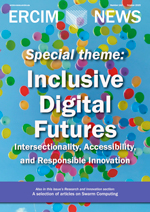
ERCIM News No. 142 Special theme: "Inclusive Digital Futures: Intersectionality, Accessibility, and Responsible Innovation"

Dear ERCIM News reader,

The October 2025 issue of ERCIM News (Number 142) is now online! The special theme of this issue looks at how Computer Science can help build more inclusive and diverse communities. This includes both the digital world and its own research and work environments. The issue features contributions from diverse fields of research and innovation, as well as reports on applied initiatives and policies that promote inclusion and diversity.

This special theme was coordinated by our guest editors Magdalini Chatzaki (FORTH-ICS) and Anna Szlávi (Johannes Kepler University)

Next Issue

No. 143 – January 2025
Special Theme: AI for Science

Announcements in this issue
  • Dagstuhl Seminars & Workshops – Call for Proposals
  • ERCIM Forum “Beyond Compliance” – 4th Edition | 29–31 October 2025 | Registration still open
  • 33rd IEEE International Conference on Software Analysis, Evolution, and Reengineering (SANER 2026) | Tracks Call for Papers
  • Welcome to the 45th SAFECOMP 2026 | Call for Papers
  • 21st International Workshop on Dependable Smart Embedded Cyber-Physical Systems and Systems-of-Systems (DECSoS 2026) | Pre-Announcement
  • ERCIM “Alain Bensoussan” Fellowship | Next application deadline: 30 April 2026
    This issue includes:

Introduction to the Special Theme 
  • p.8 Inclusive Digital Futures: Intersectionality, Accessibility, and Responsible Innovation
Inclusive Digital Futures – Intersections of Technology, Security, Discrimination, and Bias
  • p.10 Securing Open Source for a Trusted and Inclusive Digital Future
  • p.11 The Role of AI-Based Age Estimation in Promoting Safer Digital Environments for Children: Ethical and Accessibility Considerations 
  • p.13 SafeLine.gr - The First Official Trusted Flagger Organisation under the Digital Services Act (DSA) in Greece
Education & Training, Interventions, Policies, Protocols, and Tools 
  • p.27 When Used Outdoors, Augmented Reality Amplifies Situational Disabilities 
Research and Innovation
  • p.40 Forecasting Air Pollution at Construction Sites: A New Framework for Environmental and Social Sustainability
Thank for reading ERCIM News. If you’ve enjoyed this issue, please feel free to forward it to colleagues who may find it interesting and help us reach even more by sharing it on LinkedIn.

If you’re considering an even deeper partnership, advertising in ERCIM News not only helps sustain our publication but also puts your message in front of an expert, highly qualified audience.
My source with thanks: 
Peter Kunz
ERCIM
https://www.ercim.eu
https://ercim-news.ercim.eu

Thursday, September 11, 2025

New cit.? "Toward a Roadmap for Addressing Today's Health Dilemma - The 101-Statement Consensus Report"

News - this morning brought provisional acceptance of a paper, and hence a potential new citation. I greatly appreciate being involved with this project. So, fingers-crossed even at this late stage ...

Title: Toward a Roadmap for Addressing Today's Health Dilemma -The 101-Statement Consensus Report 
Submitted By: Katharina C. Wirnitzer
Authors: Katharina C. Wirnitzer, Mohamad Motevalli, Derrick Tanous, Clemens Drenowatz, Maximilian Moser, Holger Cramer, Thomas Rosemann, Karl-Heinz Wagner, Andreas Michalsen, Beat Knechtle, Zlatko Fras, Merel Ritskes-Hoitinga, Adilson Marques, Nataša Fidler Mis, Fatima Cody Stanford, Christian Schubert, Nandu Goswami, Claus - Leitzmann, Per Morten Fredriksen, Gerhard Ruedl, Doris Wilflingseder, Rodrigo Antunes Lima, Christian S. Kessler, Michael Jeitler, Naim Akhtar Khan, Hassan Joulaei, Maryam Fatemi, Andrew Knight, Karl W. Kratky, Kara K Palmer, Bernd Haditsch, Bostjan Jakse, Walter Kofler, Tomas Pfeiffer, Kathya Lorena Cordova-Pozo, Patrizia Tortella, Simon Straub, Heidi Lynch, Manuel Schätzer, Anupama Krishnan, Shahnaz Fathima, Lukas Gatterer, Fabian Kriwan, Mittal Abhishek, Hemant Nandgaonkar, Shalaka Nandgaonkar, Abiola O. Adedara, Josep Maria Haro, Corina Gericke, Gaby Neumann, Aysha Akhtar, Amir Rashidlamir, Madan Thangavelu, Ngoumou Gonza, Éva Perpék, Michael Klaper, Bhaswati Bhattacharya, Werner Kirschner, Kathelijne Bessems, Peter Jones, Gregory E Peoples, Raul Bescos, Christina Duftner and Georg Johannes Seifert

Journal: Frontiers in Nutrition, section Food Policy and Economics

Research Topic: Sustainable Approaches to Public Health Via Food Policy Actions

Accepted on: 10 Sept 2025
I will (hopefully) be able to add more details (abstract - - formatted ...) as they become available. 

Tuesday, July 15, 2025

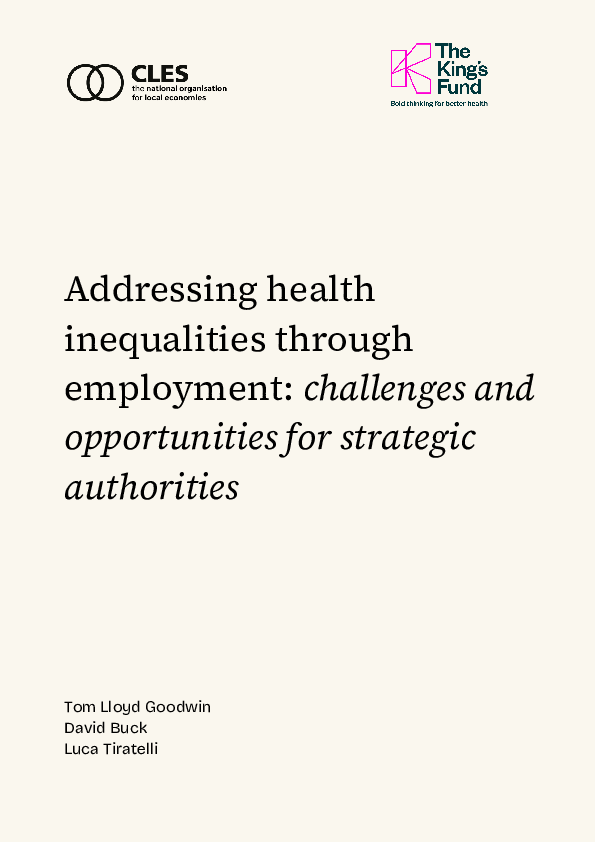
Essay: 'Addressing health inequalities through employment' July 2025


Four priorities:
  1. Establish closer working relationships across the SA [Strategic Authorities] ecosystem to prioritise action on health inequalities.  

  2. Align resources to support people on their journey to sustainable employment.

  3. Negotiate with government for greater permissions.

  4. Harness the power of anchors.
 

Many useful references are also provided, e.g. Building Blocks of Health. Plus the discussion of anchors.


Individual
|
      INTERPERSONAL    :     SCIENCES               
HUMANISTIC  --------------------------------------  MECHANISTIC      
 SOCIOLOGY  :    POLITICAL 
|
Group
employment as a determinant of health

mental & emotional health

Early intervention, employer-employee liaison, health coaching*


PLACE - PLANET

physical health - life-expectancy

LOCAL - accessible
SOCIO-

people & communities

flourishing communities

neighbourhood

People in communities on 
LONG-TERM SICKNESS

WORKWELL grants*

WIDER DETERMINANTS OF HEALTH

SOCIAL VALUE OF HEALTH

low-quality jobs - poorer health

Poverty - HOUSING SECURITY


-ECONOMIC

NHS 10 Year plan: 1. GP / dental access
2.  waiting lists hospital and community care
3. staff demoralised and demotivated
4. outcomes on major killers like cancer lag behind other countries.

STRAGEIC AUTHORITIES - DEVOLUTION
shift of wealth & power

HEALTH INEQUALITIES
inequity

WHOLE GOVERNMENT
APPROACH TO HEALTH

ECONOMIC VALUE OF HEALTH

low-quality jobs

Local strategic response


See also -

Opinion: Failing to collect, analyse, and report ethnicity data in clinical research leads to healthcare inequalities. BMJ 2025; 390 doi: https://doi.org/10.1136/bmj.r1457 (Published 14 July 2025)
Cite this as: BMJ 2025;390:r1457

 'hospital' : 'community' : 'analogue' : 'digital' : 'prevention' : 'sickness'

My source: https://x.com/TheKingsFund/status/1944678280461734226

Sunday, April 27, 2025

Citation of Hodges' model: 'Sustainable Health Model: Increasing Universal Access to Health Services in Remote Areas'

News received of another citation to add to the bibliography. It's just a sentence, but always welcome.

Noting the journal's title, Hodges' model incorporates a person's, family's, population's health career which is invariably impacted by a cascade of life chances. H2cm can also be applied temporally, longitudinally; taking in the past, current situation and future.

Good to see researchers discovering Hodges' model and considering it in respect of global health and sustainability also. If your purpose is to identify gaps, seek to reduce them, critique and evaluate change then again Hodges' model with the bridges it affords is an effective resource.

It's disappointing to see the journal - JoWFMHN list only the first author of referenced work. I must look at open access in the future, and remain grateful to Dr Wirnitzer - co-author in the cited paper - for assistance with writing and final publication, whose work includes:

The NURMI-Study (NURMI – Nutrition and Running high Mileage)
https://www.nurmi-study.com/en

Science 2 School: Nachhaltig gesund – bewegt & veggie
https://www.science2.school/

Abstract

Access to healthcare services in remote areas remains a significant global challenge, with many populations experiencing disparities in healthcare availability, quality, and affordability. Sustainable health models that ensure universal access to health services are essential for improving public health outcomes in underserved areas. This study investigates the potential for sustainable health models to increase healthcare access in remote regions, focusing on the role of telemedicine, mobile health clinics, and community health workers. The research employs a mixed-methods approach, combining qualitative interviews with healthcare professionals and quantitative data on healthcare access and outcomes in remote communities. The findings indicate that telemedicine platforms have improved healthcare delivery by 40%, while mobile health clinics and trained community health workers have expanded service reach, particularly in geographically isolated areas. Furthermore, community-based health interventions have led to a 30% reduction in preventable diseases in these regions. The study concludes that integrating technology with community-based solutions offers a scalable and effective approach to achieving universal health access in remote areas. However, challenges such as technology infrastructure, resource allocation, and healthcare workforce training need to be addressed to ensure the sustainability of these models.

Ardenny Ardenny, Le Hoang Nam, Pham Anh Tu (2025). Sustainable Health Model: Increasing Universal Access to Health Services in Remote Areas. Journal of World Future Medicine, Health and Nursing. 3. DOI:10.70177/health.v3i1.1907

Friday, April 18, 2025

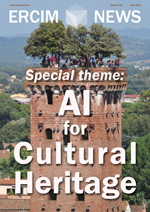
ERCIM News No. 141 Special theme: "AI for Cultural Heritage"

Dear ERCIM News reader,

The April 2025 issue of ERCIM News (Number 141) is now online! The articles featured in this issue highlight the wide spectrum of applications in the cultural heritage field that benefit from AI, as well as the diverse forms of AI being employed across the sector.

Including:

Who Are You, AI? – Artificial Intelligence as a Potential Metaphysical Humiliation of Humanity. pp.32-33.

By Michael Fleischhacker (University of Applied Sciences Burgenland), 
Igor Ivkić (University of Applied Sciences Burgenland and Lancaster University), and Friedrich Roithmayr (University of Applied Sciences Burgenland) 
'Artificial Intelligence as a potential fourth metaphysical humiliation—questioning human uniqueness in reason, freedom, and moral standing, and unsettling our place in the world after Copernicus, Darwin, and Freud.'

My source - with many thanks:
Peter Kunz
ERCIM
https://www.ercim.eu
https://ercim-news.ercim.eu

Friday, March 14, 2025

New network in Environmental Humanities: H-EcoLit

supported by H-Net

Dear colleagues, 

Hello. Sorry for cross posting as I am sharing with you the below that may be of your interest. 
 
  • newly launched network in Environmental Humanities: H-EcoLit supported by H-Net

You are welcome to register for free as member of our newly launched network called "H-EcoLit", supported by the H-Net of the Michigan State University:


H-EcoLit is an international network of academics and researchers of all levels who study the fields of Environmental Humanities, Literary Theory and Cultural Criticism. The network seeks to explore issues beyond the traditional binary of nature-culture, and examines the changing status of subjectivity, agency, and citizenship, while envisioning matters for sustainable futures in a more-than-human world. H-EcoLit is aligned with the H-Net’s aims for supporting open access research, interdisciplinary projects, and ‘unites’ different voices across the globe. The intended audience includes academics, scholars of all levels and policy makers who are working on the Environmental Humanities, Literary and Cultural Studies, and related to Environmental Humanities areas.

Welcome to join us! Thank you!

  • Publications edited and co-authored by Professor Peggy Karpouzou and Dr. Nikoleta Zampaki
1. Special Issue: "Critical Green Theories and Botanical Imaginaries: Exploring Human and More-than-human World Entanglements" published in Open Cultural Studies:
2. Special Issue: "Ecologies of Life and Death in the Anthropocene" published in Lagoonscapes. The Venice Journal of Environmental Humanities: 
3. Special Issue: "The Digital Environmental Humanities: Towards Theory and Praxis" published in HJEAS:
4. our open access chapter titled "Toward Posthuman Aesthetics: The Flesh of the World in Auguste Rodin’s Le Penseur and The Thinking Robot" published in Nidesh Lawtoo's volume titled Mimetic Posthumanism. Homo Mimeticus 2.0 in Art, Philosophy and Technics at Brill:
5. our chapter titled “The Poetics of Zombification in Ryan Mecum’s Dawn of Zombie Haiku” In Zombie Futures in Literature, Media and Culture. Pandemics, Society and the Evolution of the Undead in the 21st Century edited by Simon Bacon, published by Bloomsbury: 
[I note online events are included in an announcements page:

We will keep in touch. Thank you!

Best regards, 
on behalf of the Editors

Nikoleta
--
Dr. Nikoleta Zampaki
Postdoctoral Researcher
Faculty of Philology, School of Philosophy, 
National and Kapodistrian University of Athens, Greece
E-mail: nikzamp AT phil.uoa.gr

My source: SOPHERE list

Friday, December 06, 2024

Int. Conference on Improving University Teaching 2025


Redefining Education:

Navigating Sustainability and Innovation in a VUCA World

In a world increasingly subject to volatility, uncertainty, complexity, and ambiguity (VUCA) the goal of sustainability is aspirational, yet elusive.  A UN report published in 2024 notes that “intensifying, interconnected challenges continue to endanger the realization” of the seventeen sustainable development goals identified by the UN Sustainability Conference twelve years ago in Rio de Janeiro.  This is especially true in education, which the report correctly terms “the bedrock of sustainable development.”   It notes the negative effects of the COVID epidemic, regional conflicts, climate shock, and economic turmoil and paints a picture of a planet struggling to make progress towards them. While the big picture may be less than perfect, there is still much cause for hope, as we strive towards a better future.

Against this backdrop, the International Conference on Improving University Teaching seeks to address the challenge of sustainability, equity, and innovation as they affect higher education. In particular, we are exploring how to prepare students for a “VUCA world” in which they will have to contend with multiple challenges, while at the same time ensuring their wellbeing—and that of all academic staff—in the present. By definition, a future subject to uncertainty and ambiguity will require flexibility and adaptability on the part of students. ..

Continued ...

Previously: IUT, VUCA

Sunday, November 03, 2024

Hear* are the Global Evidence Results: Health 10 :: Education 1

individual
|
INTERPERSONAL : SCIENCES
humanistic ------------------------------- mechanistic
SOCIOLOGY : POLITICAL
|
group

EDUCATION 1

MENTAL HEALTH X?


HEALTH 10


DEFENCE 10


Key recommendations

Our main recommendation is for countries to collaborate on evidence synthesis. The most promising avenue for evidence synthesis is Living Evidence Reviews (LERs), which are systematic reviews that are continuously updated. We propose that ‘meta’ LERs are conducted across all areas of social policy to answer the questions that really matter to policymakers.

“Globally, it may be helpful for countries to join forces in producing systematic reviews and identifying evidence gaps. One proposal, currently being shaped by David Halpern and Deelan Maru, proposes that a handful of likeminded governments join forces to produce better systematic reviews and avoid duplication (Halpern and Maru, 2024)… Like the Cochrane Collaboration and the Campbell Collaboration, such an approach can help expand our knowledge of what works, and put a spotlight on the areas where more evidence is needed.”

A Blueprint for Better International Collaboration on Evidence
https://www.bi.team/publications/international-collaboration-evidence/

My source:
Harford, T. Intellect. Used in evidence. FTWeekend, Magazine 2-3 November 2024, p.9-10.

*We really need to listen and respond to this!

Friday, November 01, 2024

ERCIM News No. 139 Special Theme: "Software Security"

Dear ERCIM News reader,

A new ERCIM News issue (Number 139) is online with a special theme on Software Security. The articles in this special theme offer a comprehensive panorama of the current European research activities in software security and protection. They showcase a diverse range of research projects, highlighting the ongoing advancements and key developments of the field..

You can access the issue at https://ercim-news.ercim.eu/

This special theme was coordinated by our guest editors Sebastian Schrittwieser (University of Vienna) and Michele Ianni (University of Calabria).

Thank you for reading ERCIM News!

Please share this issue with anyone who might find it interesting. ... Let's keep the conversation going and share the latest updates together!

Next issue:

No. 140, January 2025
Special Theme: " Large-Scale Scientific Computing". Submissions are welcome! See call for contributions.

Announcements in this issue: Call for Proposals: Dagstuhl Seminars and Perspectives Workshops - Schloss Dagstuhl – Leibniz-Zentrum für Informatik is accepting proposals for scientific seminars/workshops in all areas of computer science.

Call for Papers: ACM Digital Threats: Research and Practice

ERCIM News is published quarterly by ERCIM, the European Research Consortium for Informatics and Mathematics. With the printed and online edition, ERCIM News reaches more than 10000 readers.
All issues published to date are available online.

About ERCIM

ERCIM - the European Research Consortium for Informatics and Mathematics - aims to foster collaborative work within the European research community and to increase cooperation with European industry. Leading European research institutes are members of ERCIM. ERCIM is the European host of W3C.
Peter Kunz          (With thanks!)                    	
ERCIM Office
+33 (0)7 68 16 50 47

2004, Route des Lucioles
BP93
F-06902 Sophia Antipolis Cedex

Thursday, October 10, 2024

British Computer Society: AI for One Health and Planetary Health

 BCS SPECIALIST GROUP ON ARTIFICIAL INTELLIGENCE (BCS SGAI)! 

AI for One Health and Planetary Health: Where Are We?

Friday November 8th 2024 - British Computer Society London Office (near Moorgate Underground)

Invitation to Register

http://www.bcs-sgai.org/health2024/

A full-day event with invited talks on the following topics:

  • One Health and Planetary Health: the case for considering a unified health perspective
  • Translational Diagnostics in Companion Animals
  • Mixed AI approaches to surfacing information hidden in veterinary electronic health records
  • Hands-on Tutorial: Low-Code/No-Code AI: Democratise AI for Text, Images, and Audio
  • AI for One Health and Planetary Health: is there a generic framework?
  • Low-Code/No-Code AI for Biomedical Image Classification: Visual Impairment as a case stud
  • Low-Code/No-Code AI for Planetary Health: World Fisheries and Aquaculture as a case study
The  21st  century  brings  major  global  challenges,  including  climate  change  and  rapid  population  ageing, calling  for  transdisciplinary  involvement  of  diverse  sectors  and  stakeholders,  including  academics  and students, companies and societal organisations. One Health considers human health, animal health, and our shared  environment  as  parts  of  a  deeply  interconnected  system.  Our  environment  is  changing  and  it  is affecting  our  health.  Planetary  Health  emphasises  that  everything  is  connected:  "the  quality  of  the  air  we breathe and of the water we drink, the quality and quantity of food we produce, our exposure to infectious diseases, and even the habitability of the places where we live". Digitalisation is happening in both human and veterinary medicine. Human-AI collaboration can bring humans and AI together to gain more valuable insights  than  either  could  achieve  alone. The  event  comprises  a  number  of  talks  with  speakers  from  the Animal  and  Plant  Health  Agency  (APHA.gov.uk),  Veterinary  Health  Innovation  Engine  (vHive),  Small Animal  Veterinary  Surveillance  Network  (SAVSNET),  National  Health  Service  (NHS)  England,  and  UK universities.  

Low-code/no-code AI is on the rise with Large Language Models (LLMs) at its core, including multimodal LLMs that can produce content (text, image, video, or audio/speech) as output (generative AI). Come along to the hands-on tutorial if you are interested in content generation and content analysis of text, images and  audio  with  open-source  LLMs from  Google,  Facebook,  Microsoft  and  OpenAI  in  just  3  lines  of python  code  (low-code  AI)  and  LLM  prompting  (no  code  AI).  The  exercises  can  be  executed  in  1  to  5 minutes using Google Colab (free of charge for basic use and without setup to use).  

There will be Certificates of Attendance for those who register and attend the event.

We hope that you will come and join us, and that you enjoy this new offering from the BCS SGAI.

Full details are available at http://www.bcs-sgai.org/health2024/

Reduced delegate fees!!
The  delegate  fee  is  just  £50  plus  VAT  for  BCS  and  SGAI  members  and  £90  plus  VAT  for  others. This includes  attendance  at  the  event,  lunch  and  refreshments.  A  special  rate  of  £35  plus  VAT  is  available  for students. A Group Discount Rate is available for group bookings of three or more.

--------------------------------------------------------
To register for future mailings about SGAI events go to http://www.bcs-sgai.org/register/

Max Bramer
Chair BCS Specialist Group on Artificial Intelligence (bcs-sgai.org)

Friday, September 13, 2024

ROBOTPOLITICS

26 – 27 September, 2024 
UNIVERSIDADE ABERTA LISBON, PORTUGAL


The program includes:
  • The house is on fire, but this is fine: the incoming tsunami of disinformation 
  • Encrypted subjectivity in digital space 
  • You are (not) your avatar: personhood, personal identity and legal issues in mind uploading 
  • On Techno Dharma: Neurofeedback-assisted meditation as an enhanced technology of the self 
  • Mapped in real time: Affective technologies and the post-human subjectivity 
  • Does social bots rely on beliefs to communicate the science: An implication for misinformation. 
  • The Paradox of Information Abundance: Homogenization of Political Thought in the World of Social Media 
  • The main problems of Robotpolitics. Hints for their resolutions 
  • « Smart city » / Intelligent Citizen 
  • Smart Cities and Sustainability: Malthusian Sexual Robots 
  • Sex-Bots: Friend or Foe to Human Relationships? 
  • Towards Digital Platonism 
  • Autonomous weapons systems in armed conflicts: ethical and legal implications 

See also - The Jena Declaration: https://thejenadeclaration.org 

Previously on W2tQ robots

Wednesday, July 10, 2024

ERCIM News No. 138 Special theme: "Sustainable Cities"

Dear ERCIM News reader,

A new ERCIM News issue (Number 138) is online with a special theme on sustainable cities. This ERCIM News special theme reports on research addressing technologies, systems, applications, and services for sustainable smart cities, showcasing Europe's research ecosystem.
You can access the issue at https://ercim-news.ercim.eu/

This special theme was coordinated by our guest editors German Castignani (Luxembourg Institute of Science and Technology) and Georgios Mylonas (Industrial Systems Institute, Athena Research Center).

Thank you for reading ERCIM News!

Please share this issue with anyone who might find it interesting. ... Let's keep the conversation going and share the latest updates together!

Next issue:
No. 139, October 2024
Special Theme: "Software Security". Submissions are welcome! See call for contributions.

Announcements in this issue:

  • Call for Proposals: Dagstuhl Seminars and Perspectives Workshops - Schloss Dagstuhl – Leibniz-Zentrum für Informatik is accepting proposals for scientific seminars/workshops in all areas of computer science.
  • ERCIM "Alain Bensoussan" Fellowship Programme - Postdoctoral fellowships available at leading European research institutions. Simple application procedure. Next application deadline: 30 September 2024.
  • Call for Participation: Forum Beyond Compliance 2024: Research Ethics in the Digital Age
  • Call for Participation: Edge AI Meets Swarm Intelligence - Dubrovnik, Croatia, 18 September 2024
  • SmartEdge & AIoTwin Summer School and Workshop, 16-20 September 2024, Dubrovnik, Croatia
  • Call for Participation: FMICS 2024 - 29th International Conference on Formal Methods for Industrial Critical Systems, co-located with Formal Methods (FM) 2024 in Milan, 9-11 September 2024

ERCIM News is published quarterly by ERCIM, the European Research Consortium for Informatics and Mathematics. With the printed and online edition, ERCIM News reaches more than 10000 readers.
All issues published to date are available online.


About ERCIM

ERCIM - the European Research Consortium for Informatics and Mathematics - aims to foster collaborative work within the European research community and to increase cooperation with European industry. Leading European research institutes are members of ERCIM. ERCIM is the European host of W3C.

Subscribe to the ERCIM News quarterly alert

Peter Kunz*                      	
ERCIM Office
2004, Route des Lucioles
BP93
F-06902 Sophia Antipolis Cedex

https://www.ercim.eu
https://ercim-news.ercim.eu 

*My source via email - many thanks.

n.b. A search did not find 'health', 'well-', 'care', or 'pollution' in this issue.
 
Contrast with (and other previous issues):

ERCIM News No. 98 Special theme: "Smart Cities"