Hodges' Model: Welcome to the QUAD: Search results for digital

Hodges' model is a conceptual framework to support reflection and critical thinking. Situated, the model can help integrate all disciplines (academic and professional). Amid news items, are posts that illustrate the scope and application of the model. A bibliography and A4 template are provided in the sidebar. Welcome to the QUAD ...

Showing posts sorted by relevance for query digital. Sort by date Show all posts

Sunday, November 30, 2025

Invitation to EPI-WIN webinar: 1 Dec, on UNiTE to end digital violence ...

... why digital safety is a gender and public health imperative in emergencies

We are delighted to invite you to join our webinar on #UNiTE to end digital violence, on 1 December 2025, 13.00 CET (geneva time), with Ms Reem Alsalem, UN Special Rapporteur for violence against women, its causes and consequences, Dr Stella Chungong, Director and Chair of the WHO Health Emergencies Gender Working Group, and voices of community experiences.  

Please do join the discussion and share widely.


Title: UNiTE to end digital violence: why digital safety is a gender and public health imperative in emergencies

Time and Date: 13:00 – 14:30 CET (Geneva), Monday, 1 December 2025

Registration: xxxxxxxxx

Webpage: WHO EPI-WIN webinar: UNiTE to end digital violence: why digital safety is a gender and public health imperative in emergencies

Digital violence, such as doxxing, deepfakes, and online harassment, poses significant public health risks. Millions of women, girls, and adolescents face harassment, stalking, and threats in digital spaces meant for connection.

In crisis settings, these digital threats create multiple challenges. Understand what they are and why it is important to integrate digital safety into humanitarian health responses.

Tentative Agenda and Speakers

Welcome/Opening remarks: Digital safety as a public health imperative in crises:  Dr Stella Chungong, Director, Department of Health Emergency Preparedness & Chair, WHE Gender Working Group

Preparedness begins with protection: why digital violence must be addressed in humanitarian health work: Dr Stella Chungong, Director, Department of Health Emergency Preparedness & Chair, WHE Gender Working Group

UNFPA perspective from Executive Director, UNFPA: delivered by Dr Eugene Kongyuy, Deputy Director of Humanitarian Response Division to represent the United Nations Population Fund (UNFPA).

Keynote address: Ms Reem Alsalem, UN Special Rapporteur for Violence Against Women, its causes and consequences

Risk communication, community engagement and infodemic management: digital violence as a driver of misinformation: Dr Kai Von Harbou, Unit Head, Community Protection & Resilience, WHO 

Surviving Digital Violence: DR Millie Phiri, journalist, researcher and author on digital violence

Community Voice:  Ms Sohaila Shamseldeen, Youth and Development Coordinator, Etijah

Saturday, September 03, 2022

Call for Papers: The Digital Movement in Nursing

Call for Papers: FOCUS The Digital Movement in Nursing

Focus Edition Guest Editor

Prof. Camille Cronin, Director of Research and Impact, School of Health and Social Care, University of Essex, UK

The Journal of Research in Nursing (JRN) is a leading peer-reviewed journal that underpins good research with current policy and aims to publish papers that will influence nursing practice and health- and social-care policy.

Over the last two years we have seen an unparalleled digital-technological response to the COVID-19 pandemic that has re-shaped the way health- and social-care functions, for better or worse. This change has been fast and relatively unevaluated, with little time or opportunity made available for the involvement of nurses, critical discussions or reflections. What did this do to the nursing world? JRN is commissioning this focussed edition to find out more.

We are seeking papers that showcase, describe, and highlight the impact of new digital technology and innovation on digital health related to nursing. These might include:

  • showing how nurses are leading the development of such technologies or digital solutions; or
  • how service users were involved in developing a digital resource using participatory practices; or
  • the impact these innovations have had on nurses, and patients and their families – e.g. on accessing health care, on delivering and evaluating care; or
  • what do we expect for the future and how do we enable the future health-care workforce to keep pace with such change?

Papers can be built around different research designs, case-studies, evaluations, or service improvement initiatives and may address any of these issues in relation to digital health:

  • improving the quality of health-care and health, access, and safety through digital health;
  • using digital health data to improve health- and social-care services;
  • improving recruitment, deployment and retention of health- or social-care workers using digital technology;
  • developing innovative technology and digital health strategies to improve care;
  • developing or using technology;
  • demonstrating initiatives that use technology to promote health and/or wellbeing; and
  • what, if any, are the consequences of the rapid insurgence of digital health technology?

As JRN’s mission is to contribute knowledge to nursing practice, research and local, national and international health and social policy, the contribution of the paper to, or implications for, both nursing practice and health and social-care policy must be made explicit.

Authors interested in contributing to this edition of JRN should submit by 1 JANUARY 2023.

More details ...

Sunday, January 08, 2023

Special Issue - Theorytellings: Epistemic Narratives in the Digital Humanities

Photo by Marcus Urbenz on Unsplash

Journal of Cultural Analytics

Vol. 7, Issue 4, 2022
Theorytellings: Epistemic Narratives in the Digital Humanities

"This special issue deals with existing theory narratives and conceptions in DH scholarship. Introducing the neologism “theorytellings”, this special issue invites DH scholars to narrate and discuss their own theoretical contributions to the field."
 
Kleymann, Rabea, et al. “Foreword to the Special Issue ‘Theorytellings: Epistemic Narratives in the Digital Humanities.’” Journal of Cultural Analytics, vol. 7, no. 4, Nov. 2022, doi:10.22148/001c.55593.
 
Includes:

Abstract

The status of theory in the Digital Humanities (DH) has been the subject of much debate. As a result, we find different theory narratives competing and entangled with each other. If at all, these narratives can only be grasped and examined from a somewhat detached perspective. Here, we attempt to investigate these elusive narratives by means of a conceptual history approach. In doing so, we define different theory dimensions, ranging from specific cultural and literary theory frameworks to more generic uses of the concept of theory. We examine the use and semantic changes of these theory notions in a large corpus of DH journals. Using a mixture of heuristic methods and approaches from the field of distributional semantics, we aim to create tellable conceptual stories of DH theory.

Kleymann, Rabea, et al. “Conceptual Forays: A Corpus-Based Study of ‘Theory’ in Digital Humanities Journals.” Journal of Cultural Analytics, vol. 7, no. 4, Dec. 2022, doi:10.22148/001c.55507.


 INDIVIDUAL
|
 INTERPERSONAL    :     SCIENCES               
HUMANISTIC --------------------------------------  MECHANISTIC   
SOCIOLOGY  :   POLITICAL 
|
GROUP


'theorytellings'
storytelling


Abstract

Instead of looking for new paradigms for Digital Humanities (DH), we present Grounded Theory Methodology (GTM) as a methodological approach to frame digital research practices more reflectively. By turning to the epistemological and practical implications of digital tools like Topic Modeling and digital data sources like YouTube comments, we highlight the theoretical assumptions that are already in the game—and call for more explicitness and methodical monitoring. To explain the procedures of GTM and the proposed worth for DH, we present an example of a qualitative research project using machine learning techniques to narrow down a large scale of data to human interpretable resample. The methodically monitored resampling process provided valuable means to validly minimize the amount of data without losing a qualitative trajectory of the process itself. Defining and tracing relevant content in our original data set enabled us to find related comments and textual conversations to be analyzed further. We discuss the example iteration in two ways: Our prototype and procedure show on the one hand, how qualitative research and computational methods can be better intertwined without compromising their epistemological foundations. On the other hand, we argue for an understanding of DH as research practice, that should follow an abductive research agenda in order to ground its theories in data.

Bischof, Andreas, and Konstantin Freybe. “Grounding Theory in Digital Data: A Methodological Approach for a Reflective Procedural Framework.” Journal of Cultural Analytics, vol. 7, no. 4, Dec. 2022, doi:10.22148/001c.57197.

Saturday, September 10, 2016

8 Digital Skills to Teach our Children* - related to Hodges' model


individual
|
INTERPERSONAL : SCIENCES
humanistic -------------------------------------------  mechanistic
SOCIOLOGY : POLITICAL
|
group-population
digital literacy  

digital emotional intelligence

  digital identity

digital security


digital communication

digital use  


digital safety

  digital rights


* ... and many adults too.

My source: Original tweet by Dorlee Michaeli, @SWcareer

Image source and original article:
https://www.weforum.org/agenda/2016/06/8-digital-skills-we-must-teach-our-children

Wednesday, January 07, 2026

Healthcare Evolution through AI and Digital twins - HEAD 2026

Dear colleagues,

We do hope this Call for Papers may be of your interest.
We do apologize if this CfP reaches you more than once.

Yours sincerely
HEAD Organizers

=========================================================

Healthcare Evolution through AI and Digital twins - HEAD 2026

18 - 21 May, 2026 - Sydney, Australia

https://www.head.icar.cnr.it/

- in conjunction with the 26th IEEE International Symposium on Cluster, Cloud and Internet Computing (CCGrid 2026) and in-cooperation with ACM SIGHPC

Submit your paper by using the link:

https://easychair.org/conferences/submission_new?a=35863199

=======================================================

MISSION:
------------

All over the world, the number of investments in Information and Communication Technology (ICT) for healthcare and wellbeing (eHealth) is rapidly increasing. GLOBE NEWSWIRE has predicted that the Global eHealth market is expected to reach $123.78 billion by 2030. This means that digital health is of considerable interest worldwide, as it has the potential to improve both the quality of services and users’ access to health information, while also saving time and reducing the workload and associated costs for health service providers in the long term.

In this context, an increasing interest is growing around eHealth and ICT technologies, such as Artificial Intelligence (AI), Digital Twins, Cloud computing, Edge and Fog computing, and Internet of Things (IoT),

which are at the basis of revolutionising healthcare by bringing innovative network applications and services. In fact, modern healthcare applications are becoming increasingly dependent on heterogeneous infrastructures, including IoT and edge medical devices, as well as High-Performance Computing (HPC) backends, to support the execution of AI-driven models and patient-specific Digital Twins.

The HEAD workshop would explore the open challenges and current issues surrounding the application of these technologies, while bridging the gap between healthcare innovation and the hardware and software systems that support scalable and reliable computing. HEAD aims to encourage interdisciplinary discussion about how technologies such as HPC, distributed systems and performance optimisation can facilitate the deployment of reliable and scalable Digital Twins for healthcare. The workshop will highlight the role of computing infrastructures as key enablers of future digital medicine by linking algorithmic advances with architectural and systems-level innovations.


TOPICS:
----------

■ AI Algorithms and Learning Frameworks for Healthcare
■ Modeling and Simulation Methodologies for Healthcare
■ Programming Techniques and Architectures for Healthcare
■ Data Management, Analytics, and Knowledge Extraction
■ ICT Infrastructure and Tools for Healthcare Digital Twins
■ Cloud Computing, Edge and Fog Computing for Healthcare
■ Internet of Things (IoT), Big Data, and Wearable Devices for Healthcare
■ Ethical, Legal, and Societal Implications of ICT for Healthcare
■ Accelerator-based architectures (GPUs, NPUs, FPGAs and DPUs) for Healthcare
■ Parallel and Distributed Training and Multi-GPU/Multi-Node Execution for Healthcare Applications
■ Energy-Efficient, Sustainable, and Optimization-Oriented Computing for AI in Healthcare


IMPORTANT DATES:
--------------------------

• Submission deadline: February 01, 2026
• Notification of paper acceptance: February 28, 2026
• Submission of camera-ready papers: March 15, 2026
• Registration: March 15, 2026


PAPER SUBMISSION:
---------------------------

Manuscripts should describe original work and should be formatted according to the IEEE conference proceedings format. 

Papers will be submitted through the CCGrid 2026 submission system.

Submit your paper here:

https://easychair.org/conferences/submission_new?a=35863199

All submissions will undergo a rigorous peer-review process. Each paper will be reviewed by at least three members of the Technical Program Committee. Reviews will be double-blind.

Accepted papers will be published in the CCGrid 2026 workshop proceedings and will be submitted for inclusion in IEEE Xplore.


BEST PAPER AWARD:
---------------------------

A Best Paper Award certificate will be conferred on the author(s) of a paper presented at the workshop, selected by the Chairs based on scientific significance, originality, and technical quality, as evaluated by the Program Committee.

Please visit https://www.head.icar.cnr.it/  for more information and if you have any questions kindly get back to us by sending an email

Kind regards,
HEAD 2026 Organizers

My source: Dr. Giovanna Sannino

Friday, November 28, 2025

The Silent Pandemic? The Global Rise of Early-Onset Colorectal Cancer - via HIFA

Last year, a team at The Christie NHS Foundation Trust in Manchester, UK published a real-world analysis of 203 patients with early-onset colorectal cancer (eoCRC). The study showed a dramatic surge in cases over a short period, with over half of patients presenting with metastatic disease, predominantly left-sided tumours, and a median symptom duration of just 3 months before diagnosis. The authors warned that eoCRC could represent an "evolving pandemic." 


See - http://doi.org/10.1093/oncolo/oyae239

Since then, incidence continues to rise across all continents, with similar patterns emerging in multiple national and international datasets.

Why This Matters for the HIFA community
  • eoCRC is rising rapidly among people in their 20s, 30s, and early 40s.
  • Most cases are sporadic, suggesting major gaps in understanding modifiable and early-life risk factors.
  • Awareness among young adults and clinicians remains limited, contributing to delayed presentation.
  • Meanwhile, short-form social media (e.g. TikTok reels) and AI-driven content are now the dominant information sources for young people - creating both opportunities and risks for public health.
Introducing Our Upcoming Initiative

We, the Special Interest Group in Digital Health & AI at WHO/Europe Youth4Health network, are launching a global project to develop evidence-based communication guidance for raising eoCRC prevention and awareness among young adults. The project will:
  • Convene clinical specialists, youth advocates, communication scientists, social-media creators, and digital-health experts.
  • Identify which prevention and awareness messages should be prioritised for youth.
  • Define how these messages can be adapted effectively for short-form platforms such as TikTok and Instagram Reels.
  • Examine how generative AI can support safe, accurate, and engaging content creation.
  • Co-design prototype posts to illustrate how the consensus messages can be translated into youth-appropriate communication
  • Our aim is to bridge the gap between emerging science, behavioural insights, and contemporary digital communication channels.
Why We're Sharing This Here

As we shape this work, we're keen to learn from the HIFA community:
  • What approaches have you seen succeed in raising awareness of cancer symptoms among younger populations?
  • Are there youth-driven or co-designed campaigns that we should look to as models?
  • What are the risks you foresee when using short-form social media or AI tools for public-health communication?
  • What considerations are especially important in LMIC contexts?
  • How can we strike the right balance between urgency and fear-avoidance when communicating about cancer to young adults?
eoCRC incidence is increasing rapidly and globally. Communication strategies - particularly those targeting young people - have not kept pace with this trend. We would greatly value your insight and experience as we develop this work.

HIFA profile: Kathleen Guan is a multidisciplinary researcher passionate about all things digital behavioral health and (global) community engagement. Her PhD research focuses on involving young people in the co-design of personalized AI and emerging technologies, including adaptive mobile apps, LLMs, neurotechnology, and social media reels. By developing novel participatory approaches with a focus on preventative and precision health, Kathleen aims to inform how digital tools can meaningfully enhance everyday life and help reduce mental health challenges alongside chronic disease risks. To achieve this, she prioritizes community-based implementation by working closely with stakeholders across healthcare, engineering, policy, industry, education, and the arts.

Kathleen previously studied human rights and developmental neuroscience (BSFS, Georgetown; MRes, UCL) and has experience in public health and digital innovation (with WHO, Johns Hopkins, Yale, Qatar Computing Research Institute, various early-stage digital health start-ups) as a research collaborator and advisor. She chairs the Special Interest Group in Digital Health & AI within WHO Europe's Youth4Health Network. Kathleen has resided in 7 countries and worked in diverse settings across Asia, North America, and Europe, fostering her deep commitment to global health equity. She is always open to collaboration for social impact and can be found at https://www.linkedin.com/in/kathleenwguan/.

Tuesday, January 27, 2009

Book review: Gary Hall's "Digitize This Book!" (DTB)

Book cover image
Gary Hall, DIGITIZE THIS BOOK!
Following reviews of two IT books Gary Hall's "DIGITIZE THIS BOOK!: The Politics of New Media, or Why We Need Open Access Now" (DTB) has proved a change and a challenge. While I am familiar with new media - growing up with it as a webmaster and blogger, (as a community mental health nurse) I am not exactly well read in this subject; hence my inability to summarise and the length of this review. I have read Lessig's The Future of Ideas and related texts which prompted my requesting the book from the publisher. In this review I make several references to Hodges model. I make no apologies for the same as this is my nascent open access project of the past decade and experiences there have informed this review.

There is an irony here in that Hall for me is acting as an introductory reader; in the introduction Hall bemoans the state of academic publishing, amid the internal market, increased student numbers, students as customers (where have I heard that before?), the rise of corporatization in academic publishing with its emphasis on introductory texts and regurgitated works.

The effects of change over the past few decades means short term employment for many staff, changes in disciplinary emphasis, the concentration of research. As a result Hall states there is a lack of original and challenging ideas and thinking, fewer avenues for researchers starting out on their careers. The advent of open access also highlights the cost of books and journals, which in turn affects the range and number of copies acquired by academic libraries for faculty and students.

Hall poses several questions beginning with: what kind of university is desirable, or even possible in the age of digital reproduction? A thorough set of notes permeate the text, with for example, Hall qualifying his use of university, or universities and much more. Hall believes that universities are places worth defending - as places of dissent: an ongoing consequence of the centrality of knowledge, information and communication in political struggle. I have an additional interest in what Hall has to say as (what I believe is) an independent scholar.

Hall's initial question and his own career in the humanities prompts discussion throughout the book on the status of cultural studies. From the factory as the site of struggle, to the university as a key space of conflict around the ownership of knowledge p.5. Hall backs up his concerns with references and figures, (one book across eight campuses) which given the pace of change might well benefit from being in digital form themselves. Flexibility is a much sought quality, and in publishing the ability to publish chapters and full books helps nourish new academic careers, creativity and innovation. Citations and academic tenure go pen-in-hand so this particular market is a delicate one; intellectual impoverishment is a high price to pay.

Papercentric publishing is contrasted by Hall with developments in music publishing, peer-to-peer networks; the impact of Google's Book Search and the fact that a book must be published before it becomes part of Google's project. Hall explains the rise of existing open access archives and limits his book to open access and archives. Hall shakes up the paper format a little by alternating his five chapters with four servings of metadata. These provide keywords, web links, and very helpful bridging discussion.

The open access debate has been ongoing for quite sometime, and not just regarding books and journals but data, especially geographic data - as per The Guardian's 'free our data' campaign. Hall's focus is clear (and repeated) throughout the book with the key questions:
  1. Knowledge and its authority and legitimacy and how it is affected by digitization.
  2. There has been little research on the potential impact of digital reproduction, publication and archiving; either on, or by cultural studies as distinct from digital culture. p.12-13.
For newcomers to cultural studies and new media the book is not exactly light reading, as already suggested above. Hall explores the basis for current and future theory and how the debate rests with recourse to:
  1. The intersection of philosophy and literature, key thinkers Husserl, Levinas, Derrida and the importance of ethics and "other".
  2. Deconstruction and what politics is and is not.
  3. Derrida and the need to think about the university, notably the authority and legitimacy of the contemporary institution.
  4. Analysis of ethics and politics.
Hall points to a crisis of confidence within cultural studies and it is the word within that is significant here. There is cultural studies as a discipline within the university and hegemonic links to social movements, struggles, forces, and scope for radicalism. There's a sense of cultural studies finding a minima, tantamount to a comfort zone where key targets worthy of research - including - cultural studies within the university - are passed over. I also pick up a sense of embarrassment (or at least a negative association), since being political is to be left wing. (I wondered about this when I added an 'Activism' listing to the 'Political' links page on Hodges model - as if activism is tainted.) Hall repeatedly states that the last question in discussions on politics - is politics.

In Metadata I discussion turns to capitalism, including hypercapitalism citing Graham (2002) and how the boundaries between production, consumption and circulation have become dissolved as new media pervades day-to-day existence on conceptual, physical and temporal levels p.21. Amongst several authors Hall relies upon are Poster, Hardt and Negri and their thought on biopolitical production involving ideas, images, affects and relationships with consumers as units of production themselves p.24. A point I must follow up.

The next aspect that Hall addresses I am familiar with at least within health and informatics contexts (including and especially the combined form): this is dichotomy - theory vs. practice. Accounts of digital media are discussed by Hall insofar as 215 pages plus copious notes allows. Included then is the digital dialectic Lunenfeld (2001) real-ideal; body-machine; medium-message; world-screen; the central dialectic being theory and practice. Readers conversant with cultural studies will get much more from Hall as with Lovinck's, practice-driven internet theory and his Dark Fibre (2003). Derrida is referenced unsurprisingly throughout DTB. A recurring theme is the philosopher's focus on the general and the cultural analyst's attending to the particular. Hall states the book is not a "case study". (In light of the issues at hand the question of what constitutes a case study might be an interesting debate?)

So, there are many conundrums here. In many respects cultural media tied so inextricably to technology is dynamic - constantly variable - with its white heat, bleeding and leading edges. ... Strange then, that as Hall observes it seems the use of new media prevents something from really happening in terms of our understanding of theory and practice p.30. Hall returns to his agenda since there are many other forms of engaging in new media; we need to be able to "do" both theory and practice and to what extent Hall asks - can we create a political institution using Homesite, PhotoShop, VBScript and Javascript?

For me there is quite a chasm between open access archive and political institutions - especially the institution as per the university. There is a whole minutia of detail behind Hall's argument here that begs further reading and is ably teased by Hall in the references and metadata sections. I struggle with seeing an open access service or archive as a new institution, but Hall's point (and his referents) is that these OA resources can act as agents of change.

Hall touches on the indications borne from Napster, the change in the CD-music industry and the rise of mp3. Can there be an academic Napster? One key point I learned c/o Gary Hall is the Harnard / Oppenheim pre-print corrigenda strategy, (this must be in Lessig) which enables authors to both publish in the standard (paid for) journals and books, but also post their work without penalty in open access repositories. Whilst reading DTB I contacted a global publisher and without addressing the copyright agreement I enquired about my submitting a published book chapter to an OAA such as Hall and Green's Culture Machine? I am pursuing this, with another chapter to be published this spring: so Hall for me is a mix of theory and practice no less.

For chapter 2 in my notes I read "letting go". For Hall there is a need to move beyond the pre-digital preoccupations and re-evaluate how publishing research is valued and accorded worthiness. Hall describes the change in the notion of 'professional' in media as paper takes on, or tries to synchronize with the web for publishing. How is the production of words changed? The editing process and editorial boards p. 63? What can we learn from Lev Manovich now that the database is the new symbolic form of the computer age? The rise of blogs and their status - influence debated as with wikis, anonymous contributions 'academic blogs'. Again this was of personal relevance as I blog and as the French philosopher Michel Serres has highlighted the Internet will provide opportunities for many outside of conventional 'academia'. Perhaps, I am therefore as an independent scholar - an academic of our times?

The previous stability - as evinced in place and time - in publishing has been thrown into chaos (quite explicitly in that non-linear sense). Hall reveals many examples such as text being replaced by Flash and how computer code has become art. The destabalizing effect of all this is to raise the question of quality control. In order to measure something though language is critical and so the need for a new grammar, a new language is needed. This discussion (p.67) reminded me of Michel Serres use of the Parasite as a trope. An uninvited guest at the table who can nonetheless contribute to positive change. This is new media. There is no escape from the need to 'sort, reject, eject or exclude.' New forms of peer review exist - Psycoloquy (archives on the web) and others are emerging; new approaches have also been tried by long established and venerable paper publications - Nature - no less p.67.

Derrida continues to frame the discussion on authority (Foucault is here too) to the extent that we have always been digital. Judgement and decision making (a binary - dichotomous operation) cannot be evaded in publishing. The problem is the mode of performance from rules, procedures, standards and criteria from the paper world to the digital. Here are two key quotes for me:
It is not a matter of electronic publishing simply being different from paper publishing, in a manner akin to the way that many people have pointed out that to teach online you need to do more than merely put your course materials on the Web, experiment with "course casting" - using webcasting and podcasting to record lectures as audio or video files and then make them available to students to download on to their computers or iPods - or hold seminars in Second Life. page 70.
Digital mode of reproduction raises fundamental questions for what scholarly publishing (and teaching) actually is .... page 7o.
For Hall - academic authority (the power to 'sort, reject, eject or exclude') is already digitized; that is in a sense always already in a similar condition to that which is brought about by digitization.

A seminal influence for Hall (and others judgeing from a brief literature review) is Samuel Weber. Amongst his texts is Institution and Interpretation (1987). If I am reading this correctly Weber's forte is the process and hence permanence of the institution. Institutionalization is taken for granted as something we have to describe, rather than as a process to be understood p.71. Weber is a key source for Hall for re-thinking the university. The institution has differentiated itself from what lies outside p.73. A knowledge of academic speak and the cultural studies dialect in particular helps here. I was looking up some of these terms - a problem (elsewhere) frequently being the consistency in their application. As a would-be pantologist, I appreciated Hall's moving to disciplinarity. A discipline cannot found itself. Enter then the politics of the university, the curriculum, accreditation and the power of university departments. Key to the university is the professionalist paradigm of knowledge - the absolute autonomy of the individual discipline and absolute economy. How does finance, culture and effort equate to paper publishing and e-forms of publishing? p. 78. I have followed the World Social Forum for many years maintaining links to the conferences on the political links resource. Hall purposefully plays on the title with the adage 'Another Cultural Studies is Possible'. P.78

In metadata II 'Print This!' Hall calls upon Benjamin (1973), Readings (1994) and Derrida (1996) since research is needed not only in the process of access, communication, exchanging, classification, storing and retrieving - but change in the very content and nature of that knowledge. Existing disciplines (digital media studies!) fall short. Something else beyond the recognised, legitimate, pre-constructed and disciplinary forms of knowledge is needed. Hall argues (more than once) that new conceptual frameworks are needed. Given that Hodges' model is a conceptual framework, this is a debate I wish I could pick up and wholly pursue.

Chapter 3 takes us to how to build an ethical institution with mention of existing projects: OSI, SHERPA, SPARC, DOAR. Another concept is introduced here 'iterability' - Weber's "it" and Derrida through significance, event, and context. In short, writing is iterable. We must be able to recognise something in order to work with unknowns p.88. There is a quote from Weber (page 93) that prompts me to re-join the library. Misunderstanding, hallucination and illusion are important in the transformation from familiar to unfamiliar p.94. Hall acts as his own critic. He asks - is this a proper analysis? He reflects on whether he really has built an open access archive? In a section entitled 'apprehension and anxiety' we are reminded that apprehend also means 'stop' and the presence of danger - the exception p.98.
For in even asking contributors to identify themselves and their research by title, author, publication date, subject area, abstract, keywords, and so forth we are not being open to the other but are asking them, demanding of them, that they conform to certain pre-established rules, laws, and criteria. page 101.
One of the excuses I have called upon in delaying the creation of a new - more dynamic - website, is that I am not sure about what content types to provide in the first instance and how much information to expect of the ''user' community'. I do realise that without structure there is no order.

In chapter 4 Derridean ethics is referred to but not in the moral philosopher's sense, but:
as an obligation towards the incalculable alterity of the other who renders me responsible and who calls me to question. page 105.
Here, ethics is political and Hall explores three approaches to open access:
  1. The liberal democratizing approach; (CODATA)
  2. The renewed public sphere approach - overcoming passivity;
  3. The gift economy - supplemental or rival to capitalism.
One important concept mentioned by Hall that I know of through Lessig is non-rivalrous. Hall refers to Richard Barbrook and the academic gift economy. These three approaches frame discussion of what it is to be political on the Internet and politicality - the need to remediate politics p.113. Again Hall brings in the fact that critics and researchers of new media are using pre-established frameworks of knowledge and methods of analysis. I must check on the 'transcendental' aspects of this. Once again Hall refers to Derrida in this past - future dichotomised debate; the future being understood in terms of frameworks of the old.

There are some key issues here around socio-techno-politics, in which several commentators feature: Douglas Kellner and Richard Kohn (techno-politics), Dean (2005) and politics as the circulation of content on the Internet and as the activity of officials. The Internet is described as a technical fetish - a screen projector. Much of what is assumed of the Internet as fertile ground for citizenry - a World Parliament - is illusory p.123. Hall asks - how do we frame the debate? Four perspectives are recounted:
  1. Democracy
  2. Dichotomy
  3. Dichotomy (take II)
  4. Digital dialectic
Tactical media looms large, suitably placed in the latter half of the book. Garcia and Lovink provide a seminal definition. Hall is interested in employing new media tactically p.126-127.

I arrived at the operational, tactical and strategic dialogue through information systems and readings in health care management. I have championed Hodges' model as an excellent tool because it can readily frame these and other aspects of the socio-technical debate. The incorporation into the model of a political domain makes it a tool well suited for Hall's purposes too. Once again on p.134 there is a call for conceptual frameworks. Granularity appears to be a difficulty as there is talk of strategy and the tactical, but not operations? For me tactics are intermediate. No doubt I need to read more, but is research not needed on how the miniaturized, technical, personalised, tools that people are adopting, customising, and using are 'operationalised'? How has the mobilization of new media in form and person (individualised, integrated, ubiquitous) affected the operational and hence tactical potential of new media? Amongst these applications and purposes that are deployed onto the market which are 'political' - directly or indirectly?

There is an abundance of theories to follow - the hegemonic and counterhegemonic struggle, neo-Gramscian theory, anti-political moralism (Wendy Brown) plus questions about moralism and what that may say about politics - by way of analytic impotence and political aimlessness p.144. The political terrain is mentioned, comforting as I like to try to think topographically. This part of the political domain is rather uncertain territory - which made Hall's book a challenging and enjoyable read. The rise of New Labour, Conservatism, social democracy, neoliberalism and the Iraq war protest help to reassure, illuminating the landscape. Hall highlights the need to explore politics as official policy and as the communications interactions of the public sphere.

A key argument here is that despite the protests and use of the Internet to mobilise the public, the technology fetish also functions as a means to disavow and conceal this political disempowerment or castration - Dean (2005). So, Internet politics comes out unfavourably when contrasted with other counterhegemonic forms of political struggle p.147. The tussle here is framed as between Dean and Grossberg. A further handhold for me is provided with Dean stressing the importance of context, temporal frames of reference p.148. Hodges' model can function in this way, recording conceptual snapshots across four domains of knowledge that includes the political (and collectively the 'spiritual'). Right on queue the problem of old frameworks of knowledge rears its head yet again. The concept of 'politics' creates a problem, in that there are no true 'exemplars'. One exception is raised: Marc Poster (1997) versus the work of Sherry Turkle 'Life On the Screen' (1996). Poster focuses on the Internet as a form of public sphere of which more is to follow.

Metadata III reminds us that (throughout the book) Hall stresses the need to act tactically. National statistics have been superceded by data that is complex, and yet fluid. The turn to 'power' brings in Foucault and 'heterotopia'; old and new forms of media and the differences and specificity of those new forms. I read DTB through the news of terrorism in Mumbai and became aware of government's ability to control the media - new and old - by essentially 'pulling the plug'. In this respect the Internet is posited as being (positively) 'subversive' bringing about political change and yet it can be subverted itself.

'Reward' is a key external motivator for (the) many and for Hall open access publishing differs from music and copyright in that it can work. The 'market' is different. We are told that the open access movement is neither unified or self-identical. This is a fascinating discussion as there are various performances of digital media and each has a potentiality to transform. Two important concepts lie in the singular and the 'singularity' and evident in the comprehensive index. For me a call to read further and extend. How will a new regime of digital culture emerge? (Is this to say that in being recognizable, it will be predictable; or will it emerge and as it emerges - be revealed?) p.157.

As already noted, Hall views an archive as an institution. On page 160 "an archive is not a neutral institution...". I wonder how the archiving of things 'digital' itself affects digital media? It has been stressed since the late 1970s and earlier that a great deal of digital heritage (yesterdays 'new' media) stands in danger of being lost, often but for the initial work of individuals and now agencies set to preserve the hardware and the media formats they support. The blue-ray discs of today will be the jaded drinks mats of tomorrow, as solid-state and holographic storage media take over.

Hall recounts briefly (but effectively) the history of books and how the early history was plagued with problems, until conventions emerged such as author, mass printing techniques, multiple copy editions, copyright, publishers, proof readers. Eventually books were "fixed". Digital media are still 'suspect' in terms of their authority and legitimacy (WikiPedia is a case in point). What is included? What is excluded? Who decides? I have experienced the politics of WikiPedia myself. What is fascinating for the future and current status of open access is how long it has taken the (until recently) papercentric publishing of medicine and health care to formulate and achieve 'gold' standards in publishing. Here the currency of our time is evidence-based medicine (health, nursing...) and open access aspirations are not lost in this global (health) politico-scientific world. Is there as Hall suggests a green standard of open access self-archiving and a gold standard of open access journal?

Hall seeks clarity in existing definitions of journal and archive, and what are considered the properties of digital archives (positive and negative) p.164. New forms of media are described as 'fragmented'. I'm struck by this thinking of holograms and how when shattered the pieces can still represent the whole. There is undoubtedly much more to follow from this seam of thought and discourse. Hall also writes on how cultural studies prides itself on its interdisciplinary approach and yet (the notion) of interdisciplinarity sustains the identity and limits of disciplines. Ultimately, Hall explains disciplines are more or less violently excluded, paper-world rules are applied and render disciplines (theory and practice) as legitimate or non-legitimate.

Chapter 5: hypercyberdemocracy focuses on Poster's essay 'Cyberdemocracy' with Hall advocating Poster as a means to proceed p.167. Discussion is also informed by reference to technopolitics and the work of Kahn and Kellner; who want to make technopolitics as a major instrument of political action. Garcia and Lovink seek a qualified form of humanism; a useful antidote to both the unopposed rule of money over human beings ... also all forms of technological determinism should be condemned. Technology is designed: it can be criticised, altered, undermined, mutated and, at times ignored p.169. The critical - 'user' perspectives on technology are familiar in the health care setting, with several generations of clinical (nursing) information systems that have now variously evolved into the personal health record and summary care record and seen the creation of a 'common user interface'. Suppliers know now they cannot afford to ignore usability and 'human-factors'.

The next point that spoke for me concerned a shift from emphasis on representation in there own right, and the uses of representations. This made me want to consider the discussion from within cognitive science - a very heavy user of computer based representations. We return to tactics with the question of our use of texts and artefacts as consumers. There is an interesting and illustrative analogy employed to shed light on what the Internet is. We learn that there is no simple distinction between technology and its users. Mention is made of herds, swarms and flocks, but I felt this deserved more detail possibly benefiting from references to the non-linear in cultural studies. Perhaps this is as yet limited? This seems worthy of a further book seeking sources beyond the usual cadre of commentators?

Poster's essay matters for Hall as the Internet raises questions about our traditional notions of 1) Politics; 2) Citizenship; and 3) the Public sphere. Figures on CCTV in the UK loom large here, and how the home - the most private of spaces - is the most connected. The Internet is often thought of as a heterogeneous environment, but for most users it has its mega sites with nether regions that are visited rarely even though (qualitatively) deserving of attention. Habermas writes of the Internet as a political domain p.174. For the unfamiliar, there are other intriguing angles to pursue that include - Stiegler's originary technicity and Derrida's techno-logical condition.

Following several 'World Parliament' and 'global citizenry' websites and mail lists, I identified quite readily with Poster's idea that we need to be open to the possibility of a form of politics that is something other than democracy p.179. This refers back to Hall's choice of subtitle in 'Another University is Possible', a play on the slogan of the World Social Forum. This particular debate is even more relevant as the question now one of 'new' economics not just politics (or in combination their collective governance).

Hall closes with 'hypercyberdemocracy' and states that the search for a politics that is absolutely new is of course a lost cause. Hall demonstrates this through the work of Derrida and Weber. Key though is the need to challenge the old definitions of politics, customarily associated with the state, society, power, the common good. Poster claims that there is no adequate post-modern theory of politics. Is this the case? Hall believes there are theories based on Heideggerian flavoured deconstruction of Phillip Laccouse-Labarthe and Jean-Luc Nancy, Ernst Laclau. Poster's idea of politics is of something raised to a transcendent position, where what it means to be political is already given and agreed upon a priori p.183.

In summary, the Capital vs. the Commons is revisited. The commons is 'abstract labour' as per Paul Virno and Antonio Negri: capitalism is needed to create the commons. Hall lists conditions that allow for the creation of a commons p.192. For Terranova, Barbrook is too optomistic about the hi-tech gift economy; seeing the Internet as both a gift economy and an advanced capitalist economy. As per health and education: how do you measure? Hall reviews the political potential of several thinkers. This for me is complex reading: Does Terranova repeat the dialectic as per Lovink and tactical media? Or does it enable her to think the relation is a more subtle Foucault / Deleuze and Guattari inspired non-dialectic fashion? There are other possible ways forward including Laclau and Mouffe's neo-Gramscian theory of hegemony; the philosophy of Foucault, Deleuze and Guattari or Derrida, or the Italian Autonomist Marxism of Negri, Lazzarato and Virno p.195.

While Hall regards Poster's work as significant and a signpost - in the end (my reading at least) he feels Poster is asking the wrong question. Wrong because of 1) what are identified by Poster as modern understanding of politics; 2) this modern understanding of politics may be what the Internet resists and reinvents; and 3) the wrong question because any such new framework may only be intelligible if a framework is adopted that does not limit the discipline from the outset to modern perspectives of interpretation. I am surprised in reading Hall that there are no more 'recent' commentators directing thought in this field. Can cultural studies be hung by its own petard so to speak? It has the ability (prides itself on its ability) to criticise everything, perhaps this is why there is a crisis regards the politics and for me the temporal metrics - the pace of change. The surprise is acute when you consider the temporal differences that are said muted (the 'Internet Year') to operate in this field, or is this a myth? Perhaps this is yet another variable that must be factored in?

Hall has made me hungry to read more and browse less. I've learned a lot and am still learning. He's forced me to think and re-view and that is a very good thing. I realised some ten years ago that 'democracy' is a very loose term - there are many forms - and with that perhaps a new word is needed? OA may be a key ingredient of a gift economy, but as Hall states it does not follow that OA is democratic always and everywhere. For Hall there is a vacancy that calls for a philosophy of open access. I am not sure of the status and credentials of Harnod, Guedon, Suber and Willinsky et. al., but I would really like to think that there is a role here for independent scholars too?

There is a really strange paradox in the West at present and it concerns our fixation on that point called the individual. Governments and government departments are obsessed with personalisation, the need to engage the citizen by making budgets available to individuals in health, social care and education. Services in the UK have changed greatly in the past twenty years, NHS Direct, mobile phones, the (global) 'Internet population', e-Gov. How does 'politics' keep up and how does cultural studies follow the changes: which 'cohort' are they part of?

Hall asks for a philosophical basis for how cultural studies engages with the university. Quite a different question from those ongoing throughout the book and yet behind them is the question of ethics. Hall insists to the end that the open access archive enables us to conceive of a different future for the university. Hall raises questions about the knowledge economy, new forms of exchange. How (for Negri) can the commons be taken away from exploitation? In economics new ways and means have emerged. I cannot vouch for their distance from 'capitalism', but there are examples such as the Nobel Peace Prize 2006. Alternate economies may indeed be a pre-requisite for what Hall and his peers seek?

In the final metadata IV Hall writes about the singularity of new media, referring to his activity in the field. Checking the index and reading the text the 'singularity' (and singular for that matter) is a pivotal concept that I must investigate. Amid the 'hypered' goings on in technology and this literature there is a need for 'hyperanalysis'. What politics is and what it means to act politically cannot be left completely open and undecided.

For the past 2-3 years I have been creating a new website. I've settled on Drupal as my tool. I'm convinced there is community for Hodges' model out there; there is a rationale for it: and it is global. There is a potential audience of inhabitants, a community of users for this new website. I have to make decisions to get the site out of the door (Tracey Kidder, The Soul of a New Machine). Poster says build the archive. For Hall (and this reader given my position) CSeARCH is the example; an emergent project constantly in the process of becoming.


It really is fascinating to think that with the right content types* AND users I could be helping to create an 'institution' - an archive built in accordance with an open access ethos, its politics AND ethics.

If the length of this review does indeed highlight my inability to be concise, I trust that it also shows how much I enjoyed reading DTB plus the thinking and many threads it stimulated...

215 pages, 53 pages notes, bibliography 20 pages.

*+ themes, modules, styles, code - enthusiasm, energy, engagement ...

Acknowledgement: My thanks to the University of Minnesota Press for the book copy.

My footnotes:

There was an interesting letter in The Guardian 16 October 2008, the week that the research assessment exercise (RAE) results were due to be published. This highlighted the experience of many academics, and the problems faced by some in research posts as to their ability to gain longer term security. Plus the need of established staff to ensure they have their name attached to papers in order to meet their (RAE) tally.

Mandated online RAE CVs linked to university eprint archives: Enhancing UK research impact and assessment Stevan Harnad, Les Carr, Tim Brody and Charles Oppenheim make a compelling case for optimising the UK's pre-eminence in Research Assessment.
Power Struggle: Then in January 6, 2009 Education Guardian highlighted how students are not apathetic, they have found new ways to protest and new targets for their ire p.10. Paul Redmond.

Serres on this blog: http://hodges-model.blogspot.com/search/label/Serres

Source: Michel Serres, The Internet and Learning Opportunities:
Join-Lambert, L., Klein, P., & Serres, M. (1997). Interview. Superhighways for All: Knowledge’s Redemption. Revue Quart Monde. http://www.nettime.org/Lists-Archives/nettime-l-9810/msg00137.html
(I have a paper that combines aspects of Serres and Hodges).

Tracey Caldwell, Open access citation effect illusory: First randomised trial suggests OA boosts readership but not citations, Information World Review, 03 Sep 2008.

Earth image source: formerly - http://www.geos.ed.ac.uk/homes/tcrowley

Tuesday, July 05, 2022

Two policy initiatives related to Digital and eHealth - RCN

Dear eHealth forum members 

[c/o RCN]

We just wanted to alert you to two policy initiatives related to Digital and eHealth.

1. The Digital Nursing programme in England is seeking feedback on their consultation on having a Standard for Nursing Documentation. The draft standard and form to give feedback [by 21st July] are available on the NHS futures website (https://future.nhs.uk/DigitalNursesNetwork/view?objectID=36339504). 

You may need to register to access the site:

image: FutureNHS - Digital Nursing Programme


2. NHS England has just released their plan for Digital health and social care (https://www.gov.uk/government/publications/a-plan-for-digital-health-and-social-care/a-plan-for-digital-health-and-social-care).

With very best wishes

The eHealth forum committee

n.b. Closing date for feedback added in text.


Friday, May 03, 2024

Help us build the future - Medical Aid Films' Annual Survey 2024

On Tuesday, 30 April 2024 at 14:37:02 BST, Helen Coombe, UK <helen AT medicalaidfilms.org> wrote:

At Medical Aid Films, we are asking ourselves how we can respond to the scaling up of innovative digital information and communication technologies whilst continuing to place our primary audiences at the centre of our work – ‘ensuring people-centred systems that are enabled by digital health[i]’, one of the objectives of the WHO Digital Health Strategy 2020 – 2025. It is important to us that any digital strategy reflects the needs and aspirations of the healthcare professionals we serve. We invite any healthcare professional to complete our 2024 online annual survey to help inform forthcoming digital initiatives. Your insights will provide us with a comprehensive understanding of what matters most around training and health education and how we can best serve your needs. 

c/o Medical Aid Films 

The survey can be accessed here - now closed.

the deadline to respond is Monday 13th May. 

Thank you for helping support our work.


[i] WHO Global strategy on digital health 2020-2025, https://www.who.int/health-topics/digital-health#tab=tab_1


Helen Coombe, Head of Research, Monitoring, Evaluation and Learning. Medical Aid Films, c/o Zavros Mintikkis Associates Ltd, 1st Floor, 446a Green Lanes, London, N13 5XD

HIFA* profile: Helen Coombe is Head of Evaluation and Research at Medical Aid Films, UK.

helen AT medicalaidfilms.org

*My source.

Tuesday, October 14, 2025

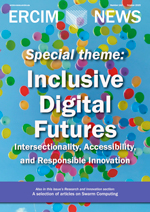
ERCIM News No. 142 Special theme: "Inclusive Digital Futures: Intersectionality, Accessibility, and Responsible Innovation"

Dear ERCIM News reader,

The October 2025 issue of ERCIM News (Number 142) is now online! The special theme of this issue looks at how Computer Science can help build more inclusive and diverse communities. This includes both the digital world and its own research and work environments. The issue features contributions from diverse fields of research and innovation, as well as reports on applied initiatives and policies that promote inclusion and diversity.

This special theme was coordinated by our guest editors Magdalini Chatzaki (FORTH-ICS) and Anna Szlávi (Johannes Kepler University)

Next Issue

No. 143 – January 2025
Special Theme: AI for Science

Announcements in this issue
  • Dagstuhl Seminars & Workshops – Call for Proposals
  • ERCIM Forum “Beyond Compliance” – 4th Edition | 29–31 October 2025 | Registration still open
  • 33rd IEEE International Conference on Software Analysis, Evolution, and Reengineering (SANER 2026) | Tracks Call for Papers
  • Welcome to the 45th SAFECOMP 2026 | Call for Papers
  • 21st International Workshop on Dependable Smart Embedded Cyber-Physical Systems and Systems-of-Systems (DECSoS 2026) | Pre-Announcement
  • ERCIM “Alain Bensoussan” Fellowship | Next application deadline: 30 April 2026
    This issue includes:

Introduction to the Special Theme 
  • p.8 Inclusive Digital Futures: Intersectionality, Accessibility, and Responsible Innovation
Inclusive Digital Futures – Intersections of Technology, Security, Discrimination, and Bias
  • p.10 Securing Open Source for a Trusted and Inclusive Digital Future
  • p.11 The Role of AI-Based Age Estimation in Promoting Safer Digital Environments for Children: Ethical and Accessibility Considerations 
  • p.13 SafeLine.gr - The First Official Trusted Flagger Organisation under the Digital Services Act (DSA) in Greece
Education & Training, Interventions, Policies, Protocols, and Tools 
  • p.27 When Used Outdoors, Augmented Reality Amplifies Situational Disabilities 
Research and Innovation
  • p.40 Forecasting Air Pollution at Construction Sites: A New Framework for Environmental and Social Sustainability
Thank for reading ERCIM News. If you’ve enjoyed this issue, please feel free to forward it to colleagues who may find it interesting and help us reach even more by sharing it on LinkedIn.

If you’re considering an even deeper partnership, advertising in ERCIM News not only helps sustain our publication but also puts your message in front of an expert, highly qualified audience.
My source with thanks: 
Peter Kunz
ERCIM
https://www.ercim.eu
https://ercim-news.ercim.eu

Tuesday, September 02, 2025

12TH ANNUAL TANZANIA HEALTH SUMMIT 2025 (reminder)

THEME: "Harnessing Data Utilization and Technologies to Accelerate Universal Health Coverage"

INTRODUCTION 

Healthcare systems are evolving worldwide through the integration of health data and technologies. This integration is crucial for advancing Universal Health Coverage (UHC), particularly in developing nations. Data forms the foundation, encompassing patient information, treatments, and outcomes. Technologies on the other hand serve as tools like cloud storage, IoT devices, and blockchain that enable efficient data collection and processing. AI, a subset of digital technologies, then transforms this data into actionable insights through machine learning and predictive analytics, improving healthcare delivery and decision-making. The healthcare AI market's projected growth of 36.8% CAGR from 2025 to 2030 (Matsukatov, 2024) reflects its potential to revolutionize healthcare delivery, from diagnosis to resource allocation. Tanzania exemplifies how this integration impacts developing healthcare systems - with its UHC service coverage index expected to exceed 48% by 2025, the country is working to bridge healthcare access and quality gaps (WHO, 2025). The upcoming 12th Tanzania Health Summit will address how these components work together in low-resource settings. The focus will be on practical applications: health technology platforms for data management, technology infrastructure for connectivity, and AI-driven analysis for disease prediction. This integrated approach shows how developing nations can leverage technologies to accelerate progress toward comprehensive healthcare coverage despite the current resource constraints. 

CONTEXT 

Tanzania's healthcare system exemplifies both the challenges and opportunities in leveraging digital technology to achieve Universal Health Coverage in sub-Saharan Africa. With a doctor-to-patient ratio of 1.3:10,000 (against WHO's recommended 1:1,000), the country has strategically embraced digital innovation to bridge critical healthcare gaps (WHO, 2025). The Tanzania Digital Health Strategy (2019-2024) serves as the blueprint for this digital transformation, focusing on three key areas: health information systems, electronic medical records (EMRs), and data-driven decision-making (Ministry of Health, Tanzania Digital Health Strategy; 2019-2024). This initiative has shown measurable progress, with EMR deployment reaching 66.57% of healthcare facilities nationwide (PORALG, 2025). The implementation of DHIS2 (District Health Information System 2) has enhanced national health data collection and analysis, notably improving disease outbreak response capabilities.

Conference details 
Text: Concept note

Friday, February 01, 2019

Book: Digital Objects, Digital Subjects: Interdisciplinary Perspectives on Capitalism, Labour and Politics in the Age of Big Data

individual
|
INTERPERSONAL : SCIENCES
humanistic ----------------------------------------------- mechanistic
SOCIOLOGY : POLITICAL
|
group

Digital Objects Digital Subjects
DIGITAL OBJECTS


DIGITAL SUBJECTS


Capitalism, Labour, Politics


My source: EUROPEAN-SOCIOLOGIST list

Cover image: Amazon

Tuesday, February 17, 2026

CFP - 2026 International Conference on Artificial Intelligence for Health and Education (ICAIHE2026)

July 8-10, 2026, Tokyo, Japan

Dear Colleagues,

We are writing to invite you to submit your papers for publication and presentation at 2026 International Conference on Artificial Intelligence for Health and Education (ICAIHE 2026) scheduled on July 8-10, 2026 in Tokyo, Japan.

https://icaihe.org

Also, we invite you to submit a workshop/special session proposal to participate in ICAIHE 2026.

The workshop/special session proposal submission deadline has been extended to: February 28, 2026.
The regular paper submission deadline is: March 1, 2026.

----------------------------------------

INTRODUCTION
---------------
With the spread of digital technology in healthcare and education, there is a growing interest in using artificial intelligence (AI) to promote human well-being in the extensive areas of health and learning. As more data becomes available from IoT, wearable devices, sensors, social media and many other online platforms, new possibilities emerge for understanding and revolutionizing digital health and learning.

ICAIHE 2026 focuses on AI-enhanced and data-driven approaches to health and education. It aims to leverage advanced AI technology to provide new opportunities in the healthcare and education sectors. This conference is committed to bringing together researchers to explore how these cutting-edge AI technologies can optimize personal health and learning environments, and to demonstrate how these emerging technologies can drive transformative practices that promote human well-being.

IMPORTANT DATES
---------------
Workshop/SS Proposal Due: February 28, 2026 (Extended)
Regular Paper Due: March 1, 2026

Workshop/SS Paper Due: March 8, 2026
Author Notification: May 1, 2026
Paper Registration Due: May 15, 2026
Camera-ready Submission Due: May 22, 2026

SCOPE AND TRACKS
---------------
Prospective authors are invited to submit papers on topics including, but not limited to:
Track 1: Emerging AI Technologies for Health and Education
  • Generative AI and LLM
  • Agentic AI and AI Agents
  • Explainable AI
  • Multimodal AI Models
  • Small Smart AI Models
  • Knowledge Graphs
  • Privacy Protection, Security, and Ethics in Emerging AI Applications
Track 2: AI-Enhanced Healthcare and Medical Services
  • AI-Enhanced Big Data Analytics in Healthcare and Medical Services
  • Multimodal Data Fusion in Digital Health
  • AI-Enhanced Biometric Analysis in Digital Health
  • Machine Learning and Deep Learning for Healthcare and Medical Services
  • AI-Enhanced Precision Healthcare
  • Metaverse and Digital Twin for Healthcare and Medical Services
  • Human-AI Interaction in Digital Health and Well-being Promotion
Track 3: AI-Enhanced Education and Learning
  • LLM-Enhanced Educational Content Generation
  • LLM-Enhanced Personalized Learning
  • LLM-Enhanced Automated Learning Feedback and Assessment
  • AI-Enhanced Collaborative Learning
  • AI-Enhanced Learning Analytics
  • AI-Enhanced VR/AR/Metaverse for Immersive Learning
  • AI Agents for Learning Management Systems
ICAIHE 2026 CALLS
---------------
Prospective authors are invited to submit original papers. Formats for the submissions are either
- Full Paper: 12-15 pages
- Short Paper: 6-11 pages
- Work-in-Progress Paper: 6-7 pages
SUBMISSIONS AND PUBLICATIONS
---------------
All accepted papers will be published in Springer CCIS series. Selected high quality papers will be recommended for possible publications on journal special issues.

For further details, please refer to https://icaihe.org/sub.html

Submission Link: https://cmt3.research.microsoft.com/ICAIHE2026
 
-------------
Hosted by
Waseda University, Japan 
 
My source: AI-SGES list - https://www.bcs-sgai.org/?section=server

Saturday, July 16, 2016

New Book Series "Coding for Humanists” 1st Vol. "Drupal for Humanists"

The Institute for Digital Humanities, Media and Culture (IDHMC) at Texas A&M University (http://idhmc.tamu.edu) is pleased to announce “Coding for Humanists,” a new book series from Texas A&M Press that addresses the practical skill-development needs of scholars in the humanities. The series is edited by Quinn Drombrowski and Laura Mandell.

The hands-on training offered at an institute or workshop such as DHSI, DHOxSS, and HILT equips scholars to pursue new directions in their research and/or pedagogy. These workshops stand apart from generic technical training sessions through their focus on the specific needs, interests and goals of humanists. The pedagogical approach respects students’ intelligence and expertise without assuming a pre-existing knowledge of other programming languages or technologies.

The “Coding for Humanists” book series follows in the spirit of these workshops (http://coding.forhumanists.org). Each volume focuses on a particular tool, technology, methodology, or programming language, using humanities examples. Without assuming any prerequisite technical knowledge, “Coding for Humanists” books guide scholars through the jargon, concepts, and processes fundamental to the technology under consideration, leaving them ready to use the technology independently, or deepen their knowledge through resources written for a general audience. For scholars who are unable to attend an in-person workshop, or who wish to develop new technical skills as time permits, the “Coding for Humanists” series fills an unmet need for clearly-written, accessible training materials developed specifically for a humanistic audience.

The first volume, Drupal for Humanists by Quinn Dombrowski (http://drupal.forhumanists.org/), will be published this fall. Co-editor of the series, Quinn Dombrowski is the Digital Humanities Coordinator in Research IT at UC Berkeley, and has developed numerous digital humanities sites using Drupal, including the DiRT Directory and DHCommons. She has taught “Drupal for Digital Humanities Projects” at DHSI since 2014, and Drupal for Humanists expands upon the materials that have been used successfully in that course.

This book is a significant expansion of, and improvement on, the open access early drafts that have been posted on this site since 2013, and are still available through the Wayback Machine. Over the next year, excerpts from the book will be posted to the site. In addition, there is a great deal of further information about Drupal modules, configuration, and tips and tricks for building Drupal sites that extends beyond the maximum feasible word count for the book. This information, too, will be posted on an ongoing basis, and contributions will be solicited from the community of humanities Drupal users and developers. (From: http://drupal.forhumanists.org/ )
Upcoming volumes in the “Coding for Humanists” series include _XQuery for Humanists_, by Clifford B. Anderson, Jonathan Robie, and Joseph C. Wicentowski; _XSLT for Humanists: Building Digital Editions_, by co-editor of the book series, Laura Mandell; and _Databases for Humanists_, by Harvey Quamen. The series is accepting proposals for additional volumes; please see submission guidelines here:
http://coding.forhumanists.org/submission-guidelines.

Laura Mandell
Director, Initiative for Digital Humanities, Media, and Culture
Professor, English
Texas A&M University
e: idhmc AT tamu.edu
@mandellc

My source: Laura via humanist AT lists.digitalhumanities.org
List info and archives at at: http://digitalhumanities.org/humanist