Hodges' Model: Welcome to the QUAD: art

Hodges' model is a conceptual framework to support reflection and critical thinking. Situated, the model can help integrate all disciplines (academic and professional). Amid news items, are posts that illustrate the scope and application of the model. A bibliography and A4 template are provided in the sidebar. Welcome to the QUAD ...

Showing posts with label art. Show all posts

Thursday, October 08, 2026

DSA & Q-Lab: 'In an Age of Answers, Questions Matter More Than Ever'

This afternoon I joined an online webinar organised by THE DIGITAL STATECRAFT ACADEMY:

'Gaining understanding by structuring inquiry: 
probing data with one right question after another is almost here'

The art, science, and practice of governing well in the algorithmic age

The Digital Statecraft Academy (DSA) is a global hub for cultivating visionary public leaders ready to navigate the complexities of data, AI, and digital governance. Backed by world-leading academic and policy institutions, DSA equips today’s leaders with the tools, knowledge, connections, and foresight to govern ethically, strategically, and resiliently in a rapidly evolving digital world.
 
 
Also highlighted was Q-Lab 


About Q-Lab

Questions shape what becomes visible, what is investigated, what is funded, and ultimately what societies come to know. They are fundamental not only to scientific inquiry but to a wide range of sectors and practices—from education and journalism to policymaking, medicine, law, and business, among others.

Despite this foundational role, questions are seldom treated as objects of systematic study. Established fields examine intelligence, knowledge production, and decision-making, yet few, if any, take questions themselves as their subject.

How should we define a good question? Which questions are most likely to serve as stepping stones toward breakthrough insights? Who determines which questions matter most? In short, what do we actually know about questions?

Questions Lab (Q-Lab) is the first multidisciplinary initiative dedicated to establishing questions as a field of study and practice, understanding how questions emerge, how they evolve, which questions make the greatest impact, and how they shape the trajectory of knowledge across disciplines and generations, in order to help individuals and institutions navigate complexity, deliberate more thoughtfully, and set better priorities.


I look forward to more events in future.
 
Previously: Questions in eclipse : 'question'

Wednesday, September 09, 2026

Bonjour Bayeux: Tapestries Historical & Modern

individual
|
INTERPERSONAL
: SCIENCES             
humanistic ------------------------------- mechanistic
SOCIOLOGY : POLITICAL   
|
group

'I think my favourite story to work on has been the 434 dinosaurs that are in the tapestry.  So much has changed about what we know about dinosaurs and all because the study of fossils and dinosaurs has grown up alongside geological survey for mining and petroleum drilling. Studies say dinosaurs were much more colourful than originally imagined and many were feathered, and in fact birds are their distant relatives.  Only 50 years ago we were taught that oil was made from decomposed dinosaurs and plants. Today research suggests oil formed from aquatic algae, called diatoms.

Much more than half of all life on earth died in a mass extinction at the end of the Cretaceous period. The most agreed upon theory, based on research, suggests the cause was when an asteroid collided with the earth and triggered volcanic eruptions, that disrupted weather patterns, growing seasons and ecosystems.  This one-two punch killed off the majority of Earth’s flora and fauna, including the dinosaurs, all of which were unable to adapt to the changes in climate.'

Sandra Sawatzky -
https://www.theblackgoldtapestry.com/notes

Detail - Panel 1 - Beginnings

The Black Gold Tapestry


THE BRITISH MUSEUM

A historic loan from France

The Bayeux Tapestry

Experience / 10 September 2026 – 11 July 2027


My source: Sandra Sawatzky, Oil in a Material World, Resurgence & Ecologist, Nov/Dec 2022, Issue 335, pp.52-55.

See also: https://www.theblackgoldtapestry.com/

Previously: 'Canada' : 'environment' : 'activism'

Monday, September 07, 2026

Host|Guest by Hospital Rooms

To mark its 10-year anniversary, arts and mental health charity Hospital Rooms presents a major exhibition at Victoria Miro this September.

Bringing together leading contemporary artists from across the Hospital Rooms programme, the exhibition features re-creations of monumental new artworks created for hospitals this year, alongside artists the organisation has collaborated with over the past decade. It reflects on the impact of transforming NHS mental health environments through art, while looking ahead to expanding access to creative programmes nationwide.

Host|Guest


My source: Ellee Su, Gallery, HOSPITAL ROOMS, FT Weekend Magazine, Number 1,192. 5 September 2026, pp.10-11.

Saturday, July 18, 2026

Hodges' conceptual framework: A model for Narrative Medicine ...

Abstract

The effective practice of medicine requires narrative competence, that is, the ability to acknowledge, absorb, interpret, and act on the stories and plights of others. Medicine practiced with narrative competence, called narrative medicine, is proposed as a model for humane and effective medical practice. Adopting methods such as close reading of literature and reflective writing allows narrative medicine to examine and illuminate 4 of medicine's central narrative situations: physician and patient, physician and self, physician and colleagues, and physicians and society. With narrative competence, physicians can reach and join their patients in illness, recognize their own personal journeys through medicine, acknowledge kinship with and duties toward other health care professionals, and inaugurate consequential discourse with the public about health care. By bridging the divides that separate physicians from patients, themselves, colleagues, and society, narrative medicine offers fresh opportunities for respectful, empathic, and nourishing medical care. ...


Charon R. Narrative Medicine: A Model for Empathy, Reflection, Profession, and Trust. JAMA. 2001;286(15):1897–1902. doi:10.1001/jama.286.15.1897 

With my emphasis.

#Identity #Group #Individual #Collective #Mind #Body #TheOdysseyHasBegun

Sunday, July 05, 2026

Degree Award in Reflective :: Reflexive Theory and Practice

Joint Hons. Running the Gauntlets in OverThinking

individual
|
INTERPERSONAL
: SCIENCES             
humanistic ------------------------------- mechanistic
SOCIOLOGY : POLITICAL   
|
group 
Photo: Peter Jones - Somerset House


See previous: 6th June 2010 - 'As one chapter closes another opens ...'

 
My source: Somerset House - 1st July 2026 M.C. Escher The Exhibition

Saturday, June 06, 2026

"step inside" TO "think outside"

  
individual
|
INTERPERSONAL
: SCIENCES             
humanistic ------------------------------- mechanistic
SOCIOLOGY : POLITICAL   
|
group


             c/o Somerset House, 6th June 2016.

Friday, June 05, 2026

'Moved to Care' amid the Boxes - RCN

A Balikbayan Box for Nursing: artists and writers in residence

'Our new Arts Council National Lottery funded project takes the Filipino custom of the Balikbayan Box as its central theme, inspired by Romalyn Ante's poem Notes Inside a Balikbayan Box. The Balikbayan Box is a long-standing Filipino cultural practice through which we are exploring the spirit of nursing across borders and boundaries. 

Visit our exhibition to explore the installation ‘Inside Home’ by Haleema Aziz and meet our writers in residence – Romalyn Ante, Jennifer Wong and Christie Watson – to explore the art of nursing with a difference.

Our writers will each be running a writing workshop for a different audience to help them engage with the exhibition themes, and develop their own writing skills: refugees, schoolchildren and young adults.

Writing residencies run in the RCN Library and Museum (20 Cavendish Square) from April – June 2026. Find our what our writers have been working on at this public celebration of art and migration panel event in July.

Our writers will be based in the Moved to Care exhibition space in the England Library from 11am-4pm during their residency week. Anybody can drop in and chat to them between 3-4pm, or if you're a member you can book a free half-hour 121 slot. Discuss your own writing, ask questions about publication or the role of art and creativity in nursing with our writers in residence.'

Previously: 'box' : 'creativity' 

My source RCN Congress 2026

Friday, May 29, 2026

'Elegy' by Gabriel Goliath - Venice Biennale

“Elegy is wound and medicine when mourning itself is under threat”

- Christina Sharpe & Rinaldo Walcott


Elegy is a life-work of mourning. It is a cry, a lament, a tender refrain of remembrance, repair and black feminist love.

For over a decade now, Gabrielle Goliath has staged performances of Elegy across South Africa and the world, invoking the absent presence of women and LGBTIQ+ people lost to fatal acts of racial-sexual violence. In each performance, a group of seven women singers enact a ritual of mourning, collectively sustaining a single, haunting tone for the course of an hour. As one singer falters, another steps up to pick up the note, and so it continues, a cyclic threading of shared breath and voice.

Each performance of Elegy is accompanied by a eulogistic text, scripted by a family member or friend of the individual commemorated: for Sinoxolo, Koketso, Noluvo, Lerato, Kerabo, and more… Other performances address historical cases of violence against women and otherwise-feminised bodies in colonial and slaveocratic contexts. For these, speculative texts by collaborating scholars reach across generations, geographies and archival erasures, recalling these ‘past’ losses and accounting for a present of anti-black, anti-femme violence.

Refusing spectacle and the objectification of bodies deemed rapeable and killable, Elegy asserts conditions of hope and avowal: affirming black, brown, indigenous, femme, queer and trans lives as loveable and grieveable. It is a work of regard, of specificity and care. For those immersed in its sonic vigil, it offers a space for shared grief and radical refusal - for the urgent, ongoing life-work of mourning.

. . .

Source: Gabriel Goliath - https://www.gabriellegoliath.com/

May 5 - July 31, elegyinvenice.com
individual
|
INTERPERSONAL : SCIENCES
humanistic ------------------------------- mechanistic
SOCIOLOGY : POLITICAL
|
group


reflection


temporal


Collective grief


violence

My source: Nadia Beard. A musical act of mourning, Venice Biennale, FTWeekend. 2/3 May 2026, p.5.

Tuesday, May 26, 2026

By Helen Frankenthaler - 'A Green thought in a Green Shade'

individual
|
INTERPERSONAL : SCIENCES
humanistic ------------------------------- mechanistic
SOCIOLOGY : POLITICAL
|
group
 
Helen Frankenthaler: A Green Thought in a Green Shade, 1981
119 × 156 1/2 in. (302.3 × 397.5 cm). Acrylic on canvas


© 2026 Helen Frankenthaler Foundation, Inc. / Artists Rights Society (ARS), New York

Image used with kind permission of The Helen Frankenthaler Foundation - and with thanks.
My source: Phoebe Evans. Opening Shot, FT.com/HTSI FTWeekend. 23rd April, 2026, p.13.
 
Gagosian. Helen Frankenthaler: The Moment and the Distance
April 30–July 2, 2026 West 21st Street, New York 
 

Saturday, April 25, 2026

MAACAL: Statues Also Breathe

Catharsis Arts Foundation in collaboration with Obafemi-Awolowo University and 108 students, 2022

This exhibition presents a collaboration between Obafemi-Awolowo University, 108 students from all across Nigeria, and the families of the Chibok girls who were kidnapped by Boko Haram in 2014. 

Inspired by the iconic terracotta heads of Ife, it was initiated by artists Prune Nourry and Ade Bantu and seeks to raise awareness on the plight of the missing girls, and to highlight the diversity of Nigerian culture. . . .

On Thursday I visited MAACAL - Museum of African Contemporary Art Al Maaden, an art gallery  I first read about in FTWeekend Life&Arts, not long after first visiting Marrakech in 2023.

The main exhibit presents itself straight away after entering:

Statues Also Breathe, exhibition view, Art Twenty One, Lagos, Nigeria
 ©Dohdohndawa Photography/DDD Studios

A short but touching film in the gallery bears testimony to the fact many 'school girls' are still absent. Repetition is standard method in design. In today's manufactured world you might think what is so special about this? Until you are there physically, and walk through them. You see each one, a who: unique, an individual, a person taken away from where they belong.

As a white man from NW England, there was a moment when I realised: I was on the same continent where this had happened and is ongoing. Searching Youtube reveals other related videos concerning the exhibitions. It's strange watching them again as a check on their availability. A short video of an event to launch three new installations earlier this year is worth watching. Unfortunately, my phone failed until I got back to Marrakech, so I've no photos. I've three works in mind though.

I walked there, and back after trying to sort a taxi with a lovely couple from Germany and their son. Some taxis are limited to carry three persons. This is what arrived. The sun, even behind clouds that day, and flights taking off from the airport helped my sense of direction. The girls, seeking an education, did not have these means of navigation.

The garden at MAACAL was small but lovely. I hope to return one day, and well before then . . .

Thursday, March 12, 2026

John Gerrard's "Western Flag" 2017

INDIVIDUAL
|
    INTERPERSONAL    :     SCIENCES               
HUMANISTIC --------------------------------------  MECHANISTIC      
SOCIOLOGY  :   POLITICAL 
|
GROUP


http://westernflag.johngerrard.net

John Gerrard - Western Flag (Spindletop, Texas), 2017

My source: Twitter

Tuesday, February 24, 2026

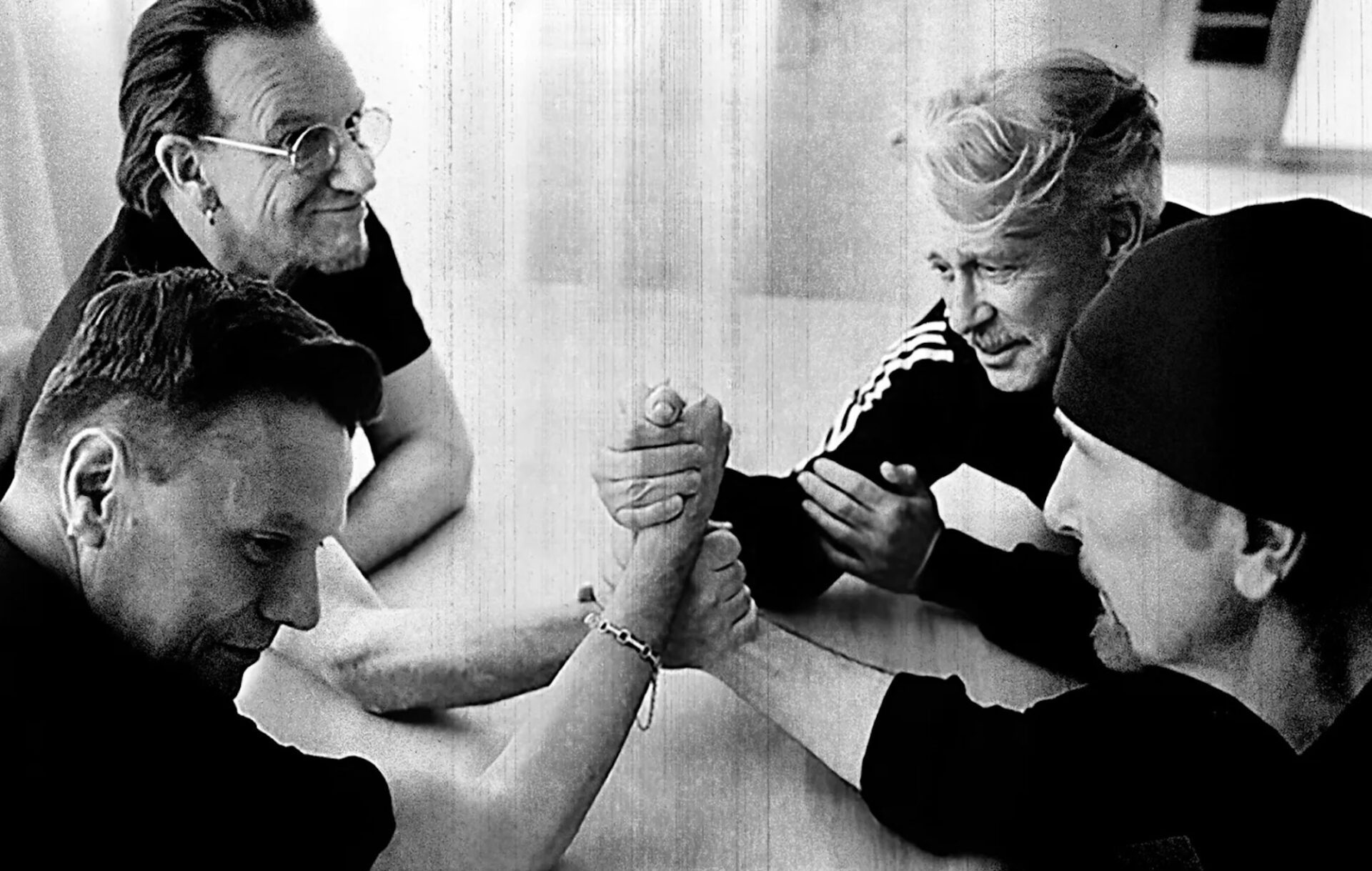
c/o RollingStone UK - "U2 surprise-drop politically charged ‘Days of Ash’ EP with six new songs"

The collection delves into ICE, Israel, the West Bank, Ukraine, Iran — and features a guest vocal by Ed Sheeran

U2 (RollingStone UK - Picture: Anton Corbijn) 

By Andy Greene

'U2 have emerged from a long hiatus with a surprise six-song EP, Days of Ash, available now, in which they address political flashpoints around the world, including ICE raids in the US, the Iranian uprisings, the war in Ukraine, and Israeli settlements in the West Bank.

The six songs — ‘American Obituary’, ‘The Tears of Things’, ‘Song of the Future’, ‘Wildpeace’, ‘One Life at a Time’ and ‘Yours Eternally’ (featuring Ed Sheeran and Taras Topolia) — are all on streaming platforms. They’ve also created lyric videos for each one.' 

Continued ...


Previously: conflict : war : hope : peace

Saturday, February 21, 2026

London: 'The Weight of Being: Vulnerability, Resilience and Mental Health in Art'

In London currently, 20th - 23rd I was on my way to Bankside Gallery and walking by Temple Place, #2 to be precise, on a board outside I read:

'The Weight of Being: Vulnerability, Resilience and Mental Health in Art'

Taking in the mental health and illness of artists, gender, domesticity, industrial and political struggle, COVID, and Gaza I spent and enjoyed a two hour detour. The building is also amazing. The exhibition is on until 19 April 2026, closed on Monday's and today 21st February. Before I share some text from their website, the interior of the building was a 'virtual' experience, but without the technology. Helpfully, the exhibition is spread across several rooms.

'Curated by Angela Thomas, this new exhibition explores artistic expression and mental health. Through depictions of deeply personal and collective experiences, it examines the powerful ways in which artists capture vulnerability, resilience, and their search for solace.

Including the work of a diverse range of twentieth century and contemporary artists and their varying perspectives, The Weight of Being showcases how artists have captured the psychological and emotional impact of societal pressures, resilience in the face of adversity, and existential uncertainty.

Alongside dozens of artworks drawn from galleries and collections across the UK, the portraits, landscapes, and figurative studies of the lesser-known artist John Wilson McCracken (1936–1982) are woven throughout. Denied the opportunity to return to the Slade School of Art following a period of hospitalisation for mental health reasons, McCracken spent much of his career in Hartlepool, producing work that reflects a profound sensitivity to the emotional and social pressures of his time. Shaped by personal and collective struggles, his art offers a deeply human perspective on the exhibition’s themes, revealing how external forces imprint themselves on the mind, body, and creative spirit.' Continued . . .

The building as a whole - Two Temple Place is owned and run by a registered charity, the Bulldog Trust. 

I will definitely (hopefully!) visit again, on the way or returning from the South Bank of the Thames. The video below presents key aspects of the building's amazing interior and history:

Saturday, February 07, 2026

National Centre for Creative Health

Creative health is increasingly recognised as a driver of better care and better value in health and care systems. Integrating creative health into prevention, public and population health strategies, management of long-term conditions, treatment and recovery pathways contributes to:

  • Reduced incidence of preventable illness
  • Improved wellbeing of patients and service users
  • Reduced demand on services

Many Integrated Care Systems and providers already incorporate creative health in physical and mental healthcare, social care, and public health, delivering measurable social and economic value.

Find out more about implementing creative health in your service, organisation or system from [our resources the resources ... 

NCCH has worked in partnership with NHS England to develop a Creative Health Toolkit. The Toolkit support systems to work with the assets in their communities and to develop their own approach.

NCCH publishes a monthly creative health newsletter created for professionals working across health and care.

Source: Email and National Centre for Creative Health 

Sunday, February 01, 2026

'First came the landscape' c/o Eden project & Resurgence & Ecologist

Ingela Ihrman - First Came the Landscape

Beech wood

'First Came the Landscape is a giant stick skeleton made from the trunk, limbs and branches of a single beech tree that was blown down during Storm Eunice in 2022. . . .'

https://www.edenproject.com/visit/things-to-do/first-came-the-landscape

◇

INDIVIDUAL
|
    INTERPERSONAL    :     SCIENCES               
HUMANISTIC --------------------------------------  MECHANISTIC      
SOCIOLOGY  :   POLITICAL 
|
GROUP


My source: Anna Souter & Ingela Ihrman. 'First came the landscape'. Resurgence & Ecologist, May/June 2023. 338: pp.44-46. 

See also: https://www.edenproject.com/visit/things-to-do/first-came-the-landscape

Previously: 'landscape' : 'ecology'

Tuesday, December 30, 2025

Beyond Empathy to System Change: Four Poems on Health by Bertolt Brecht

The canalization of a river 
The grafting of a fruit tree 
The education of a person 
The reconstruction of a state. 
These are all instances of a fruitful critique 
And they are also
 Instances of art. 
—Bertolt Brecht, “On the Critical Attitude”


Individual
|
      INTERPERSONAL    :     SCIENCES               
HUMANISTIC  --------------------------------------  MECHANISTIC      
 SOCIOLOGY  :    POLITICAL 
|
Group
'The education of a person'


'The canalization of a river
The grafting of a fruit tree'
 

'These are all instances of a fruitful critique
And they are also
Instances of art.'
—Bertolt Brecht,
“On the Critical Attitude”


'The reconstruction of a state.'


MacGregor, W., Horn, M. & Raphael, D. Beyond Empathy to System Change: Four Poems on Health by Bertolt Brecht. J Med Humanit 45, 53–77 (2024). https://doi.org/10.1007/s10912-023-09801-5

My source: 

Politics of Health Group Mail List Messages
Visit PoHG on Facebook: https://www.facebook.com/282761111845400
Follow us on Twitter: @pohguk
You can subscribe to / unsubscribe from the PoHG mail list here: http://www.jiscmail.ac.uk/POHG
And SDOH list - https://listserv.yorku.ca/cgi-bin/wa?SUBED1=sdoh&A=1

See also: 'drama' : 'empathy' : 'poetry' : 'change' : 'art'

Thursday, December 04, 2025

Yuki Kihara: Darwin in Paradise Camp - The Whitworth, Manchester

3 October 2025 – 1 March 2026

'A visually stunning exhibition centring Indigenous, queer worlds by Japanese-Sāmoan artist Yuki Kihara.
The Whitworth is proud to present Yuki Kihara’s acclaimed installation Paradise Camp (2022), first presented at the Aotearoa New Zealand Pavilion in the 59th Venice Biennale in 2022, and a new video work, Darwin Drag (2025).

Kihara delves into art histories and archives to unpick the effects of colonialism on the peoples and ecologies of the Pacific. Her visually compelling projects centre and empower the Fa’afafine and Fa’atama in Sāmoa, traditional yet marginalised third gender communities to which the artist belongs. In this exhibition, Kihara focuses on two celebrated Western figures – French modernist artist Paul Gauguin and evolutionary biologist Charles Darwin (1809-1882) – who each shaped Western understandings of the Pacific.

Paradise Camp responds to famous paintings of Tahiti and its people by French modernist artist Paul Gauguin (1848-1903). Through archival research, Kihara links Gauguin’s paintings to colonial photographs taken in Sāmoa. Described by Kihara as an act of 'upcycling', she recreates Gauguin’s compositions in a series of 12 resplendent high definition photographs, shot on location in Upolu Island. Collaborating with Fa’afafine models and production crew, Kihara repurposes these cultural artefacts to speak to, and from, queer Indigenous worlds in a profound gesture of reclamation.'

My source:

Josh Lustig. Yuki Kihara, Gallery, FT Magazine, November 22, 2025, #1152. pp.12-13.

Tuesday, December 02, 2025

Auction: Twenty-two photographs of psychiatric patients at the Surrey County Lunatic Asylum [1850s]

DIAMOND, Dr Hugh Welch (1808–1886)

Twenty-two photographs of psychiatric patients at the Surrey County Lunatic Asylum [1850s]

Estimate - GBP 100,000 – GBP 200,000

Christie's London - December 10th 2025

https://www.christies.com/en/lot/lot-6564110?ldp_breadcrumb=back

Asylum patient by Hugh Welch Diamond, c1850-58
Hugh Welch Diamond (English, 1808-1886)
Public domain, via Wikimedia Commons

'The women Iook out at us across 170 years of history with a variety of expressions - bold and shy, serene and distressed. Yet all of them were regarded at the time as "lunatics". These faces were the  subjects of a pioneering project by the 19th-century psychiatrist Hugh Welch Diamond, superintendent of the female division of an asylum in London and the world's first photographer to take pictures of patients for the purpose of diagnosis and therapy.

Twenty-two of Diamond's asylum portraits - the largest surviving group - will be put up for auction on December 10 at Christie's in London, as part of a sale of books, manuscripts and photographs from the library of The Royal Society of Medicine. If they achieve their estimated prices, RSM, a membership charity, will raise more than £2mn to invest in physical and digital infrastructure.' ...

'Diamond was working at a time when society's views of people suffering from mental illness were changing. The earlier practice of shutting patients away in secure "madhouses" was giving way to more humane treatment. Diamond seems to have believed that photography would help doctors both to diagnose and to treat patients. His diagnoses were based partly on the idea, popular in Victorian medical circles, that an individual's physiognomy - their physical features, particularly the face - could reveal their mental state.

"He wanted to make people better and put them back into the world," says Sharrona Pearl, a medical historian at Texas Christian University who has studied Diamond's work. "He also enjoyed experimenting and liked the idea of bridging his expertise in medicine and photography.' p.32.
individual
|
INTERPERSONAL : SCIENCES
humanistic -------------------------------------------  mechanistic
SOCIOLOGY : POLITICAL
|
group-population

Mental Illness
PERSON - SUBJECT
Patient's names not recorded
Portrait - Consent?

Diagnosis and Treatment
person - DATA - SUBJECT
Photography as records
Eagerness to classify - label
Social history
Change in social attitudes
Stigma and fear of mental illness
Current relatives?

Confidentiality
Institutional change
Power imbalance
Shift from 'custodial' to health care 


My source:
Clive Cookson, Mind Hunter, FT Magazine, November 15, 2025, 1151, pp.30-34.

I have noticed Prof. Brendan Kelly is a regular FT respondent, as with this article:

'These photographs were likely to have been taken without meaningful consent and in the context of power imbalance. Yet publication can reclaim their individuality, address historical injustice and underscore our common humanity. Compassion, respect and humility should guide decisions. 
 Proceeds should support medical, educational, or justice-oriented programmes. Most importantly honouring forgotten patients of the past demands better care for people with mental illness today, who often languish, neglected, in homeless hostels or prisons. We can do better.'

Brendan Kelly Professor of Psychiatry, Trinity College, Dublin, Ireland.
Letters, FT Weekend. 22-23 November 2025, p.10.

See also: 'asylum' : 'photos'

Saturday, November 08, 2025

COP30: Seeking change shopping in the far North & SOUTH

individual
|
INTERPERSONAL : SCIENCES
humanistic -------------------------------------------  mechanistic
SOCIOLOGY : POLITICAL
|
group-population


'John Kørner (born 1967, Danish): Understanding the Impact of Architecture, 12, 2020

Lithograph

Kørner pursues his artistic practice through various media, including painting, printmaking, ceramics, installations, sculpture, videos and theatre work. Throughout his career he has tackled contemporary global issues such as migration, war, and systems of production and consumption. He refers to these as 'Problems' that form an ongoing process of enquiry in his work. In his series of paintings and prints Understanding the Impact of Architecture (begun in 2014) he explores the way architecture influences, impacts and interacts with people and their environment. This print from the series addresses blind consumerism and its effect on the fragile Nordic landscape. It was made at Edition Copenhagen which along with Borch Editions is the other major print workshop in Denmark.

Acquisition supported by AKO Foundation, 2023,7056.2'

Text and my source: British Museum Room 90

Nordic noir
works on paper from Edvard Munch to Mamma Andersson


Exhibition
 / 09 October 2025 – 22 March 2026

See previously: 'care architecture' : 'architecture'

Sunday, October 19, 2025

Space, Leadership, Choice, Politics II - Do Ho Soh

individual
|
INTERPERSONAL : SCIENCES
humanistic -------------------------------------------  mechanistic
SOCIOLOGY : POLITICAL
|
group-population


Who do we put on a pedestal?


Do Ho Suh's Public Figures features an empty pedestal held up by many small figures. Donny Bajohr


Do Ho Suh - Lehmann Maupin

Image: Smithsonian - Take a Closer Look at a Surprising New Sculpture That Rethinks Who We Put on a Pedestal

My source: Andy St. Louis, Sculptural approach to far-fetched ideas, Arts, Life&Arts, FTWeekend, 31 August/1 September 2024, p.12.


"There is another!" Karma (2003) by Do Ho Suh