Hodges' Model: Welcome to the QUAD: Search results for war

Hodges' model is a conceptual framework to support reflection and critical thinking. Situated, the model can help integrate all disciplines (academic and professional). Amid news items, are posts that illustrate the scope and application of the model. A bibliography and A4 template are provided in the sidebar. Welcome to the QUAD ...

Showing posts sorted by relevance for query war. Sort by date Show all posts

Sunday, February 24, 2013

A Nurse at the Front - book

The First World War Diaries of Sister Edith Appleton

Book cover: A nurse at the Front

This book, the second in a series of four unique War Diaries produced in conjunction with the Imperial War Museum, will tell a story that is rarely heard: the experiences of a nurse working close to the Western Front in the First World War. Incredibly, Edith Appleton served in France for the whole of the conflict. Her bravery and dedication won her the Military OBE, the Royal Red Cross and the Belgian Queen Elisabeth medal among others.

Her diary details with compassion all the horrors of the 'war to end wars', including the first use of poison gas and the terrible cost of battles such as Ypres, but she also records what life was like for nurses and how she spent her time off-duty. There are moments of humour amongst the tragedy, and even lyrical accounts of the natural beauty that still existed amidst all the destruction. [Publisher's description]

Tuesday, April 07, 2026

Theatres of War and Healing

INDIVIDUAL
|
     INTERPERSONAL    :     SCIENCES               
HUMANISTIC --------------------------------------  MECHANISTIC      
SOCIOLOGY  :   POLITICAL 
|
GROUP


Theater of War Productions presents community-specific, theater-based projects that address pressing public health and social issues.


c/o Reuters

Previously: 'theatre' : 'war' : 'public (mental) health' 

Saturday, October 15, 2011

The International Health Protection Initiative (IHPI) - Resolution Sign-up


The International Health Protection Initiative believes that health care MUST be protected during armed conflict.

The International Health Protection Initiative (IHPI) is a collective movement of individuals, organisations, institutions and charities (including non-Governmental Organisations-NGOs) who have agreed to help to lobby the United Nations to act to uphold the Geneva Conventions, especially as regards safe-guarding health facilities/equipment/transport, and workers.  The Resolution was agreed following a meeting of the International Child Health Group held in November 2010.

Your support is urgently needed for an international resolution to protect healthcare during armed conflict

The resolution will ultimately be submitted to the United Nations (General Assembly, Security Council, and World Health Organization).

In order to achieve the objectives outlined in the resolution, we need the majority of the world’s healthcare organisations, institutions, NGOs and civil society, especially those in conflict afflicted countries to sign up to this important resolution.

We know that you are aware of the urgent need to protect healthcare during armed conflict, that is, to uphold the Geneva Conventions and we would be most grateful for your support.

Once you have read the resolution we respectfully urge you to sign up to it online, as an individual, or preferably, on behalf of your government, institution, or medical organisation. We also encourage you to state your reasons for supporting this resolution in the appropriate box.

So please Sign up now!

Many thanks for your time and attention and we look forward to working with you to help make this life-saving resolution a reality

The IHPI Team
info AT ihpi.org

"War... is when some adults who don't know what good is and what love is, are throwing dangerous war toys which injure innocent people" 

Tamara aged 10 years during the war in Bosnia and Herzegovena.

My source: Prof. David Southall via HIFA2015

My thoughts upon signing up:
This resolution saddens me: that we should need it in the 21st century after millennia of human conflict.

The resolution is an essential course of action that I will help to publicize. Resources by way of legal enforcement, financial and personnel as declared in the resolution to protect basic human rights and health care provision must be assured and enforced globally. As per #5 the trend of pursuing those who commit crimes against humanity should be escalated as the means to record and furnish evidence also increases. This is imperative as a deterrent to those who supposedly 'lead' and those who invariably follow. In this sense 'education for all' is also crucial to help prevent indoctrination - with the additional health dividend that education affords.

Saturday, December 18, 2021

Raymonda ...

... Care Aesthetics :: Care Architecture :: 

Care Choreography :: Care Design :: Care Journeys ...


"An epic journey of love and courage.

Taking inspiration from the ground-breaking spirit of Florence Nightingale and the women who supported the war effort in Crimea, Tamara Rojo, Artistic Director of English National Ballet, creates a new version of the classic story ballet, Raymonda.

England, 1854. Raymonda runs away from her comfortable life to become a nurse in the Crimean War. There, she becomes engaged to a soldier, John, but soon develops feelings for his friend Abdur, a leader of the Ottoman army. As turmoil grows around and inside her, who will she give her heart to?

Starring a huge cast of dancers and a full orchestra, this lavish adaptation keeps the best of the 19th-century original – its glorious and sensuous score by Alexander Glazunov and the classical choreography of ballet genius Marius Petipa – and updates it with a dramatic new story.

Introducing a heroine in command of her own destiny, and celebrating the courage of nurses and women who fought for emancipation, this beautiful production is guaranteed to thrill, move and inspire.

The original Raymonda is very rarely performed in the UK, where no dance company performs it in its entirety. This highly-anticipated version marks Tamara Rojo’s debut in directing and choreographing, building on her illustrious career as dancer and artistic director.

..."


The Trailblazing Nurses of the Crimean War


My source: RCN Bulletin 394: Winter 2021, p.26.


Sunday, June 07, 2026

Book: "The Elements of Power"

individual
|
INTERPERSONAL
: SCIENCES             
humanistic ------------------------------- mechanistic
SOCIOLOGY : POLITICAL   
|
group
logicical OR
 

the periodic table
|
mining
|
elements
COBALT


the 'table' ...

family

communities


CHILD LABOUR
 
power 


“A tale of rapacious colonialism, Cold War spy games, dazzling technical innovation, big business rivalry, big power geopolitics . . . Niarchos has produced an unflinching, landmark work on the nature of extractive capitalism.” —Patrick Radden Keefe, New York Times best-selling author of Empire of Pain and Say Nothing

Epic, shocking, and deeply reported, The Elements of Power tells the story of the war for the global supply of battery metals—essential for the decarbonization of our economies—and the terrible, bloody human cost of this badly misunderstood industry


'Congo is rich. Swaths of the war-torn African country lack basic infrastructure, and, after many decades of colonial occupation, its people are officially among the poorest in the world. But hidden beneath the soil are vast quantities of cobalt, lithium, copper, tin, tantalum, tungsten, and other treasures. Recently, this veritable periodic table of resources has become extremely valuable because these metals are essential for the global “energy transition”—the plan for wealthy nations to wean themselves off fossil fuels by shifting to sustainable forms of energy, such as solar and wind. The race to electrify the world’s economy has begun, and China has a considerable head start. From Indonesia to South America to Central Africa, Beijing has invested in mines and infrastructure for decades. But the U.S. has begun fighting back with massive investments of its own, as well as sanctions and disruptive tariffs. ...'

https://www.penguinrandomhouse.com/books/709025/the-elements-of-power-by-nicolas-niarchos/

My source: James McConnachie, The dirty truth behind our 'clean energy' cars, saturday review, The Times, 17 January 2026, p.13.

Previously: 'mining' : 'corruption' : 'Africa' 

Friday, February 09, 2024

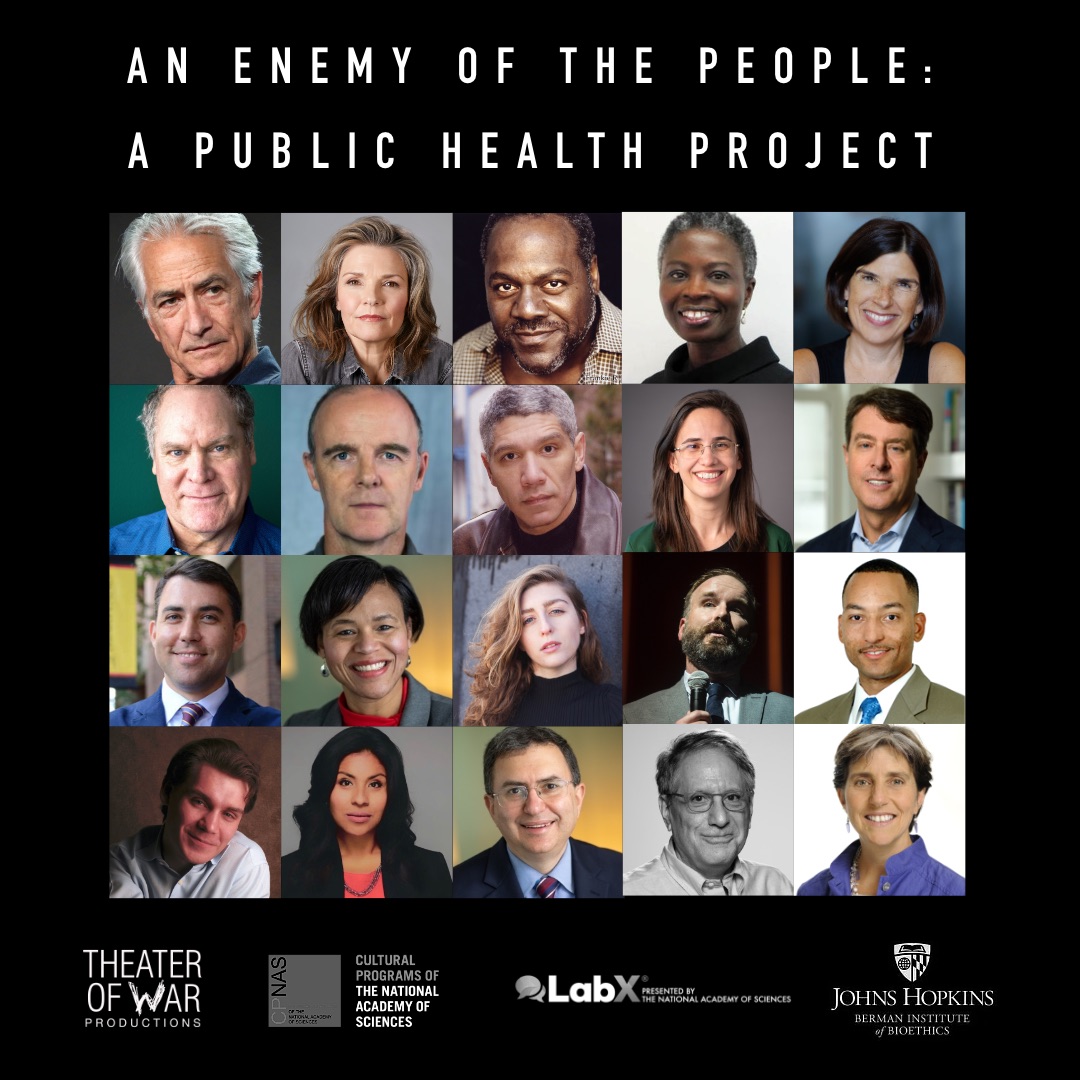
Theater of War Productions - An Enemy of The People Feb 22 + 24

Cast Update! 

We are thrilled to announce that Kathryn Erbe, Frankie Faison, and Peter Francis James have joined the cast of An Enemy of the People on February 22 and 24, alongside David Strathairn, Francis Collins, Vivian Pinn, Victor Dzau, Brían F. O’Byrne, Jay O. Sanders, Keshia Pollack Porter, Gloria Addo-Ayensu, and many more! The project will present live dramatic readings of scenes from Henrik Ibsen’s 1882 play An Enemy of the People to frame powerful audience discussions about the challenges to public in our culture today. Register below to attend in person or online! Check individual listings for confirmed cast members each night, as casts will vary and are subject to change.

An Enemy of the People: A Public Health Project
Thursday, February 22, 2024
7:00 pm - 9:30pm EST

Johns Hopkins University Bloomberg Center
555 Pennsylvania Avenue NW
Washington, DC 20001

Featuring performances by David Strathairn (Nomadland), Frankie Faison (The Wire), Kathryn Erbe (Law & Order: Criminal Intent), Peter Francis James (Oz), Jay O. Sanders (True Detective), Brían F. O'Byrne (The Wonder), Marjolaine Goldsmith (Company Manager of Theater of War Productions), Monica Feit (Executive Director, Health and Medicine Division, National Academies of Sciences, Engineering, and Medicine), Jeffrey Kahn (Director, Johns Hopkins Berman Institute of Bioethics), Keshia Pollack Porter (Chair, Department of Health Policy and Management, Johns Hopkins Bloomberg School of Public Health), Tshaka Cunningham (Chief Scientific Officer, Polaris Genomics), Gloria Addo-Ayensu (Director of Health, Fairfax County Health Department), Emily Packard Dawson (Program Officer, National Academies of Sciences, Engineering, and Medicine), Nancy Kass (Deputy Director for Public Health, Berman Institute of Bioethics), Graham Sack (Filmmaker, Dracopoulos-Bloomberg iDeas Lab Fellow), Grelia Steele (Global Continuity and Crisis Manager, Guidehouse), Peter Marks (Former Chief Theater Critic, The Washington Post), Matthew Frieman (Viral Pathogen Research Professor of Microbiology & Immunology, University of Maryland School of Medicine), and Joshua M. Sharfstein (Vice Dean for Public Health Practice and Community Engagement at the Johns Hopkins Bloomberg School of Public Health).

Register to attend in person or online

An Enemy of the People: A Public Health Project
Saturday, February 24, 2024
7:00 pm - 9:30pm EST

National Academy of Sciences 
2101 Constitution Ave, NW
Washington, DC 20418

Featuring performances by David Strathairn (Nomadland), Frankie Faison (The Wire), Kathryn Erbe (Law & Order: Criminal Intent), Peter Francis James (Oz), Jay O. Sanders (True Detective), Brían F. O'Byrne (The Wonder), Francis Collins (Former Director, National Institutes of Health), Monica Feit (Executive Director, Health and Medicine Division, National Academies of Sciences, Engineering, and Medicine), Jeffrey Kahn (Director, Johns Hopkins Berman Institute of Bioethics), Keshia Pollack Porter (Chair, Department of Health Policy and Management, Johns Hopkins Bloomberg School of Public Health), Victor Dzau (President, National Academy of Medicine), Vivian Pinn (Senior Scientist Emerita at the NIH Fogarty International Center), Ruth Faden (Berman Institute Founder; Philip Franklin Wagley Professor of Biomedical Ethics), Grelia Steele (Global Continuity and Crisis Manager, Guidehouse), Peter Marks (former chief theater critic, The Washington Post), Gloria Addo-Ayensu (Director of Health, Fairfax County Health Department), Graham Sack (Filmmaker, Dracopoulos-Bloomberg iDeas Lab Fellow), Nancy Kass (Deputy Director for Public Health, Berman Institute of Bioethics), Joshua M. Sharfstein (Vice Dean for Public Health Practice and Community Engagement at the Johns Hopkins Bloomberg School of Public Health), Marjolaine Goldsmith (Company Manager, Theater of War Productions), and Emily Packard Dawson (Program Officer, National Academies of Sciences, Engineering, and Medicine).


Register to attend online


I will register have registered (online). There is a production of An Enemy of the People in London, but it is expensive from NW England.

This afternoon I enjoyed a delayed appointment with DUNE 2021 Part 1 IMAX, a brilliant cinematic experience that includes a performance by Oscar Isaac as Duke Leto Atreides.

See also: Ibsen , theatre ...

Friday, October 06, 2023

Committing Ecocide to Hodges' model ...

INDIVIDUAL
|
     INTERPERSONAL    :     SCIENCES               
HUMANISTIC --------------------------------------  MECHANISTIC      
SOCIOLOGY  :   POLITICAL 
|
GROUP


Psychological -

 "Shock of the NewS"

Anxiety

Eco-anxiety - Climate anxiety

Anti-natalism


Polly

No planet B


Where Might We Find Ecologically Intact Communities?

How much of Earth's land is ecologically intact, in a pre-industrial and pristine state?

The answer: 3% [Plumptre, et al.].


ECOCIDE

NATURE ...
Higgins


'conscientious protector'
civil disobience


"Such a law would not only seek retribution and deterrence but also draw moral red lines."


civil society


... CRIMES AGAINST


Environmental activism

GENOCIDE

ECOCIDE - as law?

"I will leave the last word to Polly Higgins, a barrister who gave up a career in corporate law to become one of the most effective backers for criminalising ecocide. As she wrote in 2013, 'For now, in law outside of wartime, it is not a crime to cause mass destruction or loss of ecosystems. Our world has normalised... ecocide'." p.24.

"Like laws for crimes against peace, an ecocide law would trace its roots to wartime atrocities, in this case the annihilation of forests in South-East Asia, first by the UK's Royal Air Force during the guerrilla war known as the Malayan Emergency and later by the US Air Force in the Vietnam war. In 1970, the destruction inspired Arthur Galston, a plant biologist at Yale University whose PhD had led to development of agent orange, to coin the word 'ecocide'." p.24.

Plumptre AJ, Baisero D, Belote RT, Vázquez-Domínguez E, Faurby S, Jȩdrzejewski W, Kiara H, Kühl H, Benítez-López A, Luna-Aranguré C, Voigt M, Wich S, Wint W, Gallego-Zamorano J and Boyd C (2021) Where Might We Find Ecologically Intact Communities? Front. For. Glob. Change 4:626635. doi: 10.3389/ffgc.2021.626635

My sources:

Lawton, G. (2021) Crimes Against Nature, New Scientist, 250: 3333. p.24.

Obituaries. Polly Higgins. Register, The Times. May 2, 2019. p.53.
https://www.thetimes.co.uk/article/polly-higgins-obituary-92z6zd3ps

See also:

Eradicating Ecocide (2010).

Earth is Our Business (2012).

Tuesday, February 24, 2026

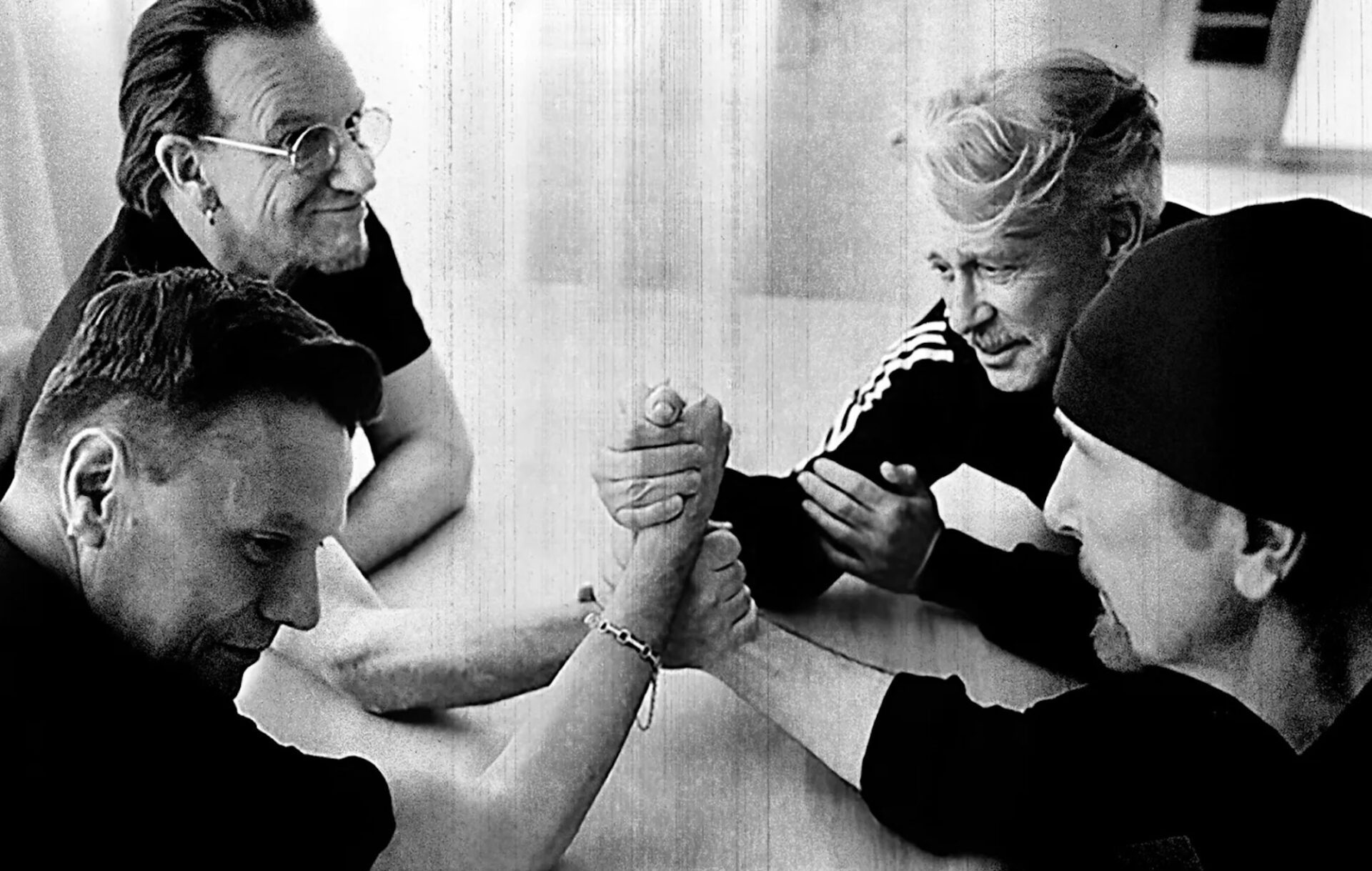
c/o RollingStone UK - "U2 surprise-drop politically charged ‘Days of Ash’ EP with six new songs"

The collection delves into ICE, Israel, the West Bank, Ukraine, Iran — and features a guest vocal by Ed Sheeran

U2 (RollingStone UK - Picture: Anton Corbijn) 

By Andy Greene

'U2 have emerged from a long hiatus with a surprise six-song EP, Days of Ash, available now, in which they address political flashpoints around the world, including ICE raids in the US, the Iranian uprisings, the war in Ukraine, and Israeli settlements in the West Bank.

The six songs — ‘American Obituary’, ‘The Tears of Things’, ‘Song of the Future’, ‘Wildpeace’, ‘One Life at a Time’ and ‘Yours Eternally’ (featuring Ed Sheeran and Taras Topolia) — are all on streaming platforms. They’ve also created lyric videos for each one.' 

Continued ...


Previously: conflict : war : hope : peace

Tuesday, April 02, 2024

Ukraine we see you - RD4U

"The Register of Damage Caused by the Aggression of the Russian Federation against Ukraine (RD4U) is proud to announce a major milestone in its mission to address the consequences of the war and bring justice and reparations to Ukraine and its people. On 2 April 2024, RD4U will officially open the claims submission process for compensation of damage, loss or injury caused by Russian aggression against Ukraine.

The historic launch will take place in The Hague as part of the Ministerial Conference "Restoring Justice for Ukraine", in the presence of the Secretary General of the Council of Europe, Marija Pejčinović Burić, heads of international organisations, ministers and senior officials from more than 60 states, underlining the global support for Ukraine's quest for justice and reparation.

The RD4U Board decided to open the Register for the submission of claims, evidence and related information after confirming that the formal and technical framework is in place. This step follows the approval by the Conference of Participants of RD4U of the rules and regulations of the Register, including the rules for the submission, processing and recording of claims and the list of categories of claims eligible for inclusion in the Register.

“Our decision to start the process of submission of claims is an important first step in this process. Success moving forward will require continued support from all stakeholders. The Register of Damage for Ukraine will continue its work with dedication and resolve to deliver justice to the Ukrainian people in conformity with its mandate”, said the Chair of the Board, Robert Spano.  

The initial launch on 2 April will focus on one critical category, namely damage or  destruction of residential property. The destruction of homes in war has an immense impact on people's lives. Between 300,000 and 600,000 claims are expected in this category. The claim form for submission of this category of claims has also been approved." . . .

Continued . . .


Individual
|
      INTERPERSONAL    :     SCIENCES               
HUMANISTIC  --------------------------------------  MECHANISTIC      
 SOCIOLOGY  :    POLITICAL 
|
Group

Loss of belongings

Trauma

Stress - Anxiety

Injury - deaths

Damage / Loss of homes / Infrastructure

Displacement 
Loss of family members

Livelihood

Education

Loss of whole communities


Palestine!: Your turn next? 

Israel - Palestine: utter despair personified.

Previously:
From - https://hodges-model.blogspot.com/search?q=ukraine

My source: 
BBC World Service, World Business Report. 2 April 2024
https://www.bbc.co.uk/programmes/w3ct606r

Monday, May 05, 2025

Knowledge - Ignorance: Political leaders always seek an informed citizenry. Discuss?

c/o 'The war on knowledge' Simon Schama 
Life&Arts :: FTWeekend


individual
|
INTERPERSONAL : SCIENCES
humanistic ------------------------------- mechanistic
SOCIOLOGY : POLITICAL
|
group


'As the Founders saw it, the great driver of freedom was knowledge. Two decades before independence, the lawyer and essayist William Livingston insisted in a journal called The Independent Reflector that "knowledge among a people makes them free, enterprising and dauntless; but Ignorance enslaves, emasculates and depresses them".

Are you an 'Independent Reflector'?


MIND

'In 1779, Thomas Jefferson (who would make sure that his role as "Father of the University of Virginia would be inscribed on his tombstone) championed a Bill for the More General Diffusion of Knowledge. Its purpose would be to "illuminate ... the minds of the people at large" - excluding of course, women and the enslaved - "and more especially to give them knowledge of those facts . .. [that] they may be enabled to know ambition under all its shapes." The 1780 Constitution of the Commonwealth of Massachusetts, primarily drafted by Adams, committed itself to "The Encouragement of Literature" so that "Harvard-College in Cambridge" would be the institution through which the diffusion of "wisdom and knowledge" would ensure health of the body politic.'

BODY
PUBLIC


'The informed citizenry'


Public understanding of the sciences.


POLITIC

'As Richard D Brown's important history The Strength of a People: The Idea of an Informed Citizenry in America, 1650-1870 points out, all of America's first four presidents (including James Madison) assumed that the security of the republic depended on the "equation of virtue and knowledge". A century later, Calvin Coolidge might assert that "the chief business of the American people is business", but a rich stream of ideas flowing from the learned optimism of the Founders, through the creation of land-grant colleges and the "brain trust" administrations of Franklin Roosevelt, assumed that professors were not the "enemy" but a resource that was indispensable for the good of the nation. The true enemy of American democracy was not professors, but ignorance.'


My source:
Simon Schama. 'The war on knowledge', Life&Arts, FTWeekend, 26-27 April, 2025, pp.1-2.

Previously: 'knowledge' : 'ignorance' : 'political'

Monday, August 26, 2013

An International Bill of the Rights of Man (reissued)

INTERPERSONAL : SCIENCES
SOCIOLOGY : POLITICAL

individual
How do we address the mental
health status of our leaders?
How can science and technology work positively to assure the Rights of All, to secure evidence of war crimes?
Where does the biosphere stand
(side-by-side : hand-in-hand)?
Should war crimes once perpetrated be relegated to cultural memory:
baggage carried forward for generations anew to avenge? How must they do this other than learning (remembering) how to hate?
What are the important lessons; of what must be remembered and what we should forget? 
An International Bill of the Rights of Man
group - population

Saturday, March 20, 2010

More SF (speculations on person-centred care...?)

I've been reading a bit more SF - this time Joe Haldeman's, The Forever War here's a fascinating excerpt:

I went to the phone in the kitchen and with some difficulty managed to get through to the hospital. A plain girl in her twenties formed in the cube. "Nurse Donalson, general services." She had a fixed smile, professional sincerity. But then everybody smiled.
"My mother needs to be looked at by a doctor. She has a --"
"Name and number, please."
"Beth Mandella." I spelled it.
"What number?"
"Medical services number, of course," she smiled.
I called into Mom and asked her what her number was.
"She says she can't remember."
"That's alright, sir, I'm sure I can find her records."
She turned her smile to a keyboard beside her and punched out a code.
"Beth Mandella?" she said, her smile turning quizzical.
"You're her son? She must be in her eighties."
"Please. It's a long story. She really has to see a doctor."
"Is this some kind of joke?"
"What do you mean?" Strangled coughing from the other room, the worse yet. "Really -- this might be very serious, you've got to--"
"But sir, Mrs. Mandella got a zero priority rating way back in 2010. "
"What the hell is that supposed to mean?"
"S-i-r . . ." The smile was hardening in place.
"Look. Pretend I come from another planet. What is a 'zero priority rating'?"
"Another -- oh I know you!" She looked off to the left.
"Sonya -- come over here a second. You'd never guess who .." Another face crowded the cube, a vapid blonde girl who smile was twin to the other nurse's. "Remember? On the stat this morning?"
"Oh, yeah," she said. "One of the soldiers -- hey, that's really max, really max." The head withdrew.
"Oh, Mr Mandella," she said, effusive. "No wonder you're confused. It's really very simple."
"Well?"
"It's part of the Universal Medical Security System. Everybody gets a rating on their seventieth birthday. It comes in automatically from Geneva."
"What does it rate? What does it mean?" But the ugly truth was obvious.
"Well, it tells how important a person is and what level of treatment he's allowed. Class three is the same as anybody else's; class two is the same except for certain life-extending--"
"And class zero is no treatment at all."
"That's correct, Mr Mandella." And in her smile was not a glimmer of pity or understanding.
"Thank you." I disconnected. Marygay was standing behind me, crying soundlessly with her mouth wide open. ...

Joe Haldeman, The Forever War, Gollancz, SF Masterworks, pp.148-149.
Link:
http://en.wikipedia.org/wiki/The_Forever_War

Saturday, June 22, 2019

Critique Issue 6: The Wartime Quartet Special Issue, 2019


individual
|
INTERPERSONAL : SCIENCES
humanistic ----------------------------------------------- mechanistic
SOCIOLOGY : POLITICAL
|
group

Elizabeth Anscombe
Iris Murdoch
Mary Midgley
Philippa Foot

Time

Voices
-
Wartime


In June 2019, Durham University Philosophy Society’s journal, Critique, will publish a special edition on the Wartime Quartet – Elizabeth Anscombe, Iris Murdoch, Mary Midgley and Philippa Foot – all of whom were peers and friends at Oxford during the Second World War, going on to become extraordinary philosophers in their own right. Midgley records in her memoir that when the men left for the war, the Quartet were free from the conventions of traditionally male-dominated philosophy. She attributed the Quartet members’ later success to this sudden amplification of their voices.
The members of the Quartet continued to associate, work, and live together long after their undergraduate years. In the thanks, dedications and references of each member’s work you are certain to find the other members too!

2019 will mark the centenary of the group and sees a series of lectures on the Quartet delivered at the Royal Institute of Philosophy – these can be viewed on YouTube: https://www.youtube.com/channel/UCEQRhXQwUe-1ZKIJmnBvHsw

In consideration of this, the theme for this edition of Critique is the Wartime Quartet. [Up to 26th of May 2019] submissions were sought based on a range of topics on the Quartet, including, but not limited to:
  • The work of individual members of the Quartet (e.g. the relevance of Anscombe’s critiques of ‘modern moral philosophy’). 
  • The relations between the Quartet’s work (e.g. their shared rejections of the separation between fact and value). 
  • The ways in which the Quartet’s work manifests in contemporary moral philosophy, and lasting effects that the Quartet’s scholarship had on the discipline.
    This edition of Critique is particularly poignant due to the recent passing of Mary Midgley and will be dedicated in her memory.

    Durham is one of the institutional homes of the In Parenthesis project which has a vibrant community of student researchers and interns. For more information see www.womeninparenthesis.co.uk

    If you have any questions about the submission process, please feel to get in touch by emailing us at du.critique AT gmail.com or its editor, Sebastián Sánchez-Schilling, at sebastian.a.sanchez-schilling AT durham.ac.uk

    n.b. With some editing as submission closed. PJ

    My source:
    Philos-L "The Liverpool List"
    https://www.liverpool.ac.uk/philosophy/philos-l
    https://www.facebook.com/PhilosL
    @PhilosL
    @LiverpoolPhilos

    Wednesday, December 14, 2022

    In health, education, in work: We are all - Four Loom Weavers


    "The author Michael Morpurgo (War Horse, Private Peaceful) explores the ways in which folk songs have reflected timeless human experiences, both in the past and today. 

    Michael Morpurgo
    With help from singers, songwriters and other passionate experts, Michael admires the indelible stories within classic songs that deal with migration, war, protest and love. Over the four themed episodes, Michael considers the locations and historical contexts that gave rise to much-loved traditional songs, and finds out how the same topics are inspiring new folk songs in the 2020s.

    In the second episode, Michael considers a song of protest: Four Loom Weaver. 

    With Professor Lawrence Goldman, Muireann Nic Amhlaoibh, Nancy Kerr, Karine Polwart, Nicola Kearey, Ian Carter, Blair Dunlop and Ashley Hutchings." BBC Radio 4

    Michael Morpurgo's Folk Journeys

    "Many Lancashire folk, can give personal testimony of relative having worked in such a role.

    My maternal grandmother was a four loom cotton weaver until the mill, where she worked, in Rawtenstall, Lancashire, was closed and relocated to India in the 1920s approx. Mill workers worked their way up to four looms which were rented from the mill. Four was the maximum so my nan told me, so a four loom weaver was an indication of the level of attainment in the industry. So I think the title is probably correct and not a corruption of a poor loom weaver.

    Will Lever, Malpas, Cheshire" Wikipedia


     INDIVIDUAL
    |
     INTERPERSONAL    :     SCIENCES               
    HUMANISTIC --------------------------------------  MECHANISTIC      
    SOCIOLOGY  :   POLITICAL 
    |
    GROUP


    Monday, December 21, 2009

    Call for Papers for Special issue on Linking the Local with the Global within Community Informatics

    Please forward as appropriate. Thanks!

    Dear all, a special issue of the Journal of Community Informatics (http://ci-journal.net/index.php/ciej) will be devoted to ´Linking the Local with the Global within Community informatics`, guest-edited by Liisa Horelli and Doug Schuler.

    The Journal of Community Informatics is a focal point for the communication of research of interest to a global network of academics, community informatics practitioners and national and multi-lateral policy makers. The field of community informatics seeks to explore the potentials of ICTs and their applications for economic, ecological and socio-cultural development efforts at the community level. It seeks to ensure that individuals and communities can take advantage of the opportunities that these technologies can provide.

    For this special issue of the Journal, we are inviting submission of original, unpublished articles. We welcome research articles from different disciplines, case studies and notes from the field. All research articles will be double blind peer-reviewed. Insights and analytical perspectives from practitioners and policy makers in the form of notes from the field or case studies are also encouraged. These will not be peer-reviewed.

    You can find the full Call for Papers below. Looking forward to hearing from you.
    Warm wishes, Liisa and Doug

    ------------------------------------------

    Journal of Community Informatics:

    Call for Papers for Special issue on Linking the Local with the Global within Community Informatics

    Guest editors: Liisa Horelli and Douglas Schuler

    The Journal of Community Informatics is a focal point for the communication of research of interest to a global network of academics, Community Informatics practitioners and national and multi-lateral policy makers.
    We invite submissions of original, unpublished articles for a forthcoming special edition of the Journal that will focus on Linking the Local with the Global within Community Informatics. We welcome research articles from different disciplines, case studies and notes from the field. All research articles will be double blind peer-reviewed. Insights and analytical perspectives from practitioners and policy makers in the form of notes from the field or case studies are also encouraged. These will not be peer-reviewed.

    What is Community Informatics?
    Community informatics

    ...links economic and social development efforts at the community level with emerging opportunities in such areas as electronic commerce, community and civic networks and telecentres, electronic democracy and online-participation, self-help and virtual health communities, advocacy, cultural enhancement, and e-planning among others....is concerned with carving out a sphere and developing strategies for precisely those who are being excluded from this ongoing rush, and enabling these individuals and communities to take advantage of some of the opportunities which the technology is providing. It is also concerned with enhancing civil society and strengthening local communities for self-management and for environmental and economically sustainable development, ensuring that many who might otherwise be excluded are able to take advantage of the enormous opportunities the new technologies are presenting.

    - Michael Gurstein in Community Informatics:
    Enabling Communities with Information and Communications

    Why a special issue on Linking Local with the Global within Community Informatics?

    Community informatics (CI) is the study and practice of information and communication systems (especially involving networked digital systems) in the community. Regardless of the agreement on the broad definition, there are inherent tensions within the CI community and with the CI perspective itself. The "simple" idea of community is the source of one tension since there are a multiplicity of definitions and usages of the word "community", many of which are semantically loaded or ambiguous. Is, for example, a "virtual community" a real community?

    Another source of tension is between the local and the global, the focus of this special issue. What's local and what's global? What is their significance in terms of our focus on "community"? How do we define the two terms so that they are meaningful and useful to our work? Perhaps these terms distract us from conceptualizing our enterprise in ways that are more useful? What characterizes phenomena or artifacts as belonging to one or the other (and how do they influence each other)? Interestingly, the community of community informatics researchers, practitioners, and activists itself is part of a new hybridity that blurs local and global.

    The term glocalization has been coined to focus on the intermixing of local and global influences which are present and active everywhere. Although the phenomenon is not new, it has intensified in recent years due to the Internet, mass communications, mobile telephones, air travel, war, migration, economic interdependence, environmental impacts, and other aspects of 21st century mobilities. But identifying and naming a phenomenon is only the beginning. We must not mistake our use of a new term for understanding. For example, how would glocalization help us understand a network of local communities?

    The availability of urban and community ICT could allow people to understand the larger impacts of their everyday decisions. It could also enable people to understand and promote not only the particularities of the local but also commonalities of the global, and to engage with the broader global “sphere”. Consequently, people could become actors who are engaged in the glocal networks of mobile people, goods and information.

    However, glocal influence or interaction could be directed from the top-down, laterally, or from the bottom-up. CI implicitly embraces the tension between the local and the global. On some level, global and local pit two types of forces against each other. How does CI consider this clash or intermingling of forces? Does it advocate larger barriers, shelters, or hiding places, from these forces or does it inspire or promote the type of collective intelligence that goes beyond "using ICT?" The recent debate on the CI-research list brought up the idea that CI could be used, in addition to the benefit of communities, to the benefit of global communities. This debate raised arguments that both supported and questioned the claim. On the one hand, there is the risk that glocalisation can dilute (and downgrade) the "community" to some larger (and less individually significant) whole. In that case, it may be important to preserve the 'local' as it maintains the community's domains of control and power over the circumstances that impacts it. It can be reasoned that greater globality essentially removes self-control and self-governance.

    On the other hand, glocalisation provides new strategic options for movements who seek resources and support far beyond national boundaries, such as the Chiapas, in Mexico. The global opportunities even begin to play part in the way local activists frame the issues they raise locally. Thus, the "outside world" affects communities, but communities exert forces outwards as well. Local communities can also share experiences and strategies, thus mutually strengthening each other. We need to figure out, how we are going to make the glocal or translocal connections work most effectively. This special issue is intended to help surface the opportunities, challenges, and risks around this theme.

    These issues give rise to a large number of research questions. Some of these are listed below but there are many yet to be identified and researched. What processes underlie the forces of globalization? Which are forces of localization? How are people affected by each? How do these forces originate, diffuse, and make their effects felt? Do these forces affect all communities equally or are gender, ethnicity, or other features significant factors? And what should CI researchers / practitioners do in relation to those forces? Is the issue trying to help communities use ICT more effectively, or is it working in a general way to develop communication systems that will help local communities intelligently address the problems that they (and the rest of the world) face? In some situations, for example, this means helping to develop collective problem-solving tools so people can more effectively resist oppression or fight the status quo. Or should their inhabitants be full citizens of the world with the rights and responsibilities that accompany that status? How can we characterize the new diversity of global / local relationships? What patterns exist? In what ways might (hyper?) localism breed parochialism and isolationism? Can we embrace CI without unnecessarily valorizing the local community? What are the opportunities (and what should the limits be) to our research and activism on behalf of and with the local community?

    Because CI is a brand new field of research and practice we have the rare opportunity to define our field. Is it useful — or even possible — to conceptualize a social enterprise that is relevant today without explicitly acknowledging climate change, environmental degradation, oppression, poverty, human rights, war and militarism, and other "global" problems that face us all, however indirectly. How should these manifest "global" concerns be factored into our enterprise? And how does the role of information and communication, the foundations of our enterprise, change — if at all — the way we answer these questions? This positioning of our enquiry at such a point should enable a new set of opportunities. CI integrates research and engagement. So its view of localism and globalism needs to be informed through those perspectives.

    We invite authors to submit in English both full articles for peer-review, as well as short pieces on specific experiences and/or policy and regulatory issues, to be reviewed by the guest editors.

    Please note the deadlines:
    Deadline for abstracts: 28 February 2010
    Deadline for submissions: 30 May 2010
    Publication date is forthcoming

    For information about submission requirements, including author guidelines, please visit:
    http://www.ci-journal.net/index.php/ciej/about/submissions#onlineSubmissions

    For further information, clarifications, comments or suggestions, and to send abstracts of papers for consideration, please contact:

    Dr. Liisa Horelli Helsinki University of Technology Centre for Urban and Regional Studies liisa.horelli AT tkk.fi
    Douglas Schuler The Public Sphere Project and The Evergreen State College douglas AT publicsphereproject.org

    Sunday, April 03, 2022

    MEMO TO: New College of Humanities and London Interdisciplinary School

    Re. "Introduction to Lifelong Learning 101"

    Since 1998, when I first went 'online' I've always been conscious of etiquette and note how this has changed - developed - over the years. The email associated with the former website domain p-jones.demon.co.uk saw a lot of emails to quite a diverse range of mail lists. Should I? Should I not? These questions remain a key consideration in trying to spread the thought and word on Hodges' model.

    Stepping on toes a couple of times, someone also asked about links to blog posts on LinkedIn. Not had those queries recently so I think readers understand the 2x2 table is critical to the post in representing the model. Twitter presents its own challenges [ #WasteOfTime ]. So please pardon my shouting, but there's an important message here about an important resource.

    I've lapsed again with no progress on the new site - maybe it is not just vapourware but a dream.

    The creation of new education institutions: 

    the New College of Humanities and London Interdisciplinary School

    - is encouraging for the work here:

    "The London Interdisciplinary School wants its students to be problem solvers with a wide range of academic interests."
    (Nicola Woolcock, Polymaths plan to teach universities a thing or two. The Times, October 2, 2021. p.17.)

    Does it, really - and by implication the NCH, plus New Model Institute for Technology and Engineering (NMITE) and others?

    The Times Education Commission with proposals for reform due in June, adds further impetus and evidence ...

    I read this evidence as supporting the argument that education and health are and always will be 'legacy issues', that is in need of change, investment, policy. All disciplines of study and knowledge are always dynamic and should be challenging, personally and collectively.

    If institutions can distract themselves from fiscal incentive of the bums on seats for a few moments and policy makers look up from the dotting of  I's and crossing of T's then student's learning can be energised by Hodges' model: a generic bootstrap for lifelong learning.

    Just to be clear. This model is NOT about boxes, it is about being aware of boundaries and being prepared to cross and use these journeys.

    In the 21st century we are humbled by what now constitutes the pantology - the system of all knowledge. No individual can take in - apprehend and master it all, but we should have a means to at least conceptually touch this incredible gift.

    INDIVIDUAL
    |
     INTERPERSONAL    :     SCIENCES               
    HUMANISTIC --------------------------------------  MECHANISTIC      
    SOCIOLOGY  :   POLITICAL 
    |
    GROUP
    Education
    Philosophy (Ethics, Logic)
    Psychology: (Applied, Child, Clinical,
    Criminal - Forensic,
    Occupational,
    Artificial Intelligence ...
    Cognitive Sciences
    Theology
    Arts
    Creativity and Design
    Eco-Anxiety
    Happiness - Metrics
    ...

    Sciences: Biology, Physics, Chemistry*
    Health: (Medicine, Nursing ...)
    Occupational Professions
    Computer Science, Information
    Mathematics
    [macro - nano] Engineering
    Architecture
    Design and Creativity
    Environmental Studies
    Hydrology
    Land use: Forestry ...

    Arts (Music, Dance, Drama ...)
    Literature
    Anthropology, Archaelogy
    Languages
    Ancient-History, History
    Future Studies
    Social Work
    Sociology (Culture, Ethnography ...)
    Anthropology
    Gender Studies
    Philanthropy
    ...

    Politics, Government
    Security
    Law & Crime - Fraud/Corruption
    Policing - Law Enforcement
    News and Media studies
    Political Science - Citizenry
    Economics
    Socio-Economics
    International Development
    Peace Studies
    Administration
    Leadership and Management
    War and Conflict ...


    I am pleased to see that the post re. Nicholas Maxwell's work is popular here:

    "How Universities Have Betrayed Reason and Humanity—And What's to Be Done About It" c/o Nicholas Maxwell 

    *So many sub-disciplines: Climate studies, Epidemiology, Marine biology, Quantum Computing / Physics, Exobiology, Astronomy, Materials, Demographics, Geology, Genomics, Cybernetics, Systems, Epigenetics, Exobiology, Neuroscience, Public (Mental) Health, Allied Health Professions ...