Hodges' Model: Welcome to the QUAD: framework

Hodges' model is a conceptual framework to support reflection and critical thinking. Situated, the model can help integrate all disciplines (academic and professional). Amid news items, are posts that illustrate the scope and application of the model. A bibliography and A4 template are provided in the sidebar. Welcome to the QUAD ...

Showing posts with label framework. Show all posts

Thursday, July 09, 2026

Leapspace? Why not ...?

Referred to a paper in an email: https://doi.org/10.1016/j.jclinepi.2026.112401.

- I noticed an invitation to try Leapspace. 

So I leapt (with much editing - for formatting here). ...


Copilot steps

Creating a plan to respond to your query

Performing search for foundational documents
Performing keyword search
Using data from Scopus
("Hodges' model" OR "Hodges model" OR "Hodges' health career model" OR "health career model" OR "care domains model") AND (nursing OR healthcare OR "health care" OR education) AND (domain* OR component* OR framework OR concept* OR definition*)

Performing natural language search
Using data from Scopus
What are the conceptual definitions, domains, and components of Hodges' model in nursing and healthcare education?

Performing keyword search
Using data from Full text
("Hodges' model" OR "Hodges model" OR "care domains") AND (diagram* OR figure* OR visual* OR schema) AND (teach* OR education OR curriculum OR learning) AND (critique OR adaptation* OR application*) AND (method* OR framework OR discussion)

Performing natural language search
Using data from Full text
How is Hodges' model represented, taught, and adapted in nursing or healthcare education, including diagrams and critiques?

Performing keyword search
Using data from Scopus
("Hodges' model" OR "Hodges model" OR "care domains framework") AND (application* OR use OR implementation OR practice) AND (critique* OR limitation* OR adaptation* OR evaluation*) AND (nursing OR healthcare OR "health care")

Performing natural language search
Using data from Scopus
What applications and critiques of Hodges' care domains framework have been reported in nursing and healthcare practice?

Done

Generated by LeapSpace, Thu Jul 09 2026

Hodges' health career - care domains - model

Hodges’ Health Career – Care Domains – Model is a generic, practice-based conceptual framework for health and social care that organizes thinking into four knowledge/care domains: science, political, sociology, and interpersonal. It is presented as broadly applicable across healthcare contexts and is used to structure reflection, critical thinking, and care planning. [1] [2] [3]

Core domains

Domain

What it covers

How it is used

Science

Cause and effect, evidence, costs, benefits, and trade-offs

Helps frame the “hard” evidence side of care and service decisions. [1]

Political

Policy, systems, and structural influences on care

Helps connect care to wider health and social policy contexts. [1] [4]

Sociology

Social context, culture, stigma, and relationships

Helps explain how social factors shape health and illness experiences. [1] [5]

Interpersonal

Therapeutic relationships, patient/carer engagement, and human interaction

Supports person-centred and relational practice. [1] [2] [6]

What the model is for

  • It is described as universal in structure and adaptable to many healthcare settings, including informatics, dementia/palliative care, forensic mental health, and oral health. [2] [3] [4] [7] [8]

  • It helps practitioners map concepts into domains, build a mind-map-like structure, and support reflective practice and critical thinking. [3] [9]

  • In forensic mental health nursing, it is proposed as a way to guide assessment, decision-making, and recovery-oriented practice. [2]

Bottom line

Hodges’ model is best understood as a four-domain lens for integrating clinical evidence, policy, social context, and relationships into one framework for care and reflection. Its main value is not in prescribing a single care process, but in helping users think more holistically and systematically about health problems and care systems. [1] [2] [3]

Confidence level: High — multiple sources consistently describe the model’s four domains, generic structure, and broad healthcare applications.

References

  1. Fox, Siobhán, FitzGerald, Carol, Harrison Dening, Karen, (...), Timmons, Suzanne (2017) Better palliative care for people with a dementia: summary of interdisciplinary workshop highlighting current gaps and recommendations for future research. BMC Palliative Care. https://doi.org/10.1186/s12904-017-0221-0

  2. Doyle, M., Jones, P. (2013) Hodges' Health Career Model and its role and potential application in forensic mental health nursing. Journal of Psychiatric and Mental Health Nursing. https://doi.org/10.1111/j.1365-2850.2012.01961.x

  3. Jones, P., Wirnitzer, K. (2022) Hodges' model: The Sustainable Development Goals and public health - Universal health coverage demands a universal framework. BMJ Nutrition, Prevention and Health. https://doi.org/10.1136/bmjnph-2021-000254

  4. Bettiol, S., Jones, P., Onyedikachi, H.A., Kernohan, W.G. (2026) Bridging Gaps in Oral Health Frameworks: Mapping With Hodges' Health Career - Care Domains - Model. Journal of Public Health Dentistry. https://doi.org/10.1111/jphd.70034

  5. Jones, P. (2008) Exploring serres' atlas, Hodges' knowledge domains and the fusion of informatics and cultural horizons. Social Information Technology: Connecting Society and Cultural Issues. https://doi.org/10.4018/978-1-59904-774-4.ch007

  6. Merritt, M.K., Procter, N. (2010) Conceptualising the functional role of mental health consultation-liaison nurse in multi-morbidity, using Peplau's nursing theory. Contemporary Nurse. https://doi.org/10.5172/conu.2010.34.2.158

  7. Jones, P. (2009) Socio-technical structures, 4Ps and hodges' model. Nursing and Clinical Informatics: Socio-Technical Approaches. https://doi.org/10.4018/978-1-60566-234-3.ch011

  8. Jones, P. (2011) Socio-technical structures, 4Ps and hodges' model. Clinical Technologies: Concepts, Methodologies, Tools and Applications. https://doi.org/10.4018/978-1-60960-561-2.ch215

  9. Jones, P. (2025) A Generic Model and Conceptual Framework to Prime Curiosity Across Health and Social Care Disciplines to Facilitate Lifelong Learning. Journal of Evaluation in Clinical Practice. https://doi.org/10.1111/jep.70252

Follow-up Suggestions 

What are the key components of Hodges' health career care domains model?

How does Hodges' model apply to interdisciplinary health care practices?

What are the implications of Hodges' health career care domains model for patient-centered care?

Saturday, June 20, 2026

ii Thoughts re. Ecosia's AI Chat 'answer'

The previous post has been updated, to the prompt is added:

 'Please provide sources and references.

[If you are new here, and too Hodges' model please see the bibliography in the sidebar.] 

A 'human' reading (still) makes me wonder if the 'answer' is what I want to hear (as a user)? Is it worrying that the first provides a 'Conclusion' the latest does not. The table is helpful as I believe that Hodges' model has a role across research (and political!) -isms through methodologies and methods. The model can also encompass ('eat'!) aspects of scale, or level.

The reply still gives me quadraphonic joy (if read out-loud). Not only are the domains recognised, but the LLM/agent ai takes the intrapersonal / interpersonal in its stride (from the blog?). Subjects related to each of the domains are given in brackets. 

There is of course a bias (several) in the prompt, as the care domains were never intended to be comparable. It is positive that each domain is seen as having its own specific scope and function. Over twenty years notes were started on a paper on Hodges' model and its role/function in helping to define 'scope of practice'. Significantly, in the UK the rise of associate positions across disciplines has provoked much debate, vitriol (on X and union and lobbying) and soul searching in certain professional groups. Given the increasing importance of the global health and social care workforce this trend is reflected globally. A situation set to be extended with uncertainties and tensions exacerbated by artificial intelligence in practice.

Before 'explaining' the asymmetries (in points 1-4) it seems the domains are complementary (for all their differences), and provide a holistic underpinning for the model as a whole (my reading).

1. Scope and Focus 

Interesting, how the science and sociology domains are described as broad. Perhaps I am underestimating the depth/density of sociology, after all folk theory is found there? Unfortunately, we can also add a myriad of conspiracy theories? Sociology can also lay claim to quite a few constructions of its own. Including aesthetics as a bridge to architecture and design(?).

On 'X', Hodges' model has been described negatively as inviting / fostering generalism. So, this is a bad thing? Is it not strange then that your Advanced Nurse Practitioner, Consultant doctors (all specialities) and students cross-curricula can all use Hodges' model? The fact that my own responses were never engaged has helped train my thought. Here the relevance of the model to students and continued professional development is made through generalizable knowledge.

The response to the political domain is supportive, acknowledging resource allocation and the distinction between individual and collective (see for example):

S. Bettiol, P. Jones, H. A. Onyedikachi, and W. G. Kernohan, (2026) Bridging Gaps in Oral Health Frameworks: Mapping With Hodges' Health Career - Care Domains - Model, Journal of Public Health Dentistry. 1–14, https://doi.org/10.1111/jphd.70034.  

I've seen tweets today regards IQ reductions in younger people. This is one reason for support of the top-left mental domain being designated as 'Intrapersonal – Interpersonal'. Our interpersonal skills and awareness are surely dependent upon our achieving a given level of inner mental life? Encouraging to see how subjectivity and objectivity is assigned too. Although, I think I'm in an echo chamber!

2. Epistemological Differences

In arguing for a model of health and social care that goes beyond:

  • medical model;
  • bio-medical model;
  • bio-psycho-social model.

Reading 1-2 from the perspective of the Intrapersonal – Interpersonal domain you see how limiting this is, if an individual in a mental health/illness/mental capacity context can only point to sciences and sociological domains. Indeed, they may be relying guardians and advocates as they are unable to does this and raise the political matter of their rights. Without the POLITICAL domain (or as a result of it - neglect, structural racism) there is no law enshrining independent advocacy...

3. Practical Application in Care

To care is to act. Think about triage and emergency response.

Now in the 21st century 'care' must include self-care, health and social care, and (delayed or not you decide?) planetary care.

This necessitates a change of mindset at an individual and collective level. Consider the literacies that (again) young people must master to be effective, productive and happy citizens tomorrow?

So the following is a gift (in my eyes): 

"This means the intrapersonal-interpersonal domain is not just another 'content area' but a lens through which all other domains are experienced and integrated."

4. Hierarchy of Integration

'While the domains are conceptually equal in Hodges’ model' ..

This is interesting in itself.

[There does seem a emphasis upon the Intrapersonal – Interpersonal domain in this answer?]

This is quite a step, as the idea of a nexus and integration are picked up; and pointing to what are the determinants of health:

'For example:

  • A scientific understanding of depression (e.g., serotonin levels) must be interpreted through the intrapersonal experience of the individual.
  • A sociological analysis of healthcare disparities must be understood through the political structures that enable or inhibit change.
  • A political decision about resource allocation must be filtered through intrapersonal values and priorities.'

I'm pleased I did this, as long as I'm not being trapped in an epistemological cocoon: otherwise known as a circle. Apart from a few occasions, I have not used AI/LLMs, perhaps it is time to explore more? I'd like to preserve my naivety, especially were maths is concerned. I'm not sure of what baggage I may pick up and lack the knowledge to interpret?

Previous post:  https://hodges-model.blogspot.com/2026/06/h2cm-domains-symmetry.html

Wednesday, May 13, 2026

WPA/IACAPAP Global Curriculum Survey

Dear Neil et al.,

Would it be possible to recirculate this invitation to complete this ~5minute survey.

We recevied a good response (~200 with 72% expressing interest to join future steps) from the last round but we could have had more representation from Oceana, the Carribean, the Mediteranean, Central Asia, Russia, and perhaps more from any areas as emphasized in line 3 below.

Thank you in advance for your consideration, David
---------------------------------------------------------------------

Dear Colleagues, Families, Relatives, Young Adults, Adults, and Friends!

Anyone affected or who knows someone who is affect by a mental health problem.

We need your help, especially from those living in remote urban or rural areas, or otherwise underserved regions anywhere in this wide world!

HELP US DESIGN A GLOBAL CHILD AND ADOLESCENT MENTAL HEALTH, PSYCHIATRY AND ALLIED PROFESSIONS TRAINING CURRICULUM FRAMEWORK IN SUPPORT OF LOCALLY INTEGRATED COMMUNITY AND FAMILY-CENTERED EDUCATION AND ACTION.

The International Association for Child and Adolescent Psychiatry and Allied Professions (IACAPAP)

and

The World Psychiatric Association (WPA) Child and Adolescent Section are developing the Global Child and Adolescent Psychiatry and Mental Health Training curriculum FRAMEWORK.

To complete a short DESIGN feedback and ENGAGEMENT survey (~5 Minutes)

Click or Copy and Paste the following URL: https://forms.cloud.microsoft/r/x4MyX0MkYt

Here is A SHORT INFORMATIONAL VIDEO: https://www.youtube.com/shorts/NdMRqb1LVVM


HIFA profile: David Cawthorpe is Adjunct Professor, Cumming School of Medicine, Department of Community Health Sciences; Adjunct Professor, Cumming School of Medicine, Department of Psychiatry | Child and Adolescent Psychiatry; and Child Health & Wellness Researcher, Alberta Children's Hospital Research Institute, Canada. 
https://profiles.ucalgary.ca/david-cawthorpe cawthordATucalgary.ca

My source: HIFA.

Wednesday, May 06, 2026

'Anthropological Theory of the Didactic' ATD - in learning mathematics

INTRODUCTION

Several studies have discussed the specific knowledge taught and learned in precalculus, calculus, and analysis courses, from different perspectives: for example, concept image and concept definition (e.g., O’Shea, 2016), APOS theory (e.g., Martínez-Planell, Trigueros Gaisman, & Mcgee, 2016), and the Anthropological Theory of the Didactic (ATD; e.g., Bergé, 2016). Our starting point is the general and relatively vague question of when in an undergraduate degree in mathematics does a student need (need in the sense of to succeed in the course) to engage in mathematical activities that may substantially, or meaningfully, lead to developing mathematical practices. We consider and frame this question within the ATD (Chevallard, 1999), which provides theoretical tools for modelling any human activity or practice. The semantic distinction between these two words is essential to us. Our hypothesis is that the kinds of didactic constructs to which professors and students are exposed are decisive in fostering the emergence of practices out of collections of local, particular, and relatively short-lived activities. From the theoretical stance we take, this means the development of mathematical knowledge out of local, particular, and relatively short-lived mathematical activities.' p.487.

THEORETICAL FRAMEWORK 

“Activity and practice”

'As mentioned above, we have come to see the semantic difference between activity and practice as pertinent to our work. The ATD’s notion of praxeology provides a fundamental model for defining mathematical practice, which, in the context of the theory, is equated to mathematical knowledge. According to the model, any practice (or piece of knowledge) can be represented by a quadruplet [T, τ, θ, Θ] involving four interconnected components: a type of tasks T, which generates the practice, the corresponding collection of techniques τ developed to accomplish T, the discourse used to describe, justify, explain, and produce the techniques (i.e., their technologies θ), and the underlying theories Θ that serve as a foundation of the technological discourse. As students progress in their studies of mathematics, they engage in numerous activities, which progressively determine the practices they develop'. p.489.

Laura Broley and Nadia Hardy. (2018). A study of transitions in an undergraduate mathematics program. In PROCEEDINGS of INDRUM 2018 Second conference of the International Network for Didactic Research in University Mathematics. pp.487-496. ERME topic conference.
https://indrum2018.sciencesconf.org/data/Indrum2018Proceedings.pdf


THEORETICAL CONSTRUCTS 

'ATD “postulates that any activity related to the production, diffusion or acquisition of knowledge should be interpreted as an ordinary human activity, and thus proposes a general model of human activity built on the key notion of praxeology” (Bosch & Gascon, 2014). The praxeology 𝛱 is represented by a quadruple [𝑇/𝜏 /𝜃/𝛩]: its praxis part (or know-how) consists of a type of tasks 𝑇 together with a corresponding technique 𝜏 (useful to carry out the tasks 𝑡 ∈ 𝑇 in the scope of 𝜏). The logos part (or know-why) includes two levels of description and justification: the technology 𝜃, i.e. a discourse on the technique, and the theory 𝛩, which often unifies several technologies. 

The elaboration of a reference epistemological model (Florensa, Bosch, & Gascon, 2015) as sequences of praxeologies, for a given body of knowledge, is an important step in any research carried out in the ATD framework. It is the tool that will be used by the researcher to describe, analyse, put in question or design the specific contents that are at the core of a teaching and learning process. In order to build such a model, “mathematical praxeologies are described using data from the different institutions participating in the didactic transposition process, thus including historical, semiotic and sociological research, assuming the institutionalized and socially articulated nature of praxeologies” (loc. cit. p. 2637).' pp.498-499.

Charlotte Derouet, Gaetan Planchon, Thomas Hausberger, and Reinhard Hochmuth. (2018). Bridging probability and calculus: the case of continuous distributions and integrals at the secondary-tertiary transition. In PROCEEDINGS of INDRUM 2018 Second conference of the International Network for Didactic Research in University Mathematics. pp.497-506. ERME topic conference.
https://indrum2018.sciencesconf.org/data/Indrum2018Proceedings.pdf

I came across this source as I'd read about the way chemistry as a discipline co-opted some mathematical symbols, but adapted them for their own use.

Previously: 'math' : 'threshold concept' : 'liminal' : 'learning'

Monday, September 22, 2025

A paper of special note: 'The Relational Care Framework ...'

Doing a search on 'person-centered care' the following paper was listed. It is useful too in contrasting personhood, and selfhood in relation to dementia, through 'The Relational Care Framework'

Abstract

We argue that contemporary conceptualizations of “persons” have failed to achieve the moral goals of “person-centred care” (PCC, a model of dementia care developed by Tom Kitwood) and that they are detrimental to those receiving care, their families, and practitioners of care. We draw a distinction between personhood and selfhood, pointing out that continuity or maintenance of the latter is what is really at stake in dementia care. We then demonstrate how our conceptualization, which is one that privileges the lived experiences of people with dementia, and understands selfhood as formed relationally in connection with carers and the care environment, best captures Kitwood’s original idea. This conceptualization is also flexible enough to be applicable to the practice of caring for people at different stages of their dementia. Application of this conceptualization into PCC will best promote the well-being of people with dementia, while also encouraging respect and dignity in the care environment.


Matthew Tieu, Steve Matthews, The Relational Care Framework: Promoting Continuity or Maintenance of Selfhood in Person-Centered Care, The Journal of Medicine and Philosophy: A Forum for Bioethics and Philosophy of Medicine, Volume 49, Issue 1, February 2024, 85–101, https://doi.org/10.1093/jmp/jhad044


The authors may find Hodges' model of relevance.

See also: 'subject' : 'object' : 'relational' : 'objective' : 'subjective' : 'personhood' : 'self' : 'identity'

Thursday, May 29, 2025

Health Policy Watch: WHO’s Big Push to Integrate Traditional Medicine into Global Healthcare Framework

This is quite a development for the lived experience of all individuals, global health and for Hodges' model. Not only for Hodges' model as a universal framework (template) and model for / of care, but the capacity of Hodges' model to conceptually and culturally encompass all data, information, knowledge and wisdom.

c/o HIFA list:

Full text: https://healthpolicy-watch.news/whos-big-push-to-integrate-traditional-medicine-into-global-healthcare-framework/

'The World Health Assembly delivered a landmark victory for traditional medicine and indigenous cultures Monday evening, approving a strategy that calls for increased investment in research and integrating ancient healing practices into modern healthcare systems worldwide.
'The approval marks a breakthrough moment for advocates of traditional medicine, with nations across Asia, Africa, the Middle East and Latin America celebrating the decision. Iran called it “a visionary yet realistic roadmap” to integrate thousands of years of medical like its own.

'But the strategy text shows WHO walking a careful tightrope, embracing practices that represent “accumulated wisdom and healing practices passed down through generations” while demanding they meet modern scientific evidence standards that could take decades to satisfy...'
Best wishes, Neil

HIFA profile: Neil Pakenham-Walsh is coordinator of HIFA (Healthcare Information For All), a global health community that brings all stakeholders together around the shared goal of universal access to reliable healthcare information.

See also: 'Oceania' : 'indigenous' : 'ancient' : 'map' : 'nature'

Friday, February 21, 2025

Rediscovering nursing ...? [ concepts-maths i/iii ]

   Individuals


'In the Introduction to his landmark book, Individuals Peter Strawson talked of the “massive central core” of human thinking that has no history … categories and concepts which, in their most fundamental character, change not at all”.'

'Strawson’s central core revolved around the need for us to identify persistent objects in a unified framework of space and time. He was not troubled that with the arrival of special and general relativity our concepts of space and time had changed, nor that our concept of middle-sized dry goods had changed to accommodate what we suppose to be their constitution by quantum particles.'


Blackburn, S. Rediscovering the Past, The Philosopher's Magazine, 1st Quarter 2018. 80: 72-73. 
https://archive.philosophersmag.com/rediscovering-the-past/

Strawson, P.F. (1964). Individuals (1st ed.). Routledge. https://doi.org/10.4324/9780203221303

https://www.taylorfrancis.com/books/mono/10.4324/9780203221303/individuals-strawson

See also:

How 'divine' is the language of care?


Monday, September 16, 2024

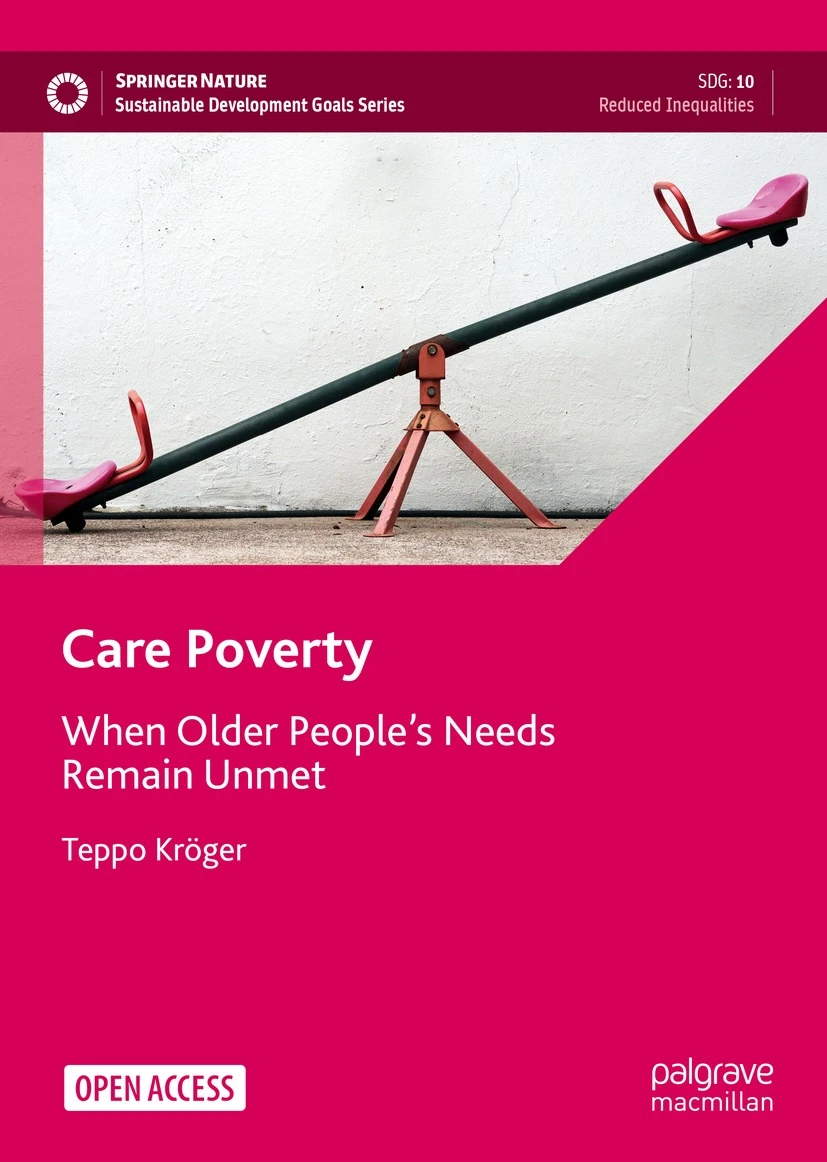
Book: Care Poverty - When Older People’s Needs Remain Unmet

CARE POVERTY
'This open access book turns the research attention of social policy scholars and long-term care researchers from comparative descriptions of care systems, focusing mostly on expenditures and volumes of long-term care services, to outcomes, and in particular to the question whether older people really receive the support that they need. Without knowledge about which needs and which social groups are currently inadequately covered, it is impossible to guide policy development.

The book puts forward a novel theoretical framework to guide future research work and public discussion on the issue of unmet long-term care needs, by broadening the current discussion so that inadequate care is seen in its societal and policy contexts, taking structural issues and policy designs into account. Kröger outlines three different domains of care poverty (personal care poverty, practical care poverty and socio-emotional care poverty) and differentiates between main methods how unmet needs are measured.' [my emphasis]

In psychiatry and psychiatric nursing, a person may be assessed to display poverty of thought, ideas or speech. As an exercise it may be useful to invert the rendering below in Hodges' model, and  consider Kröger's forms of poverty and possibly others that arise from your critique, reflections and life experience to date. Clearly, another book to add to the list!
 
individual
|
INTERPERSONAL : SCIENCES
humanistic ------------------------------- mechanistic
SOCIOLOGY : POLITICAL
|
group

CARE


CARE

CARE

POVERTY


Previously on W2tQ - (unmet) 'needs'

Kröger, T. (2022) Care Poverty - When Older People’s Needs Remain Unmet. Cham: Palgrave Macmillan. https://link.springer.com/book/10.1007/978-3-030-97243-1#about-this-book

Will check on a related title too.

Wednesday, July 31, 2024

WHO online survey on maternal well-being framework - ENG, FR and SPA translations available

 ------- ENGLISH ------

Dear colleague,

You are invited to participate in the development of the World Health Organization (WHO) maternal well-being framework through an online survey. 

This consultation is one step in a broader process led by the WHO Department of Maternal, Newborn, Child and Adolescent Health and Ageing (MCA) towards creating a comprehensive framework that supports maternal well-being across diverse environments and cultures. Based on the results of a scoping review of the literature and an expert consultation held in May 2023, a preliminary framework has been developed including a definition, domains and subdomains. WHO/MCA is now organizing multiple consultations which objectives are listed below. 

What is the purpose of the survey?

  • Ensure comprehensive coverage of all critical elements of the framework and identify potential gaps in the definition, domains and framework of maternal well-being.
  • Evaluate the framework’s applicability across various settings and cultures.
  • Foster collective agreement and consensus among key stakeholders.

Who can take part to this survey?

Any individual or organization who has interest in maternal health and well-being. This includes, but is not limited to:

  • Representatives of women's groups
  • Health workers (midwives, OBGYN, nurses, neonatal nurses, paediatricians, psychiatrists, psychologists, community health workers...)
  • Experts in human and sexual and reproductive rights, public health, health promotion, gender, mental health, economics, humanitarian, etc.
  • Academics and researchers 
  • Government organizations
  • National civil society organizations / NGOs
  • International agencies / UN agencies
  • Private sector

How to participate in this survey?

Please click on the following link: Survey Link

We expect this survey will not take longer than 15 minutes to complete. It is available in English. 

The survey will be open until 17 August 2024. 

We would be grateful for your response to this survey and your kind help in circulating to your colleagues and networks.

Please reach out to Justine Le Lez - lejus AT who.int with any further questions. 

Best regards,

On the behalf of the Department of Maternal, Newborn, Child and Adolescent Health and Ageing (WHO/MCA)


------- FRENCH / FRANCAIS ------


Bonjour,

Vous êtes invité·e à participer à l'élaboration du cadre conceptuel du bien-être maternel de l'Organisation mondiale de la santé (OMS). 

Cette enquête est une étape d'un processus plus large dirigé par le Département de la santé maternelle, néonatale, infantile et de l'adolescent et du vieillissement (MCA) de l'OMS, visant à créer un cadre conceptuel exhaustif soutenant le bien-être maternel dans divers environnements et cultures.

Sur la base des résultats d’une revue de la littérature et d’une consultation d’experts tenue en mai 2023, un cadre conceptuel préliminaire a été élaboré, comprenant une définition, des domaines et sous-domaines. L’OMS/MCA organise actuellement plusieurs consultations, dont les objectifs sont énumérés ci-dessous.

Quel est l’objectif de l’enquête ? 

  • Assurer une couverture exhaustive et identifier d'éventuelles lacunes dans le cadre actuellement proposé.
  • Évaluer l'applicabilité universelle et l'adaptation du cadre conceptuel à divers contextes et cultures.
  • Favoriser un consensus collectif afin que le cadre conceptuel reflète reflètent une large gamme de perspectives et d'idées

Qui peut participer à cette enquête ? 

Toute personne ou organisation intéressée par la santé maternelle et le bien-être. Cela inclut, sans s’y limiter :

  • Des représentants de groupes de femmes
  • Des professionnels de santé (sages-femmes, gynécologues-obstétriciens, infirmières, infirmières puéricultrices, pédiatres, psychiatres, psychologues, agents de santé communautaires…)
  • Des experts en droits humains, droits sexuels et reproductifs, santé publique, promotion de la santé, genre, santé mentale, économie, santé humanitaire, etc.
  • Des universitaires et chercheurs
  • Des organismes gouvernementaux
  • Des organisations nationales de la société civile / des ONG
  • Des agences internationales / agences des Nations unies
  • Le secteur privé

Comment participer à cette enquête ? 

Veuillez cliquer sur le lien suivant : Lien vers l’enquête

Nous estimons que cette enquête ne prendra pas plus de 15 minutes à compléter.  

L’enquête sera ouverte jusqu’au 25 août 2024.

Nous vous serions reconnaissants de bien vouloir y répondre et de la diffuser auprès de vos collègues et réseaux.

Pour toute question, n'hésitez pas à contacter Justine Le Lez.


Cordialement,

Au nom du Département de la santé maternelle, néonatale, infantile et des adolescents et du vieillissement (OMS/MCA)


------- SPANISH / ESPANOL -----

Está invitado a participar en la elaboración del marco conceptual del bienestar materno de la Organización Mundial de la Salud (OMS). 


Se le invita a participar en el desarrollo del marco de bienestar materno de la Organización Mundial de la Salud (OMS). Esta encuesta es un paso en un proceso más amplio liderado por el Departamento de Salud Materna, del Recién Nacido, del Niño, del Adolescente y del Envejecimiento (MCA) de la OMS hacia la creación de un marco integral que apoye el bienestar materno en diversos entornos y culturas.

Con base en los resultados de una revisión de la literatura y una consulta de expertos realizada en 2023, se ha desarrollado un marco preliminar que incluye una definición, dominios y subdominios del bienestar materno.  La OMS/MCA está organizando actualmente varias consultas, cuyos objetivos se enumeran a continuación. 


¿Cuál es el objetivo de la encuesta? 

· Garantizar una cobertura exhaustiva e identificar posibles brechas en el marco propuesto actualmente. 

· Evaluar la aplicabilidad universal y la adaptación del marco conceptual a diversos contextos y culturas. 

· Fomentar un acuerdo colectivo para que el marco conceptual refleje una amplia gama de perspectivas e conocimientos. 

¿Quién puede participar en esta encuesta? 


Cualquier persona u organización interesada en la salud materna y el bienestar. Esto incluye, sin limitarse a: 

·  Representantes de grupos de mujeres

· Profesionales de la salud: matronas (parteras profesionales/obstetras/obstetricias/comadronas), ginecólogos-obstetras, enfermeras, enfermeras pediátricas, pediatras, psiquiatras, psicólogos, agentes de salud comunitarios…

· Expertos en derechos humanos, derechos sexuales y reproductivos, salud pública, promoción de la salud, género, salud mental, economía, salud humanitaria, etc.

· Académicos e investigadores

· Organismos gubernamentales

· Organizaciones nacionales de la sociedad civil / ONGs

· Agencias internacionales / agencias de las Naciones Unidas

·  El sector privado

¿Cómo participar en esta encuesta?

 Por favor, haga clic en el siguiente enlace: enlace a la encuesta

Estimamos que esta encuesta no tomará más de 15 minutos para completar. 

La encuesta estará abierta hasta el 25 de agosto de 2024.


Le agradeceríamos que respondiera y difundiera la encuesta entre sus colegas y redes.

Para cualquier pregunta, no dude en ponerse en contacto con Justine Le Lez.


Atentamente, 

En nombre del Departamento de Salud Materna, Neonatal, Infantil y del Adolescente y del Envejecimiento (OMS/MCA)

Friday, April 05, 2024

CALL FOR PAPERS i - Lagoonscapes 4 | 2 | 2024

Special Issue's Title: Ecologies of Life and Death in the Anthropocene

Guest editors: Professor Peggy Karpouzou, National and Kapodistrian University of Athens, Greece & Dr. Nikoleta Zampaki, National and Kapodistrian University of Athens, Greece

Both life and death are natural states of humans and non-humans, coexisting and at the same time in an implicit ‘conflict’. The perception and mostly the experiences of death have varied through different local communities historically, often aiming to explain death through philosophical or religious interpretations of human and non-humans’ afterlife (e.g. Merchant 1979).

In the present condition of a precarious planetary time when environmental crises, wars, violence and pandemics are before us, entire ecosystems are annihilated or even destroyed. Human and more-than-human world’s vulnerabilities get amplified as death and loss become urgent environmental concerns, manifested in many cultural connotations, e.g. literary, artistic, philosophical etc., seeking to explore and explain death matter in nature as well as the consequences of death on species’ behavior and psychology. “It is about recognizing our shared vulnerabilities to human and non-human bodies, and embracing our complicity in the death of these other bodies- however painful that process may be” (Cunsolo 2017, 3-4).

Writers and artists have explored the representations of death matters beyond the human, the mourning for past, present and future ecological loss (Barnett 2022), while attempting to visualize and express ecological grief, mourning and melancholia, carve out memorial spaces and also imagine practices of the afterlife. For example, in literature, the poetic subgenre of elegy found as (anti-)pastoral elegy, eco-elegy or “ecological lament” (Morton 2009) is built on the poet’s acceptance of “death as natural […], in line with the season pattern and rebirth” (Twiddy 2012). Here death is not only synonymous with a biological end, but a rebirth, a state of a new being. However, the loss of nature itself, turning it into a ‘mirror’ of human loss, redefines the traditional elegy’s search for consolation (Sacks 1987).

Grounded in the theoretical framework of death studies, this special issue explores life and death eco-imaginaries and engagements, as they are interwoven through the study of the human and more-than-human world. It is there where an ontology of ecologies of life and death is being exposed and where the ethical territories of eco-grief and eco-mourning unfold. Therefore, the possibility of studying the ecology of life and death is questioned: How do we come up with death issues in nature? Is nature grievable? How do we mourn for it? How about the circular and linear way between life and death in nature’s spatiality and time? How about writers and artists’ perception of ecologies of life and death and how are they represented in texts and artworks? How do ecologies of life and death affect the way of writing or artistic outcome? How about the posthuman perspective on dead bodies and afterlife issues? What will it mean to live and die in the Anthropocene? (e.g., Scranton, 2016; Stiegler 2018).

While the ecologies of life and death give way to ‘decentralize’, even ‘deconstruct’ concepts like melancholy, grief and mourning, also ‘view’ the last ones as an approach of resilience and symbiosis between them, even a ‘spur’ to act. In this sense, there is a need to re-organize what is holding humanity back, such as the fear of humans' destructive power, and take action to achieve life’s preservation in order to build sustainable futures. We particularly welcome submissions that revolve around, but are not limited to, the following axes and concepts:

  • ecologies of life and death in ecocriticism, ecopsychology, eco/bio-philosophies, bioethics, plant humanities, animal studies, etc.
  • eco-anxiety, eco-grief, eco-mourning, solastalgia, toxic environments, extinction studies, political ecology of death
  • ecologies of life and death in -cene, e.g., Anthropocene, Neganthropocene, Necrocene, Symbiocene etc.
  • the genre of elegy (e.g., eco-elegy, “ecological lament”, (anti-)pastoral elegy etc.
  • ecologies of life and death in continental philosophy
  • ecologies of life and death in posthumanities (e.g., posthumanism, transhumanism, a-humanism, meta-humanism, anti-humanism, super-humanism etc.)
  • ecologies of life and death in medical humanities (e.g., pandemics, epidemics, plagues, biotechnology etc.)
  • ecologies of life and death in religious studies and anthropology
  • postcolonial narrations of death
  • “necropolitics” (Mbembe), “bare life” (Agamben), “slow death” (Berlant)
  • ecologies of life and death in indigenous studies
  • human and more-than-human world in queer death studies and gothic studies
  • ecologies of life and death in disability studies
  • ecologies of life and death in arts and aesthetics / ars moriendi
  • ecologies of life and death in visual studies, media studies, film studies
  • memorials, ways of remembering, rituals of eco-mourning
  • images, tools and practices of the afterlife in literature, philosophy and arts (e.g., mummification, cryonics, end-of-life applications, 3D printing for facial reconstruction etc.)

Deadline for full articles’ submissions: Kindly submit a full article of no more than 50,000 characters (spaces and references included), an abstract of no more than 650 characters spaces included, and at least five keywords by 31 of July 2024 at the latest.

Should your article be accepted for inclusion in the upcoming December issue, you will receive an email containing instructions on how to upload your final version within 15 days from receipt. Such articles must be suitable for blind peer review.

Please make sure to obtain the necessary reproduction rights documentation if you need to include photos in your text.

Articles must be written in English. In case you have further queries, you are welcome to send an e-mail to the Editors’ e-mails: pkarpouzou@phil.uoa.gr and nikzamp@phil.uoa.gr.


Best regards, 
on behalf of the Editors

Nikoleta
--
Dr. Nikoleta Zampaki
Postdoctoral Researcher
Faculty of Philology, National and Kapodistrian University of Athens, Greece
E-mail: nikzamp@phil.uoa.gr

Series co-Editor of "Posthumanities and Citizenship Futures" at Rowman & Littlefield: https://rowman.com/Action/Series/_/LEXPCF
Assistant and Managing Editor of “Brill Research Perspectives in Critical Theory”: https://brill.com/display/serial/RPCTS?contents=about