Hodges' Model: Welcome to the QUAD: arts

Hodges' model is a conceptual framework to support reflection and critical thinking. Situated, the model can help integrate all disciplines (academic and professional). Amid news items, are posts that illustrate the scope and application of the model. A bibliography and A4 template are provided in the sidebar. Welcome to the QUAD ...

Showing posts with label arts. Show all posts

Tuesday, September 22, 2026

Beware of the Concept

Yesterday Alan Ayckbourn's gold-nugget-laden book -

The Crafty Art of Playmaking by Alan Ayckbourn. Faber, 2004, softcover, ISBN 0571215106.
https://www.concordtheatricals.co.uk/s/45898/the-crafty-art-of-playmaking
 

- found a new owner. Beforehand, I turned up the following helpful advice (or, 'obvious rules'): 

ix Introduction

'The following is an attempt to describe, as far as I can, this double process [writing and directing, PJ]. Some of it is quite probably unique to me and contains procedures and practices that it would be highly unwise for others to try and copy. The rest is really just plain common sense. But if I've learnt anything it is that it never hurts to point out the obvious occasionally, certainly in the theatre - to actors, directors or writers and sometimes even to designers, stage managers and technicians. Often we quite wrongly suspect simplicity. We go digging around in the creative sand trying to make.our art more meaningful, somehow 'deeper'. Generally all we do is end up with our heads entirely buried, presenting the audience with our rear ends.'
Obvious Rule No. 3
If you don't have the initial inspiration, put down the pen,put the pencil back in the jar, switch off the computer and go and dig the garden instead.

.. 
'At its most successful, theatre views things from a human standpoint. It is after all the most human in scale of all the performance media. My feeling is that that's also a good place for a dramatist to start, at the human level. As a playwright it may be your intention to build a vehicle to take us to the stars. But do make sure you have people aboard.

Initial inspiration - that essential starting point - comes in all shapes and sizes.' p..9.
Obvious Rule No. 49
Beware of the Concept.

DIRECTING

'Don't be talked into anything you feel instinctively you'll regret later. If you must have a concept (God save us from that word) then let the concept be something that's worked out between you. Let it spring from the play and not from the fact that the production manager has 5oo square metres of black lino left over from their last production. I once heard the fateful words, 'I think it's about time we did something with mirrors.' If at all possible, try and persuade the producer, whoever it is, to let you make as many scenic decisions as late on as possible. There will always be an intense pressure to decide everything before you start. This can be fatal.' pp.118-19.

In pencil I noted: 'Hodges' model is different. So, don't panic.' Is it? Really?

I've saved this for the last: 

'Then there is the new old playwright. Far more difficult to deal with. They have probably nursed this script for twenty-five years and they're damned if you're going to mess it up for them when they've waited so long. Especially someone your age who wasn't even born when their harrowing play about World War Two was still raging, dammit.' p.110.

It's not that I believe I'm a (potential) playwright, it's the learning.

See also: 'Ayckbourn' : 'drama'

Wednesday, September 16, 2026

Philosophical Counselling Reading Group [and Hodges' model]

The discovery of a reading group on philosophical counselling (PC), through University of Liverpool, continues to prove helpful; to utilise professional experience, that included counselling, family therapy, cognitive therapy in psychoses, and practical experience as a mental health nurse (in-patient and community). There is overlap with Hodges' model, but it's fascinating and rewarding to listen and learn from practitioners of PC. As noted before, I was aware of PC through two popular philosophy magazines. This time around we read:

Ran Lahav, “Philosophical Counseling and Self-Transformation,” in Philosophy, Counseling, and Psychotherapy, eds. Elliot D. Cohen & S. Samuel Zinaich, Jr. (Newcastle upon Tyne: Cambridge Scholars Publishing, 2013), 82.

Abstract

This paper presents my approach to philosophical counseling, which is geared towards self-transformation, and is inspired by important thinkers throughout the history of Western philosophy whom I call transformational thinkers. I take from these thinkers the realization that our daily life is normally confined to rigid and superficial attitudes towards ourselves and our world. This is because individuals’ everyday attitudes are based on limited understandings of life, which form what I call the person’s perimeter, or perimetral worldview. The goal of philosophical counseling, as I see it, is to help counselees transcend their constricted perimetral worldview, or in the language of Plato – to realize that they are imprisoned in a “cave,” and then to step out of it towards a fuller reality. A case study is presented to illustrate the two main stages of the counseling process. 

I know there is the (biblical) phrase 'Seek and you will find'; but there is also the notion of seeing only what you seek, and missing other content - contexts. This is marked in beliefs and the development of delusional ideas. 

Of interest to me, Lahav discusses (as indicated above) a person’s perimeter, or perimetral worldview. 

We still hear how difficult it is for people to access help. I wondered (again) about referral pathways for PC? The nature of the person's problems that prompts them to seek help? Lahav acknowledges the complexity here. Speaking of 'prompt', of course now there is AI in the mix. Lahav points out how PC does not quite have the foundation and hence theoretical impetus (and rigour?) that Freud provided to psychoanalysis and psychotherapy. 

PC is, however, to some extent a broad field: '... philosophical practice has come to include several different formats in which it is practiced: one-time workshops for the general public, philosophical retreats, long-term self-reflection groups, the philosophical café, and of course philosophical counseling'. 

I wonder if philosophical counsellor's could have a role, post AI / agentic ai interventions. This could provide a step-down assurance, and be rolled into 'treatment / intervention programmes'. This could help retain the humanistic element of duty of care, underscore the person_al in care architectures/systems and provide a step-down - just in-case AI has missed, or upset something? The acknowledged strength of AI in not being subjective is balanced. Although evidence also points to misogynistic responses derived through what can be biased, and prejudiced learning sources: thus a reflection of 'society'.

In the introduction, more encouragement with reference to situated, a general map, and basic - fundamental aspects. There are (at least) two domains: 'the domain of philosophical discourse and the domain of everyday life and predicaments'. 

Hodges' model was created to facilitate the FIRST approach in PC, the Critical Thinking Approach, with an associated subtype of Problem-Solving Approach. 

It was also designed to help with the theory-practice gap. Lahav describes this in the how and what of philosophy and PC itself. I wondered to what extent if the approach of PC 'leave out the more important “what” of great philosophies.' then would a counselee be denied avenues to learning, as we may be drawn to specific philosophical schools of thought, and crucially reasoning?

The SECOND approach to PC is the Edification Approach. The author has adopted this second approach in practice.

Guess what? Yes, you've got it. Hodges' model can actually close a circle here. Or, more accurately help sustain the reflective, reflexive, recursive ... reasoning loop as needed. Another objective of Hodges' model is to produce reflective practitioners, critical thinkers and lifelong learners.

A take-away for me is the 'perimeter and the perimetral worldview'. A search for 'perimeter' here on W2tQ is null.^ I'm also wondering about transformation (in the title) and throughout the paper.

There may be an example here were a domain of Hodges' model can itself reflect the model, as in the Intra- Interpersonal domain below.

Lahav employs a case study to illustrate his thought and practice. The discussion really helped improve my reading and understanding of this.

individual
|
INTERPERSONAL
: SCIENCES             
humanistic ------------------------------- mechanistic
SOCIOLOGY : POLITICAL   
|
group

Psychology   | Philosophy(-isms)
________________________________
Psycho-Social|  Psychotherapies 

basic - fundamental

general map


case study

referral pathways

^'Peripheral' does feature in posts.

Thursday, September 10, 2026

Is the Individual-Group axis health's proscenium arch?

Speech: “All the world’s a stage”

By William Shakespeare
(from As You Like It, spoken by Jaques)
          
     All the world’s a stage, 
And all the men and women merely players; 
They have their exits and their entrances; 
And one man in his time plays many parts, 
His acts being seven ages. At first the infant,
Mewling and puking in the nurse’s arms; 
And then the whining school-boy, with his satchel
And shining morning face, creeping like snail
Unwillingly to school. And then the lover,
Sighing like furnace, with a woeful ballad 
Made to his mistress’ eyebrow. Then a soldier,
Full of strange oaths, and bearded like the pard,
Jealous in honour, sudden and quick in quarrel,
Seeking the bubble reputation
Even in the cannon’s mouth. And then the justice,
In fair round belly with good capon lin’d,
With eyes severe and beard of formal cut,
Full of wise saws and modern instances;
And so he plays his part. The sixth age shifts
Into the lean and slipper’d pantaloon,
With spectacles on nose and pouch on side;
His youthful hose, well sav’d, a world too wide
For his shrunk shank; and his big manly voice,
Turning again toward childish treble, pipes
And whistles in his sound. Last scene of all,
That ends this strange eventful history,
Is second childishness and mere oblivion;
Sans teeth, sans eyes, sans taste, sans everything.

Source: https://www.poetryfoundation.org/poems/56966/speech-all-the-worlds-a-stage


TIME FRAMES

'As Shakespeare and his contemporaries wrote for the epic scale, the imaginative commitment and the 360-degree embrace of the Globe so, three hundred years later, generations of playwrights wrote for the velvety darkness, the enclosed acoustic and the picture framing of the proscenium arch.

For a century, the story of the changing world was told inside proscenium theatres, by a series of remarkable playwrights. In over sixty irreverent, illuminating pen portraits – of both famous giants and lesser-known talents – Dominic Dromgoole takes us on a journey from 1865 to 1965, revealing how these writers used the framed stage to reflect the social upheavals of their times.' 

This post began with: 'All the world's a stage', but I realised I'm no Shakespeare. Hodges' model is a frame; and users of the model can put it to work, readily. Be that in the sciences, arts, and across curricula. The 'arch' in Hodges' model appears to be inverted, working from within, rather than out. Similarly to the proscenium arch, however, the model provides a structure, for whatever performance, situated, will surely follow.

Hodges' model: Axes and Domains

Of course, the question posed here might be re-framed as: 

Are the axes of Hodges' model, life and death's proscenium arch?


Dominic Dromgoole (2026) Time Frames: A century of proscenium playwrights. London: Faber. 
https://www.faber.co.uk/product/9780571374113-time-frames/ [Text source].

Previously: 'drama' : 'stage' : 'frame'

Wednesday, September 09, 2026

Bonjour Bayeux: Tapestries Historical & Modern

individual
|
INTERPERSONAL
: SCIENCES             
humanistic ------------------------------- mechanistic
SOCIOLOGY : POLITICAL   
|
group

'I think my favourite story to work on has been the 434 dinosaurs that are in the tapestry.  So much has changed about what we know about dinosaurs and all because the study of fossils and dinosaurs has grown up alongside geological survey for mining and petroleum drilling. Studies say dinosaurs were much more colourful than originally imagined and many were feathered, and in fact birds are their distant relatives.  Only 50 years ago we were taught that oil was made from decomposed dinosaurs and plants. Today research suggests oil formed from aquatic algae, called diatoms.

Much more than half of all life on earth died in a mass extinction at the end of the Cretaceous period. The most agreed upon theory, based on research, suggests the cause was when an asteroid collided with the earth and triggered volcanic eruptions, that disrupted weather patterns, growing seasons and ecosystems.  This one-two punch killed off the majority of Earth’s flora and fauna, including the dinosaurs, all of which were unable to adapt to the changes in climate.'

Sandra Sawatzky -
https://www.theblackgoldtapestry.com/notes

Detail - Panel 1 - Beginnings

The Black Gold Tapestry


THE BRITISH MUSEUM

A historic loan from France

The Bayeux Tapestry

Experience / 10 September 2026 – 11 July 2027


My source: Sandra Sawatzky, Oil in a Material World, Resurgence & Ecologist, Nov/Dec 2022, Issue 335, pp.52-55.

See also: https://www.theblackgoldtapestry.com/

Previously: 'Canada' : 'environment' : 'activism'

Friday, September 04, 2026

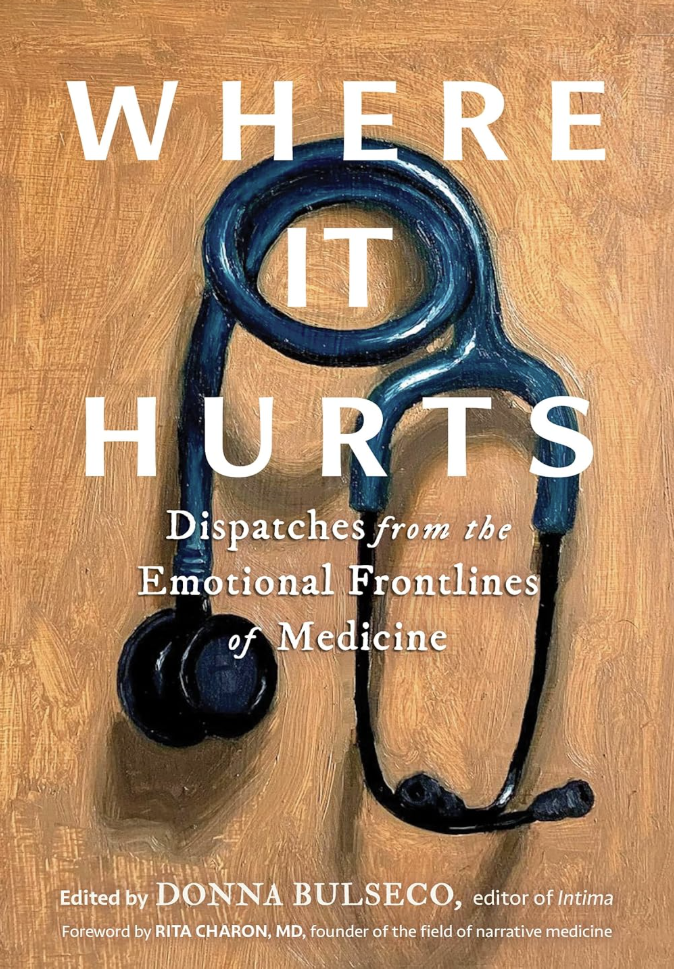
Call for Submissions: Fall-Winter 2026 Intima Journal of Narrative Medicine


OUR CALL FOR SUBMISSIONS  FOR OUR FALL-WINTER 2026
JOURNAL IS OPEN. SUBMIT YOUR WORK TODAY.


Intima: A Journal of Narrative Medicine
is a literary journal dedicated to promoting the theory and practice of narrative medicine, an interdisciplinary field that enhances healthcare through the effective communication, empathy and understanding between clinicians, caregivers and patients. Our name Intima has a specific resonance in the field: For us, narrative involves the intimate interface between people, who yield and gain from the experience of stories involving the clinical encounter.

 The word itself has an anatomical reality: intima is  the thin layer lining a blood vessel, speeding blood to the heart and brain, an apt analogy for the kind of narratives we publish that speak to the emotions and the intellect, the feelings and facts that engage the senses in stories with meaning and impact..


individual
|
INTERPERSONAL
: SCIENCES             
humanistic ------------------------------- mechanistic
SOCIOLOGY : POLITICAL   
|
group


©The Art of Anatomy by Khalil Harbie.
Intima, Fall 2013


Art - https://www.theintima.org/missionandvison also reminded of Escher and Byte Magazine.

My source: Intima list

Previously: 'creativity' : 'crossroads' : 'narrative'

Wednesday, September 02, 2026

Celebrating Black History Month with the RCN NW Multicultural Group

From Allyship to Action: Building an Inclusive, Anti-Racist Future for Nursing


22 Oct 2026, 10:00 - 16:00
6 Mount Street, , Manchester, M2 5NS

Free

Book onto our celebration for Black History Month.

Join us for a full day at the Friend's Meeting House in Manchester to celebrate Black History Month!

North west members are invite to join us in celebration alongside the RCN President, who is making a special trip to Manchester to join us for part of the day.  This year we will be exploring the theme: From Allyship to Action: Building an Inclusive, Anti-Racist Future for Nursing.

The event, organised by the member-led North West Multicultural Group, will hear from speakers including:

Estephanie Dunn: Non-Executive Director of the Caribbean and African Health Network (CAHN)

Estephanie will discuss exceptionalism and how intentional and unintentional actions can negatively impact equity, inclusion and belonging in healthcare. Her session will encourage reflection on bias, challenge inequitable practices, and promote more inclusive workplaces for all.

Temitope Babajide: General Practice Nurse

Creator of both the General Practice Nurse Starter Manual and a separate nursing-themed colouring book, will share her inspiring journey in primary care. Her session will recognise and celebrate the historic and ongoing contributions of Black nurses, while showcasing the achievements, leadership and influence of Black nursing professionals in the North West and beyond.

Patricia Hughes: Associate Director RCN : Nursing Practice Nursing

Patricia will focus on equality, leadership and career progression, encouraging greater representation of Black nurses in senior and decision-making roles.

Bejoy Sebastian: RCN President

The President, will discuss the importance of allyship and the role nursing professionals play in creating anti-racist, inclusive workplaces. He will recognise and celebrate the significant contributions of Black nurses to the NHS and wider health and social care sector. The session will explore how inclusive leadership, workforce equality standards and fair career progression can help create a culture of belonging. Attendees will be encouraged to take practical action to challenge discrimination, support equality and inspire the next generation of nursing leaders.

Anandi Ramamurthy: Professor of Media and Culture, Sheffield Hallam University; Principal Investigator, Nursing Narratives: Racism and the Pandemic; Co-Editor, Anti-Racist Nursing and Midwifery: A Resource for Students, Practitioners and Activists.

The Anti-Racist Nursing and Midwifery book, the Nursing Narratives research project, and the film 'Exposed'.

There will also be a panel discussion and a poetry workshop and 'Allyship in Action' challenge workshop in the afternoon. 

Book now to avoid missing out. This event will take place in person and is open to all North West members. A sandwich lunch is provided. 

For further information regarding the aims and objectives of the NW Multicultural Group, please visit our webpage. 

Olanike Babalola

Olanike.Babalola AT reps.rcn.org.uk

Tuesday, September 01, 2026

Blueprints ...

individual
|
INTERPERSONAL
: SCIENCES             
humanistic ------------------------------- mechanistic
SOCIOLOGY : POLITICAL   
|
group


Du Sautoy, M. (2024). Blueprints: How mathematics shapes creativity. Glasgow: 4th Estate.
https://www.4thestate.co.uk/products/blueprints-how-mathematics-shapes-creativity-marcus-du-sautoy-9780008685034/

Burgis, B., Bhaskar Sunkara, B., and Beggs, M. (2026 - 26th Sept) The Blueprint: How Socialism Can Work in the Real World. London: Verso.
https://www.versobooks.com/en-gb/products/2843-the-blueprint/

Book covers c/o Waterstones (Du Sautoy) and Verso Books. 

My source https://www.liverpool.ac.uk/philosophy/philos-l/ (Beggs et al.) and various.

Previously: 'creativity' : 'socialism' : 'politics'

Tuesday, August 25, 2026

Medicine - Mathematics & History

'We now come to the input of mathematics into medical history, and to the related questions of arithmetic and quantification, ratio and proportion, geometrical argument and diagrams, and probability. Mathematics (consisting in arithmetic, geometry, astrology and music) had an established place in the quadrivium of the medieval arts course; its application to medicine is demonstrated in such textbooks as the Articella, which include treatises on weights and measures, and in studies of proportion and ratio such as those of the medieval Oxford calculators which Italian doctors among others caused to be revived at the beginning of our period. In the sixteenth century, it was a vigorously debated subject; there is a well-documented discussion of the certainty of mathematics, concerning its status in respect to the logical adequacy of its proofs, in which some natural philosophers and doctors (notably Cardano) take part. It will come therefore as no surprise that it was prescribed for doctors by most Renaissance pedagogical writers;  this prescription is often specifically linked to Galen's geometrical (axiomatic) method whose operations are the constitution of objects from elements, the comparison of existing objects and their reduction into their constitutive elements.

Associated with mathematics are diagrams, that is, abstract quantified spatial representations. There is a modern debate about the contribution of technical innovations in illustration in the Renaissance (most notably perspective) to the scientific revolution: this is only relevant here insofar as some participants in this debate argue for the importance of diagrammatic symbolisation of mental abstractions above those, like perspective, which are still representations of the real world, and see the former as a step on the path to full algebraic notation of geometry. Not all Renaissance thinkers were persuaded of their usefulness: Argenterio describes the diagrams of Manardo and Akakia reproduced below as 'vain and false tables and figures'; but I shall argue here that they were related to the uptake of doctors from the arts course insofar as well-known logical diagrams reproduced above (4.3:3) were adapted by them for their own purposes.' pp.171-172.

Maclean, Ian. 2002. Chapter 5, Beyond logic: geometry, proportion, quantity. In Logic, Signs, and Nature in the Renaissance: The Case of Learned Medicine. Cambridge/New York: Cambridge University Press.

Related to ongoing reading, Maclean provides two (among several) historical illustrations (with apologies for the quality) on pp.174-175, the first is from the Wellcome Collection:

Dubois, Jacques, 1478-1555 (Boe͏̈, Jacques, Bois, J. d., Boë, J., del, Boë, J., Del Boë, J., DelBoe͏̈, J., . . . Sylvius/de Bois). (1548). Methodus sex librorum galeni in differentiis et causis morborum et symptomatum in tabellas sex ordine suo conjecta paulo fusius ne brevitas obscura lectorem remoretur & fallat. de signis omnibus medicis, hoc est salubribus, insalubribus, & neutris, commentarius / ... per jacobum sylvium ..Paris: Retrieved from https://www.proquest.com/books/methodus-sex-librorum-galeni-differentiis-et/docview/2090356749/se-2

Jacobus Sylvius, 1539

Which Maclean then translates / interprets (p.174):

Maclean. Figure 5.1, p.174.

'Manardo goes further, and causes and symptoms adapts the square of contraries to represent not only all the possible combinations of temperaments (combinations of cold and hot and wet and dry are cleverly excluded) but also inserts a mediate point to represent the absolutely temperate body: see fig. 5.2.
This adaptation of the square of contraries (which has precedents in the medieval period) shows the appropriation for their own use by doctors of the logical instruments at their disposal.

As we have seen, it is a feature of medical thinking to take into account many circumstantiae or variables, and, over time, the numbers of variables taken into consideration increases.' p.174-175.

Figure 5.2 Giovanni Manardo, p.175.

individual
|
INTERPERSONAL
: SCIENCES             
humanistic ------------------------------- mechanistic
SOCIOLOGY : POLITICAL   
|
group

quality

logic

quantity
past - present - future
diagrams

symptoms - signs


subjective

objective

Previously: 'medicine' : 'history' : 'diagram'

Thursday, July 30, 2026

Remembering Dr. Gilberto Cárdenas - Self Help Graphics

 Continued ...


My source:  Self Help Graphics & Art, 1300 East 1st Street, Los Angeles, CA, 90033, United States

Tuesday, April 21, 2026

WCCS26: World Conference on Complex Systems 20-22nd April

It was good that today I could relax a little sooner than I expected with my presentation delivered over lunch time instead of 1730. To recap, at the 6th edition conference theme of:

“Navigating Contemporary Complexity:
Transdisciplinary Approaches to Economic, Social, Political, and Environmental Challenges”

- my talk (I added "Hodges' model" in the slides):

'Hodges’ model: PRESENTING a UNIVERSAL and SIMPLE CONCEPTUAL WORKBENCH to SITUATE and ENCOMPASS COMPLEXITY'

This after arriving back from a conference dinner near Marrakech at 0100, but the event at Chez Ali was different and most enjoyable. 

I'm conscious that unlike other speakers I (still!) did not have 'data' to share and discuss. Equations have been necessary over the first two days. But overall all sessions have proved accessible. From comments received Hodges' model was understood and deemed relevant. One delegate noted how the visual nature of Hodges' model was apparent, the illustrations revealed the model more clearly than a verbal description the evening before.

There were two questions. I eventually recalled awareness of Franco Basaglia, the Italian pioneer of community mental health and mental health law in Italy. Another questions concerned were I though the arts, drama and culture sit, or fit in Hodges' model? I suggested a search of the blog for posts tagged 'art', 'theatre', or 'culture'; with a warning that it can be a bit of a rabbit-hole.

Discussion, in-sessions and outside have proved refreshing, and not just as a welcome change from 'world news'. There were reminders too of early career researchers, professionals, and policymakers and the need to phone home.

While I pack for a transfer to Marrakech tomorrow afternoon, I will reflect and look to add more here.

In adition to data, I need new angles so I am not self-plagiarizing; hence the attempt to see Hodges' model as a mathematical object.

Many thanks to the WCCS26 Committee for being able to participate and share this model made in the 20th century for the challenges of the 21st.

More to follow and in the meantime, you can read the programme yourself.

Friday, April 17, 2026

Ann Hutchinson Guest (Obit.), 'Authority on dance notation ... '

'Although there are many forms of dance notation going back to Pierre Beauchamp's system for Baroque dance in the 1680s, Nijinsky had developed his own cryptic version. Ann Hutchinson Guest first tried to reconstruct his work in 1956 after the choreogapher's widow, Romola, gave her his notes. "I spent years trying to work it out," she said, adding with a laugh: And I'm supposed to be the leading authority on dance notation in the world. She told how Nijinsky had revised his notes many times, often contradicting himself. 'We couldn't get anywhere. Romolo was furious. She said it was taking much too long."
    Hutchinson Guest studied dozens of different dance notation systems, translating many of them into Labanotation, a system developed in the 1920s by Rudolf von Laban who was a central figure in European modern dance. According to a  press report in 1954: "The printed Labanotation page looks like a combination of hieroglyphs, pictographs, Morse dots-and-dashes, đoodles, and a musie score turned on edge" 
    It was not until 1980 that she and Claudia Jeschke, a dance historian, succeeded in cracking Nijinsky's code after finding a copy of his annotated score in the British Library.'
Register, The Times.

My source: Ann Hutchinson Guest (Obit.), 'Authority on dance notation known for reconstructing Vaslav Nijinsky's scandalous ballet, L'Après-midi d'un faune'. Register, The Times. 20 April, 2022, p.48.
https://www.thetimes.com/uk/obituaries/article/ann-hutchinson-guest-obituary-hkw8z88ns


INDIVIDUAL
|
     INTERPERSONAL    :     SCIENCES               
HUMANISTIC --------------------------------------  MECHANISTIC      
SOCIOLOGY  :   POLITICAL 
|
GROUP
abstraction
representation
interpretation
observation - translation
code - formalism

body (bodies)
symbols - forms
dance
choreography
movement - 4D - time

group
ensemble
'anthropological composition?'
'diagnostic grouping'?
social - cultural category . . .

'collective power & attention 
evinced as time'
'The stage: the space for health'^

Hutchinson Guest in 1956
 Source: The Times.


'Dance has been called moving architecture, a truth which the complexities of contemporary choreography may mask. Not only does the dancer's body form shapes and groups of dancers form moving or static designs, but also group arrangements carve up the stage space, establishing areas of open as well as enclosed space which are significant in their changes and contrasting effects.

While the rccording of movement on paper-dance notation-does not look like movement (disregarding primitive stick figure drawings), there is an "architecture" in the sequence of graphic symbols used to record dance patterns. Over the centuries many different devices have been used to capture dance steps on paper. What are the elements that have to be represented?

The process of dance notation requires reducing four-dimensional movement (time being the fourth dimension) to a two-dimensional surface. The parts of the body in action have to be defined, as does the form of movement involved (flexion, extension, rotation, directional placement) and the duration of each in relation to the overall time structure. In group dances the relationship of dancers to one another must be determined and recorded, as well as their location on stage and their paths of travel. In a dance score each performer is like a small orchestra-arms, legs, head, torso, etc. in motion-this is then multiplied by the number of dancers who are performing individual sequences.'


Guest, A. H. (1990). Dance Notation. Perspecta, 26, 203–214. https://doi.org/10.2307/1567163

^Health is always performed in the political domain, make no mistake (excuses, or exceptions). It is not:
  1. Acknowledged, masked - covered by the 'set design' (see #2 below);
  2. Implied in the medical, biomedical, bio-psycho-social model;
  3. The intermission is neither the time, or place, to reflect upon and critique the political in health :: health in politics.

Previously: 'dance' : 'architecture' : 'movement' 
 : 'notation'

Monday, February 16, 2026

The UK Dementia Awards 2026

Dear CHAIN member,

We would like to draw your attention to the following opportunity. Please pass on as appropriate. Thank you.

Dementia Community

The UK Dementia Awards 2026

The awards are judged by a panel of dementia experts, including people with lived experience, ensuring that every nomination is seen, valued, and understood.

Whether nominating a colleague, a team, a service, or someone whose quiet dedication deserves the spotlight, this is the chance to say: you matter, and your work matters too.

Friday 27 February 2026, 5pm: Nominations Close.

For more details please see: https://journalofdementiacare.co.uk/awards/listings
Regards,

Irina Johnston

CHAIN Administrative Assistant


If you wish to publicise information on the CHAIN Network please email your request to: enquiries AT chain-network.org.uk


CHAIN - Contact, Help, Advice and Information Network – is an online international network for people working in health and social care. For more information on CHAIN and joining the network please visit website: www.chain-network.org.uk


Follow CHAIN on X: @CHAIN_Network ; Connect with CHAIN on LinkedIn

Previously: 'dementia' : 'carer'

Saturday, January 31, 2026

International Conference: the Concept of Attention - IEF

Filosofia na Agenda

international conference
the concept of attention

Theme and Objectives

Attention constitutes one of the most fundamental yet under-theorized dimensions of human experience. Despite its centrality to perception, cognition, action, and intersubjectivity, the philosophical investigation of attention as a concept in its own right remains surprisingly underdeveloped. This international conference represents the first major initiative of a four-year research program (2025-2029) dedicated to establishing the philosophy of attention as a major field of contemporary philosophical inquiry.

The philosophical engagement with attention has deep historical roots. Already in ancient Greek thought, we find attention implicitly at stake in the Socratic contrast between an 'examined' and an 'unexamined' life and in the dialectical reform of ordinary reason pursued throughout Plato's dialogues. Medieval philosophy anticipates later developments through its emphasis on representation and intentionality (intentio), particularly in the works of Augustin, Aquinas and Duns Scotus. Yet it is only with Descartes's Meditations that attention receives explicit philosophical treatment, emerging as the crucial mediating link between radical doubt and epistemic certainty. This Cartesian innovation opens a rich trajectory of reflection, pursued by thinkers as diverse as Malebranche, Berkeley, Locke, and Wolff.

The scope of philosophical inquiry into attention expands dramatically from the late 18th century onwards. No longer confined to epistemological questions, attention becomes central to investigating the fundamental structures of subjectivity itself. French spiritualism, phenomenology, and philosophies of existence explore how attention relates to apperception, sensation, emotion, and volition—a trajectory that runs from Maine de Biran and Bergson through the phenomenological movement, encompassing figures from Paul Ricoeur to Michel Henry. Meanwhile, William James's psychological and philosophical investigations, along with later thinkers like Merleau-Ponty, Simone Weil, and Iris Murdoch, demonstrate attention's significance across multiple philosophical domains.

Indeed, contemporary philosophy recognizes attention as fundamental to a remarkable range of inquiries. In ethics, attention emerges as an essential vehicle for exercising personal and collective virtues. Aesthetics invokes attention in debates about the nature of beauty and our engagement with works of art—their creation, appreciation, and critique. Social and political philosophy identifies attention as a central component of the modern media landscape, where it functions as a valuable and increasingly contested economic resource. Environmental philosophy calls upon attention to help conceptualize our evolving and often precarious relationship with the natural world. Across these diverse contexts, attention appears as a fundamental human capacity whose nature and quality largely determine the kinds of bonds we can establish with each other and our surrounding world.

This conference seeks to bring these rich historical engagements into systematic dialogue with contemporary philosophy. We welcome contributions from all philosophical traditions and approaches, including but not limited to: the reflexive tradition, hermeneutics, phenomenology, empiricist and analytic philosophy, philosophy of mind, cognitive science, pragmatism, and non-Western philosophical traditions. We aim to explore how different philosophical frameworks have conceptualized attention's structure, dynamics, and normative dimensions, and how these varied perspectives can illuminate both historical debates and current research.

Full details: international conference: the concept of attention

Image: https://www.wikiart.org/en/theo-van-doesburg/heroic-movement-1916

Tuesday, January 27, 2026

c/o Intima 'Reflect on the World' . . .

CARE/of Intima:

REFLECT ON THE WORLD WITH US EVERY FRIDAY AT NOON.

No pressure, but we want to remind you that every Friday, around noon EST, we post a Crossroads blog—a short reflection that contributors from our current issue do on something from our archives.

Think of “Friday at noon” as a blip in your busy life where you take time to yourself to reflect on our small part of the universe. Pause and spend 5 minutes reading one each Friday — it’s the equivalent of a deep-breathing exercise, a short yoga stretch, a tiny palate cleanser of lemon sorbet between the complex courses served up to us every day, or a moment stolen between patients or in a waiting room when you step out of your routine. Read the titles of recent ones below, then go and read a few. If you like what you read, set up a reminder alert.

◇

INDIVIDUAL
|
    INTERPERSONAL    :     SCIENCES               
HUMANISTIC --------------------------------------  MECHANISTIC      
SOCIOLOGY  :   POLITICAL 
|
GROUP


My source: Intima (and image) - mail list.

See also: 'reflect' : 'crossroads'