Hodges' Model: Welcome to the QUAD: dance

Hodges' model is a conceptual framework to support reflection and critical thinking. Situated, the model can help integrate all disciplines (academic and professional). Amid news items, are posts that illustrate the scope and application of the model. A bibliography and A4 template are provided in the sidebar. Welcome to the QUAD ...

Showing posts with label dance. Show all posts

Friday, April 17, 2026

Ann Hutchinson Guest (Obit.), 'Authority on dance notation ... '

'Although there are many forms of dance notation going back to Pierre Beauchamp's system for Baroque dance in the 1680s, Nijinsky had developed his own cryptic version. Ann Hutchinson Guest first tried to reconstruct his work in 1956 after the choreogapher's widow, Romola, gave her his notes. "I spent years trying to work it out," she said, adding with a laugh: And I'm supposed to be the leading authority on dance notation in the world. She told how Nijinsky had revised his notes many times, often contradicting himself. 'We couldn't get anywhere. Romolo was furious. She said it was taking much too long."
    Hutchinson Guest studied dozens of different dance notation systems, translating many of them into Labanotation, a system developed in the 1920s by Rudolf von Laban who was a central figure in European modern dance. According to a  press report in 1954: "The printed Labanotation page looks like a combination of hieroglyphs, pictographs, Morse dots-and-dashes, đoodles, and a musie score turned on edge" 
    It was not until 1980 that she and Claudia Jeschke, a dance historian, succeeded in cracking Nijinsky's code after finding a copy of his annotated score in the British Library.'
Register, The Times.

My source: Ann Hutchinson Guest (Obit.), 'Authority on dance notation known for reconstructing Vaslav Nijinsky's scandalous ballet, L'Après-midi d'un faune'. Register, The Times. 20 April, 2022, p.48.
https://www.thetimes.com/uk/obituaries/article/ann-hutchinson-guest-obituary-hkw8z88ns


INDIVIDUAL
|
     INTERPERSONAL    :     SCIENCES               
HUMANISTIC --------------------------------------  MECHANISTIC      
SOCIOLOGY  :   POLITICAL 
|
GROUP
abstraction
representation
interpretation
observation - translation
code - formalism

body (bodies)
symbols - forms
dance
choreography
movement - 4D - time

group
ensemble
'anthropological composition?'
'diagnostic grouping'?
social - cultural category . . .

'collective power & attention 
evinced as time'
'The stage: the space for health'^

Hutchinson Guest in 1956
 Source: The Times.


'Dance has been called moving architecture, a truth which the complexities of contemporary choreography may mask. Not only does the dancer's body form shapes and groups of dancers form moving or static designs, but also group arrangements carve up the stage space, establishing areas of open as well as enclosed space which are significant in their changes and contrasting effects.

While the rccording of movement on paper-dance notation-does not look like movement (disregarding primitive stick figure drawings), there is an "architecture" in the sequence of graphic symbols used to record dance patterns. Over the centuries many different devices have been used to capture dance steps on paper. What are the elements that have to be represented?

The process of dance notation requires reducing four-dimensional movement (time being the fourth dimension) to a two-dimensional surface. The parts of the body in action have to be defined, as does the form of movement involved (flexion, extension, rotation, directional placement) and the duration of each in relation to the overall time structure. In group dances the relationship of dancers to one another must be determined and recorded, as well as their location on stage and their paths of travel. In a dance score each performer is like a small orchestra-arms, legs, head, torso, etc. in motion-this is then multiplied by the number of dancers who are performing individual sequences.'


Guest, A. H. (1990). Dance Notation. Perspecta, 26, 203–214. https://doi.org/10.2307/1567163

^Health is always performed in the political domain, make no mistake (excuses, or exceptions). It is not:
  1. Acknowledged, masked - covered by the 'set design' (see #2 below);
  2. Implied in the medical, biomedical, bio-psycho-social model;
  3. The intermission is neither the time, or place, to reflect upon and critique the political in health :: health in politics.

Previously: 'dance' : 'architecture' : 'movement' 
 : 'notation'
Sunday, February 08, 2026

Intelligence - mechanistically speaking^

INDIVIDUAL
|
    INTERPERSONAL    :     SCIENCES               
HUMANISTIC --------------------------------------  MECHANISTIC      
SOCIOLOGY  :   POLITICAL 
|
GROUP
Mental
Intelligence


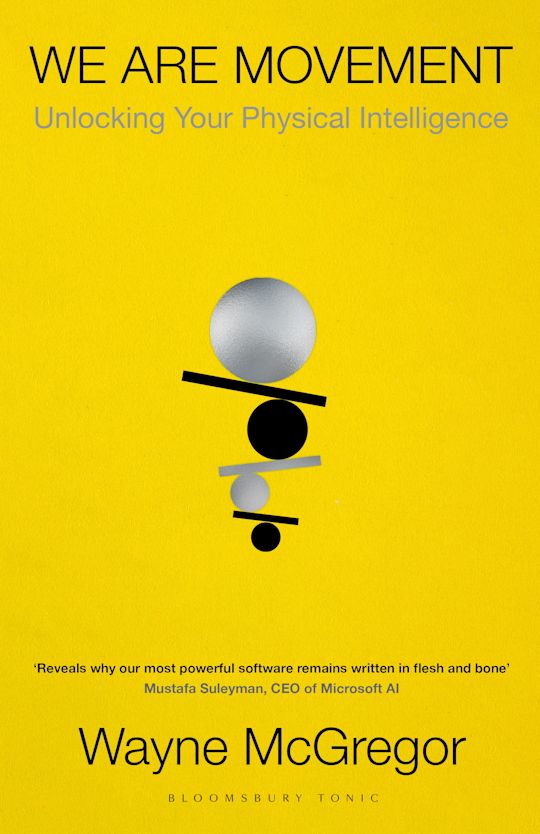
We Are Movement - Unlocking Your
Physical Intelligence

... ever increasing

'artificial' intelligence
 
here . . .?

"We?

 Yes... We! 

   We are  
a                       MOVEMENT!"


Wayne McGregor (2026) We are Movement: Unlocking Your Physical Intelligence. London: Bloomsbury. (Book cover) https://www.bloomsbury.com/uk/we-are-movement-9781526629531/

My source: Nadia Beard, Our bodies, ourselves. Life&Arts, FTWeekend, 17-18 January, 2026. p.9. 

Previously: 'movement' : 'dance' : 'intelligence' : 'art' : 'body' : 'AI'

^. . . help me find (a) the notation? 

Thursday, March 20, 2025

Book 'Your Life Is Manufactured: How We Make Things, Why It Matters and How We Can Do It Better'

Individual
|
      INTERPERSONAL    :     SCIENCES               
HUMANISTIC  --------------------------------------  MECHANISTIC      
 SOCIOLOGY  :    POLITICAL 
|
Group

My choices
  My vote

Your Life Is Manufactured

freedom
citizenry

lawful government
legitimate government

elections
Yes, you can vote -
does it 'count'?


My source: Book
Crabtree, J. Chain reactions, Books, Life&Arts, FTWeekend, 22-23 February 2025, p.11.

Video: Choreographic painting "Labor Day". Igor Moiseyev Ballet
 https://www.youtube.com/watch?v=ogLGpMH3u1w

Thursday, December 26, 2024

Moving Online Symposium: 30th Jan 2025 - Coventry University, UK

In recent years, there has been increased attention paid to the ownership of dance. There has been important work done in the area of dance and copyright1 as well as the examination of the way ownership is managed via social norms through the ‘commons’2 and as a form of ‘gift’.3  The increased circulation of dance online through archives, video platforms and social media sites has led to multiple debates about the copying and re-embodiment of dances,4 reigniting important conversations about appropriation, acknowledgment and credit.5 At the same time, there has been a flourishing of work on dance and performance ontology. For example, long-standing debates about the ephemerality of dance and performance have been reframed through discussions about the ‘post-ephemeral’6and materiality.7 There have also been new perspectives offered on questions about the nature of dances and the way in which they exist.8,9


The Moving Online symposium explores how these two areas intersect in the context of online dance and performance. The event builds on and shares the findings from Moving Online: Ontology and Ownership of Internet Dance (the project and event is funded by the Arts and Humanities Research Council [grant number AH/W01002X/1]).

The register for this event please complete this form. The draft schedule is available here.

The event is free to attend. We are offering limited number of £150 bursaries to support travel and participation by freelance artists. More information is available here. Deadline for applications 8th January 2025.

The symposium is taking place in-person at Coventry University. We plan to live stream some of the panels. If you would like to join the live stream, please select this option on the registration form.

For more information about Moving Online please see here and follow the project on X: @MovingOnlineCU and/or Instagram: @movingonlinecu

Please contact Hetty Blades with any questions: hetty.blades AT coventry.ac.uk

For notes and references please see here

Previously: 'dance' : 'movement' : 'ownership'

My source: 

Philos-L "The Liverpool List" is run by the Department of Philosophy, University of Liverpool https://www.liverpool.ac.uk/philosophy/philos-l/ Messages to the list are archived at http://listserv.liv.ac.uk/archives/philos-l.html. Follow the list on Twitter @PhilosL.

Follow the Department of Philosophy @LiverpoolPhilos 


Wednesday, June 12, 2024

Scaling-up Health Arts Programmes: Effectiveness Research (Sold Out!)

This event is located in London, it is sold-out and not online. Coming across the symposium on twitter and learning that the research has run its course prompted me to think about the life-cycle of projects, research (big and small); ever important, of course, in the dissemination of research results, outcomes and benefits.

More details are provided on the 'Sold Out' event link and in the image below:

https://www.eventbrite.co.uk/e/collaborating-to-scale-implement-established-arts-and-health-programmes-tickets-874119594237


Why bother to post this? We can't be all-knowing in terms of research / project calls. This means I've noticed how we often learn of initiatives and opportunities at their close. News of citations for Hodges' model arrive is invariably after-the-fact, the fact being the 'study' as a whole. So is the dissemination more haphazard than it needs to be? A silly question, but have all the research councils, academia in general looked at research 'alerts'. What about the Government? Especially in response to citizen science, patient engagement, public involvement? Is this an application begging for a digital solution? Perhaps there is one (several) out there already? In human resources there is employee on-boarding, orientation and there's off-boarding, or there's supposed to be the leaver's questionnaire and exit interview. Beyond the final research report what is the situation: marks out of 10?

This looks a great initiative, especially the participation, collaboration and creativity generated. Below I've related some relevant concepts within Hodges' model: embedded within the spiritual.

Individual
|
      INTERPERSONAL    :     SCIENCES               
HUMANISTIC  --------------------------------------  MECHANISTIC      
 SOCIOLOGY  :    POLITICAL 
|
Group

ipseity, identity

Health: parity of esteem - mind::body

my lived experience, efficacy

ideas, perspective, interpretation

body - movement, physio..

objects, media, physical reality

time, place, space

information sharing

art forms: fine, dance, drama, music ...

collective - collaborative creativity

shared motivation, public awareness

participant identification (biases?)


policy (national - regional, local)

research funding

physical accessibility - transport

funding distribution


My source:
https://x.com/TheNCCH/status/1798020326007472407

I also realise the access limitations presented here on a blog commenced in 2006.

Saturday, September 09, 2023

The 'quantum ballerina' - Dr Merritt Moore


INDIVIDUAL
|
     INTERPERSONAL    :     SCIENCES               
HUMANISTIC --------------------------------------  MECHANISTIC      
SOCIOLOGY  :   POLITICAL 
|
GROUP


"Her life to date reads like something dreamt up during a Disney story conference: pretty American teen fulfils a life-long dream of a career in quantum physics at both Harvard and Oxford. And the fantasy cash register goes right on ringing because our heroine has not one career, but two. Between all-night stints in the lab she leads a double life as a professional ballet dancer.
At this point one the grown-ups in our imaginary brainstorm might lean in and suggest that maybe the two-career thing was a mite, er, far-fetched? But Dr Merritt Moore, quantum physicist and alumna of four major-league ballet companies (Zurich, Boston, Norwegian, and English National), is living proof that this crazy scenario can be lived in real time by anyone with the ability to devote themselves body and soul to the dreams that devour them." p.12.

Skjalg Bøhmer Vold, Courtesy Merritt Moore


Dr Merritt Moore

Levene, L. (2021) The 'quantum ballerina' and her robot pas de deux", FTWeekend, Life&Arts, 27-28 March, p.12.

See also:
https://pointemagazine.com/merritt-moore-ballet/

Previously:
https://hodges-model.blogspot.com/2021/12/raymonda-ballet.html


Wednesday, July 20, 2022

Reflecting on The Times Education Commission 2022

"At the Apple headquarters in Cupertino, California, Susan Prescott, vice-president of enterprise and education marketing, argued that economic prosperity depended on human ingenuity. “Creativity doesn’t mean ‘Have a music and an arts class’. Creativity means across disciplines, how can you bring in ways for kids to engage in the material differently? How do you bring in opportunities for kids to reflect their learning in new ways? How do you use it to get a different, broader view rather than the fact-based stuff?" p.58. (with my emphasis and below)

Included in the 12-point plan for education:

1 A British Baccalaureate

It would offer broader academic and vocational qualifications at 18, with parity in funding per pupil in both routes, and a slimmed-down set of exams at 16 to bring out the best in every child.

2 ‘Electives premium’

This should be offered for all schools to be spent on activities including drama, music, dance and sport and a National Citizen Service experience for every pupil, with volunteering and outdoor pursuits expeditions to ensure that the co-curricular activities enjoyed by the most advantaged become available to all.

3 New cadre of Career Academies

These would be elite technical and vocational sixth forms with close links to industry, mirroring the academic sixth forms that are being established and a new focus on creativity and entrepreneurialism in education to unleash the economic potential of Britain.

4 Significant boost to early years funding

The extra funding should be targeted at the most vulnerable. A unique pupil number would be given to every child from birth, to level the playing field before they get to school. Every primary school should have a library.

5 Army of undergraduate tutors

The students would earn credit towards their degrees by helping pupils who fall behind to catch up.

6 Making the most of tech

A laptop or tablet for every child, greater use of artificial intelligence in schools, colleges and universities to personalise learning, reduce teacher workload and prepare young people better for future employment.

7 Wellbeing at the heart of education

A counsellor should be placed in every school and an annual wellbeing survey of pupils carried out to encourage schools to actively build resilience rather than just support students once problems have arisen.

8 Bring out the best in teaching

The profession’s status and appeal would be increased with better career development, revalidation every five years and a new category of consultant teachers, promoted within the classroom, as well as a new teaching apprenticeship.

9 A reformed Ofsted

Ofsted should work collaboratively with schools to secure sustained improvement, rather than operating through fear, and a new “school report card” with a wider range of metrics including wellbeing, school culture, inclusion and attendance to unleash the potential of schools.

10 Better training

Teachers should be trained to identify children who have special educational needs, a greater focus should be placed on inclusion and a duty put on schools to remain accountable for the pupils they exclude to draw out the talent in every child.

11 New university campuses

New campuses should be created in 50 higher education “cold spots”, including satellite wings in further education colleges. In addition, pay and conditions in the FE sector should be improved and a transferrable credit system between universities and colleges created to boost stalled British productivity.

12 A 15-year strategy for education

The strategy should be drawn up in consultation with business leaders, scientists, local mayors, civic leaders and cultural figures, putting education above short-term party politics and bringing out the best in our schools, colleges and universities.

Obviously idealised but mapped here to Hodges' model the long-term - policy, strategic, funding, resource and workforce emphasis is apparent.

INDIVIDUAL
|
 INTERPERSONAL    :     SCIENCES               
HUMANISTIC --------------------------------------  MECHANISTIC      
SOCIOLOGY  :   POLITICAL 
|
GROUP

7 Wellbeing at the heart of education

reflection
critical thinking,
communication
and creativity


2 ‘Electives premium’
(outdoors) ...

6 Making the most of tech

7 Wellbeing at the heart of education


2 ‘Electives premium’
(drama, music, dance) ...


1 A British Baccalaureate

2 ‘Electives premium’
(National Citizen Service experience)

3 New cadre of Career Academies

4 Significant boost to early years funding

5 Army of undergraduate tutors

8 Bring out the best in teaching

9 A reformed Ofsted

10 Better training

11 New university campuses

12 A 15-year strategy for education


What, if anything, is missing?

With its recommendations, the Commission is not intended to be prescriptive, specifying educational methods, methodologies and resources. But the aims and mapping above, point to the need to link education and health as per #7 Wellbeing at the heart of education. 

There is surely an avenue here - via the sustainable development goals, which the UK must also 'achieve'. Consider the following too:

"The system doesn’t measure creativity; it measures what you can remember of other people’s facts.” p.11.

"A British Baccalaureate at 18, an equally rigorous but broader qualification than A-levels with academic and vocational options under the same umbrella. Pupils studying for the academic Diploma Programme would take six subjects — three major, three minor — covering humanities and sciences as well as units on critical thinking, communication and creativity. Those on the Career-related Programme would combine learning (which could include BTecs or a T-level) with work experience. There would be the option for students to “mix and match” elements of both programmes to create the qualification that best suited them. All pupils would do an extended project, community service and some literacy and numeracy through to 18. Digital skills would be woven through the whole curriculum." p.95.

What is missing is understandably the aforementioned tools to facilitate creativity, but let state this as follows and join the dots with wellbeing.

  • We need to respect, support and encourage students to be and become curators of their lifelong learning and life chances. 
  • The reference p.11 to students being measured on what they can "remember of other people’s facts" is a key statement. As a curator, students should be the marshal of their own 'memory palace' pushing the boundaries, their envelope as the lifelong learning (constant test-pilot) of what we hope is a long career - and not just while in 'work'.
  • In the above mapping, we can see what is recognised in 'wellbeing'. Pupils need a foundation, they need the confidence and self-esteem to explore, express and explain any difficulties commensurate with their unique situation and identity. The importance of security (nationally, locally and personally) as the basis to address the social determinants of health are essential to integrate short and long-term policy aims and objectives, individual and collective success.

This is identified in the findings:

"Lee Elliot Major, a professor of social mobility at the University of Exeter, said there were 'bold and compelling reform' in the commission’s findings.

He welcomed the adoption of his recommendations for undergraduate tutors to help poorer pupils, adding: 'We need to consider radical reset to ensure that the education system fulfils the potential of all children.'”

https://www.thetimes.co.uk/article/times-education-commission-report-welcomed-by-tony-blair-john-major-qwc3b7ktx


The Times Education Commission 2022, 

https://www.thetimes.co.uk/society/education/education-commission

'Health career' - 'life chances'

Saturday, December 18, 2021

Raymonda ...

... Care Aesthetics :: Care Architecture :: 

Care Choreography :: Care Design :: Care Journeys ...


"An epic journey of love and courage.

Taking inspiration from the ground-breaking spirit of Florence Nightingale and the women who supported the war effort in Crimea, Tamara Rojo, Artistic Director of English National Ballet, creates a new version of the classic story ballet, Raymonda.

England, 1854. Raymonda runs away from her comfortable life to become a nurse in the Crimean War. There, she becomes engaged to a soldier, John, but soon develops feelings for his friend Abdur, a leader of the Ottoman army. As turmoil grows around and inside her, who will she give her heart to?

Starring a huge cast of dancers and a full orchestra, this lavish adaptation keeps the best of the 19th-century original – its glorious and sensuous score by Alexander Glazunov and the classical choreography of ballet genius Marius Petipa – and updates it with a dramatic new story.

Introducing a heroine in command of her own destiny, and celebrating the courage of nurses and women who fought for emancipation, this beautiful production is guaranteed to thrill, move and inspire.

The original Raymonda is very rarely performed in the UK, where no dance company performs it in its entirety. This highly-anticipated version marks Tamara Rojo’s debut in directing and choreographing, building on her illustrious career as dancer and artistic director.

..."


The Trailblazing Nurses of the Crimean War


My source: RCN Bulletin 394: Winter 2021, p.26.


Wednesday, September 23, 2020

National Day of Arts in Care Homes


Not long to go now until the second National Day of Arts in Care Homes, which takes place on Thursday 24 September.

During lockdown, we have seen a wealth of amazing activities and projects take place in care homes across the UK, including corridor choirs, garden concerts, socially distanced art sessions, online ceramics tutorials, live streamed concerts and dance, pen pal projects and postal art initiatives. Care settings have used the arts to raise morale, keep residents and staff stimulated, keep in touch with friends and loved ones, express worries and fears and also to celebrate birthdays and other occasions. 

Please show your support for the provision of arts activities in care homes on 24 September by organising an event, sharing stories and spreading the word.


Continued...

Wednesday, August 07, 2019

One Hundred and Eleven [vertebrae]

individual - self
|
INTERPERSONAL : SCIENCES
humanistic ----------------------------------------------- mechanistic
SOCIOLOGY : POLITICAL
|
group- population


111 + Self-Care = Sustainable Health Care System ?

Wednesday, July 10, 2019

"Performance Piece" by Senga Nengudi

individual - self
|
INTERPERSONAL : SCIENCES
humanistic ----------------------------------------------- mechanistic
SOCIOLOGY : POLITICAL
|
group- population


"Performance Piece" (1978) by Senga Nengudi


Thackara, T. (2019) Creative challenge, FT Weekend, Collecting, 27-28 April, p.3

Image:
https://news.artnet.com/exhibitions/senga-nengudi-1312703

Wednesday, November 23, 2016

Individual Gravitas

individual
|
INTERPERSONAL : SCIENCES
humanistic -------------------------------------------  mechanistic
SOCIOLOGY : POLITICAL
|
group-population

Trisha Brown: Man Walking Down the Side of a Building (1970)


Trisha Brown: http://www.trishabrowncompany.org/?page=view&nr=1187

My source: The Moderna Museet, Stockholm 24 August 2016.

Image source:
http://alfa-img.com/show/trisha-brown-man-walking-down.html

Saturday, March 29, 2014

Amelia: with Human Steps Lalala

INTERPERSONAL : SCIENCES
humanistic ------------------------------------------- mechanistic
SOCIOLOGY : POLITICAL
individual

Just-be


with us


NO!
Be still!
Just-ice
group - population

My source: Sky Arts 1 and Amelia - my grandmother
