Hodges' Model: Welcome to the QUAD: scale

Hodges' model is a conceptual framework to support reflection and critical thinking. Situated, the model can help integrate all disciplines (academic and professional). Amid news items, are posts that illustrate the scope and application of the model. A bibliography and A4 template are provided in the sidebar. Welcome to the QUAD ...

Showing posts with label scale. Show all posts

Wednesday, July 29, 2026

Arriving at Hodges' model via guided discovery ...

Following Brian Hodges’ lead in his notes, I have engaged a great many learners with a guided discussion through the following questions:

Questions

Answers

Outcome/Significance

Who do we care for?

The person, individual, patient, client, carer.The group, family, community, national/global population. The 'duty of care'. The Planet.

It is the individual (guardian) who consents to care. The subject at the top of the vertical axis of Hodges’ model is first identified. It is the person who consents to care (or their guardian); then the group occupies the bottom of the vertical axis.

What do we do to help deliver care?

We attempt - complete tasks and interact in ways that are both mechanistic and humanistic. We use procedures, equipment, devices, technologies, physical interventions; and the self – empathy, rapport listening, being present. Team work with effective communication, coordination and collaboration are also essential.

To care is to act. The horizontal axis is added, with humanistic to the reader’s left; and mechanistic to the right.

The axes are then complete, revealing the model’s ‘fixed’ structure. Interdisciplinary can be identified and further discussed.

What skills and knowledge do we need to care for the individual, family and populations?

Here we are concerned with the content of the given situation. This can encompass the whole curriculum and acknowledges experiential learning.

The epistemological and ontological scope and scale of health is revealed from self to planet. The importance of context and situation can be stressed. Including first-aid and its rules and risk assessment. Discussion visits and demonstrates the significance of each of the domains of Hodges’ model and the spiritual to participants. The relevance of Hodges' model to the 21st century, as a bio-psycho-socio-POLITICAL model is emphasised.

Previously: 'Hodges' model'.

Tuesday, June 30, 2026

'Oh Thomasina!' Such a drama in a diagram

Arcadia

Last evening I really enjoyed a performance of Tom Stoppard's Arcadia at the Duke of York's, or soon to be - The Tom Stoppard Theatre:

Act I, Scene 2  

'Septimus ... You should no more grieve for the rest than for a buckle lost from your first shoe, or for your lesson book which will be lost when you are old. We shed as we pick up, like travellers who must carry everything in their arms, and what we let fall will be picked up by those behind. The procession is very long and life is very short. We die on the march. But there is nothing outside the march so nothing can be lost to it. The missing plays of Sophocles will turn up piece by piece, or be written again in another language. Ancient cures for diseases will reveal themselves once more. Mathematical discoveries glimpsed and lost to view will have their time again. You do not suppose, my lady, that if all of Archimedes had been hiding in the great library of Alexandria, we would be at a loss for a corkscrew? ...'^ p.20.

 Act II, Scene 3

'Lady Croom We are intruding here - this will not do, Mr Hodge. Evidently, nothing is being learned. (To Noakes) Come along, sir! 

Thomasina Mr Noakes - bad news from Paris! 

Noakes Is it the Emperor Napoleon? 

Thomasina No. (She tears the page off her drawing block, with her "diagram" on it) It concerns your heat engine. Improve it as you will, you can never get out of it what you put in. It repays eleven pence in the shilling at most. The penny is for this author's thoughts. 

She gives the diagram to Septimus who looks at it.' p.74
...
Now Septimus retrieves his book from Thomasina. He turns the pages, and also continues to study Thomasina's diagram. ... 

Septimus Why does it mean Mr Noakes's engine pays eleven pence in the shilling? Where does he say it? 

Thomasina Nowhere. I noticed it by the way. I cannot remember now. 

Septimus Nor is he interested by determinism -------

Thomasina Oh... yes. Newton's equations go forwards and backwards, they do not care which way. But the heat equation cares very much, it goes only one way. That is the reason Mr Noakes's engine cannot give the power to drive Mr Noakes's engine. 

Septimus Everybody knows that. 

Thomasina Yes, Septimus, they know it about engines! 

Pause. He looks at his watch 

Septimus A quarter to twelve. For your essay this week, explicate your diagram. 

Thomasina I cannot. I do not know the mathematics. 

Septimus Without mathematics, then.' p.75.

 
Tom Stoppard, (1993) Arcadia (Playscript), Faber & Faber, pb. ISBN 9780571169344.
https://www.faber.co.uk/product/9780571169344-arcadia/

My text source:
https://collegearts.yale.edu/sites/default/files/attachments/arcadia_by_tom_stoppard.pdf 

^ n.b. This was therapeutic, but I still mourn the losses from Alexandria and other libraries ... today.

Tuesday, May 26, 2026

By Helen Frankenthaler - 'A Green thought in a Green Shade'

individual
|
INTERPERSONAL : SCIENCES
humanistic ------------------------------- mechanistic
SOCIOLOGY : POLITICAL
|
group
 
Helen Frankenthaler: A Green Thought in a Green Shade, 1981
119 × 156 1/2 in. (302.3 × 397.5 cm). Acrylic on canvas


© 2026 Helen Frankenthaler Foundation, Inc. / Artists Rights Society (ARS), New York

Image used with kind permission of The Helen Frankenthaler Foundation - and with thanks.
My source: Phoebe Evans. Opening Shot, FT.com/HTSI FTWeekend. 23rd April, 2026, p.13.
 
Gagosian. Helen Frankenthaler: The Moment and the Distance
April 30–July 2, 2026 West 21st Street, New York 
 

Thursday, April 09, 2026

Book: 'Complexity in Health Care - A Paradigm Shift for Clinical Practice'

This book was published in 2023, so I am most grateful to Daniela and colleagues at SpringerNature for the review copy. My reading will also inform both the presentation I've to deliver, and the learning during the conference's three days and the rest of a visit to Morocco.

With a 15 minute talk and 5 minutes for questions, I have 15 slides. The final one, is a listing of sources, plus this book:

1. Estrada, E., Submitted (2026) Emergent Geometry in Complex Systems from Relational Dynamics. I. The Classical Setting.
https://ifisc.uib-csic.es/en/publications/emergent-geometry-in-complex-systems-from-relation/
2. Napoli, P.H., Fischer, B., Salati Marcondes de Moraes, G.H. et al. (2026). When complexity does not mean chaos: nonlinear dynamics of entrepreneurial ecosystems. J Technol Transf  https://doi.org/10.1007/s10961-025-10314-7
3. Hylin MJ, Kerr AL, Holden R. Understanding the Mechanisms of Recovery and/or Compensation following Injury. Neural Plast. 2017;2017:7125057. doi: 10.1155/2017/7125057. Epub 2017 Apr 20. PMID: 28512585; PMCID: PMC5415868.
4. Zanin, M., Papo, D. (2020) Assessing functional propagation patterns in COVID-19. Chaos, Solitons & Fractals 138, 109993
5. Braithwaite J, Ellis LA, Churruca K, et al. Complexity Science as a Frame for Understanding the Management and Delivery of High Quality and Safer Care. 2020
6. Bergström, J., & Dekker, S. W. A. (2014). Bridging the Macro and the Micro by Considering the Meso: Reflections on the Fractal Nature of Resilience. Ecology and Society, 19(4), art22. https://doi.org/10.5751/ES-06956-190422
7. Rickles, D., Hawe, P., & Shiell, A. (2007). A simple guide to chaos and complexity. Journal of Epidemiology & Community Health, 61(11), Article 11. https://doi.org/10.1136/jech.2006.054254
8. Miller, K. (2007). From Fears of Entropy to Comfort in Chaos: Arcadia, The Waste Land, Numb3rs, and Man’s Relationship With Science. Bulletin of Science, Technology & Society, 27(1), 81-94.
9. Frankel, Steven & Thurber, Steven & Bourgeois, James. (2023). Complexity in Health Care: A Paradigm Shift for Clinical Practice. Cham: Springer. 10.1007/978-3-031-14949-8.

Also pointing to the bibliography in the sidebar and the template link. 

More to follow ...

Sunday, April 05, 2026

Complexity science as a frame; or, a frame for complexity science?

In reading for WCCS later this month, I wonder if Braithwaite et al. (open access) may have found Hodges' model useful in addressing both the learning objectives and questions they raise in their chapter; and as a response to the recommendations?

Braithwaite J, Ellis LA, Churruca K, et al. Complexity Science as a Frame for Understanding the Management and Delivery of High Quality and Safer Care. 2020 Dec 15. In: Donaldson L, Ricciardi W, Sheridan S, et al., editors. Textbook of Patient Safety and Clinical Risk Management [Internet]. Cham (CH): Springer; 2021. Chapter 27. Available from: https://www.ncbi.nlm.nih.gov/books/NBK585611/ doi: 10.1007/978-3-030-59403-9_27

' Learning Objectives and Questions Covered in the Chapter

  • How does a linear view of improvement contrast with a complexity science approach? 
  • The complexity frame makes it harder to manage and deliver high quality and safer care — does it therefore need to be rejected in favour of simpler improvement models?
  • What examples can be brought to bear to show how studies in the complexity frame can lead to good outcomes and positive change?'

'In addition, in homing in on any part of a CAS, we can discern elements of both selfsimilarity and local nuances. Self-similarity can manifest fractally, at different scales (e.g., features of the culture of the organisation at the team level approximate to that of the culture of the department, and then division, and then the whole organisation) or laterally (e.g., one department looks comparable structurally to another). It might seem paradoxical, but healthcare levels or departments, despite being self-similar in some respects, also each operate as unique entities. There are always localised contextual, cultural and structural distinctions. Such local nuances occur as the result of the particular configurations of agents (e.g., nurses, doctors, quality managers, patients) following their internalised rules and shared mental models (e.g., put the patients first, project a good reputation to the outside world, prioritise safety) in that unique setting.' pp.378-379.

'Bringing clinicians from different departments together with the patient as the focus, provided a deeper understanding of other’s roles and barriers, helped create a shared mental model, and fostered a whole-of-system approach to the care for patients with this condition.' p.382.

[CAS - Complex Adaptive System]
 

'Recommendations

1. Sensitise those with responsibility for leading, managing, improving or researching care settings to a systems view. 
2. Train sufficient staff in the tools of complexity: FRAM, network analyses, system dynamics modelling, process mapping, and the like. 
3. Approach quality and safety and risk management activities with a knowledge of complexity science, sense-making, and non-linearity rather than as a set of linear problems amenable to simplistic causal change logic. 
4. Consider how our studies, borrowing from complexity theory, have resisted simplifying the challenges, but have nevertheless made progress in understanding care systems and their improvement.' p.389.

 [FRAM - Functional Resonance Analysis Method]

 I will include this in my presentation, duly cited:

 'Complexity science as a frame: or, frame for complexity science?'

Thursday, March 26, 2026

Is there such a thing as the holistic bandwidth of 'resilience'?

In preparing my presentation for World Conference on Complex Systems 2026 (WCCS26) next month^, I am reading:

Bridging the Macro and the Micro by Considering the Meso: Reflections on the Fractal Nature of Resilience

ABSTRACT. We pursued the following three interconnected points: (1) there are unexplored opportunities for resilience scholars from different disciplines to cross-inspire and inform, (2) a systems perspective may enhance understanding of human resilience in health and social settings, and (3) resilience is often considered to be fractal, i.e., a phenomenon with recognizable or recurring features at a variety of scales. Following a consideration of resilience from a systems perspective, we explain how resilience can, for analytic purposes, be constructed at four scales: micro, meso, macro, and cross-scale. Adding to the cross-scale perspective of the social-ecological field, we have suggested an analytical framework for resilience studies of the health field, which incorporates holism and complexity by embracing an ecological model of cognition, something supported by empirical studies of organizations in crisis situations at various spatial as well as temporal scales.  

Key Words: human resilience; organizational resilience; resilience; resilience engineering; societal resilience 

Since the turn of the millennium, it appears 'resilience' has exploded across the media, and literature. As a result, it has also been viewed negatively by mental health service advocates, and activists as they decry the run-down state of formal services. The 'recovery model', undoubtedly closely associated with personal resilience is not the only answer.

This paper is helpful, in several respects but specifically to illustrate the idea of how Hodges' model can frame holistic bandwidth, across its care / knowledge domains.

INDIVIDUAL
|
    INTERPERSONAL    :     SCIENCES               
HUMANISTIC --------------------------------------  MECHANISTIC      
SOCIOLOGY  :   POLITICAL 
|
GROUP

individual - emotional - mental
resilience


resilience engineering

human & societal resilience

organizational resilience


I think the answer is yes. 

But, what do you think (h2cmng AT yahoo.co.uk)?

Bergström, J., & Dekker, S. W. A. (2014). Bridging the Macro and the Micro by Considering the Meso: Reflections on the Fractal Nature of Resilience. Ecology and Society, 19(4), art22.
https://doi.org/10.5751/ES-06956-190422
 
See also:
Jones P. (2014) Using a conceptual framework to explore the dimensions of recovery and their relationship to service user choice and self-determination. International Journal of Person Centered Medicine. Vol 3, No 4, (2013) pp.305-311.  
 
Previously: 'complexity' : 'resilience' : 'holistic bandwidth' : 'fractal'

^Fingers x'd!

Sunday, December 14, 2025

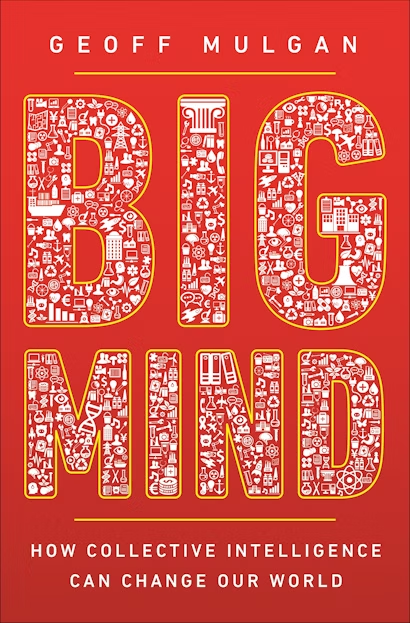
ii Big Mind: How Collective Intelligence Can Change Our World

'Everything we know is knowledge from the past, which may not apply in the future - the problem repeatedly stumbled on by models, algorithms, economic theories, and geopolitical dispositions, which made sense in one era, but then become dysfunctional in another. As social science has repeatedly discovered, the more you use a model, the less likely you are to question it. What starts as a pragmatic tool to answer a question becomes a truth in itself.

And so the models we use to think can also become traps. A model is held on to because it provides meaning and reassurance. Police forces notoriously cling to evidence they collect early in a case in the face of powerful contrary evidence that emerges later, and thus extraordinary miscarriages of justice result. The middle-aged cling to the theories they learned as undergraduates. Organizations become attached to models that become comfortable through use. I remember once meeting the planning team of a government that admitted that their forecasts had been no better than random guesses, but argued that the detailed forecasts were still needed to help with planning. The model became a comfort, even though it had no real use. 

Familiarity also breeds blindness. ...

Expertise can equally entrap. ...
 
The implication, as the Buddha pointed out, is that intelligence has to be at war with and suspicious of itself to be truly intelligent.' pp.120-121.

FIVE FUNDAMENTAL PRINCIPLES FOR EFFECTIVE COLLECTIVE INTELLIGENCE

'The first is the extent of what I call (1) autonomous commons of the intelligence in the system. By this I mean how much the elements of intelligence are allowed free rein, and not subordinated too easily to ego, hierachy, assumption, or ownership.' p.66. Chap. 5. Organizing Principles.
2. Balanced use of the capabilities of intelligence
3. Focus and the right granularity
4. Reflexivity and learning
5. Integration for action
 
'So a group is a we, but it is not just a scaling up of an I. How, then, should we think about the character of this we?' p.102. Chap. 9. The Collective.
 
Individual
|
      INTERPERSONAL    :     SCIENCES               
HUMANISTIC  --------------------------------------  MECHANISTIC      
 SOCIOLOGY  :    POLITICAL 
|
Group
 
EGO
 

 HIERARCHY


ASSUMPTION
 

OWNERSHIP


n.b. With my emphasis.

 
Geoff Mulgan (2017) Big Mind: How Collective Intelligence Can Change Our World, Princeton University Press.

Image: Princeton University Press.

See also: 'AI' : 'group' : 'axes' : 'individual'

 Previously:
Big Mind: How Collective Intelligence Can Change Our World


Sunday, November 30, 2025

Interesting ... 'Incidence structure(s)'

Unsurprising, in studying 'Hodges' model, I've been aware of Wilfrid Hodges and model theory for many years.


Now, trying to look at (Brian) Hodges' model using maths, I've wondered about possible connections with Wilfred Hodges' work.

Dr W. Hodges was listed in searches on lines, axes, and structure:
'Algebraists and geometers like to classify structures by the laws which they obey. A typical law for incidence structures reads:

"For any two different lines L and M, there is exactly one point which lies on both L and M."'
My imagination may be getting the better of me, but there seems something profound in the intersection of the model's two axes and the care - knowledge domains that are created (proposed - adopted..)?

So, is Hodges' model a form of 'incidence structure', or does it contain several incidence structures? 

Hodges, W. (1985). Truth in a Structure. Proceedings of the Aristotelian Society, 86, 135–151. http://www.jstor.org/stable/4545041

Monday, October 27, 2025

Health, planet, self: after - 'Can molecular Lego save the planet?'

Ack: © Johan Jarnestad /
The Royal Swedish Academy of Sciences

'This morning’s Nobel Prize in Chemistry is one that’s been anticipated for several years now: it goes to Susumu Kitagawa of Kyoto, Richard Robson of Melbourne, and Omar Yaghi of Berkeley for metal-organic frameworks.'
'So what’s a MOF? This goes back to the idea of “coordination chemistry”, a huge topic in the inorganic and metal-organic fields.'


The 2025 Nobel Prize in Chemistry: Metal-Organic Frameworks 


Can conceptual Lego - 'human-metal organic frameworks' -
save healthcare, planetary and self-care?

'One astonishing characteristic is the amount of surface area locked away in these new materials: a MOF weighing one gramme can have an internal surface area the size of a football pitch^. MOFs are often likened to Hermione Granger's bottomless handbag in the Harry Potter books: a tiny exterior concealing a seemingly infinite interior. Rice University chemist Stavroula Alina Kampouri has called MOFs "magical sponges", describing them as "not just elegant crystals you'd admire under a microscope; they're an entire universe of structures, each like a miniature city of tunnels and rooms waiting to be filled."'
Anjana Ahuja, Can molecular Lego save the planet?, Opinion Science. Financial Times, 15 October 2025, p.22.

individual
|
INTERPERSONAL : SCIENCES
humanistic -------------------------------------------  mechanistic
SOCIOLOGY : POLITICAL
|
group-population


'This is not an ivory-tower sort of topic, though: the importance of these sorts of complexes cannot be overstated. They were the basis for the first Nobel awarded in inorganic chemistry (1913, Alfred Werner) and metal coordination is how the iron atoms in hemoglobin carry oxygen to the cells of your body to keep you alive, for starters. You can say the same thing about photosynthesis in plants, and about the actions of the many crucial enzymes in every living creature on the planet that have metal-ion centers in them. Outside of biology and biochemistry, the structures of minerals similarly cannot be understood without a knowledge of coordination chemistry.'


The 2025 Nobel Prize in Chemistry: Metal-Organic Frameworks

Popular information. NobelPrize.org. Nobel Prize Outreach 2025. Mon. 27 Oct 2025. <https://www.nobelprize.org/prizes/chemistry/2025/popular-information/>

^Is this a question for BBC Radio 4 More or Less?

Of course, I keep posting about the Nobel Prize in the hope of a prize - due recognition for Hodges' model. Discretely of course, given a limited readership. 
Go figure: in 3D naturally.

Friday, August 15, 2025

Big Mind: How Collective Intelligence Can Change Our World


It was COVID-19 that brought home to me the true significance of the 'collective' in the synonyms for group, population, polis, citizenry et al.. An integral part of Hodges' model, an individual, a person is clearly not an island.

Speech, gesture, behaviors, drawing, writing and other media all  provide a way of recording and representing information, and knowledge. Digital technologies are the latest tools to extend our memories, and ability to analyse, synthesise and abstract from and to our experiences.

How we see the individual and collective (society) is a subject of much debate across many disciplinary fields, spanning the sciences and humanities; economics, healthcare, sociology, ethics, and philosophy. Mulgan considers as infrastructure, the measures that have emerged to support collective intelligence:


'They have evolved from physical objects (such as steel production) through aggregate concepts (like GDP and GNP) to intangibles (such as innovation indexes or measures of the value of creative industries). They have evolved from single measures of things like population to indexes (like the UN Human Development Index), and from activities to outputs and then outcomes (such as QALYs - quality adjustied life years - and DALYs - disability adjusted life years in relation to health). In all these ways, both states and societies watch themselves and recognize well-calibrated observation as the precondition for thought.' (p.52)
Using Hodges' model the focus is primarily upon individuals and teams application. Mulgan's chapter 12 (pp.145-160) on 'Problem Solving' is subtitled 'How Cities and Governments Think'. An excellent question, that was asked of me in February. How can a national government be informed of Hodges' model and its potential utility? Cities have repeatedly had to solve problems created by changes in transport, work, housing, population density, the movement of people, goods, materials, and links to rural and agricultural centers. The logistics of access to routes, ports, airports, and where to place industries efficiently (and safely)? 'City planning' is a key example of our cities thinking?

Perhaps, we need to think of mobility in a cognitive sense, and not just AI-mediated. So as we walk, run, seek access - we should take care we don't get stuck!

Individual
|
      INTERPERSONAL    :     SCIENCES               
HUMANISTIC  --------------------------------------  MECHANISTIC      
 SOCIOLOGY  :    POLITICAL 
|
Group
subjectivity

models we use can be a trap (p.120)

emotional intelligence
quality
objectivity

SYSTEMS energy, food, transport..

physical media & 'memory'
quantity

'Society Thinking as a System?' Chap. 16.

Group - Collective

collective intelligence

Patient Reported Outcome Measures (PROMs)?

See also: 'literacy' : 'prevention' : 'service' : 'severe' : 'change'

Geoff Mulgan (2017) Big Mind: How Collective Intelligence Can Change Our World, Princeton University Press.

Image: Princeton University Press.

Saturday, June 28, 2025

Jayasinghe (2025) 'People‑centred care: a systems view of a new paradigm'

C/o HIFA

Dear friends,

It is my pleasure to share the link to my article "People-centred care: a systems view of a new paradigm". It is published online in Discover Health Systems and Open Access. Please see full-text access to your paper by using the following link:

https://rdcu.be/ejNUq

Kind regards Saroj
ABSTRACT People-Centred Care (PCC) is an emergent property in an “open” system. Policies aiming at promoting PCC can be categorized under four nested levels: Micro-level; Meso-level; Macro-level; and Mega-level and used to draw systems diagrams. We develop a single composite diagram which demonstrates interactions and feedback, within and across subsystems, resembling panarchy.
Jayasinghe, S. People-centred care: a systems view of a new paradigm. Discov Health Systems 4, 43 (2025). https://doi.org/10.1007/s44250-025-00215-9.

Saroj Jayasinghe MBBS (Col), MD (Col), MRCP (UK), MD (Bristol), PhD (Col), FRCP (Lond), FCCP, FNASSL Fellow of the International Science Council, Emeritus Professor, University of Colombo, Former Head, Department of Medical Humanities, University of Colombo, Sri Lanka Consultant Physician sarojoffice AT yahoo.com, saroj AT clinmed.cmb.ac.lk

Professor Jayasinghe's paper provides several informative figures on centredness, scale and levels, micro-mega; and affords a way to use Hodges' model to help define person, patient, people and service-centred care. These definitions could be developed, refined and validated using a relational formulation.


Individual
|
      INTERPERSONAL    :     SCIENCES               
HUMANISTIC  --------------------------------------  MECHANISTIC      
 SOCIOLOGY  :    POLITICAL 
|
Group

PERSON- 
PATIENT-CENTRED


psycho-

PERSON-
PATIENT-CENTRED

location

bio-
social

PEOPLE-CENTRED

'Health systems and services designed ‘for and with people’ are captured by the concept of People-Centred Care (PCC) defined as an approach “to care that consciously adopts individuals’, carers’, families’, and communities’ perspectives as participants in, and beneficiaries of, trusted health systems that are organised around the comprehensive needs of people rather than individual disease, and respects social preferences.' Duong, et al. (2024).

political


policy - engagement - design

SERVICE-CENTRED

panarchy

'Let us together forge a new way of knowing and practicing health care in the post-Sustainable Development Goal era, using people-centred care as our guide to achieve Universal Health Coverage.' Duong, et al. (2024).


Duong DB, Holt B, Munoz C, Pollack TM. For and with people: announcing the Lancet Global Health Commission on people-centred carefor universal health coverage and a call for commissioner nominations. Lancet Glob Health. 2024:S2214-109X(24)00216-X.
https://doi.org/10.1016/S2214-109X(24)00216-X.

Previously: 'design' : 'patient' : 'person' : 'system' : 'people'

Thursday, June 26, 2025

You say Hodges' model is a map. What's the scale?

"That's another thing we've learned from your Nation," said Mein Herr, "map-making. But we've carried it much further than you. What do you consider the largest map that would be really useful?"

"About six inches to the mile."

""Only six inches!"exclaimed Mein Herr. "We very soon got to six yards to the mile. Then we tried a hundred yards to the mile. And then came the grandest idea of all! We actually made a map of the country, on the scale of a mile to the mile!"

"Have you used it much?" I enquired.

"It has never been spread out, yet," said Mein Herr: "the farmers objected: they said it would cover the whole country, and shut out the sunlight! So we now use the country itself, as its own map, and I assure you it does nearly as well."
        Lewis Carroll - The Complete Illustrated Works. Gramercy Books, New York (1982). Page 727.


My source
Text: https://people.duke.edu/~ng46/topics/lewis-carroll.htm

Plus a letter in FTWeekend: by Prof. R.T. Harrison. 'Country as its own map served as well' https://www.ft.com/content/2ad8ea16-d27d-11e1-abe7-00144feabdc0 1 Sept. 2012.

Friday, January 24, 2025

ERCIM News No. 140 Special theme: "Large-Scale Data Analytics"

Dear ERCIM News reader,

ERCIM NEWS #140
The January 2025 issue of ERCIM News (Number 140) is online with a special theme on Large-Scale Data Analytics. This issue features a Special Theme that highlights the diverse applications of large-scale data analytics across Europe. The advancements are achieved through close collaboration with European data spaces and open science platforms.

You can access the issue at https://ercim-news.ercim.eu/

This special theme was coordinated by our guest editors Andras Benczur (HUN-REN SZTAKI) and Dominik Ślęzak (University of Warsaw).

===
Note PJ: Includes: 
Breaking the Silence: Brain-to-Speech Innovations. p.36
Data Visualisation for Big Data: Digital Epidemiology. p.39.

CWI Research Semester Programme. Truth is in the Eyes of the Machines Amsterdam, 8-9 May 2025.
https://kwz.me/hF1
===

Thank you for reading ERCIM News! Please share this issue with anyone who might find it interesting. You can also support us on LinkedIn. Let's keep the conversation going and share the latest updates together!

Next issue: No. 141, April 2025
Special Theme: "Cultural AI". Submissions are welcome! See preliminary call for contributions.


ERCIM News is published quarterly by ERCIM, the European Research Consortium for Informatics and Mathematics. With the printed and online edition, ERCIM News reaches more than 10000 readers.
All issues published to date are available online.


About ERCIM

ERCIM - the European Research Consortium for Informatics and Mathematics - aims to foster collaborative work within the European research community and to increase cooperation with European industry. Leading European research institutes are members of ERCIM. ERCIM is the European host of W3C.

https://x.com/ercim_news
ERCIM LinkedIn Group
ERCIM LinkedIn Page

Peter Kunz                      	
ERCIM Office
2004, Route des Lucioles
BP93
F-06902 Sophia Antipolis Cedex

Wednesday, June 12, 2024

Scaling-up Health Arts Programmes: Effectiveness Research (Sold Out!)

This event is located in London, it is sold-out and not online. Coming across the symposium on twitter and learning that the research has run its course prompted me to think about the life-cycle of projects, research (big and small); ever important, of course, in the dissemination of research results, outcomes and benefits.

More details are provided on the 'Sold Out' event link and in the image below:

https://www.eventbrite.co.uk/e/collaborating-to-scale-implement-established-arts-and-health-programmes-tickets-874119594237


Why bother to post this? We can't be all-knowing in terms of research / project calls. This means I've noticed how we often learn of initiatives and opportunities at their close. News of citations for Hodges' model arrive is invariably after-the-fact, the fact being the 'study' as a whole. So is the dissemination more haphazard than it needs to be? A silly question, but have all the research councils, academia in general looked at research 'alerts'. What about the Government? Especially in response to citizen science, patient engagement, public involvement? Is this an application begging for a digital solution? Perhaps there is one (several) out there already? In human resources there is employee on-boarding, orientation and there's off-boarding, or there's supposed to be the leaver's questionnaire and exit interview. Beyond the final research report what is the situation: marks out of 10?

This looks a great initiative, especially the participation, collaboration and creativity generated. Below I've related some relevant concepts within Hodges' model: embedded within the spiritual.

Individual
|
      INTERPERSONAL    :     SCIENCES               
HUMANISTIC  --------------------------------------  MECHANISTIC      
 SOCIOLOGY  :    POLITICAL 
|
Group

ipseity, identity

Health: parity of esteem - mind::body

my lived experience, efficacy

ideas, perspective, interpretation

body - movement, physio..

objects, media, physical reality

time, place, space

information sharing

art forms: fine, dance, drama, music ...

collective - collaborative creativity

shared motivation, public awareness

participant identification (biases?)


policy (national - regional, local)

research funding

physical accessibility - transport

funding distribution


My source:
https://x.com/TheNCCH/status/1798020326007472407

I also realise the access limitations presented here on a blog commenced in 2006.

Friday, May 03, 2024

Help us build the future - Medical Aid Films' Annual Survey 2024

On Tuesday, 30 April 2024 at 14:37:02 BST, Helen Coombe, UK <helen AT medicalaidfilms.org> wrote:

At Medical Aid Films, we are asking ourselves how we can respond to the scaling up of innovative digital information and communication technologies whilst continuing to place our primary audiences at the centre of our work – ‘ensuring people-centred systems that are enabled by digital health[i]’, one of the objectives of the WHO Digital Health Strategy 2020 – 2025. It is important to us that any digital strategy reflects the needs and aspirations of the healthcare professionals we serve. We invite any healthcare professional to complete our 2024 online annual survey to help inform forthcoming digital initiatives. Your insights will provide us with a comprehensive understanding of what matters most around training and health education and how we can best serve your needs. 

c/o Medical Aid Films 

The survey can be accessed here - now closed.

the deadline to respond is Monday 13th May. 

Thank you for helping support our work.


[i] WHO Global strategy on digital health 2020-2025, https://www.who.int/health-topics/digital-health#tab=tab_1


Helen Coombe, Head of Research, Monitoring, Evaluation and Learning. Medical Aid Films, c/o Zavros Mintikkis Associates Ltd, 1st Floor, 446a Green Lanes, London, N13 5XD

HIFA* profile: Helen Coombe is Head of Evaluation and Research at Medical Aid Films, UK.

helen AT medicalaidfilms.org

*My source.

Thursday, April 11, 2024

Peter Higgs - Boson and Field

"Higgs theorised that particles would acquire mass by interacting with a new type of field. That field had a very special excitation of its own, another particle called the Higgs boson. The Higgs field solved a huge question in theoretical particle physics, and the Higgs boson was a tantalising target that experimentalists could hunt for in order to tie theory to reality.


“If you remove everything from the vacuum, all matter or quantum fluctuations, all electromagnetic stuff, all gravity, you will be left with the Higgs field,” says Frank Close at the University of Oxford. “And we need that just like a goldfish needs water. It stabilises empty space.”

Working independently from Higgs, Belgian physicists Francois Englert and Robert Brout reached the same conclusion, also in 1964."
On BBC Radio 4 11th April 1500 UT, Frank Close extended the goldfish analogy: "as if some clever goldfish have proved that they are immersed in something because they have found a molecule of H2O."

BBC Inside Science

The following is from a previous post:

UK Higher Education Research Excellence Framework - Disciplines
https://hodges-model.blogspot.com/2023/07/ref-uk-higher-ed-h2cm.html


INDIVIDUAL
|
     INTERPERSONAL    :     SCIENCES               
HUMANISTIC --------------------------------------  MECHANISTIC      
SOCIOLOGY  :   POLITICAL 
|
GROUP

Psychology, Psychiatry and Neuroscience

Archaeology

Theology and Religious Studies

Philosophy

[Mathematics & Logic]

^Communication 
as Intra- Interpersonal (Skills) Neurodiversity
hence an individual's
sense-making

Clinical Medicine (Neuroscience)
Public Health, Health Services and Primary Care
Allied Health Professions, Dentistry, Nursing and Pharmacy
Biological sciences 
Agriculture, Food and Veterinary Sciences

Earth Systems and Environmental Sciences
Chemistry
Physics
Mathematical Sciences
Computer Science and Informatics
Engineering
Architecture, Built Environment and Planning
Geography and Environmental Studies
Archaeology
Area Studies
Sport and Exercise Sciences, 
Archaeology
Social Work and Social Policy
Sociology
Anthropology and Development Studies
area studies
Education
Modern Languages and Linguistics
English Language and Literature
History
Classics
Communication^, Cultural and Media Studies, Library and Information Management
Art and Design: History, Practice and Theory
Music, Drama, Dance, Performing Arts, Film and Screen Studies
Leisure and Tourism


Archaeology

Economics and Econometrics

Business and Management Studies

Law

area studies

Politics and International Studies

34 subject-based Units of Assessment (UOAs)


1st April 2030 From Person to Planet:

First Call for the First Transdisciplinary Health 
and Social Care Conference -
Everyone is Invited!


Open to all health and social care professions and disciplines:

https://en.wikipedia.org/wiki/List_of_healthcare_occupations

A celebration of the Hodges' field.😉

RIP Peter Higgs

Wednesday, February 21, 2024

Universal and Generic: Hodges' model and conceptual frameworks, or

What the papers say . . .

The purpose of many research papers is to produce a conceptual framework, perhaps as a step towards a greater goal and objective.

Whatever the context or purpose of the conceptual framework:

  • Theoretical Framework
  • Conceptual Model
  • Empirical Framework
  • Descriptive Framework
  • Analytical Framework
  • Conceptual Framework for Policy Analysis
  • Logical Frameworks
  • Conceptual Frameworks for Program Evaluation
  • Conceptual Frameworks for Organizational Analysis
  • Conceptual Frameworks for Strategic Planning*

Hodges' model can be applied. This past week I saw a way to illustrate the scope of Hodges' model, which I will revisit. As ever, this merely scratches an itch on #MentalHealthNursesDay.

With apologies to authors and publishers - original citations follow:

Divya Sussana Patil, Ajay Bailey, Sobin George, Martin Hyde & Lena Ashok (2023) Unpacking the role of (INSERT [focus1..x/protected characteristic]) among (INSERT [Population]) for accessing healthcare in (INSERT [City, Town, Village, 3-words; Country]). Global Public Health, 18:1, DOI: 10.1080/17441692.2023.2274438


Ahuvia, I.L., Mullarkey, M.C., Sung, J.Y., Fox, K.R. and Schleider, J.L. (2023), Evaluating a treatment selection approach for (INSERT [modality, delivery]) single-session interventions for (INSERT [Life-stage, Condition/Diagnosis]). J Child Psychol Psychiatr, 64: 1679-1688. https://doi.org/10.1111/jcpp.13822


Xu H, Bayless TM, Østbye T, Dupre ME. Care sequences leading to the diagnosis of (INSERT [Disease] and [related]): An analysis of (INSERT [format / owner]) records. Alzheimer's Dement. 2024; 1-10. https://doi.org/10.1002/alz.13669


Original citations:


Divya Sussana Patil, Ajay Bailey, Sobin George, Martin Hyde & Lena Ashok (2023) Unpacking the role of transport inequalities among older adults for accessing healthcare in Bengaluru, India, Global Public Health, 18:1, DOI: 10.1080/17441692.2023.2274438

My source: https://x.com/HydeM1976/status/1718975653175796085?s=20 (and prompt)

Ahuvia, I.L., Mullarkey, M.C., Sung, J.Y., Fox, K.R. and Schleider, J.L. (2023), Evaluating a treatment selection approach for online single-session interventions for adolescent depression. J Child Psychol Psychiatr, 64: 1679-1688. https://doi.org/10.1111/jcpp.13822

https://x.com/acamh/status/1759539440605606159?s=20

Xu H, Bayless TM, Østbye T, Dupre ME. Care sequences leading to the diagnosis of Alzheimer's disease and related dementias: An analysis of electronic health records. Alzheimer's Dement. 2024; 1-10. https://doi.org/10.1002/alz.13669

https://x.com/DukeGHI/status/1759978730192306179?s=20


*https://researchmethod.net/conceptual-framework/

Thursday, January 11, 2024

Identity - a combination of forms and (hence) experiences

Continuing to sort books, magazines ... I realised in the autumn that I'd need to return to issue #72 of The Philosopher's Magazine and its theme of  '50 New Ideas'. ...

INDIVIDUAL
  |
     INTERPERSONAL    :     SCIENCES               
HUMANISTIC --------------------------------------  MECHANISTIC      
SOCIOLOGY  :   POLITICAL 
|
GROUP

"Who are you? Who am I? Are we persons and if we are, are we the same persons we were yesterday? What does our being persons consist in? These are the sorts of questions philosophers try to answer on the nature of personal identity, the persistence question. The persistence question is often considered the question of personal identity: what are the conditions under which a person who exists at time t1 is identical to a person who exists at time t2?" p.51.

"A new wrinkle in this debate is owed to Lynne Rudder Baker: the not-so-simple view of personal identity. Baker identifies persons with 'the first-person-perspective'. The answer to the question 'who am I?' is that I am the perspective I have of myself, and my persistence conditions are first-personal." p.52. [Grain, K.]


"Microscopes have revealed an invisible world to us and whether from secondary school science or probiotic yoghurt adverts most of us are now familiar with the idea that our bodies host a plethora of variously beneficial bacteria. These tiny creatures, which live inside us, contribute to our lives; they help us digest food and bolster our physiological defences against harmful presences - other bacteria and viruses. These 'endo-symbionts' participate in our living activity, just as we contribute to theirs in providing them with nutrients and a stable environment. The philosophical question this raises - belied by the talk of 'our' bodies and 'our' insides - is: where exactly do our organic boundaries lie?" p.49. [Ferner, A.M.]

Social foundation / scaffold
Political foundation / scaffold


Ferner, A.M., Organic identity, pp.49-50 - and 

Grain, K., Personal identity, pp.51-52 -

In The Philosopher's Magazine, "50 New Ideas", 1st Quarter 2016. Issue 72.

There is a 'simple' take-away message (thought!) here. It is the way, through its structure that Hodges' model provides a means to reflect, critique, debate and relate the self with the collective: and situate them and other concepts.

See also:
Nov. 2023: Hodges' model - as 'a' philosophy c/o TPM

Wednesday, December 27, 2023

The conjunction of reality and simulation?


 "Models are approximations of reality, constructed by scientists to address specific questions of natural phenomena using the language of mathematics. Mathematical equations allow the practitioner to decide the level of abstraction needed to tackle a given problem, thus transcending the 'billiard ball' approach." p.198.


INDIVIDUAL
  |
     INTERPERSONAL    :     SCIENCES               
HUMANISTIC --------------------------------------  MECHANISTIC      
SOCIOLOGY  :   POLITICAL 
|
GROUP


"In practice, simulations are often limited by a dynamic range problem, meaning that one runs out of computing power to simulate behavior at all scales. The discretization of mathematical equations in order to program them into a computer introduces subtleties such as numerical dissipation - an artificial side effect of differential equation calculations that does not arise from physics. It is also likely that one needs different numerical methods to simulate behavior on different scales, and a single method may be insufficient for all spatial scales. Perhaps the advent of AI will allow us to overcome some of these limitations, but for now emulations remain an aspiration." p.199.
 " 

"Generally, examining the microscopic components of a complex system in order to understand how macroscopic behaviour emerges falls short - think biology and economics. Implicitly, this brute-force approach suggests that one may study complex systems without having a scientific question in mind, and if enough computing power is deployed then insight naturally emerges. The billion-euro Human Brain Project is a spectacular example of the limitations of such an approach. Essentially, their  simulations have failed to replace laboratory experiments.
As has been noted by climate scientist Isaac Held, there is a tension between simulation and understanding.  We simulate in order to mimic as much of an observed phenomenon as possible. But we achieve understanding by using idealized models to capture the essence of the phenomenon. By design, idealized models necessarily employ assumptions." p.198.


Heng, K., Approximating Reality, American Scientist - Special Issue: Scientific Modelling, July-August 2023. 111:4,198-199.

Saturday, December 16, 2023

Vera Spencer - Artist versus Machine c.1954


Tate Etc.
"The paper card used to create this collage by the artist Vera Spencer may look unassuming, but the idea behind them is monumental. Around 1800, the French merchant and weaver Joseph Marie Jacquard first developed the automated loom, a machine which used perforated cards to store advanced weaving patterns. These perforations - a series of holes or not-holes - created the world's first large-scale system of binary data storage. Jacquard's loom went on to inspire British mathematician Charles Babbage to design the Analytical Engine, the first punch-card calculator and a precursor to the modern computer - the potential of which was grasped by the mathematician Ada Lovelace, regarded as the first computer programmer. . . . 

By modifying punched cards, Vera Spencer started up a material fight with the very tissue of automation. The same automation that today, with the invention of self-learning image and text-creating algorithms like Dall-E and ChatGPT, has reached the practices of artists and writers, challenging our very concept of creativity and ultimately threatening their work." p.99.


 Individual
  |
     INTERPERSONAL    :     SCIENCES               
HUMANISTIC --------------------------------------  MECHANISTIC      
SOCIOLOGY  :   POLITICAL 
|
GROUP
creativity

automation
material
size-scale:
loom <> punched card computer 
tissue

Vera Spencer Artist versus Machine c.1954


Smith, A., on Vera Spencer Artist versus Machine c.1954, Summer 2023, Tate Etc., Issue 58, p.99.

Previous posts on W2tQ:
Ada Lovelace