Hodges' Model: Welcome to the QUAD: collective intelligence

Hodges' model is a conceptual framework to support reflection and critical thinking. Situated, the model can help integrate all disciplines (academic and professional). Amid news items, are posts that illustrate the scope and application of the model. A bibliography and A4 template are provided in the sidebar. Welcome to the QUAD ...

Showing posts with label collective intelligence. Show all posts

Monday, December 15, 2025

Q. Is Hodges' model Person OR University-centered? [ 'Big Mind' iii? ]

To date, I have not written a paper on Brian Hodges' original purpose for his model in curriculum development, design, planning and evaluation. Geoff Mulgan's book and referenced sources provide support, if not evidence, for the increasing relevance of Hodges' model.

The center of Hodges' model, the nexus, can be variously occupied by an individual student, researcher; a group, or team, or even an institution. Why not a university?

Since 1987-88, when I applied Hodges' model in a case study, I've acquired a broad understanding of the 'POLITICAL' domain in terms of institutions and organisations. Even if that learning is now 'archived':

https://web.archive.org/web/20150414073721/http://www.p-jones.demon.co.uk/linksIV.htm

In 'Big Mind', Chapter 14, The University as Collective Intelligence (pp.174-180) refers to 'third-loop learning' and a document from Nesta:

Geoff Mulgan, Oscar Townsley, and Adam Price, "The Challenge-Driven University: How Real-Life Problems Can Fuel Learning", Nesta, accessed April 28, 2017.
accessed 15/12/2025: https://media.nesta.org.uk/documents/the_challenge-driven_university.pdf 

'This paper focuses on one important strand of change: the rise of what we call ‘challenge-driven’ university models. These models develop students by putting them up against difficult problems and challenges for which there are no established answers.  Instead students to draw on many disciplines to solve them; they have to work in teams; and they have to collaborate with organisations outside higher education.

These models aren’t a replacement for the classic core of university education - mastering a discipline.   But they provide an important complement to this core, and they may be better suited to preparing young people for the needs of the world. They also re-emphasise one of the founding principles of some ancient universities: a focus on questions rather than answers as the key to deep learning.'

Within the Nesta document, Mulgan et al. list educational institutions who have succeeded, and are trying to effect change (with much editing):

US

The approach was pioneered by McMaster University Medical School in the late 1960s where in response to changing demands on the profession, the curriculum was changed so that students learned collaboratively, working on real-life cases in small groups. ...

... examples like High Tech High in the US, use project-based learning, centred on real-life problems, as the core curriculum for students.

Olin College of Engineering has quickly gained a reputation for being one of the most innovative institutions in the US since it opened in 1997.

Last year, the Ash Center for Democratic Governance and Innovation at the Harvard Kennedy school founded the ‘Urban Innovation Field Lab’, a project aiming to improve social conditions in cities in Massachusetts.

Canada

In Canada, the University of Waterloo uses a model of co-operative education, where students’ time is split between study and assessed work experience.

Europe 

Aalto University in Finland was created out of a merger between Technology, Economics and Art Universities in Helsinki and now runs four interdisciplinary ‘factories’ - Design, Health, Media and Service, where teams of academics and students work with companies and communities to develop new products that respond to demand from the real economy. 

The Norwegian University of Science and Technology in Trondheim has a similar approach. As part of their courses, students are required to join a ‘village’ (i.e. area of interest) of around 30 members which address questions such as ‘Biofuels - a solution or a problem?’, ‘Sustainable, affordable housing for all’, and ‘Portable technology and well-being’.

At Maastricht University (the second youngest university in the Netherlands), all teaching uses a problem-based learning model, and this has become one of the main attractions of the university. 

Twelve to fifteen students discuss problems in group sessions, with one student appointed to lead the discussion. The students are given complex problems from everyday professional practice which they brainstorm and research both together and separately. ...

UK 

Imperial College London and the Royal College of Art (RCA) are two particularly innovative higher education institutions. For the last ten years, Imperial has been running the Energy Futures Lab - a cross-discipline, issue-based department aimed at tackling global energy challenges. It was established to bring together disparate fields of study that are relevant to energy including engineering, environmental sciences, computer science, business, policy and mathematics. ...

Imperial and the Royal College of Art also run a Double Masters in Innovation Design Engineering (IDE) which is well known for producing some of the best talent in the field. Their flagship international module ‘GoGlobal’ takes students abroad for three week cross cultural, collaborative projects with academics and industry partners. ... The University of Lincoln has challenge-driven education at the core of its teaching.

Globally? South?

... 

Over the years I've reached out to a great many private and public bodies. 

MEMO TO: New College of Humanities and London Interdisciplinary School

I note the NESTA document is a 'draft'. I'd be pleased to help update and complete this work. Keen to frame Hodges' model not just in the context of problems, but strengths, weaknesses, risks, opportunities and more. When your model emerges from health, you quickly learn when it comes to problems that versatility and adaptability are essential. Always ready to cross disciplines - insofar as I understand them, borders and boundaries as required.

Previously:

https://hodges-model.blogspot.com/2025/07/big-mind.html

https://hodges-model.blogspot.com/2025/12/ii-big-mind-book.html

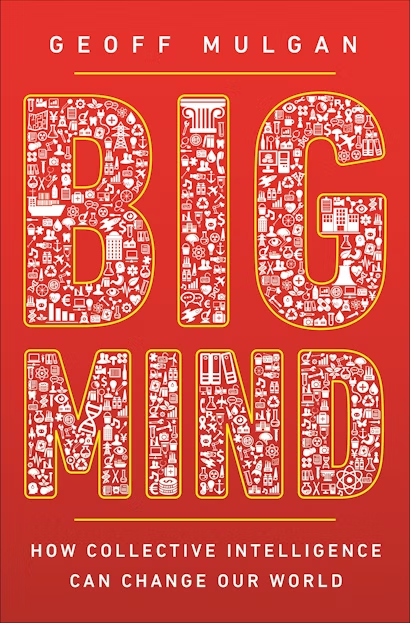
Geoff Mulgan (2017) Big Mind: How Collective Intelligence Can Change Our World, Princeton University Press.
Sunday, December 14, 2025

ii Big Mind: How Collective Intelligence Can Change Our World

'Everything we know is knowledge from the past, which may not apply in the future - the problem repeatedly stumbled on by models, algorithms, economic theories, and geopolitical dispositions, which made sense in one era, but then become dysfunctional in another. As social science has repeatedly discovered, the more you use a model, the less likely you are to question it. What starts as a pragmatic tool to answer a question becomes a truth in itself.

And so the models we use to think can also become traps. A model is held on to because it provides meaning and reassurance. Police forces notoriously cling to evidence they collect early in a case in the face of powerful contrary evidence that emerges later, and thus extraordinary miscarriages of justice result. The middle-aged cling to the theories they learned as undergraduates. Organizations become attached to models that become comfortable through use. I remember once meeting the planning team of a government that admitted that their forecasts had been no better than random guesses, but argued that the detailed forecasts were still needed to help with planning. The model became a comfort, even though it had no real use. 

Familiarity also breeds blindness. ...

Expertise can equally entrap. ...
 
The implication, as the Buddha pointed out, is that intelligence has to be at war with and suspicious of itself to be truly intelligent.' pp.120-121.

FIVE FUNDAMENTAL PRINCIPLES FOR EFFECTIVE COLLECTIVE INTELLIGENCE

'The first is the extent of what I call (1) autonomous commons of the intelligence in the system. By this I mean how much the elements of intelligence are allowed free rein, and not subordinated too easily to ego, hierachy, assumption, or ownership.' p.66. Chap. 5. Organizing Principles.
2. Balanced use of the capabilities of intelligence
3. Focus and the right granularity
4. Reflexivity and learning
5. Integration for action
 
'So a group is a we, but it is not just a scaling up of an I. How, then, should we think about the character of this we?' p.102. Chap. 9. The Collective.
 
Individual
|
      INTERPERSONAL    :     SCIENCES               
HUMANISTIC  --------------------------------------  MECHANISTIC      
 SOCIOLOGY  :    POLITICAL 
|
Group
 
EGO
 

 HIERARCHY


ASSUMPTION
 

OWNERSHIP


n.b. With my emphasis.

 
Geoff Mulgan (2017) Big Mind: How Collective Intelligence Can Change Our World, Princeton University Press.

Image: Princeton University Press.

See also: 'AI' : 'group' : 'axes' : 'individual'

 Previously:
Big Mind: How Collective Intelligence Can Change Our World


Saturday, May 08, 2021

[c/o HIFA] Lancet Planetary Health: An argument for the naturalistic study of collective intelligence

Citation, extracts and a comment from me below. Full text here: https://www.thelancet.com/journals/lanplh/article/PIIS2542-5196(21)00077-2/

CITATION: An argument for the naturalistic study of collective intelligence Jonathan Nattel, David Akullian
Comment| volume 5, issue 5, e247-e248, may 01, 2021
Published:May, 2021 DOI:https://doi.org/10.1016/S2542-5196(21)00077-2 

SELECTED EXTRACTS 

Over the past decade, corporate-owned digital media—minimally regulated, geared towards profit, and willing to engage a broad range of psychological techniques to command an expansive swath of human attention5—have increasingly caused information to flow around, rather than through, the structures of professional journalism as it makes its way from politicians to the public at large.

The circumvention of professional journalism as a means for filtering, organising, and distributing information has led to multiple distortions of collective perception, including the decontextualisation of information, propagation of false information, and the manipulation of public opinion by agents with a broad variety of interests. 

 the overall result has been an increase in polarisation, fragmented collective perceptions of reality, and the ensuing failures of collective discourse and decision making. All in all, ideal conditions for the emergence of populist, fascist, or dictatorial leadership. 

A study of how information is channelled within a society to support collective wellbeing and decision making might allow us to ask crucial questions, such as when a new technology for communication arrives, in what way is it healthy? In what way is it unhealthy? And in what ways must it be contained?... Given the critical juncture at which humanity currently finds itself, the timing of such a project could hardly be more crucial.

 --

Comment (NPW): 'The circumvention of professional journalism... has led to multiple distortions'. The same could be said for the circumvention of processes required for reliable and actionalble healthcare information to be made available to end users (whether the public, health workers, or policymakers). 

Neil Pakenham-Walsh, 

HIFA Coordinator, neil AT hifa.org www.hifa.org

HIFA: Healthcare Information For All: www.hifa.org 

I  have related concepts from this short work to Hodges' model, followed by a reference that reflects the naturalistic scale of the study suggested here:

individual
|

INTERPERSONAL : SCIENCES
humanistic ----------------------------------------------- mechanistic
SOCIOLOGY : POLITICAL
|
group

[ Multi- ] Context - Situated [ model ]

HEALTH WORKERS

individual perception & intelligence
- literacy

Individual values

Individual sense making

WELL-BEING of NATURAL WORLD

HEALTH WORKERS

Physical PROCESSES: Time

[Is there an 'Over-arching theory of health communication'?]

Channels of information - tech / forms

WELL-BEING of SOCIETY

Intergenerational coherence (*amid change*)

PUBLIC

Social processes: Diffusion, Sharing

SOCIO-tech?

societies: channels of information?

collective perception & intelligence
(wisdom of crowds?)

Channels of information - control

Journalism

Populist, fascist, or dictatorial leadership

POLICYMAKERS

Digital & other divides?

Political processes

Electoral Politics
 
 
Jones, P. (1996) An overarching theory of health communication? Health Informatics Journal,2,1,28-34.

Monday, January 20, 2020

Collective Intelligence in Hodges' model: c/o Röling (2009)

individual
|
INTERPERSONAL : SCIENCES
humanistic ----------------------------------------------- mechanistic
SOCIOLOGY : POLITICAL
|
group - population
Intelligence Quotient

Emotional Intelligence
Spiritual Intelligence
...

Individual beliefs
Individual motivation


"Can individuals really be rational and modify behaviours accordingly?"

Ozone layer
Troposphere
Biosphere

 HUMANS are a FORCE of NATURE

Deepest Ocean bed

"Anthropogenics would also be a praxiology - a science that informs decisions and action." p.40.
 

The 'Enlightment' tradition:
Science, Knowledge, Human ideals distilled in history and future history.

"Can we adapt tools forged to create wealth and use them for sustainable development?
Is ever-increasing wealth the only viable measure of progress?"

"A close understanding of how institutions determine individual behaviour might even curb the enthusiasm for "methodological individualism", the tendency to explain collective things such as the marketplace as a necessary outcome of individual choices." p.41.


[Context: How can agriculture feed the world ..? ]
"One of the things this exercise brought home to me was how poorly we understand humans as agents of planetary change, how little of what we do know is widely shared, and that this knowledge is scattered across disciplines that appear distant to governance. I began to ask if we needed a new discipline, one that could beyond the work of thousands of ecologists, climatologists, economists, anthropologists, psychologists, political scientists, neuroscientists and the like. I decided to appropriate the name "anthropogenics" for my dream discipline. p.40.

My source:
Röling, N. (2009) Profile. A proper study of mankind, New Scientist, 17 January, 201, 2691. pp.40-41.
