Hodges' Model: Welcome to the QUAD: Search results for individual

Hodges' model is a conceptual framework to support reflection and critical thinking. Situated, the model can help integrate all disciplines (academic and professional). Amid news items, are posts that illustrate the scope and application of the model. A bibliography and A4 template are provided in the sidebar. Welcome to the QUAD ...

Showing posts sorted by relevance for query individual. Sort by date Show all posts

Sunday, July 29, 2018

Relatedness and Similarity - in The Health Career Model

How can we demonstrate the basis for the axes, 'found' conceptual structures and conceptual clustering in Hodges' model?

UMLS::Similarity Web Interface (measuring pairwise similarity and relatedness of medical concepts)

Some results and definitions obtained from the above.

Results:

The similarity of person (C0027361 ) and patient (C0030705 ) using Lin (lin) is 0.85.
Using:    SAB :: include MSH
    REL :: include PAR/CHD

The similarity of person (C0027361 ) and patient (C0030705 ) using Conceptual Distance (cdist) is 0.5.
Using:    SAB :: include MSH
    REL :: include PAR/CHD

The similarity of person (C0027361 ) and patient (C0030705 ) using Resnik (res) is 1.6384.
Using:    SAB :: include MSH
    REL :: include PAR/CHD

The similarity of person (C0027361 ) and patient (C0030705 ) using Jiang & Conrath (jcn) is 1.7295.
Using:    SAB :: include MSH
    REL :: include PAR/CHD

The similarity of person (C0027361 ) and patient (C0030705 ) using Path Length (path) is 0.5.
Using:    SAB :: include MSH
    REL :: include PAR/CHD

The similarity of person (C0027361 ) and patient (C0030705 ) using Wu & Palmer (wup) is 0.8.
Using:    SAB :: include MSH
    REL :: include PAR/CHD

The similarity of person (C0027361 ) and patient (C0030705 ) using Nguyen & Al-Mubaid (nam) is 0.2038.
Using:    SAB :: include MSH
    REL :: include PAR/CHD

The similarity of person (C0027361 ) and patient (C0030705 ) using Random Measure (random) is 0.5703.
Using:    SAB :: include MSH
    REL :: include PAR/CHD

The similarity of person (C0027361 ) and patient (C0030705 ) using Leacock & Chodorow (lch) is 2.9957.
Using:    SAB :: include MSH
    REL :: include PAR/CHD

--
The relatedness of individual (C0027361 ) and group (C1257890 ) using Vector Measure (vector) is 0.7869.
Using:    SABDEF :: include UMLS_ALL
    RELDEF :: include CUI/PAR/CHD/RB/RN

The relatedness of individual (C0027361 ) and group (C1257890 ) using Adapted Lesk (lesk) is 9584.
Using:    SABDEF :: include UMLS_ALL
    RELDEF :: include CUI/PAR/CHD/RB/RN

--
The relatedness of self (C0036588 ) and group (C1257890 ) using Adapted Lesk (lesk) is 263.
Using:    SABDEF :: include UMLS_ALL
    RELDEF :: include CUI/PAR/CHD/RB/RN

The relatedness of self (C0036588 ) and group (C1561557 ) using Vector Measure (vector) is 0.4054.
Using:    SABDEF :: include UMLS_ALL
    RELDEF :: include CUI/PAR/CHD/RB/RN

Definitions:

individual (C0027361)
HL7V3.0 : A living subject of the species homo sapiens.
NCI : Human beings in general.
NCI : A human being.
NCI_BRIDG : A human being.
MSH : Persons as individuals (e.g., ABORTION APPLICANTS) or as members of a group (e.g., HISPANIC AMERICANS). It is not used for members of the various professions (e.g., PHYSICIANS) or occupations (e.g., LIBRARIANS) for which OCCUPATIONAL GROUPS is available.
individual (C0237401)
individual (C3245468)
HL7V3.0 : Description:Person as specified by coverage policy or program.
HL7V3.0 : Description:The level of coverage under the policy or program is available to an individual.
HL7V3.0 : Description: A role played by a party covered under a policy as the policy holder. An individual may be either a person or an organization.
Note: The party playing the role of an individual insured is not a claimant in the sense conveyed by the RoleClassCoveredParty CLAIM (claimant). However, a named insured may make a claim under a policy, e.g., a party that is the named insured and policy holder under a comprehensive automobile insurance policy may become the claimant for coverage under that policy if injured in an automobile accident and there is no liable third party. In the case of an individual insured making a claim, a role type code INSCLM (insured claimant) subtypes the class to indicate that an individual insured has filed a claim for a loss.
Example: The individual insured under a comprehensive automobile, disability, or property and casualty policy that is the policy holder.
HL7V3.0 :
self (C0036588)
HL7V3.0 : The "same" roleclass asserts an identity between playing and scoping entities: that they are in fact instances of the same entity and, in the case of discrepancies (e.g different DOB, gender), that one or both are in error.
Usage:
playing and scoping entities must have same classcode, but need not have identical attributes or values.
Example:
a provider registry maintains sets of conflicting demographic data for what is reported to be the same individual.
NCI : The individual as the object of his own reflective consciousness.
HL7V3.0 : The relationship that a person has with his or her self.
self (C1551994)
HL7V3.0 : Covered party is the policy holder. Also known as the subscriber.

See also:

WordNet::Similarity

This is a Perl module that implements a variety of semantic similarity and relatedness measures based on information found in the lexical database WordNet. In particular, it supports the measures of Resnik, Lin, Jiang-Conrath, Leacock-Chodorow, Hirst-St.Onge, Wu-Palmer, Banerjee-Pedersen, and Patwardhan-Pedersen. 

n.b. While Hodges' model was created for application in health and social care contexts it can be applied generally.

Wednesday, November 20, 2024

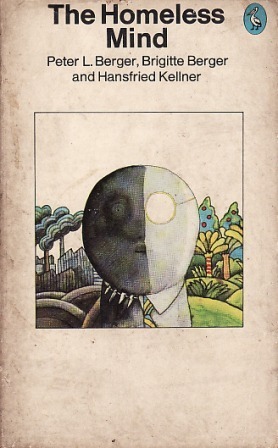
Hello? Is anyone there? 'The Homeless Mind'

individuality
|
INTERPERSONAL : SCIENCES              
humanistic ------------------------------- mechanistic
SOCIOLOGY : POLITICAL   
|
group

'Put differently, the componentiality of the cognitive style pertaining to technological production extends to identity. Again, a specific kind of double consciousness develops. In this case the dichotomy is between concrete identity and anonymous identity. The individual now becomes capable of experiencing himself in a double way: as a unique individual rich in concrete qualities and as an anonymous functionary. This dichotomization in the subjective experience of identity makes it possible for the individual to establish subjective distance vis-à-vis certain features of this identity.9 

For example, the individual will now experience that portion of his identity that contains his anonymization as a 'worker' as being 'less real' than his identity as a private person or family man. Since each portion of identity relates to specific roles, it now becomes possible for the individual to perform some of these roles 'tongue in cheek'. The componentiality of identity, as the componentiality of social relations, makes possible an 'engineering' practice. This time what is involved is the 'engineering' of one's own self. Those aspects of identity that a defined as 'more real' must be protected against threats coming from the 'less real' components of identity.' p.37-38.


Helpful reference to ideas of multi-relational synchronization and institutional vectors and how our mind's became homeless.

Also encouraging, even though 'historic', discussion on life plans and life planning.

'A basic presupposition is that life careers are not firmly fixed but are at least relatively open. Put simply the individual is faced with a number of alternative careers, especially in his " younger years, and therefore must make decisions about these available options. It is possible for the individual to imagine, himself as having different biographies. This possibility has both positive and negative consequences for the emotional economy of the individual. Positively, it may give him a feeling of frees dom to shape at least certain parts of his life. Negatively, it increases the likelihood of frustration regarding specific careers One is, after all, less likely to resign oneself to a particular situation if one believes that other situations are, in principle, possible.' p.67.
'Implicit in this scale of probabilities is a general 'sociology', on whatever level of theoretical sophistication. The individual has a `map of society' within which he can locate and project himself in terms of both past biographical recollection and future projects. The individual's life is perceived as a trajectory across this 'map'. There is also a large body of factual knowledge, most of which is 'weighted' in terms of the individual's life plans. Thus if a particular career appears to the individual as a realistically plausible project, he will have more factual knowledge about it than about a career in which he can participate only in pragmatically irrelevant fantasy. In other words, a good deal of background knowledge is related to 'anticipatory socialization'. p.68.
'However vaguely this may be defined, there is the underlying concept of life plan, both for the individuals and for the a family unit. This life plan is the totalization of all the relevant timetables, their grand sum and their integrative meaning In modern society, such life planning has become a value in itself. Its absence is commonly an occasion for reproach. The family unit thus operates as a life-planning workshop.' p.69.

'There is a general expectation of justice. It is expected that everyone in the relevant category - as, for example, those en-titled by law to a passport - will receive equal treatment. It is, of course, understood that certain persons may be excluded from this relevant category - for example, resident aliens or convicted criminals. It is also understood that the bureaucratic procedures may codify certain preferences, for example, in favour of diplomats or other people travelling on urgent government business. Once the categorial system has been established, however, the presumption of equality holds within each category. In the most general way, bureaucracy is expected to conform to the Roman principle suum cuique. An implication of this is that there will be no favouritism or any other intrusion of personal bias in the bureaucrat's handling of each client's case. The bureaucrat is expected to handle every case sine ira et studio. In other words, there is the general expectation that bureaucracy will operate impersonally and with 'affective neutrality'.2 These considerations bring us to an important point: unlike anything discussed in the preceding chapter, the cognitive style of bureaucracy contains a moral quality, not just as a limiting factor (after all, there are also moral assumptions about technological production - for example, that no one will be killed in the course of it), but as an intrinsic part of its own structure of consciousness. The source for this moral element is probably to be sought in the primary social location of bureaucracy in the political sphere.' pp.52-53.


Berger, P. L., Berger, B., & Kellner, H. (1973). The homeless mind: Modernization and consciousness. Penguin. 

Cover image: https://www.goodreads.com/book/show/3368465-the-homeless-mind

9 This is an amplification, by way of phenomenological description, of what Erving Goffman has called 'role distance'.

2 This term was coined by Talcott Parsons.

See also: 'homeless'

Wednesday, January 06, 2016

Dualistic- thinking checks and balances [II]

Continuing from Thinking checks and balances [I] how can Hodges' model help us understand and provide ready access to three forms of thought: these being -

  1. Dualist
  2. Multiplistic
  3. and Relativistic thinking?
To recap, resort to dualist thinking might be a pathway to evidence for Hodges' model building the case for the model in education, healthcare theory, practice and policy making ... Taking each form of thinking in turn, dualist thinking in Hodges' model can be identified in six ways. Before discussing these, there are some general observations to make.

The axes provide an initial compass for differentiation.
The model is first situated (as per B.E. Hodges).
Situation precedes person but should not subvert the latter when the model is applied.
Upon arrival in any context it is what we draw in the sand.

The most obvious influence on thinking is in what the model gives to us through its structure - the two axes. Firstly, the individual - group axis can stand for the many variations of self and other: from patient - health care team; patient - family; citizen - civil society; person - friends (work colleagues); child - parents (or guardian - a status vested legally by others); clinical case - demographic (world) population. This might be considered a compound view, potentially incorporating scope and roles (as per the context).

Secondly, the individual aspect of the vertical axis also serves the reductive requirement of movement between many-one. Reductivism is a fundamental approach in scientific enquiry and quantitative research. There is in the above the reduction to the individual in the intra- interpersonal domain. Reductive descriptions and phenomena from the sciences can then be ascribed to the individual as per the conceptual content of the sciences domain.

The third factor is derived from the first and is evolutionary and developmental. It has a certain irony in also being a child's developmental milestone - the so-called 'terrible twos'. Whatever age an infant starts to assert their independence, establishing, coming to terms with their difference from the adult figures in their lives - this is a pivotal moment. As they set out to become them-selves, we can say that developmentally they, this nascent individual is drawn out of this particular axis. The axis is first of all then not dualist. The self is always a product of the group (even if the latter is absent). The individual, the self emerges from the other. This is an extended dynamic action, through our first 2-3 years. Self flows from otherness.

Illness, disease disruptions what should be the expected relation, crises whether of temperature or emotion places self-other in contention on a temporary or more permanent basis. The ‘health career’ in the full title of Hodges’ model is also pertinent, as this refers to life chances and the life course.

Perhaps, to borrow a term from genetics / chemistry the vertical axis represents a bivalent quality? The vertical axis has that telescopic property. The vertical axis is reflective the individual sees the group; the group sees the individual. Even as we contemplate the patient in person-centred care, what, who are we - the observers?

The fourth cognitive prompt utilises the model's horizontal axis which spans dualist thinking defined by the categories of humanistic and mechanistic. This can also be viewed as human - machine. This axis also gives an indication for the final, fourth type of dualistic thought. Since the 1960s this axis can also be described as the social - technical, or socio-technical (Baxter and Sommerville, 2011). The notion of machine logic then suggests objectivity and the contrast with subjective types of knowledge. This is a fundamental dualism that is debated by philosophers.

The fifth type a dualistic thinking could be described as replacing the axes above and inviting a free-for-all. Is this where creativity and innovation lie? Does this dualistic form open up conceptual probes and avenues to insight (association and relation)? There are a great many dualities, dichotomies, polarities that can (literally) be shot through the model. Through the centre, between adjacent care domains, within domains: consider, for example; demand-supply, mind-body, public sector-private sector-third sector and voluntary admission-sectioned.

Finally and sixth there is a translation, a progression from the axial duality to the epistemological background of the care domains. This can be constructed from the founding (root) disciplines of Hodges' model:
  • Psycho-Social
  • Psycho-Somatic
  • Physico-Political
  • Socio-Political
Superimposed on Hodges' model there is then another set of axes. This could be a means to explain Hodges' model. These trace out the domains of Hodges' model. Is this self-referential quality a coincidence or evidential towards making the case for Hodges' model? These axes act as either, or both a bridge and a brace. Since structure is all about geometry we can close at this point by noting that the strength of the triangle. In Hodges' model there are several diametrical dualities (oppositions), for example:

medicine - society*
individual - political involvement
a society's engagement in - the sciences
individual (demand) Political - health services (supply)
the individual who is mentally ill and the State, Mental Health Act legislation

As we see in this post in addressing dualities Hodges' model is concerned with DISCIP-LINES.


*Medicine and society represent a duality and an established discipline in medical sociology? Socio-technical is not a discipline in this sense and might provide a theoretical contrast - marker?

(The above and posts to follow are a work in progress and will form a larger - referenced - whole in terms of studies.)

Baxter, G. Sommerville, I. (2011) Socio-technical systems: From design methods to systems engineering. Interacting with Computers, 23 (1): 4-17 doi:10.1016/j.intcom.2010.07.003
http://iwc.oxfordjournals.org/content/23/1/4.full

Saturday, June 01, 2024

Comparison and contrasting the Meikirch Model and Hodges' model

Learning of another conceptual framework, which helpfully is also described as a model, there is a website, publications and illustrations (well executed PNGs). Enter, the Meikirch Model:

Bircher J. und Hahn E. G., Will the Meikirch Model, a New Framework for Health, Induce a Paradigm Shift in Healthcare? Cureus 9(3): e1081. DOI 10.7759/cureus.1081

The title of the paper is impressive, and on reflection worthy because we really do need a paradigm shift in healthcare. 

How to achieve universal health coverage and do so sustainably? In turn, how to realise the Sustainable Development Goals, while having regards the dependencies, determinants of health? For Hodges' model this is factored in by Brian (Hodges') recognising the political in situations including health. (So, I would argue that the required paradigm shift extends much further, but more on that to follow.)

Below I will review some of the main arguments, facets, and principles of the Meikirch Model, drawing from their website: https://meikirch-modell.ch


Meikirch Model: Overview

The Meikirch begins with 'demands of life':

"Each living creature has to fulfill the demands life puts on him or her. In man these demands include biological, psychosocial and environmental shares."

From the outset the INDIVIDUAL being - as a living creature (hence animals, flora too?) is highlighted - as per the individual - self, in Hodges' model. Maslow's hierarchy is presented too in stressing the need for shelter to counter the demands of the environment.

I like the way the individual draws upon 'biological given' and 'personally acquired' "potentials". In Hodges' model the individual's interpersonal development, their intellectual abilities, motivation, attitude, personality and more all contribute to a person's self-actualisation.

Demands of life provides the basis for the Individual in the Meikirch model, as per the figure. In the notes the responsibility of the individual in the extent to which they achieve their potential appears to be emphasized. Responsibility extends to:

  • how he or she cultivates the relationship to other human beings.
  • how she or he participates with the life of the society.
  • how he or she deals with the natural environment.
There is acknowledgement of how the biologically given potential can be reduced, and so:
"may compensate their defects to a large part by further developing their personally acquired potential. "
The Meikirch model is "A new concept of health based on science".

For the Individual, an example is given of type 1 diabetes were the person is able to become an proficient in management of their condition, possibly even an expert - and most likely the expert barring complications (infection ...).

I've blogged (I think!)* and Twi/Xed about the old joke (of course, it is not) of the N.H.S. being a misnomer. It really stands for the "National Ill-Health Service". Since drafting this in February, I'm sure I've heard this again on the radio, amid the ongoing UK election process. The website notes how generally:
"The health care system is 'sick'

This sickness results from a concept of health that is blind itself."

It is also not just just the need for change, as stressed by Meikirch; but how to make the transition to health education, promotion and prevention? Meikirch is a marvellous addition to the argument.

Moving further another common component with Hodges' model is the SOCIETY and social determinants in the Meikirch model, Sociology in Hodges' model. As Profs Bircher and Hahn note, relationships are key:
"The social context of a person encompasses the family, friends, acquaintances, schools, employers, including political institutions. Good lively personal relationships in family and social settings promote health. In contrast, burdensome relationships may compromise health. Whoever damages human relationships, exacerbates the development of the personally acquired potential of affected persons including his own."
The role of the law in the social framework is acknowledged, and how anxiety, greed and abuse can obviously impact on an individual's health. This extends from within the family, community, to the workplace; relationships between employees and managers for example.

Helpfully, society is also responsible for the health of (its) individuals. But this also relies upon mutuality with individuals:
"each individual must also contribute his or her part for a proper functioning of the society."
A reference that links the collaborative nature of society with public health:

Johannes Bircher, Shyama Kuruvilla, Defining health by addressing individual, social, and environmental determinants: New opportunities for health care and public health. Journal of Public Health Policy (2014) 35,363-368. (with link).

The ENVIRONMENT makes up the outer-most ring in the diagram. The Meikirch author's connection with Switzerland is evident in the protective examples of avalanche barriers and a natural deficiency of iodine and fluorine. 
"iodization of cooking and table salt and fluoridation of tooth pastes to prevent thyroid diseases and dental caries. Construction of avalanche barriers and of houses resistant to earthquakes also protects health."
Sadly we have seen backward steps in dental services provision in the UK; and recent earthquakes have demonstrated the tragic consequences of lapse building regulation when buildings 'pancake' in a progressive collapse. 

I contacted the authors https://meikirch-modell.ch/en/authors/ but no response has been received.

I will reflect further - adding a table with concepts related to Hodges' model and discuss the table at: https://meikirch-modell.ch/en/model/

Theories Concerning Health and Disease
Type of thinking

Epistemology

Means for comprehension

Prescientific
Personal experience
Intuition

Scientific: Meikirch-Model
Scientific argumentation
Rational mind

Sunday, March 07, 2010

CfP International Journal of People-Oriented Programming (IJPOP)

********************* CALL FOR PAPERS *********************
(edited here for length)
*** INAUGURAL ISSUE ***

SUBMISSION DUE DATE: 1st May 2010

International Journal of People-Oriented Programming (IJPOP)

Official publication of the Information Resources Management Association
http://www.igi-global.com/IJPOP

Co-Editors-in-Chief: Steve Goschnick & Sandrine Balbo
Published: Semi-annual (both in Print and Electronic form)

Mission of IJPOP:

The International Journal of People-Oriented Programming (IJPOP) is cross-discipline in range yet singularly focused on empowering individuals to conceptualise, design, program, configure and orchestrate Internet-powered mashups, game mods (modifications), aggregate and structure personal media and build standalone cloud-based and client-side applications (on smartphones, netbooks, laptops, desktops, home network and novel appliances) – into self-fashioned tools and products that ultimately suit the user's own unique needs and aspirations. Other individuals may well take up such apps, mods and mashups for themselves, further customising, enhancing and embellishing them, or they may in part be used in a social or family context (to the benefit of the collective aspirations of those Social Worlds of which the individual is a part) – nonetheless, the focus of composition, development and customisation is on a product for oneself, upon theory, concepts, techniques, methodologies and ultimately tools that service a market of one. Our mission is to be the first journal that comes to mind to academics and practitioners alike and remain the best with regard to all aspects of People-Oriented Programming. Our papers and reviews will be insightful and compelling to both educators and researchers, and often to a wider audience too – the people for whom this paradigm of software development has come about.

SCOPE:

People-Oriented Programming requires high-level tools to empower both the technical and non-technical user, which in turn calls upon research into meta-models that inform design and construction, that aid comparisons of these tools, and facilitates the interchange of content between them. The meta-models of most interest to POP initially, are drawn from two disparate disciplines – the Task Analysis (TA) and Agent-Oriented (AO) paradigms– both of which often have models with representations of entities matching the needs of POP, e.g. goal, task, object, agent, individual, role, intention and communication. Several AO architectures and methodologies have called upon branches of Psychology to formulate AO meta-models that incorporate mentalistic notions such as perception, motivation and intention, but which are most often aimed at constructing artificial humans and the like. In POP we too call upon those same Psychologies and similarly enhance and formulate meta-models and methodologies influenced by them, but with the intention of augmenting and empowering the individual human, in areas where they themselves desire aid or have identified a gap in their own abilities or resources, which they want to enhance.

From Sociology, POP draws upon ethnography with a focus on self-ethnography using tools such as cultural probes, life blogs and life logs to capture aspects of the individual's own life, themselves (or through a life coach), from which they draw the desire and/or frame the need for new technological artefacts to be used in their own lives. Interactivity, with respect to facilitating and streamlining a regular user's intention to build their own artefacts, and situatedness in terms of the individual's current location and activities, are two other facets of HCI (human computer interaction) that POP encompasses.

Video gaming is the first application area where large numbers of everyday users have been able to envisage and then developed their own innovations within existing games. So-called game mods are working examples of POP where players have appropriated userfriendly tools, usually built into the game engines by the vendors (e.g. The Sims, World of Warcraft, etc.). Video games have joined other media (e.g. movie, novel, comic) in the new genre of transmedia storytelling (e.g. franchises such as Tomb Raider, The Matrix, Harry Potter), allowing the player to enter the story 'so far', extending it in the 'now', constructing their own individualised narratives and increasingly, with the capability to enhance and extend the realm of the game itself. These individual constructed game mods allow players to extend virtual realms and narratives in real-time, in directions often unforeseen by the game engine makers. Such activities are increasingly a part of an individual's entertainment and education. Game modding as described, and the engines and tools that enable it, are within the scope of POP.

Internet-based mashup tools (e.g. Google Wave) have opened up a second application front beyond game mods, where POP is likely to gain mass adoption and occasionally produce radical user innovation. The selection and orchestration of disparate distributed services (e.g. web services; information feeds; the Cloud) by an individual within a user-friendly toolkit or framework, is also in the scope of POP. While the formal protocols and the technical enactment of such specific services are of little interest here, the quality, access, usage, aggregation and orchestration of them by the individual themselves, into a personalised synergy of capability made available through some enacting technology, are of acute interest to POP. Modeling techniques and people-friendly notations that bridge and coordinate distributed services together with local resources within POP tools – ones that the layperson can understand and use in conceptualising their designs - encompasses another cross-discipline facet of POP.

RECOMMENDED TOPICS:

Topics to be discussed in this journal include (but are not limited to) the following:

* Activity theory and modeling
* Agent meta-models, mental models
* Alert filter and notification software, automated task assistance
* Augmented reality, augmented interaction
* Automating personal ontologies, personalised content generation
* Client-side conceptual modeling
* Computational models from psychology
* Context-aware systems, location-aware computing, ubiquitous computing
* Cultural probes, self-ethnography
* End-user composition, end-user multi-agent systems
* Game development support tools
* Game mods, game engines, open game engines
* Home network applications
* Human-centred software development
* Interface generators, XML-based UI notation generators
* Interface metaphors
* Life logs, life blogs, feed aggregators
* Mashups, mashup tools, cloud mashups
* Model-driven design, didactic models, model-based design and implementation
* New generation visual programming
* Personal interaction styles, touch and gestures
* People-Oriented Programming (POP)
* People-Oriented Programming case studies
* Personal ontologies and taxonomies
* Personalisation, individualisation, market of one
* Personas and actors
* Real-time narrative generation engines
* Role-based modeling
* Service science for individuals
* Situated computation, social proximity applications
* Smart-phone mashups, home network mashups, home media mashups
* Software analysis & design, software process modeling
* Software component selection
* Speech and natural language interfaces
* Storyboarding, scenarios, picture scenarios
* Task flow diagrams, Task-based design
* Task models, task analysis, cognitive task models, concurrent task modeling
* Use case models, user interface XML notations
* User-centered design, usage-centered design
* User interface tools, XML-based UI notations
* User modelling, end user programming, end user development
* Wearable computing, bodyware
* Web-service orchestration, web-service co-ordination


SUBMITTING TO IJPOP:
Prospective authors should note that only original and previously unpublished articles will be considered. INTERESTED AUTHORS MUST CONSULT THE JOURNAL’S GUIDELINES FOR MANUSCRIPT SUBMISSIONS at:
http://www.igi-global.com/Files/AuthorEditor/guidelinessubmission.pdf

PRIOR TO SUBMISSION. All article submissions will be forwarded to at least three members of the Editorial Review Board of the journal for double-blind, peer review. Final decision regarding acceptance/revision/rejection will be based on the reviews received from the reviewers. All submissions must be forwarded electronically to: stevenbg AT unimelb.edu.au

All inquiries and submissions should be should be directed to the attention of:

Steve Goschnick
Co-Editor-in-Chief
International Journal of People-Oriented Programming
E-mail: stevenbg AT unimelb.edu.au

Additional links:

Goschnick, S. (2009). People-Oriented Programming: from Agent-Oriented Analysis to the Design of Interactive Systems, In. J.A. Jacko (Ed.): Human-Computer Interaction, Part I, HCII 2009, LNCS 5610, pp. 836–845.

Tuesday, August 13, 2019

Individual & Group process - Collective Intelligence [CI] c/o Radcliffe, et al. (2019)

No explanation is needed as to why this paper caught my attention in a tweet that featured the figure [2] below? The context is medical, not nursing and the extended multidisciplinary team, but as per the threshold concepts post the focus is decision making.

From a nursing perspective and using Hodges' model the 'individual processes' would include data gathering, patient assessment, liaison with relatives and colleagues and reflection to integrate information. Evidence-based sources will also be involved depending on the reason for referral, the patients (relatives) account, and the status of the diagnosis. Information technology input will be through the electronic health record that should also provide a history of previous episodes of care and the conclusions reached.

Within Hodges' model below I have added socio-technical and governance. Perhaps, as a systematic scoping review and applied to a specific healthcare profession there is less emphasis on the 'political' dimensions of decision making (management, policy, rules, reporting, targets). Equally from a nursing perspective there is the 'data cleaning' within the research process but then also nurses, and students in particular not being negatively impacted by comments about a forthcoming clinical placement, or a patient / client who has been referred (or referred) to the service / team.


individual - self
|
INTERPERSONAL : SCIENCES
humanistic ----------------------------------------------- mechanistic
SOCIOLOGY : POLITICAL
|
group- population

individual as subject of mental health Dx

Individual knowledge and experience
Reflection
Learning and decision-making styles and bias
(positive and negative?)
Feedback from Collective Intelligence?


individual as subject of physical Dx


Analysis
Individual Input
Group Input
Synthesis

Information Technology

Collaborative working
Clinical Teams

Level of SOCIO-technical
integration
outcomes
Studies were:
 individual or group process
several a combination.

governance


My source:

Radcliffe, K., Lyson, H. C., Barr-Walker, J., & Sarkar, U. (2019). Collective intelligence in medical decision-making: A systematic scoping review. BMC Medical Informatics and Decision Making, 19(1), 158. https://doi.org/10.1186/s12911-019-0882-0

Monday, December 13, 2021

6th World Congress of the World Association of Cultural Psychiatry (WACP2022)

ROTTERDAM, THE NETHERLANDS 
15 - 17 September 2022 
pre-conference day 14 September 2022

What do we mean by 'culture'?
(draft - ideas...)
 
Individual
|

INTERPERSONAL : SCIENCES
humanistic ------------------------------------------ mechanistic
SOCIOLOGY : POLITICAL
|
Group
As individuals we are socialised into one or more cultures, depending upon our formative years, parenting and guardianship. Individual capacities and opportunities to learn and life experiences all influence a person's self-identity, their relationship to others and the society in which they reside (when not excluded). A key concept here is salience not just for the person, but the people close to them and the community. Reality can be defined individually, and socially; but it is mediated and ultimately negotiated and determined (often legally) elsewhere. This is why education is so important (to all the literacies?), to all in realising their potential. This begins in infancy and early childhood and must be protected.
A scientific perspective, reference and emphasis on evidence at the expense of personal experience. An approach that might be characterised and described as reductionist. It may see the individual in a mechanistic way, as 'broken' with a deficit, often defined in neurobiochemical and increasingly genetic terms that may not be fully understood by the individual concerned. 'Space' here can be interpreted literally; as ability to respire, to live in - shelter, how much space is 'my space' to live in? Personal recognition, status and hence identity, may be accorded and prioritised by papers I possess, the borders proximate to and bounding my current location and the history (evidence) of my being here.
Sociologically speaking, culture and society are discrete concepts. Cultures vary markedly across the globe, and this richness is to be celebrated. It is here we try to 'sense-make' our own context and that of others and the 'world' - if the opportunities are afforded to us (the social determinants of health are realised). Culture is noisy. Its silence can be deafening. Its vibrancy can be joyous, exemplify humanity at its best. Its modes and mediums of communication can also be subverted and weaponised. COVID-19 continues to reveal the value and values of social capital, local community, belonging and relationships, cooperation and our interdependence.
Culture can also refer to the capacity of an individual and society to not only exercise choice, but the range of choices available, access in a cognitive and physical sense. The political culture can profoundly influence freedom, autonomy and self-expression that an individual may represent through several identities and social roles. The combination of these identities and roles contribute to 'make' them the 'person' they are (or should be). Were an individual is vulnerable the culture 'here' also determines the extent of participation socio-economically,  especially when the individual is alone, in poor health and cannot self-advocate. Societies and cultures need security, law and justice to ensure no one is left behind.


My source: twitter @wacp06

Wednesday, April 14, 2010

Reading the signs - Idealised Care

Hodges' model
With the axes of the health career model labelled and the care domains - that fall between - identified, what can we read into and from the health career - care domains - model?

What basics of care and caring can we find there, what assumptions can we jump upon?

Here is a list ... (which also illustrates how the model grows with the learner) :)


  • Health, well-being and social care are not declared in the face of the model, this suggests the model is high-level - generic.
  • Health care (here) has at least seven disciplinary degrees of freedom:

    • Sciences (biology, physics, chemistry)
    • Politics
    • Psychology
    • Sociology
    • Spirituality
  • Health and social care theory and practices are reductive.
  • Health care involves the traversal of space - distance.
  • Health and social care has the potential to be depersonalising and alienating.
  • Health and social care is simple and complex.
  • The environment is inherent within the model in its varied forms.
  • There is a moment of imbalance within the INDIVIDUAL - GROUP.
  • Context is essential as a means to situate care (co-ordinate in an 'x','y' sense).
  • The means is provided to situate the care context in a person-centred way.
  • This model provides a template for personal and group reflection (shallow or deep).
  • The model is open in terms of the final content, the content as expressed in care approach, philosophy, discipline, description (concepts, problems, priorities, strengths, a 'mash-up') is not dictated.
  • In acknowledging the existence and primacy of the individual (located at the top so - must be important), the model provides a (potential) focus and vehicle for individualised, personalised, person-centred care.
  • Whilst individualised care is at the center of care theory, practice and management, it cannot be defined purely by virtue of the INDIVIDUAL-group axis and the claim of an associated INTRA-INTERPERSONAL care domain.
  • The individual must also be considered as a POLITICAL entity, a citizen, a legal entity that falls under the auspices of human rights. As such the individual is someone who can (or has previously) expressed their choices, wishes as to their health, care, well-being, best interests.
  • Being an INDIVIDUAL within the family of humankind - 1 of some 6.x or > 7 billion - this person is unique and deserving of highest quality care, dignity and respect that should be accorded to all people.
  • Health and social care whilst organisationally distinct (POLITICAL - POLICY) are to the INDIVIDUAL and carers (GROUP) concurrent, transparent and ideally integrated activities.
  • Physical care (SCIENCES) can be, and is, defined in mechanistic terms; for example, time (objective), events, place, outcomes, observations / data (discrete, quantitative).
  • Physical care is hence primarily objective.
  • Emotional INTERPERSONAL care can be, and is defined in humanistic terms; for example, time (subjective), communication, responses to events (behaviour), feelings, beliefs, relationships (SOCIAL), expectations, fears, observations / data (subjective, qualitative).
  • Physical care, emotional care is often mediated through the SOCIAL domain and the group - the family unit.
  • Since this model indicates an initial structure and content the model is of potential use as a reflective resource for novice through to expert.
  • The model is generic and as such not limited to health and social care.
  • Such is the generic nature of the model it can support all learners in lifelong learning.
  • The Spiritual is not there: it is ineffable. It is everywhere, everything, every'I' and everynow.
  • Time is inherent in several forms within health and social care.
  • The economics of health care is infused to all the domains, notably in the first instance to the SCIENCES and SOCIAL domains.
  • The economic effects upon the individual in a humanistic sense, may be remote, but is inverse in terms of its impact.
  • The model reinforces dualism: mind - body (but cognitively innoculates also).
  • In highlighting boundaries, dichotomy, limits the model can stress the need for integration.
  • The model suggests an antipodean fracture in relationships*: the patient and clinician (across physical care and mental health) inhabit the Northern hemisphere; while the carer (public), manager and policy maker the Southern.
  • Health and social care is grounded in human communication (and that which is mediated).
  • 'Sense making' must be a key issue in health and social care.
  • Given the scope of the model, technology must be making a major impact across all fields of health and social care.
  • The model can simultaneously represent the SOCIO- and the -TECHNICAL.
  • A great many (potentially - all) values and standards are inherent in the model.
  • This model can be represented using many media.
  • This model is open to the Management Consultant's delicacy alphabet soup, i.e. using letters to represent approaches / methods, e.g. 4P's, 4C's.
  • Health and social care can also be described holistically.

*Clearly, given the relationships and issues that arise this bears further examination and discussion.


This list is subject to revision - addition.

Image source:
http://en.wikipedia.org/wiki/File:Antipodes_LAEA.png

Monday, August 27, 2007

INTERPERSONAL links: Holistic Bliss or Tristram Shandy ... III

The INTERPERSONAL domain links are to my mind (no pun intended) fairly obvious, at least that first row complements the SCIENCES top row opposite.

Basically, who needs a talking therapy and who needs a drug therapy?

The two uppermost care domains are intended to represent the INDIVIDUAL axis, so just as the SCIENCES [ANATOMY & PHYS] domain covers physical care; so the INTERPERSONAL domain encompasses emotional and mental health care.

Hodges' model is comprised of four care domains, but it is these two [INTERPERSONAL : SCIENCES] applied to the individual that even today we struggle to balance in theory and practice.

A key factor in Brian Hodges' early nursing career (and mine) has been the role of institutions, organisations and the formal policies and structures they represent. This can be depicted as:

EMOTIONAL HEALTH : PHYSICAL HEALTH (both 'individual')
OTHERS family, society : INSTITUTIONS (both 'group')

As to the INTERPERSONAL links themselves - I arrived at mental health through reading a psychology text on Wundt and introspection, then James..... PSYCHOLOGY being of central importance in this domain has two listings, with MENTAL HEALTH and closely related THERAPIES also sharing the top row. I may swap these around: PSYCH-OLOGY as a cognitive science should be placed rightmost, while MENTAL HEALTH and THERAPIES should be further to the left being more 'humanistic'. What do you think?

Do the sciences have to be corralled in the SCIENCES domain? I think I remember Bryan Magee and John Searle in conversation noting that many disciplines with science in their title are probably not sciences - in that upper right hand quadrant sense. Maybe it is just that -

cognitive science : "SCIENCE" (physics, biology, chemistry)
social science : political science

- are still running wild out there, untamed and as yet unbroken? Cognitive science has however, clearly come of age and the 21st century will undoubtedly be the century of the brain when anatomy, physiology and genetics are linked to thought and individual (and even social) behaviour.

Already the content here highlights cognition (thought). The inclusion of other link categories in this upper-left set can be explained with recourse to cogitation. After PSYCHOLOGY, PHILOSOPHY (with ETHICS) is the rather obvious 'ology'.

For better or for worse our culture is driven more by IDEAS and ideology than philosophy. Call it the informal philosophical engine that drives CREATIVITY.

COMMUNICATION lies at the heart of all things human-e. Given the millennia that the patient-physician relationship has been around, you might expect it to be perfected by now. Well health and social care workers and the public they serve are still trying to reach empathic nirvana (although that may be to take communication a bit too far).

Hodges' model has a role to play supporting reflection for all.

IDEAS, COMMUNICATION lead us to belief and a central component in psychological therapies. Belief is also a thread can be used by one individual to lead others positively or to subvert other individual's capacity to think critically. It is in this INTERPERSONAL domain that good and evil are so proximal they create heat, fanned by a culturally driven winds of history and media from the South. Be-life indeed. Here then - THEOLOGY is purposefully placed with TRANSDISCIPLINARITY. If it is to serve humanity Religion must be bound and integrated into the corpus of knowledge and that includes reconciliation with the SCIENCES. We cannot deny myth and yet myth cannot deny evidence - a debate that will go on......

The economic emphasis placed
currently on creativity is quite remarkable, not just at a national level (cue ramble...). Cities recognise that their future development, sustainability and very survival depends on the generation and flow of ideas. Some things do not change. In myth a special place has been reserved for the isolated thinker, the one individual who takes themselves away for weeks-months, to be touched by the spiritual realm, to return to the community delivering insight, creative sustenance. Now creative individuals are needed more than ever. The isolation is virtual, the community potentially global. The energies of individuals are directed at solving problems concerning more mundane matters of cost, risk, flexibility and growth. Those creative outputs are distilled through team work and although they are then diluted they remain invaluable - such is the scale of the problems to be solved. Just as the great rivers that feed our cities have their sources - often remote and isolated in the high mountains, so ideas and creativity begin with one individual. That flow of personal knowledge now finally enters the ocean of KNOWLEDGE MANAGEMENT - EXPERT SYSTEMS (decision support systems).

I have a little mantra that I share with students. It's not perfect as there is much overlap; but I figure that what
aptitude is to engineering so attitude is to caring.

HEALTH PROTECTION and PROMOTION, SELF CARE are all about attitude.
Of course, money in the form of departmental budgets (those institutions do matter) and family income can make a huge difference, but if the right attitudes are not present then you may as well - "go fish!".

In light of the above STUDY SKILLS and EDUCATION and TRAINING speak for themselves - on this occasion at least. One of the original purposes of Hodges' model was to facilitate reflective practice
(more to follow). We are familiar with the mechanical tools in use everyday to the extent they are taken for granted. Now the focus of training is more likely on the software tools that translate IDEAS into art, artefacts and conceptual frameworks.... ;-) These graphical and design tools must be learnt and the HUMAN-COMPUTER INTERFACE and its ACCESSIBILITY 'quotient' can prove to be either a brick wall or a leg-up for the individual user (even if networked or a collaborative tool - see SOCIOLOGY links).

If the SOCIAL domain reflects the worlds of the others, then the last INTERPERSONAL row REST & RECREATION reflects something of me and my family.

"Next!" - the SOCIOLOGY domain links....

Wednesday, July 15, 2020

Editorial: Dismantling racism in education: In 2020, the year of the nurse & midwife, “it's time.”

Maya Angelou:

"The plague of racism is insidious,
entering into our minds as smoothly
and quietly and invisibly as floating airborne microbes enter into our bodies
to find lifelong purchase in our bloodstreams"


individual
|
INTERPERSONAL : SCIENCES
humanistic ----------------------------------------------- mechanistic
SOCIOLOGY : POLITICAL
|
group - population
Mind

(My) Education
[Student - Teacher]

Individual Ideology
Cognitive bias

INDIVIDUAL RACISM

 reflection - cultural humility
SUBJECTIVE
Covert Racism
 (What information I choose to share/not share)

Mental Health Nursing

Mental Health Disparities

Healthcare Disparities
(lived individual experience
micro-MACRO aggressions)

Cognitive access, languages

NURSING?: "Abstracting the individual from
Body
COVID crisis
Physical Health (General) Nursing

Covert Racism
Overt Racism
Geography - Areas Population Ethnicity
Physical environment

Statistical evidence -
BAME/BIPOC population

OBJECTIVE
RACE: Physical access - Health access ->
BURDEN OF DISEASE

'Placement' variation in experiences.

Race in the curriculum - jaundice,

"The colour of my skin is..."
The visibility of 'whiteness' ..."
(Visibility of gender in research...)


  Silence is NOT                    (Profiling:) Racial
 the context of a racialised society through well-meaning attempts to individualise care must also be critiqued."


"Nursing's  ̳transcultural‘ or  ̳multicultural‘ practices, where proficiency is measured by gaining more ― ethnocentric knowledge"

Social Determinants of Health
Socially determined health risks

Covert Racism/subtle abuse
(Information I don't read/hear of...)
Overt Racism
Interpersonal exchange:
Outright abuse (criminal)
Healthcare Disparities
(as experienced collectively
micro-MACRO aggressions)

 Sinophobic abuse of Asian/Chinese peoples

 Social isolation
Social exclusion
 Social inclusion
Social justice, fairness, equality, equity
What does 'teamwork' really mean?
Peer group (belonging)

STRUCTURAL
neutral                                           Violence
Education Inst.
Diversity in Nurse Education
Professors, Degree attainment ...
Power: Faculty - Students - Race
'neoliberal discourse'

Law & Order
The 'Protected Characteristics'
Codes of practice - Worldwide
Institutional Ideology as 'sustained' in
Org. Structures
 [policies, governance, audit, reporting]

Covert Racism
Overt Racism -
Political Groups (even if banned)
Employment - Short-list, Selection
Tokenism
Healthcare Disparities -
measures - change?
Visible BAME/BIPOC in Faculty
 "If you can‘t see one, you can‘t be one."

#BlackLivesMatter
curricula
CHANGE championed by -
Nursing and Midwifery leadership -

RACISM ............ "No SIIR!"

The 'can of worms' that is SIIR infects, pervades and moves around each and all the care domains above and can affect the spiritual also. It can no longer evade individual, collective and institutional attention: action must follow.
.
SIIR: structural, individual and ideological racism

A. Burnett, C. Moorley, J. Grant, et al., Dismantling racism in education: In 2020, the YEAR of the nurse & midwife, “IT'S time.”, Nurse Education Today (2020). https://doi.org/10.1016/j.nedt.2020.104532
https://www.sciencedirect.com/science/article/pii/S0260691720311916

Friday, February 08, 2019

c/o The King's Fund: Making sense of integrated care systems, integrated care partnerships and accountable care organisations in the NHS in England

When I see a 'model' I ask myself; what does this mean in itself? What is its purpose? I also (invariably) ask how does it relate to, or how might it support the theory and application that might underpin h2cm?

In February 2018 The King's Fund posted this item on integrated care systems. It wasn't just the 2x2 figure that caught my eye, but the axes and the additional amber tab (figure 1). Pondering for a time I have transposed this to Hodges' model below figure 1. Beneath that, I've provided an explanation for the altered schematic; recognising that as with h2cm such models are idealised representations.

c/o The King's Fund


individual
|
INTERPERSONAL : SCIENCES
humanistic ----------------------------------------------- mechanistic
SOCIOLOGY : POLITICAL
|
group
Individual care management

Care for patients presenting with illness or for those at high risk of requiring care services

Population Health (systems)

Improving health outcomes across whole populations including the distribution of health outcomes

[Improving population health outcomes requires multiple interventions across systems]


'Making every contact count'

Active health promotion when individuals come into contact with health and care services


Integrated care models

Co-ordination of care services for defined groups of people (eg. older people and those with complex needs)


INTRA- INTERPERSONAL:
Individual care management has been changed from care services and individuals to this domain, which conceptually preserves the original placement. In h2cm as can be seen the interpersonal domain combines the individual and humanistic. In the 4Ps this domain also includes 'purpose'. Whenever possible it here (individual motivation) that self-care and self-efficacy and staying as well as possible relies on the patient's awareness and education about their condition and level of health literacy. There is recognition now that children need some awareness of mental health issues and the law needs to protect what images and content youngsters are exposed to on social media. So, ultimately 'how I manage myself' has a major bearing on the 'whole care management enterprise.' The focus on 'high risk' also denotes a need for an assessment and one that is part of the move to parity of esteem in respect of physical and mental health.

SCIENCES:
I have shifted Population Health (systems)from population to this (physical) individual domain, on the basis that our research, as in, quantitative and qualitative, needs to be synthesized and then ultimately generalised - across populations. While complex systems cannot be taken apart it is from the sciences (including social sciences) that evidence-based practice flows. There should be a feedback loop here, research that also takes into account the multiple interventions across systems (the amber tab in figure 1) and the outcomes achieved.

POLITICAL:
The King's Fund's figure 1 stands as it is of course, but I have 'moved' Integrated care models most radically. If there is no organisation, rules, order, policy, procedures ... then things will NOT happen (as they should). Agreement is also needed on definitions for reasons of standards, measures and accountability. Such matters are political (even if ignored - kicked in the long-grass). For services that are evidence-based (as just mentioned in SCIENCES) we need when possible for health and social care policies to also be evidence-based (for reasons of efficiency, equity, effectiveness and equality). While we cannot 'break' complex systems we can break models; 'health care systems' need to break ("be broken whilst still in flight") in order to be transformed for the 21st century.

SOCIOLOGY:
Making every contact count I have placed in the h2cm's Sociology domain. To me this initiative remains with care services, but I have switched this from individual to group-population within h2cm. Health care education places constant emphasis (research, CPD, mandatory training) upon interpersonal - communication skills and this is where clinical and social care interactions and interactions ultimately count. It is here that trust, the 6Cs, unconditional positive regard ... are 'counted' in qualitative terms. If the psychological represents the theory of psych-social intervention, it is in the social outcomes and benefits were the practice is (truly) delivered. It is also here that partnerships are forged and social capital found.

In social care as an example, the integrated care model should politically permit - allow for a sufficiently skilled and remunerated work-force (socially valued?) with sufficient time to ensure that every contact really does count.

<>

Forty years in the NHS suggests that when ever 'integrated care' is being written and even spoken about, then the context should be indicated at the same time; so at least - integrated care1-5 as above?

'integrated' as in -
  • philosophy (ethics, morality, values)
  • spiritual (values) (and part-whole of 1-5)
  • political - policy, government funding
  • economically - commissioning (models of care, sustainability)
  • management
  • care delivery
  • team organisation
  • community involvement
  • patient involvement
  • health literacy, health promoting
...?

Accessibility: apologies that there is no equivalent text to figure 1.

My source: https://twitter.com/TheKingsFund/status/1093556280248147969

Wednesday, March 16, 2011

Person centred care, wormholes, pesterers, care domains (iii)

Person centred care, wormholes, pesterers, care domains (i)

Person centred care, wormholes, pesterers, care domains (ii)

Mentor: Shall we re-turn to your question?

Student: OK. Good idea.

Mentor: So to recap how we can define and represent person centered care? Where does person centered care fit in h2cm (Hodges' health career model)?


The INDIVIDUAL-GROUP vertical axis places the person, the individual - at the top of the model. That could be a positive if we are thinking hierarchically, but shouldn't a model that is situated AND person centred be explicit and put the person at the center? Is that the nub of it?

Student: Yes.

Mentor: So can you suggest an avenue to pursue?

Student: No... but I was struck by the talk of movement.

Mentor: And that was your suggestion if I recall correctly. In a similar way you also mentioned ensuring that the individual is taken into account across all the domains of care. So it sounds like there is a theme there?

Student: Yes, but this may as well be a foreign language - ironically I am stuck - conceptually and physically.

Mentor: Mmm.. What do you do?
Student: Exactly!

Mentor: No sorry, really - what do you do?

Student: I study obviously. Mentor: And...? Student: Well I study and work as a nurse - a student nurse...

Mentor: So you should know the answer? I do not practise clinically as much as I used to, so you have an advantage over me in terms of finding the answer.

Student: If the answer lies in practice?

Mentor: For matters 'person centered' is there a better place to look?

Student: True. OK. So - movement... reasoning... 

Mentor: Is your job easy in practice?

Student: It varies of course, but in general - no it's not easy: it takes effort.

Mentor: Ah, now you may have something there!

Student: Oh well that's heartening [with a smile]. In terms of effort then - nursing - health and social care takes concentration and attention as per active listening. You finish a shift and you know you're spent - and there's that assignment and self-directed study to complete.

Mentor: So it sounds like nursing requires - demands even several forms of effort.

Student: Yes in thought and action.

Mentor: And the model - h2cm - can support you in your reasoning and action?

Student: Yes it can because the model encourages you to consider each of the care domains back and forth - and in so doing you move the individual from the top of the I-G axis to the center of the model. Right at the heart, the nexus!

Mentor: So if the model says something about person centered care what does it say?

Student: Well, it says that person centered care is not a given it has to earned. And there - clearly [smiling] is the effort!

Mentor: Well found. Yes, it takes a lot of effort on the part of individual practitioners to put the patient, carer, member of the public - the person - at the center and keep them there. Socio-political factors and lest we forget sometimes the individual themselves will sweep the center clear. What we find and place there are the constraints which are always many and can always be found, such as; location, finance, beliefs, politics... Nursing, health and social care is a constant struggle not necessarily against nature, but with nature and many other factors.

Student: You said something about the INDIVIDUAL-GROUP continuum being irregular and I'm sure there must be more to that?

It's almost as if there are the four pages - the care domains - through which we consider and write our care assessments, plans, evaluations and outcomes. And yet I'm intrigued regards the movement between these pages and the knowledge domains they give rise to.

 Mentor: That is another very worthwhile question and in the same way that we remember the fifth care domain - the spiritual; I am sure you will find a way with that question also in good time ...

-+-

"Riemann's cut, with two sheets are connected together along a line. If we walk around the cut, we stay within the same space. But if we walk through the cut, we pass from one sheet to the next. This is a multiply connected surface."

Kaku, Michio (1994). Hyperspace: A Scientific Odyssey Through Parallel Universes, Time Warps, and the Tenth Dimension. Oxford: Oxford University Press. Fig. 2.4, p. 42.
