Hodges' Model: Welcome to the QUAD: open source

Hodges' model is a conceptual framework to support reflection and critical thinking. Situated, the model can help integrate all disciplines (academic and professional). Amid news items, are posts that illustrate the scope and application of the model. A bibliography and A4 template are provided in the sidebar. Welcome to the QUAD ...

Showing posts with label open source. Show all posts

Saturday, January 20, 2024

c/o Eliot Higgins: 'Moment of truth' or 'Movement to Critical Thinking'?

   moment

a : tendency or measure of tendency to produce motion especially about a point or axis

b : the product of quantity (such as a force) and the distance to a particular axis or point

https://www.merriam-webster.com/dictionary/moment


Here on W2tQ in posts applying Hodges' model I have tended to equate the subjective and the objective with the humanistic and mechanistic domains respectively. Of course, these mappings - conceptual placements are idealised. In reality there is a great deal of overlap. 

"Social media platforms such as X, once celebrated as democratising forces, are under even more scrutiny. The challenge isn't just rogue posts or unchecked algorithms. It reflects a deeper malaise, rooted in societal distrust, exacerbated by business models and perpetuated by reactive policies. The ramifications of disinformation spill on the streets with tangible, often devastating real-world consequences. 
These processes were already underway in 2014, when I founded the open-source investigative group Bellingcat." p.1. 
"The delicate balance between combating misinformation and ensuring digital freedoms remains elusive. ...

Addressing the root causes of disinformation requires a grassroots approach. Education stands at the forefront of this strategy. The idea is simple yet transformative: integrate open-source investigative and critical thinking into the curriculum. Equip the youth with the skills to navigate the labyrinthine digital realm, to question, analyse and verify before accepting or sharing information. ...

The potential of such a grassroots movement doesn't stop at school gates. Envision a world where universities become hubs of open source investigation, with national and international networks of students sharing methodologies, tools and insights. As these students move into their professional lives, they carry forward not just skills but a mindset - one that values critical thinking over blind acceptance." p.2.

Higgins, E. Moment of truth, Life&Arts, FT Weekend, 16-17 December 2023, pp.1-2.
 

 Individual
  |
    INTERPERSONAL    :     SCIENCES               
HUMANISTIC --------------------------------------  MECHANISTIC      
SOCIOLOGY  :   POLITICAL 
|
Group

mental well-being

critical thinking

education - learning

subjective
PSYCHO-

physical well-being

fact (checking)

digital media literacy

objective


social well-being

society

social impacts of info disorder


-POLITICAL
political well-being

policy - regulation

political impacts of info disorder


https://thestudentview.org/

https://citizenevidence.org/

Access to education to combat information disorder, through digital media literacy is essential. There are now many claimed forms of literacy, and informatics. Engaging students must not just rest with  universities and graduate level education; especially as the 'professions' are set to change and new ones arise.

Previous posts 'information disorder' , 'ignorance'.

Monday, August 23, 2021

Dries! I promise ...

... if you get your blogging mojo back I will pick up Drupal and put this blog (and twitter) in much more than semi-stasis.

Clearly, my Drupal use may not be as profound, but after a decade I have quite a requirement (some might describe it as 'stonking'), but this merely demonstrates the seductive nature of 'ideas'. How easy it is to appear clever, to have thoughts - compared to action.

As I've been told and blogged before: I need to do something instead of blogging and twitter.

So yes, there's an irony here for me, but good luck and thanks for the (much-needed) prompt!

c/o Dries Buytaert:

Wanted: a new blogging routine


Monday, April 12, 2021

DrupalCon Summits: Higher Education & Healthcare

DrupalCon Attendee
DrupalCon North America 2021 started today and the programme includes  several summit events; two of particular interest next week:

Higher Education Summit

Using Drupal at a college or university? Attend this summit to connect with other Higher Education Drupal users, typically web developers, managers, communicators, graphic designers,  editors and the like. 

Learn from peer Drupal users and experts, working in a variety of contexts in the higher education sector, about the ever-changing Drupal and web landscape, including new trends and current best practices. 

Expect small group discussions, lightning talks, a keynote, and other formats allowing you to engage with your peers. 


The DrupalCon Higher Education Summit is informal, and focuses on best practices, case studies, and discussing solutions to the unique situations inherent to higher education.

Who should attend?

The DrupalCon Higher Education Summit is open to all higher education staff, volunteers, and service providers who are using, or considering using, Drupal as part of their technology stack. This summit is not intended for vendors to pitch new business. 

https://events.drupal.org/drupalcon2021/summit/higher-ed 


Plus:

Healthcare Summit

The healthcare space is now, more than ever, a critical area for all development communities. Digital communication and technologies offer the promise of improved access for patients, but building good solutions requires a solid foundation in accessibility, security and compliance.

Whether you are at a pharma working towards the next vaccine or therapy, a hospital network treating patients with AND without COVID, an insurance company making sure all patients have access to critical healthcare during this tough time, there is much for you to gain from this summit.

Join us for a day of facilitated peer-to-peer problem solving combined with industry leaders sharing their experience solving common challenges like building a digital roadmap for a healthcare system, vaccine distribution platforms, and building user-centered patient experiences.

Who should attend? 

Anyone interested in hearing how companies and the community are creating rich Digital Experiences in the Healthcare space and all levels of colleagues in the Pharma, Medical, Clinical, Hospital, Payers, Caregivers and Healthcare Professional space.

https://events.drupal.org/northamerica2021/summit/healthcare 


Tuesday, December 15, 2020

Blog, Twitter, Drupal, Reading and Writing ...

It is over a year - October 2019 - since I updated on the above. 

First, let's get the elephant sorted. The elephant is the 'new website'. A non-trivial task in so many ways, not just physically, but psychologically, giving rise to frustration, embarrassment but still an exciting and promising 'project'.

The IT literacy I do possess allied with conference and media engagement suggests I should give up trying to build this myself and pass the 'requirement' and 'specification' to real software developers - and stop acting the goat (is that elephant smiling?). 

Lockdown has been a great opportunity to crack-on with the website, so no excuses. Hopefully the posts over the past year can still represent learning, growth and progress.

At the start of 2020 I was hoping to do some p/t tutoring. COVID-19 upset that plan and with it planning for a pilot study and engaging with prospective partners. I am ready to pick this up, but in terms of Drupal I have to refer back to 2019...

Learning Drupal 8
At DrupalCamp London 2019 I won 'Learning Drupal 8' in a raffle. I replied to Dora who emailed the news, but don't think I thanked the company here So thank you to Inviqa and the many other sponsors who make these events possible.

Drupalcamp London: And all that jazz

I attended this year 13-15 March, pre-lockdown (obviously) and the tone was somewhat muted. Many people were unable/unwilling to travel. I felt ridiculous myself being in London (in February too) and a nurse. That feeling was magnified when pre-booked I found myself in the basement again for jazz. Like everyone at present, I miss London and so many other places. Human nature being what it is, during lockdown 1 & 2 on reflection there was a sense of relief in having run the gauntlet in February and early March.

Next year, DrupalCamp London will be online. 

Last week and last minute, I signed up for DrupalCon Europe, not in Barcelona but online. Still sorting (reducing) papers, I can see how through Drupal versions 7 to 8, the platform is focused upon 'enterprise solutions'. While I'm not an Enterprise (but would love to be a crew member), the project that is Hodges' model warrants the potential to scale.

DrupalCon Europe was a confusing experience - in a  positive sense. I missed the journey, the Basilica Santa Maria del Pi, the Guitar concerts and much more. As many of us have discovered, I was pleased to avoid the additional costs of travel and accommodation. Given this, my saying that the 250 Euros was worth it, has a less hollow ring. I missed even more the buzz of the community, which was still very much evident online. I'm looking forward to the NWDUG online meeting on the 22nd.

I know (!!) I've said this before: but I really, really need to stop blogging, tweeting and exercise this itch to the exhaustion of possibility. I've a co-authored draft to complete for submission and (two) books to read for review. So that will be an ongoing thread. Finally I will also make use of the text above.

With each abandoned (messed-up) Drupal 'dev' site, I've carried forward the legacy HTML pages that are Brian Hodges' original lecture notes. Following DrupalCon it would be progress to have more tangible outputs to carry forward, apart from being able to get to were I was much quicker. Having a content strategy is one take-away c/o the sessions that I plan to secure.

Noting the two most recent additions to the bibliography, if I can help you use Hodges' model, please let me know (I may need the distraction).

Wherever you are - take care; and for me if this is the journey - that's great too. I'd like to think there is some learning to be had here - even if not in the form of a reflective workbench.


Thursday, April 19, 2018

Workshop on Research Objects (RO2018)

2018-10-29 at IEEE eScience 2018, Amsterdam, The Netherlands
http://www.researchobject.org/ro2018/

## Timeline
...

## Research Objects

Scholarly Communication has evolved significantly in recent years, with an
increasing focus on Open Research, FAIR data sharing and community-developed
open source methods. A question remains on how to publish, archive and explore
digital research outputs.

A number of initiatives have begun to explore how to package and describe
research outputs, data, methods, workflows, provenance and structured metadata,
reusing existing Web standards and formats.

Such efforts aim to address the challenges of structuring multi-part research
outcomes with their context, handling distributed and living content and
porting and safely exchange what we collectively can call “Research Objects”
between platforms and between researchers.

## Call for Papers

In the workshop RO2018 we will explore recent advancements in Research Objects
and publishing of research data with peer-reviewed presentations, invited
talks, short demos, lightning talks and break-out sessions to further build
relationships across scientific domains and RO practitioners.

RO2018 welcomes submissions of academic abstracts (1-2 pages), data/software
articles (3-6 pages) and short research articles (4-8 pages) on cross-cutting
case studies or specific research on topics including, but not limited to:

  FAIR metrics; platforms, infrastructure and tools; lifecycles; access control
  and secure exchange; examples of exploitation and application; executable
  containers; metadata, packaging and formats; credit, attribution and peer
  review; dealing with scale and distribution; driving adoption within current
  scholarly communications and alignments with community efforts; and
  domain-specific and cross-domain Research Objects.

## Submitting

Submitted abstracts and articles can be in a range of open formats (e.g. HTML,
ePub) and are particularly encouraged to be submitted in a FAIR research data
packing format.

Accepted abstracts and articles will be included in the IEEE eScience 2018
proceedings. Submitted preprints will, upon acceptance, be made available as
Green Open Access on the RO2018 website with DOI links to the Zenodo record and
(eventually) the published IEEE proceeding article.

It is a requirement that at least one author of each accepted submission
attends the RO2018 workshop and at the IEEE eScience 2018 conference, where
registration fees applies.

Further details on submitting ...
...

Stian Soiland-Reyes (my source: by email)
The University of Manchester
http://www.esciencelab.org.uk/
http://orcid.org/0000-0001-9842-9718

Sunday, April 08, 2018

A new Paradigm? No just Paragraphs...

While I have not had the practical reason to apply it (to my shame) I have known of 'maintenance mode' for donkey's y-ears. I have been listening. As tweeted earlier this week, I've been trying to remove Webform so I can update / replace it. I'm avoiding core 'experimental' modules in an attempt to avoid future problems. I'd managed to remove webform bootstrap, but trying to delete from the usual Drupal interface did not work. I checked the tables and those for webform were empty. Impatience set-in and I removed the folder within modules. That was the big mistake. For a time there, I could not access the localhost site on my laptop. I thought it had gone...

I had a MySQL backup and imported this while a CTRL 'Z' restored the folder. This did the trick. I have the HTML source for the archive pages as files too.

At several Drupal events Paragraphs has been presented as very useful site building module. With four 'basic pages' whatever follows will benefit from and no-doubt demand more thought about content types. Checking out some videos Paragraphs really does seem to fit the bill when allied with field group.

I'm looking forward to the local Drupal meetup in Manchester this Tuesday.

Thursday, March 08, 2018

Drupalcamp London: And all that jazz

Drupalcamp London was a bootcamp literally in light of the weather. This affected the schedule a bit but it was well worth attending.

The first session on my list was not the intended module development but:

Flexible content editing with paragraphs and Drupal 8 - with Baddý Sonja Breidert who stepped in at short notice. We were encouraged to look at Open Doors as an example of Paragraphs being deployed. The fact that there were 25 types of paragraphs prompts the thought - not so much how many would I would need but the users? Apparently, paragraphs are not that user friendly to edit. Navigation was indicated 'Manage Display' - 'Preview' - 'Paragraph'. The 'environment indicator' flagged whether the site in use was live or dev: a reminder. A future tip included not using entities, but media for anything reusable. Reusable paragraphs were applied to banner and images, using simple entities. There were some special functions (and specific modules) in the table of contents, entity embed, entity browser, insert view and add map.

In considering when to use paragraphs this connects with choosing content types - another key question for me. There was a lot more in what was a 'changed session'. I'll check the slides / videos were available and for those below. The three keynotes were excellent too:

Let’s take the best route - Exploring Drupal 8 Routing System

Drupal in the era of microservices

"Hi user, I am Drupal. How can I help you?"

Accelerating Drupal projects with Thunder: a case study

In 'Make your site findable' dutchyoda Dick Rensema pulled me up short. So, I will check out the metatags module and use this from the outset. As for being findable - it's also best to have separate text and images not have both within a WYSIWYG editor. Another point is to 'make it long'. That sits well for the archive pages for Hodges' model.

Lunchtime on Sunday was preceded with gambry on Plugin API, a key idea being:

ENTITY - Same model different data
PLUGIN - Same "thing" type different ways

This was a captivating, dense, rich session and one to revisit.

Finally, the 0930 start in London helped as I'd been up late. Ronnie Scott's is an amazing experience, the second house from 1030 doors open through to 0300: I left at 3 thanks also to Resolution 88.


Saturday, July 16, 2016

New Book Series "Coding for Humanists” 1st Vol. "Drupal for Humanists"

The Institute for Digital Humanities, Media and Culture (IDHMC) at Texas A&M University (http://idhmc.tamu.edu) is pleased to announce “Coding for Humanists,” a new book series from Texas A&M Press that addresses the practical skill-development needs of scholars in the humanities. The series is edited by Quinn Drombrowski and Laura Mandell.

The hands-on training offered at an institute or workshop such as DHSI, DHOxSS, and HILT equips scholars to pursue new directions in their research and/or pedagogy. These workshops stand apart from generic technical training sessions through their focus on the specific needs, interests and goals of humanists. The pedagogical approach respects students’ intelligence and expertise without assuming a pre-existing knowledge of other programming languages or technologies.

The “Coding for Humanists” book series follows in the spirit of these workshops (http://coding.forhumanists.org). Each volume focuses on a particular tool, technology, methodology, or programming language, using humanities examples. Without assuming any prerequisite technical knowledge, “Coding for Humanists” books guide scholars through the jargon, concepts, and processes fundamental to the technology under consideration, leaving them ready to use the technology independently, or deepen their knowledge through resources written for a general audience. For scholars who are unable to attend an in-person workshop, or who wish to develop new technical skills as time permits, the “Coding for Humanists” series fills an unmet need for clearly-written, accessible training materials developed specifically for a humanistic audience.

The first volume, Drupal for Humanists by Quinn Dombrowski (http://drupal.forhumanists.org/), will be published this fall. Co-editor of the series, Quinn Dombrowski is the Digital Humanities Coordinator in Research IT at UC Berkeley, and has developed numerous digital humanities sites using Drupal, including the DiRT Directory and DHCommons. She has taught “Drupal for Digital Humanities Projects” at DHSI since 2014, and Drupal for Humanists expands upon the materials that have been used successfully in that course.

This book is a significant expansion of, and improvement on, the open access early drafts that have been posted on this site since 2013, and are still available through the Wayback Machine. Over the next year, excerpts from the book will be posted to the site. In addition, there is a great deal of further information about Drupal modules, configuration, and tips and tricks for building Drupal sites that extends beyond the maximum feasible word count for the book. This information, too, will be posted on an ongoing basis, and contributions will be solicited from the community of humanities Drupal users and developers. (From: http://drupal.forhumanists.org/ )
Upcoming volumes in the “Coding for Humanists” series include _XQuery for Humanists_, by Clifford B. Anderson, Jonathan Robie, and Joseph C. Wicentowski; _XSLT for Humanists: Building Digital Editions_, by co-editor of the book series, Laura Mandell; and _Databases for Humanists_, by Harvey Quamen. The series is accepting proposals for additional volumes; please see submission guidelines here:
http://coding.forhumanists.org/submission-guidelines.

Laura Mandell
Director, Initiative for Digital Humanities, Media, and Culture
Professor, English
Texas A&M University
e: idhmc AT tamu.edu
@mandellc

My source: Laura via humanist AT lists.digitalhumanities.org
List info and archives at at: http://digitalhumanities.org/humanist

Sunday, March 20, 2016

Reading: Design of a Community-Engaged Health Informatics Platform with an Architecture of Participation

Abstract

Community-engaged health informatics (CEHI) applies information technology and participatory approaches to improve the health of communities. Our objective was to translate the concept of CEHI into a usable and replicable informatics platform that will facilitate community-engaged practice and research. The setting is a diverse urban neighborhood in New York City. The methods included community asset mapping, stakeholder interviews, logic modeling, analysis of affordances in open-source tools, elicitation of use cases and requirements, and a survey of early adopters. Based on synthesis of data collected, GetHealthyHeigths.org (GHH) was developed using opensource LAMP stack and Drupal content management software. Drupal’s organic groups module was used for novel participatory functionality, along with detailed user roles and permissions. Future work includes evaluation of GHH and its impact on agency and service networks. We plan to expand GHH with additional functionality to further support CEHI by combining informatics solutions with community engagement to improve health.

Get Healthy Heights (misspelt above)

Millery, M., Ramos, W., Lien, C., Aguirre, A. N., & Kukafka, R. (2015). Design of a Community-Engaged Health Informatics Platform with an Architecture of Participation. AMIA Annual Symposium Proceedings, 2015, 905–914.
http://www.ncbi.nlm.nih.gov/pmc/articles/PMC4765661/

Thanks to Michael Gurstein - ciresearchers AT vancouvercommunity.net


Monday, September 28, 2015

Drupalcon Barcelona: Researching code contributions, Mental health and SVG

Winding the calendar back to 2008 and Szeged, Hungary I doubted I would see it: 'depression', 'anxiety' and other mental health - related concepts writ-large in a Drupalcon presentation. And not just any presentation, but a community keynote.

Drupalcon Barcelona 2015 Mike Bell 24 Sept keynote
Mike Bell has repeatedly shown great courage as he has refined his presentation and delivered in full last Thursday in Barcelona:

Mental Health and Open Source

Mike's a key personality within the NW (UK) Drupal User Group also helping to make local Drupalcamps a reality.

As a sign of several things:
  • 2008 is a long time ago;
  • Drupalcon has travelled far and wide around Europe;
  • I've still no new website;
  • Drupal itself has evolved from 4.7 to Dries Buytaert's announcement in his keynote that Drupal 8 release candidate will follow on October 7;
- this conjunction of mental health and the world of code is quite significant at this point in time. If I can pass the remaining assignments I'm due to move from part 1 to part 2 of studies at Lancaster University in February. Sooner in terms of formulating a research question. This is where Drupal, Hodges' model and Technology Enhanced Learning will (must) be fused.

David Rozas (left)

Of course there were many other sessions and another keynote of particular interest as Mike shared the community keynote session with David Rozas:

Talk is silver, code is gold? Contribution beyond source code in Drupal

Computer science is about as academic as you can get, but how refreshing to find research methodologies, methods, data... and mental health sharing a keynote session. It was brilliant to see open source - Drupal embracing research, seeking an evidence base not just for what makes the machines tick but the contributors too.

Drupalcon David Corbacho Román

For quite a few years I've followed the rise, waning and what seems a rebirth for SVG.

Next generation graphics: SVG

David Corbacho Román's session is a great source for tips and resources and also demonstrated just how dynamic the web can be. You can follow the sessions through the links.

I'll post on Drupal and Drupalcon again soon.

Thanks to all the sponsors of Drupalcon Barcelona.

Sunday, May 10, 2015

New York, New York ... the Bronx is up but TEL and Clinical Informatics are down ...

 on the subway of course...

Subway advertisement for Penn State Online

City Tech CUNY.EDU New York subway

Yesterday the following email was also received:

New white paper released
ELMS Learning Network: An EdTech Platform for Sustaining Innovation

Read more at https://www.elmsln.org/

Thursday, February 26, 2015

H5P February release note (Drupal, TEL)

Here is an update on what H5P can offer. My interest lies in the Drupal module and this update includes news of:

experience API (from the Tin Can project)

Now you may store more and more data about what your user is doing with the H5Ps you create. How many attempts did she use? What scores did she get? How much time did she spend? All of this is available now, and more statements will be added - when did she stop the video? What did she answer when? What slides has she seen?

H5P triggers javascript events every time a xAPI statement is generated. ...

You may also use the xAPI to adapt to what the user does in the H5P. For instance you may display more content on a completed event with full score. H5P uses xAPI internally for the adaptivity, in the question set and in the presentation content types.
H5P February 2015 release note

Additional link:
IMS: Formative Assessments Gone Digital, by Ken Zimmerman
http://info.iu13.org/ims/formative_assessments_gone_digital

Sunday, September 28, 2014

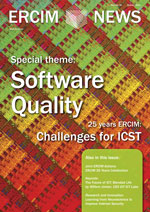
ERCIM News No. 99 Special theme: "Software Quality"

Dear ERCIM News Reader,

ERCIM News No. 99 has just been published at
http://ercim-news.ercim.eu/en99

http://ercim-news.ercim.eu/en99Special Theme: "Software Quality"
http://ercim-news.ercim.eu/en99/special/

And on the occasion of ERCIM’s 25th anniversary, we published a selection of articles on the future challenges of ICST:
http://ercim-news.ercim.eu/en99/challenges-for-icst

Keynote by Willem Jonker, CEO EIT ICT Labs: "The Future of ICT: Blended Life"
http://ercim-news.ercim.eu/en99/keynote/the-future-of-ict-blended-life


This issue is also available for download as:
pdf:  http://ercim-news.ercim.eu/images/stories/EN99/EN99-web.pdf
epub: http://ercim-news.ercim.eu/images/stories/EN99/EN99.epub

Next issue: No. 100, January 2015 - Special Theme: "Scientific Data Sharing"

Thank you for your interest in ERCIM News.
Feel free to forward this message to others who might be interested.

Best regards,
Peter Kunz
ERCIM News central editor

Tuesday, July 29, 2014

Stanford offers new open access MOOC - Open Knowledge: Changing the Global Course of Learning

Open source, open science, open data, open access, open education, open learning -- This fall Stanford faculty and librarians are working with international partners to offer the innovative free (no-cost) course Open Knowledge: Changing the Global Course of Learning on [updated] http://online.stanford.edu.


The course provides an introduction to the important concept of openness from a variety of perspectives, including library and information studies, education, publishing, economics, politics, and more. Open Knowledge is international and multi-institutional, bringing together instructors and students from Stanford University (USA), Fordham University (USA), University of British Columbia (Canada), Simon Frasier University (Canada), the Kwame Nkrumah University of Science and Technology (Ghana), the Universidad Autónoma del Estado de México (Mexico), and the rest of the world.

Learn more about the concept of "open", develop your digital literacy skills, and connect with peers from around the world.

For more information and to register: ...

Lauren A Maggio, MS (LIS), MA
Lecturer, Department of Medicine
Director of Research and Instruction
Lane Medical Library & Knowledge Management Center
Stanford University Medical Center
300 Pasteur Drive, L109, Stanford, CA 94305-5123

My source: HIFA2015

Saturday, June 14, 2014

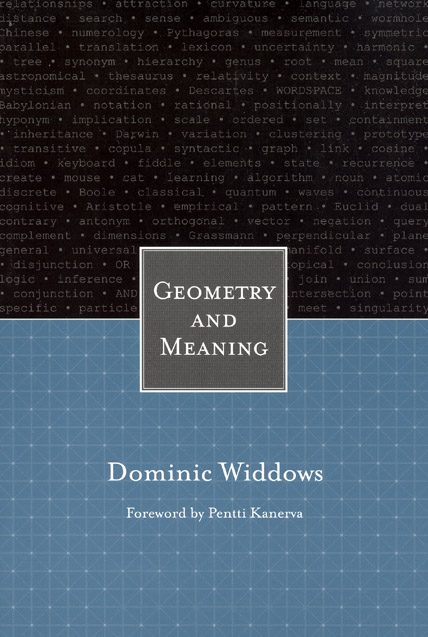
Books: The Geometry of Meaning, Gärdenfors & Geometry and Meaning, Widdows


http://www.mitpressjournals.org/doi/pdf/10.1162/coli.2006.32.1.155
There are two additions to my library. They are technical in parts and beyond my math and technical abilities, but as background this is essential reading.


Widdow's Geometry and Meaning includes details of the software used in the text. See the companion website below. While Gärdenfors' book The Geometry of Meaning is new, Widdow's text is a decade old and so demands some checking of software. I notice there are broken links on the companion site. The book, both in fact are great resources even as they increase the permanence of the geometry upon my furrowed brow...


Dominic Widdows, Geometry and Meaning - Companion website

Saturday, March 01, 2014

Drupalcamp London 2014: The Government Digital Service, Drupal 8 Multilingual features, Twig

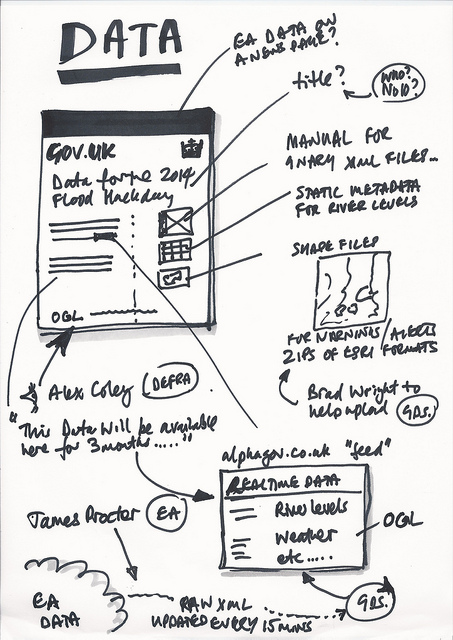
https://gds.blog.gov.uk/2014/02/23/flood-hack-developing-solutions/
Flood hack
DrupalCamp London today got underway with a keynote Delivering User-centred Digital Services by Mark O'Neill from the UK Government Digital Service.

Given the record of public and private sector led IT projects it was refreshing to hear of the GDS's approach being user-centred, the extension of 7 design principles and Mark's previous experience. It's clearly too late for the health care sector to coin and create the Needotron - GDS beat us to it.

Drupal 8 is looking formidable both in its potential and the (learning) stack it presents. Another great session to pick out was - A whole new world for multilingual sites in Drupal 8 by Gábor Hojtsy. The progress here is phenomenal and even though incomplete it is a major achievement and a credit to the Drupal community.

It's humbling as it reminds me to post some introductions to Hodges' model on W2tQ in several languages.

As to being user-centred, the Harmony Forum is a real tease. I know a forum will not moderate itself (is that the new Sorcerer's Apprentice?) and yet time is of the essence. Harmony is one for me to watch - so I'm signed up for the newsletter. Two sessions on Twig and Entities rounded up a busy few days.

This began on Thursday with Cutty Sark, the Royal Greenwich Observatory (learned much from their interactive designs) Turner and the Sea, The British Library - Beautiful Science (60-90 mins ample), and Ibsen's Ghosts at Trafalgar Studios.

I was also able to visit a university yesterday and meet a member of faculty who used Hodges' model many years ago. Here's hoping that some of the materials can be retrieved even though it seems unlikely. I hope to keep in touch with this nursing contact (and not just for the dinner!). I've met several other people here, the Drupal community is another great asset - and with thanks to the sponsors who make these events feasible for many of us.

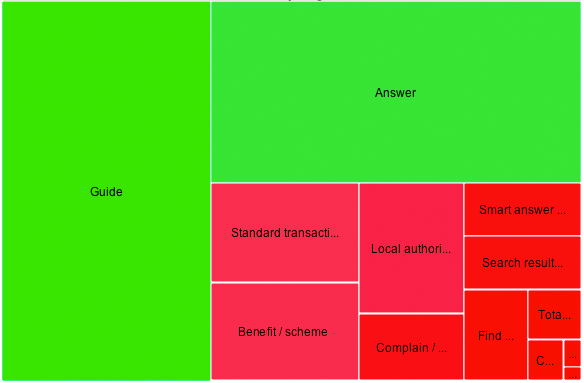
Output from Needotron


I'll end this post back with Mr O'Neill and the GDS.

I wonder to what extent healthcare figured in the flood deliberations?

It seems that an output from the Needotron may not be so far removed from h2cm?

Happy St David's Day too - in the closing minutes here!


Monday, February 24, 2014

Drupal in Education: Richer experiences with Drupal 7 and H5P (HTML5 Package)!

The H5P module is finally available for Drupal 7! Now you can download H5P and H5P content types empowering you to create great rich experiences for your users to enjoy. Content like interactive videos, presentations, drag and drop, fill in the blanks questions and more are available from h5p.org.

We have received many enthusiastic requests for an H5P D7 module and we are proud to present the newly released version. You can find it available on the H5P project page.

You create the content with your web-browser and the content will work just as great on smartphones and tablets, as on you desktop computer.

Below is a summary of the H5P content types that are currently available for Drupal 7 (and all other platforms we support).

Interactive video
Perhaps the most powerful tool in the H5P toolbox. Upload videos and animations, and make them interactive by adding quizzes, images and text along the way.

Presentation
Create a presentation slideshow with interactions along the way. Add text, images, video and various quiz tasks to your presentation.

Boardgame
A level based board game where the user must complete tasks in various levels to win. Depending on whether the user completes or fails, a video is shown at the end of each level. The game is fully customizable.

Flashcards
An image is displayed and the user has to insert a corresponding text by using the keyboard. The card turns to display the solution. Several cards can be added in a sequence.

Fill in the blanks
Create sentences and leave out words, adjectives, conjugations etc. for the user to complete by typing the missing text on the keyboard.

Question set
Your staple quiz question tool. Add a mix of multiple choice questions, fill in the blanks & drag and drop tasks.

Contact button
A simple widget that allows users of your website to get in touch with you using their preferred channel, such as email, Facebook or Twitter.

For those that are new to H5P, H5P is short for HTML5 Package, and is a simple way to create and share rich and interactive web content. H5P is modular and consists of several content types and applications, perfect for use in e-learning and advertising.

See all the content types in action on H5P.org

With H5P you can:

  • Export and import content types and applications between sites, e.g. from a Joomla site to a Drupal site.
  • Use existing content types and applications, and build on these to create your own content.
  • Create and edit rich web content directly in your browser. No technical skills are needed.
  • As a developer, build upon existing content types and applications, or create you own from scratch. Share your work with the rest of the world on the h5p.org!
Source: https://groups.drupal.org/node/409763

Looking forward this next weekend and London for DrupalCamp.

Sunday, December 22, 2013

mEDucator 3.0 | Open Linked Education - Melina+ (Drupal)


http://www.meducator3.net/melinaplus/

Checking through links yesterday I came across the mEDucator initiative and Melina+ [no longer available] which is part and noticed it is built using Drupal.

There is a thread on Drupal.org on science applications:

https://groups.drupal.org/science-applications

I posted in 2009 about the Science Collaboration Framework - SCF (for creating biomedical resources).

The link to SCF no longer works; there is an archive of this and other work that was part of Harvard's Initiative in Innovative Computing (IIC).

So it's important to consider these initiatives at least in terms of their longevity, their scale and number of participants, as examples of funded research and as Drupal projects.

Saturday, September 28, 2013

Drupalcon Prague: sessions, missed ops, leaflets and old contacts - renewed

The structure of Drupalcons provide a range of sources for learning, networking and information. The main sessions are the most obvious source, plus there are many vendors providing and marketing various services from development, hosting to specialist services. Less formal there are the Birds of a Feather BoFs, core conversations. I did not get to any BoFs, it is always difficult when these things run concurrently.

I'll list here some things that stood out from leaflets left on the coffee tables to BoFs that clashed (I've revisited the program). First up is a BoF that points to a useful bundled project:

Creating Graphs and Maps with SearchAPI

BoFs, being informal are quite dynamic so the lesson for me is to check the program for additions and things you may have missed. I missed a BoF on e-learning in Drupal, the Quiz and related modules - H5P that I posted about last May. Gutted for sure, as I can envisage how I could use these tools beyond the old HTML multiple choice form.

The above BoF included a demo of Opigno an LMS - learning management system.

As to companies, the Semantic Web Company offers Drupal services. This lead was a flyer I picked up on the last day and another prompt to revisit Neologism a Drupal project I came across in Drupalcon Szeged, Hungary in 2008 and posted about. The introductory text from the DERI Neologism website reads:

Neologism is a vocabulary publishing platform for the Web of Data, with a focus on ease of use and compatibility with Linked Data principles. Neologism is free and Open Source.
With Neologism, you can create RDF classes and properties, which are needed to publish on the Web of Data. Neologism makes creating and publishing vocabularies easy and fast. It supports the RDFS standard, and a part of OWL.
Among a great many people, I met Alan Burke in Szeged back in '08 and he re-introduced himself this week in Prague. He is now full-time dedicated to Drupal and was pleased to learn that as an 'enthusiast' I am still engaged. I qualified this - with a website still to do; but yes, I'm very much still on-board. I really appreciate Alan's coming over during the break and hearing of his progress and that of his colleagues.

Scalability is a common discussion in software. Scale is an issue for new businesses also. One of the sessions in Prague (several probably) drew attention to the complexity of the 'Drupal stack'. Is it possible for an end-user to fully master it? In our quick chat it became apparent that this was partly why Alan was pleased to learn that I am still climbing the curve. Scalability can be a problem for individuals too, as in making sense of the commercial offerings, whether semantic services or hosting.

There was a BoF on data visualization too - but again I was elsewhere. Dataseed sounds an interesting fusion. I also followed sessions on creating multilingual sites, Drupal 8, Symfony, plus Twig the new templating system for Drupal 8. All in all it was a great event with some sight seeing last Monday. The greatest source though is the community!

Wednesday, September 25, 2013

Surveys, Nursing Education, Drupal and Webform

Just before heading to Drupalcon Prague I learned of a new paper by Gill et al.:

Using a web-based survey tool to undertake a Delphi study: Application for nurse education research

Background: The Internet is increasingly being used as a data collection medium to access research participants. This paper reports on the experience and value of using web-survey software to conduct an eDelphi study to develop Australian critical care course graduate practice standards.
Methods: The eDelphi technique used involved the iterative process of administering three rounds of surveys to a national expert panel. The survey was developed online using SurveyMonkey. Panel members responded to statements using one rating scale for round one and two scales for rounds two and three. Text boxes for panel comments were provided.
Collecting data and providing feedback: For each round, the SurveyMonkey's email tool was used to distribute an individualized email invitation containing the survey web link. The distribution of panel responses, individual responses and a summary of comments were emailed to panel members. Stacked bar charts representing the distribution of responses were generated using the SurveyMonkey software. Panel response rates remained greater than 85% over all rounds.
(in press)
The paper is interesting in combining surveys and an e-variant of the Delphi research method. Conclusions highlight the improved accessibility to experts and how ethics needs to keep pace with technical change and affordances.

Yesterday at Drupalcon there was a presentation on Webform:

Webform 4.0: Surveys in Drupal Improved


I've mocked up a enquiry form using Webform, but this session pointed to how the module can be extended for polls and contact forms. Based on Gill et al. and the eDelphi technique they explain this could be a really powerful combination.


Gill, F.J., et al., Using a web-based survey tool to undertake a Delphi study: Application for nurse education research, Nurse Education Today (2013), http://dx.doi.org/10.1016/j.nedt.2013.02.016