Hodges' Model: Welcome to the QUAD: depression

Hodges' model is a conceptual framework to support reflection and critical thinking. Situated, the model can help integrate all disciplines (academic and professional). Amid news items, are posts that illustrate the scope and application of the model. A bibliography and A4 template are provided in the sidebar. Welcome to the QUAD ...

Showing posts with label depression. Show all posts

Friday, March 13, 2026

'GlobalMinds' - NHS study severe mental health problems

Together we can change lives

Depression, bipolar, schizophrenia and related conditions affect millions of people around the world.

Yet mental health receives less than 1% of global research funding. 

This has left healthcare for these conditions stuck in the past:

Cross icon

Diagnosis can take years

Cross icon

Treatments target symptoms, not underlying causes

Cross icon

Half of the prescribed drugs cause severe side effects

GlobalMinds is a major research programme seeking to advance the understanding of mental health conditions and improve lives.


My source: 
News, NHS study to transform mental health treatment, The Times, 14 February, 2026, p.6

Saturday, February 21, 2026

London: 'The Weight of Being: Vulnerability, Resilience and Mental Health in Art'

In London currently, 20th - 23rd I was on my way to Bankside Gallery and walking by Temple Place, #2 to be precise, on a board outside I read:

'The Weight of Being: Vulnerability, Resilience and Mental Health in Art'

Taking in the mental health and illness of artists, gender, domesticity, industrial and political struggle, COVID, and Gaza I spent and enjoyed a two hour detour. The building is also amazing. The exhibition is on until 19 April 2026, closed on Monday's and today 21st February. Before I share some text from their website, the interior of the building was a 'virtual' experience, but without the technology. Helpfully, the exhibition is spread across several rooms.

'Curated by Angela Thomas, this new exhibition explores artistic expression and mental health. Through depictions of deeply personal and collective experiences, it examines the powerful ways in which artists capture vulnerability, resilience, and their search for solace.

Including the work of a diverse range of twentieth century and contemporary artists and their varying perspectives, The Weight of Being showcases how artists have captured the psychological and emotional impact of societal pressures, resilience in the face of adversity, and existential uncertainty.

Alongside dozens of artworks drawn from galleries and collections across the UK, the portraits, landscapes, and figurative studies of the lesser-known artist John Wilson McCracken (1936–1982) are woven throughout. Denied the opportunity to return to the Slade School of Art following a period of hospitalisation for mental health reasons, McCracken spent much of his career in Hartlepool, producing work that reflects a profound sensitivity to the emotional and social pressures of his time. Shaped by personal and collective struggles, his art offers a deeply human perspective on the exhibition’s themes, revealing how external forces imprint themselves on the mind, body, and creative spirit.' Continued . . .

The building as a whole - Two Temple Place is owned and run by a registered charity, the Bulldog Trust

I will definitely (hopefully!) visit again, on the way or returning from the South Bank of the Thames. The video below presents key aspects of the building's amazing interior and history:

Tuesday, June 10, 2025

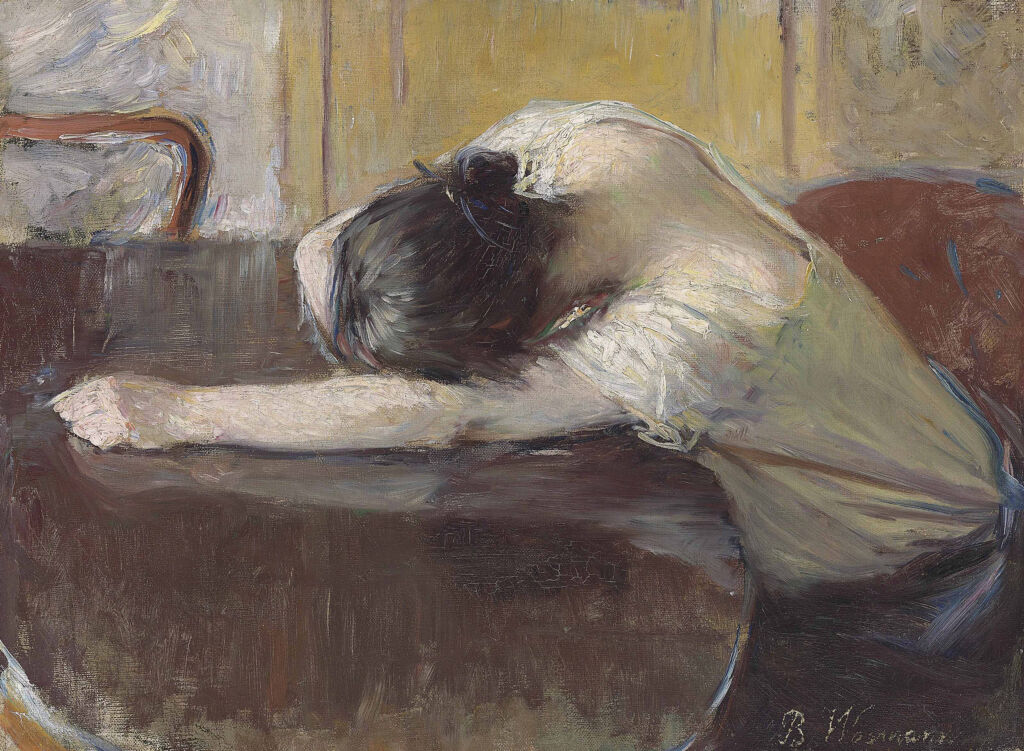
"Despair" by Bertha Wegmann

individual
|
INTERPERSONAL : SCIENCES
humanistic ------------------------------- mechanistic
SOCIOLOGY : POLITICAL
|
group
Despair by Bertha Wegmann (Danish, 1847 – 1926)


Okoro, E. A time to rest and recharge. The Art of Life: Life&Arts, FTWeekend. 17-18 May 2025. p.2.
https://www.ft.com/content/6c2d4362-a464-45e4-8288-a80d5e8a730f

See also: https://en.wikipedia.org/wiki/Bertha_Wegmann

How Bertha Wegmann communicated the 19th-century female experience. Christie's

Image: https://high.org/collection/despair/

Tuesday, June 03, 2025

Self, ego, life and death

The INDIVIDUAL - GROUP axis continues to fascinate:


individual
|
INTERPERSONAL : SCIENCES
humanistic ------------------------------- mechanistic
SOCIOLOGY : POLITICAL
|
group

SELF - IDENTITY - PERSONHOOD

ego superego id

mood - depression - mania

psychoactive substances

ego death - reset, reconstitition, re-birth?

NATURE

 personhood -
rivers, mountains, trees, land

medicine(s)

psychedelics

cultural identity, knowledge

social history, practices

corporate personhood

law 'person'


See also:

Pahnke, Walter N. “The Psychedelic Mystical Experience in the Human Encounter with Death.” The Harvard Theological Review 62, no. 1 (1969): 1–21. http://www.jstor.org/stable/1509131.

Adler, Nathan. “Ethics, Ethos, and Actualization: The Paradigm of the Antinomian Therapies.” Issues in Criminology 5, no. 1 (1970): 85–99. http://www.jstor.org/stable/42912546.

Blainey, Marc G. “Forbidden Therapies: Santo Daime, Ayahuasca, and the Prohibition of Entheogens in Western Society.” Journal of Religion and Health 54, no. 1 (2015): 287–302. http://www.jstor.org/stable/24485257.

Nail, Thomas. “How to Read the Nature of Things.” In Contemporary Encounters with Ancient Practice, edited by Abraham Jacob Greenstine, Ryan J. Johnson, and Dave Mesing, 1st ed., 299–321. Edinburgh University Press, 2025. http://www.jstor.org/stable/10.3366/jj.17381661.21.

Corporate personhood
https://en.wikipedia.org/wiki/Corporate_personhood

Friday, November 15, 2024

Podcast: Local green spaces and mental health

Dear CHAIN member,

We would like to draw your attention to the following NIHR alert. Please pass on as appropriate. Thank you.

NIHR

Local green spaces are linked with better mental health

Podcast: Local green spaces and mental health

In this podcast, Helen Saul, Editor in Chief of NIHR Evidence, and study author Sarah Rodgers, Professor of Health Informatics, University of  Liverpool, discuss the impact of local green spaces on people's mental health.

Researchers analysed data on more than 2 million people in Wales over 10 years to explore the impact of green spaces on mental health. They linked information about people’s mental health with information about the greenness of their home’s immediate surroundings and how close they lived to green or blue spaces (such as parks, lakes, and beaches). They found that people had a lower risk of anxiety and depression if:

· their home’s immediate surroundings (within 200-300 metres) were greener
· they could access green and blue spaces nearby.

The researchers say that local authorities could improve the mental health of their community by increasing the greenery in their towns and cities and improving access to green and blue spaces.

Read more at: https://evidence.nihr.ac.uk/alert/local-green-spaces-are-linked-with-better-mental-health/?source=chainmail

Regards,

Irina Johnston
CHAIN Administrative Assistant

(and my source.)

Previously: 

Thursday, October 17, 2024

‘Guanyin: Confessions of a Former Carebot’ by Lawrence Lek

individual
|
INTERPERSONAL : SCIENCES
humanistic ------------------------------- mechanistic
SOCIOLOGY : POLITICAL
|
group

Carebot


Adnan, M.Z. Can robots have nervous breakdowns, Collecting, FTWeekend, 5-6 October 2024, p.7.

Monday, July 15, 2024

FT: "Nearly 3mn people fell into financial difficulty last year"

Access to credit and illegal lending


Individual
|
      INTERPERSONAL    :     SCIENCES                   
HUMANISTIC  --------------------------------------  MECHANISTIC      
 SOCIOLOGY  :    POLITICAL 
|
Group

study included an online survey 3,101
 financially vulnerable people
+
nationally representative online study
with a sample of 1,500 people


>20mn classed as vulnerable

'44% of the UK adult population'


exclusion from financial services

'People with flaws in their credit scores,
risk being excluded from affordable
financial services, being forced to
rely on subprime lenders.'


"the poverty premium costing the country
a staggering £2.8bn per year."

economic determinants of health

'We need to view financial inclusion
as a key enabler of growth.'


Hickey, S. Nearly 3mn people fell into financial difficulty last year, Money, FTWeekend, 13 July, 2024. p.2. https://www.ft.com/content/9fa98712-b73e-4eac-ba5f-71d3bad13fa7


Friday, October 07, 2022

A twitter reply re. diagnosis - mental illness


My source: With thanks to Justin Garson and other respondents.

https://twitter.com/justin_garson/status/1577988186600611840?s=20&t=tcSVMBQbxNPSAlvudfVsSQ

Sunday, October 02, 2022

Patient navigation model - Paper: mapped to h2cm


On twitter I learned of an EU project @CANCERLESS_EU and an initial paper:

 Exploring the application of the navigation model with people experiencing homelessness: a scoping review, Journal of Social Distress and Homelessness, DOI: 10.1080/10530789.2021.2021363

Phrases like 'navigation', 'architecture', 'maps' are a trigger so after some tweets, I was kindly directed to the above paper.

Here, I'm mapping patient navigation and related concepts I have added, to Hodges' model.


"Patient navigation is a community-based and person-centered intervention, whereby a named worker – the navigator – supports and guides individuals to overcome the barriers they face in accessing healthcare services and works to facilitate timely and appropriate access to care for the individual as well as their relatives, and caregivers, when needed (Freeman, 2012; Wang et al., 2015)."

 INDIVIDUAL
|
 INTERPERSONAL    :     SCIENCES               
HUMANISTIC --------------------------------------  MECHANISTIC      
SOCIOLOGY  :   POLITICAL 
|
GROUP
psycho-
depression, anxiety,
distress, trauma (psyche)
serious mental health
substance misuse
dual diagnosis

vulnerability
isolated

difficult to engage, missing appointments, no designated point of access - Address

Personally reliant on welfare/benefits for finance - phone contact sporadic.

providing emotional support, phone, transport
Hit by energy costs/rent (pre-payment)
if finding a place.
hopelessness, lack of trust - let down many times? Stigmatized attitudes towards treatment?
tailored health education

asocial (due to lived experience, trauma..?)

-geography
low-income areas, or areas with a high proportion of ethnic minorities or migrants
USA - other nations - terminology?

method: scoping review, literature search,
inc. exc criteria
interventions tailored to age and gender

respiratory conditions,
trauma (physical)
excess winter mortality

"homeless population having an average age at death of just 47, 30 years lower than that for the general population"

exposure to activities known to
increase risk of cancer
HIV patients
data - inc. no-show rates
in-person / phone

Timeliness of screening, intervention

Navigators - lay persons,
or clinical professionals

Lived experience, "near peer" family

Training for Navigators

organizing and attending appointments and facilitating self-care/self-management

clinical and community settings, parks, pavements, and homeless encampments,
home visits, walking and support groups

*
risk of stigmatization and
experienced discrimination

navigation less successful with certain groups?


Underserved, marginalized people
Homelessness
High-risk of poor health-related outcomes
reported barriers

access to appropriate healthcare for this population are also often compounded by lack of insurance, legal problems*...

...the PN model has been associated with a reduction in hospital costs, and even in some cases, increased revenue

histories of offending and/or care
women in rural areas
non-specific vulnerable populations

reduce incarceration, vocational and volunteering activities, access to housing


Christina Carmichael, Lee Smith, Edelweiss Aldasoro, Alejandro Gil Salmerón, Tamara Alhambra-Borrás, Ascensión Doñate-Martínez, Radhika Seiler-Ramadas & Igor Grabovac (2022) Exploring the application of the navigation model with people experiencing homelessness: a scoping review, Journal of Social Distress and Homelessness, DOI: 10.1080/10530789.2021.2021363

Thursday, September 17, 2020

Suicide Prevention Research Fund PhD Scholarship

About the PhD Scholarship 

Suicide Prevention Research Fund PhD Scholarship 

The PhD Scholarship provides funding for successful applicants to attain a Doctor of Philosophy (PhD).

The PhD Scholarship is a funding agreement between Suicide Prevention Australia and the applicant’s Administering Institution (a University in Australia). 

The PhD Scholarship aims to support outstanding graduates who are at the early part of their research career. The Scholarship supports research relevant to all aspects of suicide prevention and to develop a capacity for original independent research within Australia. 

... continued ...

individual
|
INTERPERSONAL : SCIENCES
humanistic ----------------------------------------------- mechanistic
SOCIOLOGY : POLITICAL
|
group - population

Hear from Dr Katie McGill with further information on the Suicide Prevention Australia PhD scholarship application process.

Hear from Professor Myf Maple, deputy chair of the Suicide Prevention Australia Research Advisory Committee, on what we look for in PhD Scholarship applications.


My source:

https://twitter.com/Kavanagh_AM/status/1305694590574292992?s=20

Please note my using h2cm here is not intended to represent endorsement by the respective organisations / institutions.

Thursday, September 10, 2020

World Suicide Prevention Day #WorldSuicidePreventionDay #WSPD2020

'Suicide' https://hodges-model.blogspot.com/search/label/suicide 

'Activism' https://hodges-model.blogspot.com/search/label/activism

Wednesday, January 08, 2020

BAD or FAB? Let the individual (child?) decide ..

individual
|
INTERPERSONAL : SCIENCES
humanistic ----------------------------------------------- mechanistic
SOCIOLOGY : POLITICAL
|
group - population


BaD


FaB


FaB


BaD


BaD: Betting and Despair
FaB: Football and Betting


https://www.independent.co.uk/sport/football/news/fa-cup-games-stream-betting-website-bet365-review-broadcast-rights-heads-up-mental-health-awareness-a9274791.html

#children
#publicMENTALhealth
#vulnerability
#exposure
#mentalpollution

#BeautifulGame? 


Tuesday, September 03, 2019

CLEAR as a Mental Health Million...?

individual
|
INTERPERSONAL : SCIENCES
humanistic ----------------------------------------------- mechanistic
SOCIOLOGY : POLITICAL
|
group - population
ASK 
about underlying social problems

TREAT
 the immediate health problem
...

REFER
to local social support resources

ADVOCATE
for


Constantly rationalising; it's still the Northern summer holidays, people are away, not everyone's on twitter, the tweet's still warm, blimey - get a life ...!

I wonder how no one else can consider the very obvious 'fit' between key elements of the CLEAR initiative and Hodges' model, sufficient to consider the tweet of that post worthy of a like at least? Not a one. (There's another post perhaps..?)

Oh well... Plough on ...

The other week Mental Health Million on twitter featured a gif that caught my eye again today. This graphic provides a lesson that also incorporates CLEAR.

If we consider the ASK advice, then this supposes of course that the person, patient, client is engaged with the health professional. Engaged, to such an extent that in competency terms the professional's interpersonal skills come to the fore. It really is how we ask, and at that first encounter that is crucial.

individual
|
INTERPERSONAL : SCIENCES
humanistic ----------------------------------------------- mechanistic
SOCIOLOGY : POLITICAL
|
group - population
ASK 
about underlying social problems

TREAT
 the immediate health problem
...

REFER
to local social support resources

ADVOCATE
for

Although I may write about the importance of parity of esteem in mental and physical health this is often thought of in funding, research terms and the physical health of people with more chronic forms of mental illnesses who are prescribed and take long term psychotropic medication. It is not easy to envisage the extent of the challenges for patients, their families and the health and social care team. The CLEAR website notes the use of the initiative across many health contexts and hence conditions, including dementia.

The animation tweeted by Mental Health Million and their reference to the 'One in Four' statistic, highlights the complex nature of 'care pathways'.

Yes, the solutions are "out there" but the key is making them available.

No pun intended, but pathways are often taken for granted in the sense that they are CLEARed and straightforward to follow. CLEAR checks this assumption and takes a global approach. CLEAR and Hodges' model draw attention to the humanistic, the social side of medicine, health care. These are often not factored in from the outset, as a vital part of the outcome process (policy, purposes and practices).

As mental health care professionals realise that ability to 'ask' can be hard-won in terms of the patience that needs to be exercised.
The counterpoint to that is a twitter thread last week. A person with mental illness and in difficulty at that time, was suggesting that the professionals "Go Away" (not exactly the words used).

As this animation suggests, getting referred is one thing, being heard and seen is another. Getting to the point were dialogue is possible is a delicate negotiation. Mutual respect, being able to agree to disagree. Do we agree as to the type of the fruit on the tree; never mind what might be 'low-hanging'?  Whatever the perceived and actual differences we must try to reduce that distance, listen, share and make progress.

No one should have to sit, walk, Be alone if they do not want to. ...


individual
|
INTERPERSONAL : SCIENCES
humanistic ----------------------------------------------- mechanistic
SOCIOLOGY : POLITICAL
|
group - population


TREAT
the immediate health problem


REFER
to local social support resources


ADVOCATE
for

Friday, August 23, 2019

Barber's model of hairdressing - "Care in the Community"?

Through the 1980s and 90s when models of nursing and nursing theory were flavour of the month, I remember a conversation that being so numerous, there was no doubt a "Model of Hairdressing" too. This is not to denigrate hairdressing in anyway (not at all Sis!).  I've actually considered this as a demonstration of the scope of Hodges' model. This post even prompted me to check the previous 2379 to see if I've been here before on W2tQ, but it appears not. (I do have an article somewhere - a parody on 'models of care'.)

There is a developmental tale here though, that is itself interesting. The story runs from the late 90s early 2000s thinking about hair, its qualities, scalp problems, nits (and diplomacy), health and safety at work, the equipment, the pictures displayed - advertising, ingredients, person-centredness, position - comfort and mobility, safety with some preparations and processes, gender and cultural aspects, the history of barbers and of the other 'services': ("Something for the weekend sir?"). So clearly hairdressing like all employment can be complex and rewarding. In addition: there are hosts of medical conditions and psychological factors (for example, self neglect*, phobias, children's reactions) that can affect the hair; its care, management, loss and compensating for this (with specialist help) as needed.

The social event that a visit to the hairdressers / barbers invites, was apparent as a child recalling my mother's former visits and the local 'news' that followed afterwards. In the later 2000's the need for dementia friendly communities was a further development. Business owners can see changes in their regular customers too. Many businesses seek to sustain this awareness and sensitivity in their approach and business. On my visits, the whole process is very relaxing. A further invitation as we shift from the sinks to the chair and mirror. There we are reflected in a before and after. The banter may also include the aspirations and educational options as students work through part-time work. As you may also have heard, over the past few years the actual and potential role of barber's in mental health has been more formally recognised:

https://www.thelionsbarbercollective.com/about-us/

https://www.independent.co.uk/life-style/hairdresser-suicide-prevention-mental-health-tom-chapman-safe-space-torquay-a7644021.html

Recognised also in the arts:

individual - SELF
|
INTERPERSONAL : SCIENCES
talk - HUMANISTIC - chat ----------------------------------------------- snip - MECHANISTIC - buzz..
SOCIOLOGY : POLITICAL
|
OTHERS - population

Mental health

Physical health

Public mental health policy


*What are the thresholds that pertain here - no doubt there are several - compounded?

Wednesday, May 08, 2019

AffecTech Workshop: Lancaster Tuesday May 14th 2019, 9-1pm

Presented by Lancaster University

Help shape the future of innovative technologies for mental health

We hope you will join us as a guest of Lancaster University, for a special workshop and networking opportunity exploring interactive mental health technologies being developed here in Lancaster. This is a first of a kind opportunity for professionals and public to engage with new prototypes being developed as part of the AffecTech network – a major international research project developing personal technologies for affective health.

Where: Reading and Writing Room, Storey Arts Centre, in Lancaster City Centre
(Next to Lancaster Railway Station)

When: Tuesday May 14th 2019, 9.00 am to 13.30 pm

Why: Learn about personal technologies for affective health, and help shape a major initiative dedicated to delivering self-help technologies to help sufferers of affective health conditions such as depression, anxiety and bipolar disorder.

More information and registration (free). 


[Hope to see you there!]

Friday, April 19, 2019

Friday, April 06, 2018

c/o @TheLancetPlanet - Paper: Residential greenness and prevalence of major depressive disorders... or "All colours fictitious"

individual
|
INTERPERSONAL : SCIENCES
humanistic ------------------------------------- mechanistic
SOCIOLOGY : POLITICAL
|
group


Disclaimer:

Any significance that might be deemed between greenness as identified in Hodges' model with mental health, psychology, ecopsychology, memory, personhood, emotional, beliefs, mood ... and other colours* as portrayed is, of course, entirely coincidental.

 *colours to include black & white

Search of 'mental health' posts:
https://hodges-model.blogspot.co.uk/search/label/mental%20health

Friday, February 23, 2018

Depression Worskhop: c/o and with thanks to AffecTech

As posted last September I enjoyed an evening at the launch of AffecTech at Lancaster. This post is prompted by a tweet:

I should add that this post is not intended to represent an endorsement by AffecTech but there is an opportunity to reflect and show how Hodges' model can be used.  I contacted the researchers who - in the spirit just mentioned - kindly forwarded higher resolution images. Of course, not being present at the workshop a lot of information is lost. The reference to art is interesting in itself. It is difficult to capture the context of the whole workshop but - as per the tweet - a short article sets the scene:

AffecTech Design Workshop: Discussion on Cross-disciplinary Methods for Depression Treatment

I have provided two examples of Hodges' model mapping the contents of the workshop. The first,  covers Figure 1: Concept maps of depression causes and symptoms. I don't have a key so there may be the thoughts of several individuals - as per the colours and codes on the flipcharts. Some terms are immediately not only cross-disciplinary but multicontextual in terms of their everyday meaning, for example, darkness, falling, stuck-ness, negative spiral (thoughts, actions), imprisonment mentally, physically, and politically due to dependency, financial constraints.

individual
|
INTERPERSONAL : SCIENCES
humanistic --------------------------------------- mechanistic
SOCIOLOGY : POLITICAL
|
group
Unreachable hope                                     Pain
                                          Weight - burdened
       Immobility - motivation
                  DEPRESSION    Anxiety
DESPERATION                                          Stuck
                Darkness    Grief             Falling
Insomnia
      Negative filter         No hope
Nowhere
  Negative spiral                             Lack of
interest and motivation
Internalising rage   Suppressed emotions
Anger Not being listened to                  Darkness
Pain
Im-mobility 
Physical decline Weight

Stuck
Chained/Locked


to go
energy

imprisonment
Darkness
Imprisonment – Social Isolation

No support

Hiding

Loneliness
Imprisonment – Powerlessness?

Loss of control

Next, I have examined the text immediately following and mapped this [my emphasis] to the model.

individual
|
INTERPERSONAL : SCIENCES
humanistic ----------------- THE SYSTEM --------------- mechanistic
SOCIOLOGY : POLITICAL
|
group
Identified, general state of lack of interest as a main symptom of depression (lack of energy, negative spiral), and as one of the obstacles for technology-based treatment of it.

Therapist input: the emotion regulation component of the system should be suggestion-based (promoting novelty in the patient daily routine). system should be able to continuously monitor* (and predict) the user mood

should have an appealing and trust-worthy interface from which it can communicate with the user and modifying his/her immediate context.

If depressed - the agent engages the user in a discussion in which a range of emotion regulation techniques is proposed to him/her.
Includes: (i) modifying environment (light changes, playing music); (ii) recommending activities; (iii) proposing mindfulness exercises; (iv) engaging the user in a discussion; or (v) recommending the user to look for the support of a friend.

Further, at the end of each day the user and the agent discuss progress made over recent days, and define small steps that could be taken in the near future.

Requirement for a pro-active intervention system, and engage the user as soon as (or better just a bit before) a critical situation is detected.

System should: *real time - 'always on'? provide daily feed-back to the user (giving a sense of incrementally overcoming problems).

Low-fidelity prototype of a system that meet these requirements. Composed of two components: (i) wrist-band device worn by the user that monitors the user mood; and (ii) an assistive agent that is responsible for the emotion regulation system component.


Working principle of system - wrist-band devices communicates to the agent when the user is in a depressed mood (- use of biosensors)


Should strive to connect the user with his/her close friends. 

Emotion regulation techniques - (v) recommending the user to look for the support of a friend (see above).


The above is provided as a 'pause for thought'. I'm no expert on NLP, but I am acutely aware of the power of the words we use. And how what is said to patients, carers can be returned as a sizzling hot potato that may reveal: great foresight in what you have missed; a major lack of understanding of a situation and treatment plan; and (then) as follows a need for urgent educational intervention. In applications such as this - care needs to be taken in when and were particular words are used. 'Treatment' is in the title, but can be a loaded term as understood by the patient, client, carer, or user. People will say, "No it isn't - this is a 'balanced' approach." but herein risks lie.

Services should be non-ageist and yet culturally if you survey treatment and related terms - from a decennial perspective I wonder what you would find? I have patients who refer to Dr Google and will challenge and ask about their care and if not satified seek further opinions - a fresh pair of eyes; and others who are quite institutionalized in respect of passively accepting what is 'prescribed'. This may be reflected in the length of their mental 'health career' and their previous mental health history.

Please note the inclusion of THE SYSTEM above in the axes and domains of Hodges' model. This is non-trivial. 

At the end of the day (and the start of the night - for someone with depression?) what is the system? I'm not being awkward, but the 'system' in research can become a lay-by. As a compound term it is shorthand, but obviously we need to focus on the elements, constituents and what glues the system together: coherence. As an example, how often in IT project are 'Requirements' the sought after token that signifies "We are on the right track!"? The focus from the above is laudable being clearly person- patient-centred. Is there more that can be said about the system and requirements in the social and political domains? Is there a way also for the agent to figure higher up the design ecosystem (hierarchy)? This is no doubt were the hard work matters - theory, practice - the thesis!

Given the complexity of the (design, care, technical, global...) problems we face I do believe that Hodges' model may serve a purpose in helping to sustain, or ‘recover’ the context – of a situation. This is the purpose of stories of course. The aim of AffecTech's project here is no less than detecting a critical situation. Perhaps this is the truth of 'integrated health records' from wrist device, to agent, patient's record and health services'? It is brilliant to see such initiatives getting underway they are the future....

 (I may add to this post in coming days - weeks.)

With thanks to Alan Cole and Andrea Patane of AffecTech at Lancaster University.