Hodges' Model: Welcome to the QUAD: computing

Hodges' model is a conceptual framework to support reflection and critical thinking. Situated, the model can help integrate all disciplines (academic and professional). Amid news items, are posts that illustrate the scope and application of the model. A bibliography and A4 template are provided in the sidebar. Welcome to the QUAD ...

Showing posts with label computing. Show all posts

Sunday, June 28, 2026

1st Workshop on the Internet of Mirrors (IoM): Connected Intelligence for Healthcare, Beauty, and Immersive Digital Experiences

Dear Colleagues,

I would like to invite your technical papers submissions to our 1st Workshop on the Internet of Mirrors (IoM): Connected Intelligence for Healthcare, Beauty, and Immersive Digital Experiences, which will be held in IEEE WF-IoT 2026 in Abu Dhabi, UAE.

Workshop Focus


The Internet of Mirrors (IoM) is an emerging IoT ecosystem built around interconnected smart mirrors that can sense, process, communicate, and deliver personalised services across healthcare, beauty, wellness, assisted living, fitness, and immersive digital experiences.
Although the workshop is centred on the Internet of Mirrors, the realisation of this vision requires multi-domain expertise. As such, we are very keen to receive contributions not only from researchers directly working on IoM, but also from those developing the architectures, algorithms, communication technologies, computing frameworks, and application domains that will underpin future intelligent IoT ecosystems.

Topics of Interest
  • Relevant topics include, but are not limited to:Edge, fog, and cloud computing for IoT systems
  • Distributed intelligence and multi-agent AI
  • AI-enabled IoT applications and personalised services
  • Multimodal sensing, data fusion, and contextual awareness
  • Intelligent task orchestration and adaptive resource allocation
  • Wireless connectivity, 5G/6G, and network optimisation
  • Privacy-preserving AI, security, interoperability, and trustworthy AI
  • Human-computer interaction, accessibility, and inclusive smart interfaces
  • Digital twins, immersive technologies, and metaverse-enabled experiences
  • Internet of Sounds, Internet of Medical Things, and broader Internet of Everything ecosystems
  • Smart healthcare, assisted living, wellness, fitness, beauty, and immersive digital lifestyle applications
  • Proof-of-concept implementations, benchmarking, testbeds, and real-world IoT deployments
Important Dates 
  • Paper submission deadline: 12 July 2026
  • Notification of acceptance: 15 August 2026
  • Camera-ready deadline: 30 August 2026

Workshop Chairs

  • Lina Mohjazi, University of Glasgow, UK
  • Luca Truchet, University of Trento, ITALY
  • Ahmad Taha, University of Glasgow, UK
  • Rabeb Mizouni, Khalifa University, UAE
  • Muhammad Ali Imran, University of Glasgow, UK
  • Haneen Fatima, University of Glasgow, UK

Information

Workshop website: https://sites.google.com/view/wfiot2026-workshop-iom
Submission link: https://edas.info/newPaper.php?c=34901&track=138858

Contact Emails:
l.mohjazi AT ieee.org
ahmad.taha AT glasgow.ac.uk

It would be wonderful if you could consider submitting relevant work, or share the call with colleagues and students who may be interested!
--
Kind regards,
Dr Kubra Duran
Postdoctoral Fellow
Edinburgh Napier University, UK

My source: SOCIOTECH list - JISC

Monday, September 08, 2025

Online: Artificial Intelligence (AI) in Healthcare - Weds 17th Sept 2025 BCS Coventry Branch

Online event organised by British Computer Society (BCS)

Full details: 
https://www.bcs.org/events-calendar/2025/september/webinar-ai-in-healthcare-neural-ai-v-symbolic-ai-why-we-need-neuro-symbolic-ai/

*** Agenda (UK time) *** 

18:30 - Meeting opens
Welcome and Introductions
18:40 - Hand-over to speaker
19:30 - Questions
20:30 - End

Scope of workshop

This is to support you in putting together your application for the FEDIP application and the workshop will focus on:

  • What level you should apply for
  • How to work with the Standard
  • How to map your evidence
  • Putting together context
  • Preparing your evidence in the best way 
  • What the assessors will look for
Free-of-charge registration to obtain the Zoom link

https://www.eventbrite.co.uk/e/ai-in-healthcare-neural-ai-v-symbolic-ai-why-we-need-neuro-symbolic-ai-registration-1383661000299?aff=oddtdtcreator
___________________________

My source: Dr Mercedes Arguello Casteleiro.

FEDIP: https://www.fedip.org/

Monday, September 01, 2025

BCS - AI Health 2025 - Artificial Intelligence SG (reminder)

Date and time: Friday 7 November, 9:30am - 4:30pm

Location: BCS, The Chartered Institute for IT, Ground Floor, 25 Copthall Avenue, London, EC2R 7BP

Price: 42 - 108 GBP

Synopsis

BCS-SGAI, the BCS, The Chartered Institute for IT's Specialist Group on Artificial Intelligence, was founded in June 1980. Its mission is: "To foster achievement, capability and awareness in both business and research in Artificial Intelligence, and to promote the interests of the related community". It is one of Europe's longest-established groups working to support the community of artificial intelligence developers and users and is the organiser of one of the longest-running annual series of AI conferences in Europe: the AI-20xx series.

In England, 189 out of 208 (91%) hospital trusts are using electronic health records (EHRs) bringing opportunities and challenges and for Artificial Intelligence (AI). In the morning, there will be a session about EHRs with speakers from UK (animal health records), France (European Health Data Space infrastructure for the use and exchange of EHRs), and Spain (personal health records). Before lunch break, there will be a brief 101 hands-on tutorial about Neuro-Symbolic AI with short exercises. In the afternoon, there will be a session about clinical decision, exemplifying the use of AI-based healthcare technologies. Come along if you are interested in AI and its potential in healthcare.
  • A comparison between open-source biomedical LLMs and general-domain LLMs (e.g. DeepSeek, Gemini, Claude, and ChatGPT-4)
  • How to lower the technical skills overhead (understanding of AI and programming code) needed to use open-source LLMs for content generation and content analysis of text, images and audio
  • Exploring the plausible benefits of neuro-symbolic AI, combining neural AI (to process and extract patterns for health issues from unstructured data) with symbolic AI (explicit representations of background knowledge)
There will be Certificates of Attendance for those who register and attend the event.

We hope that you will come and join us, and that you enjoy this new offering from the BCS SGAI.

Speakers

Programme

More details and registration ...

(I look forward to attending.)

My source: BCS SGAI mail list.

Friday, November 01, 2024

ERCIM News No. 139 Special Theme: "Software Security"

Dear ERCIM News reader,

A new ERCIM News issue (Number 139) is online with a special theme on Software Security. The articles in this special theme offer a comprehensive panorama of the current European research activities in software security and protection. They showcase a diverse range of research projects, highlighting the ongoing advancements and key developments of the field..

You can access the issue at https://ercim-news.ercim.eu/

This special theme was coordinated by our guest editors Sebastian Schrittwieser (University of Vienna) and Michele Ianni (University of Calabria).

Thank you for reading ERCIM News!

Please share this issue with anyone who might find it interesting. You can also support us on X (https://x.com/ercim_news) and LinkedIn. Let's keep the conversation going and share the latest updates together!

Next issue:

No. 140, January 2025
Special Theme: " Large-Scale Scientific Computing". Submissions are welcome! See call for contributions.

Announcements in this issue: Call for Proposals: Dagstuhl Seminars and Perspectives Workshops - Schloss Dagstuhl – Leibniz-Zentrum für Informatik is accepting proposals for scientific seminars/workshops in all areas of computer science.

Call for Papers: ACM Digital Threats: Research and Practice

ERCIM News is published quarterly by ERCIM, the European Research Consortium for Informatics and Mathematics. With the printed and online edition, ERCIM News reaches more than 10000 readers.
All issues published to date are available online.

About ERCIM

ERCIM - the European Research Consortium for Informatics and Mathematics - aims to foster collaborative work within the European research community and to increase cooperation with European industry. Leading European research institutes are members of ERCIM. ERCIM is the European host of W3C.

Peter Kunz                      	
ERCIM Office
+33 (0)7 68 16 50 47

2004, Route des Lucioles
BP93
F-06902 Sophia Antipolis Cedex

@ercim_news 

Wednesday, October 23, 2024

Register for Free! AI for One Health and Planetary Health: Where Are We?

Friday 8 November, 9:30am GMT – onwards

BCS, The Chartered Institute for IT, Ground Floor, 25 Copthall Avenue, London EC2R 7BP

Join BCS SGAI in London for an engaging full-day event featuring a line up of exciting talks. Attendees will have the opportunity to participate in a hands-on tutorial on low-code/no-code AI and Certificates of Attendance will be provided.

* Speakers & Agenda
https://www.bcs.org/events-calendar/2024/november/ai-for-one-health-and-planetary-health-where-are-we-artificial-intelligence-sg/

* Invitation for Free Registration
https://ArtificialIntelligence081124.eventbrite.co.uk


100% Discount Code: AIHealth24Committee

--------------------------------
Hope to see you there - in London 6th-9th November.

Book received: 'Handbook on the Ethics of Artificial Intelligence'

Many thanks to Edward Elgar Publishing for a review copy of this book which arrived today:

Edited by David J. Gunkel, Professor of Communication, Northern Illinois University, US, and Professor of Applied Ethics, Łazarski University, Poland

Publication Date: 2024 ISBN: 978 1 80392 671 1 Extent: 336 pp
This engaging Handbook identifies and critically examines the moral opportunities and challenges typically attributed to artificial intelligence. It provides a comprehensive overview and examination of the most pressing and urgent problems with this technology by drawing on a wide range of analytical methods, traditions, and approaches.

This is timely, prior to next month's event on AI and Planetary Health, about which news to follow shortly, especially if you are based near London and southern England.

I also can't believe it is 34 years since publication of the following case study:

Davies, M. and Owen, K. ‘Complex uncertain decisions: medical diagnosis’, Case Study 10 in Expert System Opportunities from the DTI’s Research Technology Initiative, HMSO 1990.

Ethics in AI 2024 :: Expert Systems 1990

Sunday, September 01, 2024

British Computer Society: Real AI 2024 -::- AI for One Health and Planetary Health

In July I posted news of this month's Real AI event 27th September. Plans are in place to attend.

In November, London beckons again:

Friday November 8th 2024

Even as I look forward to September's trip; I'm pinching myself. 

Following a BCS event last year, Hodges' model has been recognised. A video chat and many email exchanges has revealed there is a model possessed with the necessary holistic bandwidth. Hodges' model has the conceptual scope to encompass intelligence(s), One Health and planetary health. 

This also fits with current reading - interrupted by Hardy's A Mathematician's Apology (£2.00) - with posts to follow that will also inform November's co-presentation.

More to follow and clearly I have learned a great deal from engaging with the BCS. While my affiliate  membership has lapsed now, since the early 1990s the Society's publications, specialist groups: medical informatics, nursing, methods, security, expert systems, and now AI have proved well worth getting involved!

I am also hoping for some part-time tutoring at Bolton University in the new academic year.

Wednesday, January 31, 2024

ERCIM News No. 136 Special Theme "Large Language Models (LLMs)"

Dear ERCIM News reader,

A new ERCIM News issue (136) is online with a special theme on Large Language Models (LLMs). This issue features articles on diverse topics, such as LLMs in education and professional training, ethics and fairness in public sector use, knowledge management, information retrieval, software modeling, LLM capability assessment, and advancements like enhanced pre-training efficiency.

You can access the issue at https://ercim-news.ercim.eu/

This special theme was coordinated by our guest editors Diego Collarana Vargas (Fraunhofer FIT) and Nassos Katsamanis (Athena RC).
Thank you for reading ERCIM News! Please share this issue with anyone who might find it interesting. You can also support us on Twitter (@ercim_news) and LinkedIn (https://www.linkedin.com/company/ercim). Let's keep the conversation going and share the latest updates together!


Next issue:

No. 137, April 2024
Special Theme: "Extended Reality". Submissions are welcome! See call for contributions.

ERCIM News is published quarterly by ERCIM, the European Research Consortium for Informatics and Mathematics. With the printed and online edition, ERCIM News reaches more than 10000 readers.
All issues published to date are available online.


About ERCIM

ERCIM - the European Research Consortium for Informatics and Mathematics - aims to foster collaborative work within the European research community and to increase co-operation with European industry. Leading European research institutes are members of ERCIM. ERCIM is the European host of W3C.

Subscribe to the ERCIM News quarterly alert

Peter Kunz*       	
ERCIM Office
2004, Route des Lucioles
BP93
F-06902 Sophia Antipolis Cedex

------------------------------
*My source with thanks.
Of note:
Chatbots & Socrates: Dialogues in Learning. pp.18-20.
Towards AI-Assisted Data Storytelling. pp.28-29.

Wednesday, November 01, 2023

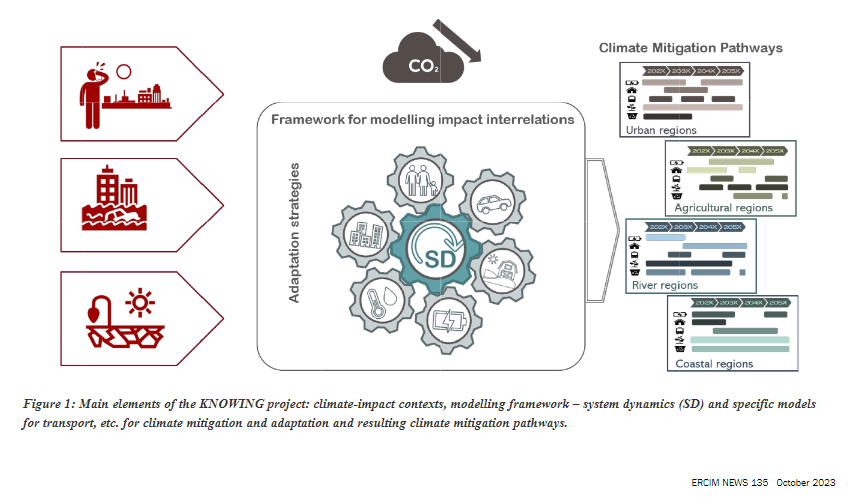
ERCIM News No. 135 Special Theme "Climate-Resilient Society"


Dear ERCIM News reader,

A new ERCIM News issue (135) is online with a special theme on Climate-Resilient Society! This special theme aims to put a spotlight on recent research, innovation and Implementation activities that could be taken up by the EU Mission on Adaptation to climate change, focusing on actionable knowledge, tools and solutions for planning, implementation, and progress monitoring. We encourage you to read the full issue to learn more about the latest advances in climate change adaptation research and practice. You can access the issue at the following link: https://ercim-news.ercim.eu/


This special theme was coordinated by our guest editors Athina Lykos (AIT Austrian Institute of Technology) and Sobah Abbas Peterson (NTNU).

Thank you for reading ERCIM News! Please share this issue with anyone who might find it interesting. You can also support us on Twitter (@ercim_news) and LinkedIn (https://www.linkedin.com/company/ercim). 
Let's keep the conversation going and share the latest updates together!

Next issue:
No. 136, January 2024
Special Theme: "Large Language Models". Submissions are welcome! See call for contributions.


Announcements in this issue:

Call for Proposals: Dagstuhl Seminars and Perspectives Workshops Schloss Dagstuhl – Leibniz-Zentrum für Informatik is accepting proposals for scientific seminars/workshops in all areas of computer science.

Social Robotics, Artificial Intelligence & Multimedia Winter School, Grenoble, France, 19-23 February 2024

ERCIM "Alain Bensoussan" Fellowship Programme - postdoctoral fellowships available at leading European research institutions. Simple application procedure. Next application deadline: 30 April 2024.

ERCIM News is published quarterly by ERCIM, the European Research Consortium for Informatics and Mathematics. With the printed and online edition, ERCIM News reaches more than 10000 readers.
All issues published to date are available online.


About ERCIM

ERCIM - the European Research Consortium for Informatics and Mathematics - aims to foster collaborative work within the European research community and to increase co-operation with European industry. Leading European research institutes are members of ERCIM. ERCIM is the European host of W3C.

Peter Kunz                      	
ERCIM Office
2004, Route des Lucioles
BP93
F-06902 Sophia Antipolis Cedex

Includes:
Clean air
20 Improving Urban Air Quality and Climate-resilience in Cities with Inclusive, Policy-relevant Citizen Science
by Pavel Kogut (21c Consultancy), Lieven Raes (Digital Flanders) and Susie McAleer (21c
Consultancy) 
Energy
21 LoCEL-H2 - Low-cost, Circular, Plug and Play, Off-grid Energy for Remote Locations including Hydrogen
by Athanasia-Maria Tompolidi (Consortium for Battery Innovation, CBI), Jonathan Wilson (Loughborough University) and Hassan A Khan (Lahore University of Management Sciences)
Transferable mitigation pathways
28 KNOWING How to Deal with Climate Change 
by Alexandra Millonig and Marianne Bügelmayer-Blaschek (AIT Austrian Institute of Technology) - with image:
Figure 1: Main elements of the KNOWING project: ... p.28.

Friday, September 22, 2023

"Why models go wrong" BYTE, 1985

Why models go wrong
BYTE


"A model can be a physical object: a scale-model of an ancient settlement inferred from archeological evidence, or a physical anthropologist's reconstruction of a skeleton from a few bones and fragments. Most social models, however, are mathematical isomorphisms that specify one-to-one relationships between elements of the model and observable processes or entities. This abstractness gives models great versatility, but it also opens doors to potential problems. You don't need to be a naval architect to see that a model battleship has no bottom, but flaws in an equally defective sociometric model that repeatedly factors a large covariance matrix might escape casual scrutiny." p.151.


My source:
Houston, T.R. 1985. Why models go wrong. BYTE 10(10) : 151-164.


Thursday, August 17, 2023

Identity, entity and continuity - c/o Evans (2009)

"Many things are defined by their identity, and not by any attribute. In our typical conception, a person ... has an identity that stretches from birth to death and even beyond. That person's physical attributes transform and ultimately disappear. The name may change. Financial relationships come and go. There is not a single attribute of a person that cannot change; yet the identity persists. Am I the same person I was at age five? This kind of metaphysical question is important in the search for effective domain models. Slightly rephrased: Does the user of the application care if I am the same person I was at age five? 

A conceptual identity has to be matched between multiple implementations of the objects, its stored forms, and real-world actors such as a phone caller. Attributes may not match." p.90.

"Object modeling tends to lead us to focus on the attributes of an object, but the fundamental concept of an ENTITY is an abstract continuity threading through a life cycle and even passing through multiple forms.

"Some objects are not defined primarily by their attributes. They represent a thread of identity that runs through time and often across distinct representations. Sometimes such an object must be matched with another object even though the attributes differ. An object must be distinguished from other objects even though they might have the same attributes. Mistaken identity can lead to data corruption.

An object defined primarily by its identity is called an ENTITY. ...

Domain-Driven Design
Of course, most "ENTITIES" in a software system are not people or entities in the usual sense of the word. An ENTITY is anything that has continuity through a life cycle and distinctions independent of attributes that are important to the application's user. It could be a person, a city, a car, a lottery ticket, or a bank transaction." p.91.


Eric Evans, (2009). 
Domain-Driven Design: Tackling Complexity in the Heart of Software, Model-Driven Design. Addison-Wesley.
[Emboldened text as per book.]

Monday, July 10, 2023

5th Multidisciplinary International Symposium on Disinformation in Open Online Media


Call for Contributions

The Multidisciplinary International Symposium on Disinformation in Open Online Media (MISDOOM) is returning for its 5th edition on 21 and 22 November 2023. This time, the conference will be hosted by the National Research Center for Mathematics and Computer Science (CWI) at Amsterdam Science Park (Netherlands). MISDOOM values multidisciplinary research and is designed to be inclusive of different academic disciplines and practices.

The symposium provides a platform for researchers, industry professionals, and practitioners from various disciplines such as communication science, computer science, computational social science, political science, psychology, journalism, and media studies to come together and share their knowledge and insights on online disinformation.

My source - ERCIM NEWS posted previously:

https://hodges-model.blogspot.com/2023/07/ercim-news-134-xai.html

Thursday, January 26, 2023

Edge(s) Computing ... IEEE EDGE 2023

IEEE EDGE 2023 - CALL FOR PAPERS

c/o AI-SGES list


“It’s the edges of the maps that fascinate ...”
David Mitchell, The Bone Clocks
[Goodreads.com]


 INDIVIDUAL
|
 INTERPERSONAL    :     SCIENCES               
HUMANISTIC --------------------------------------  MECHANISTIC   
SOCIOLOGY  :   POLITICAL 
|
GROUP
'domains'

"Edge computing, as the convergence of computing and communications executed close to data collection and places of storage and application, provides a paradigm that offers several research and application opportunities across a wide range of domains." ... [IEEE EDGE 2023] ...

'domains'
'domains'


Tuesday, January 18, 2022

Call for Short Essays - Interfaces: Essays and Reviews in Computing and Culture

Dear Colleagues,

Interfaces hope some of you will consider publishing with us, please forward to others who might be interested.  Many thanks!

Interfaces; Essays and Review in Computing and Culture publishes short essay articles and essay reviews connecting the history of computing/IT studies with contemporary social, cultural, political, economic, or environmental issues. It seeks to be an interface between disciplines, and between academics and broader audiences. It is very much interdisciplinary and past essays published have been from scholars and doctoral students from sociology, media studies, communication, information studies, history, history of sci/tech, science and tech studies,etc.  Essays are generally 2,000 to 3,500 words (a few go up to 4,000 which is fine if you wanted a longer essay, but 2,000 to 3,000 or 3,500 the norm).

Some possibilities, but not limited to...
  • Think piece on some aspect of the sociology, geography, anthropology, history, or other social or cultural study of the digital world
  • addressing a contemporary issue that in part contextualizes looking back at change over time
  • An essay that provides a short, popular version that promotes a larger work (draws from and promotes a full-length article or a book, could announce pre-publication or point to post publication of larger work)
  • Reflections on a body of literature (including an essay review on two or more books, essay on digital exhibit on computing/digital world)
  • Other types of short essays on computing and culture

Essays go through editorial review (myself and my colleague Amanda Wick, co-editors), which is usually short and straightforward and leads to publication in about a month from original submission.

I hope you will consider submitting an essay to us! If I can answer any questions, please let me know.

Best, Jeff
"Injustice wears the same harsh face wherever it shows itself."-Ralph Ellison

Jeffrey R. Yost, Ph.D.
Director, Charles Babbage Institute
Research Professor, History of Science, Technology, and Medicine
222  21st Avenue South
University of Minnesota
Minneapolis, MN 55455
 
<>
 
Previously on W2tQ:
 
My source: SOCIOTECH list
https://www.jiscmail.ac.uk/cgi-bin/webadmin?A0=SOCIOTECH

Friday, April 02, 2021

ERCIM News No. 125 Special theme: "Brain-inspired Computing"

Dear ERCIM News reader,

ERCIM News No. 125 has just been published at https://ercim-news.ercim.eu/

The Special Theme of this issue highlights ongoing brain-inspired computing research with contributions from some of the leading academic and industrial research laboratories in Europe, coordinated by our guest editors Robert Haas (IBM Research Europe) and Michael Pfeiffer (Bosch Center for Artificial Intelligence).

Thank you for your interest in ERCIM News. Feel free to forward this message to anyone who might be interested.

Next issue:
No. 126,  July 2021
Special Theme: "Privacy-preserving computation"

Announcements in this issue:


Call for Proposals: Dagstuhl Seminars and Perspectives Workshops
Schloss Dagstuhl – Leibniz-Zentrum für Informatik is accepting proposals for scientific seminars/workshops in all areas of computer science, in particular also in connection with other fields. https://www.dagstuhl.de/dsproposal

ERCIM "Alain Bensoussan" Fellowship Programme - postdoctoral fellowships available at leading European research institutions.
Simple application procedure. Next application deadline: 30 April 2021
https://fellowship.ercim.eu/


ERCIM News
is published quarterly by ERCIM, the European Research Consortium for Informatics and Mathematics.
With the printed and online edition, ERCIM News reaches more than 10000 readers.

About ERCIM
ERCIM - the European Research Consortium for Informatics and Mathematics - aims to foster collaborative work within the European research community and to increase co-operation with European industry. Leading European research institutes are members of ERCIM. ERCIM is the European host of W3C.
https://www.ercim.eu/
https://twitter.com/ercim_news 
ERCIM LinkedIn Group
------------------------------------------------------------------------
Peter Kunz*                  	
ERCIM Office
2004, Route des Lucioles
BP93
F-06902 Sophia Antipolis Cedex 
*With many thanks.
Includes: 
 
Higher Cognitive Functions in Bio-Inspired Artificial Intelligence 
by Frédéric Alexandre, Xavier Hinaut, Nicolas Rougier and Thierry Viéville (Inria) 
"From a modelling point of view, this organisation of architecturally similar loops is very interesting because it implies that similar computing principles (implemented in the circuitry of cortico-basal loops) are exploited on different kinds of information to implement different kinds of behaviour (reflexive and reflective)." p.20.
http://www.imn-bordeaux.org/en/teams/mnemosyne-mnemonic-synergy/ 
 

Thursday, March 11, 2021

PhD position on "Analyzing the Interactions Between Spaces of Argumentation in Different Contexts"

We are seeking applicants for a PhD position on «Analyzing the Interactions Between Spaces of Argumentation in Different Contexts» at LAMSADE (University Paris-Dauphine).

The Covid19 crisis shows us that arguments can circulate between different social worlds, as they have done between scientific and academic worlds, media, and social media, in different directions. However, the way people discuss in these different environments is very different and rely on different standards to recognize proofs.

How can different groups advance in a debate when sharing information, evidence on a complex issue, refer to different notions of arguments and proof standards?

For example, in recent months we could observe some ideal-typic description of the shape of the argumentation:

  1. in the mediatic world: repeat, follow, approve/disprove, exaggerate, attack ad hominem;
  2. in the scientific world: decide paradigm, decide hypothesis, test, revise, purify, consolidate, invalidate, give examples, give counter-example.

The literature on argumentation theory has elaborated several defeasible argumentation schemes, which are abstract argument forms that do not necessarily fall into the classical deductive or inductive argument structures, and that capture also what traditionally is classified as a fallacy.

For a detailed description see:

https://www.lamsade.dauphine.fr/fileadmin/mediatheque/lamsade/documents/propositions_theses_2020/pigozzi.pdf

*Required Profile*

- Master degree in Computer Science (or equivalent) with good GPA
- Knowledge in Computer Science, Mathematics, Economics and Logic
- Minimal programming skills
- Strong interest for multidisciplinary research
- Autonomy and ability to work in a team
- Good writing skills in English

*Application procedure and deadline*

Interested candidates should send the following PDF documents to Juliette Rouchier (juliette.rouchier AT dauphine.fr) and Gabriella Pigozzi (gabriella.pigozzi AT dauphine.fr) before 11 April 2021:

- CV
- Scan of transcripts of marks with their ranking
- A letter of motivation
- One letter or recommendation

A first selection will be performed amongst eligible applications, and selected candidates will be interviewed.

PS: Please forward this email to potential candidates.

My source: 

Philos-L "The Liverpool List" is run by the Department of Philosophy, University of Liverpool https://www.liverpool.ac.uk/philosophy/philos-l/

Saturday, April 25, 2020

Grant: Helmut Veith Stipend for Female Master’s Students in Computer Science

The Helmut Veith Stipend is awarded annually to motivated female students in the field of computer science who pursue (or plan to pursue) one of the master’s programs in Computer Science at TU Wien taught in English.

Helmut Veith Stipend

The Helmut Veith Stipend is dedicated to the memory of an outstanding computer scientist who worked in the fields of logic in computer science, computer-aided verification, software engineering, and computer security. Helmut Veith, who tragically passed away in March 2016, was a strong advocate and mentor for women in computer science. More on Helmut Veith´s research on the pages of his research group FORSYTE (to follow).


Award

Students who are awarded the Helmut Veith Stipend, receive:
  • EUR 6000 annually for a duration of up to two years.
  • Waiver of all tuition fees at TU Wien.


Eligibility

1. Applicants must be eligible for admission to one of the master’s programs in computer science at TU Wien that are taught in English. In 2019/2020 and 2020/2021 those are:

• Master in Logic and Computation
• Master in Business Informatics
• European Master in Computational Logic
• Master in Computer Engineering (Technische Informatik)
• Master in Data Science
• Master in Media and Human-Centered Computing


Continued... Helmut Veith Stipend ...


My source:
Rozman, Mihaela - mihaela.rozman AT tuwien.ac.at

Thursday, July 18, 2019

ERCIM News No. 118 Special theme "Digital Health"

ERCIM News No. 118 has just been published at https://ercim-news.ercim.eu/

Dear ERCIM News Reader,

ERCIM News 118

This issue features a special theme that provides a vibrant illustration of a sample of the multi-disciplinary research activities which underpin the upcoming revolution of digital health.

Guest editors: Sara Colantonio (ISTI-CNR) and Nicholas Ayache (Inria).

This issue is also available for download in pdf and ePub.

Thank you for your interest in ERCIM News. Feel free to forward this message to anyone who might be interested.

This issue includes:

SmartWork: Supporting Active and Healthy Ageing at Work for office Workers

"“Work ability” has been developed as an important multi-factorial concept that can be used to identify workers at risk of an imbalance between health, personal resources and work demands[2]. An individual’s work ability is determined by his or her perception of the demands at work and their ability to cope with them. The current challenge in using the concept is to establish adequate tools to evaluate and measure work ability continuously, in order to capture the changing and evolving functional and cognitive capacities of the worker in various contexts.  ...

The holistic approach for work ability modelling captures the attitudes and abilities of the ageing worker and enables decision support for personalised interventions for maintenance/improvement of work abilities. ...
The modelling of work ability will consider:

• generic user models (groups ofusers),
• personalised patient models,
• personalised emotion and stress models of the office worker,
• personalised cognitive models,
• contextual work tasks modelling,
• work motivation and values." p.35-36.

WellCo: Wellbeing and Health virtual Coach

"The WellCo European H2020 project (2017-2021), delivers a radical new information and communication technologies (ICT) based solution in the pro-vision of personalised advice, guidance,and follow-up for its users. Its goal is to encourage people to adopt healthier habits that help them maintain or improve their physical, cognitive, mental, and social well-being for as long as possible. Advice is given through behaviour change interventions tailored explicitly to each user. These interventions range from setting social goals to recommending activities around the seven areas defined in WellCo: cognitive stimulation, leisure and entertainment, supporting groups, physical activity, health status, nutrition, and tips (Figure 1). The behaviour change concept leverages the Behaviour Change Wheel model [2]." p.37.

Research and Innovation: A Language for Graphs of Interlinked Arguments

Next issue:
No. 119,  October 2019
Special Theme: Smart Things Everywhere


Peter Kunz
ERCIM Office
2004, Route des Lucioles
BP93
F-06902 Sophia Antipolis Cedex
 
Thank you to ERCIM and Peter Kunz.

[WellCo reminds me of the efforts of the AffecTech initiative.]

Wednesday, April 03, 2019

Navigating Health and Social Care: We are on a mission - aren't we ...?*


"Before the introduction of instrument navigation, an aircraft pilot had to give up his mission whenever weather conditions worsened to a degree where visual orientation did not allow for secure landing at his destination airfield. This is situation of today's surgery." p.43.

Adams L, Krybus W, Meyer-Ebrecht D, Rüger D, Gilsbach JM, Mösges R, Schlöndorff G (1990)
Computer assisted surgery. IEEE Computer Graphics and Applications. 10:43–51.

*All together.

Friday, November 02, 2018

1959 - 60 years and still all to do ...

individual
|
INTERPERSONAL : SCIENCES
humanistic ----------------------------------------------- mechanistic
SOCIOLOGY : POLITICAL
|
group

'Computers' have not always been a matter of mechanism. Depending on your definition, what we describe as medical informatics, clinical informatics and nursing informatics could be said to originate in the data-gathering, recording and graphic work of John Bell, Florence Nightingale and many other pioneers. If John Bell and Florence Nightingale introduced the arrival of modern public health and nursing respectively, there is still a need to 'fix' the history of medical informatics.

"Pinpointing the beginning of the field of medical informatics is challenging, but it is perhaps best to begin any discussion of the field with the 1959 paper “Reasoning foundations of medical diagnosis; symbolic logic, probability, and value theory aid our understanding of how physicians reason” by Ledley and Lusted [19]. Ledley went on to invent the whole-body CT scanner [20], and Lusted became a leader in the field of medical decision-making. Their 1959 paper, however, laid out a probabilistic model for medical diagnosis, with grounds in set-theory and Bayesian inference." p.642.
[19] R.S. Ledley, L.B. Lusted, Reasoning foundations of medical diagnosis; symbolic logic, probability, and value theory aid our understanding of how physicians reason, Science 130 (3366) (1959) 9–21.
[20] D.F. Sittig, J.S. Ash, R.S. Ledley, The story behind the development of the first whole-body computerized tomography scanner as told by Robert S. Ledley, J. Am. Med. Inform. Assoc. 13 (5) (2006) 465–469.

Wright, A., Sittig, D.F. (2008) A four-phase model of the evolution of clinical decision support architectures, International Journal of Medical Informatics. 77: 641–649.