Hodges' Model: Welcome to the QUAD: global South

Hodges' model is a conceptual framework to support reflection and critical thinking. Situated, the model can help integrate all disciplines (academic and professional). Amid news items, are posts that illustrate the scope and application of the model. A bibliography and A4 template are provided in the sidebar. Welcome to the QUAD ...

Showing posts with label global South. Show all posts

Sunday, November 22, 2026

The question is not whether Hodges' model is fit for purpose ...

... what of the COP process?

 
individual
|
INTERPERSONAL
: SCIENCES             
HUMANISTIC ------------------------------------------------ MECHANISTIC
SOCIOLOGY : POLITICAL   
|
group
Being -
authentic


PROCESSES

SCIENCE: Evidence-based policy?


Social
Anxieties
 
'Evidence'
here 


My source: Various 

Previously: 'climate change' : 'planetary health'

Thursday, June 25, 2026

To which care/knowledge domain does this video belong?


P.S. There isn't a domain called 'bin' but there is plenty of waste.

There isn't one called denial, or ignorance either, but you will find them in abundance too.

Rest assured (if you still can!) that each domain carries its own truth. 

Wednesday, October 08, 2025

11th Living Knowledge Conference 2026 – Call for proposal now open

Dear all,

we are excited to announce the Call for Proposals for the -

11th Living Knowledge Conference

in Gdańsk, Poland, from July 7-10, 2026!

Taking place in the birth of the Solidarity Movement, the theme of the conference is "Research and Solidarity" which will appeal to everyone interested in supporting, facilitating, or doing community-driven, collaborative research, thereby fostering a ‘community of practice’ that welcomes both old and new friends.

We look forward to hearing from both experienced and new, early-career researchers and practitioners working with community-based research, engaged research, or citizen science.

Deadline for submissions is Dec. 15 / Jan. 10 for poster submission.

Conference Info:

📅 Key Dates & Deadlines
📢 Call for Proposal
💻 Session Formats

More information about the venue and registration will be announced soon.

Attached please find a communication kit that can help to amplify this Call For Proposals. Please share with your networks, community partners, students and faculty.


With thanks,

The Living Knowledge Conference team

Saturday, August 02, 2025

Maguire et al. - 'A systematic scoping review of the noma evidence landscape: current knowledge and gaps'

Abstract

Background Noma (cancrum oris) is a severe gangrenous disease of the mouth and oro-facial structures. Noma often affects young children living in extreme poverty, malnutrition and poor sanitation. Gaps remain in understanding its aetiology, pathogenesis, prevention and treatment.

Methods and findings We systematically searched databases for all primary research studies (clinical trials, cohort studies, case–control, cross-sectional, other observational studies, case studies/series) reporting noma patients of any age up to 7 December 2022. The 366 publications (published between 1839 and 2022) included in our scoping review describe 15 082 patients. Although 53 cohort and 29 cross-sectional studies were identified, enrolling 13 489 patients, interventional research remains extremely limited, with only six studies identified (101 patients, range: 7–26) and only one in the past decade, highlighting a critical gap in treatment evaluation. A total of 380 different treatment modalities were described, which underscores lack of a standardised practice. Disease aetiology remains unclear, with 117 microorganisms reported across 113 studies, yet none more consistently linked to noma development. Since 2000, 91.2% of cases have been reported in Sub-Saharan Africa, though occurrences outside the ‘noma belt’ and into Asia and the Americas suggest a broader risk. The 212 potential risk factors identified in 269 (73.5%) publications reflect substantial heterogeneity, complicating efforts to determine definitive causative factors. Additionally, the inconsistent definition and reporting of noma staging significantly hinder comparability across studies, with wide adoption of the WHO staging classification needed.

Conclusion This comprehensive review of the literature underscores the urgent need for robust, policy-driven research to address the vast knowledge gaps in the physiopathology of noma and the limited evidence currently available to guide therapeutic and preventive policies. Collective action and increased research investment are crucial, especially now that noma is officially recognised as a neglected tropical disease by the WHO.

Brittany J Maguire, Rujan Shrestha, Prabin Dahal, Roland Ngu, Lionel Nizigama, Sumayyah Rashan, Poojan Shrestha, Elinor Harriss, Paul Newton, Yuka Makino, Benoit Varenne, Philippe J Guerin - Systematic scoping review of the noma evidence landscape: current knowledge and gaps: BMJ Global Health 2025;10:e018023 https://gh.bmj.com/content/10/7/e018023


Individual
|
      INTERPERSONAL    :     SCIENCES               
HUMANISTIC  --------------------------------------  MECHANISTIC      
 SOCIOLOGY  :    POLITICAL 
|
Group
PSYCHOLOGICAL IMPACT
mental & emotional complications
WITHDRAWAL
LOST EDUCATION & LIFE CHANCES
DEPRESSION
PSYCHO-
malnutrition and poor sanitation
PHYSICAL IMPACT
LIMITED EVIDENCE - DISEASE KNOWLEDGE GAPS - AETIOLOGY
 knowledge gaps in the physiopathology of noma
-SOCIAL MANAGEMENT
SOCIAL IMPACT - LIFE CHANCES
STIGMA
SOCIAL EXCLUSION
extreme poverty, infrastructure
NEED FOR POLICY-DRIVEN RESEARCH
THERAPEUTIC - PREVENTIVE POLICIES
RECOGNITION

Previously: 'neglected' : 'noma'

My source: https://x.com/benoit_varenne/status/1950955812915982487

Monday, February 24, 2025

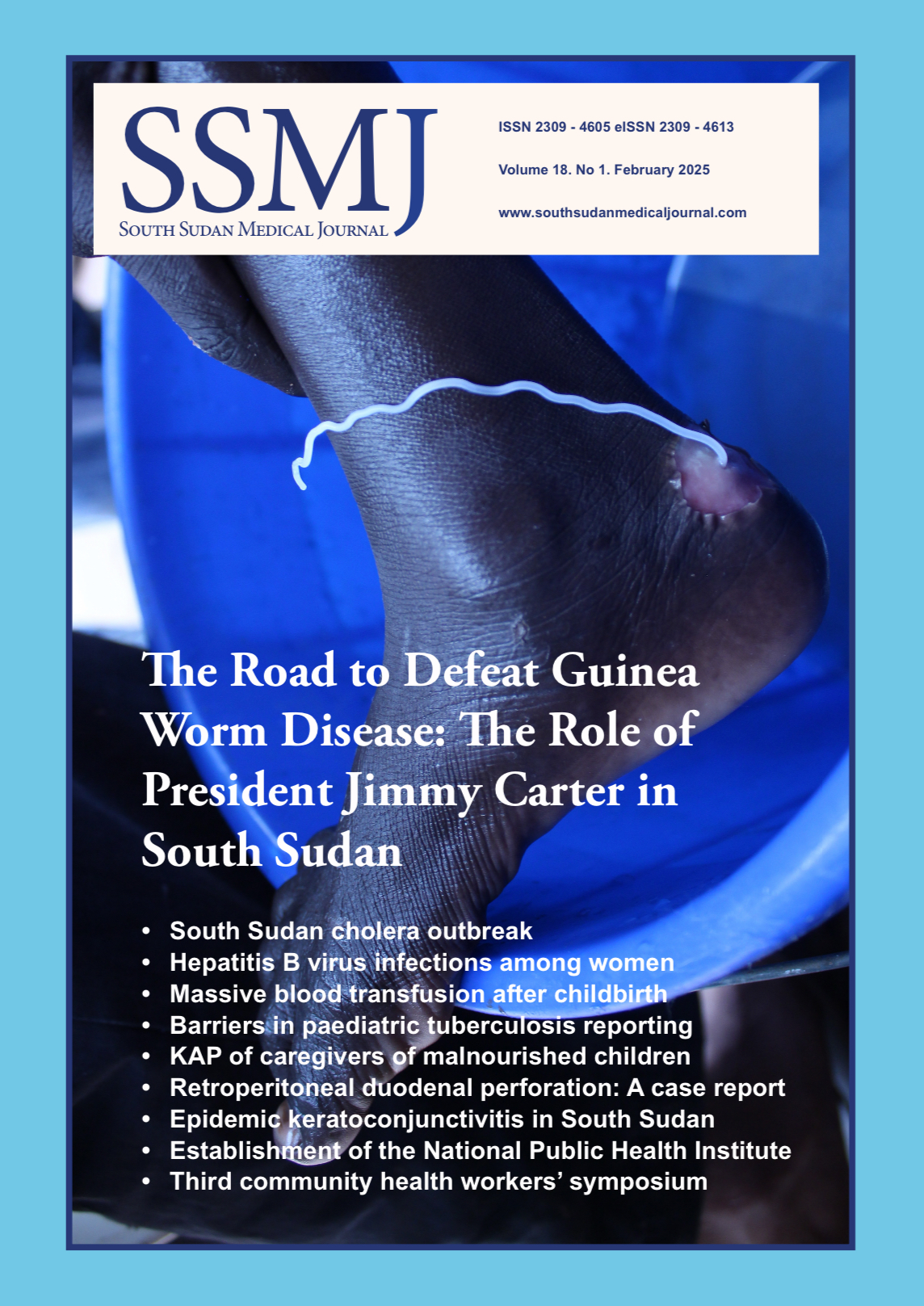
SSMJ February 2025 - South Sudan Medical Journal

Dear Reader,

The full issue of our February 2025 issue is online here; the articles are listed below. 

Editorial 
  • South Sudan cholera outbreak: A call to improve sanitation Ruot Garjiek Teny 
Research Articles 
  • Prevalence and associated risk factors of hepatitis B virus infections among women of reproductive age in Juba, South Sudan Ezbon WApary, Akway M. Cham, Oromo F. Seriano 
  • Management and outcome of women requiring massive blood transfusion after childbirth: A cross-sectional study at Muhimbili National Hospital, Tanzania Wangwe Peter Joseph, Sawe Eshi-Fisha Linda, Meda Elineema Robson 
  • Addressing barriers in paediatric tuberculosis reporting: A qualitative study of private healthcare providers’ perspectives Suryanti Chan, Idris Adewale Ahmed, Hamzah Hamzah 
  • Knowledge, attitudes, and practices of caregivers of malnourished children at the Al Sabbah Children’s Hospital, Juba, South Sudan Francis Beek Akook, Nyok Daniel Ngor 
Case Report 
  • Evaluation and surgical repair of retroperitoneal duodenal perforation following blunt trauma: A case report Rashmi Ranjan Sahoo, Abhinav Voona, Nalini Naik, and Jyotirmay Jena 
Main Articles 
  • Epidemic keratoconjunctivitis (Pink Eye) in South Sudan: A review Wani Mena The Establishment of the National Public Health Institute (NPHI) in South Sudan Nyinypiu Tong, Anthony Garang, Joseph Lako 
  • The third community health workers’ symposium, Liberia, 2023: What are the implications for South Sudan’s Boma Health Initiative? Kon Alier, Solomon Anguei, William Kuon, Christopher Ajumara 
Short Communications 
  • South Sudan’s journey to defeat Guinea Worm Disease: The role of President Jimmy Carter and the Carter Center Makoy Samuel Yibi Logora 
  • Letter to the Editor: President Jimmy Carter deserves a special recognition for his work to eradicate Guinea worm in South Sudan. Victor Vuni Joseph 
  • Letter to the Editor: Simulation-based education amid conflict: The Sudanese American Medical Association experience in Sudan Mohamed Almahal, Mohamed Ahmed, Omer Gomaa, Salaheldin Abusin, Ihab Abdalrahman
  • Obituary: Maj. Dr Santino Kuot Maluil 
  • Obituary: Dr Benjamin Peter Oduk 
See the back page for instructions on how to prepare and submit manuscripts for publishing in SSMJ.

Thanks to everyone who supports SSMJ - authors, editors, and, especially, our peer reviewers.

The SSMJ team
Email: southsudanmedicaljournal AT gmail.com
Website: http://www.southsudanmedicaljournal.com
Follow us on Twitter@SSMedJournal and our Facebook Group,

SSMJ is published by the Health and Social Science Research Institute of South Sudan (HSSRI-SS)

Copyright © 2025 South Sudan Medical Journal, All rights reserved

Previously on W2tQ:

Saturday, January 04, 2025

Are concepts of adolescence from the Global North appropriate for Africa? A debate

'The proponents for the motion argued that adolescence is indeed a distinct developmental phase when puberty is achieved and the neurocognitive development that occurs shapes behaviours that impact health outcomes. This occurs universally, is marked by cultural rites, and recognised in legal frameworks and therefore geographical distinctions in understanding are unnecessary.'

'The opponents argued that adolescence is more than a biological or legally recognised transition to adulthood: instead, concepts, including that of adolescence, are shaped by beliefs, values and expectations founded within a cultural milieu. The concept is dissonant to Africa as it prioritises individualism over communalism, and attributes gender and social roles as accepted in the Global North.'

'Thus, many interventions targeted at adolescents in Africa have remained ineffective. The notion that the concept of adolescence, which originated in the Global North but is universally applied, is a consequence of colonialism giving less value to the lived realities and understandings of peoples from the Global South.

For achieving both epistemic justice and effective health policy and programmes in global health, acknowledgement and centralisation of context are critical. However, in a more interlinked and open world, there is a massive potential for cross-learning and collaboration across geographies to develop a concerted approach to improve the health of adolescents and for a more equitable global health practice.

However, adolescence is also a social entity shaped by beliefs and values within different cultural contexts. A move away from universal, often western-defined concepts of adolescence, to centring the distinct sociocultural factors that shape adolescence in different societies will enable more effective policies and programming.' (Summary box) 

INDIVIDUAL
|
   INTERPERSONAL : SCIENCES              
humanistic ------------------------------- mechanistic
 SOCIOLOGY : POLITICAL   
|
GROUP
debate (argumentation)


mental space, mindset

my beliefs

values
expectations

ENCULTURATION

Not just NORTH - SOUTH 
but WEST - EAST
philosophy of mind
belief systems

"I DID IT MY WAY"

individualism
[Hodges' model] 'Health career' - 'life chances'

 2018 - scientific symposium
Mwanza, Tanzania

'Adolescence is widely defined as a distinct phase in the life-course during which an individual completes their biological development and transitions from childhood to adulthood.'

Appropriate for Africa - health interventions and global health policy that are shaped by such concepts can be universally applicable and relevant?

geographical distinctions

physical place, space, locale

biology - neurocognitive - puberty
communalism

universal - cultural rites

adolescence - global north culture
but applied universally

'adolescence is also a social entity shaped by beliefs and values within different cultural contexts'

ETHNOLOGY - SOCIO-CULTURAL

Gender - social roles

The rise of POPULAR CULTURE:
Arts - music, film, drama, literature ...
media, technology

"WE DO IT OUR WAY"?!

"Comme d'habitude"

legal - policy

Is there a universal conceptual model to critique*:

UNIVERSALITY
'GLOBAL HEALTH'
UNIVERSAL HEALTH COVERAGE
HEALTH FOR ALL
HEALTH INFORMATION FOR ALL
'COLLECTIVE EMPATHY'
EQUITY - EQUALITY ...?

In policy can you ignore LONG-LAT?

epistemic justice 
effective health policy
programmes in global health
- aimed at adolescents

acknowledgement
centralisation of context 

glocal/global - WHO - national/local


Many thanks to the authors:

Nothando Ngwenya, Chido Dziva Chikwari, Janet Seeley, Rashida Abbas Ferrand - Are concepts of adolescence from the Global North appropriate for Africa? A debate: BMJ Global Health 2023;8:e012614. https://gh.bmj.com/content/8/12/e012614

My source:
https://x.com/chidodc/status/1735564926423277571?s=20

Reminded of 'My Way' :: 'American Graffiti'

*I have long wondered what models of care, models of nursing, nursing and care theories may be found in Africa, across Europe, Asia, South America, Native North America, Australasia and Oceania?  
Is Hodges' model truly global and universal - is it (can a model of care be) culturally neutral? Perhaps, this is another conference debate, or might constitute a special journal issue?

Tuesday, December 31, 2024

Call for Abstracts (for Publication): "Visual Narratives, Aesthetics, and Decoloniality: Imagery and the Construction of the Other"

Mappæmundi is pleased to announce a call for papers for a collective publication on 

"Visual Narratives, Aesthetics, and Decoloniality: Imagery and the Construction of the Other"

Please find all the details below.

We invite contribution proposals for the edited volume Visual Narratives, Aesthetics, and Decoloniality: Imagery and the Construction of the Other. The book aims to critically examine the persistent influence of colonialism in shaping modern subjectivities, tracing its historical roots in the formation of Western modernity and interrogating its continued implications in contemporary contexts. It positions media and visual narratives as central discursive spaces where colonial legacies are both perpetuated and, potentially, contested. This volume conceptualizes and critically interrogates aesthetics as a foundational condition that establishes a visual lexicon integral to Western modernity. The aesthetic framework not only shapes the development of visual narratives but also plays a crucial role in the construction and perpetuation of varied subjectivities.

In particular, we focus on the critical analysis of the role of visual narratives within the framework of epistemological colonialism. Visual narratives have been central in defining, reinforcing, and legitimizing colonial ideologies by shaping perceptions and controlling representations of colonized peoples and cultures. These visual narratives have played a fundamental role in constructing colonial time and space, which were systematically controlled by Western epistemologies. This volume positions itself as a counterpoint to this colonial legacy, offering critical perspectives that challenge and re/deconstruct the visual lexicon of Western modernity. Through this lens, the book seeks to uncover pathways for alternative visual expressions that resist colonial frameworks and promote inclusive, decolonized understandings of identity and, more broadly, cultural production.

The arts, the media, and communication are powerful forces that can either perpetuate or challenge colonial legacies. Addressing and dismantling these legacies is essential for the creation of just, inclusive, and equitable societies - i.e., societies that value, embrace and benefit from the diversity of reason. From a decolonial lens, the book seeks not only to question the validity of established forms of knowledge but also to question the very criteria by which knowledge is defined. The objective is to contribute to critical discourses on potential pathways forward by amplifying cultural voices marginalized within the colonial matrix of power.  To this aim, we invite contributions that engage with scholarship in diaspora studies, subaltern and postcolonial studies, critical race studies, decolonial aesthetics, visual culture, and visual practices, with a particular emphasis on non-hegemonic epistemologies.

When bringing together these critical issues and perspectives, the book shall offer a comprehensive and interconnected framework for understanding postcolonial experiences in the 21st century. It will explore the role of aesthetics in shaping modern subjectivities, tracing the roots of domination in multiple paths toward modernity. This book intends to serve as an essential resource for scholars, researchers, activists, and the general public, encouraging deeper engagement with colonial histories that continue to shape contemporary life.

We especially encourage contributions from scholars, artists, and practitioners from the Global South that:

  • Engage in theoretical discussions on aesthetics and visual narratives from a decolonial perspective.
  • Combine theoretical frameworks with analyses that directly engage with visual arts, such as photography and other forms of artistic expression.
  • Discuss case studies that examine individual works of art, archives, photojournalistic projects, or other forms of visual narratives.
  • Explore media as a space for resisting and challenging colonial legacies.
  • Offer comprehensive analyses of how media and art contribute to the perpetuation or disruption of colonial ideologies.
  • Provide practical strategies and share lived experiences that contest colonial-rooted narratives.
  • Critique prevailing ideologies within the discursive spaces of media and art production and consumption.

Submission Details

The volume Visual Narratives, Aesthetics, and Decoloniality: Imagery and the Construction of the Other will be part of the Mappæmundi series published by Ventura Edizioni. It will be edited by Dr. Tomás Cajueiro (Universitat Autònoma de Barcelona) and Dr. Estevão Bosco (American College of the Mediterranean and the Latin American Social Science Faculty). The final publication will be exclusively in English. However, abstracts may be submitted in Portuguese, English, Spanish, or Italian. Once a proposal is accepted, authors will be responsible for translating their final chapters into English. Chapters should range from 20,000 to 40,000 characters, including spaces, and must incorporate visual materials to support the analysis of visual works. 

Proposals must be submitted to tomaskju AT gmail.com by April 4, 2025.

Theoretical and Textual Articles

Chapters may integrate theoretical insights with practical interventions or focus solely on theoretical exploration. Contributions can draw on real experiences from individuals, communities, and organizations. Potential research methods include literature reviews, case studies, comparative analyses, discourse analyses, and analyses of photographs and visual works. Abstracts should have a maximum of 5,000 characters, including references. Chapters should fall between 35,000 and 40,000 characters.

Visual narratives

For contributions focusing on the analysis of visual content, the textual component must range from 10,000 to 15,000 characters. The abstract, while limited to a maximum of 5.000 words, should also include an overview of the visual material being analyzed.

Important Dates 

Abstract Submission Deadline: April 4, 2025
Notification of Proposal Acceptance: May 11, 2025
Full Chapter Submission Deadline: September 11, 2025 
For more info: tomaskju AT gmail.com
--
Departamento de Filosofia, Comunicação e Informação
Faculdade de Letras da Universidade de Coimbra
3004-530 Coimbra, Portugal ... (and my source).

Friday, December 20, 2024

New citations - Practice Without Theory: A Philosophical Inquiry into Contemporary Nursing in South Asia

It is always welcome news when I learn of a paper (Asmat, 2024) recognising and citing Hodges' model from the nursing and wider literature. In this case an educational journal, focussed upon health and social care:

Kainat Asmat (2024). Practice Without Theory: A Philosophical Inquiry into Contemporary Nursing in South Asia: Nursing Practice without Theory. International Journal of Practice-based Learning in Health and Social Care. 12. 125-131. 10.18552/ijpblhsc.v12i2.1068. 

I have quoted at length, but it is good to have a different 'excuse' (not just extending the tail of a relevant book, or paper). ... 

'Similarly, Hodges' Health Career Model exemplifies its use as a tool for reflection during clinical assessments, care planning, and decision-making processes (Doyle & Jones, 2013). The model encourages nurses to reflect on their practice through multiple lenses, ensuring a comprehensive understanding of patient needs and care strategies. The Interpersonal domain emphasizes the relational aspects of nursing, including communication and empathy. The Sociological domain highlights the impact of societal factors and social determinants on health. The Scientific domain focuses on evidence-based practice and the integration of scientific knowledge into care. Finally, the Political domain addresses the influence of healthcare policies and organizational structures on contemporary nursing practice. In contemporary nursing practice, a nurse might use Hodges’ model to provide holistic and personalized care by considering the patient's social background, the scientific basis of their care, interpersonal dynamics, and relevant political or policy-related factors. According to Jones (2017), using conceptual models like Hodges' can greatly enhance nurses' critical thinking, fostering a reflective and engaged nursing workforce.' p.126.

'Collectively, nursing theory remains a cornerstone of contemporary nursing practice, providing an essential framework that guides clinical decision-making, promotes critical thinking, and supports reflective practice. Peter Jones, in his seminal works, underscores the critical role of theoretical models in enhancing nursing practice. His insights provide compelling evidence for the continued relevance of theory in contemporary practice. In "Humans, Information, and Science", Jones (1996a), articulates the interrelationship between human factors, informational processes, and scientific principles in healthcare. He argues that nursing, as a discipline, uniquely integrates these elements to form a comprehensive approach to patient care. This integration is fundamental in moving beyond task-oriented care towards a practice that is reflective and evidence-based. Jones emphasizes that without a theoretical foundation, contemporary nursing practice risks becoming fragmented and superficial, lacking the depth required for truly effective patient care. Similarly, in "An Overarching Theory of Health Communication",  Jones (1996b) explores the necessity of robust communication theories in healthcare. He posits that effective communication is not merely a skill but a complex process grounded in theoretical understanding. This perspective is particularly relevant to nursing, where communication is pivotal in patient interactions, interdisciplinary collaboration, and health education. Jones’ work illustrates that theoretical frameworks in communication enhance nurses' ability to engage with patients and colleagues thoughtfully and effectively, fostering better health outcomes and professional practice. Jones’ analyses reinforce the argument that nursing theory is indispensable in contemporary practice. Likewise, McEwen and Wills (2021) also highlight that nursing theory is integral to the development of nursing as a discipline. They assert that without the theoretical underpinnings, nursing risks regressing to a technical occupation devoid of critical thinking and judgment that characterize nursing professional practice. Thus, the survival and progression of nursing as a distinct profession depend on the continued integration and application of theory in contemporary nursing practice.' p.127.

In addition, the short conclusion is supportive and encouraging for ongoing efforts. As with all discovered citations thus far, I'm not sure of how Kainat Asmat located the publications on Hodges' model? A literature search - no doubt, or perhaps the blog's sidebar listing? The selection made, fits the author's purpose. 

Over the years, I've tried to indicate the scope and scale that Hodges' model can 'reach'. Especially in self-care, family, local, global and planetary health. Now, c/o Asmat (2024), Hodges' model has a much valued connection with South Asia. The required scope of Hodges' model (its inter- and transdisciplinary potential^) is also conceptual, referred to previously as holistic bandwidth. Hence the model's relevance and potential in theory and practice.

Many thanks to Kainat Asmat and the journal's editorial team.*

I will read again and return to the paper in our New Year.

Listed in the bibliography:

Doyle, M., Jones, P. (2013). Hodges’ Health Career Model and its role and potential application in forensic mental health nursing. Journal of Psychiatric and Mental Health Nursing. 20, 7, 631-640.
http://onlinelibrary.wiley.com/doi/10.1111/j.1365-2850.2012.01961.x/abstract

Jones, P. (1996a) Humans, Information, and Science, Journal of Advanced Nursing, 24(3),591-598. https://onlinelibrary.wiley.com/doi/abs/10.1046/j.1365-2648.1996.23321.x

Jones, P. (1996b) An overarching theory of health communication? Health Informatics Journal,2,1,28-34.

Where I have now added this paper.

^Still on the agenda as a paper; as with 'revisiting' 1996a. Happy to support others in referencing, or writing more specifically about Hodges' model (a case study, mapping exercise?); especially student nurses, carers and personnel in social care and early career researchers. To which, I'd better add later career nurses, allied disciplines, nurses returning to practice (surely a UK and global policy focus?) and proof of reading (your choice of course on the paper, chapter, book...); and reflection for continuing professional development (CPD). If you're still unsure, it was a relief to put the 'pen' down, well writing is still a major challenge (and pain) here. 

*And, of course - Brian E. Hodges RIP - too.
https://hodges-model.blogspot.com/2023/08/brian-e-hodges-r-i-p.html

Monday, December 16, 2024

Fragile: This way up - Frozen goods!

Apollo 17 'Blue Marble' Photograph
 
Apollo 17 1972 NASA Original Blue Marble Photograph

Or, some water 'heading your way' ...
'NASA’s archival designation for it is AS17-148-22727, and the original image was taken upside down with the South Pole at the top. In its myriad reproductions, it’s flipped up to match what we would normally expect to see.'

Text: https://www.thephoblographer.com/2013/12/09/behind-blue-marble/


Does the model still 'work' -

Group
|
 POLITICAL        :     SOCIOLOGY  
MECHANISTIC --------------------------------------  HUMANISTIC
            SCIENCES       :    INTERPERSONAL
|
Individual
POLITICAL

SOCIOLOGY

SCIENCES

INTERPERSONAL


- this way ...?

Image source: https://www.forum-conquete-spatiale.fr/t15428-apollo-17-1972

Prompt for 'Blue Marble' - Plate 1 in Brotton, J. (2024) The Four Points of the Compass: The Unexpected History of Direction, London: Allen Lane.

Previously: 'compass'

A planet is not just for Christmas.

Friday, March 10, 2023

Special Issue: Health and Human Rights Journal

Dear Colleagues and friends

I am writing to share with you the special issue of the Health and Human Rights Journal, which we are publishing to commemorate the first anniversary of the death of Paul Farmer. 

https://bit.ly/HHRSpecialIssue

Special Section in Volume 25, Issue 1, June 2023, published on the first anniversary of the death of Paul E. Farmer, former Editor-in-Chief, who worked for the right to health for all.

Kulina girl
"A decolonial gaze" by Angel Martínez-Hernáez


In it, you will find articles that expand the conception of the right to health, with significant contributions from the global South. We gather contributions from Africa, South Asia, Latin America, Eastern Europe, North America, and Western Europe.

The articles are positioned from a wide range of critical perspectives, such as Social Medicine, Collective Health, Latin American Critical Medical Anthropology, the Indigenous Research Paradigm, Human Rights Pedagogy, and Structural Competency.

We hope that these works will inspire your reflections and practices. We'd like to thank you in advance for sharing them.

Yours faithfully.

Carlos Piñones-Rivera, Ángel Martínez-Hernáez, Michelle E. Morse,
Kavya Nambiar, Joel Ferrall, and Seth M. Holmes

Dr. Carlos Piñones Rivera
Departamento de Ciencias Sociales (DECSO)
Universidad de Tarapacá, Chile

Posted (and my source) from the Spiritof1848 Listserv WWW.SPIRITOF1848.ORG #Spiritof1848

(Edited from original - thanks to Carlos and Ángel).

Tuesday, November 29, 2022

From: The Communication Initiative (The CI) [ or The impact of Geo-Politics ]

With many thanks to Kier and 'The CI' Community ...
 
Dear Peter Jones,

Warm greetings from The Communication Initiative (The CI) - https://www.comminit.com

Thanks so much for contacting us on November 25th to submit/share your work. I am writing to let you know that we have added a summary of "Hodges' Model: The Sustainable Development Goals and Public Health - Universal Health Coverage Demands a Universal Framework" to The CI website. Please do me the favour of reviewing the summary here - xxxxxxx - and sending along any feedback you may have. I will be glad to make the necessary changes promptly.

For more information on our editorial objectives and the principles that guide our posting of information, please see: https://www.comminit.com/global/content/editorial-policy-ci-global

In the future, this summary may be featured in our e-newsletters, including The Drum Beat and Drum Beat Clicks. If you wish to subscribe to these mailings so you can see when your work is featured and read about other relevant programmes and resources, simply log into your registration page: xxxxxxxx

We plan to spread the word about this summary via social media and would appreciate it if you might do the same.

Kind regards,
Kier

Kier Olsen DeVries, MA
Senior Editor, The Communication Initiative
Editor, The Drum Beat
kdevries AT comminit.com
https://www.comminit.com
Facebook: The Communication Initiative Network
https://www.facebook.com/The-Communication-Initiative-Network-344005148956579/
https://twitter.com/warrencomminit

PJ - The paper in question (is listed in the bibliography - please see the blog's sidebar):

Jones P, Wirnitzer K. Hodges’ model: the Sustainable Development Goals and public health – universal health coverage demands a universal framework. BMJ Nutrition, Prevention & Health 2022;0:e000254. doi:10.1136/bmjnph-2021-000254

Saturday, November 05, 2022

Lab rats ... Experiment ongoing ... c/o BBC Radio 4


 INDIVIDUAL
|
 INTERPERSONAL    :     SCIENCES               
HUMANISTIC --------------------------------------  MECHANISTIC      
SOCIOLOGY  :   POLITICAL 
|
GROUP

define: pacific

psychological resource (fight)

lab rats, guinea pigs

'piece of kit', equipment

"out of sight (a hemisphere away!)"

welfare & wellbeing

Armed Forces Covenant

Group - who is left?

informed consent

the State: Test veterans

What did you say 'pacific' means?


British Nuclear Test Veterans Association BNTVA

Friday, November 04, 2022

Editorial: "COP27 climate change conference: urgent action needed for Africa and the world" c/o HIFA

Dear HIFA colleagues,

Chris Zielinski and colleagues achieved a remarkable feat by publishing a climate emergency editorial simultaneously in more than 250 journals. What does this tell us about communicating health research to policymakers?

https://bjsm.bmj.com/content/early/2022/10/18/bjsports-2022-106442

The point was 'to demonstrate the united will of the medical profession, including all areas (nursing, mental health, veterinary medicine, etc.), to combat the health effects of climate change'.

The key message of the authors is to urge 'wealthy nations to finally step up', particularly to realise 'the promised target of providing US$100 billion of climate finance a year... ensuring these resources focus on increasing resilience to the existing and inevitable future impacts of the climate crisis, as well as on supporting vulnerable nations to reduce their greenhouse gas emissions'.

The message is supported by a well-worded case, and by a string of references to published research.

The piece is jointly authored by the editors of medical journals, which was presumably a deliberate decision to emphasise solidarity rather than including climate scientists and others.

In relation to 'communicating health research to policymakers' the exercise suggests more can be achieved when scientists work in solidarity and cooperatively than individually and in competition.

It will be interesting to see what happens at COP27. Will there be major steps forward along the lines that this editorial calls for? If so, what were the key contributing factors to the decisions made? One suspects the shared voices of 250-plus journals will play an important role. Moreover, their solidarity and cooperation is in place and ready to take on the next major advocacy challenge.

Best wishes, Neil

Joint Coordinator, HIFA Communicating health research https://www.hifa.org/projects/new-effective-communication-health-research-policymakers

Neil Pakenham-Walsh, Global Coordinator HIFA, www.hifa.org neil AT hifa.org Global Healthcare Information Network: Working in official relations with WHO

Thursday, December 16, 2021

Oncology nursing in the Global South during COVID-19

A new special issue published in ecancer includes narratives from oncology nurses across the world describing the psychosocial effects of the COVID-19 pandemic on their family and work lives.

Oncology nurses and their patients face a double burden in Lower and Middle Income Countries (LMICs), where resources are limited under normal circumstances and now must accommodate pandemic-related challenges.  The special issue includes personal reports and narratives describing the the early psychosocial effects of the pandemic, for example lockdowns and increased staff shortages due to diversion to COVID-19 wards or vulnerable nurses with chronic conditions or pregnancy staying at home while some became infected with COVID-19 and died.

The significance of the oncology nurse’s contribution to the care of people with cancer is more relevant than ever before due to their role as the cornerstone of health services, either on the frontline offering compassionate care or in leadership, research and education.

The special issue is open access and can be read here:

https://ecancer.org/en/journal/special-issue/30-oncology-nursing-in-the-global-south-during-covid-19

Katie Foxall
Head of Publishing

+44(0) 117 942 085213 King Square Avenue, Bristol, BS2 8HU

HIFA profile: Katie Foxall is Head of Publishing at eCancer, Bristol, UK. katie AT ecancer.org

My source: HIFA

Saturday, November 13, 2021

Living on the Edge: 'Counting the Coast'

Individual
|

INTERPERSONAL : SCIENCES
humanistic ------------------------------------------ mechanistic
SOCIOLOGY : POLITICAL
|
Group
COAST*
C
O
A
S

T

COAST

C
O
A
S
T

COAST
COAST"
C
O
A
S
T
COAST
COST

C
O
S
T
COST^

*Coast - a spiritual place - this 'home' where I imagine and dream - as our people have done for ages.

"Coast - where grandmother, grandfather and elders explain to me where the coast used to be ...

^cost - 'the bottom line'


 My source: BBC World Service, Business Report - COP26

Mention of the challenge for governments of island nations to persuade their peoples and communities to move from the coast, to be resettled and the ultimate prospect of whole islands / nations being lost, with the need for mass migration.


Thursday, January 07, 2021

Special Malaria Issue: South Sudan Medical Journal

EDITORIAL

Special Malaria Issue

South Sudan’s New National Malaria Strategic Plan 2021-2025 is a Game Changer

Harriet Akello Pasquale

Director, National Malaria Control Program, National Ministry of Health, Republic of South Sudan

The Ministry of Health of the Republic of South Sudan has just approved an ambitious 5-year National Malaria Strategic Plan 2020-2025 to control and prevent malaria, the third since South Sudan became an independent country in 2011. Read more.


See all articles from Issue 13 5 December 2020


We look forward to receiving manuscripts relevant to health care in South Sudan from you  - remember we can help you prepare these.  Also, encourage colleagues to join the mailing list here, follow us on Twitter @SSMedJournal and find previous SSMJ articles at African Journals Online (AJOL) and the Directory of Open Access Journals (DOAJ).

Kind regards,

The SSMJ team
Email: admin AT southernsudanmedicaljournal.com

Thursday, May 23, 2019

New Special Issue from Global Public Health

From: Global Public Health
Sent: Monday, May 20, 2019 10:41 AM
Subject: New Special Issue from Global Public Health

Please join Global Public Health in celebrating the launch of our newest special issue:


This special issue considers the legacy of the Latin American Social Medicine and Collective Health (LASM-CH) movements and other key approaches—including human rights activism and popular opposition to neoliberal governance—that have each distinguished struggles for collective health in Latin America during the 20th and now into the 21st century.

At a time when global health worldwide has been pushed to adopt increasingly conservative agendas in the wake of global financial crisis, the rise of radical-right populist politics, and the rupture of liberal democratic regimes, attention to legacies of Latin America’s epistemological innovations and social movement action are especially warranted. Examining the nexus of activism, policy, and health equity, the collection advances understanding of health politics in the region and the lessons they offer.


This special issue includes four Free Access articles. We invite you to share the links to these articles (see below) and details about the special issue across your networks.

Richard Parker, Editor in Chief

Featuring 4 Free Access Papers

Social inequities and contemporary struggles for collective health in Latin America
Emily E. Vasquez, Amaya Perez-Brumer, and Richard G. Parker

Social Medicine and International Expert Networks in Latin America, 1930-1945
Eric Carter

Latin American social medicine across borders: South–South cooperation and the making of health solidarity
Anne-Emanuelle Birn & Carles Muntaner

Revisiting the social determinants of health agenda from the global South
Elis Borde & Mario Hernández

My source:
Spirit of 1848 Listserve. WWW.SPIRITOF1848.ORG

Sunday, February 25, 2018

2nd Planetary Health Annual Meeting in Edinburgh

Since learning about the 2nd Planetary Health Annual Meeting in Edinburgh late last year, I realise I didn't post the news, which is a gift in terms of the purposes of Hodges' model. So, this post celebrates what is a vital subject and call for action and an invite to present a poster. Unfortunately regards the poster, in my haste I did not check the registration terms and the applicable early bird fee of £250 is too much for me personally. If you are a student, or resident citizen of a low and middle income countries opportunity knocks with a welcome reduced early bird registration fee until 9 March.

The planet and planetary health have featured here on W2tQ, on the now defunct website 1998-2015 and in papers, notably:

Jones, P. (2008) Exploring Serres’ Atlas, Hodges’ Knowledge Domains and the Fusion of Informatics and Cultural Horizons, IN Kidd, T., Chen, I. (Eds.) Social Information Technology Connecting Society and Cultural Issues, Idea Group Publishing, Inc. Chap. 7, pp. 96-109.

 Jones, P. (2012). Exploring several dimensions of local, global and glocal using the generic conceptual framework Hodges's model. The Journal Of Community Informatics. 8(3). Retrieved from http://ci-journal.net/index.php/ciej/article/view/876/

Jones P. Exploring the relationship of threshold concepts and Hodges’ model of care from the individual to populations and global health. Rev Cuid. 2017; 8(3): 1697-720. http://dx.doi.org/10.15649/cuidarte.v8i3.464

Another short paper is under review on Hodges' model and the Sustainable Development Goals.

Amid the embarrassment of having to turn the offer down I will follow developments with keen interest and hope that another opportunity may arise.

Thursday, November 09, 2017

Due South - 360 degree perspectives


Andy Goldsworthy "Touching North" (1989)

Being a cultural theorist the concept of ‘the south’ is particularly interesting to me (as are the other points of the compass, since they are often set in binaries and have values attached to them when set in opposition – for example the North/South divide in Britain). Coverley begins the introduction by showing us a 17th century map of the south pole and then describes the work by the artist Andy Goldsworthy entitled Touching North (1989) (see below). Touching North was situated at the North Pole, with the four individual parts of the sculpture facing each other and also outwards, with holes in the centre providing them with an opening which enabled them a space accessible from anywhere and everywhere. Coverley says that the sculpture “demonstrates how the directions of the compass may effectively be rendered meaningless: emerge through any of the four arches and one finds oneself heading south” (page 9). From:
http://particulations.blogspot.co.uk/2016/12/south-by-merlin-coverley.html


INDIVIDUAL
|
interpersonal : science
humanistic --------------------------------------- mechanistic
sociology : political
|
GROUP and POPULATION


N


S

NORTH?


SOUTH?


Photo: "Touching North" from:
http://beautifuldecay.com/wp-content/uploads/2014/01/goldsworthy-andy-1989-touching-north.jpg

Additional link:
http://www.goldsworthy.cc.gla.ac.uk/
