Hodges' Model: Welcome to the QUAD: parity

Hodges' model is a conceptual framework to support reflection and critical thinking. Situated, the model can help integrate all disciplines (academic and professional). Amid news items, are posts that illustrate the scope and application of the model. A bibliography and A4 template are provided in the sidebar. Welcome to the QUAD ...

Showing posts with label parity. Show all posts

Friday, March 13, 2026

'GlobalMinds' - NHS study severe mental health problems

Together we can change lives

Depression, bipolar, schizophrenia and related conditions affect millions of people around the world.

Yet mental health receives less than 1% of global research funding. 

This has left healthcare for these conditions stuck in the past:

Cross icon

Diagnosis can take years

Cross icon

Treatments target symptoms, not underlying causes

Cross icon

Half of the prescribed drugs cause severe side effects

GlobalMinds is a major research programme seeking to advance the understanding of mental health conditions and improve lives.


My source: 
News, NHS study to transform mental health treatment, The Times, 14 February, 2026, p.6

Sunday, July 20, 2025

Infracare - Hodges' Health Career - Care Domains - Model

Trying to sort papers again, I'd saved the article by Floridi (below) the title having caught my attention.

If Hodges' model has a meta-function, there is also a role in the infrastructure of care.

There is an opportunity for me to do the proverbial '360' exercise, visit each of the care domains in turn and literally throw in the kitchen sink:

Individual
|
      INTERPERSONAL    :     SCIENCES               
HUMANISTIC  --------------------------------------  MECHANISTIC      
 SOCIOLOGY  :    POLITICAL 
|
Group

I see you! Who you are.

 person-centred  care 

IDENTITY (identities)

A model of care -

A theory of (health) communication

Information theoretic, information disorder 
 and relational studies


 person-centred care 

I see you! Who you are.

identity - (IDENTITIES)

- addressing Parity of Esteem in -

- Practice & Research

Information theoretic, information disorder 
 and relational studies

NHS and Social  Care

Community Care as a resource

Self care education and health promotion built in to education system

Value Social Capital
Law and Justice to
protect and secure Peoples & Populations

Policy - National & Global
that supports health and health promotion

Declared integrated care
care philosophy

Adopted generic model for self, national and global and planetary health


Infraethics, Luciano Floridi. January 2013. The Philosophers Magazine. DOI: 10.5840/tpm20136010

Wednesday, July 16, 2025

'Proper domain' c/o Machery 2017

On a visit to London 4-7th, in Foyles on Charing Cross Road amongst many desirable titles I came across:

Machery, Edouard, Philosophy Within Its Proper Bounds (Oxford, 2017; online edn, Oxford Academic, 24 Aug. 2017), https://doi.org/10.1093/oso/9780198807520.001.0001, accessed 24 June 2025.


Philosophy and knowledge are in constant play: hide and seek. So the title's 'proper bounds' piqued my interest. I found a previous paper by Machery, also cited in the book:

MACHERY, E. (2011). THOUGHT EXPERIMENTS AND PHILOSOPHICAL KNOWLEDGE. Metaphilosophy, 42(3), 191–214. http://www.jstor.org/stable/24439937

The paper is technical (as 'metaphilosophy' suggests) with discussion of thought experiments, parity defence, but there is utility here:
'If we have reason to suspect that a physical skill or a psychological capacity is applied outside its proper domain, our confidence in the success of this application should decrease. If we have no further information about the circumstances in which the skill or capacity is applied or about how these circumstances impact its reliability, then, for all we know, the reliability of the skill or capacity in this particular application might be almost as high as it is in its proper domain, or it might be very low: that is, we have a reason to believe that its reliability is lower than in its proper domain, but we do not know how low it is. In these conditions, we should be reluctant to express much confidence in the success of the application of the skill or capacity'. p.201.

I'm hoping for an e-copy of the book, which avoiding even more screen-time, I won't read through (review - as I call it...) but I will search, read selectively and post again.

Tuesday, February 06, 2024

'Other exhausted words' ... ?

"A writer I admire expresses in a few words his disdain for plausible but empty political language, beginning with one good example. "The word, Fascism," he writes, "has now no meaning insofar as it signifies 'something not desirable.'" He adds other exhausted words, including democracy, freedom and patriotic - convenient terms for establishing righteousness, easily melting into self-righteousness.

The writer is George Orwell, in his celebrated 1946 essay "Politics and the English Language." Orwell contended that language had become corrupt and debased in his time, but the survival of his examples into the present contradicts him, suggesting that not only the problem but the very examples may be timeless."

Plain, direct language remains rare, desirable - and risky in ways that authority, even more than the rest of us, tries to avoid." ...

... "Dilution of meaning is familiar in a way that can make us feel comfortable, or even worse, comfortably righteous."

Individual
   |
      INTERPERSONAL    :     SCIENCES               
HUMANISTIC  --------------------------------------  MECHANISTIC      
 SOCIOLOGY  :   POLITICAL 
|
Group
concept

critical thinking

parity


framework

evidence-based

transformation


holistic care

integrated care

person-centred


outcomes

prevention

sustainable health care


n.b. With some words more exhausted than others; while some have not, as yet, been fully exercised.

Pinsky, R. When language fails us and the moment. The New York Times International Edition. January 30, 2024, p.12.

Previously: 

Wednesday, July 05, 2023

NHS 75 Years - Happy Birthday!


"Here's looking at you kid."


INDIVIDUAL
|
INTERPERSONAL    :     SCIENCES               
HUMANISTIC --------------------------------------  MECHANISTIC      
SOCIOLOGY  :   POLITICAL 
|
GROUP
53.38737144811205, -2.6100497479996965
Peter Jones 20 June, 2023, Warrington, UK


SOCIETY
PUBLIC SERVICES


- and in another 75 years!

My source: 'Night Vision A full moon is framed perfectly, creating the impression of a watchful presence behind the North Window desert rock formation in Arches National Park, Utah. ELLIOT MCGUCKEN/ANIMAL NEWS AGENCY. The Times, 22nd June 2023, p.32.
(Photo source: https://petapixel.com/2023/06/23/photographer-captures-full-moon-that-looks-like-a-giant-eye/)

NHS75 image - 
https://twitter.com/NCFCareForum/status/1676478578693664770?s=20

Wednesday, June 21, 2023

Thanks for the memories . . .

. . . may they last your life time and then some . . .

INDIVIDUAL
|
INTERPERSONAL    :     SCIENCES               
HUMANISTIC --------------------------------------  MECHANISTIC      
SOCIOLOGY  :   POLITICAL 
|
GROUP
53.38737144811205, -2.6100497479996965
Peter Jones 20 June, 2023, Warrington, UK

 self-storage (physical)


Photo: Peter Jones 20th June, 2023, Warrington, UK.

Thursday, October 06, 2022

PROCESS 0 : 4 DOMAINS

No, 0 - 4 is not a sports score.   

Quite a while ago and over several years I associated 4P's with each of the domains of the model:

SCIENCES: process
SOCIOLOGY: practice
POLITICAL: policy
INTRA- INTERPERSONAL: purpose

 
Although, this brings home the model's being an idealisation - there remains much to learn and discover. In addition to physical processes there are political, psychological, social processes too. If you were to prioritise the concept of PROCESS across the model how would you do this?
 
My take - which could (will) differ tomorrow - and could well do so if the context was specific. 
 
I've tended to think of triage, physical and psychiatric emergencies the focus being on the SCIENCE domain (ABC medical emergency...!) and that is the starting point. If triage is excluded, then #MyNameIs follows crucially in obtaining a comprehensive assessment and addressing 1-1 parity of esteem. There is a need to (really) attend to the INTERPERSONAL domain.
 
In a way the 'individual' domains INTERPERSONAL - SCIENCES should (must) collapse into one. This is to help assure, strive to achieve person-centred and integrated care; and not to reduce, rationalise, and generalise the nurse curriculum. We need mental health nurses equipped for the 21st century.
 
Reflecting on this though I'm jumping ahead.
 
We actually start with the POLITICAL domain 0 - below. With nurses in the UK being balloted on strike action this is difficult medicine to swallow, but there we are. Globally, we saw the literal power of the POLITICAL domain in health during the (ongoing) pandemic. We will do so again in future security, health, and climate challenges to follow. We don't want future generations to face ours, they will have their own.

 INDIVIDUAL
|
 INTERPERSONAL    :     SCIENCES               
HUMANISTIC --------------------------------------  MECHANISTIC      
SOCIOLOGY  :   POLITICAL 
|
GROUP
3
1
2
0

Spiritual - 4

So, in 0 is there an advanced directive? Even before this, can I as a nurse, or other practitioner - nurse, treat, care ... for this person? Do we have consent - can they give consent? Is there a Dr 'in the house', a responsible medic? Have they been admitted, their referral accepted and acknowledged? Are there cultural or religious reasons not to proceed as we might otherwise? POLICY, safety, protocol also dictates that if we are a first responder then we do not become a casualty - that is obviously undesirable. So we are checking the environment (SCIENCES domain 1*) - the specific context.

THEN - I'm selecting 2 the SOCIOLOGY domain. The information obtained from the person (if any) is crucial to what follows. The 'if any' is non-trivial too were the INTERPERSONAL domain 3 is concerned (and the aforementioned collapse [3-1]. Even if the person declines, or is unable to communicate with us, we can still glean essential details about physical AND mental status. So, yes, the specialist skills of the practitioner and lived experienced colleagues really do matter.

With the SPIRITUAL domain (which can encompass the model) we close a circle, back to the religious, cultural, human rights and values dimensions acknowledged above. This conjunction of political and spiritual is a little surprising in global terms, and so maybe encouraging too.

*Yes, the SOCIOLOGY domain 2 also. You may think you are only going to visit a 79 year old man/women; not realising that their grandchild also arrives with a forensic history. This could be a very positive rewarding encounter, or otherwise.


Sunday, August 07, 2016

Future of Mental Health Nurse Training - Generic Course

It is an old debate: the generalist versus specialist. In nursing it's the divide in the tree of knowledge that gives us the branches of adult - general  and mental health nursing. Never unique this physical-mental, mind-body divide is repeated. A fractal feature of being human.

Without checking these two camps have been mentioned on W2tQ previously. Ever defensive I have probably been responding to the critique so readily aimed at Hodges' model:

Well, it is plain to see and read from the model that it is reinforcing the Cartesian division. The model is putting the patient in a box, not only that but using the medical model's reductionist practice by having four boxes. The model acts as an elaborated checklist.

individual
|
INTERPERSONAL : SCIENCES
humanistic ---------------------------------------  mechanistic
SOCIOLOGY : POLITICAL
|
group

MENTAL HEALTH CARE

PHYSICAL CARE


On the 15th I am 39. Yes, I wish I was. On the 15th it is 39 years since I started as a Nursing Assistant at Winwick Hospital, Warrington, UK. The change in mental health since then has been phenomenal. Winwick is gone as the local, or one of several regional asylums.

There is a proposal for students to specialise in the last year of training, to ensure there is an adequate grounding in physical care. The concern is that mental health skills will be diluted. There is some progress to be gained, ironically, in that suddenly the training will mirror what is experienced by the public and mental health services in terms of parity and spending.


MENTAL HEALTH CARE


PHYSICAL CARE


If we want to demonstrate nursing as a science and art let's mix the blue and green:


MENTAL HEALTH CARE and PHYSICAL CARE


SOCIOLOGY domain

POLITICAL domain

Voila! 50% of the work of the model is done. You wanted integrated care; you got integrated care: everything is all 70s Hunky Dory.

Of course, it is never that simple.

I've picked this issue up after it featured in Nursing Times (Stephenson, 2016) last month. Among the points raised:

  • Mental health risks being sidelined. 
  • Dilution of the mental health specialty could have a "devastating" impact.
  • Some mental health courses have already be revised to incorporate more generic content. This can leave students with the "the worst of both worlds". There is a risk of a bias to adult nursing. 
  • Recruitment and differences in the appeal of courses is also noted, mental health candidates may already have related qualifications and more life experience.
  • There is a need for a responsive and flexible workforce who can work pretty much anywhere (pp.2-3).

It seems as if there is climate for merger and acquisitions activity. In truth it has been there for a long time.

Mental health has changed. From my limited perspective I have not needed a work-issued briefcase for a decade. There was one case for us to use as needed. This one facet of a service-defined stepped care model that reflects change. From institution issue 3-piece suit plus white coats to smart-casual on the community. It is several years since I last needed to give an i.m. injection. I do feel I could tomorrow if needed, but if it is Risperidone - Consta I would once again need to read about the client and digest the info leaflet before doing the visit. Questions about competence are the constant. Believe me I'm not wishing for a return for the old-days: I remember it very well.

As a sign-off mentor there has been a panic to find a student the necessary experience. Now it seems there is less urgency in this respect. This is a positive sign in terms of mental health nursing and social change and yet a loss of a clinical skill being learned and exercised.

The emphasis over the past 1-2 decades is on nursing assessment. The nurse as therapist in the formal - psychological sense is no longer emphasised. A further diminution of mental health nursing. This may be a bias on my part, as a new community psychiatric nurse in the 1980s.

Where I mention merger and acquisitions above, what of interest rates? What difference will the loss of the student bursary make? Workforce planners may benefit from more certainty and an increase in numbers, but what of the quality of the future workforce? This is a crucial factor in retention. I came to mental health nursing first then did two years for the SRN - RGN. Currently, some courses are structured such that in the first 6 months the student is already committed to the pathway. Change is not possible even if desired.

At the very least this suggests the need for a four year course?

The locus of my nursing career has been the community and begs the question: Is the project complete? The media and countless promises on mental health funding (ongoing) show that this is far from the case. Where would this place children's mental health, women's services and forensic? Has the reduction in beds been compensated for by community resources?

But ALL the above misses another agenda; one that is now: 21st century nursing; (this is also represented in the third rendering of Hodges' model above).

Policy makers must address the social and political foundations upon which all nurses, social workers and allied health professions (theorize and) practice.

Where is the workforce that will help the public to self-care? Where is the focus on prevention? How are those 'troubled families' doing?

There is a prospective dividend to follow from big-data, that can extend this debate to the real questions of - society, policy, and life-styles - and provide evidence for real change. Finally:

Where is the generic conceptual framework to help integrate physical - general nursing and mental health?

Stephenson, J. (2016). Rift over move to 'generic' courses. Nursing Times, 20.07.16. 112:29, 2-3.

Friday, September 04, 2015

A rolling issue: Parity of esteem in physical & mental healthcare

individual
|
INTERPERSONAL : SCIENCES
humanistic --------------------------------------- mechanistic
SOCIOLOGY : POLITICAL
|
group


"What about social care?"


"Did you hear something then?"


Image source:
http://coconutheadsets.com/2009/12/29/sisyphus-for-startups/

Sunday, June 28, 2015

Non-Cartesian points, opposing corners and capital redux

individual
|
INTERPERSONAL : SCIENCES
humanistic --------------------------------------- mechanistic
SOCIOLOGY : POLITICAL
|
group
"I felt


capital Patient?


Patient capital?

like
 the
 mad
man
 in the corner,"


senior NHS figure said of recent top level meetings discussing the financial travails and sliding performance of the provider sector. ... The delineation between these two camps is becoming clearer. ... p.3 


Source: McLellan, A. (2015) Leader: Modernisers must cut the deficit to keep their side of the deal. Health Service Journal, 3 June. 125;6449:p.3.

See also:
Capital 'p': Patient, Person, Person-centred, Personhood

Friday, March 27, 2015

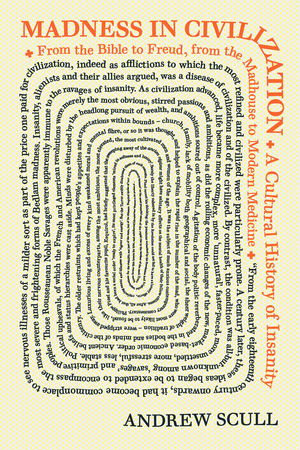
Book: Madness in Civilization - A cultural history of insanity

individual
INTERPERSONAL : SCIENCES
humanistic ------------------------------------------- mechanistic
SOCIOLOGY : POLITICAL
group
Need for asylum
http://press.princeton.edu/titles/10439.html
Book cover: Madness in Civilization
physical health
diagnosis
treatments

stigma, sense making, community care,
social history

power, institutionalised care, custodial,
parity of esteem, 'asylum'


Image source:
https://press.princeton.edu/books/hardcover/9780691166155/madness-in-civilization

Friday, October 10, 2014

WMHD II c/o LSE: Investing in crisis care for people with schizophrenia makes moral and economic sense

“When someone has a mental health crisis, it is distressing and frightening for them as well as the people around them. Urgent and compassionate care in a safe place is essential – a police cell should never need to be used because mental health services are not available. For me, crisis care is the most stark example of the lack of equality between mental and physical health.” 
(The Rt Hon Norman Lamb MP, Care and Support Minister)
There is a strong moral and economic case for investing in innovative approaches that support people with schizophrenia to live independently in the community. Crisis resolution and home treatment teams and crisis houses can help reduce the need for expensive hospital admissions with some studies suggesting that the costs of care can be reduced by up to 30% through these service models. There is a clear potential for Clinical Commissioning Groups to make better use of their resources by investing in home treatment teams and crisis houses as approaches to crisis resolution.
My source: The London School of Economics and Political Science, Health and Social Care blog email

Hodges' model in recovery ...
Jones P. (2014) Using a conceptual framework to explore the dimensions of recovery and their relationship to service user choice and self-determination. International Journal of Person Centered Medicine. Vol 3, No 4, (2013) pp.305-311.

World Mental Health Day 2014: or...

https://www.time-to-change.org.uk/sites/default/files/WMHD%202014%20EVENTS%20POSTER%20FINAL.pdf
https://www.time-to-change.org.uk/WMHD


http://www.mentalhealth.org.uk/our-work/world-mental-health-day/world-mental-health-day-2014/

or - World Parity of Esteem Day 2014?

Friday, May 16, 2014

If you must rumple the care domains - rumple them together

individual
INTERPERSONAL : SCIENCES
humanistic ------------------------------------------- mechanistic
SOCIOLOGY : POLITICAL
group

'A Man’s body and his mind, 
with the utmost reverence to both I speak it, 
are exactly like a jerkin, and a jerkin’s lining; – 
rumple the one – you rumple the other.’ 1


1 Sterne L. The Life and Opinions of Tristram Shandy, Gentleman (1761), vol. 3, ch. 4 (eds M New, J New). University of Florida Press, 1978.

Source: Royal College of Psychiatrists (2013) Whole-person care: from rhetoric to reality Achieving parity between mental and physical health. Occasional Paper 88, March 2013. p.2.

Wednesday, November 13, 2013

Held in equal esteem: Physical health and Mental health

As a mental health nurse you are familiar with concept of ‘esteem’. Self-esteem is central within assessments of clients, central to all care workers as safe and effective practitioners; and self esteem tests carers in those people for whom their condition means self-esteem is something attributed by proxy.

I noticed just recently use of the term esteem applied to the disparity between physical health and mental health. The two upper-most domains in Hodges' model (interpersonal and sciences) draw attention to the historical duality of mind and body. To integrate the two means acknowledging differences and this is acute in terms of finance, research and treatment plus many other measures.

The limitations of my emphasis in a series of previous posts on holism, holistic care, holistic approaches become apparent as long as the political domain is not addressed. You can be as holistic as you like, identifying, processing and integrating the full remit of health care concepts relevant in a case. If esteem is not achieved then the benefits of being holistic must be severely damaged. They may even be considered futile politically (speaking - just a whisper)?

Through the links below this post demonstrates that esteem is stirring in the political, policy and legislative domain and is being addressed, even if a solution will not arrive overnight.

My original sources: New Scientist, the HSJ and BBC.

Nick Craddock (2013) Opinion: Where's our Higgs? New Scientist, 27 April, 2914; pp.30-31.
Psychiatry needs the star quality of physics to help recruit top academics and fight the scourge of mental illness - this opinion piece concludes:

So, in 2013, psychiatry has powerful scientific tools and a developing narrative that already points to strong theoretical bases. Yet, in the UK research into mental illness is stalled at around 5 per cent of the annual medical research budget, and the picture is similar in other rich countries. That will have to change – and governments and funders are starting to see this. The door is open: all that is needed is for more of the best to come in and find out just how hot psychiatry really is.

‘Esteem gap’ between mental and physical health remains
10 October, 2013 | By Alastair McLellan
The government knows the challenges the facing mental health sector, but without radical solutions the goal of treating mental and physical health service users on an equal footing seems as far away as ever.
http://www.hsj.co.uk/opinion/leader/esteem-gap-between-mental-and-physical-health-remains/5064120.article

Debate on 10 October: Parity of Esteem for Mental and Physical Health - Lords Library Note
http://www.parliament.uk/briefing-papers/lln-2013-024/debate-on-10-october-parity-of-esteem-for-mental-and-physical-health

Lords debate – Parliament TV:
http://www.parliamentlive.tv/Main/Player.aspx?meetingId=13879&st=11:51:20

Royal College of Psychiatrists: OP88. Whole-person Care: from rhetoric to reality (Achieving parity between mental and physical health)
https://core.ac.uk/download/pdf/34719468.pdf