Hodges' Model: Welcome to the QUAD: priority

Hodges' model is a conceptual framework to support reflection and critical thinking. Situated, the model can help integrate all disciplines (academic and professional). Amid news items, are posts that illustrate the scope and application of the model. A bibliography and A4 template are provided in the sidebar. Welcome to the QUAD ...

Showing posts with label priority. Show all posts

Friday, January 09, 2026

Space for Medicine - ISS


Individual
|
     INTERPERSONAL    :     SCIENCES               
HUMANISTIC  --------------------------------------  MECHANISTIC      
 SOCIOLOGY  :    POLITICAL 
|
Group
 
ETHICS
CONFIDENTIALITY
CONFIDENCE
 
'COMMS' 
 
MENTAL HEALTH
 
BEHAVIOURAL HEALTH &
PERFOIRMANCE
 
PRIVATE PSYCHOLOGICAL
COMMUNICATION 
 
CIRCADIAN HEALTH

PERSON-CENTRED HEALTH/DISABILITY


INTERNATIONAL SPACE STATION 
distance - remoteness
EARTH orbit

 LAUNCHES - RE-ENTRY WINDOWS  

TRAINING
MEDICAL EMERGENCY in SPACE

HEALTH - EMERGENCY
CONSTRAINTS - CONTIGENCIES
PLANNING - TIME - PROBABILITY
'MONTE CARLO' MODELS/SIMULATIONS

DIAGNOSIS: INJURY, RADIATION, MUSCULOSKELETAL, NEUROLOGICAL, VISION, microGRAVITY


CREWS
WELFARE - PRIORITY 
SOCIAL - WELL-BEING


NASA
POLICY - PREPAREDNESS
MEDIA RELATIONS


NASA Spaceflight Human System Standard Volume 1: 
Crew Health

'NASA-STD-3001 Volume 1 covers the requirements needed to support astronaut health and provide medical care while Volume 2 covers human-related vehicle system design and operations requirements that will maintain astronaut safety and promote performance.'

Additional reading:
Farrell, R.M., Fogarty, J.A., Covington, M. et al. A moonshot for female astronaut health, a win for all astronauts and space exploration. npj Microgravity 11, 38 (2025). https://doi.org/10.1038/s41526-025-00495-8
 
Marshall Porterfield, D., Tulodziecki, D., Wheeler, R. et al. Critical investments in bioregenerative life support systems for bioastronautics and sustainable lunar exploration. npj Microgravity 11, 57 (2025). https://doi.org/10.1038/s41526-025-00518-4
  
Rizzo, A., Borra, E.M., Ciciani, L. et al. Foundations of radiological protection in space: the integrated multidisciplinary approach for next manned missions in deep space. Eur. Phys. J. Plus 138, 1001 (2023). https://doi.org/10.1140/epjp/s13360-023-04572-3


The National Space Institute -  
https://nss.org/the-national-space-institute/

During the 1990s I was a member of the 
Space Nursing Society -
https://nss.org/space-nursing-society-chapter/ 

London Institute of Space Policy and Law
https://www.space-institute.org


See also: 'NASA' : 'astronautics'
 

Friday, December 05, 2025

Conquering Today's Health Paradox with the Power of HEAL – An Expert Consensus Report plus Research Priorities and Policymaker Roadmap

A further post will follow with full PR, but the paper is now published:

Article type: Policy Brief
Journal: Frontiers in Public Health - Public Health Education and Promotion
Manuscript ID: 1695757
Received on date: 30 Aug 2025

Abstract

Background. Despite growing scientific evidence and health guidelines, the global health paradox persists, with rising lifestyle-related diseases and escalating healthcare costs exposing the inadequacy of current efforts.

Objective
. 3 multidisciplinary congresses were held to generate evidence-based conclusions to tackle the global health paradox.

Methods
. 58 experts from 62 entities participated in the international research and knowledge exchange panels. Experts reviewed the latest findings to develop practical strategies, key research and policy priorities, focusing on the “Healthy Eating & Active Living” (HEAL) approach.

Results
, Conclusions, and Relevance. The expert consortium endorsed a 33 evidence-based consensual-statement policy roadmap for addressing global health challenges, emphasizing the HEAL approach can significantly contribute to the “Prevention First” appeal and broad ethical, social, ecological, and economic advantages, and eventually policy change.


Wirnitzer KC, Motevalli M, Tanous DR, Drenowatz C, Moser M, Cramer H, Rosemann T, Wagner K-H, Michalsen A, Knechtle B, Fras Z, Ritskes-Hoitinga M, Marques A, Mis NF, Stanford FC, Schubert C, Goswami N, Leitzmann C, Fredriksen PM, Ruedl G, Wilflingseder D, Lima RA, Kessler C, Jeitler M, Khan NA, Joulaei H, Fatemi M, Knight A, Kratky KW, Palmer KK, Haditsch B, Jakse B, Kofler W, Pfeiffer T, Cordova-Pozo K, Tortella P, Straub S, Lynch H, Schätzer M, Krishnan A, Fathima A. S, Gatterer L, Kriwan F, Abhishek M, Nandgaonkar H, Nandgaonkar S, Adedara AO, Haro JM, Gericke C, Neumann G, Akhtar A, Rashidlamir A, Thangavelu M, Ngoumou GB, Perpék É, Klaper M, Bhattacharya B, Kirschner W, Bessems KMHH, Jones P, Peoples G, Bescos R, Duftner C, Seifert G (2025). Toward a roadmap for addressing today’s health dilemma–The 101-statement consensus report. Frontiers in Nutrition, Volume 12:1676080. doi:10.3389/fnut.2025.1676080.

 https://doi.org/10.3389/fnut.2025.1676080


Sunday, January 05, 2025

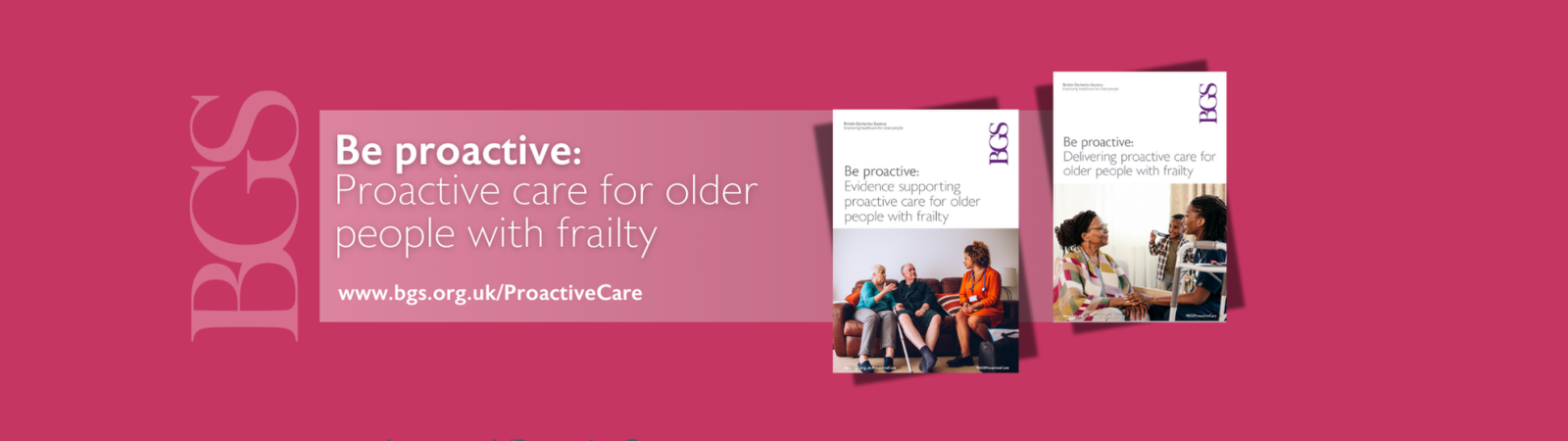
Be proactive: Evidence supporting proactive care for older people with frailty


'These BGS publications outline evidence and delivery recommendations for proactive care and support for older adults with moderate to severe frailty. 

We set out how to deliver proactive care against core components and key enablers, with recommendations for success of a proactive care service. Building on NHS England's proactive care guidance, Proactive care: providing care and support for people living at home with moderate or severe frailty, we also outline key recommendations for the successful implementation of proactive care services across the UK. 

We hope that users will be able to use all three documents when designing proactive care services, with the NHS England guidance document acting as key framework and starting point, BGS’s Be proactive: Evidence supporting proactive care for older people with frailty as a business case, and Be proactive: Delivering proactive care for older people with frailty  as a roadmap for implementing the NHS England framework and delivering services. ...'

https://www.bgs.org.uk/ProactiveCare


[All best Charlie (on your Christening Day), Casper and Jamie]. #hope #love #future #action #HealthCareer #LifeChances

Tuesday, July 16, 2024

Honouring 'Wheatfield: a Confrontation' by Agnes Denes

"In the summer of 1982, two acres of wheat were planted and harvested by artist Agnes Denes, two blocks from Wall Street and the World Trade Center and facing the Statue of Liberty.

Planting and harvesting a field of wheat on land worth $4.5 billion created a powerful paradox. Wheatfield was a symbol, a universal concept; it represented food, energy, commerce, world trade, and economics. It referred to mismanagement, waste, world hunger and ecological concerns. It called attention to our misplaced priorities.

The harvested grain traveled to twenty-eight cities around the world in an exhibition called “The International Art Show for the End of World Hunger”, organized by the Minnesota Museum of Art (1987-90). The seeds were carried away by people who planted them in many parts of the globe." twistedsifter

Individual
|
         INTERPERSONAL    :     SCIENCES                   
HUMANISTIC  --------------------------------------  MECHANISTIC      
 SOCIOLOGY  :    POLITICAL 
|

http://agnesdenesstudio.com/

'Honouring Wheatfield: a Confrontation' - ArtBasel from June 10:
https://www.artbasel.com/stories/ecology-pioneer-american-artist-agnes-denes-basel-messeplatz-wheat-field-climate-change-awareness

Images: 

In 1982, An Artist Harvested Two Acres of Wheat on Land Worth $4.5 Billion by TwistedSifter

https://twistedsifter.com/2018/03/new-york-city-wheat-field-by-agnes-denes/

Roux, C. Reaping what you sow, Collecting, FTWeekend, 8-9 June 2024, p.4.
https://www.ft.com/content/346ad7e8-9ddf-4802-9658-053d1c5758a8

Monday, October 17, 2022

REGULATORS, WAKE UP!

"The IPCC have declared a climate
change code red for humanity."


INDIVIDUAL
|
 INTERPERSONAL    :     SCIENCES               
HUMANISTIC --------------------------------------  MECHANISTIC      
SOCIOLOGY  :   POLITICAL 
|
GROUP


Science Based
Targets initiative (SBTi)


"Corporate climate action has potential, but it's currently voluntary... and failing."


"The very people giving the seal of approval
to business climate climate action - like the
Science Based Targets initiative (SBTi) -
are allowing companies to write their own
questionable rules, without checking whether
those rules are even being followed."

My source:

FTWeekend, 24-25 September 2022, p.11. 

See also:

Thursday, October 06, 2022

PROCESS 0 : 4 DOMAINS

No, 0 - 4 is not a sports score.   

Quite a while ago and over several years I associated 4P's with each of the domains of the model:

SCIENCES: process
SOCIOLOGY: practice
POLITICAL: policy
INTRA- INTERPERSONAL: purpose

 
Although, this brings home the model's being an idealisation - there remains much to learn and discover. In addition to physical processes there are political, psychological, social processes too. If you were to prioritise the concept of PROCESS across the model how would you do this?
 
My take - which could (will) differ tomorrow - and could well do so if the context was specific. 
 
I've tended to think of triage, physical and psychiatric emergencies the focus being on the SCIENCE domain (ABC medical emergency...!) and that is the starting point. If triage is excluded, then #MyNameIs follows crucially in obtaining a comprehensive assessment and addressing 1-1 parity of esteem. There is a need to (really) attend to the INTERPERSONAL domain.
 
In a way the 'individual' domains INTERPERSONAL - SCIENCES should (must) collapse into one. This is to help assure, strive to achieve person-centred and integrated care; and not to reduce, rationalise, and generalise the nurse curriculum. We need mental health nurses equipped for the 21st century.
 
Reflecting on this though I'm jumping ahead.
 
We actually start with the POLITICAL domain 0 - below. With nurses in the UK being balloted on strike action this is difficult medicine to swallow, but there we are. Globally, we saw the literal power of the POLITICAL domain in health during the (ongoing) pandemic. We will do so again in future security, health, and climate challenges to follow. We don't want future generations to face ours, they will have their own.

 INDIVIDUAL
|
 INTERPERSONAL    :     SCIENCES               
HUMANISTIC --------------------------------------  MECHANISTIC      
SOCIOLOGY  :   POLITICAL 
|
GROUP
3
1
2
0

Spiritual - 4

So, in 0 is there an advanced directive? Even before this, can I as a nurse, or other practitioner - nurse, treat, care ... for this person? Do we have consent - can they give consent? Is there a Dr 'in the house', a responsible medic? Have they been admitted, their referral accepted and acknowledged? Are there cultural or religious reasons not to proceed as we might otherwise? POLICY, safety, protocol also dictates that if we are a first responder then we do not become a casualty - that is obviously undesirable. So we are checking the environment (SCIENCES domain 1*) - the specific context.

THEN - I'm selecting 2 the SOCIOLOGY domain. The information obtained from the person (if any) is crucial to what follows. The 'if any' is non-trivial too were the INTERPERSONAL domain 3 is concerned (and the aforementioned collapse [3-1]. Even if the person declines, or is unable to communicate with us, we can still glean essential details about physical AND mental status. So, yes, the specialist skills of the practitioner and lived experienced colleagues really do matter.

With the SPIRITUAL domain (which can encompass the model) we close a circle, back to the religious, cultural, human rights and values dimensions acknowledged above. This conjunction of political and spiritual is a little surprising in global terms, and so maybe encouraging too.

*Yes, the SOCIOLOGY domain 2 also. You may think you are only going to visit a 79 year old man/women; not realising that their grandchild also arrives with a forensic history. This could be a very positive rewarding encounter, or otherwise.


Friday, March 13, 2020

A free online-learning opportunity for those interested in Implementation Science

INSPIRING CHANGE

Open for enrollment March 9 to May 18, 2020

A FREE mini-course providing a high level overview on how to create impact with evidence-based implementation

This mini-course will help you:
  • Understand what evidence-based implementation is and how to proactively plan for change.
  • Discover how process models, theories, and frameworks can be the backbone of your change plan.
  • Be inspired to use behavior change theory.
  • Be more purposeful with your time, by addressing high-priority areas and anticipating resistance to change.
  • Learn simple tips and tricks that can set you up for success.
Cost: FREE

Time to complete: It takes about 1.5 hours to complete the videos and activities.

Available: Enrollment open twice a year (from March to May; and from September to October)


My source:
Julia E. Moore, Ph.D.
Senior Director
647-390-1929
thecenterforimplementation.com
https://www.linkedin.com/in/julia-e-moore/

Follow us on Twitter: @TCI_ca

We urgently need funding to continue our work in 2020. Support the HIFA Appeal: www.hifa.org/appeal

To send a message to HIFA simply send an email to: hifa AT hifaforums.org

HIFA: Healthcare Information For All: www.hifa.org

n.b. My revalidation is due and in (hopeful) preparation for a further three years 2020-2023 I will apply for this myself.

Wednesday, December 11, 2019

Poverty on Election Eve: Gross Neglect

INDIVIDUAL
|
INTER-PERSONAL : SCIENCES
HUMANISTIC -------------------------------------------------- MECHANISTIC
SOCIOLOGY : POLITICAL
|
GROUP

POVERTY
in
THOUGHT

Social care
(Displaced demand)
'here'
Social Care
(Supply deficit)
'here'

POVERTY
in
POLICY 
&
LEADERSHIP

Monday, January 08, 2018

Scratching the surface: Optimization algorithms

... In healthcare ..? 
Well - yes,
we've definitely scratched the surface,
but not a sufficient number of surfaces,
and not necessarily the right ones 
in the right order...

individual
|
INTERPERSONAL : SCIENCES
humanistic --------------------------------------- mechanistic
SOCIOLOGY : POLITICAL
|
group

http://ruder.io/optimizing-gradient-descent/index.html#gradientdescentvariants


My source:


Friday, December 08, 2017

Is Hodges' model a selection machine?

Sober (1984) Child's toy
"It is gratifying to find these biological ideas already enshrined in the ordinary meaning of 'selection for' and 'selection of'. My young son has a toy which takes all the mystery out of this distinction. Plastic discs with circles cut out of them are stacked with spaces in between in a closed cylinder. Top-most disc contains very big holes, and the holes decrease in size as one moves down from disc to disc. At the top of the cylinder are found balls of different sizes. A good shaking will distribute the balls to their respective levels. The smallest balls end up arrayed at the bottom. The next smallest sized balls settle at the next level up, and so on. It happens that the balls of the same size also happen to have the same color. Shaking sends the black balls to the bottom, the pink to the next level up, and so on. The whole cylinder (plus paternal administered shaking) is a selection machine. The device selects for small balls (these are the ones which pass to the bottom). It does not select for black balls (even though these are the ones that pass to the bottom). But when we ask after a shaking what was selected, it is equally correct to say that the black balls were selected and that the small ones were. 'Selection for' focuses on causes; 'selection of' picks out effects." p.50-51.
Sober, E. Force and disposition in evolutionary theory. In. Hookway, C. (ed.) (1984). Minds, Machines And Evolution. Cambridge: Cambridge University Press. pp.43-61.

Image adapted from figure 4 within "Is art an adaptation? Prospects for an evolutionary perspective on aesthetic emotions" http://homes.chass.utoronto.ca/~sousa/artfunction/art.htm

See also: slide 35/47  http://slideplayer.com/slide/9735486/

Sunday, February 22, 2015

Still Alice - You're Not Alone

individual
INTERPERSONAL : SCIENCES
humanistic ------------------------------------------- mechanistic
SOCIOLOGY : POLITICAL
group

Kim Noble - You’re Not Alone
https://sohotheatre.com/shows/kim-noble-youre-not-alone/


CommuNity CARE


£300m dementia research funding

Evening Standard, Review, Kim Noble: You're Not Alone

Image source:
http://sohotheatre.com/files/images/applicationfiles/936.6402.Kim_Noble_IMAGEsohovr.jpg/600x600.fitdown.jpg

Saturday, March 15, 2014

So many gardens: Press Release [ now ]

It had to happen. Twice over.

The irony that just as so many homes with older people living in them have gardens that are in a state of neglect, so too do many nursing and care homes.

Of course this is a sign in those domestics homes of reduced abilities.

In the residential care and nursing homes, garden neglect is reassuring.

A $ure sign that the love and spending is on the blooms inside?

Thursday, February 13, 2014

Five Days at Memorial by Sheri Fink: Book

INTERPERSONAL : SCIENCES
humanistic ------------------------------------------- mechanistic
SOCIOLOGY : POLITICAL

individual
group - population


Five Days at Memorial by Sheri Fink: The Indepedent - Review

Image source: http://www.barnesandnoble.com/w/five-days-at-memorial-sheri-fink/1114975091?ean=9780804128094

Thursday, May 24, 2007

Holistic Bandwidth: All or Nothing

Quite a few years ago (Jones, 2004), I took the term bandwidth from the information and communication technology (ICT) world and applied it to health and social care. We seem to have been trying to achieve holistic and integrated care for decades. When care assessment, planning, intervention and evaluation is limited in scope this creates a narrowing of perspective, a bottleneck. Just as bandwidth problems used to affect the quality of on-line experience, so the bandwidth in health and social services ultimately affects the quality of care.

There's nothing wrong with perspective.

It's essential to making sense of the world. And after all, that railway line travels all the way to the vanishing point and it doesn't stop there. Road or railway - there's enough space reading between the lines to launch a whole film and literary genre.

I've said it before – but it really is ironic that many of the constraints in ICT have been overcome through broadband, memory costs/capacity and multi-core processors; while health services still struggle, still need to change:

From DISEASE - TREATMENT to PREVENTION - ENABLING ...

Single-track thinking is no longer sufficient, even if it is reassuring being able to see where you came from.

There’s an interesting non-trivial aside that follows from this bandwidth notion. The old conundrum of quality versus quantity.

Quality and quantity are the ties that bind, the Gordian knot. Cut this one at your peril!

Failure to focus on priorities, to take in that single, that utmost life-threatening perspective could result in disaster. Intensive care is the obvious example. Failure to attend to the physical priorities because of what seem new-age, airy-fairy ideas will quickly get you noticed.

There’s probably a paper out there on quality, quantity and appeals to holistic care. Returning to bandwidth I have wondered about how to measure this? Integrated care pathways and variance might be one approach, serious incident reports may be another revelatory approach? If it’s a care concept and moves ((uses energy) has currency) measure it!

There are a raft of measures for all sorts of things including, mood, behaviour, nursing care related, quality, risk and dependency. If you know of any that might measure holistic bandwidth, please let me know and add a comment here.

In the meantime I’ll ramble on - travelling h2cm's tracks…


Jones, P. (2004). Viewpoint: Can Informatics And Holistic Multidisciplinary Care Be Harmonised? British Journal of Healthcare Computing & Information Management, 21, 6, 17-18.

Gordian knot image c/o Bernice Steinbaum Gallery.
