Hodges' Model: Welcome to the QUAD: individual

Hodges' model is a conceptual framework to support reflection and critical thinking. Situated, the model can help integrate all disciplines (academic and professional). Amid news items, are posts that illustrate the scope and application of the model. A bibliography and A4 template are provided in the sidebar. Welcome to the QUAD ...

Showing posts with label individual. Show all posts

Friday, October 02, 2026

Gaps and Legacy Issues in Health and Education

 ... and across the Professions and Disciplines

I've just revised what may be table 1 of an exploratory paper. The table's role is to inform the motivation, scope and overall purpose within the introduction. The aim is to outline the gaps and legacies in health and education. Is this the combined inheritance of life chances, health and work career: gaps?

  1. Theory-Practice gap

    A. Research in Practice – Translational Research;
     B. Education/Training: University – Apprenticeship (see 4.B);

  1. There is no research-based conceptual framework taught and applied across health and social care systems and services.

  2. Individual – Collective (Population) Health

  3. Legacies of:
      A. Integrated care (global: funding / philosophy / location / disciplines / academic …);
      B. Parity of Esteem
           i   Mind - Body – Cartesian dualism;
           ii  Funding of Health Services [mental health - general];
           iii Research funding; Policy & Education);

C. Person-Centred Care – Service-Centred Care;

D. NHS - Social care;

  1. (Ill-Health-Disease, see 4.B.ii) Treatment versus Prevention first 

  2. Long-term policy Vs Short-termism

  3. Personal, Local, Global: Developed – Developing Health Systems & Services 

  4. Determinants of Health (Schrecker and Bambra, 2025)

Any thoughts, key sources ... are most welcome, e.g. should there be a place for sustainability, self-care, the literacies and the basis of funding public, private, or charitable (mixed)? h2cmng AT yahoo.co.uk
 

Schrecker, T., Bambra, C. (2025). ‘Lethal But Legal’: The Corporate Connections (Commercial Determinants of Health). In: How Politics Makes Us Sick. Palgrave Macmillan, London. 
https://doi.org/10.1057/978-1-349-96127-6_7

Friday, September 18, 2026

Euclidean or Projective Care?

How many dimensions does a written - narrative record have?

Sketching out some ideas, I asked the question on Google and as usual an AI Overview response followed - snippet:
AI Overview

A physical written record has two primary spatial dimensions (length and breadth/width) as a flat document, or three dimensions (including thickness or depth/height) when considering its physical form or binding. [1, 2]

In archival and Records Continuum theory, a written record exists dynamically across four conceptual dimensions: [1, 2].

I put the question to the Records Management list with the above snippet and received several useful suggestions and sources. Perhaps I can share that at a future point? 

Acutely aware of not pursuing maths and category theory for its own sake, the query was driven by an attempt to look at Hodges' model in mathematical terms. Starting, rather obviously with the models structure and axes. When the model is assembled, as per many posts, the vertical axis:

INDIVIDUAL
|
GROUP

- shouts out the issue of parity and the distinction between mind and body. It does this at the individual and collective level. If we were to draw a silo, a cylinder springs to mind, and there are specific reasons for silos adopting this shape. Descartes gives us the perfect excuse, in the ongoing legacy. 

     Mathematical Visions

The question above came up from Joan L. Richards book 'Mathematical Visions' (c/o Lancaster Univ. library). Euclidean and the emergence of projective geometry is described. There is an interplay between 2D and 3D representation, that made me think about the health record and its dimensions. Not in a dataset sense (multi-dimensional), more generally and concretely(?). A patient's record on paper has physical dimensions (A4), there is a flow. An EHR has its virtual dimensions (discuss!). Abstractly the content is a time machine. At some point in a health encounter it is a literal 'history', the level of detail in accord with the context. The record might present the problem, premorbid situation, diagnosis, current state, observations and prognosis and much more.

I can revisit this, Richards provides a series of figures. We progress from two distinct circles (my silos) through to examples with a discussion of continuity and projection that sees the circles touching, then intersecting. This is a radical axis.

Richards, Joan L. (1988), Mathematical Visions: The Pursuit of Geometry in Victorian England, Boston: Academic Press, ISBN0-12-587445

Book cover: Amazon.

Thursday, September 10, 2026

Is the Individual-Group axis health's proscenium arch?

Speech: “All the world’s a stage”

By William Shakespeare
(from As You Like It, spoken by Jaques)
          
     All the world’s a stage, 
And all the men and women merely players; 
They have their exits and their entrances; 
And one man in his time plays many parts, 
His acts being seven ages. At first the infant,
Mewling and puking in the nurse’s arms; 
And then the whining school-boy, with his satchel
And shining morning face, creeping like snail
Unwillingly to school. And then the lover,
Sighing like furnace, with a woeful ballad 
Made to his mistress’ eyebrow. Then a soldier,
Full of strange oaths, and bearded like the pard,
Jealous in honour, sudden and quick in quarrel,
Seeking the bubble reputation
Even in the cannon’s mouth. And then the justice,
In fair round belly with good capon lin’d,
With eyes severe and beard of formal cut,
Full of wise saws and modern instances;
And so he plays his part. The sixth age shifts
Into the lean and slipper’d pantaloon,
With spectacles on nose and pouch on side;
His youthful hose, well sav’d, a world too wide
For his shrunk shank; and his big manly voice,
Turning again toward childish treble, pipes
And whistles in his sound. Last scene of all,
That ends this strange eventful history,
Is second childishness and mere oblivion;
Sans teeth, sans eyes, sans taste, sans everything.

Source: https://www.poetryfoundation.org/poems/56966/speech-all-the-worlds-a-stage


TIME FRAMES

'As Shakespeare and his contemporaries wrote for the epic scale, the imaginative commitment and the 360-degree embrace of the Globe so, three hundred years later, generations of playwrights wrote for the velvety darkness, the enclosed acoustic and the picture framing of the proscenium arch.

For a century, the story of the changing world was told inside proscenium theatres, by a series of remarkable playwrights. In over sixty irreverent, illuminating pen portraits – of both famous giants and lesser-known talents – Dominic Dromgoole takes us on a journey from 1865 to 1965, revealing how these writers used the framed stage to reflect the social upheavals of their times.' 

This post began with: 'All the world's a stage', but I realised I'm no Shakespeare. Hodges' model is a frame; and users of the model can put it to work, readily. Be that in the sciences, arts, and across curricula. The 'arch' in Hodges' model appears to be inverted, working from within, rather than out. Similarly to the proscenium arch, however, the model provides a structure, for whatever performance, situated, will surely follow.

Hodges' model: Axes and Domains

Of course, the question posed here might be re-framed as: 

Are the axes of Hodges' model, life and death's proscenium arch?


Dominic Dromgoole (2026) Time Frames: A century of proscenium playwrights. London: Faber. 
https://www.faber.co.uk/product/9780571374113-time-frames/ [Text source].

Previously: 'drama' : 'stage' : 'frame'

Monday, August 31, 2026

Reflection: Turn it over ...

individual
|
INTERPERSONAL
: SCIENCES             
humanistic ------------------------------- mechanistic
SOCIOLOGY : POLITICAL   
|
group
In your mind


in your hands

with-in your community


in your (cold) warm collective heart, wealth, or technology?


Previously: 'wealth' : 'poverty' : 'justice'

Wednesday, July 29, 2026

Arriving at Hodges' model via guided discovery ...

Following Brian Hodges’ lead in his notes, I have engaged a great many learners with a guided discussion through the following questions:

Questions

Answers

Outcome/Significance

Who do we care for?

The person, individual, patient, client, carer.The group, family, community, national/global population. The 'duty of care'. The Planet.

It is the individual (guardian) who consents to care. The subject at the top of the vertical axis of Hodges’ model is first identified. It is the person who consents to care (or their guardian); then the group occupies the bottom of the vertical axis.

What do we do to help deliver care?

We attempt - complete tasks and interact in ways that are both mechanistic and humanistic. We use procedures, equipment, devices, technologies, physical interventions; and the self – empathy, rapport listening, being present. Team work with effective communication, coordination and collaboration are also essential.

To care is to act. The horizontal axis is added, with humanistic to the reader’s left; and mechanistic to the right.

The axes are then complete, revealing the model’s ‘fixed’ structure. Interdisciplinary can be identified and further discussed.

What skills and knowledge do we need to care for the individual, family and populations?

Here we are concerned with the content of the given situation. This can encompass the whole curriculum and acknowledges experiential learning.

The epistemological and ontological scope and scale of health is revealed from self to planet. The importance of context and situation can be stressed. Including first-aid and its rules and risk assessment. Discussion visits and demonstrates the significance of each of the domains of Hodges’ model and the spiritual to participants. The relevance of Hodges' model to the 21st century, as a bio-psycho-socio-POLITICAL model is emphasised.

Previously: 'Hodges' model'.

Saturday, July 25, 2026

vi WCCS26: World Conference on Complex Systems 20-22nd April

April and WCCS26 seems an age ago, but the motivational impetus provided by this experience has been ongoing.

Luis Comolli - Best Paper Award 
for Emergence in Designed Agroecosystems:
Collective Dynamics in a Perennial Multi-Species 
Agroforestry Network

At the closing ceremony there was an award for the best paper which was awarded to Luis Comolli for:

Emergence in Designed Agroecosystems: 
Collective Dynamics in a Perennial Multi-Species Agroforestry Network

Sat by Luis, I offered to take his photo to which he agreed - so better late than never! And: Well done Luis!

My presentation on the 21st April was part of:

Parallel Session 2
Track 1 - Agent-Based and Social Complexity
Session chair: Helena Knyazeva

    ▪ Peter Jones
Presenting a Universal and Simple Conceptual Workbench to Situate and Encompass Complexity

    ▪ Nisrine Jarmoune and Bouchra Lebzar
The Ontology of Behavior: Formalizing the Institutional Project as a Complex System
    
    ▪ Lionel Scotto d’Apollonia, Florian Charvolin, Lise Verlaet, Deborah Nourrit, Dominique Deveaux, Elisabeth Sénégas and Nourdine Bara
Participatory Action Research with and for Society: The Case of “Oasis of Fraternity”

▪ Harvey Spencer Sánchez-Restrepo, Jorge Louçã, Martha Belén Carmona-Soto and Sofialeticia Morales-Garza
Topological Patterns of Academic Success: Insights from Complex Network Analysis

To be clear there was a great deal in all the sessions (see below!). I noticed in Nisrine Jarmoune's presentation, however, more specific conceptual overlap in terms of the individual, collective - groups, behaviour and institutions, with reference to ontology and philosophy. Several mathematical concepts also arose and since April online discussion has proved very interesting. In the near future I hope to report on how ideas develop and may be taken further, both for Nisrine's PhD studies and my work on Hodges' model.

We are considering, especially with the options to participate available -

https://www.measuringbehavior.org/
'The next Measuring Behavior conference will take place from 28 to 30 April, 2027, in Düsseldorf, Germany. Düsseldorf is in a region with a high concentration of behavioral research across a variety of fields both in universities and industry. It is easy to reach by international trains and flights. It is a city combining innovative modern architecture with a historic city centre. The conference will take place in the Clayton Hotel, which is in the Little Tokyo region of Düsseldorf, with its distinctive Japanese flavor. We will be hosted by the Heinrich Heine Medical University and the location is within easy walking distance of the central station.'
https://www.measuringbehavior.org/call-for-symposia-mb2027-2/

Going back to the Monday, the closing Keynote Speaker: Abdelmajid Ibenrissoul 

Public Decision-Making and Complexity: What Rationality for Evaluation?

- provided fascinating insights and economic history:

Abdelmajid Ibenrissoul - Public Decision-Making and Complexity: What Rationality for Evaluation?

There remains much to follow up, seek understanding and see how this relates to Hodges' model.

More details to follow.

I have noticed the main website for WCCS appears to be unavailable? I will check.

Wednesday, July 22, 2026

I don't want to look cool ...

individual
|
INTERPERSONAL
: SCIENCES             
humanistic ------------------------------- mechanistic
SOCIOLOGY : POLITICAL   
|
group

"What is it with all this 
stuff, tat, rubbish 
they try to sell you? 
I don't want to look cool:


... what I want is for those 
with the power, to 
keep the planet cool."


Thursday, July 16, 2026

How is your Odyssey (thus far ...)?

THE ODYSSEY

As a tool for lifelong learning Hodges' model must be capable of providing a structure through which a narrative can woven. A person's career, as in work, is another distinct example. And again the 'health career' through health, illness, physical and mental trials and tribulations is perhaps the prime example. As the example, it forms the basis of myth underpinning the world's cultures, pre- and ancient histories.

Tomorrow, is the day of "Two Odysseys". No: this is not 2001, 2010, 2061 or 3001.

One odyssey, heads off to the South West, to a place where the land ends, apparently. Memories to be made, a story to unfold.

The other, is based on a voyage: an incredible tale, an epic journey - the epic (in the west). This ODYSSEY will be found in the cinema (and not on a phone, TV, PC, laptop ...); and vitally also in an amazing book. Recounting, what was originally the oral tale of Odysseus on his fantastical 10-year journey home after the Trojan War.

Hodges' model provides a structure to weave this narrative, the twists and turns of patients, carers, students and personnel - all the narrative forms.

Image: https://www.rottentomatoes.com/m/the_odyssey_2026

See also: The Hero's Journey and Joseph Campbell

Sunday, July 12, 2026

Level Headed Questions about Identity

individual
|
INTERPERSONAL
: SCIENCES             
humanistic ------------------------------- mechanistic
SOCIOLOGY : POLITICAL   
|
group

Individual - Person
IDENTITY
 Personality
Character
Traits
 
Spiritual identity
 
Religious identity


brain in a vat 
thought experiment
  
SPIRIT level
 
 
'LEVEL HEAD'

Social identity (cohesion)

Collective & Cultural identity
 
Role & Family identity
 
Relational identity
Languages

media(-ted) identities

Local / Regional identity

National identity:
North-South :: West-East divide

Organisational / Inst. identity
Political
 
GLOBAL
NORTH:SOUTH 


The Legend of St Edmund and the Wolf

Source: 'The Bay Horse' local pub and Coffee House.

Previously: 'identity' : 'philosophy' : 'alcohol' : 'South' : 'language'

Saturday, July 11, 2026

"Train midwives as nurses" - Ockenden

Re. Ockenden Report

Catching up on the newspapers, I noticed in the Times reporting of Ockenden calling for midwives to train as nurses first. Provoking debate about nurse education.

Within maternity services there are problems with continuity of care and skills in dealing with complex cases:

'Maternal Deaths 

60. The Review examined 27 maternal deaths that occurred between 2006-2024. Five cases fell outside of the Terms of Reference of the Review. Of the 22 remaining cases, reviewers identified failures in care that may have or substantially impacted on the outcome in six deaths. 

61. The profile of maternal deaths at NUH over this period broadly aligned with the known demographics and causes as identified by MBRRACE. 11 of the deaths occurred to women living in the most deprived areas of the city and 14 occurred amongst women who were not white British.

62. The common failures reviewers identified that might prevent future maternal deaths included: listening to women and families and acting promptly on concerns; continuity of care particularly for those with additional social/medical complexities; robust clinical governance to ensure timely information sharing across organisations and prompt access to imaging for women presenting with concerning neurological symptoms.' xiv

AI Overview (Ecosia) suggests that although direct entry to midwifery has always been possible(?), the English National Board created the pathway some 39 years ago.

The Ockenden Report describes how in combination health systems, culture, leadership and training can contribute to compassion fatigue (p.313).

When you look at Hodges' model and our languages, a great many challenges for curricula, training and education programmes can be found. The most powerful of what can be progressive, or threats are invariably mechanistic:

  • shorten
  • bypass
  • shortcut
  • cutting corners
  • short-circuit

Nursing must always move forward, continuous professional development is built on this principle. In the late 70s and 1980s post-registered qualifications were held in high esteem. Especially midwifery, paediatrics, health visiting, emergency and intensive care. 

Clearly, decision and policymakers can underestimate the value of basic nurse training. Having an idea since childhood is brilliant, but at interview saying you're compassionate and want to make a difference will soon be tested. Sometimes as a student rather bluntly, as with a first placement in forensic nursing. I wonder how many students have been lost there? I'm sure the majority will cope, manage, enjoy and prosper, but I've seen the student peers who miss these cohort members on subsequent learning experiences. What preparation is employed?

Basic nurse training, is just that. Demonstrating competence in communication, awareness of basic needs and how these are expressed behaviourally. What interpersonal skills and knowledge are needed. As highlighted before, the director of nurse education worried about those of us who worked as nursing assistants risked being trained in poor care. Not recognising 'bad practice', a 'poor attitude', not using observation and most important of all listening: to what is said and unsaid. When I started I remember thinking about not responding - as individually programmed to do so, through a reflex action. That was a worry back then. 

While the news in the Ockenden Report is bleak. The depth of the report (for me) is manifest in identification of not only socioeconomic factors, but sociotechnical too (with five mentions) and the critical interplay of seeing (and hearing!) the individual amid the collective:

'2. Fetal monitoring

Rather than reflecting simple failures of individual interpretation, growing evidence suggests that intrapartum fetal monitoring is best understood as a complex sociotechnical practice, shaped by system design, workload, team dynamics, guideline variability and organisational culture.119 Continuous CTG itself has well-recognised limitations, including poor specificity for predicting long-term neonatal outcomes and substantial inter- and intra-observer variation in interpretation.5 Reviews of intrapartum care are therefore unavoidably influenced by retrospective bias, with greater apparent clarity afforded by knowledge of the outcome than was available to clinicians at the time. 

However, despite this, a sociotechnical understanding does not negate the importance of examining individual cases in which intrapartum monitoring was demonstrably substandard. National inquiries and confidential reviews repeatedly describe cases involving sustained failure to recognise pathological fetal heart-rate patterns, delayed escalation despite repeated triggers, and missed opportunities for timely intervention. 2,3,120,121 These cases cannot be explained solely by the inherent limitations of CTG or by hindsight bias.' p.143.

It is quite shocking to hear this conclusion: the need to train as a nurse first. Counterarguments: where is the evidence(?!) - have followed. But then if you undervalue and miss the fundamentals (see Hodges' model!) then individuals, families, communities, students, practitioners, services and systems suffer.

Previously: 'maternity' : 'report' : 'safety'

Saturday, April 11, 2026

'Sociological Theory in Transition' (always ..?)

Conclusion: Sociology as a Skin Trade

In other writings (O'Neill, 1972, 1985) I have set out a rival conception of the embodied subject who suffers the hopes and defeats of what I have called 'sociology as a skin trade'. At the same time I began to renovate the imagery of society as a body-politic, to differentiate the levels of the bio-body, the productive body and the libidinal body as sites where human beings pursue the relevant knowledge and values of health, work and happiness. Each level of discourse requires he formulation of relevant technical knowledge (medicine, political economy, sociology and psychoanalysis) and each level has its own emancipatory discourse about health creativity and self-expression. Because each of these discursive interests is likely to be articulated by professional social scientists and therapists, it is necessary to require the institutionalization of mechanisms of political and ethical accountability to laypersons' common-sense knowledge and values regarding their bodies, their families, their work and their souls. Medical and sociological nemesis is not the result of a therapeutic conspiracy against society. It belongs to the radical technological a priori of Western knowledge whose ambition is fundamentally bio-technological. The sin of Adam and Eve was the best humankind could manage at the time. In today's laboratory Adam and Eve can be bypassed and life can be set in motion according to the best genetic formulas. Huge legal, ethical and sociological problems are simultaneously generated. And thus we step into a new 'crisis of opportunity` for which very few social scientists are prepared - whether by training or morals.' p.35.
INDIVIDUAL
|
     INTERPERSONAL    :     SCIENCES               
HUMANISTIC --------------------------------------  MECHANISTIC      
SOCIOLOGY  :   POLITICAL 
|
GROUP
psychoanalysis

body as a machine
bio-technological

body-
bio-

sociology

-politic

bio-politics of the population


'In concrete terms, starting in the seventeenth century, this power over life evolved in two basic forms ... One of these poles - the first to be formed, it seems - centered on the body as a machine: its disciplining, the optimisation of its capabilities, the extortion of its forces, the parallel increase of its usefulness and docility, its integration into systems of efficient and economic controls, all this was ensured by the procedures of power that characterised the disciplines: an anatomo-politics of the human body.
The second, formed somewhat later, focussed on the species body, the body imbued with the mechanics of life and serving as the basis of the biological processes: propagation, births and mortality, the level of health, life expectancy and longevity, with all the conditions that can cause them to vary. Their supervision was effected through an entire series of interventions and regulatory controls: a bio-politics of the  population. (Foucault, 1980a, p. 139; altered for my emphasis)' p.24.
'Bio-power regulates bodies individually, as in the clinical model. and collectively, as on the model of social medicine. The two strategies are combined to produce the most complete system of discipline ever known in the history of power. Disciplinary power works in hospitals. schools, prisons, armies, factories and bureaucracies. It is compatible with shifting vocabularies of rights, reform and welfare. It is intimate and collective; it is obeyed not because of its power over death but because of its power over life. It is this shift in emphasis that is the source of the expansion of bio-power whose corresponding apparatus we may call the therapeutic state.' p.25.
 
O’Neill, J. Sociological Nemesis: Parsons and Foucault on the Therapeutic Disciplines, Chapter 1 (pp.21-35). In. Wardell, M.L. and Turner, S. (Eds.). (1986) Sociological Theory in Transition. London: Allen & Unwin, Inc. https://digitalcommons.usf.edu/phi_facpub/86

Previously: 'sociology' : 'power' : 'body'

Thursday, March 26, 2026

Is there such a thing as the holistic bandwidth of 'resilience'?

In preparing my presentation for World Conference on Complex Systems 2026 (WCCS26) next month^, I am reading:

Bridging the Macro and the Micro by Considering the Meso: Reflections on the Fractal Nature of Resilience

ABSTRACT. We pursued the following three interconnected points: (1) there are unexplored opportunities for resilience scholars from different disciplines to cross-inspire and inform, (2) a systems perspective may enhance understanding of human resilience in health and social settings, and (3) resilience is often considered to be fractal, i.e., a phenomenon with recognizable or recurring features at a variety of scales. Following a consideration of resilience from a systems perspective, we explain how resilience can, for analytic purposes, be constructed at four scales: micro, meso, macro, and cross-scale. Adding to the cross-scale perspective of the social-ecological field, we have suggested an analytical framework for resilience studies of the health field, which incorporates holism and complexity by embracing an ecological model of cognition, something supported by empirical studies of organizations in crisis situations at various spatial as well as temporal scales.  

Key Words: human resilience; organizational resilience; resilience; resilience engineering; societal resilience 

Since the turn of the millennium, it appears 'resilience' has exploded across the media, and literature. As a result, it has also been viewed negatively by mental health service advocates, and activists as they decry the run-down state of formal services. The 'recovery model', undoubtedly closely associated with personal resilience is not the only answer.

This paper is helpful, in several respects but specifically to illustrate the idea of how Hodges' model can frame holistic bandwidth, across its care / knowledge domains.

INDIVIDUAL
|
    INTERPERSONAL    :     SCIENCES               
HUMANISTIC --------------------------------------  MECHANISTIC      
SOCIOLOGY  :   POLITICAL 
|
GROUP

individual - emotional - mental
resilience


resilience engineering

human & societal resilience

organizational resilience


I think the answer is yes. 

But, what do you think (h2cmng AT yahoo.co.uk)?

Bergström, J., & Dekker, S. W. A. (2014). Bridging the Macro and the Micro by Considering the Meso: Reflections on the Fractal Nature of Resilience. Ecology and Society, 19(4), art22.
https://doi.org/10.5751/ES-06956-190422
 
See also:
Jones P. (2014) Using a conceptual framework to explore the dimensions of recovery and their relationship to service user choice and self-determination. International Journal of Person Centered Medicine. Vol 3, No 4, (2013) pp.305-311.  
 
Previously: 'complexity' : 'resilience' : 'holistic bandwidth' : 'fractal'

^Fingers x'd!

Sunday, March 15, 2026

viii Book: Bill Ross - 'Order and the Virtual'

 'The Philosophy and Science of Deleuzian Cosmology'

So much of what we experience is nuanced. What was conscious thought, becomes tacit knowledge and unconscious. Is that consciousness nullified as Ross writes on page 76? I wrote a note 'reflection as hesitation'; also prompted to think about intution (p.83) and our word uses in 'retardation' (which here is no problem at all - in physics and complex sciences/systems. Again the 'principle of least action' arises (p.82). With more physics and cosmology to follow, it helps a little that 'manifold' has landed begging to be understood across the contexts. Bill Ross notes how Delueze and Michel Serres used the game metaphor [Game analogy #1]. Again, lifting this to a scribble 'Health-Illness is quite a game'! This will be the subject of a post soon. In England at least the law and manifold on health (being productive) and illness has been utterly disrupted. The game-table has been kicked over, by those in society who still able? New spaces, and canvases are needed. Kantian thought and interpretations are added to Leibniz. A heady mix but clearly essential as Bill Ross's critique is developed. 
 
The book was a must-read, as in the contents: Complexity (with a presentation next month), cosmology, Serres, and Claude Shannon. In Game Analogy #2, "Communication is understood here to encompass much more than meaningful exchange; all phenomena 'communicate'". p.85. I couldn't agree more with with these 'games', this thought being 'situated within the purchase of information theory' (p.86). Bizarrely (or not), in the same year two papers:
Jones, P. (1996) Humans, Information, and Science, Journal of Advanced Nursing, 24(3),591-598.

Jones, P. (1996) An overarching theory of health communication? Health Informatics Journal,2,1,28-34. 
Ross explains the global view of Michel Serres when it comes to 'information'. This entranced me, and I only scratched the skin:
Jones, P. (2008) Exploring Serres’ Atlas, Hodges’ Knowledge Domains and the Fusion of Informatics and Cultural Horizons, IN Kidd, T., Chen, I. (Eds.) Social Information Technology Connecting Society and Cultural Issues, Idea Group Publishing, Inc. Chap. 7, pp. 96-109.
Here there's a pointer to the cosmology to follow - Ross is true to the title. I have let most of the Astronomy Yearbooks go, but retain a few. Not just for key birth-years, but articles that are well written and researched historical snapshots. Here, Bill Ross discusses the game of Cepheid variables and their significance in mapping the universe. Truly, fascinating. Weaver's three levels of salient action are listed. Threads are tied too, with conclusions offered. These rules are reappraised, physics ever present. In light of one of the above papers I should revisit Serres, and Leibniz; the search for 'overarching explanatory power' (p.91) is ongoing. This game draws on Serres invitation to imagine a diagram, a network of nodes, channels, and propositions. This tabular formulation and its relations for me, spans the history of economics (Quesnay's tableau), the current state of economics (human values), and next (mathematical?) steps for Hodges' model. So many questions here: surely node  can't be an axis? I felt like Hansel, picking up sweets, Cartesian lines, scalene forms, thresholds, coming across hoops to jump through through to terminal equilibri. As you walk the sound of the thalweg, downstream... where Bergson features once again.
 
Reading Ross, over several months coincided with several key themes gaining in personal coherence. Bayesian ideas as might be applied to Hodges' model, even if in a naïve way (c/o feedback on draft notes). The remainder of chapter 3 includes time (thought), percept (space), to close with Deleuze's Ideal Game. I looked up Cortázarian Hopscotch https://en.wikipedia.org/wiki/Hopscotch_(Cort%C3%A1zar_novel), as the preface is titled. Ross reflects on the Ideal Game (does it exist, for Deleuze, only in thought?), and the distinction between 'domestic' chance (Baysian) and radical contingency belonging to the clinamen. In response to 'physical action and and the thought being on the same continuum', don't ask (please!), but I scribbled: 'corridor care' - a dangerous game, far from ideal. Plus, bird's using quantum entanglement to navigate. 'Kant's chaotic manifold', I will also investigate for next month(?).
Chapter 4 'Order as Complexity' proved most relevant. Every page is touched by graphite.

Deleuze has a 'blind spot' (p.111), something that Hodges' model seeks to ameloirate. But then of course at the model's center (nexus - as noted) that decussation of the axes invites a darkness of its own. If Hodges' model assists forethought and foresight  While inviting complexity, this interdisciplinary palette can also facilitate trandiscipinary sense-making. 'Magnitudes of intensity' reminded me of logarithmic thresholds within our perceptual apparatus. This is like reading Serres. A flow of punctum, simultaneity, delay (again) but its contribution to causal series, and Aionic time. I was taken (frequently)  to plane, person, personhood, chronicity, scales, local to global to glocal.

There is a 'corner' amid those thousand plateaus. n.b. to self - 'triangulation always needs one other'. I cannot resolve the frameworks as yet, scientific - otherwise or otherwhere; but you can take flight from here. Physics takes it place as 'complexity begets complexity'. Bill Ross utilises well-recognized sources, Penrose, Kauffman, Kolmogorov and Bohm.

As with the frameworks internal and external complexity must be untangled 1-4 (p.124?). I can laugh now, did I really try to marry up Order  - Disorder :: Simple - Complex (complicated?) to the domains of Hodges' model? So often reading philosophy, you feel an imposter playing games with words, as in: 'different similarities' and 'similar differences' (p.125). But of course, this is serious scholarship. Especially, when it involves lines, a rough circle, segments and dimensions: disorder becomes different degrees of order. Page 126 delivers Deleuze in spades, Ross pulls his thoughts together. It is fitting for me that Ross closes chapter 4 with a nod to transdisciplinarity.
Chapter 5 deals with symmetry and disymmetry; indifference and difference; limits and non-locality. There is an argument to follow (p.133). With 'group theory' mentioned on p.131, I've a lot of things to 'look up' [topology too]. Despite appearances I recognise the lack of symmetry in Hodges' model. This is what the situation does (practice) and means (theory): 'There is no reason under the sun which can rely on perfect symmetry' (p.135).  Where do/can we locate 'spooky action at a distance' in Hodges' model (p.140)? 

The Higgs role! Who knew? 'the speed of light. It represents a retardation.' Thanks Bill Ross, fascinating pp. 135-174. Plus, axes too. Note to self: when we die do we 'simply' set sail on the Dirac Sea? Attending the Bill Ross Memorial Workshop – BSP Special Event 2025 last September:

https://hodges-model.blogspot.com/2025/09/bill-ross-memorial-workshop.html

the esteem .. and love .. that Bill Ross engendered in the people that knew him. The preface refers to chats in university cafes. How I wish. I wonder what Bill would have made of Hodges' model and the ongoing project here? Vitally, I get a distinct sense that he would have found time to listen ... 
'Bill Ross (1964 – 2022) had interests ranging widely across contemporary philosophy and culture, with a particular interest in the relations between science and philosophy. As managing editor, he was the driving force behind Clinamen Press, which in the early 2000s published new works by contemporary philosophers, and English translation of important works by continental philosophers such as Henri Bergson, Gaston Bachelard and Michel Serres. He completed his PhD in philosophy at Staffordshire University, where he taught on the MA in the Philosophy of Nature, Information, and Technology. Bill had a lifelong passion for the connections between science and philosophy, on which he had published several important articles. Bill was working on a monograph on the philosophy and science of Deleuzian cosmology, which was has been posthumously published by Edinburgh University Press. This event is to celebrate Bill’s book and his life, and to allow his friends, his colleagues, and anyone interested in his work or the topics and issues addressed by his work to continue the conversation that Bill’s work inspires.'
https://www.thebsp.org.uk/bill-ross-memorial-workshop-deleuzian-cosmologies/
 
Many thanks again to Edinburgh University Press for my copy - a keeper! Bill Ross RIP.
 
Bill Ross (2024) Order and the Virtual: The Philosophy and Science of Deleuzian Cosmology. Edinburgh: Edinburgh University Press.
https://edinburghuniversitypress.com/book-order-and-the-virtual.html

Sunday, March 01, 2026

Definition: Individual and Group Counselling

INDIVIDUAL
|
    INTERPERSONAL    :     SCIENCES               
HUMANISTIC --------------------------------------  MECHANISTIC      
SOCIOLOGY  :   POLITICAL 
|
GROUP
"Counsellor"


"Counsellor of state"


My source: Robert Wright, Starmer eyes succession law change for Andrew, FTWeekend, 21-22 February, 2026, p.2.

Previously: 'counselling' : 'therapy'

Monday, February 23, 2026

Millikan's Unicepts and Unitrackers

An underpinning theory of Hodges' model must help us make sense of what is happening within the care domains, between the domains, and possibly say something about what may be significant relation[s]-ships that are diametric. Arriving at threshold concepts I wondered in Hodges' model about there being compound threshold concepts. Consider, when 2-3 thresholds are (b)reached in one (the sciences) domain? Contrast this then, with 4-5 thresholds across care domains? There may also be care concepts applicable that are for example, person-centred: that is, patient, carer, 'management', or policy defined? These concepts while not threshold related per se, are nonetheless relevant.

I came across the work of Ruth G Millikan in London, several years ago as I followed 'epistemology' around the shop. It is time to pick this up and earlier work:

Millikan, Ruth Garrett. “Biosemantics.” The Journal of Philosophy 86, no. 6 (1989): 281–97. https://doi.org/10.2307/2027123

https://www.researchgate.net/publication/235734046_Biosemantics 

INTRODUCTION TO PART I

0.4 Unicepts and Unitrackers

'Neither the clusters in the world nor their properties are found at the sensory surfaces. The properties characterize distal objects and events. They are manifested in diverse and irregular ways through signs impinging on the sensory surfaces, energy patterns that are contingent on shifting intervening circumstances.' ...

'A unitracker is a mechanism or faculty for same-tracking something, for recognizing when incoming information concerns it, then linking and storing this information together as information about one and the same thing. Only then can it can be brought to bear together on inference and action. The link connecting stored information about the same thing together is a "unicept." The information is recognized, paradigmatically,by the initiation or strengthening of an intentional attitude of credence, which we tentatively model as a temporary or enduring connection between the unicept and unicepts for other things.'

'Both unicepts and unitrackers are particulars. You and I do not have any of the same unicepts or unitrackers. What we have in common is unicepts and unitrackers for many of the same things.' ...

'Unitrackers are same-trackers used for collecting knowledge about their targets.' pp.7-8.

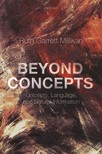
Millikan, Ruth Garrett, Beyond Concepts: Unicepts, Language, and Natural Information (Oxford, 2017; online edn, Oxford Academic, 19 Oct. 2017), https://doi.org/10.1093/oso/9780198717195.001.0001, accessed 16 Feb. 2026.

Sunday, February 15, 2026

vii Book: Bill Ross - 'Order and the Virtual'

'The Philosophy and Science of Deleuzian Cosmology'

On the publisher's site, the content listing is limited to the chapter (section) titles (as shared in iii). 

There is also one review:

'In classical physics and its mechanical paradigm, events are stories about fundamental objects. In quantum physics, it is the objects that are the stories by which we understand physical systems in their most fundamental form--as histories of events. In Order and the Virtual, Bill Ross makes a compelling case that the event-ontological philosophies of Deleuze and Whitehead will become for the new physics what the philosophies of Newton and Locke were for the old.'

– Michael Epperson, Research Professor and Director, California State University, Sacramento
[ https://edinburghuniversitypress.com/book-order-and-the-virtual.html ] 

It is worth listing the content details in full:

Series Editor's Preface vii
Preface by Robin Durie and David Webb ix
Abbreviations xii

Chaos I
Chaos and Complexity Theory I
Nietzschean Chaos and the Superior Principle of Sufficient Reason 5
The Eternal Return and the Disparity of Forces 8
Ergodicity and Infinite Duration 10
Post-Classical Physics and the Question of Entropy 15

2. Entropy and the Complete Concept in Leibniz and Deleuze 24
Dissymmetry, Energy Gradients and the Ultimate Origination of Things 29
On the Ultimate Origination of Things 30
From Many Worlds to Chaosmos 34
The Calculating God 36
Mathematical Thought, the Problem and the Cosmos 38
The Compete Concept and Disjunctive Synthesis in Sufficient Reason 44
Physical Systems, Disparity and Disjunctive Synthesis 50
Chaosmos as Cosmology 56
Absolute Zero, Limits and the Infinite 60
Simple Order 68

3. Order 71
Mechanism and Vitalism, Order and Complexity 73
The Game Analogy #I: Leibniz and Kant 81
The Game Analogy #2: Claude Shannon and Michel Serres 83
Game #2.1: Claudo Shannon's 'A Mathematical Theory of Communication' 86
Game #2.2: Michel Serres The Birth of Physics 94
Game #3.0: Deleuze's Ideal Game 98

4. Order as Complexity 109
Complexity as Principle 122
Limits without Negation 127

5. Sufficient Reason as Dissymmetry and the Evolutionary Paradigm 131
Limits and Non-Locality 135
A Network Paradigm: Loop Quantum Gravity 150
A Holographic Paradigm: David Bohm's Implicate Order I54
Evolutionary Expansiveness 161

Conclusion 175
Notes 182
Bibliography 207
Index 217

I can see why my reading of OatV is not at the usual 21st century pace. 'Section 2. Entropy and the Complete Concept in Leibniz and Deleuze', pp.24-68, as already noted, is a real melange of ideas from several sources. As noted already, you have to unpick Deleuze, Simondon and Ross's guiding thought. your reading and purpose also matters however; an amazing gift of texts like this.

'CHAOSMOS AS COSMOLOGY

If energy gradients are the sufficient reason of all that appears for ther- modynamics, symmetry is to most intents and purposes the sufficient reason from which modern physics draws its rationale. Mathematical relations of symmetry have come to take the place of 'law` in classical physics: where there is symmetry, science identifies an underlying order, As we shall see, however the point of contention between Deleuze and the prevailing scientific consensus is by no means so black and white. and far from universally upheld among the scientific community. Once again, it is in the particularities of this tension that productive exchange may be found.' p.56.

Leibniz's 'individual' (and monads) differs from that in Hodges' model, but there is the question of time and scale (at both ends of the vertical axis in Hodges' model):
'Each individual is in contact with, expresses, all individuals in the world, but obscurely, again, as with Leibniz, through infinitely ramifying lines of divergence.' p.54.

'Each individual, then, remains necessarily the sum of all its predicates, but in the same sense as a singularity contains its own power of expressing innumerable contradictions; here is Deleuze's 'object = x', the concept which overcomes the idea of world understood merely as a circle of convergence.' p.55.

We often speak in terms of 'take-aways'. Ross provides a packed (yet nutritious!)  lunch and really useful snippets:

'Disjunction becomes a relation' (p.49).

Identity runs through section 2. Difficulties of orientation are noted. I wondered about a symbol for singularity, but I cannot find one(?). Ross, himself, describes as dense, Leibniz's essay on 'Origination'.

Is the nursing process, predicated up Aristotlean 'hylomorphism' (p.50)? To capture the (cognitive) orientation of an individual, do we locate the basis for the immanence of nursing, in problems that are potential, or actual?

Amongst, particle physics, absolute zero, a two-dimensional plane, and 'symmetry'; I found 'ill health'. At least, I did in a spontaneous pencilled note. And, nearby: 'Symmetry is Law'; (p.59)'.

There is grist-for-the-mill in producing new formulations for Hodges' model. Do 'non-commutative relationships, and vectorial transformations abound? (p.60)

Health and ill-health break symmetry (which Deleuze resists), and do so within and across all the domains of Hodges' model.

Ross quotes in Section 3 'Order', page 73 in Bergson's Creative Evolution (236): '[The mechanistic order] may be defined as geometry which is its extreme limit; more generally, it is that kind of order that is concerned, whenever a relation of necessary determination is found between causes and effects'. I could go on ... but scribbled 'cogeography/cogeographical'.

Many thanks to Edinburgh University Press for my review copy.

More to follow here ...

Bill Ross (2024) Order and the Virtual: The Philosophy and Science of Deleuzian Cosmology. Edinburgh: Edinburgh University Press.
https://edinburghuniversitypress.com/book-order-and-the-virtual.html

Thursday, February 05, 2026

c/o Jayne Wilton: Reflex-ive :: Reflection - Breathe : DO - REPEAT - WHILE

INDIVIDUAL
|
    INTERPERSONAL    :     SCIENCES               
HUMANISTIC --------------------------------------  MECHANISTIC      
SOCIOLOGY  :   POLITICAL 
|
GROUP

'Many of us will have experienced playing with the interaction of our breath on shiny surfaces such as windows and mirrors, allowing us temporary fields of condensation in which to doodle thoughts or messages. In emergency situations a mirror or shiny surface is held in front of the mouth of a subject to confirm whether or not they are breathing. The Breathe series makes use of these dynamics.

The breath of a series of  individuals was captured on a shiny copper surface and then etched to create a negative of the breath where it sat on the copper plate. The result is a series of evocative landscapes. This work employs and yet subverts traditional printing processes. The inscription of spent breath onto precious metal immortalises a discharge and presents an alternative to portraiture.'

Jayne
Reflection - Reflexive
 
Resuscitation 

 
mirror
Wilton

- is a visual artist who explores the breath as a unit of exchange between people and their environments. Her practice uses darkroom processes with drawing, photography, video and sound to capture the usually invisible trace of breath as it moves across a surface. www.jaynewilton.com


My source and thanks to Jayne Wilton: 

Jayne Wilton. Breathe, Artist's Statement. Resurgence & Ecologist, July/August2023: 339: p.47 & (p.49 image).

Previously: 'breathing' : 'reflex' : 'reflection' : 'art'