Hodges' Model: Welcome to the QUAD: ecosystems

Hodges' model is a conceptual framework to support reflection and critical thinking. Situated, the model can help integrate all disciplines (academic and professional). Amid news items, are posts that illustrate the scope and application of the model. A bibliography and A4 template are provided in the sidebar. Welcome to the QUAD ...

Showing posts with label ecosystems. Show all posts

Wednesday, September 09, 2026

Bonjour Bayeux: Tapestries Historical & Modern

individual
|
INTERPERSONAL
: SCIENCES             
humanistic ------------------------------- mechanistic
SOCIOLOGY : POLITICAL   
|
group

'I think my favourite story to work on has been the 434 dinosaurs that are in the tapestry.  So much has changed about what we know about dinosaurs and all because the study of fossils and dinosaurs has grown up alongside geological survey for mining and petroleum drilling. Studies say dinosaurs were much more colourful than originally imagined and many were feathered, and in fact birds are their distant relatives.  Only 50 years ago we were taught that oil was made from decomposed dinosaurs and plants. Today research suggests oil formed from aquatic algae, called diatoms.

Much more than half of all life on earth died in a mass extinction at the end of the Cretaceous period. The most agreed upon theory, based on research, suggests the cause was when an asteroid collided with the earth and triggered volcanic eruptions, that disrupted weather patterns, growing seasons and ecosystems.  This one-two punch killed off the majority of Earth’s flora and fauna, including the dinosaurs, all of which were unable to adapt to the changes in climate.'

Sandra Sawatzky -
https://www.theblackgoldtapestry.com/notes

Detail - Panel 1 - Beginnings

The Black Gold Tapestry


THE BRITISH MUSEUM

A historic loan from France

The Bayeux Tapestry

Experience / 10 September 2026 – 11 July 2027


My source: Sandra Sawatzky, Oil in a Material World, Resurgence & Ecologist, Nov/Dec 2022, Issue 335, pp.52-55.

See also: https://www.theblackgoldtapestry.com/

Previously: 'Canada' : 'environment' : 'activism'

Sunday, August 16, 2026

Well-being of Future Generations (Wales) Act 2015

I do remember reading about the Well-being of Future Generations (Wales) Act 2015 in Resurgence & Ecology, Russell Warfield, Acting for the future. Issue 322. 2020. pp.20-24 [with another gem to follow]. Belatedly, here it is:

The Well-being of Future Generations Act

There are 7 connected well-being goals for Wales. They are:

  • A prosperous Wales
  • A resilient Wales
  • A healthier Wales
  • A more equal Wales
  • A Wales of more cohesive communities
  • A Wales of vibrant culture and thriving Welsh language
  • A globally responsible Wales

 ...

This is about ensuring that future generations have at least the same quality of life as we do now. The act provides for better decision-making by ensuring that public bodies:

  • take account of the long term
  • help to prevent problems occurring or getting worse
  • take an integrated approach
  • take a collaborative approach, and
  • consider and involve people of all ages and diversity.

Text source, video below with a 10th Anniversary video also:
 https://www.gov.wales/well-being-of-future-generations-wales


I wonder what tools they use to help the integration?

Saturday, July 25, 2026

vi WCCS26: World Conference on Complex Systems 20-22nd April

April and WCCS26 seems an age ago, but the motivational impetus provided by this experience has been ongoing.

Luis Comolli - Best Paper Award 
for Emergence in Designed Agroecosystems:
Collective Dynamics in a Perennial Multi-Species 
Agroforestry Network

At the closing ceremony there was an award for the best paper which was awarded to Luis Comolli for:

Emergence in Designed Agroecosystems: 
Collective Dynamics in a Perennial Multi-Species Agroforestry Network

Sat by Luis, I offered to take his photo to which he agreed - so better late than never! And: Well done Luis!

My presentation on the 21st April was part of:

Parallel Session 2
Track 1 - Agent-Based and Social Complexity
Session chair: Helena Knyazeva

    ▪ Peter Jones
Presenting a Universal and Simple Conceptual Workbench to Situate and Encompass Complexity

    ▪ Nisrine Jarmoune and Bouchra Lebzar
The Ontology of Behavior: Formalizing the Institutional Project as a Complex System
    
    ▪ Lionel Scotto d’Apollonia, Florian Charvolin, Lise Verlaet, Deborah Nourrit, Dominique Deveaux, Elisabeth Sénégas and Nourdine Bara
Participatory Action Research with and for Society: The Case of “Oasis of Fraternity”

▪ Harvey Spencer Sánchez-Restrepo, Jorge Louçã, Martha Belén Carmona-Soto and Sofialeticia Morales-Garza
Topological Patterns of Academic Success: Insights from Complex Network Analysis

To be clear there was a great deal in all the sessions (see below!). I noticed in Nisrine Jarmoune's presentation, however, more specific conceptual overlap in terms of the individual, collective - groups, behaviour and institutions, with reference to ontology and philosophy. Several mathematical concepts also arose and since April online discussion has proved very interesting. In the near future I hope to report on how ideas develop and may be taken further, both for Nisrine's PhD studies and my work on Hodges' model.

We are considering, especially with the options to participate available -

https://www.measuringbehavior.org/
'The next Measuring Behavior conference will take place from 28 to 30 April, 2027, in Düsseldorf, Germany. Düsseldorf is in a region with a high concentration of behavioral research across a variety of fields both in universities and industry. It is easy to reach by international trains and flights. It is a city combining innovative modern architecture with a historic city centre. The conference will take place in the Clayton Hotel, which is in the Little Tokyo region of Düsseldorf, with its distinctive Japanese flavor. We will be hosted by the Heinrich Heine Medical University and the location is within easy walking distance of the central station.'
https://www.measuringbehavior.org/call-for-symposia-mb2027-2/

Going back to the Monday, the closing Keynote Speaker: Abdelmajid Ibenrissoul 

Public Decision-Making and Complexity: What Rationality for Evaluation?

- provided fascinating insights and economic history:

Abdelmajid Ibenrissoul - Public Decision-Making and Complexity: What Rationality for Evaluation?

There remains much to follow up, seek understanding and see how this relates to Hodges' model.

More details to follow.

I have noticed the main website for WCCS appears to be unavailable? I will check.

Sunday, June 28, 2026

1st Workshop on the Internet of Mirrors (IoM): Connected Intelligence for Healthcare, Beauty, and Immersive Digital Experiences

Dear Colleagues,

I would like to invite your technical papers submissions to our 1st Workshop on the Internet of Mirrors (IoM): Connected Intelligence for Healthcare, Beauty, and Immersive Digital Experiences, which will be held in IEEE WF-IoT 2026 in Abu Dhabi, UAE.

Workshop Focus


The Internet of Mirrors (IoM) is an emerging IoT ecosystem built around interconnected smart mirrors that can sense, process, communicate, and deliver personalised services across healthcare, beauty, wellness, assisted living, fitness, and immersive digital experiences.
Although the workshop is centred on the Internet of Mirrors, the realisation of this vision requires multi-domain expertise. As such, we are very keen to receive contributions not only from researchers directly working on IoM, but also from those developing the architectures, algorithms, communication technologies, computing frameworks, and application domains that will underpin future intelligent IoT ecosystems.

Topics of Interest
  • Relevant topics include, but are not limited to:Edge, fog, and cloud computing for IoT systems
  • Distributed intelligence and multi-agent AI
  • AI-enabled IoT applications and personalised services
  • Multimodal sensing, data fusion, and contextual awareness
  • Intelligent task orchestration and adaptive resource allocation
  • Wireless connectivity, 5G/6G, and network optimisation
  • Privacy-preserving AI, security, interoperability, and trustworthy AI
  • Human-computer interaction, accessibility, and inclusive smart interfaces
  • Digital twins, immersive technologies, and metaverse-enabled experiences
  • Internet of Sounds, Internet of Medical Things, and broader Internet of Everything ecosystems
  • Smart healthcare, assisted living, wellness, fitness, beauty, and immersive digital lifestyle applications
  • Proof-of-concept implementations, benchmarking, testbeds, and real-world IoT deployments
Important Dates 
  • Paper submission deadline: 12 July 2026
  • Notification of acceptance: 15 August 2026
  • Camera-ready deadline: 30 August 2026

Workshop Chairs

  • Lina Mohjazi, University of Glasgow, UK
  • Luca Truchet, University of Trento, ITALY
  • Ahmad Taha, University of Glasgow, UK
  • Rabeb Mizouni, Khalifa University, UAE
  • Muhammad Ali Imran, University of Glasgow, UK
  • Haneen Fatima, University of Glasgow, UK

Information

Workshop website: https://sites.google.com/view/wfiot2026-workshop-iom
Submission link: https://edas.info/newPaper.php?c=34901&track=138858

Contact Emails:
l.mohjazi AT ieee.org
ahmad.taha AT glasgow.ac.uk

It would be wonderful if you could consider submitting relevant work, or share the call with colleagues and students who may be interested!
--
Kind regards,
Dr Kubra Duran
Postdoctoral Fellow
Edinburgh Napier University, UK

My source: SOCIOTECH list - JISC

Wednesday, April 22, 2026

BCS SPECIALIST GROUP ON ARTIFICIAL INTELLIGENCE (SGAI) - Ethical and Legal Aspects of AI

The next in our series of free evening virtual seminars will be on Wednesday May 6th from 6 p.m. to 7.30 p.m. (UK time). The topic will be Ethical and Legal Aspects of AI.
 
The speakers will be

  • Prof. Bernd Stahl (University of Nottingham) on 'Artificial Intelligence for a Better Future - An Ecosystem Perspective on the Ethics of AI'
  • Prof. Dr. Griet Verhenneman (Ghent University, Belgium) on 'Patch Day in Brussels: How the EU AI Act ran into the unusual scenario of reform prior to application' and
  • Dr Uchenna Nnawuchi (Sheffield University) on 'The “Why” being Algorithmic Decision Making: Explainability as the Backbone of AI Governance'.
The seminar will be chaired by Dr. Carlisle George (Middlesex University).
 
The virtual seminar series is free and open to all. For further details and for the zoom link to use go to https://bcs-sgai.org/seminars/2026-05-06/.
 
Details of future SGAI events will be placed on the website at https://bcs-sgai.org as they become available. To register to be sent information about future SGAI events by email go to https://www.bcs-sgai.org/register/.
 
Max Bramer
Chair, BCS SGAI
----------------------------------------------------
Chair, British Computer Society Specialist Group on Artificial Intelligence
Emeritus Professor, School of Computing, University of Portsmouth, UK
http://www.maxbramer.org

My source: BCS SGAI list

Thursday, April 09, 2026

Book: 'Complexity in Health Care - A Paradigm Shift for Clinical Practice'

This book was published in 2023, so I am most grateful to Daniela and colleagues at SpringerNature for the review copy. My reading will also inform both the presentation I've to deliver, and the learning during the conference's three days and the rest of a visit to Morocco.

With a 15 minute talk and 5 minutes for questions, I have 15 slides. The final one, is a listing of sources, plus this book:

1. Estrada, E., Submitted (2026) Emergent Geometry in Complex Systems from Relational Dynamics. I. The Classical Setting.
https://ifisc.uib-csic.es/en/publications/emergent-geometry-in-complex-systems-from-relation/
2. Napoli, P.H., Fischer, B., Salati Marcondes de Moraes, G.H. et al. (2026). When complexity does not mean chaos: nonlinear dynamics of entrepreneurial ecosystems. J Technol Transf  https://doi.org/10.1007/s10961-025-10314-7
3. Hylin MJ, Kerr AL, Holden R. Understanding the Mechanisms of Recovery and/or Compensation following Injury. Neural Plast. 2017;2017:7125057. doi: 10.1155/2017/7125057. Epub 2017 Apr 20. PMID: 28512585; PMCID: PMC5415868.
4. Zanin, M., Papo, D. (2020) Assessing functional propagation patterns in COVID-19. Chaos, Solitons & Fractals 138, 109993
5. Braithwaite J, Ellis LA, Churruca K, et al. Complexity Science as a Frame for Understanding the Management and Delivery of High Quality and Safer Care. 2020
6. Bergström, J., & Dekker, S. W. A. (2014). Bridging the Macro and the Micro by Considering the Meso: Reflections on the Fractal Nature of Resilience. Ecology and Society, 19(4), art22. https://doi.org/10.5751/ES-06956-190422
7. Rickles, D., Hawe, P., & Shiell, A. (2007). A simple guide to chaos and complexity. Journal of Epidemiology & Community Health, 61(11), Article 11. https://doi.org/10.1136/jech.2006.054254
8. Miller, K. (2007). From Fears of Entropy to Comfort in Chaos: Arcadia, The Waste Land, Numb3rs, and Man’s Relationship With Science. Bulletin of Science, Technology & Society, 27(1), 81-94.
9. Frankel, Steven & Thurber, Steven & Bourgeois, James. (2023). Complexity in Health Care: A Paradigm Shift for Clinical Practice. Cham: Springer. 10.1007/978-3-031-14949-8.

Also pointing to the bibliography in the sidebar and the template link. 

More to follow ...

Saturday, November 29, 2025

If "mechanism-based approach to theorizing offers an encompassing way ...

... to think about social and ecological phenomena":

What if there was a model that could encompass 
mechanism-based and humanistic-based theorising?

'A core challenge of studying ecosystems and societies as one system is integrating social and ecological theorizing. Although the social and the ecological intertwine in multiple ways, much traditional theory focuses on one or the other (Schlüter et al. 2022). Despite good intentions, attempts for integration are often only partially successful. One reason for this is the apparent incommensurability of methodological and theoretical approaches. However, the mechanism-based approach to theorizing offers an encompassing way to think about social and ecological phenomena by framing them in terms of entities and their interactions. Mechanism-based theorizing has been gaining popularity in science philosophy (Machamer et al. 2000, Craver 2007, Glennan and Illari 2017), including social sciences philosophy (Elster 1989, Hedström and Swedberg 1998, Hedström and Ylikoski 2010) and philosophy of ecology (Pâslaru 2017, González del Solar et al. 2019). It has helped to resolve many traditional problems related to scientific explanation and it is consistent with the way in which social and natural scientists talk about theorizing, causation, and explanation.'


Fig. 1. The social-ecological expansion of Coleman’s diagram.


Martínez-Peña, R., & Ylikoski, P. (2024). Coupling social and ecological mechanisms with the Coleman boat. Ecology and Society, 29(4). https://doi.org/10.5751/ES-15209-290406

See also: 'micro' : 'macro' : 'Bunge'

Friday, July 18, 2025

Narketpally syndrome: A different approach to medical education and research

From: Marc Jamoulle
MD (UCL 1974), PhD (ULg 2017)
Family physician, Belgium (INAMI 15324119004)
marc.jamoulle AT uliege.be
Associate researcher at HEC-Liège, BAS-SCM, University of Liège, University of Rouen, D2IM & CAMG-UCL, Brussels


hi friends,

in an unknown syndrome, another way to deal with the patient, to learn from the patient, to develop a partnership with the patient, caring while waiting for the cure,

Jamoulle, M., & Soylu, S. (2025). Phenotyping Long COVID in Children in Primary Care: A Case-Based Study Using the Human Phenotype Ontology. ORBi-University of Liège. https://orbi.uliege.be/handle/2268/334447

From: Rakesh Biswas
rakesh7biswas AT gmail.com


This paper illustrates a global patient-centered learning ecosystem, anchored in Narketpally, that adopts a syndromic approach to medical education and research. Rooted in the etymological origins of 'syndrome' ("together we flow"), this approach reframes medical research as a collective, contextual response to individual patient needs.

https://pubmed.ncbi.nlm.nih.gov/40674544/

Methods: The structure of the paper is intentionally modeled as a team-based learning exercise, grounded in our prior Web 2.0-based cognitive tools: CBBLE (Case-Based Blended Learning Ecosystem) https://pmc.ncbi.nlm.nih.gov/articles/PMC6163835/ and PaJR (Patient Journey Record) https://pajr.in/. These are framed against the conceptual scaffolding provided by three key publications: a framework by Sturmberg et al. and two contrasting commentaries by Greenhalgh and Ioannidis.

Results: Through our ongoing CBBLE-PaJR workflow, thematic learning outcomes emerged in response to these frameworks. Sturmberg's stratified realism helped us recognize how individual patient connections, recorded in our daily practice and online learning portfolios, can drive both contextual learning and meaningful changes in patient outcomes. Greenhalgh's commentary inspired our conceptualization of a 'wildebeest river crossing value model,' contrasting population-based efficiency with individual-centered compassion. Ioannidis's critique of methodological rigor highlighted the potential for expanding low-resource, high-impact research through patient-centered designs, particularly in phases 1 and 4 of the clinical trial hierarchy.


Podder, V., Kulkarni, R., Samitinjay, A., Salam, A., Gade, S., Agrawal, M., Surendran, A. K., & Biswas, R. (2025). Narketpally Syndrome and the Embedding of Contextual Values in Real-Life Patient Pathways. Journal of evaluation in clinical practice, 31(5), e70186. https://doi.org/10.1111/jep.70186
[Citation added PJ].
--

My source:
You received this message because you are subscribed to the Google Groups "Unnecessary Services in Clinical Medicine & Public Health" group.

Friday, September 20, 2024

Book: [ii] 'The Systems View of Life - A Unifying Vision'

The introduction highlights the oscillation through history between reductivism, holistic and integrative perspectives; the relationship between theology and the claims for and crystallisation of knowledge and the sciences. The development of cybernetics and systems theory in the 1950s and 1960s does not have it all its own way: 

'The eclipse of systems thinking from pure science had become so complete that it was not considered a viable alternative. In fact, systems theory began to be seen as an intellectual failure in several critical essays. One reason for this harsh assessment was that Ludwig von Bertalanffy (1968) had announced in a rather grandiose manner that his goal was to develop general systems theory into "'a mathematical discipline, in itself purely formal but applicable to the various empirical sciences.'' He could never achieve this ambitious goal because in his time no mathematical techniques were available to deal with the enormous complexity of living systems.' p.11.

(With Zeeman's book on Catastrophe Theory on-loan at present the above is helpful.)

I've picked up a book of Arne Naess's, put it down again: or did I buy 'The Ecology of Wisdom'? I can't check at present (the books I've left are all boxed / created), but Naess sets the scene for the mechanistic worldview.

'Care flows naturally if the 'self" is widened and deepened so that protection of free Nature is felt and conceived as protection of ourselves. .. Just as we need no morals to make us breathe... [so] if your "self" in the wide sense embraces another being, you need no moral exhortation to show care.. . You care for yourself without feeling any moral pressure to do it. (quoted by Fox, 1990, p. 217)
'What this implies, according to the eco-philosopher Warwick Fox (1990), is that the connection between an ecological perception of the world and corresponding behavior is not a logical but a psychological connection. Logic does not lead us from the fact that we are an integral part of the web of life to certain norms of how we should live.' p.14.
Science fiction gives you an appreciate of 'deep', even if not initially the philosophical connotations. Deep space, A.C. Clarke's Deep Range, and more recently deep time brought me to consider deep care on the old website and here on W2tQ with Hodges' model a means of navigation. Naess refers to shallow and deep ecology. Now we also have deepfakes, although the climate change deniers may struggle to believe their deepfake - that is: reality.  Although the book was published pre-sustainable development goals, sustainable development is discussed in detail. For me, the climate change and the SDGs demand we consider ecology, ecosystems, life, and the Earth across the domains of Hodges' model and the spiritual explored in chapter 13.
 
individual
|
INTERPERSONAL : SCIENCES
humanistic ------------------------------- mechanistic
SOCIOLOGY : POLITICAL
|
group


shallow
|
DEEP


A table on page 13 contrasts several opposites across thinking and values:


As usual, I can't shift beyond the book's introduction, but these points for me underscore the value of the book and Hodges' model. Throughout the blog and papers various dichotomies, polarities, oppositions arise. The structure of Hodges' model lends itself to this, and consequently finding the middle. All the above can be reflected upon in relation to Hodges' model, and also searched.

Chapter 1 explains how the discoveries of Galileo, Descartes, Bacon, Newton and Darwin contributed to the world and life - in biology being viewed mechanistically. The focus of the book is 'Western' and the developed nations; as the main contributor to the current state of the planet. The Cartesian divide - mind & matter/body distinction (p.24) is implicit within Hodges' model:

individual
|
INTERPERSONAL : SCIENCES
humanistic ------------------------------- mechanistic
SOCIOLOGY : POLITICAL
|
group

res cogitans


res extensa


Newton's work is described and the limitations of Newtonian physics - the social sciences presented a challenge(!). Thermodynamics is introduced helpful for subsequent chapters.

For general science students the book provides a historical primer, and even an introduction to the philosophy of science. Chapter 2 is short but conjoins cells, molecules, genes (Mendel, Watson & Crick; Franklin & Wilkins, and others), and mechanistic medicine. 

'This will not change until medical science relates its study of the biological aspects of illness to the general physical and psychological condition of the human organism and its environment, The conceptual problem at the center of contemporary healthcare is the confusion between disease processes and disease origins. Instead of asking why an illness occurs and trying to remove the conditions that led to it, medical researchers try to understand the mechanisms through which the disease operates, so that they can then interfere with them. These mechanisms, rather than the true origins, are seen as the causes of disease in current medical thinking. In the process of reducing illness to disease, the attention of Physicians has moved away from the patient as a whole person.' p.43.

Thinking about this in basic instrumentalist terms the reliance on optics, the craft of telescopes and microscopes to discover the very large (our Milky Way as 'a' galaxy) and the invisible - germs, bacteria must have been a profound factor.

If you are selecting subjects for age 16 exams, do not underestimate the value of SOCIO-ECONOMIC history. It has helped me as a community mental health nurse. Especially in light of austerity (UK), the cost of living and energy crisis and the 'housing disaster' (book 2024 with) posts to follow. Chapter 3 uses b&w illustrations of key figures, such as, Locke, Adams, and Marx. I remember in the media, economics education being questioned. That is part 1: concise (p.59!) and yet still relevant today.

Many thanks again to CUP for the pb copy.

Fritjof Capra and Pier Luigi Luisi (2014) The Systems View of Life - A Unifying Vision. Cambridge: Cambridge University Press.

https://www.cambridge.org/gb/universitypress/subjects/life-sciences/genomics-bioinformatics-and-systems-biology/systems-view-life-unifying-vision?format=HB&isbn=9781107011366

Wednesday, September 18, 2024

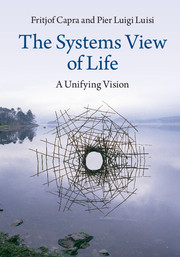
Book: 'The Systems View of Life - A Unifying Vision' [i]

The Systems View of Life -
A Unifying Vision
Published in 2014; I needed this book in the early 1990s, as did we all.

As a review request I'm grateful to CUP for forwarding a copy - that is much easier on the eyes than a screen. This book deserves a much longer-tail.

Reading Resurgence for many years, joining The Ecology Party before they turned Green, and aware of systems, cybernetics this book has brought a great deal together. It has helped me in further thought and formulation about Hodges' model: A system of systems? 

Since 2014 clearly much has changed, I will highlight points where a new edition would be welcome. Although CUP and the authors could find themselves frenetic, such we hope is the pace of change now - or from now on, especially pre-COP29?

Come on petro-states it's time to really deliver.

Even in paperback this book is a reassuring handful, running to 452 pages, excluding the bibliography and index. Part 1 reinforced the encouraging signs in the introduction:
'The basic tension is one between the parts and the whole. The emphasis on the parts has been called mechanistic, reductionist, or atomistic; the emphasis on the whole, holistic, organismic, or ecological. In twentieth-century science, the holistic perspective has become known as "systemic" and the way of thinking it implies as "systems thinking,'' as we have mentioned.

In biology, the tension between mechanism and holism has been a recurring theme throughout its history. At the dawn of Western philosophy and science, the Pythagoreans distinguished "number," or pattern, from substance, or matter, viewing it as something which limits matter and gives it shape. The argument was: do you ask what it is made of - earth, fire, water, etc. - or do you ask what its pattern is?' p.4.
  • Preface
  • Acknowledgements
  • Introduction: paradigms in science and society
  • Part I. The Mechanistic World View:
    • 1. The Newtonian world-machine
    • 2. The mechanistic view of life
    • 3. Mechanistic social thought
  • Part II. The Rise of Systems Thinking:
    • 4. From the parts to the whole
    • 5. Classical systems theories
    • 6. Complexity theory
  • Part III. A New Conception of Life:
    • 7. What is life?
    • 8. Order and complexity in the living world
    • 9. Darwin and biological evolution
    • 10. The quest for the origin of life on Earth
    • 11. The human adventure
    • 12. Mind and consciousness
    • 13. Science and spirituality
    • 14. Life, mind, and society
    • 15. The systems view of health
  • Part IV. Sustaining the Web of Life:
    • 16. The ecological dimension of life
    • 17. Connecting the dots: systems thinking and the state of the world
    • 18. Systemic solutions
  • Bibliography
  • Index
This is an excellent primer for students of biology - human biology, including eager learners in secondary school - there is technical discussion that can serve as initial exposure to new terminology, extending vocabulary. The scope of the book however covers all academic subjects, chemistry, physics, anthropology, sociology, general studies, economics and of course ecology, environmental studies.

The book is clearly well-designed and presented. Readable generally and when dealing with technical concepts. Each chapter benefits from illustrations and use of boxes, with short guest essays introduced throughout. There is less reliance on tables. Each chapter is well referenced, and towards the end chapters 17-18 urls are provided. Obviously, the references and urls are dated now; a matter we will return to. Despite the passing decade, the quality of the book still shines through.

I just noticed the cover is attributed to Andy Goldsworthy 1988, Derwent Water, Cumbria and remember out with the family, coming across Goldsworthy's work in Grizedale forest.

I will share news of my reading over several posts and many other connections.

Many thanks to CUP for the hard copy - which has been an informative companion - over the past 4-6 weeks.

Fritjof Capra and Pier Luigi Luisi (2014) The Systems View of Life - A Unifying Vision. Cambridge: Cambridge University Press.

https://www.cambridge.org/gb/universitypress/subjects/life-sciences/genomics-bioinformatics-and-systems-biology/systems-view-life-unifying-vision?format=HB&isbn=9781107011366

Sunday, June 30, 2024

Learning Health Systems/AcademyHealth 2024 SUPPLEMENT now available

 Dear Readers of Learning Health Systems,

We are pleased to announce the first-ever Supplement Issue of Learning Health Systems! 


You may view the complete Supplement online at:

https://onlinelibrary.wiley.com/toc/23796146/2024/8/S1


Guest Editors for the 2024 Supplement were: 

Lucy A. Savitz,  Sarah M. Greene,  Michael K. Gould,  Harold S. Luft


The LHS/AH Supplement is the result of a collaboration and memo of understanding between Learning Health Systems (University of Michigan), AcademyHealth, and John Wiley & Sons.


***********************************************************


Guest Commentary

The Right Stuff:  Getting the right data at the right time and using that data to drive evidence-based practice and policy


Lucy A. Savitz,  Sarah M. Greene,  Michael K. Gould,  Harold S. Luft

May 27, 2024


Experience Report

Leveraging data to support health equity in an integrated delivery and finance system


Jane Kogan, Joan Eichner, Hyagriv Simhan, Erin Dalton, Alex Jutca, Beth Quinn, Jennifer Chaney, Anna Patterson, Donna Keyser

April 15, 2024


Continued...

Wednesday, November 01, 2023

ERCIM News No. 135 Special Theme "Climate-Resilient Society"


Dear ERCIM News reader,

A new ERCIM News issue (135) is online with a special theme on Climate-Resilient Society! This special theme aims to put a spotlight on recent research, innovation and Implementation activities that could be taken up by the EU Mission on Adaptation to climate change, focusing on actionable knowledge, tools and solutions for planning, implementation, and progress monitoring. We encourage you to read the full issue to learn more about the latest advances in climate change adaptation research and practice. You can access the issue at the following link: https://ercim-news.ercim.eu/


This special theme was coordinated by our guest editors Athina Lykos (AIT Austrian Institute of Technology) and Sobah Abbas Peterson (NTNU).

Thank you for reading ERCIM News! Please share this issue with anyone who might find it interesting. You can also support us on Twitter (@ercim_news) and LinkedIn (https://www.linkedin.com/company/ercim). 
Let's keep the conversation going and share the latest updates together!

Next issue:
No. 136, January 2024
Special Theme: "Large Language Models". Submissions are welcome! See call for contributions.


Announcements in this issue:

Call for Proposals: Dagstuhl Seminars and Perspectives Workshops Schloss Dagstuhl – Leibniz-Zentrum für Informatik is accepting proposals for scientific seminars/workshops in all areas of computer science.

Social Robotics, Artificial Intelligence & Multimedia Winter School, Grenoble, France, 19-23 February 2024

ERCIM "Alain Bensoussan" Fellowship Programme - postdoctoral fellowships available at leading European research institutions. Simple application procedure. Next application deadline: 30 April 2024.

ERCIM News is published quarterly by ERCIM, the European Research Consortium for Informatics and Mathematics. With the printed and online edition, ERCIM News reaches more than 10000 readers.
All issues published to date are available online.


About ERCIM

ERCIM - the European Research Consortium for Informatics and Mathematics - aims to foster collaborative work within the European research community and to increase co-operation with European industry. Leading European research institutes are members of ERCIM. ERCIM is the European host of W3C.

Peter Kunz                      	
ERCIM Office
2004, Route des Lucioles
BP93
F-06902 Sophia Antipolis Cedex

Includes:
Clean air
20 Improving Urban Air Quality and Climate-resilience in Cities with Inclusive, Policy-relevant Citizen Science
by Pavel Kogut (21c Consultancy), Lieven Raes (Digital Flanders) and Susie McAleer (21c
Consultancy) 
Energy
21 LoCEL-H2 - Low-cost, Circular, Plug and Play, Off-grid Energy for Remote Locations including Hydrogen
by Athanasia-Maria Tompolidi (Consortium for Battery Innovation, CBI), Jonathan Wilson (Loughborough University) and Hassan A Khan (Lahore University of Management Sciences)
Transferable mitigation pathways
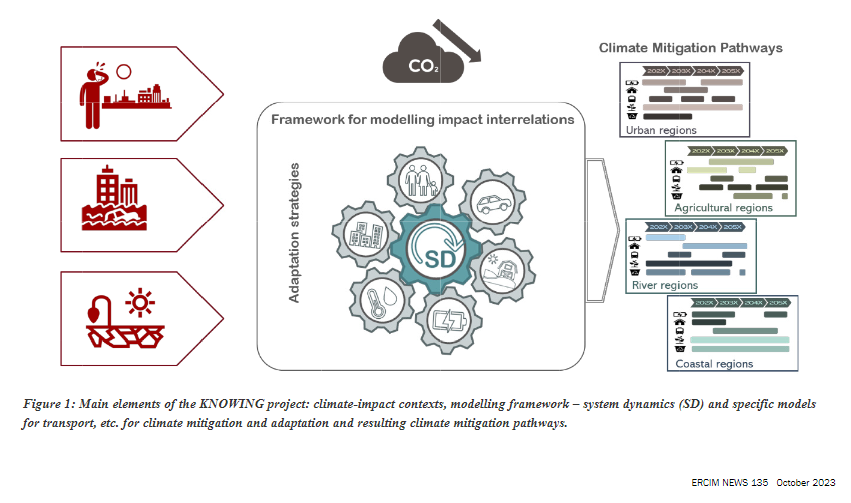
28 KNOWING How to Deal with Climate Change 
by Alexandra Millonig and Marianne Bügelmayer-Blaschek (AIT Austrian Institute of Technology) - with image:
Figure 1: Main elements of the KNOWING project: ... p.28.