Hodges' Model: Welcome to the QUAD: seminar

Hodges' model is a conceptual framework to support reflection and critical thinking. Situated, the model can help integrate all disciplines (academic and professional). Amid news items, are posts that illustrate the scope and application of the model. A bibliography and A4 template are provided in the sidebar. Welcome to the QUAD ...

Showing posts with label seminar. Show all posts

Sunday, May 10, 2026

Final Call December AI-2026: Cambridge, UK :: June: Virtual seminar on 'A Future with AI Agents'

FINAL CALL FOR PAPERS AND POSTERS

The proceedings of the AI-20xx conference series are now published by Springer in Lecture Notes in Artificial Intelligence (LNAI), a sub-series of the distinguished Lecture Notes in Computer Science (LNCS) series of conference proceedings.

AI-2026: Cambridge, UK, December 15th-17th 2026

Organised by BCS SGAI: The British Computer Society Specialist Group on Artificial Intelligence (a EurAi Member Society).The leading series of UK-based international conferences on Artificial Intelligence and one of the longest running AI conference series in Europe.

CALL FOR CONTRIBUTIONS

AI-2026 is the forty-sixth SGAI International Conference on Innovative Techniques and Applications of Artificial Intelligence. The scope of the conference comprises the whole range of AI technologies and application areas. AI-2026 reviews recent technical advances in AI technologies and shows how these advances have been applied to solve business problems. Key features are:
  • Papers will be published by Springer in the Lecture Notes in Artificial Intelligence (LNAI) subseries of the popular Lecture Notes in Computer Science (LNCS) series (
  • Papers are invited in two streams. The Technical Stream presents the best of recent developments in AI, covering a wide range of technical areas. The Application Stream is the largest annual showcase in Europe of real applications using AI technology.
  • It is expected that the best papers will be reprinted in expanded form in an international journal.
  • A mixture of full papers (maximum 14 A4 pages) presented orally and short papers (maximum 6 A4 pages) presented as posters. Papers of both kinds will be included in the proceedings.
  • Prizes for best paper and best student paper in each stream and best presented short/poster paper.
  • Invited keynote lectures.
  • The first day comprises tutorials and workshops to provide greater depth in selected topics. (Separate one-day registration for this day is also available.
  • A panel session or a debate on a topical subject.
  • An 'AI Open Mic' session to allow delegates to have their say about any aspect of AI.
  • In addition to the formal sessions, the conference programme includes a welcome reception and a Gala Dinner.
AI-2026 offers a valuable opportunity to keep up to date with developments in AI and to share experiences in the practical issues of developing AI systems.

:::: PLUS :::::

-------- Virtual Meeting seminar on A Future with AI Agents --------

The next in our series of free evening virtual seminars will be on Wednesday June 10th from 6 p.m. to 7.30 p.m. (UK time). The topic will be A Future with AI Agents.
 
Humans are becoming the minority online with bots generating almost 50% of all internet traffic. The World Economic Forum recognised that the advancement of agentic AI is obvious and the agent-driven economy is here. The global AI agents market is growing from a $5.4 billion market in 2024 to $236 billion by 2034. Come along and find out about some technical foundations of agentic systems and how to build a minimal AI agent from scratch.
 
The speakers will be

Anirban Lahiri (Arndit Ltd., Cambridge, United Kingdom) on Agentic AI: A Friend or Foe'
Dr Mercedes Arguello Casteleiro (SGAI) on 'AI Agents 101'

The virtual seminar series is free and open to all. For further details and for the zoom link to use go to https://bcs-sgai.org/seminars/2026-06-10/.
 
Details of future SGAI events will be placed on the website at https://bcs-sgai.org as they become available. To register to be sent information about future SGAI events by email go to https://www.bcs-sgai.org/register/.
 
Max Bramer
Chair, BCS SGAI
----------------------------------------------------
Chair, British Computer Society Specialist Group on Artificial Intelligence
Emeritus Professor, School of Computing, University of Portsmouth, UK
http://www.maxbramer.org
 
My source: AI-SGES list

Wednesday, April 22, 2026

BCS SPECIALIST GROUP ON ARTIFICIAL INTELLIGENCE (SGAI) - Ethical and Legal Aspects of AI

The next in our series of free evening virtual seminars will be on Wednesday May 6th from 6 p.m. to 7.30 p.m. (UK time). The topic will be Ethical and Legal Aspects of AI.
 
The speakers will be

  • Prof. Bernd Stahl (University of Nottingham) on 'Artificial Intelligence for a Better Future - An Ecosystem Perspective on the Ethics of AI'
  • Prof. Dr. Griet Verhenneman (Ghent University, Belgium) on 'Patch Day in Brussels: How the EU AI Act ran into the unusual scenario of reform prior to application' and
  • Dr Uchenna Nnawuchi (Sheffield University) on 'The “Why” being Algorithmic Decision Making: Explainability as the Backbone of AI Governance'.
The seminar will be chaired by Dr. Carlisle George (Middlesex University).
 
The virtual seminar series is free and open to all. For further details and for the zoom link to use go to https://bcs-sgai.org/seminars/2026-05-06/.
 
Details of future SGAI events will be placed on the website at https://bcs-sgai.org as they become available. To register to be sent information about future SGAI events by email go to https://www.bcs-sgai.org/register/.
 
Max Bramer
Chair, BCS SGAI
----------------------------------------------------
Chair, British Computer Society Specialist Group on Artificial Intelligence
Emeritus Professor, School of Computing, University of Portsmouth, UK
http://www.maxbramer.org

My source: BCS SGAI list

Sunday, April 12, 2026

Seminar: 'MedGemma and HAI-DEF: A family of open models'


Dear Madam/Sir, 

We are glad to announce the following seminar: 

MedGemma and HAI-DEF: A family of open models by Andrew Sellergren, Software Engineer & Researcher at Google.

Save the date: 

Thursday, April 16, 2026 - 4:30 PM (CEST) 
Aula Pitagora - MT11 (Cubo 30B), Unical 
Hybrid Format / Live Streaming 

Link: https://dub.sh/medgemma2026

See also: https://goo.gle/medgemma

MedGemma Technical Report

My source: francesco.calimeri AT unical.it

Sunday, February 22, 2026

BCS SPECIALIST GROUP ON ARTIFICIAL INTELLIGENCE: Virtual seminar 'Generative AI'

BCS SPECIALIST GROUP ON ARTIFICIAL INTELLIGENCE (SGAI)

The next in our series of free evening virtual seminars will be on Wednesday March 11th from 6 p.m. to 7.30 p.m. (UK time). The topic will be Generative AI.

Synopsis
Generative AI is rapidly reshaping the landscape of intelligent systems. This virtual seminar covers cutting-edge research and visionary perspectives on the design, deployment, and governance of generative models. It explores how generative models are enabling adaptive control, task planning, and embodied intelligence in dynamic environments. It also addresses GenAI robustness, interpretability, and alignment which are critical pillars for deploying generative systems in high-stakes domains.

The speakers will be Dr Mark Post (University of York) on 'Safety, Trust, and Perception of Generative AI: Is it deceiving us, or are we deceiving ourselves?' and Dr Erfu Yang (University of Strathclyde) on 'Generative AI in Robotics and Automation: Applications, Advancements and Challenges'.
The virtual seminar series is free and open to all. For further details and for the zoom link to use go to http://https://bcs-sgai.org/seminars/2026-03-11/.

Details of future SGAI events will be placed on the website at https://bcs-sgai.org as they become available. To register to be sent information about future SGAI events by email go to https://www.bcs-sgai.org/register/.

Max Bramer
Chair, BCS SGAI
----------------------------------------------------
Chair, British Computer Society Specialist Group on Artificial Intelligence
Emeritus Professor, School of Computing, University of Portsmouth, UK
http://www.maxbramer.org

My source: BCS-AI mail list.

Friday, November 14, 2025

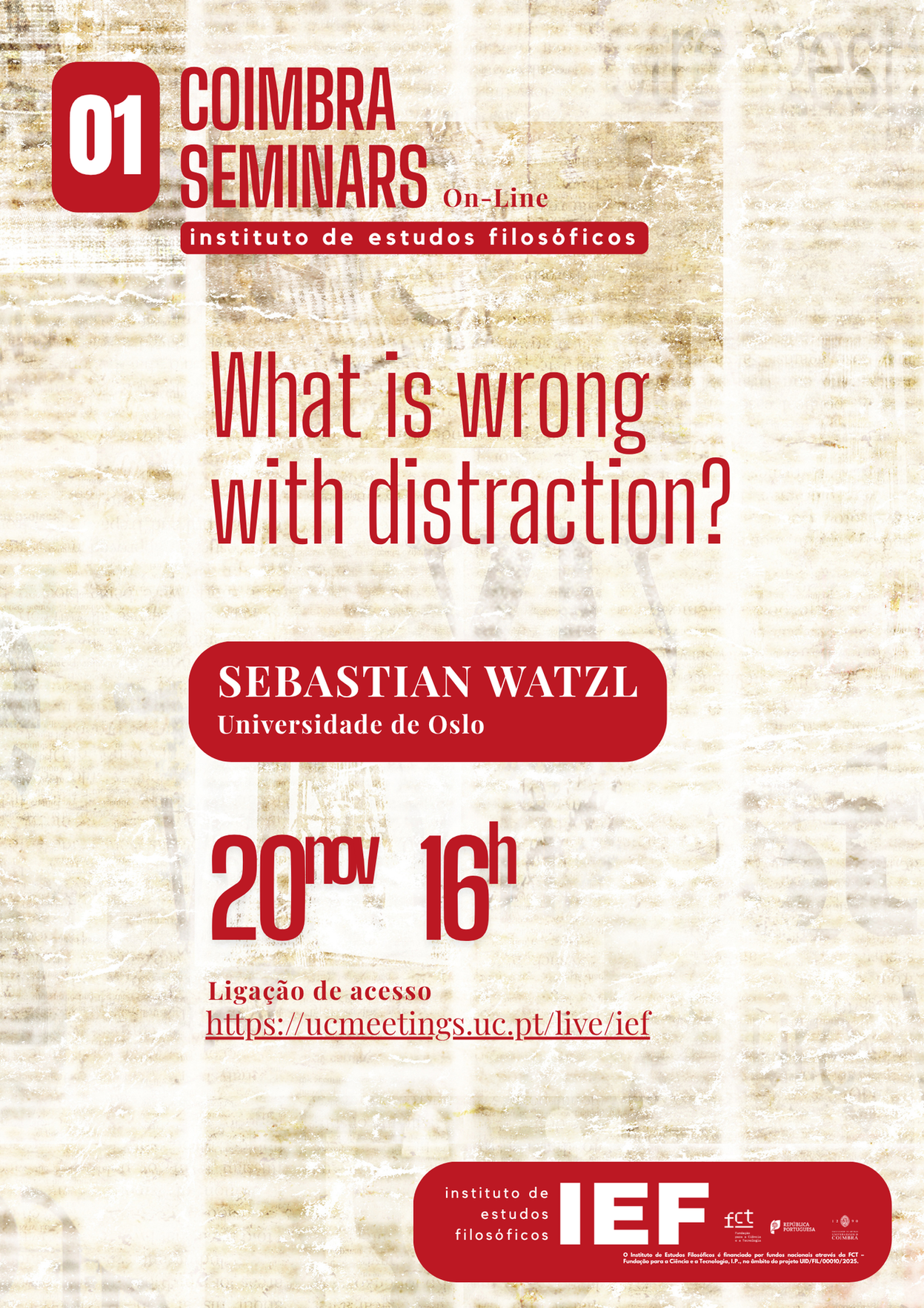
Filosofia - What is wrong with distraction? Sebastian Watzl c/o IEF


'Sebastian Watzl is a professor of philosophy at the University of Oslo (Norway). He specializes in philosophical issues about attention. He is the author of Structuring Mind (OUP), and recipient of an ERC grant on GoodAttention.

His research investigates the nature of attention, how it shapes consciousness, and the normative role and assessment of attention. Some of his current work is on the ethics of attention, the commodification of attention and its ethical assessment, the epistemic role of attention, and the use of attention as a political weapon.'

Sebastian Watzl - UoO Norway


Website: https://www.uc.pt/fluc/ief/agenda/coimbra-seminars-01/
LinkedIn: https://www.linkedin.com/posts/iestudosfilosoficos_ief-filosofia-philosophy-activity-7394448924947779584-fLSV
Instagram: https://www.instagram.com/p/DQ96aNVka0A/?igsh=MXJsejg0ZWE4bnBvZw==
Facebook: https://www.facebook.com/share/p/16uSVu9mNK/?mibextid=wwXIfr


individual
|
INTERPERSONAL : SCIENCES
humanistic -------------------------------------------  mechanistic
SOCIOLOGY : POLITICAL
|
group-population

My Mind
My Attention
My choice(s)?

Sources of distraction
Devices - access
Exposure - time
Social media
Assessment of attention
Children's education

Corporate Ethics of Attention
'Attention economy'
Policymakers & Policy
Attention as a political weapon


C/o IEF and thanks to Marta Santos (Secretariat).

Thursday, May 01, 2025

HC@AIxIA AI&Health May Seminar: 'Building Trustworthy AI for Health'

Dear Madam/Sir,

This is to officially announce the MAY 2025 seminar of the "AI & Health: Seminars 2025" series as hosted by HC@AIxIA, i.e., the "Artificial Intelligence for Healthcare" working group of the Italian Association for Artificial Intelligence.

*** Save the date: 12 MAY 2025. 3:30 CET ***

We hope you will attend and participate in the discussion on the relevant topics that will be presented and by our speakers. Feel free to share this with those potentially interested.

Link for participating: https://bit.ly/hc-2025-05 (PLEASE CHECK the site https://aixia.it/en/gruppi/hc/ for any changes or updates) - Please find some details below, and a poster attached.

== May 2025 seminar ==
2025 May 12 - 3:30PM CET

Prof. Barbara Di Camillo, Department of Information Engineering, University of Padova, Italy

Title: Building Trustworthy AI for Health: Robust and Generalizable Models with a Focus on Challenging Cases

Abstract: To make artificial intelligence useful in real clinical settings, it is crucial that AI tools follow the principles of trustworthy AI. This means ensuring the accuracy and reliability of the results, defining the areas where the results are valid, and making sure the predictions are understandable. This approach ensures that humans remain at the center of the decision-making process. BRAINTEASER (https://brainteaser.health/) is a data science project that uses artificial intelligence to help patients with amyotrophic lateral sclerosis (ALS) and multiple sclerosis (MS), along with their doctors. In the presentation, I will show how, during the development of the machine learning methods within the project, we took into account the robustness and generalizability of the model, and how we identified and characterized the subjects for whom making predictions is more challenging.

Short Bio: Barbara Di Camillo is full professor in computer science with the Department of Information Engineering, University of Padova. Her research activity is centered in the development and application of advanced modeling, data mining and machine learning methods for high-throughput biological data analysis in the field of Bioinformatics and Systems Biology. In particular, she has developed and applied different methods for robust biomarker discovery, predictive modeling and clustering of clinical data and next generation sequencing data. She has also a great expertise in the development and application of differential equation based models, Boolean and Bayesian Networks for modeling the relationships between the variables and the pathways along which they influence the disease progression.

Flyer: https://drive.google.com/open?id=15badJ0Nfj8lrA0gZdFc9aOGeR3pelms-&usp=drive_fs

====

Some notes
Serving as coordinators of the working group on AI for Healthcare of the Italian Association of Artificial Intelligence (AIxIA, see: https://aixia.it/en/gruppi/hc/), part of our commitment consists of fostering contamination and collaboration between AI researchers and experts and operators in Medicine and Healthcare; in particular, we aim to contribute in building a two-way road for informing healthcare operators about AI results and opportunities, while also raising awareness among AI researchers about challenges and problems in medicine and healthcare.
Therefore, the 2025 seminar series, in the trail of the 2024 edition, will feature a number of experts presenting research results, projects, best practices, ideas, and more to a mixed audience of AI researchers and healthcare operators.

Thank you for your interest in the AI & Health seminar series and the HC@AIxIA working group, and see you soon!

Sincerely,
Francesco Calimeri, Mauro Dragoni, Fabio Stella
(coordinators of the HC@AIxIA working group)

Thursday, February 27, 2025

(In-person) Seminar: Healthism, Neurodiversity, and Respectability Politics

Accustomed to posting news of many seminars and events that I cannot attend, this one does produce some frustration in that it is of marked interest but in-person. I am reaching out, seeking slides, and papers, and will follow-up, as for me, Professor Kukla's seminar really 'speaks' to Hodges' model. The relation conjoins the individual and collective, as it did originally for Brian Hodges in creating the eponymous model:


Hodges' model is invariably potentiated, as are all conceptual (idealised) models to encompass self-care, individual health care through to family, public and population health. As posted previously, the family(!) of -isms can be represented too:

https://hodges-model.blogspot.com/search?q=ism

Seminar Series in Analytic Philosophy 2024-25: Session 15

Healthism, Neurodiversity, and Respectability Politics

Quill Kukla (Georgetown University)

28 February 2025, 16:00 (Lisbon Time – WET)

Faculdade de Letras de Lisboa, Sala Mattos Romão [C201.J] (Departamento de Filosofia)


Abstract: “Healthism” is the pervasive ideology according to which each of us is responsible for valuing and protecting our own health and prioritizing health over other values, while society has the right to enforce, surveil, and reward healthy living. Neurodiversity and other forms of cognitive difference are generally understood through the lens of health: they are taken as diagnosable pathological conditions that should be treated or mitigated via medical interventions. Putting these two ideas together, neurodivergent people are supposed to try to be “healthy,” through pharmaceuticals, behavioral therapy, and the like, and society has an investment in making them be “healthy.” But neurodivergence is not a morbidity in a typical sense, so it is unclear what “health” means in this context. In practice, our societal standards for health for neurodivergent people are defined in terms of what avoids disrupting neurotypical expectations and systems or making neurotypical people uncomfortable. “Health,” for neurodivergent people, is in effect respectability—it is not defined in terms of their own needs or flourishing but in relation to the norms and needs of others. This can be seen from a close reading of diagnostic definitions and official medical “treatment” methods and goals. Trying to “treat” neurodivergent people by making them respectable citizens who are palatable within neurotypical productivity culture is usually likely to backfire; typically bad for their own well-being, and a social loss.


See also: 'recovery'

Jones P. (2014) Using a conceptual framework to explore the dimensions of recovery and their relationship to service user choice and self-determination. International Journal of Person Centered Medicine. Vol 3, No 4, (2013) pp.305-311.

Wednesday, February 05, 2025

HC@AIxIA: AI&Health Seminar - FEBRUARY 13 3:30 CET ... the model of Bronchopulmonary Dysplasia and Post-prematurity Respiratory Disease

The context around artificial intelligence in medicine:
the model of Bronchopulmonary Dysplasia and Post-prematurity Respiratory Disease

Dear Madam/Sir,

This is to officially announce the SECOND seminar of the "AI & Health: Seminars 2025" series as hosted by HC@AIxIA, i.e., the "Artificial Intelligence for Healthcare" working group of the Italian Association for Artificial Intelligence.

  *** Save the date: 13 FEBRUARY 2025. 3:30 CET ***

We hope you will attend and participate in the discussion on the relevant topics that will be presented and by our speakers.
Feel free to share this with those potentially interested.

Link for participatinghttps://bit.ly/hc-2025-02 (PLEASE CHECK the site https://aixia.it/en/gruppi/hc/ for any changes or updates) - Please find some details below, and a poster attached (link). 

Anna Lavizzari, MD, MSc, Attending Physician - S.C. di Neonatologia e Terapia Intensiva Neonatale, Fondazione IRCCS Cà Granda Ospedale Maggiore Policlinico, Milano, Italy

TitleThe context around artificial intelligence in medicine: the model of Bronchopulmonary Dysplasia and Post-prematurity Respiratory Disease
AbstractPreterm infant survival has dramatically increased in the last decades, including those infants born at very low gestational age/at the limit of viability. However, the rate of Bronchopulmonary dysplasia (BPD) has increased. BPD is one of the most worrisome complications of prematurity and the most common chronic respiratory disorder of early childhood. Infants with BPD present respiratory sequelae in early childhood, including wheezing, recurrent respiratory infections, re-hospitalization, need for home- oxygen and inhaled therapy. During adolescence, they still present with airway obstruction symptoms, exercise fatigue, and an early decline in lung function toward Chronic Obstructive Respiratory disease has been described in early adulthood. The BPD pathogenesis is complex and multifactorial. It includes 1) the premature arrest of lung development, 2) the antenatal exposure to infection/inflammation, growth restriction and smocking; 3) post-natal exposure to invasive/non-invasive respiratory support and supplemental oxygen, post-natal infections/inflammation and poor nutrition; 4) genetic predisposition. The formal diagnosis of BPD is assessed at 36 weeks post-menstrual age, and it is currently based on the degree of respiratory support required at that time point. However, the window for intervention (preventive strategies and pharmacological interventions) occurs in the first days of life. Diagnostic tools for early identification of infants at risk are currently lacking, due to both the vulnerability of this population and the lack of suitable lung function testing. Artificial intelligence has the potential for early identification and stratification of the population at risk, offering the opportunity for targeted therapy and more accurate prognostic prediction.

Short BioAnna Lavizzari is a consultant neonatologist at the Neonatal Intensive Care Unit of Fondazione IRCCS Cà Granda Ospedale Maggiore Policlinico – Milan, Italy. Her clinical research has focused on lung recruitment strategies at birth, neonatal non-invasive respiratory support, Forced Oscillation Technique for assessing respiratory mechanics, individualized surfactant therapy, respiratory support optimization and lung function follow-up of former preterm infants. She did a research fellowship at the Murdoch Children’s Research Institute, Melbourne (2013-2014) with Dr D Tingay and Dr P Dargaville. She has participated in experimental research on the long-term respiratory complications in former preterm lambs (Dr J Pillow, University of Western Australia, and Dr K Albertine, University of Utah). She served as secretary (2019-2021) and chair (2022-2024) of the Pediatric and Neonatal Intensive Care group of the European Respiratory Society. She is a member of the Pulmonology Board of the Italian Society of Neonatology (SIN) and a member of the Pulmonology section of the European Society for Paediatric Research (ESPR).

Flyerhttps://drive.google.com/open?id=1-S7_FHkpFtm1mdBZK9fZpY9WBiFJ3htm&usp=drive_fs

Link to participatehttps://bit.ly/hc-2025-02
(PLEASE CHECK the site https://aixia.it/en/gruppi/hc/ for any changes or updates)

====

== Are you interested in Joining the group? ==
Please head to https://aixia.it/en/gruppi/hc/ fo find out how. Do not hesitate to contact us at hc-aixia@googlegroups.com for any information or clarification.

Thank you for your interest in the AI & Health seminar series and the HC@AIxIA working group, and see you soon!

Sincerely,
Francesco Calimeri, Mauro Dragoni, Fabio Stella
(coordinators of the HC@AIxIA working group)

Monday, October 07, 2024

“Violência, Memória, Redes” :: "Violence, Memory, Networks” - Monthly online seminar March 2025


Caros colegas,

A partir de Março de 2025 realizar-se-á, mensalmente, um seminário online sobre a tríade “Violência, Memória, Redes”.

Este é organizado pela nossa equipa de um dos grupos de investigação interdisciplinar do CEIS20, um centro ligado à Universidade de Coimbra (Portugal) dedicado a temas de memória, entre outros tópicos multidisciplinares. Esta nova série de seminários dará continuidade ao sucesso do anterior trabalho sobre “Memória, Trauma e Narrativas sobre Si” (2021-22).

Desta forma, pedimos que seja divulgada pelos vossos canais a Call for Papers com a data limite em Janeiro de 2025.

Toda a informação adicional pode ser encontrada na página do seminário (https://www.uc.pt/fluc/seminarvmn/) e no anexo. Os pedidos de esclarecimento devem ser endereçados para: vmn AT uc.pt.

Disponíveis para qualquer esclarecimento adicional.

Cumprimentos,

A Comissão científica:

Edmundo Balsemão Pires (CEIS20/UC)
Joana Ricarte (CEIS20/UC)
Cláudio Carvalho (UCP/FFCS / IF/UP)
Giovanni Zanotti (CEIS20/UC)

-------------------

Dear colleagues, 

From March 2025 onwards, an online seminar will be held monthly on the triad “Violence, Memory, Networks”. 

This is organized by our team from one of the interdisciplinary research groups at CEIS20, a center linked to the University of Coimbra (Portugal) dedicated to memory themes, among other multidisciplinary topics. This new series of seminars will continue the success of the previous work on “Memory, Trauma and Narratives about the Self” (2021-22). 

Therefore, we ask that the Call for Papers be published through your channels with a deadline of January 2025. 

All additional information can be found on the seminar page (https://www.uc.pt/fluc/seminarvmn/) and in the annex. Requests for clarification should be addressed to: vmn AT uc.pt. Available for any additional clarification. 

Compliments, ...

My source: IEF

Saturday, September 21, 2024

Hybrid: Seminar & Tetralogic Model


individual
|
INTERPERSONAL : SCIENCES
humanistic ------------------------------- mechanistic
SOCIOLOGY : POLITICAL
|
group
my corner 'I'

The person - self
The person's -
mental state, mental capacity
orientation (time, place, person) continuity - 
mental illness
identity
(advanced?) choice ...
my decisions?
PSYCHO-

physical environment
place, time
embodiment - sense of self
deprivation of liberty
anticipated future developments
probability
silk
my body?!
next of kin
family
friends
carers
Social Housing
Community Care
Residential care sector
personal welfare decisions
-POLITICAL

UK - EU Politics
European Convention on Human Rights
Law - Case Law
Solicitors Barristers Silk Judge
Court of Protection
Decisions of the Court
Mental Capacity
Mental Health Law
🌍

My source: https://x.com/hfp91/status/1837526633235833079

Tuesday, September 03, 2024

HC@AIxIA: AI&Health Seminar Series (2024) - 16 September

Generative AI in sequencing: enhancing models by synthetic omics data

 
16 September 2024 - 04:30PM CET

Speaker
Giuseppe Jurman, Head of DSH (Data Science for Health) Unit, Fondazione Bruno Kessler – FBK (Trento, Italy)

Title
: Generative AI in sequencing: enhancing models by synthetic omics data.

  • Abstract: Synthetic data have recently gained momentum in several scientific areas as an effective solution to dealt with several aspects of data poverty and missingness. In translational medicine, biomedical images and EHR data have been the first to benefit from synthetic augmentation techniques through generative AI algorithms such as GANs or, more recently, Diffusion-like models. Extension of these methods to omics data poses further challenges due to the nature of the signal, such as the need of taking into account sample variability and multilevel omics coherence. In this talk, we will present an overview of the state-of-the-art of the synthetic data in the omics universe, including the generative methodologies, the future perspectives, and the related caveats, concluding with some applicative use cases. (joint work with Marco Chierici and Silvia Menchetti)
  • Short Bio: Giuseppe Jurman is a mathematician, with a PhD in Algebra, currently Head of the Data Science for Health (DSH) Unit at FBK. His main interest is the development and the application of artificial intelligence, machine learning and complex network models for diagnosis, prognosis and prediction in medicine, life science and computational biology, starting from EHRs, omics data and biomedical images, including digital pathology, with a particular emphasis on reproducibility and explainability. He is also interested in scientific programming with Python and other computing languages, and he teaches Data Visualization at the M.Sc. in Data Science at the University of Trento. 
  • Flyerlink
  • Link for participatingwebex link + details
  • VIDEO: available afterwards
c/o: Francesco Calimeri, Mauro Dragoni, Fabio Stella
(coordinators of the HC@AIxIA working group)

Tuesday, May 07, 2024

BCS Specialist Group on AI : SGAI Virtual Seminar - 8th May UK

Welcome

The SGAI Virtual Seminar Series is a new series of free evening Zoom events, open to all, which ultimately we intend to run monthly from October to June on a Wednesday evening from 6 p.m. to 7.30 p.m. (UK time). No prior registration is needed.

It is organised on behalf of BCS SGAI - the BCS Specialist Group on Artificial Intelligence.

The next seminar in the series will be on Wednesday May 8th from 6 p.m. to 7:30 p.m. (UK time).

There will be talks by Matt Armstrong-Barnes, Chief Technology Officer, Hewlett-Packard Enterprises, who asks 

‘If Artificial Intelligence is mainstream and the cornerstone of digital transformation, why do so many projects fail?”

and by Dr Diego Maseda Fernández, an Acute and General Internal Medicine Consultant, whose topic is ‘Large Language Models in Healthcare: What Frontline Clinicians Are Being Told’.


This will be followed by a tutorial by students at the University of Southampton entitled ‘Large Language Models: Democratise AI with Low-Code/No-Code’.

My source: Email today.

Saturday, October 29, 2022

Gaia and Philosophy – international seminar

Dear all,

Here is the program for an upcoming international symposium: 

Jean Michel Etchecolonea, CC BY-SA 3.0 via Wikimedia Commons / Cropped
Gaia and philosophy

1-3 December, Donostia – San Sebastián
Basque Country University (UPV/EHU)
Organised by IAS-Research – Outonomy project


The recently edited volume of James Lovelock's and Lynn Margulis scientific correspondence will be presented for the first time at the occasion. Different lectures will discuss the scientific and philosophical status of Gaia theory and contemporary approaches to the understanding of the Earth as a self-organised entity. 

The seminar will be available to follow online. Feel free to distribute to however might be interested.

Registration form.

best regards
Alejandro Merlo 

---
IAS Research Centre for Research on Life, Mind and Society
Department of Logic and Philosophy of Science
University of the Basque Country UPV/EHU

---

n.b. I plan to attend online.