Hodges' Model: Welcome to the QUAD: social media

Hodges' model is a conceptual framework to support reflection and critical thinking. Situated, the model can help integrate all disciplines (academic and professional). Amid news items, are posts that illustrate the scope and application of the model. A bibliography and A4 template are provided in the sidebar. Welcome to the QUAD ...

Showing posts with label social media. Show all posts

Friday, May 08, 2026

iv WCCS26: World Conference on Complex Systems 20-22nd April

Day 1: Panel 2 - Rethinking Knowledge in the Age of Complexity

  • Helena Knyazeva - Dancing with Complexity: How the World Thinks Through Us
  • Carlos Gershenson - The Implications of Complexity
  • Leonardo Rodríguez Zoya - Can Statistics Think? Complexity, Future, and Freedom in the Age of Large Language Models
    Panel Chair: Nigel Gilbert 

Courage is one of the 6Cs in nursing, and was on display at WCCS26.

Carlos Gershon began by offering two references, the first:

De Domenico, et al., (2019). Complexity explained: A grassroot collaborative initiative to create a set of essential concepts of complex systems. https://complexityexplained.github.io

This is a brief 20 pages, larger text, and provides a helpful primer to complexity and related concepts covering:

Interactions
Emergence 
Dynamics 
Self-organization
Adaptation
Interdisciplinarity
Methods

For each concept, the authors explain:

Definition/Description
Examples
Relevant Concepts
References

Plus, secondly:

Gershenson, C. The Implications of Interactions for Science and Philosophy. Found Sci 18, 781–790 (2013). https://doi.org/10.1007/s10699-012-9305-8

I liked the practical feel here, the encouragement to think anew, and perhaps taste the "flavors of emergence": synchronic - space; diachronic - time, weak and strong feedback, transversal of scale - upwards and downwards.

There is further conference on complexity later this year (and also online!):

CCS 2026:
The 2026 Conference on Complex Systems
OCTOBER 9 - 16, 2026 BINGHAMTON, NY, USA & ONLINE

In my search I also found:

Carlos Gershenson; Complexity, Artificial Life, and Artificial Intelligence. Artif Life 2025; 31 (3): 289–303. doi:https://doi.org/10.1162/artl_a_00462

Gershenson, C. Self-organizing systems: what, how, and why?. npj Complex 2, 10 (2025). https://doi.org/10.1038/s44260-025-00031-5

Leonardo Rodríguez Zoya's presentation helpfully connected social practice, interdisciplinary bridges, statistical rationality, complex (human) rationality and the future(s): desirable, possible, latent and probable.

individual
|
INTERPERSONAL : SCIENCES
humanistic ------------------------------- mechanistic
SOCIOLOGY : POLITICAL
|
group
COMPLEX (HUMAN) RATIONALITY
 
cognition

STATISTICAL RATIONALITY
Techopraxis
LLMs - technology

socio-
HUMAN PROBLEMS
SOCIAL PRACTICE
PRACTICE (one of the 4Ps)

ELECTION - CAMPAIGN SPENDING
PEACE NEGOTIATIONS
ISLAND ECONOMY
CRYPTOCURRENCY

To answer the prompt - 

"Give me a less likely but more fruitful interpretation of this [concept]*."

*Replace with a significant concept in your practice

Would it might help to have a simple, and yet complexity (and simplicity!) primed conceptual framework to assist reflection, argumentation, and progress?
 
I missed the poster at the afternoon break, and followed track 1. I greatly enjoyed Julian Arevalo's - Adaptive Readiness: an Agent-Based Model of Peace Negotiations. Perhaps this accounts for my having no notes or photos for this track except for one. I realise now we did speak, sitting together for the conference dinner. I'm sure I remember Negotiation Lab 1.0 - 

https://www.comses.net/codebases/1256dc74-9ae4-4f49-a235-1ec129be1930/releases/1.0.0/
 
This past week I heard discussion (BBC Radio 4) of the 'income' Norway obtains from its expertise and engagement in peace negotiations.
 
Nicholas Roxburgh, and colleagues Rachel Creaney, Mindi Premarathne and Ruth Wilson through 
Exploring Interdependencies in an Island Economy, reminded me of public engagement in research. Especially when it involves their community; and that community is somewhat rural, or remote.
 
Remah Dahdoul, with Jan Korbel and Stefan Thurner presented -
Campaign-Spending Driven Polarization Transition in a Double-Random Field Model of Elections. The following paper brings home the mathematics in complex systems. The reference is:
 
Jan Korbel and Remah Dahdoul and Stefan Thurner. (2026) Empirical validation of the polarization transition in a double-random field model of elections. arXiv. https://arxiv.org/abs/2510.00612.  doi.org/10.1103/9gjj-1df6.
 
The paper by Saida Hachimi El Idrissi and Mohamed Nemiche is not open access, but the abstract follows. 
 
S. H. El Idrissi and M. Nemiche, "Formation of Complex Societies: An Agent-Based Model Inspired by Freudian Theory," 2024 World Conference on Complex Systems (WCCS), Mohammedia, Morocco, 2024, pp.1-6, doi: 10.1109/WCCS62745.2024.10765573.
Abstract: The rise and emergence of complex societies in the Old World mark a pivotal chapter in human history, characterized by the transition from small, kin-based communities to large, hierarchical states. This transformation raises fundamental questions: How did human societies progress from small, cohesive groups characterized by face-to-face cooperation to the expansive, anonymous societies of today, often organized as states? What factors account for the significant variation in different human populations' capacity to construct stable and functional state structures? To address these questions, we developed an agent-based model grounded in Freud's hypothesis, which posits that civilization could neither emerge nor evolve without the repression of human desires. In the context of social evolution, this repression of desires can be interpreted as the repression of intra-societal competition, ultimately strengthening the society and facilitating the formation of complex social structures. We implemented this model within a realistic representation of the Afroeurasian landmass, incorporating various geographical factors. To validate our model, we compared our simulated results with historical data. The model-predicted pattern of expansion of complex societies demonstrated remarkable congruence with the observed historical patterns in the Old World. The emergence, growth, and distribution of large-scale societies predicted by our computational model showed remarkable consistency with the archaeological and historical record.

keywords: {Analytical models; Computational modeling; Predictive models; Data models; Agriculture; Rivers; History; Complex systems; component; Agent-based Modeling; Repression of satisfaction; cooperation; competition; Social Simulation},
URL: https://ieeexplore.ieee.org/stamp/stamp.jsp?tp=&arnumber=10765573&isnumber=10765499 
Unless you are a microsurgeon (increasingly with robotic co-workers), is the word practice, more likely to manifest what is larger, the big picture, a sense of space, even at a societal or continental scale? In reading, I came across four forms of attractors. For me, how they fit into the question of scale makes this paper worthy of seeking out. 

M. Nemiche was unable to attend the conference, and was greatly missed.

Monday, May 04, 2026

iii WCCS26: World Conference on Complex Systems 20-22nd April

Chaos
Making a New Science 
by James Gleick


When I first learned of WCCS26, I saw a connection, an affinity across the conference themes. This was reinforced when I read the final program for WCCS. Here was a home for the model, a way-point for Hodges' model. For an independent scholar, it was quite a trip to Ben Guerir, to the north of Marrakech; 13 hours (brief by global standards). It was a place to wave wildly, making use of the opportunity to present Hodges' model, to say - "Dear All, can you do anything with this?".


It is almost 40 years since I read James Gleik's, Chaos: Making a New Science. That was in Cornwall I think? Now, something more than book - a complexity conference 

 After the first two keynotes - two panels: 

 Panel 1 - Complexity, Society & Global Challenges

▪ Carlos Álvarez Pereira - No Limits to Hope: Escaping from the unreasonable effectiveness of Modernity
▪ David Chavalarias - The Artificialization of Cultural Evolution: the Impact of Very Large Digital Infrastructures on Individuals and Society
▪ Louis Klein - Noospheric Singularity and the Mirror of Tamkeen
Panel Chair: Karima Kadaoui

These confirmed I was in the right place. Well, it was bit late if I wasn't! I was reminded of the slow movement, and how in healthcare, specifically client-nurse intereactions you had time to manage your time, that is your caseload to deliver person-centred care. I don't mean time-wasting, as in social chat, tea and custard creams either. This is what being professional is about, truly trying to make a difference - that lasts. So we worked through: What is; (science) what we understand; and (tech and law) what should be. Ecologically, we often refer to the size of our footprints. Panel one considered this individually and collectively - institutionally. Fascinating to reflect upon these themes and how modernity is stamping about in a rather chaotic way? We are seemingly power-less to stop this.

c/o Carlos Álvarez Pereira
No Limits to Hope: Escaping from the unreasonable effectiveness of Modernity

Three reports to the Club of Rome were displayed, spanning 'NO LIMITS TO LEARNING - Bridging the human gap' 1979; 'Limits and Beyond' 2022; 'NO LIMITS TO HOPE - Liberate the potential for Collective Learning' 2026. Should we be troubled, worried even, that the latest followed after a mere four years? There are of course, many reports as per the link above.

David Chavalarias - The Artificialization of Cultural Evolution: the Impact of Very Large Digital Infrastructures on Individuals and Society spoke about the beneficial and malign impacts of social media AI tools. Covid featured as might be expected. Within the sciences, what was worrying, was an innovation slowdown associated with AI, non-AI use, chartered around a central point (centroid). I believe the slide referred to:

Qianyue Hao & Fengli Xu & Yong Li & James Evans, 2026. "Artificial intelligence tools expand scientists’ impact but contract science’s focus," Nature, vol. 649(8099), pages 1237-1243, January. 

There was one slide:


Is this the demise of any efforts to achieve SOCIO-technical synergy? Even to the extent of realising benefits for the human in socio-technical systems? Did Covid not teach us anything about the informational difference technology can make? When so many technologies are muted by a virus? This is what we need: things to think about, question and critique. 

There used to be a series of A3 step-by-step oil painting magazines in the 1970s. One presented a desert campfire, clearly set in the east. I did try it, though not sure were the result is now. ... Such a scenario was presented by Louis Kleinand the Noospheric Singularity and the Tamkeen Process - Regenerative Hermeneutics, with the following reference provided:

Klein, L., & Kadaoui, K. (2024). Realising metamorphic transformation in the mirror of Tamkeen: Growing a shared understanding from co-reflected lived experiences. Systems Research and Behavioral Science, 41(5), 738–749. https://doi.org/10.1002/sres.3058 

There was much I could identify with. And, once again, I cannot continue at this pace. We have only covered (touched!) panel one. Hopefully you now have an idea of the depth of the conference programme. More however, will follow.

See also: thefifthelement.earth

Chaos - cover: https://www.goodreads.com/book/show/826080.Chaos

Thursday, April 02, 2026

Launch of National Knife Crime Centre

INDIVIDUAL
|
    INTERPERSONAL    :     SCIENCES               
HUMANISTIC --------------------------------------  MECHANISTIC      
SOCIOLOGY  :   POLITICAL 
|
GROUP
Is this a knife I see before me?
Or is it something else?
 
Am I being duped and taken for a fool?
But, nobody will bother me now!
I'm ready...!
 
I don't think this is right.
 
Either way, I'm asking for trouble?
 
Will anybody else listen? 


Should I risk trying to buy a knife?
How? Shop, or online?

Do I look 18?
I've seen the signs by the tills.

Can I pass as an 18 year old?
Should I pick it up and take it?

Or, do I leave it exactly where it is hidden?

Do I really need a knife, 
because he/she/they have one?

Can I ask a friend?
My cousin? No they'd grass on me.
Could I pay that 5th year?

Ben Kinsella Trust


NATIONAL CENTRE FOR KNIFE CRIME
 
Ronan's Law


My sources: BBC Radio 4 'Today' 2nd April 2026.

Previously: 'crime' : 'knives' : 'law'

Sunday, March 29, 2026

Children: FACE the past, future, your social media, Capitalism

INDIVIDUAL
|
    INTERPERSONAL    :     SCIENCES               
HUMANISTIC --------------------------------------  MECHANISTIC      
SOCIOLOGY  :   POLITICAL 
|
GROUP

MENTAL HEALTH and WELLBEING

LIFELONG LEARNING
 
KEY LITERACIES 

PSHE EDUCATION -
 Personal, Social, 
Health and Economic
The Face
'Apps such as TikTok and Instagram are filled with videos of young girls and teenagers advising their peers on elaborate skincare routines, especially through a popular line of content called "Get Ready with Me".

Parents have sounded the alarm over this trend, while recent medical literature has recognised the phenomenon of "cosmeticorexia", also called "dermorexia", defined as a culturally reinforced preoccupation or obsession with achieving "flawless" skin that can lead to "excessive, age-inappropriate or compulsive use of cosmetic products".'

'Italy is investigating a beauty retailer and make-up brand owned by French luxury group LVMH over claims their marketing has fuelled "cosmeticorexia", an unhealthy obsession with skincare among young girls.
The Italian Competition and Market Authority (AGCM) said yesterday it was probing Sephora and Benefit Cosmetics for suspected "unfair commercial practices" with the promotion of skincare products such as face masks, serums and anti-ageing creams to girls as young as 10 years old.
Those marketing campaigns were carried out mainly via social media, the  regulator said, leading young girls to "compulsively" buy such products.'


My sources: Amy Kazmin, LVMH's Sephora probed in Italy over fuelling young girls' skincare obsession, FTWeekend, 28-29 March 2026, p.1. FTWeekend and The Times. Reviews.

See also: Kazmin et al. Beauty industry scrutinised over age-inappropriate teen marketing. FTWeekend. 11-12 April, 2026, p.14. 

London visit February. Waterstones, Foyles, Hatchards & others.

Book image: https://www.amazon.ca/Face-Cultural-Fay-Bound-Alberti/dp/1538766531
 
Previously: 'health' : 'face' : 'child' : 'obsession' : 'social media'

Friday, November 28, 2025

The Silent Pandemic? The Global Rise of Early-Onset Colorectal Cancer - via HIFA

Last year, a team at The Christie NHS Foundation Trust in Manchester, UK published a real-world analysis of 203 patients with early-onset colorectal cancer (eoCRC). The study showed a dramatic surge in cases over a short period, with over half of patients presenting with metastatic disease, predominantly left-sided tumours, and a median symptom duration of just 3 months before diagnosis. The authors warned that eoCRC could represent an "evolving pandemic." 


See - http://doi.org/10.1093/oncolo/oyae239

Since then, incidence continues to rise across all continents, with similar patterns emerging in multiple national and international datasets.

Why This Matters for the HIFA community
  • eoCRC is rising rapidly among people in their 20s, 30s, and early 40s.
  • Most cases are sporadic, suggesting major gaps in understanding modifiable and early-life risk factors.
  • Awareness among young adults and clinicians remains limited, contributing to delayed presentation.
  • Meanwhile, short-form social media (e.g. TikTok reels) and AI-driven content are now the dominant information sources for young people - creating both opportunities and risks for public health.
Introducing Our Upcoming Initiative

We, the Special Interest Group in Digital Health & AI at WHO/Europe Youth4Health network, are launching a global project to develop evidence-based communication guidance for raising eoCRC prevention and awareness among young adults. The project will:
  • Convene clinical specialists, youth advocates, communication scientists, social-media creators, and digital-health experts.
  • Identify which prevention and awareness messages should be prioritised for youth.
  • Define how these messages can be adapted effectively for short-form platforms such as TikTok and Instagram Reels.
  • Examine how generative AI can support safe, accurate, and engaging content creation.
  • Co-design prototype posts to illustrate how the consensus messages can be translated into youth-appropriate communication
  • Our aim is to bridge the gap between emerging science, behavioural insights, and contemporary digital communication channels.
Why We're Sharing This Here

As we shape this work, we're keen to learn from the HIFA community:
  • What approaches have you seen succeed in raising awareness of cancer symptoms among younger populations?
  • Are there youth-driven or co-designed campaigns that we should look to as models?
  • What are the risks you foresee when using short-form social media or AI tools for public-health communication?
  • What considerations are especially important in LMIC contexts?
  • How can we strike the right balance between urgency and fear-avoidance when communicating about cancer to young adults?
eoCRC incidence is increasing rapidly and globally. Communication strategies - particularly those targeting young people - have not kept pace with this trend. We would greatly value your insight and experience as we develop this work.

HIFA profile: Kathleen Guan is a multidisciplinary researcher passionate about all things digital behavioral health and (global) community engagement. Her PhD research focuses on involving young people in the co-design of personalized AI and emerging technologies, including adaptive mobile apps, LLMs, neurotechnology, and social media reels. By developing novel participatory approaches with a focus on preventative and precision health, Kathleen aims to inform how digital tools can meaningfully enhance everyday life and help reduce mental health challenges alongside chronic disease risks. To achieve this, she prioritizes community-based implementation by working closely with stakeholders across healthcare, engineering, policy, industry, education, and the arts.

Kathleen previously studied human rights and developmental neuroscience (BSFS, Georgetown; MRes, UCL) and has experience in public health and digital innovation (with WHO, Johns Hopkins, Yale, Qatar Computing Research Institute, various early-stage digital health start-ups) as a research collaborator and advisor. She chairs the Special Interest Group in Digital Health & AI within WHO Europe's Youth4Health Network. Kathleen has resided in 7 countries and worked in diverse settings across Asia, North America, and Europe, fostering her deep commitment to global health equity. She is always open to collaboration for social impact and can be found at https://www.linkedin.com/in/kathleenwguan/.

Friday, November 14, 2025

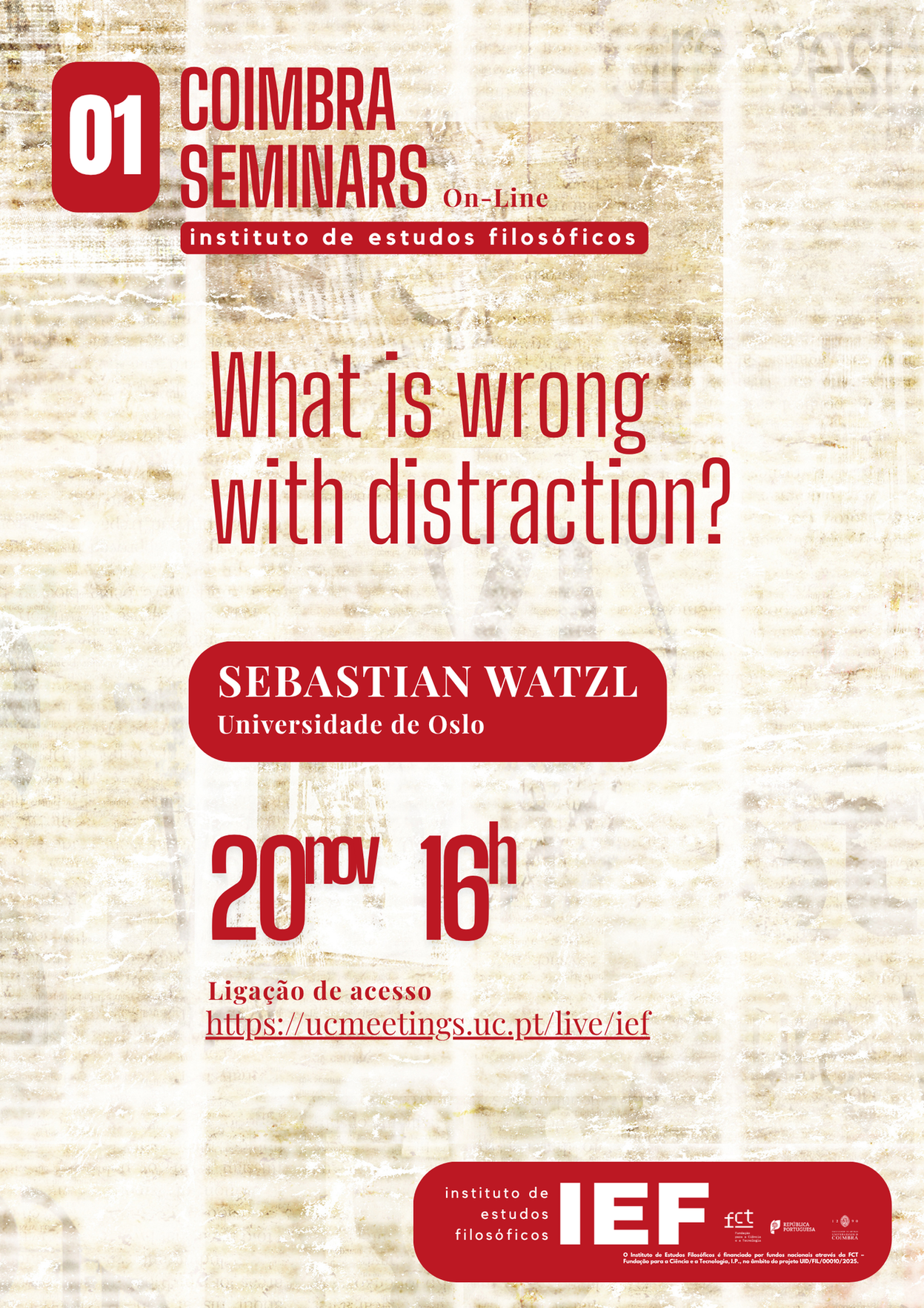
Filosofia - What is wrong with distraction? Sebastian Watzl c/o IEF


'Sebastian Watzl is a professor of philosophy at the University of Oslo (Norway). He specializes in philosophical issues about attention. He is the author of Structuring Mind (OUP), and recipient of an ERC grant on GoodAttention.

His research investigates the nature of attention, how it shapes consciousness, and the normative role and assessment of attention. Some of his current work is on the ethics of attention, the commodification of attention and its ethical assessment, the epistemic role of attention, and the use of attention as a political weapon.'

Sebastian Watzl - UoO Norway


Website: https://www.uc.pt/fluc/ief/agenda/coimbra-seminars-01/
LinkedIn: https://www.linkedin.com/posts/iestudosfilosoficos_ief-filosofia-philosophy-activity-7394448924947779584-fLSV
Instagram: https://www.instagram.com/p/DQ96aNVka0A/?igsh=MXJsejg0ZWE4bnBvZw==
Facebook: https://www.facebook.com/share/p/16uSVu9mNK/?mibextid=wwXIfr


individual
|
INTERPERSONAL : SCIENCES
humanistic -------------------------------------------  mechanistic
SOCIOLOGY : POLITICAL
|
group-population

My Mind
My Attention
My choice(s)?

Sources of distraction
Devices - access
Exposure - time
Social media
Assessment of attention
Children's education

Corporate Ethics of Attention
'Attention economy'
Policymakers & Policy
Attention as a political weapon


C/o IEF and thanks to Marta Santos (Secretariat).

Thursday, August 07, 2025

'Finding the Signal through the Noise' - WHO EARS

It is deprived communities who desperately want to do their best for family, but struggle to have access to and make sense of many sources of information. News and information not just through 'traditional' channels, but social media. Trying to be objective, non-judgemental it can still be surprising how TVs and smartphones are the key personal and furniture items.

Outside of London, Liverpool has a low uptake of immunisation against measles:

Liverpool, now has cases and a child's death from measles:

https://liverpool.gov.uk/council/public-health-liverpool/measles-on-the-increase/

https://www.liverpoolecho.co.uk/news/liverpool-news/alder-heys-plea-after-child-32050189

Located in-between, I often visit Manchester and Liverpool. I wonder now if I should visit Liverpool less. My daughter and her partner expecting their second child have a decision to make next year.

I noticed on X a reference to 'social listening'. This was missed while drafting a paper on COVID, technology, social media and information disorder. More positively, work on 'infodemic' was captured and posted. 

Blowing the dust of another draft, I will reassess this stream of work and seek specific literature, especially contributions to improved outcomes - public (mental) health.


McGowan B. S. (2022). World Health Organization's Early AI-supported Response with Social Listening Platform. Journal of the Medical Library Association : JMLA, 110(2), 273–275. https://doi.org/10.5195/jmla.2022.1398

See also:

Fryer, Jon. “Information Literacies – Learning, to Thrive in a Digital Age” IRMS Bulletin 230 (2022): 16-21.

Jones, P. (1996) Humans, Information, and Science, Journal of Advanced Nursing, 24(3),591-598.

Thursday, June 05, 2025

World Happiness Report 2025

WORLD HAPPINESS REPORT 2025


. . . and looking ahead to WHR 2026 . . .


Prof Lord Richard Layard

Editor, World Happiness Report

In World Happiness Report 2024, we presented evidence of a concerning decline in the wellbeing of young people in Western industrialised countries.

Obviously, a child’s wellbeing matters for the same reason that any individual’s wellbeing matters. But wellbeing among children and adolescents is also critical since it is the best predictor of how happy said child will be in their subsequent life – with a higher predictive power than the qualifications which they might obtain.


There has been much debate about the reasons for such a downward trend, with many competing theories and policy recommendations. However, one explanation has captured public and political attention more than any other: social media.


Also in 2024, Jonathan Haidt, a social psychologist at New York University’s Stern School of Business, published The Anxious Generation, arguing that the decline in youth wellbeing is driven by a transition from a play-based childhood to a phone-based childhood. The book has been a best-seller and sparked heated debate, both in academia and the wider world.


As editors of the World Happiness Report, we have followed this debate closely, concerned that rigorous science was being overshadowed by shallow media narratives.


In World Happiness Report 2026, we see an opportunity to bring all sides of the debate together to establish the facts, clarify disagreements, and provide decision-makers with a balanced assessment of what we know, what we don’t know, and what should be done.


We’re encouraging researchers from across the world to submit chapter proposals focusing on the relationship between social media and subjective wellbeing before the deadline of Sunday 15 June. Full details are available on the World Happiness Report website.


My source: Email from info AT worldhappiness.report

Previously: 'happiness'

Saturday, January 20, 2024

c/o Eliot Higgins: 'Moment of truth' or 'Movement to Critical Thinking'?

   moment

a : tendency or measure of tendency to produce motion especially about a point or axis

b : the product of quantity (such as a force) and the distance to a particular axis or point

https://www.merriam-webster.com/dictionary/moment


Here on W2tQ in posts applying Hodges' model I have tended to equate the subjective and the objective with the humanistic and mechanistic domains respectively. Of course, these mappings - conceptual placements are idealised. In reality there is a great deal of overlap. 

"Social media platforms such as X, once celebrated as democratising forces, are under even more scrutiny. The challenge isn't just rogue posts or unchecked algorithms. It reflects a deeper malaise, rooted in societal distrust, exacerbated by business models and perpetuated by reactive policies. The ramifications of disinformation spill on the streets with tangible, often devastating real-world consequences. 
These processes were already underway in 2014, when I founded the open-source investigative group Bellingcat." p.1. 
"The delicate balance between combating misinformation and ensuring digital freedoms remains elusive. ...

Addressing the root causes of disinformation requires a grassroots approach. Education stands at the forefront of this strategy. The idea is simple yet transformative: integrate open-source investigative and critical thinking into the curriculum. Equip the youth with the skills to navigate the labyrinthine digital realm, to question, analyse and verify before accepting or sharing information. ...

The potential of such a grassroots movement doesn't stop at school gates. Envision a world where universities become hubs of open source investigation, with national and international networks of students sharing methodologies, tools and insights. As these students move into their professional lives, they carry forward not just skills but a mindset - one that values critical thinking over blind acceptance." p.2.

Higgins, E. Moment of truth, Life&Arts, FT Weekend, 16-17 December 2023, pp.1-2.
 

 Individual
  |
    INTERPERSONAL    :     SCIENCES               
HUMANISTIC --------------------------------------  MECHANISTIC      
SOCIOLOGY  :   POLITICAL 
|
Group

mental well-being

critical thinking

education - learning

subjective
PSYCHO-

physical well-being

fact (checking)

digital media literacy

objective


social well-being

society

social impacts of info disorder


-POLITICAL
political well-being

policy - regulation

political impacts of info disorder


https://thestudentview.org/

https://citizenevidence.org/

Access to education to combat information disorder, through digital media literacy is essential. There are now many claimed forms of literacy, and informatics. Engaging students must not just rest with  universities and graduate level education; especially as the 'professions' are set to change and new ones arise.

Previous posts 'information disorder' , 'ignorance'.

Tuesday, March 28, 2023

PHT-2 Obesity paper - Chance is still up. Please help us WIN the @Nutrients_MDPI "Nutrients 2023 Best Paper Award"

Dear Professors and Colleagues,

https://doi.org/10.3390/nu13041200

the chance is still up to win the @Nutrients_MDPI "Nutrients 2023 Best Paper Award" for our Childhood Obesity paper from the School Study.

Nutrients Editorial Office prepared for us this banner (above) to use for social media etc.

Motevalli, Mohamad, Clemens Drenowatz, Derrick R. Tanous, Naim Akhtar Khan, and Katharina Wirnitzer. 2021. "Management of Childhood Obesity—Time to Shift from Generalized to Personalized Intervention Strategies" Nutrients 13, no. 4: 1200.
https://doi.org/10.3390/nu13041200

Pls help us with your continuous support to WIN, kindly asking
2nd time now to POST & SHARE widely the prepared text-blocs below with the attached grafic, thx so much!

Best Katharina

Like, Post, share and recommend at/via:

Friday, June 10, 2022

#HelloMyNameIs ... Socrates^


INDIVIDUAL
|
 INTERPERSONAL    :     SCIENCES               
HUMANISTIC --------------------------------------  MECHANISTIC      
SOCIOLOGY  :   POLITICAL 
|
GROUP
The Last Days of Socrates*


Cancelling Socrates

Overview

“They say Pericles caught democracy from you in bed.”

Today, Socrates is revered as the founding father of Western philosophy. But in 399BC Athens, he was a pain in the neck. The plague is over, democracy is (just about) restored, and everyone would like to get back to normal. How hard is it for one ageing firebrand to stop asking questions? It’s time to shut him up… Based on eyewitness accounts, Cancelling Socrates is a provocative, witty and dangerous world premiere from Howard Brenton, one of our foremost dramatists, whose acclaimed plays have been staged at the National Theatre, RSC, Shakespeare’s Globe, and worldwide. He reunites with our Artistic Director, Tom Littler.


My sources: 'Front Row' BBC Radio 4, 9 June 2022.

Images - c/o Penguin and Nick Hern Books (https://www.nickhernbooks.co.uk/cancelling-socrates)
Jermyn Street Theatre - text (as per links).

*(Just) A philosopher.

^You can play here too.
There is a play in #h2cm
#HelloMyNameIs #aPlay too,

Sunday, December 05, 2021

Draft paper: Abstract - "Society, Technology and COVID19 in Hodges' model"

"Society, Technology and COVID19 in Hodges' model"


Abstract


This descriptive paper explores technology, society and the COVID pandemic, curated through a generic conceptual framework: Hodges' model. Developed in health and education, the model provides an underlying structure and four care, or knowledge domains. Each domain can represent part of what would formally and globally be recognised as curricula. Of four prompts leading to the model's creation, one was to facilitate reflection and critical thinking. The COVID-19 pandemic makes Hodges' model an ideal tool to expatiate its socio-political and individual mental health impacts and technoscientific reponse. This will be demonstrated by using the model to reflect and critique the paper’s themes, exposing conceptual content, dependencies, relationships, stand-points, issues and opportunities. The pandemic has crystalised the irony of the 'information age' and a concurrent gift of an 'infodemic'. In response the paper's focus is the experiential impact of misinformation, fake news, ignorance, and literacies.

To begin, Hodges' model is introduced, then COVID, followed by society and technology in combination, an approach based on previous work that Hodges' model affords. Incorporated in Hodges' model, the political domain invites and facilitates dialectic critique. The model is situated, a product of the combination of structure and potential content. The awareness of various polarities, dualities, and dichotomies inculcates recognition of the 'middle' in whatever context the model is applied. This endows Hodges' model with a substrate inherently suited to deliberation and argumentation, namely, for example, subjective-objective, qualitative-quantitative, person-population, arts-sciences, demand-supply and dependent-independent dualities. The application of the model is explained with several examples, to reveal the convention for committing the model to paper. As will be evident, the author is located in the United Kingdom, but continues to seek - as with this work - a global perspective.


Keywords: COVID; technology; society; conceptual framework; Hodges’ model; ignorance

Awaiting news!

Thursday, November 18, 2021

Social media: Sanity saver or Mischief maker..?

Individual
|

INTERPERSONAL : SCIENCES
humanistic ------------------------------------------ mechanistic
SOCIOLOGY : POLITICAL
|
Group


"The Mercury Project is a global consortium of researchers dedicated to combating the impacts of mis- and disinformation on public health and to finding interventions that support the spread and uptake of accurate health information."


My source: https://twitter.com/ssrc_org/status/1460619132437774337?s=20

See previous posts:

WHO: Infodemic Management News Flash Thursday 4 November 2021 #25

COVID: Logic is the patient - again..

'Hermes'

Jones, P. (2008) Exploring Serres’ Atlas, Hodges’ Knowledge Domains and the Fusion of Informatics and Cultural Horizons, IN Kidd, T., Chen, I. (Eds.) Social Information Technology Connecting Society and Cultural Issues, Idea Group Publishing, Inc. Chap. 7, pp. 96-109.

Jones, P. (1996) Humans, Information, and Science, Journal of Advanced Nursing, 24(3),591-598.


Sunday, November 14, 2021

Opening windows always ...

takes  effort ...
 
takes work ...
 
takes energy ...

Window pulleys - by Peter Jones @h2cm
Window pulleys

individual
|
INTERPERSONAL : SCIENCES
humanistic ----------------------------------------------- mechanistic
SOCIOLOGY : POLITICAL
|
group - population
windows on the soul

I can reflect

Hey! No looking!
frosted glass

windows of opportunity?
the eye
- touch -
the senses

(night) sky
windows on the universe


a mirror

science
Window on
GREEN spaces


shared
vision

rich-er picture

role models

stained glass wonder awe fear
social media window to identity
(glass ceilings)
transparency
/ opacity


Windows™

barred window
no light

 perseverance too ...


Thursday, November 04, 2021

WHO: Infodemic Management News Flash Thursday 4 November 2021 #25

Individual
|

INTERPERSONAL : SCIENCES
humanistic ------------------------------------------ mechanistic
SOCIOLOGY : POLITICAL
|
Group

My source: EPI-WIN maillist: From the website ...


Feature art

"Infodemic managers understand the potential for misinformation to grow rapidly and cause harm. There is evidence of rumours spreading quickly and impacting poorly on public health, public trust and vaccine acceptance. Yet every piece of viral misinformation starts small, as seen in the third frame above. At this stage, the little piece of misinformation looks innocent enough, all alone and quite innocuous. It probably doesn't have lots of social media interactions attached to it, it probably isn’t being shared very much.

Narrator: Friends, that little piece of misinformation had big plans

The image highlights why identifying information voids and emerging information hazards before they go viral is so important. If we can use the tools we have to listen to emerging concerns and questions and proactively identify information voids in conversations, we may be able to intervene early by filling in that conversation space in the third frame with high quality information before that piece of misinformation progresses to frame four. At WHO we are working with our partners on some useful tools for managing the COVID-19 infodemic. Keep an eye on the News Flash for more information."

Image credit: Man Martin/Manoverboard

I could instantly relate the image to the domains of Hodges' model as above.

Thursday, April 08, 2021

"Public Domain" - The Vaudeville Theatre

individual
|
INTERPERSONAL : SCIENCES
humanistic ----------------------------------------------- mechanistic
SOCIOLOGY : POLITICAL
|
group


Public Domain is a dark, funny, verbatim musical about the internet: Those who own it; those who live in it; and YOU!

Following an acclaimed digital debut at Southwark Playhouse this thrilling, new British musical, composed entirely from the real-life words of YouTube vloggers, Instagram influencers, Facebook’s tech giants, and everyday internet users now has its live world premiere in the West End.

Written and performed by the hugely talented Francesca Forristal (Oddball) and Jordan Paul Clarke (Showstopper! The Improvised Musical), this blackly comic musical follows two teenage influencers; Millie (sporty spice, health guru, buddha bowls – millennial) and Z (GCSEs existential dread, swag – generation Z), as well as featuring exclusive ‘footage’ of inside Mark Zuckerberg and wife Priscilla Chan’s family home…

You’re gonna get their honest, true selves… with some serious bass, obvs. Authentic, right?

Remember, it’s like ‘Black Mirror’ but real and set to music.

The Vaudeville Theatre operates strictly under the government COVID-19 guidelines. For further information check our COVID-19 secure information page. All bookings in a party must only be from the same household or the legally defined support bubble.