Hodges' Model: Welcome to the QUAD: functions

Hodges' model is a conceptual framework to support reflection and critical thinking. Situated, the model can help integrate all disciplines (academic and professional). Amid news items, are posts that illustrate the scope and application of the model. A bibliography and A4 template are provided in the sidebar. Welcome to the QUAD ...

Showing posts with label functions. Show all posts

Thursday, December 11, 2025

Bourdieu: systems, axes, maps, practical logics

I have checked these quotes and am fairly sure they are accurate. The first, I feel, improves with re-reading, and presents a clearing at the end? 

The clearing could be a template, and as per the second it may be old; but retains its practical function.

'Intellectualism is inscribed in the fact of introducing into the object the intellectual relation to the object, of substituting the observer's relation to practice for the practical relation to practice. Anthropologists would be able to escape from all their metaphysical questioning about the ontological status or even the 'site' of culture only if they were to objectify their relation to the object, that of the outsider who has to procure a substitute for practical mastery in the form of an objectified model. Genealogies and other models are to the social orientation which makes possible the relation of immediate immanence to the familiar world, as a map, an abstract mode of all possible routes, is to the practical sense of space, a "system of axes linked unalterably to our bodies, which we carry about with us wherever we go", as Poincaré put it.' p.34.
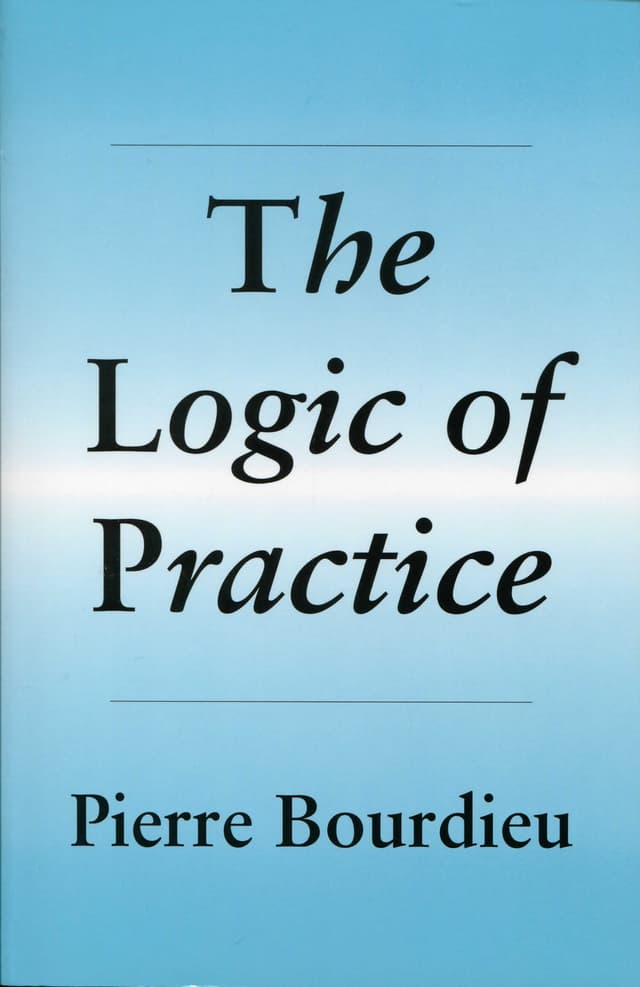
The Logic of Practice
'The logical [kinship] relations he constructs are to 'practical' relations - practical because continuously practised, kept up and cultivated - as the geometrical space of a map, a representation of all possible routes for all possible subjects, is to the network of pathways that are really maintained and used, 'beaten tracks' that are really practicable for a particular agent. The family tree, a spatial diagram that can be taken in at a glance, uno intuitu and scanned indifferently in any direction from any point, causes the complete network of kinship relations over several generations to exist in the mode of temporal existence which is that of theoretical objects, that is, tota simul, as a totality in simultaneity. It puts on the same footing official relationships, which, for lack of regular maintenance, tend to become what they are for the genealogist, that is, theoretical relationships, like abandoned roads on an old map; and practical relationships which really function because they fulfil practical functions.' p.35.


My source:
Bourdieu, P. (1990). The Logic of Practice. Stanford University Press. https://doi.org/10.1515/9781503621749 [and image source].

Bourdieu, Pierre, "The Logic of Practice (1990)" (1990). eTextbooks for Students. 875.
https://stars.library.ucf.edu/etextbooks/875

See also: https://hodges-model.blogspot.com/search?q=bourdieu

Thursday, August 17, 2023

Identity, entity and continuity - c/o Evans (2009)

"Many things are defined by their identity, and not by any attribute. In our typical conception, a person ... has an identity that stretches from birth to death and even beyond. That person's physical attributes transform and ultimately disappear. The name may change. Financial relationships come and go. There is not a single attribute of a person that cannot change; yet the identity persists. Am I the same person I was at age five? This kind of metaphysical question is important in the search for effective domain models. Slightly rephrased: Does the user of the application care if I am the same person I was at age five? 

A conceptual identity has to be matched between multiple implementations of the objects, its stored forms, and real-world actors such as a phone caller. Attributes may not match." p.90.

"Object modeling tends to lead us to focus on the attributes of an object, but the fundamental concept of an ENTITY is an abstract continuity threading through a life cycle and even passing through multiple forms.

"Some objects are not defined primarily by their attributes. They represent a thread of identity that runs through time and often across distinct representations. Sometimes such an object must be matched with another object even though the attributes differ. An object must be distinguished from other objects even though they might have the same attributes. Mistaken identity can lead to data corruption.

An object defined primarily by its identity is called an ENTITY. ...

Domain-Driven Design
Of course, most "ENTITIES" in a software system are not people or entities in the usual sense of the word. An ENTITY is anything that has continuity through a life cycle and distinctions independent of attributes that are important to the application's user. It could be a person, a city, a car, a lottery ticket, or a bank transaction." p.91.


Eric Evans, (2009). 
Domain-Driven Design: Tackling Complexity in the Heart of Software, Model-Driven Design. Addison-Wesley.
[Emboldened text as per book.]

Wednesday, June 14, 2023

[ Towards . . .] A Geometry of Care*

Context -
"Introduction: We present a new model of skilled performance in geometry proof problem solving called the Diagram Configuration model (DC)." p.577.

INDIVIDUAL
|
INTERPERSONAL    :     SCIENCES               
HUMANISTIC --------------------------------------  MECHANISTIC      
SOCIOLOGY  :   POLITICAL 
|
GROUP
"A safe abstraction only ignores irrelevant details, i.e., details which only discriminate between objects that are functionally equivalent with respect to the problem solving task." p.582.

So much to consider here, I may be overstretching analogies but then Hodges' model can act as both a conceptual rack and resolver.


"For instance, to use the side-angle-side rule for inferring triangle congruence a problem solver must locate three congruence relationships - two between corresponding sides of the triangles and one between corresponding angles. In searching for a list of statements for these three relationships, one might need to consider numerous possible combinations of three statements that exist in the list. However, if these relationships are marked on a diagram, one can quickly identify them since the side-angle-side configuration comes together in each triangle at a single vertex. In other words, related information is often easier to find in a diagram because it is typically in the same locality whereas the same information may be separated in a in a list of statements. This is the locality feature of diagrams." p.584.


not just 'local' -


- but intra- interdomain -
with constant stress on safety.


Koedinger, K.R. & Anderson, J.R. (1995) Abstract Planning and Perceptual Chunks. In  Diagrammatic Reasoning: Cognitive and Computational Perspectives. Janice Glasgow, N Hari Narayanan, B. Chandrasekaran (Eds.). Massachusetts: AAAI PRESS / MIT Press. pp.577-625.

Book cover: https://dl.acm.org/doi/book/10.5555/546459

*There may be several? But -
"One of the places where the Geometry tutor expert (GTE) gets bogged down while attempting difficult problems is in the fruitless application of algebra inferences. Algebra expressions can be combined and manipulated in infinite variety and as a result, algebra inferences often lead problem solvers into black holes in the search space from which they may never return." (17.4.3 Avoiding Algebra in the Diagram Configuration Space),  p.593. 


Sunday, December 04, 2022

Time - for care to commute [an appendum]

"The whole thrust of nursing in the last decade [1981-91] has been directed towards seeing the patient as an integrated, individual human being rather than as a piece of malfunctioning anatomy. The patient is a person not 'the mastectomy in bed 3' or 'the man with the leg'. This means that any model of nursing must take into account the patient's psychological and social functioning as well as anatomy and physiology." p.53.
Ack. Walsh, M. (1991). Models in clinical nursing: The way forward. London: Bailliere Tindall.
[Book now bound for students.]

 INDIVIDUAL
|

 INTERPERSONAL    :     SCIENCES               
HUMANISTIC --------------------------------------  MECHANISTIC      
SOCIOLOGY  :   POLITICAL 
|
GROUP

psychology

anatomy, physiology

social


employment, studying ...
life chances / end of life choices


We need to consider concepts of care for a person, patient, and carer, not only in terms of their respective, or primary care domain [ e.g. leg, mastectomy; anatomy, physiology; sciences ] and associations with the academic disciplines; but in Hodges' model, focus upon the horizontal, vertical and diametric relation across and between care domains.

As described by Walsh, talk of  'the mastectomy in bed 3' or 'the man with the leg', is a dated trope; yet sadly it can signify the nature of staff (team) attitudes, the quality of care and experience of patients and their families. 
 
Technically, I see Hodges' model as a relational ontology. What this means basically, is that the model facilitates, encourages the user of the model to consider what they identify in a situation as objects (entities), events, concepts, relationships, data, and so on. An important assumption here is that what 'stands out' is what has salience (what the patient says - non-verbally too, what they mean, what they don't say?); that is, meaning and significance. 
 
Returning to Walsh's example: What does this event, diagnosis, prognosis (including anatomy and physiology) mean for this person as an individual? (If it means 'nothing' this may still - in a mental health context - be important.) What will it mean for the person's friends and family? What do the person it will mean to friends and family - significant other? What about their ability to work, and study? Can they resume their life plans and what of the person's life chances and those also affected? 
 
Crucially, there may not be a connection, a relation, across the care domains of Hodges' model. Asking the question is key, however; to go beyond what can be(come) task-based care. The ability of the model to assure and improve health care rests on this. The same applies for self-care too, with the model's support of reflection and critical thinking, essential to health and other forms of literacy.

Parity of esteem means we have to travel across the model. If we are 'collapse' the model's domains - four sets, into one that actually means something for the nurse, patient, manager, policy maker and researcher. This something, at least conceptually; is no less than person-centred, holistic and integrated care.

Q. Can care commute?