Hodges' Model: Welcome to the QUAD: Search results for math

Hodges' model is a conceptual framework to support reflection and critical thinking. Situated, the model can help integrate all disciplines (academic and professional). Amid news items, are posts that illustrate the scope and application of the model. A bibliography and A4 template are provided in the sidebar. Welcome to the QUAD ...

Showing posts sorted by relevance for query math. Sort by date Show all posts

Wednesday, January 28, 2026

ii Math Without Numbers - final notes & obs

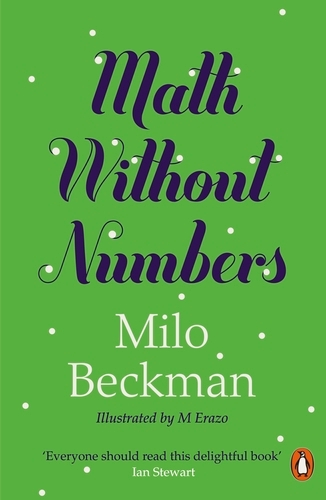
In Math Without Numbers the chapters and topics flow and slot in really well, even for novices. There is no index, the inclusion of which is a first-check usually. The book's appeal was its non-technical title and invitation reading the sleeve notes. The title throws up words and visuals, the latter, to repeat, are ably and simply furnished by M Erazo. Remaining notes to highlight (record here) include (and capture overthinking!):
Math Without Numbers

Reference to 'ideology space', 'conceptual space' and the role of visual analogies, idioms, and how 'the list of spaces to choose from is always the same.' ... pp.28 & 29. On page 30, 'When you say that gender is a spectrum rather than a binary, that's a topological claim: You're  saying gender space is one-dimensional (a line) rather than zero-dimensional (two separate points). 'Questions about which conceptual paradigm to use sometimes boil down to questions of dimensionality.' Discussion of an infinite continuum had me making an axis of Hodges' model warp, this way and that: concave-convex (p.59). Maps and correspondence is already well established, as per a new paper (abstract and thanks to follow 1st Feb):

S. Bettiol, P. Jones, H. A. Onyedikachi, and W. G. Kernohan, “Bridging Gaps in Oral Health Frameworks: Mapping With Hodges' Health Career - Care Domains - Model”, Journal of Public Health Dentistry (2026): 114, https://doi.org/10.1111/jphd.70034 

Interesting to read of general map facts, flowing substances inside a rigid container, and vector maps. A pencilled note to share:

'Because when you look at things in the abstract like this, dusting off the specifics of a situation to focus on underlying dynamics, you start to realize there are only so many different patterns and structures out there. These patterns and structures are called mathematical objects, and thinking about them is called math.' p.79

The chapter on (generalised) Algebra, forced me to reconsider the Socratic, guided discovery and arrival at the structure of Hodges' model. (lines & points : nodes & edges). For page 88, I noted 'generic' invites abstraction. Isomorphism is discussed. Again I tested this against Hodges' model. I've always found it helps to immerse oneself in a new vocabulary: so welcome (anew) - structures, fields, rings, groups, loops, graphs, lattices, orderings, semigroups, groupoids, monoids, magmas, modules . . . algebras, p.101. Some are named only, but on graphs raises questions ... p.103.

'How densely interconnected is it? How segregated into different cliques? Does it cut clean into two subgraphs, with no connections between them? Can it be drawn without any lines crossing? Are there any lone dots without any connections?' 

There's the matter of 'friend of a friend' who have broken out of the sociological domain. Other notes to self: Significance of concepts - patient-centred, service-centred? The distance between between (vertical, horizontal, diametric)? There are weighted graphs (p. 104) and acknowledgement of category theory (p.115). A chapter on modelling pp.161-175, and models p.164 & p.169 are just a selection of highlights on a marvellous tour.

A hidden puzzle in the book remains a mystery for me.

Milo Beckman (2021) Math Without Numbers. London, Penguin Books. Illustrated by M. Erazo.

Previously: 'math' : 'diagrams
Plus, now archived Science domain links: 
https://web.archive.org/web/20150414125339/http://www.p-jones.demon.co.uk/linksTwo.htm

Believe it or not, this 'diversion' does help my reading of Order and the Virtual

Monday, May 30, 2022

1+1=2

INDIVIDUAL
|
 INTERPERSONAL    :     SCIENCES               
HUMANISTIC --------------------------------------  MECHANISTIC      
SOCIOLOGY  :   POLITICAL 
|
GROUP

belief
my purpose


1+1=2

0,1 ...
society
social groups
social networks
1+1= ?

"When people talk about how math is or should be apolitical, because "1+1=2" does not depend on politics and neither does the Riemann hypothesis, it seems that the only math that they can think of is pure math. This line or argument completely falls apart for applied math.@imathematicians [thread]


My source:

https://twitter.com/imathematicians/status/1530724466073952261?s=20&t=eF1XRD9HbkSJ2XWWbIk2qQ 

Previously: 'maths' ,  '2 + 2 = ?'

https://twitter.com/imathematicians/status/1530724466073952261?s=20&t=eF1XRD9HbkSJ2XWWbIk2qQ

Tuesday, February 25, 2025

So, I can proceed, fall flat on my face - [ concepts-maths iii/iii ]

- and utilise the inevitable!

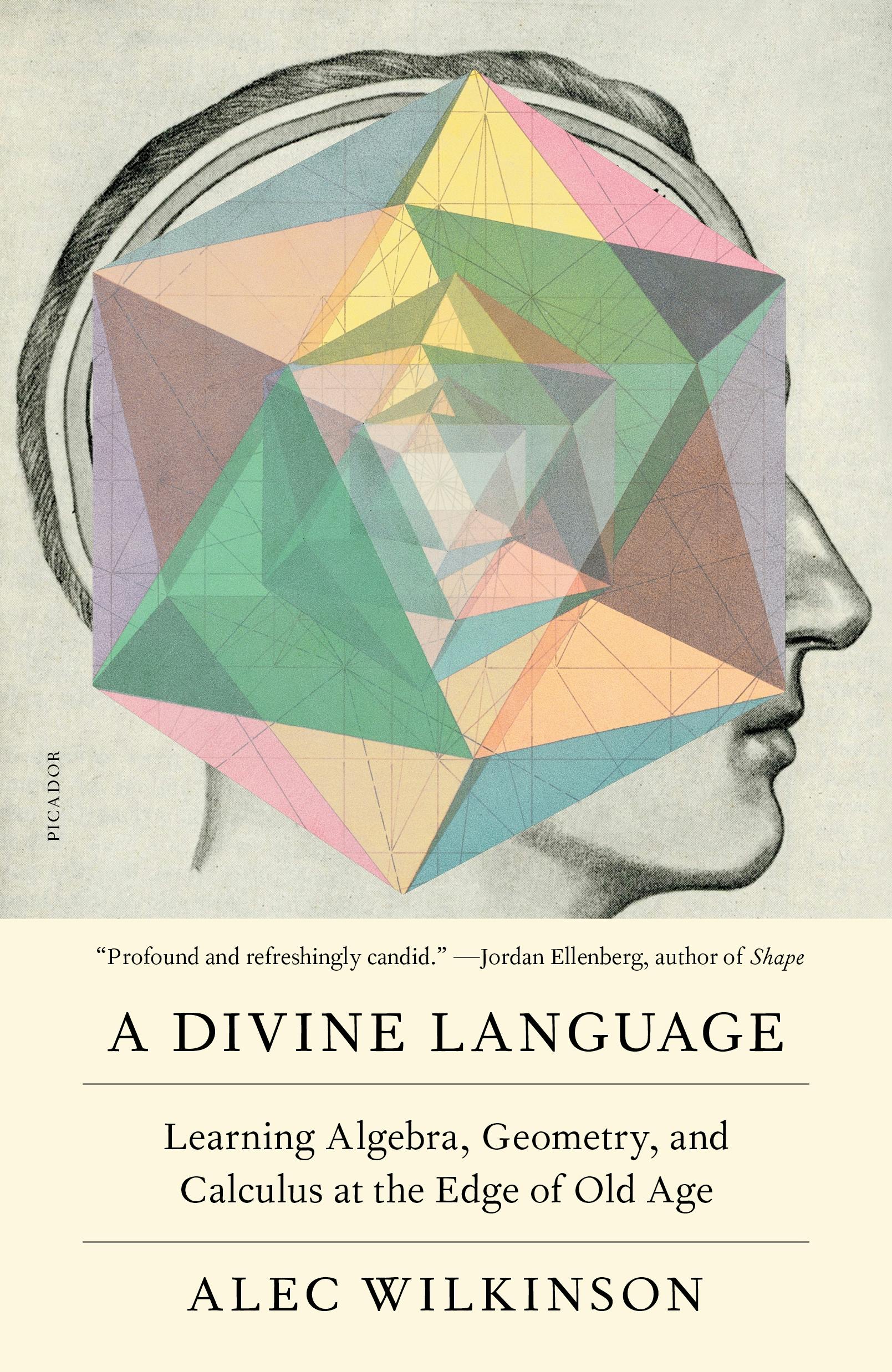
'Decades after struggling to understand math as a boy, Alec Wilkinson decides to embark on a journey to learn it as a middle-aged man. What begins as a personal challenge—and it's challenging—soon transforms into something greater than a belabored effort to learn math. Despite his incompetence, Wilkinson encounters a universe of unexpected mysteries in his pursuit of mathematical knowledge and quickly becomes fascinated; soon, his exercise in personal growth (and torture) morphs into an intellectually expansive exploration.' 
https://us.macmillan.com/books/9781250168580/adivinelanguage/


A Divine Language

As observed many times in the literature and here on W2tQ writing about Hodges' model, healthcare - medicine and nursing are both a science and art. Hodges' model is an invitation to the arts in liberal form, with an emphasis on practice: social sciences, humanities, physical sciences and even mathematics. 

There is now quite a bank of posts on W2tQ tagged art/arts and more specifically prints. I still plan to attend a workshop on printing. As ever, in my head, my mind's eye - I've an amazing, brilliant .. (!?) arts project, just waiting to be released. A true collage of the care concepts.

If Hodges' model is 'simple' in its basic form, then it is clearly possible for other people to create their own artistic impressions, interpretation of Hodges' model. My effort would of course be unique, as would theirs. There could be a competition and I end-up missing out. Not even short-listed for a prize; a victm of familiarity perhaps? 

Quite 'naturally' in a way, or at least by way of childhood experiences, a need for therapy and validation; I have also arrived at a belief that there is a mathematical project here (Oh, for goodness sake! Is there no end to this?). 

As posted before, like Alec Wilkinson I am no mathematician. Embarrased, shamed to a husk at school on many occasions, I encountered math teachers who must have empathised. Well, that's one way to explain the appreciation of maths I have always felt. Or more accurately, a love of knowledge; of which maths and logic are a part? Since I can hardly understand, I am more in love with the idea of maths, than mathematics itself. I have always been in awe of maths and people who 'get it', even if that is only  mastery of the high school mathematics curriculum.

Convinced that there is more to Hodges' model than meets the eye, I have thought of following Wilkinson - who tries to be systematic - to underpin a book - back into the nightmare lands of my youth. Should I retake GCSE maths? 'There be dragons', without a doubt. The heat can be recalled, like it was yesterday. This isn't just a dragon, it is a chimera. At times it wants to be a friend, providing familiar terms, domain, set, and group. Wilkinson's quest is structured and seeks a reasoned and disciplined approach. Why am I bothering? I have a choice surely? Nursing, health, global health can all collectively furnish many items of epistemological fruit. No need for calculative flagellation. Through Hodges' model you can productively span the disciplinary bridges once again: call in - sociology, economics, policy and more. How many Königsberg bridges do you need?

While the artist in me, might waste time. In pointing to Hodges' model as a potential mathematical object, this little seed might fall on fertile and (much) more capable ground(?), as Wilkinson describes:

'Mathematics might be the only creative pursuit in which inevitability figures. Other artists might be defeated by a task beyond their capabilities, but they do not live with knowing that sooner or later, if their work is consequential, someone will do what they haven't been able to do. Mathematicians work within a discipline in which, so long as their suppositions are correct, there is always a precise and irrefutable answer, even if they can't find it.' p.135.

I can hope for this at least.

Alec Wilkinson. (2022) A Divine Language. Learning Algebra, Geometry, and Calculus at the Edge of Old Age. New York: Farrar, Straus and Giroux. https://us.macmillan.com/books/9781250168580/adivinelanguage/

Previously: How 'divine' is the language of care?

n.b. At some point I will go though all the posts and unpublish/delete items that add little to the core.

Sunday, January 25, 2026

'Maths Without Numbers' by Milo Beckman

'Before you go tell your loved ones that you read a book about math and learned that a square is a circle, keep in mind: Context matters. A square is a circle, in topology. A square is most certainly not a circle in art or architecture, or in everyday conversation, or even in geometry, and if you try to ride a bike with square tires you won't get far.' pp.7-8.

'Like a line:

(Illustration - pen drawing of a line, a 'C' and an almost closed circle.)

A line can be bent almost into a circle, but to finish the job we'd need to click the ends together--not allowed. No matter how you manipulate a line, you'll always have those two special points on either end, where the shape just stops. You can't get rid of end-points. You can move them around and stretch them apart, but the two end-points are an unchanging feature of the shape.

For a similar reason, a figure-eight is a different shape too. There aren't any end-points, but there's still a special point in the middle where the lines cross, where there are four arms reaching out instead of the usual two at any other point. Stretch and squeeze all you want, you can't get rid of a crossing-point either. p.9.

Math Without Numbers
'The circle (aka S-one) and the infinite line (named R-one) are the only manifolds in the first dimension. To avoid end-points, you either have to loop back around or just go on and on forever. And don't forget: Because all the shapes in topology are stretchy, this also covers any closed-loop shape and any goes-on-forever shape. It doesn't have to be literally a circle or a straight line.' p.16.

The third dimension, dough-type manifolds, is pretty well understood at this point, though it took a hundred years and a million-dollar prize to get there, and we still don't have a totally neat and clean classification like the lower dimension. In dimensions five and up, topologists use a set of techniques called "surgery theory" to operate on manifolds and construct new ones.

That just leaves dimension four.

I wish I could tell you what's going on in dimension four. I'm not sure there's anyone who really knows. It's a weird boundary case: too many dimensions to do visually, but not enough to use sophisticated surgery tools. There are entire textbooks dedicated to what little we know about four-manifolds, and I couldn't make sense of anything past the opening pages. A professional topologist once told me she'd wanted to work on four-manifolds as an undergraduate but was advised to steer clear.' pp.23-24.

"Like a line" ... Yes. Take two that cross. Then the universes open up. 

Milo Beckman (2021) Math Without Numbers. London, Penguin Books. Illustrated by M. Erazo.

Previously: 'surgery'

Sunday, August 25, 2024

Hodges' model? Ah! You mean the naïve conceptual framework that ...

... thinks it's a theory! (i)

Yes, I suppose it is naïve, now you mention it. It's naïve in a number of ways:

  1. The assumed state of students - new learners; although of course, in healthcare and other professions for many years mature students - far from naïve - can make up a notable proportion;
  2. When a patient assessment begins, especially upon initial (and first) referral, the data gathering, our knowledge should then be assumed to be naïve.
  3. The quest for a theoretical underpinning of Hodges' model, may display naïve associations between concepts that are misplaced, misunderstood and wholly inappropriate.
Worth noting in #1, that policy-makers and recruitment specialist hope to increase the number of mature entrants, given demographic pressures.

If you consider the way nursing as a profession has received 'nursing theory', or in a similar vein, consider the status of nursing theory, and models of care in nurse (and healthcare) curricula today, then the approach is pragmatically naïve? From the 1970's -

Vinner, S. (1976). The Naive Concept of Definition in Mathematics. Educational Studies in Mathematics7(4), 413–429. http://www.jstor.org/stable/3481947

Vinner writes:

"As a matter of fact, all of us start to deal with definitions at a very young age when we start to leam our mother tongue. At this stage, various types of definition occur and the subject is too complicated to be dealt with here. After several years, especially at school, one type of definition becomes dominant; the lexical definition. In a lexical definition, the meaning of a certain word (or words) is explained by means of other words (we shall deal here only with the case in which the word and its definition are at the same language). This type of definition generally occurs in mono-lingual dictionaries." p.425.

"The sentence: 'A rectangle is a quadrangle that has four right angles' does not have in it any underlying assumptions about the role of definition in mathematics. It can be interpreted in any of the following three ways:
  1. We (math teachers and math students) hereby agree that instead of saying, "a quadrangle that has four right angles" we will say: "a rectangle" (The formalistic approach).
  2. In the mathematical community the meaning of the word rectangle is a quadrangle that has four right angles (The lexical approach from the expert's point of view).
  3. The object denoted by the word 'rectangle' is a quadrangle that has four right angles (The lexical approach from the naive standpoint). 
Thus, not adding anything to definitions like the above we let the student choose his own interpretation out of the three mentioned (or even possibly more) interpretations. We claim that in most cases the student's choice will be the third one." pp.427-428.

Does the diaeresis here point to forms of parity of esteem, oppositions, polarities, dichotomy?

Saturday, August 10, 2019

Threshold Concepts: Reflection on chaos, complexity and AI

Here are the reflections on the photograph posted in June following the Conference on Threshold Concepts:


Chaos can occur in any one ... or all of the four domains of Hodges' model. The same applies to order.

http://homepages.math.uic.edu/~kjerland/Lorenz/lorenz_attractor.html


This is a characteristic of chaos and chaotic systems.

Chaos can arise at any time: in the here and now, being sown now for the future (climate change?), or springing from the past, as in pleasurable, or traumatic memories.

While the Lorenz attractor and other graphical examples are grounded in mathematics and science, in #h2cm we need to imagine the butterfly diagram extended across and simultaneously at work across the models four domains.


individual - self
|
INTERPERSONAL : SCIENCES
humanistic ----------------------------------------------- mechanistic
SOCIOLOGY : POLITICAL
|
group- population


Even in instances of riot and anarchy there will be pockets of 'order', but would you would want to take your chance of finding one? Amid talk of being in the wrong place, at wrong time; to what extent is this dependent upon who we associate with socially? Or, what we believe is the political course we might, should, will, must follow?

The context of Prof. Land's slide is learning and decision making. As a 'political' matter when chaos occurs, how is it manifested in disintegration? Can we hear the 'gears grind'? What exactly goes awry? Is it the processes as in the timing, leadership and with it responsibility?

The slide is powerful in giving support, to clinical decision-making as a context in which complex decision making is very common and simultaneously encompasses political, rationale and judgemental (ethical) forms of decision making.

Hodges' model can also facilitate recognition of differentiation between relational chaos and the explicit state of decision-making. For example, a healthcare practitioner and client/patient/carer may have achieved empathy and rapport, but the complex demands of the clinical decision still presents a great deal of uncertainty. Alternately in instances when the relationship is being forged then the communications: verbal and non-verbal (and a function of the clinical team) can be a confounding factor if not negotiated professionally (and in socially acceptable terms by members of the public). Another useful perspective is Personal and Public Involvement (PPI) at what point is this achieved? What are the thresholds in the public's learning, as they engage and are engaged if they are not to label the initiative as a checkbox exercise? Again Hodges' model can help us to reflect upon the scope and complexity of such situations.


AI, artificial intelligence was mentioned (I'm sure?) in the presentation and the benefits of AI in healthcare are already being realised. This is tempered with the requirement for AI systems to be able to explain their 'reasoning', rather than this be taken at face value. As AI takes on tasks that include initial automated screening of job applications that include videos then another dimension of learning is presented to students.

Health and justice is by default complex. Consider, the task of being seen by society that justice is duly served and doing so with a duty of care and welfare of the prisoners. To this, we can add the aspiration of custody being rehabilitative. For a prisoner, even on remand, there will be times when health needs and patiency must be recognised. When a long-term prisoner becomes chronically ill, this can present a major challenge to law-makers, prisoners, their families, the healthcare team and society.

individual - self
|
INTERPERSONAL : SCIENCES
humanistic ----------------------------------------------- mechanistic
SOCIOLOGY : POLITICAL
|
group- population

Identity (use of name, touch ...)
(My) PURPOSE
Beliefs, Personal values
 Safety (personal) Thresholds
Trigger warning
Critical - critique 
not taking it personally


PROCESS
[Space] - physical &
degrees of freedom in decision making
constraints
Rationale*
Evidence
Theory
Quantitative Research


Qualitative Research


Patient : Healthcare practitioner
decision making
 PRACTICE
Critical - agreeing to disagree

Schism - 'distance'

Consensus (bridge building)
 Autonomy (in decision making)
Administration / Bureaucracy
Professionalism
Anti- 'X' movements
Riot and anarchy
safety (POLICY)
Critical - political


*While placed within the sciences domain, 'rationale' can be evidenced physically, psychologically,  politically and socially.  It is this that forces us to acknowledge the several edges of chaos.

See also:
Inaugural Scottish Threshold Concepts Conference: TCs in Action [i]


Images:
http://homepages.math.uic.edu/~kjerland/Lorenz/lorenz_attractor.html

https://www.thingiverse.com/thing:3774260/comments
(Original image)

Friday, January 03, 2025

How 'divine' is the language of care?

'My impression was that algebra was less a subject than a practice into which one was inducted by the algebra priests after a series of mortifications. The letters and equations that the teacher drew on the board did not seem related to the numbers I had handled in other classrooms. For one thing, a problem in arithmetic was vertical, one number beneath another, and a problem in algebra, an equation, was horizontal. I felt as if in a permanent present, unable to see how the past and the future were joined. In Ulysses James Joyce writes that the present is the drain that the future goes down on its way to becoming the past.' p.12.
'The mathematician Alonzo Church, who taught Alan Turing, told another of his students, David Berlinski, "Any idiot can learn anything in mathematics. It requires only patience." I would sit with a pencil and paper trying to solve an algebra problem and sometimes go only so far before my mind would halt, because I had could used up what little I knew that might apply. It hadn't occurred to me to think of algebra as the bright boys and girls I had been among had thought of it, as a series of related procedures. They were constructing a map. I was collecting postcards from places where anxiety or incuriousness had kept me from leaving my hotel.' p.31.
(my emphasis)


Alec Wilkinson. (2022) A Divine Language. Learning Algebra, Geometry, and Calculus at the Edge of Old Age. New York: Farrar, Straus and Giroux. https://us.macmillan.com/books/9781250168580/adivinelanguage/

Previously: math :: logic

Saturday, April 05, 2008

"Great Scot!" Ruby & Rails - Scotland On Rails

Just back from Edinburgh this evening. Took it steady about 60mph, so used just half a tank of fuel - not bad for 400 miles (return). Had to take it easy as it was just above freezing in places and I ended up playing Star Trek. It was snowing for a time North of Penrith. When I was able I put the head lights on full-beam: warp drive!

Scotland On Rails was great - the organisation, speakers, content and company. The sessions I attended included testing, testing testing, migrating to Ruby 1.9, DSLs .... and the last session on JRuby with the announcement of version 1.1 that provoked a round of applause:

JRuby on Rails: Up And Running!

Charles Oliver Nutter and Thomas Enebo

JRuby 1.1 has been released, and is becoming the Rails platform of choice for many Rails shops. In this session, we’ll show how to start from scratch or migrate your existing Rails app to JRuby. We’ll demonstrate the various deployment options on JRuby. We’ll show how to integrate Java libraries into your app. We’ll walk through NetBeans’ Ruby and Rails support and talk about how JRuby has enabled better tools and better solutions for Ruby developers. And we’ll have a conversation with the audience about where JRuby on Rails should go from here. Be prepared to talk shop and see lots of code and demos.
I'd been really looking forward to Joe's presentation on DSLs and was not disappointed. My enthusiasm here is not because Hodges' domains makes a DSL a dead-cert, far from it; it's just that I miss playing with Plasticine:
Domain Specific Languages : Moulding Ruby

Joe O'Brien

Ever wondered what all the fuss is about when it comes to DSL’s and Ruby? It seems to be all we hear about. This talk will peel away the onion and look at what it is about Ruby that makes it the perfect candidate for creating your own languages. I will show you, through examples, how you can create your own languages without the need for compilers and parsers. We will also cover some real world examples in areas of Banking and Medicine where DSL’s have been applied.
Amid the clamour that is Rails, Joe also stressed that people should focus and explore Ruby itself. Something I need to get on with. Paul Dix's talk this afternoon was fascinating in terms of scale, processing, math libraries and mention of clustering:
Collective Intelligence: Leveraging User Data to Create Intelligent Rails Applications
Paul Dix

Take advantage of user data to create intelligent Rails applications! This talk will focus on data mining to create complex application behavior and gain insight into the patterns and habits of your users. Examples of these techniques can be seen with recommendation systems like those created by Amazon, Netflix, last.fm, and others. Additional examples include spam filtering systems for email or comment filtering provided by Akismet.
I will focus on techniques for gathering data, specific gems and plugins for performing various data mining and machine learning tasks, and performance issues like how to distribute the work to separate servers. Theory in this talk will be light and the specific algorithms will only get a mention by name. We’ll be looking at real world Ruby and Rails code examples for building recommendation, ranking, and classification systems.
I wasn't the only Ruby newbie and met a few of my peers, we noticed on the first day the number of sessions on the theme of testing. Last week I'd watched Matz' February talk on Ruby 1.9 and the future which helped me out through the past two days. Last night in The Crags one of the speakers Ritchie (whose session I missed) kindly explained about his conjoint talk and the significance of JRuby, NetBeans IDE and IntelliJ. Given Richie's knowledge, experience and that closing session, I'll definitely investigate these.

There's only one conclusion - totally overwhelming: but totally worth the brain ache.
So great job and many thanks to Alan and the team, plus the luminous speakers and sponsors.

Friday, June 23, 2023

Evidence-based care: What are 'we' missing?

Perhaps, proof of (what) works? 

Blockchain Revolution

"The mechanism for reaching consensus is critical. 'Consensus is a social process,' blogged Vitalik Buterin, pioneer of the Ethereum blockchain. Human beings are fairly good at engaging in consensus . . . without any help from algorithms." He explained that, once a system scales beyond an individual's ability to do the math, people turn to software agents. In peer-to-peer networks, the consensus algorithm divvies up the right to update the status of the network, that is, to vote on the truth. The algorithm doles out this right to a group of peers who constitute an economic set, a set that has skin in the game, so to speak. According to Buterin, what's important about this economic set is that its members are securely distributed: no single member or cartel should be able to overtake a majority, even if they had the means and incentive to do so.

To achieve consensus, the bitcoin network uses what's called a proof of work (PoW) mechanism. This may sound complicated but the idea is a simple one. Because we can't rely on the identity of the miners to select who creates the next block, we instead create a puzzle that is hard to solve (i.e., it takes a lot of work), but easy to verify (i.e., everyone else can check the answer very quickly). Participants agree that whoever solves the problem first gets to create the next block. . . . For each block they find, miners receive  bitcoin as a reward." p.31.

INDIVIDUAL
|
     INTERPERSONAL    :     SCIENCES               
HUMANISTIC --------------------------------------  MECHANISTIC      
SOCIOLOGY  :   POLITICAL 
|
GROUP


'proof of activity'
'proof of work'
'proof of burn'

'proof of capacity'
'proof of disk'
'proof of storage'
'proof of existence'


'proof of asset'
'proof of storage'
'proof of stake'
'proof of property'


Hodges' model = Proof of Care?

Proof of Concepts (at least?)

How do we prioritise and focus
our energy expenditure, and energies in the 21st century?

*And education?

Tapscott, D. and Tapscott, A. (2018) Blockchain Revolution How the Technology behind Bitcoin Is Changing Money, Business, and the World. Penguin, New York.
[See also index, p.355 'proof of a,b,c...'.]

Monday, May 09, 2011

'Gaps' a poem by Philip Holmes - Journal of Humanistic Mathematics

Gaps

Philip Holmes
pholmes at math.princeton.edu 

Take a line and take away
the middle third, and then
the middle thirds of two thirds
left behind, and middle thirds
of those four ninths remaining.
Go on and on: what’s left at last
is utterly disjoint – beginnings,
ends – each point divided from
the next, but oh! so close,
infinitely numerous
as what you started with
and carefully have pried apart.
Will there be time to measure up
this dust of unremembering?

* *

Take a line and take away the middle third,
and then the middle thirds of two thirds
left behind, and middle thirds of those four
ninths that still remain. Reiterate:
what’s left at last is utterly disjoint –
beginnings, ends and more – each point
divided from the next and yet uncountable
and numerous as what you had before.
Take a life and take the most part out,
for so it happens; only the best-rehearsed
of memories remain: a voice transformed
among the absences, a face, a hand.
You brought me here, but there was more:
dust that blows away, gaps that captivate.


Journal of Humanistic Mathematics Vol 1, No 1, January 2011.
Editors: Mark Huber, Claremont McKenna College; Gizem Karaali, Pomona College

Used with permission of Philip Holmes and JoHM with thanks.

Wednesday, August 07, 2024

"How did you get that answer? Show your working out!"

As students of - math, maths, mathematics (pick one!) or arithmetic, algebra - know only too well: Learning, no doubt, through a series of prompts, especially if numerically challenged:

The way you derived your answer is an important - the most important part of the exercise. It is the exercise in most cases.

As may be apparent here on W2tQ, in addition to visual methods, mind-mapping, diagrams and computers, the professional basis for the study and the draw of Hodges' model was models of care and nursing theory. I've blogged previously about if we stress the theoretical, this variously invites yawns, and critique (always welcome), if not ridicule from outside.

In practice we seem struggle to do the ideal. This is one aspect of the theory-practice gap; bridging this gap was one reason for the creation of Hodges' model. What the student health professional learns in the  class/lecture theatre/online, may not be reflected and realised 100% in practice. 

On clinical placements the real-world intervenes, upsetting the academic comforts. Suddenly the armchair hypotheses do not sit so comfortably. Reality bites. Are there enough staff, is the skill-mix 'ideal'. Patients present their own variables. Which are also often at least binary (and invariably more), to include carers, family, with prior experiences. There are specific life experiences and situations of the patient; and yes, in plural.

Competence with paperwork, the electronic health record (EHR) is key to a student's progress:

From communication skills, establishing a therapeutic relationship (yes, so 'old school'?), enabling and concurrent with care assessment, care planning, intervention and evaluation. Plus, the 'writing' of the same including all the processes, messages received, clinical team meetings, allocations, supervision. All the while being mindful of ethics, professionalism and accountability.

Regarding theory: I do wonder; are we missing something? Something that artificial intelligence may (will) pick-up eventually (quite quickly in-fact!). With the legacy of largely abandoned nursing theories, models of care, health frameworks … do we need to look at theory in a more literal (yes, idealised) form? To have any chance of success do we need to leave behind what we have thus far? In addition to science, nursing, medicine are often described as an art. Even if this theoretical treatment is impressionistic surely it is worth trying - to be creative, innovative, to hypothesise and speculate on the edge?

Can we use Hodges' model, or another 'tool' you might care to propose even more suited to the purpose? 

Throwing caution to the wind: this is a theoretical exercise. It may be based upon sand? Then so be it! If there is a practical, pragmatic and practice-based application that would be marvellous. Why does this matter? The rationale here is driven by the fact that health has its feet, or draws every-other-breath in the humanities. Yes, evidence is grounded in science, anatomy, physiology, life sciences and the rest. The humanistic care - knowledge domains need, demand their own unique theoretical space. A sandpit to play with a theoretical language. And make no mistake, the sand is already hurting these eyes.

There are malign agents who would deny any practical benefits of such an effort, and yet this should be in prospect. This should be an outcome to follow in the near future (although delayed by COVID). In fact it is a necessity, a requirement even, given attention and prioritisation of the SDGs, and the determinants of health,. Add to this the politics of health, and health in politics and the world🌍🌎🌏🌐today; full implementation, achievement and ongoing development will costs billions (trillions of dollars) and once-and-for-all a long-term perspective. 

There is a now, a holistic need to show your working out. How you have arrived at your answer. 

Wednesday, May 14, 2025

c/o Ridgway - assimilation & accommodation

An approach to testing and teaching

'Consider the problems of acquiring new knowledge; two ideas are particularly important. The first is that existing knowledge and conceptual structures affect the way that new materials are perceived and learned; the second is that new experiences bring about changes in our knowledge and conceptual structures. These two processes are referred to as assimilation (analogous to the way in which the stomach digests food, whose later structure cannot be recognized as being similar to its earlier structure) and accommodation (analogous to the way that the pupil of the eye adjusts itself different light levels). Biological analogies make it easier to understand these concepts but leave unresolved the question of when one accommodates and when one assimilates. In general, one accommodates (i.e. changes one's conceptual structures) when fresh knowledge provides strong challenges to what is in mind; so dramatic counter-examples to currently held beliefs, or coherent patterns in the world, which cannot be explained by existing beliefs are both likely to bring about accommodation. Assimilation (interpreting new events in terms of old ideas) can be made to work when the number of counter-examples to predictions made from old beliefs are rather low. It follows, therefore, that if misconceptions are to be remedied (i.e. the mechanism of assimilation is overcome and the mechanism of accommodation stimulated) a representative sample of questions in the domain of interest is unlikely to have the desired effect because the number of cases which violate pupils' misconceptions and which therefore  might cause accommodation, will be relatively small. To foster accommodation it is necessary to provide dramatic examples which violate current conceptions and to provide these examples in quantity. Examples which are most likely to be dramatic are those in which it is obvious to pupils that the results they are obtaining using particular misconceptions are at variance with what they 'know to be true' from everyday experience.' pp.46-47.

Jim Ridgway (1988). Assessing Mathematical Attainment. Chapter 3, Using Test Results.Windsor Berkshire. NFER-NELSON. pp.40-52. [Ack. length of quote - See also: https://www.nfer.ac.uk/ ]

Thanks to Lancaster Univ. Library.

Previously 'assimilation' : 'accommodation' : 'math'

Saturday, June 14, 2014

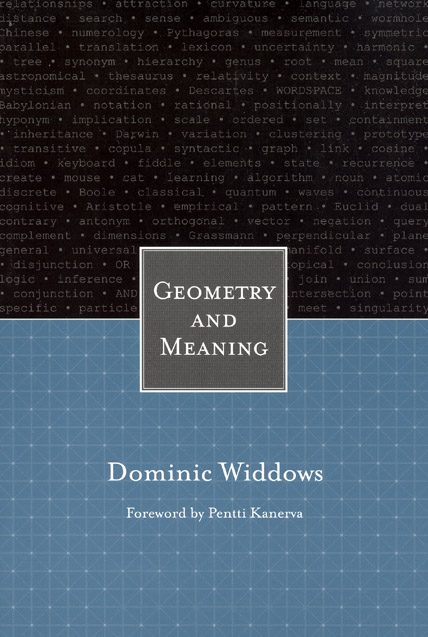
Books: The Geometry of Meaning, Gärdenfors & Geometry and Meaning, Widdows


http://www.mitpressjournals.org/doi/pdf/10.1162/coli.2006.32.1.155
There are two additions to my library. They are technical in parts and beyond my math and technical abilities, but as background this is essential reading.


Widdow's Geometry and Meaning includes details of the software used in the text. See the companion website below. While Gärdenfors' book The Geometry of Meaning is new, Widdow's text is a decade old and so demands some checking of software. I notice there are broken links on the companion site. The book, both in fact are great resources even as they increase the permanence of the geometry upon my furrowed brow...


Dominic Widdows, Geometry and Meaning - Companion website

Monday, November 25, 2024

The naïve approach

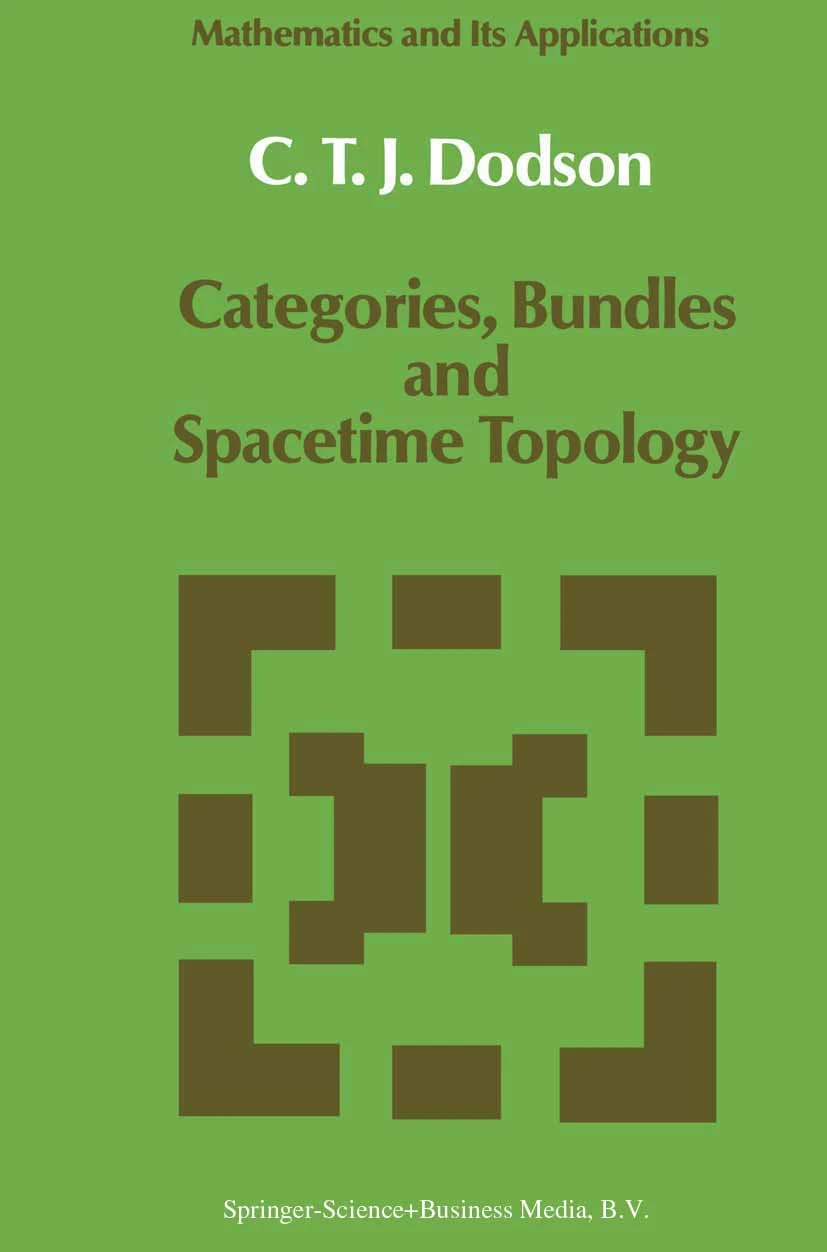
Categories, Bundles and
Spacetime Topology 
 

'First steps' are by their nature plagued by uncertainty of intent and direction, ungainliness, missteps, stumbles and ('finally') possibly falls.

Finding a starting point can be difficult.

Where to find a hand-hold, place one's foot, or other anchor?

At Lancaster University library I came across this book, first published in 1980. The cover displayed is from the 1988 edition.

In order of appeal I read:

applications, categories, spacetime and topology.

Section I starts with Preliminaries: Notation and Abbreviations; always useful (reminder).

The next, Section II Naïve Category Theory, had my immediate attention. We often speak of learners as being naïve. As lifelong learners we all meet this descriptor. I keep revisiting this word, concept - 'naïve'.

Naivety is a starting point for practitioners in health and social care too. Hence the need for supervision, mentors, the tokens of probationary (driver) and 'newly qualified'. 

Many posts on W2tQ stress the diagrammatic quality of Hodges' model. It is visibly a 2x2 matrix, (once again..) beloved of management consultants, psychologists and change agents. In Section II Dodson recognizes the London Underground map as a graph. A small example is developed, explained and illustrated on p.6. 

Graph example, drawing on the London Underground. p.6.

Section II may be a small part of the overall book but it is invaluable to me. As the photo above suggests, the book is old, especially as 1st edition. I will try to access the 2nd edition. If this work is a project with which you can (more ably!) assist, I would greatly appreciate your input. The aim is to signpost Hodges' model as a potential focus for all researchers. Especially researchers interested in trying to conjoin the sciences and humanities and develop visualization in the latter. 

C.T.J. Dodson. Categories, Bundles and Spacetime Topology. 1st Edition, Shiva, Kent. 1980.

Previously: 'math'

'Diagram' resources listed on former, now archived website.

Wednesday, August 05, 2026

"It's an equation Jim, but not as we know it!"

Silver (2013) in “The Signal and the Noise” refers to Drake’s equation, which has fascinated me since my teens. It is a formula that provides a framework for predicting the number of intelligent extraterrestrial species in the galaxy. Due to the high number of parameters and uncertainties that make up Drake's equation, Silver describes how the extreme range of results depend on the initial ‘inputs’. Given the variables presented they are estimates. I made a connection to Drake's work through BBC BASIC programming:

'The Nursing Process'
'Computer-Aided Patient Assessment'
'Blood Groups'
'Shades of Grey'

As time went on the simplicity of 'The NP' gave way to DIM arrays, which can provide data structures, and DEF PROC and DEF FN with parameters. 

The evidence for the elements of Drake's equation has made great strides since the 1990s. Despite the remaining uncertainties, Silver notes that Drake's equation has provided a useful lens for astronomers, plus - philosophers and the lay-person to think about life, the universe and everything.

Is there an implicit theory – an equation – in Hodges’ model?

See also: BBC BASIC

Previously: 'Sagan' : 'SETI' ; 'math' : 'Publication list (2024)'

Nate Silver (2013). “The Signal and the Noise”, Notes 89, London: Penguin. p.488.

Title Ack. the original is often misattributed: https://www.youtube.com/watch?v=FCARADb9asE

Friday, May 24, 2019

Dear McKinsey and Company, Re. "The era of exponential improvement in healthcare?"

Re. Your article:

The era of exponential improvement in healthcare?

(By Shubham Singhal and Stephanie Carlto)
Technology-driven innovation holds the potential to improve our understanding of patients, enable the delivery of more convenient, individualized care—and create $345 billion to $420 billion in value by 2025.

Healthcare advances have delivered great benefits to society, bringing material improvements in average life spans and quality of life.1 Yet these improvements have come at a cost—an ever-expanding portion of the US GDP is being consumed by healthcare expenses.2 Could technology, enabling delivery of healthcare advances while improving affordability, be part of the solution? We have reviewed the evidence, done the math, and identified technology-enabled use cases that could create between $350 billion and $410 billion in annual value by 2025 (out of the $5.34 trillion in healthcare spending projected for that year3 ).
Read more ...
<>

But how would we recognise the era of exponential improvement in healthcare?


SELF - individual
|
INTERPERSONAL : SCIENCES
humanistic ----------------------------------------------- mechanistic
SOCIOLOGY : POLITICAL
|
group - POPULATION
The exponential benefits realised 'elsewhere' in global, local and glocal health and healthcare systems finally sees the achievement of parity of esteem with mental health not only fully funded, but designated as the key that must be turned 4 happiness. Despite the diametrical opposition of this domain to the political domain, there is a breakthrough in policy makers and the body politic prioritising "The Long Now"
"Predictions of an exponential increase in people living with dementia in the coming 30 years require evidence-based strategies for advancing dementia care and maximizing independent living. However, the evidence required to inform priorities for enabling improvements in dementia care is rarely presented in a way that stimulates and sustains political interests."  Martin, O’Connor, & Jackson (2018).


Community-based healthcare becomes
 the norm and the educational,
preventive and sustainable ethos for
health and healthcare systems
is adopted globally.
Look at the readiness and response-to potential epidemic crises, plus
 interventions in population health. 
Exponential benefits are accrued.
Evidence - look at the number of
 (new) hospital beds.
The community IS the market.


Exponential growth in global
healthcare funding, health information
for all, access to universal health care.
 Social Determinants of Health not
just a vision: but enacted and ongoing
#SDoH-X.
Evidence - climate change slowing,
air quality improving -
the 21st Century truly begins ...


Martin, A., O’Connor, S., & Jackson, C. (2018). A scoping review of gaps and priorities in dementia care in Europe. Dementia. https://doi.org/10.1177/1471301218816250

My source:
email - McKinsey Insights

Wednesday, May 06, 2026

'Anthropological Theory of the Didactic' ATD - in learning mathematics

INTRODUCTION

Several studies have discussed the specific knowledge taught and learned in precalculus, calculus, and analysis courses, from different perspectives: for example, concept image and concept definition (e.g., O’Shea, 2016), APOS theory (e.g., Martínez-Planell, Trigueros Gaisman, & Mcgee, 2016), and the Anthropological Theory of the Didactic (ATD; e.g., Bergé, 2016). Our starting point is the general and relatively vague question of when in an undergraduate degree in mathematics does a student need (need in the sense of to succeed in the course) to engage in mathematical activities that may substantially, or meaningfully, lead to developing mathematical practices. We consider and frame this question within the ATD (Chevallard, 1999), which provides theoretical tools for modelling any human activity or practice. The semantic distinction between these two words is essential to us. Our hypothesis is that the kinds of didactic constructs to which professors and students are exposed are decisive in fostering the emergence of practices out of collections of local, particular, and relatively short-lived activities. From the theoretical stance we take, this means the development of mathematical knowledge out of local, particular, and relatively short-lived mathematical activities.' p.487.

THEORETICAL FRAMEWORK 

“Activity and practice”

'As mentioned above, we have come to see the semantic difference between activity and practice as pertinent to our work. The ATD’s notion of praxeology provides a fundamental model for defining mathematical practice, which, in the context of the theory, is equated to mathematical knowledge. According to the model, any practice (or piece of knowledge) can be represented by a quadruplet [T, τ, θ, Θ] involving four interconnected components: a type of tasks T, which generates the practice, the corresponding collection of techniques τ developed to accomplish T, the discourse used to describe, justify, explain, and produce the techniques (i.e., their technologies θ), and the underlying theories Θ that serve as a foundation of the technological discourse. As students progress in their studies of mathematics, they engage in numerous activities, which progressively determine the practices they develop'. p.489.

Laura Broley and Nadia Hardy. (2018). A study of transitions in an undergraduate mathematics program. In PROCEEDINGS of INDRUM 2018 Second conference of the International Network for Didactic Research in University Mathematics. pp.487-496. ERME topic conference.
https://indrum2018.sciencesconf.org/data/Indrum2018Proceedings.pdf


THEORETICAL CONSTRUCTS 

'ATD “postulates that any activity related to the production, diffusion or acquisition of knowledge should be interpreted as an ordinary human activity, and thus proposes a general model of human activity built on the key notion of praxeology” (Bosch & Gascon, 2014). The praxeology 𝛱 is represented by a quadruple [𝑇/𝜏 /𝜃/𝛩]: its praxis part (or know-how) consists of a type of tasks 𝑇 together with a corresponding technique 𝜏 (useful to carry out the tasks 𝑡 ∈ 𝑇 in the scope of 𝜏). The logos part (or know-why) includes two levels of description and justification: the technology 𝜃, i.e. a discourse on the technique, and the theory 𝛩, which often unifies several technologies. 

The elaboration of a reference epistemological model (Florensa, Bosch, & Gascon, 2015) as sequences of praxeologies, for a given body of knowledge, is an important step in any research carried out in the ATD framework. It is the tool that will be used by the researcher to describe, analyse, put in question or design the specific contents that are at the core of a teaching and learning process. In order to build such a model, “mathematical praxeologies are described using data from the different institutions participating in the didactic transposition process, thus including historical, semiotic and sociological research, assuming the institutionalized and socially articulated nature of praxeologies” (loc. cit. p. 2637).' pp.498-499.

Charlotte Derouet, Gaetan Planchon, Thomas Hausberger, and Reinhard Hochmuth. (2018). Bridging probability and calculus: the case of continuous distributions and integrals at the secondary-tertiary transition. In PROCEEDINGS of INDRUM 2018 Second conference of the International Network for Didactic Research in University Mathematics. pp.497-506. ERME topic conference.
https://indrum2018.sciencesconf.org/data/Indrum2018Proceedings.pdf

I came across this source as I'd read about the way chemistry as a discipline co-opted some mathematical symbols, but adapted them for their own use.

Previously: 'math' : 'threshold concept' : 'liminal' : 'learning'

Tuesday, March 22, 2016

FIELDS arranged by PURITY c/o xkcd

The cartoon below is one [ http://xkcd.com/435/ ] of many amusing and creative comic sketches on xkcd - A webcomic of romance, sarcasm, math, and language. The web has produced many variations on this particular theme, this example I came across on twitter.

While Hodges' model appears to support pigeon-holing, categorising things including knowledge this is not the case. The model seeks to encourage context-related reflection and assuring an integrated and holistic perspective.

individual
|
INTERPERSONAL : SCIENCES
HUMANISTIC ---------------------------------------  MECHANISTIC
SOCIOLOGY : POLITICAL
|
group


Sunday, September 22, 2019

c/o JAN: Formal Concept Analysis ... and an encouraging footnote

My source:


Andersson, N, Silver, H. Fuzzy cognitive mapping: An old tool with new uses in nursing research. J Adv Nurs. 2019; 00: 18. https://doi.org/10.1111/jan.14192

This tweet prompted a reply and further reflection, as I've been aware of FCA for quite a while. A math disability (but remote fascination?) precludes me really 'getting to grips' with this. As noted before on W2tQ, visualization in the humanities (social sciences) has still not realised its potential. Those researchers, professional workers ... who could benefit from its application, being in the 'humanities', often do not understand the underlying mathematics. Even though they are not necessarily that advanced (sixth-form - undergraduate?).

Over the years I have built up a small library of related papers and books. The Macgill (1984) paper referenced below, I started to 'read' and work through and got a short way. The print quality is rather poor and obviously dated, but that is not the problem. I will try again. Since the 1980s software has changed beyond the proprietary packages of MathCad, MathLab, Maple and Mathematica and collectively they should (must?) make these methods more accessible. Of course, I thought this with regards to the use of content management system for a website (yes, that one!). Again though it's not the tools, but my choice, time and focus.

I write this and it might only be intuition, but I'm not just sure, I know there is something here.

Seeing FCA in JAN's tweet I thought of a certain footnote even though on my copy the reference seems incomplete:

Kwong, C. P. A Topological Framework for Formal Concept Analysis, The Chinese University of Hong Kong.

On the first page the footnote reads:

"The adjective "formal" is used to emphasize the mathematical substance of the objects being studied, which may be left out when such a formality is superfluous."

As you can imagine this is quite a gift for me. In a way it suggests the following from a 2x2 matrix with keywords (concepts), to an arbitrary array:

individual
|
INTERPERSONAL : SCIENCES
humanistic ----------------------------------------------- mechanistic
SOCIOLOGY : POLITICAL
|
group - population

1001
1110
0001
1111

1101
0100
1010
0011

1111
0011
0011
0110

0110
1111
0000
0110

There is a worry here. When your formative nurse education and training stressed the need to shift from a task-oriented approach to individualised, then filling the domains of Hodges' model with '1's and '0's is a bona fide task-checklist - even if a binary one.

There is a response to that concern for another post; but before that there is another source c/o:

Johana Ramírez Gaviria (2015) Aspectos topológicos en el Análisis deConceptos FormalesTopological aspects in Formal Concept Analysis, Universidad Nacional de Colombia Facultad de Ciencias Exactas y Naturales Departamento de Matemáticas y Estadística Manizales, Colombia. p.6.
c/o Google, Spanish – detected, English
En [26] se plantean nuevos modelos para el FCA usando nociones de la topología algebraica. El contexto formal convencional es reemplazado por una matriz con entradas ”1” ó ”0” denominada matriz contexto, para construir una familia simplicial (familia concepto), de ahi se desprenden propiedades que relacionan la teoría de la topología algebraica con el FCA.

Cabe resaltar que hasta el momento no se ha trabajado en dotar de estructura topológica los contextos formales en el FCA generalizado, donde los datos de las tablas toman valores difusos en lugar de valores binarios como se tiene para el FCA clásico.
In [26] new models for the FCA are proposed using notions of the topology algebraic The conventional formal context is replaced by a matrix with “1” or "0" called context matrix, to build a simplicial family (concept family), from there properties that relate the theory of algebraic topology with the FCA.

It should be noted that so far no work has been done to provide a topological structure the formal contexts in the generalized FCA, where the data in the tables take values diffuse instead of binary values ​​as you have for the classic FCA. 
[26, reference is Kwong]
  The whole thesis would need translating, but I have a sense that this too is useful.

Working through papers, files, journals, books getting rid of, sorting, re-filing ... I'll see if I can add to the reading below.

Atkin, R. (1974). Mathematical Structure in Human Affairs. London, Heinemann.

Macgill, S.M. (1984). Structural Analysis of Social Data, A Guide to Ho's Galois Lattice Approach and A Partial Re-Specification of QAnalysis, Working Paper 416, School of Geography, University of Leeds.

Previous post:
Bell jars and bell curves


Thanks to @jadvnursing for this tweet in-particular and for RTs.
(Paper e-copy received with thanks c/o Neil Andersson, 25 Oct 2019.).

Friday, May 22, 2020

Book Review: Mathematics and Art: A Cultural History

Spotting this book really hurt my face. The resulting contortion: the half-smile - half-grimace was painful, but I had to approach the publisher for a review copy.

In the email I was honest. I fessed-up to being a mathematical hopeless lover of the discipline. So many maths teachers, so many broken pieces of chalk, so much pain and anxiety. In the early 1970s my late uncle Doug (Engineering, Liverpool University) provided some tuition at weekends. This did not translate into exam success, but he did not diminish my wonder and awe of this subject.

I mention this to set some personal background and give you a sense of my gratitude to Princeton University Press for the privilege of this tome with its 576 pages and 9.5 x 12 in. The email included my work in mental health nursing and having this blog with a small readership and twitter. I've already posted highlighting this book, but thanks to PUP and your faith.

In Waterstones, Gower St, London in February I saw a copy downstairs, so although published in 2016 this book still has currency. The hardback, sat on your knee, you know it's there. That isn't a problem, but sometimes the clearly high production standards and quality literally 'shone' in certain lighting. The quality, high legibility and art reproductions are not to be missed: 444 color + 102 b/w illustrations.

Maybe there are a few math (maths?) teachers who will pass this way and think about their teaching methods, a child's ability, aptitude and sense of wonder. Even if the mind before them doesn't 'get it', please leave that sense of wonder intact. Nurture it, nudge it as best you can to inform the other literacies and provide the momentum for lifelong learning.

There's a word missing from the title, philosophy, which Gamwell combines in a balanced, almost formulaic manner, that had me captured - enraptured from chapter 1. No! Wrong again. Even the preface works indicating the global scope to follow soon. ...

Mathematics and Art: A Cultural History


Lynn Gamwell (2016) Mathematics and Art: A Cultural History. Princeton, New Jersey: Princeton University Press. ISBN: 9780691165288. p.283.

(Thank you to PUP for the review copy - more to follow.)