Hodges' Model: Welcome to the QUAD: reasoning

Hodges' model is a conceptual framework to support reflection and critical thinking. Situated, the model can help integrate all disciplines (academic and professional). Amid news items, are posts that illustrate the scope and application of the model. A bibliography and A4 template are provided in the sidebar. Welcome to the QUAD ...

Showing posts with label reasoning. Show all posts

Wednesday, April 15, 2026

Book: 'Logic on the Track of Social Change'

When I walked into Lancaster Univ. library in February, I had no idea I was being followed.

From the maths shelves, the lights switching on as you progress, I decided to walk across to the more familiar realm of sociology. Looking for something, it was nice to see the parity in lighting, even as my struggle for mathematical enlightenment continues.

Logic on the Track of Social Change    

I do use the e-library, and other e-resources, but sometimes real shelves and varying levels of mustiness (remember the 'new acquisitions' - fewer these days?) invite a bit of serendipity. Suddenly, over my shoulders, the stranger,  pointed (with four arms of course). Was it my shadow? Or, was it my unconscious that 'read': LOGIC and TRACK and SOCIAL CHANGE, on the spine of -

David Braybrooke, Bryson Brown & Peter K. Schotch (eds.), Logic on the Track of Social Change, Oxford University Press. 1995?

In the early decades of health informatics, there was much talk - and still is(?) - of  'languages for health', even languages for nursing. Coding and classification systems were constantly developing, as posted here, but while physical diagnoses were the driver, the psychosocial dimensions of person - patienthood proved more nebulous. DSM is still subject much debate.

 Chapter 8 in Braybrook et al. is brilliant: A Rules-Analysis, Following Foucault, of the Birth of Clinical Medicine.

I've been in situations when surgery is suggested for an older person, and family, friends wonder is this really necessary? This chapter literally brings the history home, and not only that, but the emergence of the hospital system, versus care at home, in the community. The social determinants of health have been ever-present. This is essential reading for students, with the history of ICD, and the history of medicine. There are insights too into public attitudes and expectations to health services and provision here in the UK and in France.

For me, and Hodges' model, the significance of Braybrook, Brown, Schotch and Byrne is that it precedes:

Sallach, D.L. Categorical Social Science: Theory, Methodology and Design. September 2012
Conference: Fourth World Congress on Social Simulation. Taipei, Taiwan.
https://www2.econ.iastate.edu/tesfatsi/Sallach2012CategoricalSoSci4.WCSS-SS.pdf

And so, I do need my own secondhand copy of  Logic on the Track of Social Change. More to follow (indeed)! ... and help still welcome and needed.
 

Thursday, January 29, 2026

Paper: 'Intra-Personal Compromises'

ARGUMENTA

Issue 21

November 2025

https://www.argumenta.org/issue/issue-21/

Intra-Personal Compromises  

Juha Räikkä

University of Turku 

Abstract

The most usual philosophical questions about compromises have been those related to inter-personal compromises, in which parties are compromising with each other, rather than intra-personal compromises, which are often psychologically demanding. This paper aims to fill the gap in the discussion and briefly analyze the nature of intra-personal compromises. The starting point here is the assumption that inter-personal compromises cannot be made without intra-personal compromises, although intra-personal compromises are common even when they are not linked to inter-personal compromises. The main question addressed in the paper is whether the intra-personal compromises that we accept in all kinds of contexts are similar to those intra-personal compromises that we make when we compromise with others. I argue that they are more or less similar, although there are also some distinctive features in intra-personal compromises that are involved in inter-personal compromises. When a person makes an intra-personal compromise in the context of an inter-personal compromise she is forced to act under uncertainty, as she cannot know beforehand what options are really available. The price of the compromise is known only after the negotiation process. This is a special feature, or so I will claim. 

Keywords: Inter-personal compromise, Intra-personal compromise, Bargaining, Uncertainty. 

Räikkä, R. 2025, “Intra-Personal Compromises”, Argumenta 11, 1, 149–162.
https://www.argumenta.org/wp-content/uploads/2026/01/Argumenta-11-1-Juha-Raikka-Intra-Personal-Compromises.pdf
 

For a long time I have viewed the INTERPERSONAL domain of Hodges' model as being concurrent, interchangable, working as the INTRAPERSONAL domain. This paper is a helpful discovery, c/o Philos-L "The Liverpool List" which is run by the Department of Philosophy, University of Liverpool https://www.liverpool.ac.uk/philosophy/philos-l/

There are several examples/cases discussed. While brief, a HOSPITAL CEO example is relevant to studies for Hodges' model, as with, a CRITICAL CITIZEN:

'The above examples are rather similar but have small differences. In the ‘Judge’ example, the overriding principle is based on the importance of institutional rules. In the ‘Hospital CEO’ example, the main concern and the strongest value is pragmatic. In the ‘Critical Citizen’ example, the question is about omission rather than action.' p.157. 

The observation about the CEO speaks volumes, across public and private health sectors (and social care?). There is no discussion of reflection, reflexivity, or critical thinking explicitly. But individual, and collective distinctions, and impacts are explored, especially responsibility and mutuality. Three arguments precede concluding remarks. Further progress might be made exploring and relating these to the concepts of bargaining, uncertainty and compromise through Hodges' model and identity: both person-al and organisational?

Thursday, January 22, 2026

NANDA-I Newsletter - theme of clinical reasoning


'This month at NANDA-I, we have been exploring the theme of clinical reasoning.


Clinical reasoning is at the heart of nursing; it’s how nurses make sense of complex patient information and choose the best path forward. While many nurses think of diagnosis as the centerpiece, it’s really the thinking that leads up to it, gathering cues, interpreting what matters most, and then safely determining goals and actions, that makes all the difference in outcomes. Strong reasoning helps nurses notice subtle changes and act with confidence.


As healthcare grows more complex, understanding how nurses think, not just what tools they use, helps elevate care for every patient. We’ll be sharing insights throughout the year to help you stay connected to nursing knowledge and its impact on care delivery and education.'


Teaching Tip: Clinical Reasoning in Practice

Start With Assessment to Improve Reasoning

When nurses work with standardized languages and clinical judgment tools, it’s tempting to dive right into diagnosis. But the most accurate and useful nursing judgments always come from strong, systematic assessment first. Quality assessment supports better interpretation of patient needs and more precise identification of nursing responses.


Quick Tip: Use a flexible assessment framework, whether it’s a conceptual model or a tool like functional health patterns, to make sure you’re capturing the data that matters most first. When you build a solid foundation with assessment, everything that follows (including diagnostic thinking) becomes clearer and more grounded.  


My source: 'Friends of NANDA®-I Newsletter' subscription (with my emphasis).

See also:
https://nanda.org/2025/12/nanda-360-for-educators-and-researchers-strengthening-nursing-knowledge-through-diagnosis-centered-reasoning/

Assessment, plus planning, implementation - action, evaluation (plus, formulation).

Functional and cognitive [Health, Illness, Climate, Poverty, Political, Security, Prevention, Self-care, ...] patterns.

'... make sure you’re capturing the data that matters most first' - Situated, Context, Salience.

For a competent practitioner an assessment can also be 'therapeutic' for the patient.

Previously: 'classification' : 'diagnosis' : 'NANDA' : 'ICD'

Friday, December 19, 2025

ii Learn your lines and the hyperplanes will follow

With these lines, partitions, axes and domains in mind, when a clinical practitioner is presented with a new person, whether as a patient, client, or carer ... they can, using Hodges' model (and other tools!) approach their assessment in an open and receptive manner.

This means that the information provided by the 'patient' can be readily fielded, captured whatever the context and situation.

As noted previously, my study of Hodges' model began in the late 1980s. Application in my work as a community mental health nurse, with an interest in informatics followed quite naturally(?). Primed as I was, for various reasons to carry this forward, I also carried a mathematical learning disability. At the risk of getting bogged down in my thought, use and approach to Hodges' model I need a challenge.

Mathematics is the challenge for me. It's fascinating how we have in-built 'calculators' that can help us catch a ball, and judge fairly well where to throw a ball for interception. There seems then to be an informal or naïve  mathematics, at work unconsciously. Does the same apply to Hodges' model? If so, how can I isolate, and identify it?

  • Is it represented somewhere, implicit in Hodges' model itself?
  • Is it (once again) to be found in the user of the model?
  • Is it (more likely, and obviously) a combination of these two?
  • Or, is it a product of the system, or a series of systems? 

I was reminded of what is a Sober toy, several years ago:

Is Hodges' model a selection machine?

All four original purposes of Hodges' model:

  1. Person-centred, integrated and holistic care;
  2. To bridge the theory - practice gap;
  3. To facilitate reflection and reflective practice;
  4. To support curriculum development;

- are concerned with conjunction and choice, selection. So is life itself through distinction, difference, and differentiation.

Hodges' model is a selection machine, that is both fhuman and machine driven.

A clinician may obtain the referral information through an email, a history of previous contacts can be retrieved from a clinical information system; the context and purpose supporting access to the information.   

A whole series of blog posts describe the role of Hodges' model to help assure parity of esteem across mental and physical health. What does this mean in practice?

For the practitioner, they take selected data from the referral, a history - if available, an initial telephone contact, a conversation with a colleague who remembers the person re-referred and starts to populate Hodges' model. What are the psychological concepts that arise? What are the physical?

If a referral in whatever form, or a database record can be viewed as a bag-of-words, then Hodges' model is a collection of care concepts. Four bags then. Sets or classes. An experienced user of Hodges' model may position care concepts that throws attention on the INDIVIDUAL↔GROUP axis. Lying between the INTRA- INTERPERSONAL and SCIENCES domains, this axis (like all the others) earns its keep. There is work to be done that is also of interest in machine learning:

'A support vector machine (SVM) is a supervised machine learning algorithm that classifies data by finding an optimal line or hyperplane that maximizes the distance between each class in an N-dimensional space.

SVMs were developed in the 1990s by Vladimir N. Vapnik and his colleagues, and they published this work in a paper titled "Support Vector Method for Function Approximation, Regression Estimation, and Signal Processing"1 in 1995.' 

https://www.ibm.com/think/topics/support-vector-machine

Strange to think that perhaps the VERTICAL axis and others in Hodges' model are not precisely S-N-E-W in their bearing? There may also be several vectors at work in fact?

Image: c/o https://www.ibm.com/think/topics/support-vector-machine

The word 'naïve' has been bubbling away for a good-many years. A close colleague Silvana Bettiol, Univ. of Tasmania kindly read my draft on Hodges' model as a mathematical object, and mentioned the introduction points to Bayes theorem even if informally. Even in those initial 'clinical' encounters (and social meetings, that attend to empathy, rapport and engagement...) complex judgements are being made, beliefs tested, from what is often partial and disparate sources of information.

Checking other leads led to Frequentist and Bayesian Approaches

'Statistical inference is a series of methods used to make decisions and draw conclusions based on available data. There are two primary approaches for inference: Frequentist and Bayesian. Each framework relies on a different philosophical perspective on probability and modeling, leading to different techniques and interpretations. Each has its own strengths and drawbacks, so understanding the distinctions between them is vital for researchers, data scientists, and statisticians who aim to choose the most suitable approach for their specific analysis.'
https://www.statology.org/comparing-frequentist-and-bayesian-approaches/

More reading required and threads to run.

Earlier this week I posted re. Cromer's book -

Cromer, A. (1997) Connected Knowledge: Science, Philosophy, and Education, Oxford: Oxford University Press

Before passing the book on, p.198, Chapter 8 notes, #4:

'"Understanding" is a commonly used English word which has no precise meaning. It's sometimes taken to mean the ability to apply knowledge to new situations. In this sense, it is a very high-level skill. Benchmarks for Science Literacy says, "Learning to solve problems in a variety of subject-matter contexts, if supplemented on occasion by explicit reflection on that experience, may result in the development of a generalized problem-solving ability that can be applied in new contexts' (American Association for the Advancement of Science, 1993)." The key word here is "may." 'We really don't know how to help students develop a generalized problem-solving ability, or whether there is such an ability apart from mere knowledge of many different problem-solving strategies. Whatever the case, since we do know how to teach students to solve specific, problems. this should be the primary focus of science education' p.198.

Ack. IBM.

Thursday, December 18, 2025

Learn your lines and the hyperplane will follow i

Take an empty [rectangular] space (A4 paper in landscape)

Blank! Isn't it?

Take a line. Yes, call it that.

Divide the space vertically, and equally, in two. 

Do this again but horizontally.

You can call these lines, partitions if you wish?

Or, as per adopted convention here, axes.

Now, there are four empty spaces.

These spaces can be called quadrants, planes, or domains. The latter term usually adopted here.

Labels can be decided, and assigned to the axes and the resulting domains.

Given a purpose, in practice (initially) the 'empty' spaces have the ability to assign significance to what may be placed within them.

Such decisions are non-trivial, in the sense that context and situation determine what follows, influenced by objective and subjective considerations.

The domains can contain concepts, or keywords with decisions driven by categorical reasoning.

The content of the domains can also be viewed as classes and sub-classes.

ii to follow (with revision here?)

Wednesday, December 17, 2025

'Connected Knowledge' - 4MAT

'Very different is the 4MAT system, which classifies students along two axes according to their answers to a multiple-choice questionaire. One axis measures the student's preference for acquiring knowledge concretely versus abstractly, and the other measures his preference for applying knowledge concretely versus abstractly (McCarthy, 1980). His scores on these axes places the student into one of the four quadrants: 

1. Innovative Learners (acquire concretely, apply abstractly); 
2. Analvtic Learners (acquire abstractly, apply abstractly; 
3. Common Sense Learners (acquire abstractly, apply concretely);
4. Dynamic Learners (acquire concretely, apply concretely). 

Each of these quadrants is divided again, according to whether the student prefers processing information analytically (left-brain mode) or holistically (right-brain mode). The 4MAT System trains teachers to write lesson plans that cycle through all eight learning styles and brain modes.

Such more-or-less arbitrary classification schemes abound in the social sciences. They are easy to dream up, and virtually impossible to validate (Wilkerson and White, 1988). This doesn't mean that they're totally useless. ...' pp.63-64. 
(Edited 1-4 for readability.)

Individual
|
      INTERPERSONAL    :     SCIENCES               
HUMANISTIC  --------------------------------------  MECHANISTIC      
 SOCIOLOGY  :    POLITICAL 
|
Group
Abstract
 
Personhood

Concrete

Objecthood


The notion of 'learning styles' is sticky: especially when you look back several decades to the literature?

Cromer, A. (1997) Connected Knowledge: Science, Philosophy, and Education, Oxford: Oxford University Press.

McCarthy, B. (2000). About Teaching: 4MAT® in the Classroom. Wauconda, IL: About Learning, Inc.

McCarthy, B. (1980). The 4MAT® System: Teaching to Learning Styles with Right/Left Mode Techniques. Barrington, IL: EXCEL, Inc.

Wilkerson, R. and White, K. (1988). Effects of the 4MAT system of instruction on students' achievement, retention, and attitudes. Elementary School Journal 88, pp.257 - 368.

Sunday, December 07, 2025

AI - World Models

'What Is a World Model?

World models are neural networks that understand the dynamics of the real world, including physics and spatial properties. They can use input data, including text, image, video, and movement, to generate videos that simulate realistic physical environments. Physical AI developers use world models to generate custom synthetic data or downstream AI models for training robots and autonomous vehicles.'

https://www.nvidia.com/en-us/glossary/world-models/

In healthcare a 'world model' is slightly more expansive, hence the importance of experienced humans. We call these - nurses, doctors, physiotherapists, occupational therapists, social workers and many other professions, support workers and disciplines. They learn and train for many years and must continue to learn and unlearn throughout their careers. Their work and engagement is shaped and directed by human values, which are in turn informed by social change, evidence-based research, professional guidance, policy and law.

individual
|
INTERPERSONAL : SCIENCES
humanistic -------------------------------------------  mechanistic
SOCIOLOGY : POLITICAL
|
group-population


WORLD MODEL


Saturday, October 04, 2025

Argumentation - Journal: Informal Logic

Early evening (UK) yesterday, I joined a further webinar on argumentation. Through the speaker, and discussion, I was led to a journal

INFORMAL LOGIC

It is in informal logic that I see a role for Hodges' model. The model's structure providing a universal foundation of knowledge domains to be applied in practice. The bonus of this journal, is its being open access, a search revealed the following paper:

Mark Weinstein. Towards a Research Agenda for Informal Logic and Critical Thinking. XII.3, Fall 1990.
https://ojs.uwindsor.ca/index.php/informal_logic/article/view/2609

'This paper recommends that the recent concern with informal logic and critical thinking be redirected from its general philosophical focus and towards a greater appreciation of the particulars of practice in the various domains of human understanding. The redirection recommended is prompted by the central role that critical thinking and informal logic can be seen to play in meaningful educational reform, especially at the undergraduate level.' 

'Critical thinking, similarly, should be redirected from concerns typical of philosophers and towards issues and approaches more representative of critical thinking both within and across the wide range of disciplines represented by the course of undergraduate studies.' p.121.

'The sense that there is an internal relationship between arguments, argumentation and domains of knowledge persists despite attempts to show relevant and useful notions of critical thinking that are generally available for instruction and neutral in respect of the disciplines. The resolution of the issues generated by these competing views, requires that reflective practitioners of the disciplines, students of the history of ideas, methodologists and specialists in teaching increasingly engage in the task of generating and organizing the data upon which an informed and adequate notion of critical thinking across the disciplines must be based.' p.125.

I believe that the structure of Hodges' model provides a basis for Weinstein's ordinary argumentation and stylized argumentation.

For me (at present) ordinary argumentation, is 'open' argumentation. That is, without differentiation in (using) Hodges' model. I might (well, I would) have Hodges' model in mind, but choose not to apply it. As per the paper, stylized argumentation is using Hodges' model and doing so in a multidisciplinary manner - within my discipline. 

The problem and challenge for nurses and other health professionals is the need, if:

  • person/patient-centred;
  • integrated;
  • and holistic - having regard for parity of esteem (mind - body)

- not to stray, extend the disciplinary scope, while working within one's professional scope.

In highly effective multidiscioplinary teams that touch on being transdisciplinary (hybrid?), can experienced team members have insight into the stylized argumentation of their colleagues?

Ack. ​Argumentation network of the AMERICAS - https://www.argnet.org/ethics-of-arg.html

Previously: 'critical thinking'

Sunday, July 06, 2025

Int. Joint Workshop of AI for Healthcare (HC@AIxIA) and HYbrid Models for Coupling Deductive and Inductive ReAsoning (HYDRA)

From: Francesco Calimeri, Mauro Dragoni, Fabio Stella on behalf of the
HC@AIxIA – Working Group on Artificial Intelligence for Healthcare 

HC@AIxIA + HYDRA 2025 

International Joint Workshop of Artificial Intelligence for Healthcare (HC@AIxIA) and HYbrid Models for Coupling Deductive and Inductive ReAsoning (HYDRA)

Bologna, Italy, 25-26 October 2025

CALL for PAPERS

The workshop welcomes original research contributions, summaries of recent work, and work-in-progress studies on frameworks, applications, and methodologies for combining deductive and inductive approaches. It invites a wide multidisciplinary spectrum of researchers, industrialists, entrepreneurs, and healthcare practitioners: submissions are welcome from a range of stakeholders, including Computer scientists, health informaticians, and emergency medicine experts; Public health experts, epidemiologists, clinicians, etc.; National and international public health agencies; Epidemic intelligence systems providers; NGOs and Agencies; Industry and startups. Collaborations across disciplines will bridge the gap between theory and practice and foster actionable AI-driven solutions across diverse domains. 
Continued ...

Saturday, May 03, 2025

AI-2025: December 16th-18th 2025, Cambridge, UK - fourth call for papers and posters

FOURTH CALL FOR PAPERS AND POSTERS

The proceedings of the AI-20xx conference series are now published by Springer in Lecture Notes in Artificial Intelligence (LNAI), a sub-series of the distinguished Lecture Notes in Computer Science (LNCS) series of conference proceedings.

AI-2025: Cambridge, UK, December 16th-18th 2025

Information for authors and to submit a paper  https://www.conferenceexpert.org.uk/?conf=ai2025&section=authors

Organised by BCS SGAI: The British Computer Society Specialist Group on Artificial Intelligence (a EurAi Member Society).

The leading series of UK-based international conferences on Artificial Intelligence and one of the longest running AI conference series in Europe.

CALL FOR CONTRIBUTIONS

https://www.bcs-sgai.org/ai2025/

AI-2025 is the forty-fifth SGAI International Conference on Innovative Techniques and Applications of Artificial Intelligence.

The scope of the conference comprises the whole range of AI technologies and application areas. AI-2025 reviews recent technical advances in AI technologies and shows how these advances have been applied to solve business problems. Key features are:

  • Papers will be published by Springer in the Lecture Notes in Artificial Intelligence (LNAI) subseries of the popular Lecture Notes in Computer Science (LNCS) series (www.springer.com/lncs).

  • Papers will be presented in two streams. The Technical Stream presents the best of recent developments in AI, covering a wide range of technical areas. The Application Stream is the largest annual showcase in Europe of real applications using AI technology.

  • A mixture of full papers (maximum 14 A4 pages) presented orally and short papers (maximum 6 A4 pages) presented as posters. Papers of both kinds will be included in the proceedings.

  • Prizes for best paper and best student paper in each stream and best short paper.

  • Invited keynote speakers, including Prof. John Naughton, University of Cambridge..

  • The first day comprises tutorials and workshops to provide greater depth in selected topics. (Separate one-day registration for this day is also available.)

  • A panel session on a topical subject.

  • An 'AI Open Mic' session to allow delegates to have their say about any aspect of AI.

  • In addition to the formal sessions, the conference programme includes a welcome reception and a Gala Dinner.
AI-2025 offers a valuable opportunity to keep up to date with developments in AI and to share experiences in the practical issues of developing AI systems.

FAIRS '25, the seventeenth annual forum for AI research students will immediately precede the AI-2025 conference at Peterhouse College on Monday December 15th, 2025. The aim of FAIRS is to support student members of the AI community providing advice and feedback on their research plans and work. This event is free of charge for research students except for a contribution towards the cost of refreshments and lunch in the College and no conference registration is required.

IMPORTANT DATES

  • Paper/Poster Submission: Friday 27th June 2025

    This deadline is considerably later than for previous conferences in this series and will not be extended.

  • Notification of Acceptance: Friday 29th August 2025

  • Camera Ready Paper: Friday 12th September 2025
CONTRIBUTIONS

Contributions presenting original work in AI are invited for both the technical and the application stream. Contributions may be submitted either as full papers of up to fourteen A4 pages for oral presentation or as short papers of up to six A4 pages for poster presentation. ...

For more details of Contribution types please see: https://www.bcs-sgai.org/ai2025/
...

All further information including details of the conference committee, program committees, paper format and uploading instructions is given on the conference website.

ALL CORRESPONDENCE SHOULD BE SENT BY EMAIL TO THE CONFERENCE SECRETARIAT: 
sgai-conference AT bcs.org.uk

My source: SGES List - https://www.jiscmail.ac.uk/cgi-bin/webadmin?A0=AI-SGES

Thursday, March 06, 2025

Understanding Mathematics + Domains towards Corridors

It is for others to judge - whether it is helpful or distracting; but I find concepts defined by other disciplines, or professions illuminating and insightful. Especially so, when it comes to 'domain'. In Hodges' model - all four of them. Five! When (not if), we include the spiritual:
'Greeno (1991) argued that students develop understanding when

"a domain is thought of as an environment, with resources at various places in the domain. In this metaphor, knowing is knowing your way around ir the environment and knowing how to use its resources. This includes knowing what resources are available in the environment as well as being able to find and use those resources for understanding and reasoning. Knowing includes interactions with the environment in its own terms - exploring the territory appreciating its scenery and understanding how its various components interact. Knowing the domain also includes knowing what resources are in the environment that can be used to support your individual and social activities and the ability to recognize, find, and use those resources productively. Learning the domain, in this view, is analogous learning to to live in an environment: learning your way around, learning what resources are available, and learning how to use those resources in conducting your activities productively and enjoyably. (p. 175)"

In particular, in chapter 8, Nemirovsky et al. use the metaphor of becoming familiar with a new place (e.g., a town, a train station) and the process of learning a new mathematical concept.' p.7.

Greeno, J. (1991), Number sense as situated knowing a conceptual domain.,Journal for Research in Mathematics Education, 22(3), 170-2 18. 

Understanding Mathematics and Science Matters
. Edited by Thomas A. Romberg Thomas P. Carpenter Fae Dremock University of Wisconsin-Madison. EA LAWRENCE ERLBAUM ASSOCIATES, PUBLISHERS 2005 Mahwah, New Jersey London. (I hope there is a 2nd edition?)

(I will try to add the Nemirovsky et al. reference when I can.)

Previously: 'territory' : 'map' : 'vocabulary'

Friday, January 03, 2025

How 'divine' is the language of care?

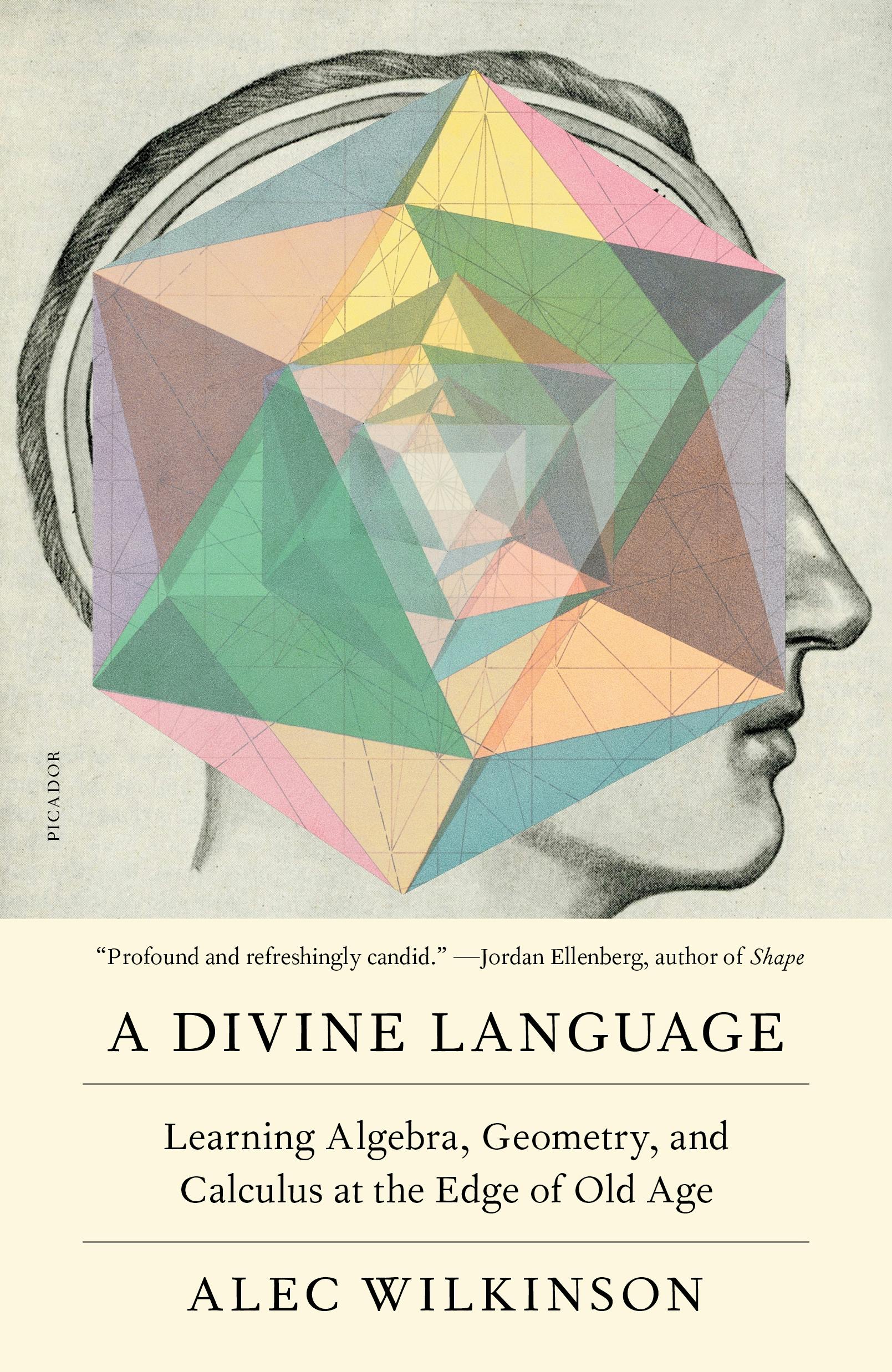
'My impression was that algebra was less a subject than a practice into which one was inducted by the algebra priests after a series of mortifications. The letters and equations that the teacher drew on the board did not seem related to the numbers I had handled in other classrooms. For one thing, a problem in arithmetic was vertical, one number beneath another, and a problem in algebra, an equation, was horizontal. I felt as if in a permanent present, unable to see how the past and the future were joined. In Ulysses James Joyce writes that the present is the drain that the future goes down on its way to becoming the past.' p.12.
'The mathematician Alonzo Church, who taught Alan Turing, told another of his students, David Berlinski, "Any idiot can learn anything in mathematics. It requires only patience." I would sit with a pencil and paper trying to solve an algebra problem and sometimes go only so far before my mind would halt, because I had could used up what little I knew that might apply. It hadn't occurred to me to think of algebra as the bright boys and girls I had been among had thought of it, as a series of related procedures. They were constructing a map. I was collecting postcards from places where anxiety or incuriousness had kept me from leaving my hotel.' p.31.
(my emphasis)


Alec Wilkinson. (2022) A Divine Language. Learning Algebra, Geometry, and Calculus at the Edge of Old Age. New York: Farrar, Straus and Giroux. https://us.macmillan.com/books/9781250168580/adivinelanguage/

Previously: math :: logic

Monday, December 09, 2024

Baseball: One of the games people play ... Fisher (2001) ii

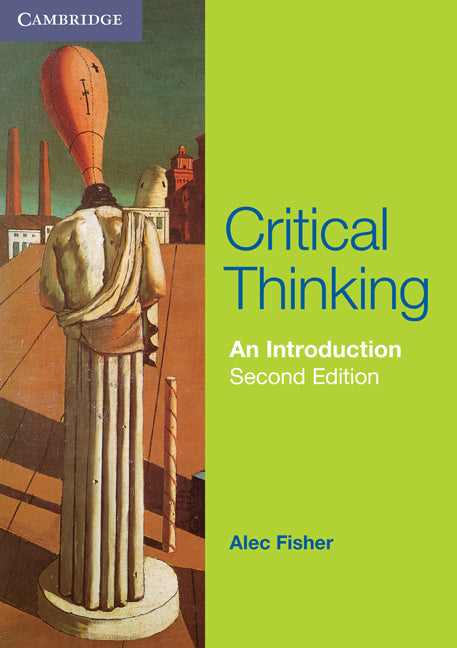
Critical Thinking 
2nd Ed. Cover

Returning to Fisher's excellent book I mentioned an analogy from basket ball in discussion about Richard Paul's definition of critical thinking and 'thinking about your thinking'.
'Critical thinking is that mode of thinking - about any subject, content or problem - in which the thinker improves the quality of his or her thinking by skilfully taking charge of the structures inherent in thinking and imposing intellectual standards upon them. (Paul, Fisher and Nosich,1993, p. 4).' pp.4-5.
Fisher's daughter aged eleven wanted to learn how to play basket ball and attended coaching sessions. At the first the raw recruits were divided into two teams and with simplified rules set to play. Initially, getting the ball and in a position to score: shoot.

After the chaos, the coach had them practice shooting after he demonstrated how they had been playing. He explained and pointed out the basics of technique and 'drew attention to how he held the ball, where he looked, how he stood and so on.' p.5. Acknowledging their efforts, they subsequently moved on to passing, then guarding, or marking - practising each skill. 

This is a great analogy and can be applied to health, social care, medicine, nursing and other novices. Hodges' model is the basket ball, tennis, squash court, football, hockey pitch. You might move to a position to obtain an advantageous point of view. In reflective, critical thinking terms, additional data to support or negate a line of thought.

The axes of Hodges' model, serve as a scaffold to help structure our 'game player', and possibly better co-ordinate a group or team's efforts. The domains of Hodges' model cover the knowledge or subject bases that will relate to any context. Hodges' model is situated. If there is need to consider spiritual matters - experiences, then a conceptual journey ... at least, as befits an individual's or group's beliefs and purpose can be made. So forms if intelligence (emotional, cultural, spiritual ...) can also be factored in, as necessary.
 
Are there relational, logical, even mathematical standards that can be applied (formally, in theory) to our thinking? Does 'subject, content or problem' equate with 'situated'? Another book to pass on.

Fisher, A. (2001) Critical Thinking: An Introduction. Cambridge University Press, Cambridge, England. PB. 


Post: ... 'anyone for tennis'.

Sunday, December 08, 2024

Critical thinking: several definitions

Critical Thinking 
2nd Ed. Cover


An original purpose of Hodges' model was to facilitate reflection, and so help to develop practitioners who were also competent reflective practitioners, and critical thinkers.

Continuing to clear books, I've arrived at:

Fisher, A. (2001) Critical Thinking: An Introduction. Cambridge University Press, Cambridge, England. PB. 

Now in a 2nd edition (2011), my copy has several definitions of 'critical thinking' quoted below, with my emphasis.

There is a pdf of this 1st edition online which may be useful. The reward of the book, however, is in the discussion about each definition and how more recent work has built upon Dewey's legacy.  There is also a baseball analogy, which I will return to soon, or append here. I have omitted a definition by Richard Paul, which is nonetheless important to me, as it draws on meta-cognitive qualities:
"1.1.1 John Dewey and 'reflective thinking' ...

In fact, people have been thinking about critical thinking and have been researching how to teach it for about a hundred years In a way, Socrates began this approach to learning over 2,000 years ago, but John Dewey, the American philosopher, psychologist and educator, is widely regarded as the 'father' of the modern critical thinking tradition. He called it 'reflective thinking' and defined it as: 
"Active, persistent, and careful consideration of a belief or supposed form of knowledge in the light of the grounds which support it and the further conclusions to which it tends. (Dewey, 1909, p. 9)."' p.2.
 'Glaser defined critical thinking as:
(1) an attitude of being disposed to consider in a thoughtful way problems and subjects that come within range of one's experience; (2) knowledge of the methods of logical enquiry and reasoning; and (3) some skill in applying those methods. Critical thinking calls for a persistent effort to examine any belief or supposed form of knowledge in the light of the evidence that supports it and the further conclusions to which it tends. (Glaser, 1941, p.5).' p.3.
1.1.3 Robert Ennis - a widely used definition ...
'Critical thinking is reasonable, reflective thinking that is focused on deciding what to believe or do. (Cf. Norris and Ennis, 1989).' p.4.
Notice the emphasis on being 'reasonable' and 'reflective', which picks up on earlier definitions, but notice also that Ennis speaks of 'deciding what to do', which was not explicitly mentioned earlier; so decision making is part of critical thinking in Ennis's conception. Unlike Dewey's definition, this definition needs no further explanation

A final definition of critical thinking 
One last definition is worth reviewing. Michael Scriven has recently argued that critical thinking is 'an academic competency akin to defines it thus: reading and writing' and is of similarly fundamental importance. He defines it thus:
'Critical thinking is skilled and active interpretation and evaluation of observations and communications, information and argumentation. (Fisher and Scriven, 1997, p. 21).' p.10."

Friday, November 29, 2024

'Domain-specific is wider than specific domain knowledge' Kalyuga (2013)

 'Developing learner ability to apply knowledge in relatively new situations is an important aim of learning and instruction, and many instructional programs and materials explicitly state this goal. However, not many of them demonstrate a consistency in achieving this goal using sufficiently well-specified instructional procedures and techniques. According to a popular view, transferable knowledge and skills in complex domains result from problem solving experiences (e.g. Inagaki and Miyake 2007). At the same time, there is evidence indicating the importance and effectiveness of explicit learning generalized theoretical frameworks and abstract conceptual knowledge for deep understanding of tasks and en hancing transfer capabilities (Karpov and Bransford 1995; Hinds et al. 2001). Gick and Holyoak (1983) convincingly demonstrated the value of the acquisition of abstract schémas as mediators of analogical transfer between very different task areas.'

'Many studies in expert problem solving have demonstrated that relying on highly contextualized domain-specific knowledge associated with concrete situations is the most effective way to solve problems in familiar task areas and that expert performance is largely based on the acquisition of organized domain-specific knowledge structures (schémas; Chi et al. 1982). ... For example, the game of chess has traditionally represented a classical example of expertise based on the acquisition of a huge amount of highly specific knowledge structures (chunks) corresponding to various concrete game situations (De Groot 1965; Chase and Simon 1973). However, more recent studies have indicated that experts use not only concrete chunks but also more general patterns, such as "templates" (Gobet and Simon 1998) or generalized chunks (Walczak and Fishwick 1997) representing typical classes of chess positions with substantial variations in concrete board locations. Based on his observations of the behaviour of rats in maze situations, Tolman (1948) was one of the first to discuss the role of broad vs. narrow cognitive constructs (cognitive maps) in both animal and human learning. 

Domain-specific knowledge that is applicable only to a limited range of tasks represents the most powerful tool for dealing with these tasks in terms of efficiency of achieving immediate results. On the other hand, knowledge that can be applied more broadly is likely to be less efficient for solving specific problems since it would require additional searching, reasoning, and elaborating activities, whilst specific knowledge directly leads to a definite solutions.' pp.1478-1479.

Kalyuga, S. (2013). Enhancing transfer by learning generalized domain knowledge structures. European Journal of Psychology of Education, 28(4), 1477–1493. http://www.jstor.org/stable/23580919

Monday, August 12, 2024

Laws of Form - Society, Conference, and Journal (to follow)

Finding out last minute at the end of last week, I attended the Laws of Form Conference at the Old Library, Liverpool University, 19 Abercromby Square L69 7ZN, UK. It was 17 minutes away by rail, so I made the short walk from Lime Street Station, as pre-existing commitments allowed.

The Society, devoted to the ideas and work of George Spencer-Brown is quite new 2023. I was greeted with a welcome that actively encourages the widest range of ideas as relates to LoF, the AGM also revealed future plans.

Laws of Form Books: Source lof50.com 

I've been on the LoF mail list for many years and every so often I've replied to themes that also touch thinking on Hodges' model. Now trying to look at Hodges' model more formally, learning of the conference I had to attend.

At the close today the vote of thanks expressed for the support of University of Liverpool and West DenHaag was shared here.


After the introduction, the first session by Andrew Crompton, of The Alternative Natural Philosophy Association, How to Make a Horse Vanish included insights into the scope of George Spencer-Brown's thought, combining philosophy, design, and architecture with great visuals. All the sessions were interesting, helpful and stimulating, including several that were technical detailing applications of Laws of Form:

".. Spencer-Brown has pointed out that he discovered an arithmetic that underlies Boolean algebra. This arithmetic is the Spencer-Brown Calculus of Indications generated by the mark <> (here written in typographical form) subject to the relations of calling, <><>=<>, and crossing, <<>> = , where, in crossing, the two marks are erased in the plane of writing. .." 
KEYNOTE Louis H Kauffman, Arithmetic in 'Laws of Form' - also Weds 7th Aug

Even though I could not understand the approach, listening to purposes, application and and the terminology is useful. 

I was online Thursday, and only followed the first two sessions. I have been exasperated with the various -isms, a response possibly shared with Jonathan Mize, Mind, Your Business: Reimagining business, art and science:

"The world is aching for a fresh approach to how we interact with one another. A popular prescription for our ailment is some type of new “ism,” some meticulously engineered set of dictums that propose to “fix society” once and for all. In this paper, I offer no “isms,” no grand new paradigms and no set of rules that humanity “must follow,” lest they slip into oblivion. What I offer is something very simple—a re-seeing of our approach to our everyday lives, a lifting of the vision from the “ills” and the “evils” of the world to the potential for our collective creation and experience. ..." Thurs 8th Aug.

Secondly, Diego Lucio Rapoport Campodonico, presented The Geometry and Topology of the Primal Distinction: Phenomenology and cosmo-sociomorphisms. If the public's understanding of science can be represented as a morphism, then it was extended here so I will explore.

There was a slide in the session of Florian Grote, Playing the Game of Counting to Two: On the question of requisite re-entries in communication including artificial intelligence (Friday 9th August)that I could immediately relate to Hodges' model:

"In the poem which provided the title for the book Only Two Can Play This Game, James Keys (1971) aka George Spencer-Brown provides the reader with a thorough reflection on the unlikely inevitability of a communicative – a social – world."

I can't cover all the examples of interest, but over the years systems, systems theory invariably crop up. Through the UKSS and Open University I have come across people with ties to the Schumacher Inst.. This thread continued 10th Aug, with Laws of Context with Philip Franses.

Hans Rudolf Straub's The Form and the Bit as Basic Building Blocks of Information: A comparison stood out as a source of reading conjoining LoF and informatics.

Marcus J. Carney's talk (also Sat 10th) Letting Go. The Form of Mourning reminded me of what does a single discipline mean when it uses the term 'applied'? Nursing a cold I didn't want to use the mic, but I think Marcus's work could support theory given the attention on trauma-informed care and therapy at present. There were obvious immediate connections in the abstract, borne out (well delivered!) in his presentation.
"Threnos in antiquity was understood as the activity of mourning. S. Freud dichotomised mourning with melancholia, entangling both in libido. A. and M. Mitscherlich took this up in the 1960s for the German people post Holocaust as their “inability to mourn”. J. Ruesen tried “Trauer” in this context again in the 1990s as “mourning humaneness”, bloating its abstraction. While M. Rothberg introduced the notion of “implicated subject” to the field/s of historical violence and injustices to modify R. Hilberg’s perpetrator-victim-bystander triad in 2019, the German “Historikerstreit 2.0” was raging, but not about Rothberg’s “implication”, yet about his 2009 concept of “multidirectional memory”, wherewith he demonstrated how the Holocaust had enabled the articulation of other histories of victimisation at the same time that it had been declared "unique" among human-perpetrated horrors, while uncovering the more surprising fact that public memory of the Holocaust emerged in part thanks to postwar events that seemingly had little to do with it."
As noted in a previous post, there's also the approach of Parallel Histories. You wonder from where dialogue can follow: Israel and Palestine ... but it must. On Wednesday the recent rioting impinged on proceedings with directions to close earlier and dining plans impacted. 

After too many years I must explore George Spencer-Brown's Laws of Form and try to apply it to Hodges' model as an additional and alternative theoretical resource.

The GSB Society have a forthcoming journal which I will post about here as details follow.

The next conference is in 2026 and will be based in Cambridge - a great prospective source of ideas.

Wednesday, November 29, 2023

Mathematical 'objects' c/o TPM

INDIVIDUAL
|
     INTERPERSONAL    :     SCIENCES               
HUMANISTIC --------------------------------------  MECHANISTIC      
SOCIOLOGY  :   POLITICAL 
|
GROUP

"Fine's position is called 'procedural postulationism'. When we postulate, when we do a certain sort of reflection on mathematical objects, our acts in a sense bring those objects into existence. But what's going on is not quite like an author imagining a character. It's more like intellectually bumping into something, where the bumping and the something result in a new grip on mathematical objects. But he suggests that the objects, once we have them, in a  sense have always been there. I ask him how he makes sense of the idea." p.23.

"The right picture isn't one in which we just create the objects the way you might create a statue, bring into existence something that didn't exist before. What you're doing when you postulate is extending the domain of quantification, you're extending the objects about which you're talking. It's not that you're bringing them into existence. You're targeting the domain of quantification, a domain of discourse which hadn't been previously targeted. These objects are themselves mathematical objects that don't exist in time, in fact, if they exist they necessarily exist. So it's not that they previously didn't exist, it's just that you now managed to target a new domain of eternal, necessary existence." p.23.


"Logical and philosophical investigations into parts and wholes have been dominated by a certain tradition that goes under the name 'mereology'. ... I hold the view according to which there are many different ways in which parts can form wholes, and many of those ways are not mere sums. I think it's unfortunate for philosophy that philosophers focus so much on mereology as traditionally conceived."
"But how can a thing be more than the sum of its parts? Where does the more come from? Fine explains, 'If you take a tower of blocks that a child might make, that's composed of the blocks, but it's not a mere sum of the blocks. The blocks have to be in a certain order, one has to be on top of the other. I'm inclined to think of that tower as the blocks in a certain arrangement. So when you think of it in that way it's not a mere sum of the blocks. If you want to actually understand mereological structure as it's presented to us, it's very rare that we're going to be talking about mere sums. We're going to be talking about objects structured in a certain way to constitute a whole.'" p.25.


Garvey, J., with Fine, K. The silence of the lambdas, The Philosopher's Magazine, 4th Quarter 2011. 55: pp.19-27.

Thursday, November 23, 2023

Hodges' model - as 'a' philosophy c/o TPM

As much as I might like, or aspire to write, this is not a treatise on Hodges' model as a philosophy. Anyway: why limit ourselves to one 'philosophy', when several might apply, or at least be found?

Other TPM articles within the 50 new ideas issue point to Hodges' model (of course 😉).

Philosophy itself may benefit. Philosophy is "the love of wisdom". While there are dangers in siloed kowledge and the thought that put it there, what is classed as wise across the domains of Hodges' model in a given context? Contexts change, but how can philosophical reasoning help us 'keep our options open'? Or is the situation and context 'closed'? 

Again much as I might like, in response to Benatar's Forsaking wisdom (pp.23-24) I'm not trying to clever - even my sense of humour does not extend that far. We do want to apply Hodges' model  practically. Maybe disciplines exist in a perennial state of self-doubt? Peter Boghossian discusses Philosophy that matters (pp.29-30). Nursing is no exception being challenged still regards its professional and academic identity. In mental health nursing there are concerns about the field as a specialty being genericised. The nursing discipline for which identity and meaning is key finds its own identity challenged. Helen De Cruz writes of The Philosopher's rut (pp.41-42). A contributing factor is the tendency in philosophical debates to be dominated by two-well-outlined opposing positions. This framing can stifle exploration, and yet in Hodges' model with oppositions built-in the model as a whole provides conceptual escape; a series of conceptual spaces to explore. 

Hodges' model can help postpone what De Cruz refers to as cognitive closure, another reason for the philosopher's rut. We tend, psychologically to draw quick conclusions such that we are averse to ambiguity. This may be innate to a degree, as seen in 'black and white' thinking. Ironically, for me with Hodges' model is the counterposition of reflection as navel-gazing, resulting in too many options, and no decision at all.  

With the self, I, individual appearing to take a prime position in Hodges' model, Michael Cholbi reminds us of the philosophical significance and history of self-knowledge (pp.35-36). Student nurses need to acquire sufficient substantial self-knowledge to be safe, effective, competent, satisfied and lifelong learning practitioners. In another issue 98 4th Quarter 2022, Jonathan Matheson asks Why Think for Yourself (pp. 26-32), is there a rationale in intellectual autonomy and love of truth? You can exercise your intellectual autonomy and make it collaborative, by deciding on the port of entry to Hodges' model. This is a determinant in terms of the context, the situation that prompts you reach for the model in the first place. 

me - you INDIVIDUAL - the few
  |
     INTERPERSONAL    :     SCIENCES               
HUMANISTIC --------------------------------------  MECHANISTIC      
SOCIOLOGY  :   POLITICAL 
|
others - GROUP - many
inherent philosophy in Hodges' model

the mind - my mind
Personal identity
epistemology
ontology - being - identity
my - beliefs - (yours)

abstraction
logic - mathematics

concept of opposition^
opposition of concepts^

representation of -isms

ethics - moral reasoning

values - value

unconditional positive regard


physicality - materialism

the brain - my brain - body
Organic identity
implicit binary structure

superimposed relations
vectors

coding and classification

language corpora

reality as orientation:
(e.g., what three things do we need to know?)

personalised medicine ('up here')

professional scope - curricula
silos of knowledge

scientific method/methodologies

language - semantics - meaning
dialectics
'other minds'
practical reasoning

applied philosophy

individual-collective debate:
utilitarian principles

social philosophy

socialisation of learners (professions)

conformance - group think


health in politics
politics in health
human rights

the unborn - future humans

protected human characteristics

diametrical oppositions in Hodges' model
(e.g., 1. my mental state - mental health law; 2. public understanding - of science; 3. my freedom - the law. 4. culture - (techno-culture!) - science...)

power - freedom

political philosophy


In John Corvino's Applied philosophy out of the closet (pp.39-40), I'm not sure if it was Martha Nussbaum who stressed the need for philosophy to be practical. Is this the same as applied? I note her work on capabilities. Hodges' model seeks to reduce the gap between the learning involved in (between - hence bridging) theory and practice - to achieve competencies. For the future of (Brian) Hodges' model this matters, as I understand that efforts are ongoing to apply category theory to the social sciences. It is a pragmatic conceptual structure. To return to identity, A M Ferner tackles (literally?) Organic identity (pp.49-50); while Kerrie Grain takes on what is next-door in Hodges' model - Personal identity (pp. 51-52). As I continue to sort papers, journals and books there is more to follow. 


The Philosopher's Magazine, "50 New Ideas", 1st Quarter 2016. Issue 72. pp.20-120.

TPM #72 cover image: https://ericthomasweber.org/correcting-political-correctness/

^Ack.
Needham, R. (1987). Counterpoints. Berkeley: University of California Press.
(Looking f/w - I think - to chapters 7-8. With specific post(s) to follow.)