Hodges' Model: Welcome to the QUAD: classification

Hodges' model is a conceptual framework to support reflection and critical thinking. Situated, the model can help integrate all disciplines (academic and professional). Amid news items, are posts that illustrate the scope and application of the model. A bibliography and A4 template are provided in the sidebar. Welcome to the QUAD ...

Showing posts with label classification. Show all posts

Wednesday, April 15, 2026

Book: 'Logic on the Track of Social Change'

When I walked into Lancaster Univ. library in February, I had no idea I was being followed.

From the maths shelves, the lights switching on as you progress, I decided to walk across to the more familiar realm of sociology. Looking for something, it was nice to see the parity in lighting, even as my struggle for mathematical enlightenment continues.

Logic on the Track of Social Change    

I do use the e-library, and other e-resources, but sometimes real shelves and varying levels of mustiness (remember the 'new acquisitions' - fewer these days?) invite a bit of serendipity. Suddenly, over my shoulders, the stranger,  pointed (with four arms of course). Was it my shadow? Or, was it my unconscious that 'read': LOGIC and TRACK and SOCIAL CHANGE, on the spine of -

David Braybrooke, Bryson Brown & Peter K. Schotch (eds.), Logic on the Track of Social Change, Oxford University Press. 1995?

In the early decades of health informatics, there was much talk - and still is(?) - of  'languages for health', even languages for nursing. Coding and classification systems were constantly developing, as posted here, but while physical diagnoses were the driver, the psychosocial dimensions of person - patienthood proved more nebulous. DSM is still subject much debate.

 Chapter 8 in Braybrook et al. is brilliant: A Rules-Analysis, Following Foucault, of the Birth of Clinical Medicine.

I've been in situations when surgery is suggested for an older person, and family, friends wonder is this really necessary? This chapter literally brings the history home, and not only that, but the emergence of the hospital system, versus care at home, in the community. The social determinants of health have been ever-present. This is essential reading for students, with the history of ICD, and the history of medicine. There are insights too into public attitudes and expectations to health services and provision here in the UK and in France.

For me, and Hodges' model, the significance of Braybrook, Brown, Schotch and Byrne is that it precedes:

Sallach, D.L. Categorical Social Science: Theory, Methodology and Design. September 2012
Conference: Fourth World Congress on Social Simulation. Taipei, Taiwan.
https://www2.econ.iastate.edu/tesfatsi/Sallach2012CategoricalSoSci4.WCSS-SS.pdf

And so, I do need my own secondhand copy of  Logic on the Track of Social Change. More to follow (indeed)! ... and help still welcome and needed.
 

Monday, March 02, 2026

Thoughts re. 2026 Lancaster Philosophy of Psychiatry Work in Progress Workshop

After posting on the 19th February about the 2026 Lancaster Philosophy of Psychiatry Work in Progress Workshop last Thursday, 1100 through to 1530 on Friday - was well worth attending. I am also grateful for the opportunity to present Hodges' model, share current challenges and questions. Running through the programme what helped here:

While seemingly open in title the first presentation with Hane Maung, was (as with all) specific, but related to aspects of psychiatry and philosophy applicable here; classification, what is a 'disease'?, concepts, Millikan also appears in a reference: https://philpapers.org/go.pl?aid=MAUTDO-6.

As 2nd speaker, there were several questions after my presentation. Fourteen slides went to time: 20 minutes with 10 for Q&A. I'm not the best judge, but I believe I answered them. As my 'subject' is always the same in Hodges' model, I do make an effort to try (at least) to say something new. Listening, I soon realised this is an established Lancaster-grounded group, and welcoming too. If there is ever another opportunity, something new would definitely have to follow.

I can see scope for this in Matthew Williams's - The failure of the harm-minimisation argument for BID Surgery and the necessity of therapeutic justification. 'BIDS' is 'Body integrity dysphoria surgery' a challenging and ethics-bound situation, that while still rare, has made the news for (as ever) the wrong reasons. The relations to be considered cross all the domains and dimensions of health, care and more.

It is possible to become complacent regards our conceptual currency. Without taking care, we grow to take them for granted. I'm grateful to Clive Duddy for a refresh were autonomy is concerned.

'Difference' is a recurring trope in healthcare, informatics and other fields. George Turner's 'difference denied' and subsequent discussions was extra insightful therefore, addressing ongoing (legacy?) issues for service users, carers, patient and public involvement and engagement (PIE).

Presenting, 'Different ways of medical knowing in Walzer's different spheres of justice?', Dieneke Hubbeling drew my attention to Walzer's book: Spheres Of Justice: A Defense Of Pluralism And Equality. In addition capacity and capacities (to achieve an outcome), plus difference (again)especially when it comes to knowledge and knowing. I remember thinking about rather than putting the person at the centre of Hodges' model, place 'equality' and reflect upon that.

I note that we overlap with a journal too, and another topic - overtreatment - that was something of an elephant in the room (perhaps?): a further theme to follow - https://openaccess.sgul.ac.uk/id/eprint/113806/1/jep.13632.pdf

Ali Walker's Forget Fictionalism: Psychiatric Disorders are Quasi-Real,with a topological - cartographic themed slide perked me up later afternoon. The subject of Borderline Personality Disorder also reminded me of the extent of change in adult community mental health services, in practice through 1985-1995 and that encountered in 2019. Much to digest here. A 3 minute video of Ali's thesis BPD Disorder - Trauma is available from last year: https://www.youtube.com/watch?v=5tMSyt71hvs

I will review/add more details here, or a new post.

Thursday, January 22, 2026

NANDA-I Newsletter - theme of clinical reasoning


'This month at NANDA-I, we have been exploring the theme of clinical reasoning.


Clinical reasoning is at the heart of nursing; it’s how nurses make sense of complex patient information and choose the best path forward. While many nurses think of diagnosis as the centerpiece, it’s really the thinking that leads up to it, gathering cues, interpreting what matters most, and then safely determining goals and actions, that makes all the difference in outcomes. Strong reasoning helps nurses notice subtle changes and act with confidence.


As healthcare grows more complex, understanding how nurses think, not just what tools they use, helps elevate care for every patient. We’ll be sharing insights throughout the year to help you stay connected to nursing knowledge and its impact on care delivery and education.'


Teaching Tip: Clinical Reasoning in Practice

Start With Assessment to Improve Reasoning

When nurses work with standardized languages and clinical judgment tools, it’s tempting to dive right into diagnosis. But the most accurate and useful nursing judgments always come from strong, systematic assessment first. Quality assessment supports better interpretation of patient needs and more precise identification of nursing responses.


Quick Tip: Use a flexible assessment framework, whether it’s a conceptual model or a tool like functional health patterns, to make sure you’re capturing the data that matters most first. When you build a solid foundation with assessment, everything that follows (including diagnostic thinking) becomes clearer and more grounded.  


My source: 'Friends of NANDA®-I Newsletter' subscription (with my emphasis).

See also:
https://nanda.org/2025/12/nanda-360-for-educators-and-researchers-strengthening-nursing-knowledge-through-diagnosis-centered-reasoning/

Assessment, plus planning, implementation - action, evaluation (plus, formulation).

Functional and cognitive [Health, Illness, Climate, Poverty, Political, Security, Prevention, Self-care, ...] patterns.

'... make sure you’re capturing the data that matters most first' - Situated, Context, Salience.

For a competent practitioner an assessment can also be 'therapeutic' for the patient.

Previously: 'classification' : 'diagnosis' : 'NANDA' : 'ICD'

Friday, May 02, 2025

Book review iii: 'Categories we live by'

In thinking about (with?) Hodges' model, I often feel there is a flip-flop nature to where exactly concepts sit; or more accurately the perspective (care/knowledge domain) from which they are viewed.

Murphy introduces dual-character concepts, 'which are things that have both a prototype (or rule) and an ideal.' p.30. and quotes from:

Knobe J, Prasada S, Newman GE. Dual character concepts and the normative dimension of conceptual representation. Cognition. 2013 May;127(2):242-57. doi: 10.1016/j.cognition.2013.01.005. Epub 2013 Mar 1. PMID: 23454798.
Do dual character concepts operate at varied levels, and in their association (semantic) proximity - relationship to other concepts? All this changing according to context.

Murphy explores the dual category nature of people who claim to be scientists, but are really following a hobbyhorse. That is not lost on me. Others, a baker is following scientific principles while not technically being a scientist p.31. The discussion on art - artists is also informative; turn the page, and that on RINOs - Republican In Name Only - is very timely! There are the problems that science itself can contribute. If you don't know your oxeye daisy from osedaxes you can find out here: fascinating. 

'Health' is dual category in a great many respects (and with a chapter to follow). Many have been and will continue to be discussed here:
  • person :: service-centredness
  • parity of esteem (mental - physical)
  • confusion - dementia :: delirium (infection, dehydration)
  • mental capacity :: best interests
  • community care :: 'in care'
  • clinical risk - positive risk taking
  • healthcare :: social care
There's a need for careful deliberation too as does this apply to any situation in which there is a smell of  dichotomy: good, or bad?

Chapter 3 'Categories in the World and in the Head' helps straight away - declaring a false dichotomy. For me, it's worth revisiting natural categories, natural kinds and essential categories and psychological essentialism. Get these right and surely that's a useful toolkit, or more accurately - first aid kit?

I'm grateful for the placeholder essence (p.46) from:
Medin, D. L., & Ortony, A. (1989). Psychological essentialism. In S. Vosniadou & A. Ortony (Eds.), Similarity and analogical reasoning (pp. 179–195). Cambridge University Press. https://doi.org/10.1017/CBO9780511529863.009
'Psychological essentialism should not be equated with the classical view that concepts are representations of classes of objects that have singly necessary and jointly sufficient conditions for membership. ... More generally, we propose that the knowledge representations people have for concepts may contain what might be called an essence placeholder. There are several possibilities for what is in such placeholder. In some cases, but by no means in all, it might be filled with beliefs about what properties are necessary and sufficient for the thing to be what it is. In other cases it might be filled with a more complex, and possibly more inchoate, "theory" of what makes the thing the thing that it is (see Murphy & Medin,1985). It might, additionally, contain the belief (or a representation of the belief) that there are people, experts, who really know what makes the thing the thing that it is, or scholars who are trying to figure out exactly what it is. Just as with theories, what the placeholder contains may change, but the placeholder remains.' pp.184-185.
Hodges' model provides four placeholders. In reading and watching videos on category theory, it appears there is a role for 'placeholders'. I realise the applications - contexts differ, but analogies are powerful too.

Regards, classification as an exercise in convenience, despite the emphasis upon evidence, how often even in clinical matters does it come down to convenience? More to follow on this.

I've never wanted Hodges' model to be a grab-bag for keywords, concepts - categories! So it helps ease that concern, in chapter 4 to see words and categories contrasted. I always wondered about the media's preoccupation with the Inuit and 'snow'. 'Salient' is here as expected in 'Language, Culture and Categories' and with the Sapir-Whorf hypothesis p.53. And, of course, nursing and everything else relies on language p.57. Prof. Murphy's mention of children figuring out when it comes to language, and adults just how crazy it - the rules - can seem. While impossible, by definition, I had this thought of toddlers instigating a class action to get things put right. I like the way Murphy reaches across cultures for answers, highlighting the field of ethnobiology p.61. The appeal of this is exaggerated as it stretches across Hodges' model diametrically [sociology - sciences]. I'm still on the look out for models possessed of an 'otherness', that retain legitimacy, validity where and for whom they are employed. (There is much to debate there still.) The objective and subjective dimensions also loom large. I remember a meeting concerned with nursing terminology 1990s, with reflection on the terms used for injection across the UK. That in itself demonstrated wide regional variations that also give pause for thought.

More to follow, with Part 2 'case studies'.

Murphy, Gregory L. Categories we live by: how we classify everyone and everything. Cambridge, MA: The MIT Press, 2024.

Many thanks to MIT Press for the review copy.

See also:

Categories are destiny' Freud p.6. of 'Categories we live by'


Monday, April 28, 2025

Book review: 'Categories we live by' ii

In that first post I felt a bit guilty getting bogged down in the introduction, and not really saying much about the book itself.

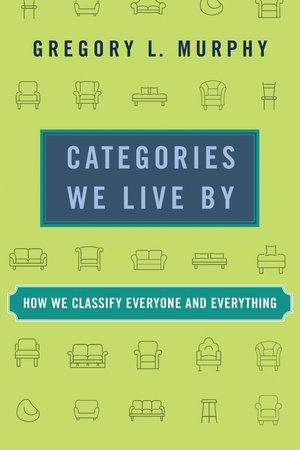
Well, Chapter 1 is the 'Introduction' so that is great, and as you may be I am swept up by what's between the covers. Speaking of which, this is an effective design, and green colour; especially for a northern reading in March - May.

The book is slim considering the topic, 164 pages, plus just over a page of notes, four and a half of references and an index. It is, I think a slightly larger format paperback but fits well in the hands for outdoors reading. The fonts and layout are clear.

Murphy's style is straightforward and readable. It is not technical, but includes terms such as classification, nomenclature, and domain [ ;-) ]. The division into two parts, lends itself to a wide readership, the second part providing case studies giving the book a pragmatic, practical emphasis. I'll post again about chapters 6 & 7 on Psychodiagnostic Categories; and Categories and Power respectively (brief, but a joy!).


Before moving on from the Intro, Murphy explains how the same category may be thought of in different ways at different times' and encourages us to be 'critical of our categories'. p.12. This stands out for me. Especially being suitably equipped to critique our categories as we use them.

Chapter 2 on The Classical Tradition, has a natural starting point; describing Aristotle (with his book Categories), essences, definitions with properties that are necessary and sufficient p.14-15.
'Necessity: If it's in the category, it has the features,
Sufficiency: If it has the features, it's in the category.' p.15.

I was prompted to reflect on relations and identities here. While I suggested the book is not technical, there is a important point about dictionaries and the definitions we seek there. We should remember that many members of the public would still rely on what is the classical way to create, confirm category membership: there must be a rule.

Wittgenstein follows pp.17-20, but I took note of:
'The problem is that necessity and sufficiency are in tension with each
other. As you make the list of properties longer and longer, it's more likely
to be sufficient but less likely to be necessary. Forming a list of features that
are both necessary and sufficient is usually impossible.' p.19.
I pencilled in (Eleanor) Rosch on p.13, and on page 21 her contribution to the destruction of the classical world is described; with other researchers. The book is well referenced, without being intrusive. Murphy provides specific pointers, suggesting further reading and skipping a chapter. Helpful, given how precious time is these days.

There is a critical invitation on page 13: 

'Want to start an argument with someone? Ask them whether a stove is a kitchen utensil or nursing is a science.'

I wonder if nursing theory colleagues in the United States and globally have already responded?

More to follow - surely!

Murphy, Gregory L. Categories we live by: how we classify everyone and everything. Cambridge, MA: The MIT Press, 2024.

Many thanks to MIT Press for the review copy.

Saturday, April 26, 2025

'Categories are destiny' Freud p.6. of 'Categories we live by'


Reading and enjoying for review:

Murphy, Gregory L. Categories we live by: how we classify everyone and everything. Cambridge, MA: The MIT Press, 2024.

Let's start at the beginning -
'Nowadays we are suspicious of categories, especially categories of people. Gender, ethnic, racial, and class categories are seen as a source of discrimination and inequity. If we saw each person as a unique individual, perhaps we wouldn't have all the problems caused by racism, sexism, and all the other -isms that afflict society.
In spite of these problems, I will argue that we cannot get rid of categories in general. They simplify and distract us from individual identities, which can be bad, yet if we didn't have them, we would find it impossible to navigate the world and deal with its incredible diversity.' p.7.


Reading what follows also from the book's introduction, I thought about public sector funded (socialist)  healthcare and the private provision:

'So, my sweater and my hair might both be brown, so we can say that they are both in the category of brown things. They are equivalent in the sense that I call both of them "brown." However, the category of brown things is not very interesting. When you know that something is in that category, you know exactly one thing about it-its color. There's nothing else to be known. Maybe the brown thing is alive or maybe it's inanimate; maybe its microscopic or maybe it's as big as a planet; maybe it moos or maybe it sings oI maybe it is silent. The category doesn't tell you any of those things These single-criterion categories are kind of degenerate. Yes, items that share the criterion (brownness, being three inches long, taking at least half an hour, or whatever) are equivalent, but only in the one property that defines the category. Indeed, you can define trivial categories that only have one ridiculous feature in common, like things that you have touched in the last forty-nine seconds, or objects that are exactly fifteen miles from Cincinnati. Those are not categories that people form, because they are not useful.' p.11.
There is much ongoing debate about parts of the UK's NHS being 'sold-off' - taken-over by private companies with consequences for the quality of care, e.g. cataract services:

https://www.theguardian.com/society/article/2024/jul/10/eye-doctors-say-private-cataract-operations-have-hurt-the-nhs?CMP=share_btn_url

Having worked for the NHS - now NHS Professionals since 1977, the current problems faced by the service and experienced by some patients, carers, friends and family members is upsetting.

Murphy's observation contrasting the utility of categories at the individual and collective level is a great opener. Especially for the basic structure of Hodges' model and the vertical axis.

I've written previously(?) how I think that it is true, throughout my career even as a ward manager (there were some exceptions!) and community MH nurse, I/we have been cocooned from having to be concerned about the budget. When you stop and think about it, how do the 'things' in the category of economics impinge on the biomedical, biopsychosocial model? The ward was a mechanism; it kind-of run itself, which for change agents (those who use the word transformation a lot) is an ongoing issue. The two categories that matter - even as they are global - are illness and prevention. The NHS puts supertankers to shame, in its inability to pivot - turn.

At the end of the day (and night - 24/7/365!) though healthcare must be paid for.

Murphy's explanation about degenerate categories is fascinating too (and this is just the intro!). It sees me (in danger of making a category mistake) as I think about singletons, and 'degenerate' as applies in mathematics, and the debate of finance. The tension of seeing the individual as a unique being, in order to be person-centred, but the service, the system would place them in all in the category of 'payer'.

Viewed across the funding divide, is the other inevitably viewed as degenerate? On page 80 now. More to follow. I'm still kicking all this around; while the government kicks the 'can' of social care down the road.

Many thanks to MIT Press for the review copy.

Tuesday, March 11, 2025

Joint-carving - 'The First Cut is the Deepest' c/o Traldi

Last Friday I joined in another online session of the Argumentation network c/o Andrew Aberdein and Kat Stevens. 

The subject was “The Epistemology and Politics of Redefinition” by Oliver Traldi.

As ever, it was interesting, technical, relevant and a prompt to concepts new, briefly encountered previously. I can't remember if in the talk, or Q&A, but mention was made of 'joint-carving' but I checked some sources:
'Because properties are so abundant, they are undiscriminating. Any two things share infinitely many properties, and fail to share infinitely many others. That is so whether the two things are perfect duplicates or utterly dissimilar. Thus properties do nothing to capture facts of resemblance. That is work more suited to the sparse universals. Likewise, properties do nothing to capture the causal powers of things. Almost all properties are causally irrelevant, and there is nothing to make the relevant ones stand out from the crowd. Properties carve reality at the joints -- and everywhere else as well. If it's distinctions we want, too much structure is no better than none.' p.346.
Lewis, D. 1983. New Work for a Theory of Universals, Australasian Journal of Philosophy, 61(4): 343–377. doi:10.1080/00048408312341131

'Though the facts or truths that the realist judges mind-independent are most commonly put in terms of a kind’s ‘naturalness’ (or lack thereof), they may be formulated in alternative locutions, such as the ‘reality,’ ‘non-reality,’ or ‘artificiality’ of a kind or kinds. For example, that human races are not real, or that protons form a natural kind, both express such facts. Equivalently, Plato’s famous carving metaphor may be used to do so, as when it is asserted that the classifications of the DSM-5 do not carve nature at the joints. For the sake of expository simplicity I will exclusively use the language of ‘naturalness’ here, but translations into alternative terminology are straightforward.'
Franklin-Hall, L. 2015. Natural kinds as categorical bottlenecks. Philosophical Studies 172 (4):925-948.


Further, Sass writes:
'The goal is to have a consistent and informative test for what counts
as a realist versus an anti-realist view about natural kinds. Bird’s(2018) taxonomy,
building on Hawley and Bird(2011), focuses on the questions of whether natural
kinds exist, and if so, what sort of entity kinds are. Franklin-Hall’s (2015) taxonomy
focuses instead on whether kinds are individuated by a mind-independent principle,
or whether kinds “carve at the joints”.1 This paper focuses mainly on the issues raised
by Bird’s (2018) taxonomy.' p.11862.
Sass, R. 2021. An ontology of weak entity realism for HPC kinds. Synthese, 198(12), 11861–11880. https://www.jstor.org/stable/48692794 [ homeostatic property cluster (HPC) theories of kinds ].

In the past, I've written about the (nursing, IT, psychological...) models muddle. At the risk of adding to my muddle, Traldi's presentation is a timely prompt. Timely, because trying to looking at Hodges' model as a mathematical object, it needs to be stripped down to its bare components (and purposes?). Is redefinition the order of the day? I will leave defining the components to one-side at present (in drafted notes). But even from Hodges' model as a template, with its (two) axes and (four) domains we can (must) consider:

1. The two axes taken as a whole - do they intersect, or not?*

Relationally, the axis between:

INTERPERSONAL | SCIENCES
SOCIOLOGY | POLITICAL
INTERPERSONAL - SOCIOLOGY
SCIENCES - POLITICAL

2. Each axis (treated independently) to the centre of Hodges' model. (See 1.)

The conjoining of axes (do they?):

The INDIVIDUAL - HUMANISTIC and INDIVIDUAL - MECHANISTIC.

The HUMANISTIC - GROUP and GROUP - MECHANISTIC.
                                
Hodges' model
I won't continue now, but I have wondered if one axis is primary? Which one comes first? Faced with a blank piece of paper, or flipchart ... which axis gets drawn first?

In guided discovery workshops, teaching sessions I have been directed by the context and duty of care. Given that this is clinical then the I-G is where I start, or lead the discussion.

Perhaps, (as per the previous post) there is a safety dividend in having to consider this question more formally (forcibly)?


I remember Rod Stewart's rendition of  'The First Cut is the Deepest' - even as governments work to make this cut as shallow as possible.

The INDIVIDUAL - GROUP cut: has it every time.

Previously: 'argumentation'

Thursday, October 10, 2024

British Computer Society: AI for One Health and Planetary Health

 BCS SPECIALIST GROUP ON ARTIFICIAL INTELLIGENCE (BCS SGAI)! 

AI for One Health and Planetary Health: Where Are We?

Friday November 8th 2024 - British Computer Society London Office (near Moorgate Underground)

Invitation to Register

http://www.bcs-sgai.org/health2024/

A full-day event with invited talks on the following topics:

  • One Health and Planetary Health: the case for considering a unified health perspective
  • Translational Diagnostics in Companion Animals
  • Mixed AI approaches to surfacing information hidden in veterinary electronic health records
  • Hands-on Tutorial: Low-Code/No-Code AI: Democratise AI for Text, Images, and Audio
  • AI for One Health and Planetary Health: is there a generic framework?
  • Low-Code/No-Code AI for Biomedical Image Classification: Visual Impairment as a case stud
  • Low-Code/No-Code AI for Planetary Health: World Fisheries and Aquaculture as a case study
The  21st  century  brings  major  global  challenges,  including  climate  change  and  rapid  population  ageing, calling  for  transdisciplinary  involvement  of  diverse  sectors  and  stakeholders,  including  academics  and students, companies and societal organisations. One Health considers human health, animal health, and our shared  environment  as  parts  of  a  deeply  interconnected  system.  Our  environment  is  changing  and  it  is affecting  our  health.  Planetary  Health  emphasises  that  everything  is  connected:  "the  quality  of  the  air  we breathe and of the water we drink, the quality and quantity of food we produce, our exposure to infectious diseases, and even the habitability of the places where we live". Digitalisation is happening in both human and veterinary medicine. Human-AI collaboration can bring humans and AI together to gain more valuable insights  than  either  could  achieve  alone. The  event  comprises  a  number  of  talks  with  speakers  from  the Animal  and  Plant  Health  Agency  (APHA.gov.uk),  Veterinary  Health  Innovation  Engine  (vHive),  Small Animal  Veterinary  Surveillance  Network  (SAVSNET),  National  Health  Service  (NHS)  England,  and  UK universities.  

Low-code/no-code AI is on the rise with Large Language Models (LLMs) at its core, including multimodal LLMs that can produce content (text, image, video, or audio/speech) as output (generative AI). Come along to the hands-on tutorial if you are interested in content generation and content analysis of text, images and  audio  with  open-source  LLMs from  Google,  Facebook,  Microsoft  and  OpenAI  in  just  3  lines  of python  code  (low-code  AI)  and  LLM  prompting  (no  code  AI).  The  exercises  can  be  executed  in  1  to  5 minutes using Google Colab (free of charge for basic use and without setup to use).  

There will be Certificates of Attendance for those who register and attend the event.

We hope that you will come and join us, and that you enjoy this new offering from the BCS SGAI.

Full details are available at http://www.bcs-sgai.org/health2024/

Reduced delegate fees!!
The  delegate  fee  is  just  £50  plus  VAT  for  BCS  and  SGAI  members  and  £90  plus  VAT  for  others. This includes  attendance  at  the  event,  lunch  and  refreshments.  A  special  rate  of  £35  plus  VAT  is  available  for students. A Group Discount Rate is available for group bookings of three or more.

--------------------------------------------------------
To register for future mailings about SGAI events go to http://www.bcs-sgai.org/register/

Max Bramer
Chair BCS Specialist Group on Artificial Intelligence (bcs-sgai.org)

Friday, August 30, 2024

Still sorting books: "The holographic paradigm and other paradoxes"

There has been overlap in my subscription to the Laws of Form mail list and a (David) Bohm list. With the difference, I unsubscribed from the latter, in an effort to focus. The work of Bohm is still very much on the radar and book shelves (well, boxes currently). Continuing to clear books, I've been reading through some relevant sections and quote here at length from:

Wilber, K. (Ed.), (1982) The holographic paradigm and other paradoxes. Boulder, CO: Shambhala.

The Enfolding-Unfolding Universe: A conversation with David Bohm (pp.44-104)

"WEBER: You've spoken of clarity often today and in the past: therefore, isn't it necessary at this point to consider consciousness and the knower, the one who is or isn't clear?

BOHM: Yes, we could come to that. The point is that consciousness is confused. Confusion is nonclarity. And if you say, a person is not clear, you mean he's confused, although it is more polite to say he's not clear. And confusion means "melting together." Things that are different are seen as one and things that are one are seen as broken up into many. So confusion clearly causes chaos." p.61.

"BOHM: Well, yes, we can consider that maybe that is what is, but, at the same time we have to be very  careful to say that thought cannot grasp it, so at some stage thought has to put this question aside as to what is, you see. Thought cannot grasp that which is. And any attempt to grasp that which is engages us in serious self-deception which confuses everything. So that thought has to learn or somehow come to a state of discipline, or whatever you want to call it, spontaneous discipline, its own discipline. 

WEBER: Order?  

BOHM: Yes, order, in which it does not attempt to grasp the questions which are beyond it, such as the question of that which is. It can grasp any relative question which is conditioned, or in some way, conditional. So even the nonmanifest consciousness of the  nonmanifest matter, which is highly subtle, is still within the possible area of thought."  p.64.


"WEBER: Deeply. So you're saying that prior to this current awareness of the centrality of consciousness, what we've been trying to do is hopeless because we've addressed small social problems all in the wrong domain, so to speak. 

BOHM: Yes. Well, really not going to their source at all." p.80.


"WEBER: Which was the old Cartesian or dualistic model.  

BOHM: Right. It also leads to infinite regress, unless you end it by  God or somewhere.
Now I think we come to a point where we're raising a question which was similar to what was raised in  yesterday's discussion.  How long can we go on trying to talk about what is beyond thought by making an intellectual construction? You see, because when we  make such an intellectual construction we  have a content and we have implied that the one who is constructing it is also supposed to be beyond that content. So he evades the very thing we attempt to include him in and in that very attempt he gets out. And so it seems that there is some limit to how far you can go in that  process, in that approach. Therefore it's best to say that in this approach in which we attempt to make a map, or a sketch of some  kind of what reality is, that we are really dealing with something limited. Korzybski used to say: "Whatever we say it is, it isn't."

WEBER: The map is not the territory. . . .

BOHM: That's right. Yes. And therefore what we are doing is making maps, making sketches, making concepts. And see, that's why I said the other night that science, for example, theoretical  science, is not primarily concerned with observing things but with observing ideas. ..."  p.84


The Tao of Physics Revisited  (pp.215-248)

"CAPRA: Yes, they would look at genetics, individual parts and so on. 

WEBER: They have the Cartesian view, whereas you're saying that this is the new vision, emphasizing interdependence, interconnectedness, the dynamics of the whole. 

CAPRA: But I should say that both reductionism and holism are necessary. 

WEBER: I understand. You are not suggesting that we abolish the other. You are saying we should supplement one with the other. 

CAPRA: If you want to get the full story, then you need both views. Because either one gives you only half of the story. This is what I see as the future of science, and I see a future science as no longer distinguishing between disciplines. 

WEBER: That's a very radical view. 

CAPRA: Yes, and by the way Heinsenberg already said that years ago. In one of his books, The Part and the Whole, he ends with his view of future science, and I agree very much with that. I have come to believe that in the future we will apply a network of models, and we will use different languages to describe different phenomena at different levels. We will not worry any longer whether we are doing biology or psychology or physics or anthropology or whatever; we won't be worried about these classifications." p.241.

Reading of The Systems View of Life - A Unifying Vision is also ongoing (p.240 ... and a joy) with posts to follow.

See also:
https://kfoundation.org/krishnamurti-and-david-bohm/

Wednesday, May 01, 2024

Hodges' model: A tool for Curation

CURATION
"Curation helps solve the problems of today and tomorrow. It's the mass sourcing of the expertise needed to navigate and comprehend the saturated, complex markets* of the twenty-first century." p.166.

Bhaskar also lists (and briefly introduces) the principles of curation:
  • Saving time
  • Freeing cognitive resources
  • Sparing us anxiety
  • Maximising utility
  • Cutting down complexity
  • Finding quality
  • Overcoming information overload
  • Creating contrast 
  • Redefining creativity
  • Channeling attention
  • Providing context
  • Beating overproduction (pp.167-168).

*To markets above, I would add disciplines and professions.

By definition an aide-mémoire should save us time. 

The structure of Hodges' model provides a conceptual scaffold, a substrate affording us cognitive economy.

Through selection (self guided discovery) we are assuring data, information gathering, properly supervised this should spare us anxiety.

We are trying to ensure the effective use of our time, and efficiently zero-in on the concepts that are salient.

By reducing complexity, we increase the relevance and value of what is noted, recorded, acted upon. Data, facts, observations that are not redundant can be dismissed.

Contrast is co-confirmed by using innate oppositions, polarities and dichotomies with attention on the other and the middle.

When needed, Hodges' model can explode subject headings, concepts assisting exploration and creativity, potentially assisting at a transdisciplinary level.

Context rationalisation by testing and filtering a situation, helps to focus attention.

Duplication and repetition do not foster sustainable services, but there should always be scope for verification and person-centredness.
"As the eighteenth-century English painter Joshua Reynolds put it, 'Simplicity is an exact medium between too little and too much.' Curation helps ensure that exact medium." p.159. 

Bhaskar. M. (2016) Curation: The power of selection in a world of excess. London: Piatkus.

Book image: Waterstones.

See also: Is Hodges' model a selection machine?

Saturday, July 01, 2023

ERCIM News No. 134 Special theme: "Explainable AI (XAI)"

Dear ERCIM News reader,

ERCIM NEWS 134
ERCIM News No. 134 has just been published. This issue's special theme dives into Explainable AI (XAI) – uncovering its application across healthcare, industry, ethics, climate change, and generative language models. Discover the significance of transparency and interpretability in complex ML models, offering insights into decision-making and building trust.

This special theme was coordinated by our guest editors by Manjunatha Veerappa (Fraunhofer IOSB) and Salvo Rinzivillo (CNR-ISTI).

Thank you for your interest in ERCIM News! Help us spread the word by forwarding this message to those who might find it interesting. We also appreciate your support on Twitter @ercim_news and other social media platforms. Let's keep the conversation going and share the latest updates together!


Includes:

Explainable AI in Health Care

16 Explaining Ensemble Models for Lung Ultrasound Classification

by Antonio Bruno, Giacomo Ignesti and Massimo Martinelli (CNR-ISTI)

18 A Governance and Assessment Model for Ethical Artificial Intelligence in Healthcare

by Luigi Briguglio, Francesca Morpurgo and Carmela Occhipinti (CyberEthics Lab.)

20 Current Challenges and Future Research Directions in Multimodal Explainable Artificial Intelligence

by Nikolaos Rodis, Christos Sardianos and Georgios Th. Papadopoulos (Harokopio University of Athens)

22 Predictive Model for Functional Outcome after Orthopaedic Surgery Using Machine Learning Methods

by Alexandre Lädermann (Hôpital de La Tour, Meyrin, Switzerland), Philippe Collin (American Hospital of Paris, France) and Patrick J. Denard (Oregon Shoulder Institute, Medford, Oregon, USA)

23 Unleashing the Power of Artificial Intelligence for Personalised Drug Design

by Michaela Areti Zervou, Effrosyni Doutsi, Panagiotis Tsakalides (University of Crete and ICS-FORTH)

Next issue:
No. 135,  October 2023
Special Theme: "Climate-Resilient Society".

Submissions are welcome! See call for contributions.

My source:
Peter Kunz                      	
ERCIM Office
2004, Route des Lucioles
BP93
F-06902 Sophia Antipolis Cedex

https://www.ercim.eu
https://ercim-news.ercim.eu 
--------------------------------
@ercim_news
http://twitter.com/ercim_news

join the ERCIM Linkedin Group
https://www.linkedin.com/groups/81390/

Wednesday, March 30, 2022

Re-Inventing Schizophrenia: Updating the Construct

INDIVIDUAL
|
 INTERPERSONAL    :     SCIENCES               
HUMANISTIC --------------------------------------  MECHANISTIC      
SOCIOLOGY  :   POLITICAL 
|


Re-Inventing Schizophrenia: Updating the Construct. Edited by Rajiv Tandon, Matcheri Keshavan, Henry Nasrallah. Schizophrenia Research. Volume 242, Pages 1-150 (April 2022).

My source:
https://twitter.com/JeroticStefan/status/1508898715473530888?s=20&t=X61DSrPzEyLvX-FhzY5r-A

Need for bio-psycho-socio-POLITICAL perspectives - spiritual too.

Previously on W2tQ: DSM


Saturday, March 19, 2022

NANDA International's First Webinar

On Thursday a webinar - NANDA-I's first - provided an update on Nursing Diagnoses:


It wasn't just what is new and revised in the diagnoses that was of interest, but the explanation and discussion of the Level of Evidence criteria. Resources, challenges, ways to get involved, and future directions were also described. The levels of evidence criteria for diagnoses submission stood out, reinforcing how 'concepts' remain key to this work and application.

In the Q&A I asked about NANDA-I (and other classification schemes) contributing to the metrics for the Sustainable Development Goals (and not just 'health' SDG-3) and Social Determinants of Health. Since the 1990s nursing informaticians saw terminology systems and technology having a role in making nursing visible. This is crucial at the global* level of SDGs, SDoH and challenges that are not 'on the horizon', but are a present and real danger: climate change, conflict, pandemics, and mass migration. Despite such uncertainties, I found the event very encouraging.

 *local, and glocal too.

TABLE OF CONTENTS:

Part 1 The NANDA International Terminology: General Information

1 What's New in the NANDA-I 2021-2023 Edition
2 International Considerations on the Use of the NANDA-I Nursing Diagnoses


Part 2 Recommendations for Research to Improve the Terminology
3 Future Improvement of the NANDA-I Terminology
4 Revised Level of Evidence Criteria for Diagnosis Submission


Part 3 The Use of NANDA International Nursing Diagnoses
5 Nursing Diagnosis Basics
6 Nursing Diagnosis: An International Terminology
7 Clinical Reasoning: From Assessment to Diagnosis
8 Clinical Application: Data Analysis to Determine Appropriate Nursing Diagnosis
9 Introduction to the NANDA International Taxonomy of Nursing Diagnoses
10 Specifications and Definitions Within the NANDA International Taxonomy of Nursing Diagnoses
11 Glossary of Terms


Part 4 The NANDA International Nursing Diagnoses

Domain 1. Health promotion
Domain 2. Nutrition
Domain 3. Elimination and exchange
Domain 4. Activity/rest
Domain 5. Perception/cognition
Domain 6. Self-perception
Domain 7. Role relationship
Domain 8. Sexuality
Domain 9. Coping/stress tolerance
Domain 10. Life principles
Domain 11. Safety/protection
Domain 12. Comfort
Domain 13. Growth/development

Friday, January 21, 2022

Webinar: WHO Classification of Self-Care Interventions for Health - Feb 14th

Webinar to present the WHO Classification of self-care interventions 

 09:00 Washington / 15:00 Geneva

This classification aligns with a people-centred approach to health and well-being outlined in the WHO global Guideline on Self-Care Interventions for Health and Well-being. This classification has a health system focus and aims to promote an accessible and bridging language for researchers, policymakers, donors and health programme managers working on self-care. 

Please register here:

https://attendee.gotowebinar.com/register/7796921047088796688

WHO resources on self-care interventions: 

 https://www.who.int/health-topics/self-care#tab=tab_1

WHO Classification of self-care interventions: 

https://www.who.int/publications/i/item/9789240039469

We look forward to your participation! 

Ados V. May, MPA | WHO/IBP Network

Senior Technical Advisor

email: ados.may AT phi.org


  Self - Individual - Person
|

INTERPERSONAL : SCIENCES
humanistic ------------------------------------------ mechanistic
SOCIOLOGY : POLITICAL
|
Community - Group - Population
 Classification of Self-Care
Interventions for Health
Classification of Self-Care
Interventions for Health

Service planning and development
Public engagement
Informal carers
Social care
Care Givers
Accountability
Value for Money
Population Health
Users

Patient - Self - Citizen Research?


Health For All
Human Rights
Health Services
Reporting, Statistics and
Planning, Standards
Information Systems Infrastructure
Governance, Regulation

Population Health
Finance, Value for Money
Outcomes - Policy:
National - International
Sustainability


My source: IBP Network


Wednesday, June 03, 2020

Diagnosis vs Formulation in Mental Health

"Should psychological formulation replace diagnosis?"

When Brian Hodges created the model the original purposes (c. 1983-84) were to facilitate:
  1. Reflection and reflective practice;
  2. Integrated - person-centred care;
  3. Holistic care (mental, physical, social, political and spiritual) and;
  4. Bridge the Theory - Practice gap.
After learning and applying the model in 1987-88 I quickly recognised the multi-fold purposes and functions to which Hodges' model can be applied. One of these is clinical assessment which are encapsulated in 1-4 above. Importantly this includes assessment across all fields of health and social care; and more specifically case formulation as applied within various psychological therapies and interventions.

Noting a tweet (see below) I knew straight away that here is a blog post, even before being pointed to an associated blog post,

In 1998-9 I started a course on the use of psychosocial intervention and cognitive behaviour therapy in psychoses. From the outset as a student mental health nurse, you are constantly made aware of the politics in psychiatry and mental health nursing:

Clare, A.W. (1976) Psychiatry in Dissent: Controversial Issues in Thought and Practice. London: Tavistock

Even on twitter (and I don't wish to denote surprise) there is often marked debate, critique, even sniping between psychology, psychiatrists and users of mental health services, patients, or survivors whichever nomenclature you prefer.

I have always tried to draw student's attention to coding and classification. Key to this is purpose: clinical diagnosis, epidemiology, research, demographics, national and international reporting and statistics (plus of course - pandemic management). Being a health care professional demands an awareness of diagnosis, the tools available, how they change and their limitations. Even if it is 'not your job' to 'diagnose', that understanding is important to your effectiveness and ability to empathise with patients, carers and families.

Implicit in Hodges' Health Career - Care Domains - Model is time and potential or otherwise for change in and throughout someone's life.

Students will and should become embroiled in the debate of mental illness as a social construct. Although world events at present heighten the view of things being polarised and now in its starkest form - people too and Yes - #BlackLivesMatter. The continuum model of mental health affords another viewpoint. It suggests the gradual way a person's beliefs can become more bizarre over time. Substance harmful use is not some necessary (essential) precipitating factor, but it can accelerate a negative transformation of a person's view of themselves, others, the world and future.

A diagnosis can be constructive, providing renewed certainty and direction. A diagnosis can also be destructive in terms of how a patient, their loved ones, friends and society receive it. There are nursing diagnoses also; and as such Hodges' model provides a means for a nursing, psychological and clinical case formulation.

In response to reference to the 'medical model', I have tweeted many times how the biopsychosocial model, of which the medical model is a part, is incomplete.

Beyond diagnosis and formulation, there is a need to see the model that really does the work,
for the real elephant in the room to reveal itself.

I am of course referring to the bio-psycho-socio-political model.

Appeal to the medical model, without reference to the political is ingenuous. It is the political after all that permits institutions to award degrees and the granting of licensing and registers to 'practice', prescribe drugs and other treatments. Ready incorporation of the political should be acknowledged by the extent of change through the past 40 years of mental health service provision (and more recent stasis?).

Or, perhaps legislation passed in that time does not yet speak volumes?

The role of community mental health nursing has changed profoundly in this time and the accent (as evinced three days a week Nov-Mar 2020) is upon assisting individuals to manage their substance harmful use, financial affairs, strained therapeutic relationships and emotional dysregulation. Very often it is statutory agencies who 'rely' on diagnoses. A psychological formulation would probably have little 'leverage' as part of a Personal Independence Payment (PIP) assessment or appeal. It is here that a medical diagnosis - has currency. Consultant Psychiatrists have little enough time so the CPN/CMHN acts as the go-between. Reaching across from the intra- interpersonal domain to the political.

The narrative written on the assessment/appeal form will include content that would no doubt contribute to a psychological formulation (and even psychodynamic) were this is relevant purely for the purpose of the assessment. As such it is the dialogues and narratives that are engendered that can increase self and mutual understanding and awareness. This can in turn provide the opportunity to progress more positively a person's situation within which diagnoses and formulations play a part. There is still a great 'gap' between the formulaic and diagnostic outputs and the therapies that are available.


individual
|
INTERPERSONAL : SCIENCES
humanistic ----------------------------------------------- mechanistic
SOCIOLOGY : POLITICAL
|
group - population
Diagnostic and Statistical Manual of Mental Disorders (DSM–5)

multiaxial?

Psychological formulation

Psychodynamic formulation

Psychiatric diagnosis

TI:ME

Health career - life chances

Medical diagnosis

multiaxial?

International Classification of Diseases

SNOMED CT

TI:ME

Health career - life chances


[Recruitment agencies seek mental health nurses as 'disability assessors'. I am a realist. I know some people are beyond the pale, but that doesn't mean we should not try. These assessments can be opportunities to engage anew, but of course that is not what is required?]

My prompt:
Samei Huda - Twitter

Wednesday, April 15, 2020

Forgotten Rationales ... ?

individual
|
INTERPERSONAL : SCIENCES
humanistic ----------------------------------------------- mechanistic
SOCIOLOGY : POLITICAL
|
group - population


"One of the earliest attempts to systematically classify disease began with John Graunt’s mid-seventeenth-century examination of London’s Bills of Mortality (1939[1662]). London’s series of bubonic plague outbreaks in the first half of the seventeenth century served as the backdrop for Graunt’s statistical analysis. His primary objective was to develop a more comprehensive picture of London’s mortality in order to construct a disease-incident baseline from which to better understand the effects of plague, which tended to overshadow other causes of death. Essential to these objectives were the broader concerns for creating "population profiles through a study of causes of death" (Alter and Carmichael 1999, 121), which Graunt accomplished by estimating London’s population through a geographical analysis, allowing him to calculate crude mortality rates." p.96.


UK coronavirus: care providers allege
Covid-19 death toll underestimated

Care operators warn coronavirus may
 already be in more than
50% of nursing homes

(Robert Booth and Rowena Mason,
Wed 15 Apr 2020 07.09 BST.
The Guardian)


"Sydenham designed his nosology with the needs of the physician rather than those of the statistician in mind. Accordingly, Sydenham and Graunt produced different classification systems based on the distinct purposes for which they were intended. This distinction (clinical vs. demographic) played a more significant role in the nineteenth century, foreshadowing some of the tensions and cross-purposes that informed the development of modern classification systems. As Alter and Carmichael (1999, 121) note: 'The problematic relationship between causes of morbidity and causes of mortality thus presented an ideological barrier between the concerns of physicians and the interests of statisticians. ...one group were lumpers, the other splitters.'" p.97.


Beemer, Jeffrey Keith, "Social Meanings of Mortality: The Language of Death and Disease in 19th Century Massachusetts" (2011). Open Access Dissertations. 428.
https://scholarworks.umass.edu/open_access_dissertations/428


Q. Is the state of social care and the applicable policy and legislation under which it operates an example of an 'inverted ring-fence'? Discuss & debate, justifying key policy and legislation as you see it and the implications amid the COVID-19 crisis and future (health and social care) policy.
https://twitter.com/h2cm/status/1250405469929328647?s=20


Remember(?) also:
Forgotten Streams ...  

Sunday, July 29, 2018

Relatedness and Similarity - in The Health Career Model

How can we demonstrate the basis for the axes, 'found' conceptual structures and conceptual clustering in Hodges' model?

UMLS::Similarity Web Interface (measuring pairwise similarity and relatedness of medical concepts)

Some results and definitions obtained from the above.

Results:

The similarity of person (C0027361 ) and patient (C0030705 ) using Lin (lin) is 0.85.
Using:    SAB :: include MSH
    REL :: include PAR/CHD

The similarity of person (C0027361 ) and patient (C0030705 ) using Conceptual Distance (cdist) is 0.5.
Using:    SAB :: include MSH
    REL :: include PAR/CHD

The similarity of person (C0027361 ) and patient (C0030705 ) using Resnik (res) is 1.6384.
Using:    SAB :: include MSH
    REL :: include PAR/CHD

The similarity of person (C0027361 ) and patient (C0030705 ) using Jiang & Conrath (jcn) is 1.7295.
Using:    SAB :: include MSH
    REL :: include PAR/CHD

The similarity of person (C0027361 ) and patient (C0030705 ) using Path Length (path) is 0.5.
Using:    SAB :: include MSH
    REL :: include PAR/CHD

The similarity of person (C0027361 ) and patient (C0030705 ) using Wu & Palmer (wup) is 0.8.
Using:    SAB :: include MSH
    REL :: include PAR/CHD

The similarity of person (C0027361 ) and patient (C0030705 ) using Nguyen & Al-Mubaid (nam) is 0.2038.
Using:    SAB :: include MSH
    REL :: include PAR/CHD

The similarity of person (C0027361 ) and patient (C0030705 ) using Random Measure (random) is 0.5703.
Using:    SAB :: include MSH
    REL :: include PAR/CHD

The similarity of person (C0027361 ) and patient (C0030705 ) using Leacock & Chodorow (lch) is 2.9957.
Using:    SAB :: include MSH
    REL :: include PAR/CHD

--
The relatedness of individual (C0027361 ) and group (C1257890 ) using Vector Measure (vector) is 0.7869.
Using:    SABDEF :: include UMLS_ALL
    RELDEF :: include CUI/PAR/CHD/RB/RN

The relatedness of individual (C0027361 ) and group (C1257890 ) using Adapted Lesk (lesk) is 9584.
Using:    SABDEF :: include UMLS_ALL
    RELDEF :: include CUI/PAR/CHD/RB/RN

--
The relatedness of self (C0036588 ) and group (C1257890 ) using Adapted Lesk (lesk) is 263.
Using:    SABDEF :: include UMLS_ALL
    RELDEF :: include CUI/PAR/CHD/RB/RN

The relatedness of self (C0036588 ) and group (C1561557 ) using Vector Measure (vector) is 0.4054.
Using:    SABDEF :: include UMLS_ALL
    RELDEF :: include CUI/PAR/CHD/RB/RN

Definitions:

individual (C0027361)
HL7V3.0 : A living subject of the species homo sapiens.
NCI : Human beings in general.
NCI : A human being.
NCI_BRIDG : A human being.
MSH : Persons as individuals (e.g., ABORTION APPLICANTS) or as members of a group (e.g., HISPANIC AMERICANS). It is not used for members of the various professions (e.g., PHYSICIANS) or occupations (e.g., LIBRARIANS) for which OCCUPATIONAL GROUPS is available.
individual (C0237401)
individual (C3245468)
HL7V3.0 : Description:Person as specified by coverage policy or program.
HL7V3.0 : Description:The level of coverage under the policy or program is available to an individual.
HL7V3.0 : Description: A role played by a party covered under a policy as the policy holder. An individual may be either a person or an organization.
Note: The party playing the role of an individual insured is not a claimant in the sense conveyed by the RoleClassCoveredParty CLAIM (claimant). However, a named insured may make a claim under a policy, e.g., a party that is the named insured and policy holder under a comprehensive automobile insurance policy may become the claimant for coverage under that policy if injured in an automobile accident and there is no liable third party. In the case of an individual insured making a claim, a role type code INSCLM (insured claimant) subtypes the class to indicate that an individual insured has filed a claim for a loss.
Example: The individual insured under a comprehensive automobile, disability, or property and casualty policy that is the policy holder.
HL7V3.0 :
self (C0036588)
HL7V3.0 : The "same" roleclass asserts an identity between playing and scoping entities: that they are in fact instances of the same entity and, in the case of discrepancies (e.g different DOB, gender), that one or both are in error.
Usage:
playing and scoping entities must have same classcode, but need not have identical attributes or values.
Example:
a provider registry maintains sets of conflicting demographic data for what is reported to be the same individual.
NCI : The individual as the object of his own reflective consciousness.
HL7V3.0 : The relationship that a person has with his or her self.
self (C1551994)
HL7V3.0 : Covered party is the policy holder. Also known as the subscriber.

See also:

WordNet::Similarity

This is a Perl module that implements a variety of semantic similarity and relatedness measures based on information found in the lexical database WordNet. In particular, it supports the measures of Resnik, Lin, Jiang-Conrath, Leacock-Chodorow, Hirst-St.Onge, Wu-Palmer, Banerjee-Pedersen, and Patwardhan-Pedersen. 

n.b. While Hodges' model was created for application in health and social care contexts it can be applied generally.