Hodges' Model: Welcome to the QUAD: cognitive linguistics

Hodges' model is a conceptual framework to support reflection and critical thinking. Situated, the model can help integrate all disciplines (academic and professional). Amid news items, are posts that illustrate the scope and application of the model. A bibliography and A4 template are provided in the sidebar. Welcome to the QUAD ...

Showing posts with label cognitive linguistics. Show all posts

Monday, February 23, 2026

Millikan's Unicepts and Unitrackers

An underpinning theory of Hodges' model must help us make sense of what is happening within the care domains, between the domains, and possibly say something about what may be significant relation[s]-ships that are diametric. Arriving at threshold concepts I wondered in Hodges' model about there being compound threshold concepts. Consider, when 2-3 thresholds are (b)reached in one (the sciences) domain? Contrast this then, with 4-5 thresholds across care domains? There may also be care concepts applicable that are for example, person-centred: that is, patient, carer, 'management', or policy defined? These concepts while not threshold related per se, are nonetheless relevant.

I came across the work of Ruth G Millikan in London, several years ago as I followed 'epistemology' around the shop. It is time to pick this up and earlier work:

Millikan, Ruth Garrett. “Biosemantics.” The Journal of Philosophy 86, no. 6 (1989): 281–97. https://doi.org/10.2307/2027123

https://www.researchgate.net/publication/235734046_Biosemantics 
INTRODUCTION TO PART I

0.4 Unicepts and Unitrackers

'Neither the clusters in the world nor their properties are found at the sensory surfaces. The properties characterize distal objects and events. They are manifested in diverse and irregular ways through signs impinging on the sensory surfaces, energy patterns that are contingent on shifting intervening circumstances.' ...

'A unitracker is a mechanism or faculty for same-tracking something, for recognizing when incoming information concerns it, then linking and storing this information together as information about one and the same thing. Only then can it can be brought to bear together on inference and action. The link connecting stored information about the same thing together is a "unicept." The information is recognized, paradigmatically,by the initiation or strengthening of an intentional attitude of credence, which we tentatively model as a temporary or enduring connection between the unicept and unicepts for other things.'

'Both unicepts and unitrackers are particulars. You and I do not have any of the same unicepts or unitrackers. What we have in common is unicepts and unitrackers for many of the same things.' ...

'Unitrackers are same-trackers used for collecting knowledge about their targets.' pp.7-8.

Millikan, Ruth Garrett, Beyond Concepts: Unicepts, Language, and Natural Information (Oxford, 2017; online edn, Oxford Academic, 19 Oct. 2017), https://doi.org/10.1093/oso/9780198717195.001.0001, accessed 16 Feb. 2026.
Saturday, April 26, 2025

'Categories are destiny' Freud p.6. of 'Categories we live by'


Reading and enjoying for review:

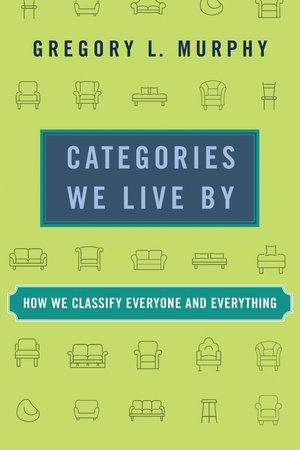
Murphy, Gregory L. Categories we live by: how we classify everyone and everything. Cambridge, MA: The MIT Press, 2024.

Let's start at the beginning -
'Nowadays we are suspicious of categories, especially categories of people. Gender, ethnic, racial, and class categories are seen as a source of discrimination and inequity. If we saw each person as a unique individual, perhaps we wouldn't have all the problems caused by racism, sexism, and all the other -isms that afflict society.
In spite of these problems, I will argue that we cannot get rid of categories in general. They simplify and distract us from individual identities, which can be bad, yet if we didn't have them, we would find it impossible to navigate the world and deal with its incredible diversity.' p.7.


Reading what follows also from the book's introduction, I thought about public sector funded (socialist)  healthcare and the private provision:

'So, my sweater and my hair might both be brown, so we can say that they are both in the category of brown things. They are equivalent in the sense that I call both of them "brown." However, the category of brown things is not very interesting. When you know that something is in that category, you know exactly one thing about it-its color. There's nothing else to be known. Maybe the brown thing is alive or maybe it's inanimate; maybe its microscopic or maybe it's as big as a planet; maybe it moos or maybe it sings oI maybe it is silent. The category doesn't tell you any of those things These single-criterion categories are kind of degenerate. Yes, items that share the criterion (brownness, being three inches long, taking at least half an hour, or whatever) are equivalent, but only in the one property that defines the category. Indeed, you can define trivial categories that only have one ridiculous feature in common, like things that you have touched in the last forty-nine seconds, or objects that are exactly fifteen miles from Cincinnati. Those are not categories that people form, because they are not useful.' p.11.
There is much ongoing debate about parts of the UK's NHS being 'sold-off' - taken-over by private companies with consequences for the quality of care, e.g. cataract services:

https://www.theguardian.com/society/article/2024/jul/10/eye-doctors-say-private-cataract-operations-have-hurt-the-nhs?CMP=share_btn_url

Having worked for the NHS - now NHS Professionals since 1977, the current problems faced by the service and experienced by some patients, carers, friends and family members is upsetting.

Murphy's observation contrasting the utility of categories at the individual and collective level is a great opener. Especially for the basic structure of Hodges' model and the vertical axis.

I've written previously(?) how I think that it is true, throughout my career even as a ward manager (there were some exceptions!) and community MH nurse, I/we have been cocooned from having to be concerned about the budget. When you stop and think about it, how do the 'things' in the category of economics impinge on the biomedical, biopsychosocial model? The ward was a mechanism; it kind-of run itself, which for change agents (those who use the word transformation a lot) is an ongoing issue. The two categories that matter - even as they are global - are illness and prevention. The NHS puts supertankers to shame, in its inability to pivot - turn.

At the end of the day (and night - 24/7/365!) though healthcare must be paid for.

Murphy's explanation about degenerate categories is fascinating too (and this is just the intro!). It sees me (in danger of making a category mistake) as I think about singletons, and 'degenerate' as applies in mathematics, and the debate of finance. The tension of seeing the individual as a unique being, in order to be person-centred, but the service, the system would place them in all in the category of 'payer'.

Viewed across the funding divide, is the other inevitably viewed as degenerate? On page 80 now. More to follow. I'm still kicking all this around; while the government kicks the 'can' of social care down the road.

Many thanks to MIT Press for the review copy.

Friday, December 16, 2016

Time, Space and the Individual (ego)

individual
|
INTERPERSONAL : SCIENCES
humanistic -------------------------------------------  mechanistic
SOCIOLOGY : POLITICAL
|
group-population


Images source:
How we think and speak

My source:
Gattis, M. (Ed.). (2001). Spatial Schemas and Abstract Thought, MIT Press: Cambridge. p.204.

Saturday, June 14, 2014

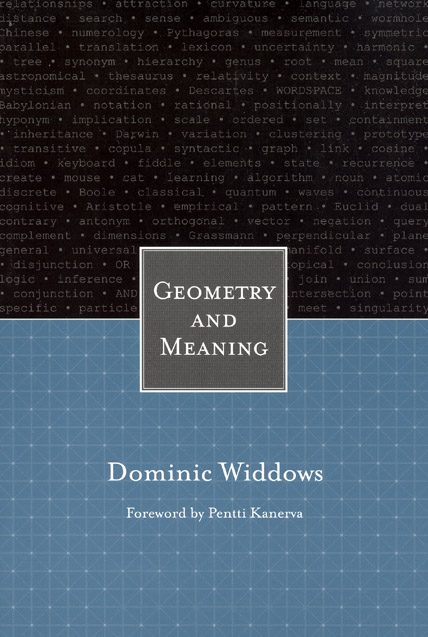
Books: The Geometry of Meaning, Gärdenfors & Geometry and Meaning, Widdows


http://www.mitpressjournals.org/doi/pdf/10.1162/coli.2006.32.1.155
There are two additions to my library. They are technical in parts and beyond my math and technical abilities, but as background this is essential reading.


Widdow's Geometry and Meaning includes details of the software used in the text. See the companion website below. While Gärdenfors' book The Geometry of Meaning is new, Widdow's text is a decade old and so demands some checking of software. I notice there are broken links on the companion site. The book, both in fact are great resources even as they increase the permanence of the geometry upon my furrowed brow...


Dominic Widdows, Geometry and Meaning - Companion website

Friday, November 01, 2013

A book chapter: Spatial semantics - definitions...

This book would appear to be an essential reference in respect of h2cm, the following is from chapter 13:

Spatial semantics is the study of the meaning of spatial language, but what is to be regarded as ‘spatial language’? A moment’s reflection suffices to show that the answer to this question is anything but trivial, since SPACE is not a self-contained ‘semantic field’, but rather constitutes an important part of the background for all conceptualization and meaning (Kant [1787] 1964). Furthermore, the term ‘space’ has been used all too often in an extended, metaphorical sense in Cognitive Linguistics and Cognitive Science, e.g., ‘Space Grammar’ (Langacker 1982), ‘Mental Spaces’ (Fauconnier 1985), ‘Conceptual Spaces’ (Gärdenfors 2000). Hence, an unrestricted interpretation of the term ‘space’ might lead us to think that ‘all semantics is spatial semantics’, a conclusion that not even cognitive linguists would find too attractive. Therefore, the scope of spatial semantics needs to be restricted, and this can and has been done in at least three different ways: by form class, by semantic category, and by communicative function. The three definitions based on these restrictions do not coincide, however, and each leaves something to be desired.

Jordan Zlatev (2007) Spatial Semantics, Chapter 13. In. Hubert Cuyckens and Dirk Geeraerts (eds.) Handbook in Cognitive Linguistics. Oxford, Oxford University Press.

Friday, June 29, 2012

Reflections [VII] Conceptual Spaces At Work: OntoSpaces - A Perspectivist Approach to CS

This session started fairly quietly but was one that rather shouted out in the end because of its possible relevance to Hodges' model. There was a clue having recognised one contributor from a reference already found:

Hautamäki, A. (1992). A Conceptual Space Approach To Semantic Networks, Computers and Mathematics with Applications. 23, 6-9, 517-525.

Kaipainen and Hautamäki began by asking what is the origin of quality dimensions? They proceeded to explain their use of perspectivism and the perspectival nature of cognition directing the audience to Giere (2006). The history of this is based on philosophy and the work of Nietzsche, Goodman and Putnam.

The work of Kaipainen and Hautamäki proposes the OntoSpace as a means to further extend Gärdenfors' work. An ontospace is an n-dimensional metadata space. In this space a perspective is an array of weights. The weights express the interest or attention towards each onto-dimension.


A transformation can be made from Ontospace A to lower dimensional space B. There are many technical points here to get to grips with. A figure was provided (I have gone over the yellow square 'Topical Domain' as it was indistinct; the green circle reads 'b Representational Space B').

This is an ecological and manageable means to conceptualization of a topical domain in ontospace A. Mention of ecological and manageable prompted me to clarify what this means, as I can see h2cm as being ecological and manageable. In the sense of breadth and depth of knowledge and possibly reducing the data context (as ever), patient, carer, nurse, learner....

The presentation included a software demonstration insofar as time allowed. The context was banking. The interface both applied dimensions and prioritised them. In the break I was able to explain Hodges' model to Mauri (Kaipainen), using a board in the upstairs dining room. By email Mauri subsequently noted that the home page of the old website actually reflects the model down to the placement of the menu links. (This is a struggle with Drupal and its themes, trying to come up with something that is original, represents the model and yet is not gimmicky the interface being obscure.) I approached Mauri and his colleague regards referencing their draft paper and they are happy for me to do so.

In health and social care of course we are very used to 'perspectives'. Especially seeking a caring perspective through empathy and rapport, putting on the shoes of the other and trying to appreciate the perspective they may or may not see. As I have said before I wonder at times if my passion for h2cm is an overvalued idea. I feel at times I am clutching at straws to find a theoretical underpinning for Hodges' model. At this conference there were no warts, and this presentation added more very useful ideas and in this case interdisciplinary bridges:
Solomon describes Nietzsche’s perspectivism so that it’s a view that “one always knows or perceives or thinks about something from a particular perspective - not just a spatial viewpoints, but a particular context of surrounding impressions. influences, and ideas, conceived of through one’s language and social upbringing and, ultimately, determined by virtual everything about oneself, one’s psychophysical make-up, and one’s history” (Solomon 1996, 195). Kaipainen and Hautamäki (to follow)
Ontospaces also seems to reflect the resulting dialogues found in health and social care and the need to constantly attend to and reconcile the same:
As Baghramian sees it, there can be more than one correct account of how things are in any given domain (2004, Chapter 10). Thus the issue is not which perspective is correct or true, but how to explore and mutually relate multiple perspectives.

Kaipainen, M., Hautamäki, A. Ontospaces: A Perspectivist Approach to Conceptual Spaces (to follow).

Giere, Ronald, N. (2006). Scientific Perspectivism. Chicago and London: The University of Chicago Press.

Images: Peter Jones (with thanks to the presenters)

Sunday, June 17, 2012

Reflections [VI] Conceptual Spaces At Work: Adams & Raubal - CSML

The final day of the CS@W conference started with a topic I was really anticipating as per a previous blog post. Ben Adams and Martin Raubal had indicated by email that CSML was a work in progress and a chat after their session emphasized the same. The existence of CSML and looking at some code examples holds great promise.

Direction in Lund, Sweden May 2012 by Peter Jones
The motivation for their work stems from geographical information systems [GIS] and how to formalise conceptual spaces. Palmer (1978) was cited as providing one form of representation. Palmer's mental model being matched with formal conceptual spaces. As per Gardenfors' book Minkowski's vector space is central to this work and informs a previous paper by Raubal (2004).

Way-finding provided an example: how there are different domains with semantic distances and weights that can change according to context. The facades of buildings and the contexts of day and night. What features stand out in terms of the shape, colour, visibility, area of buildings?

Adams and Raubal moved to differentiating topological relations that emphasise dynamic concepts. Piaget's contribution was noted in how we perceive conceptual change and the work of Torsten Hägerstrand whose time geography was illustrated (the geographical aspect of their work).

Behind CSML is a conceptual space algebra that is still being developed. On conceptual spaces and the semantic web, Adams and Raubal observed through their slides that:
Description logics are limited in ability to represent semantic content (RDF, OWL).
They fail to easily express
    Semantic similarity which plays an important role in cognitive categorization.
    Complex concept combinations.
Present Semantic Web technologies are restricted in their ability to answer queries and make inferences.
My BA(Philosophy and Computing Joint Hons.) project was on the application of semantic networks in nursing. The hard work was done for me in that it was directed by existing work in GRAIL. The dissertation I produced was essentially descriptive looking at nursing examples, identifying care issues and modelling them using is_a relationships. Among a great many slides and fascinating explanations Adams and Raubal note that:
Is-A, Instance-Of
Strong – based on topological relationships
Weak – based on similarity relationships
- so the advent of conceptual spaces, CSML and their efforts to engage with the existing semantic web community shows the ongoing dynamic of the semantic web's development. They are pursuing a reification of OWL 2 CS file to OWL 2:
Unique IRI for OWL classes, individuals, properties
Unique IRI for CS domains, concepts, and instances
There may be a future website to follow in addition to the CSML source. Questions followed about whole spaces, contrast classes and support vectors.

Reflecting back, my studies from 1996-97 and the examples produced - mobility... did not really even scratch the surface. Ben and Martin's work begs the question of trying to develop CSML examples that go beyond the surface(s) and enter the conceptual space (or spaces) that is Hodges' model.

Adams, B., Raubal, M. (2009). Conceptual Space Markup Language (CSML): Towards the Cognitive Semantic Web. ICSC '09 Proceedings of the 2009 IEEE International Conference on Semantic Computing IEEE Computer Society Washington, DC, USA.

Wednesday, June 13, 2012

What is the foundation of h2cm? Gabora & Aerts 2009

I've described h2cm as a foundation, a substrate for the health and social care assessments that follow. And that's the question: what is there before the conceptual framework is populated? As a foundation the model is initially empty, void, null. In terms of theory, practice, values and judgements there are none. The piece of paper is blank. So is the screen. Once (quickly) learned, the professionals have the conceptual framework in mind (ready to call upon), but it is not exercised. Until they encounter a patient, client, carer amid a situation, the conceptual space is empty.

Lund, Hobykrok B&B in the distance - the farm track
If we allow for the structure to permanently reside what then? Does this situation produce an array of potential? An array of potential concepts? Nurses are used to potential and actual problems (often re-framed as strengths). It seems this is the case with language, the amazing compositional scope of different words to produce sentences and meanings.

In a way I don't want to venture into this space. There are monsters there. I know the above is far removed from nursing. Where is  compassion, dignity, respect, plans and empathy in all this? ... Once the care concepts are realised then: yes - do lead the way. But before the light is turned on: no.

No: but there is no choice. The question needs to be asked and settled.

Liane Gabora gave a talk at Conceptual Spaces At Work. Checking back on her previous work I found this (SCOP: State COntext Property theory of concepts):
An important notion in SCOP is the ground state of a concept, denoted p. This is the ‘raw’ or ‘undisturbed’ state of a concept; the state it is in when it is not being evoked or thought about, not participating in the structuring of a conscious experience (such as, most likely, the concept ZEBRA when you began reading this paper). The ground state is the state of being not disturbed at all by the context. One never experiences a concept in its ground state; it is always evoked in some context. The notion of ground state is somewhat similar to the notion of prototype. The ground state is a theoretical construct; it cannot be observed directly but only indirectly through how the concept interacts with various contexts (which may include other concepts). p. 436.

Gabora, L., Aerts, D. (2009) A model of the emergence and evolution of integrated worldviews, Journal of Mathematical Psychology. 53, 434–451.

Thursday, June 07, 2012

Reflections [V] Conceptual Spaces At Work: Zwarts

As per previous CS@W posts Joost Zwarts' Constructing Conceptual Spaces for Lexical Semantics provided one of several examples at the conference of data analysis derived from large datasets. The abstract included:

The similarity structure of a conceptual space can be determined using lexical data or pile sorting, but it can also be based on some sort of analysis of the values involved. Using the work of Geeraerts et al. (1994) on Dutch clothing terminology, Zwarts (2010) demonstrates how a space of “shirts” can be constructed (either using graph or MDS techniques) along such lines, with fruitful results.  
This talk outlined the way features can be identified and decomposed. Key to this are classifiers which Zwarts listed as:
1 Psychological classifiers (piles)
 From similarity judgments or sorted piles
2 Lexical classifiers   (words)
 From common lexical descriptions
3 Analytical classifiers  (features)
The presentation provided a small example based on containers, which for me was very helpful as data is a real issue for my study of Hodges' model. There are datasets out there - nursing, classification systems - and secondary data sources to consider. As mentioned above Zwarts took a dataset comprised of 38,000 possible items from the clothing domain and used 244 from the sub-domain of shirts. [Geeraerts, Grondelaers, Bakema (1994). The Structure of Lexical Variation. Berlin: Mouton de Gruyter. ]

I am probably simplifying things but discussion of Hamming distance recalled for me old Byte articles on bit-classifiers. Whether a sign of progress (maturation) or my focus, but in the 1980s there were many articles on data structures and algorithms, for some reason quad trees proved quite an attraction. There was an approach to clinical classification by Johnson (1987) that adopted a ZIP code format. As Zwarts related his presentation I wondered where a primary care problem might reside in Hodges' model: (1000, 0100, 0010, 0001)? Alternately where is the emerging problem that is nudging this individual towards possible relapse?

Graphviz was used and multidimensional scaling. The talk became more technical, understanding aided by graphical examples as classical categories were introduced: A category C is classical iff it can be defined by a particular set of feature values. The conclusion brought together the technical aspects of the data examined: convexity is too strong, connectedness somewhat too weak, but that there is a clear notion of coherence. There was much here to learn from.

Johnson, B. (1987) Health Code, The Guardian, 23 July, 16 (see also (1990) Journal of Health Care Computing).

The following page is out of date but cites Johnson:
http://www.p-jones.demon.co.uk/infselct.htm [no longer available]

(I don't want to upset searches on Google for 'conceptual spaces', so I've two more further posts this month on the conference concerning CSML and OntoSpaces.)

Here is the view from my B&B I enjoyed some lovely walks into Lund, plus using the bus. With a map that stayed in my laptop bag, I enjoyed getting lost on two occasions.

The view from Hobykrok B&B

Saturday, June 02, 2012

Reflections [IV] Conceptual Spaces At Work: Parthemore, Unified Conceptual Space

In my notes on Hodges' model, nursing theory and conceptual spaces I've referred to Rosch, Gärdenfors and there is much of note in my copy of The Big Book of Concepts. There are gaps to fill, key sources to find and digest including the history of concepts. In Empirical Investigations in Conceptual Spaces Theory and the Unified Conceptual Space Joel Parthemore really helped this effort. His presentation began with: What is a concept? Which (for me) begs the question: What is a concept within Hodges' model? Is it a single entity?

Joel's slides included the following:
In the Beginning Was...
  • Classical definitionism: concepts are like entries in a dictionary.
  • Classical imagism: concepts are like pictures in the mind.
And then came their descendants:
  • Prototype and exemplar theories (Rosch)
  • Informational atomism (Fodor)
  • Proxytypes theory (Prinz)
  • Conceptual spaces theory (Gärdenfors)
Listening to Joel introduce his work on unified conceptual spaces I can relate several points to Hodges' model especially the following.
  • Attempt to describe how all of an individual conceptual agent’s conceptual spaces map or weave together into a single unified space, a “space of spaces” describable along certain common axes.
  • By extension, how all of the individual conceptual agents’ unified spaces map together, in linguistic human society, into a single, common unified space.
  • Unlike CST, UCST is explicitly enactive: concepts are located not in the agent nor in the environment but in the interaction of agent and environment.
A couple of speakers brought up the question of a 'space of spaces'. Centeredness also preoccupies us in health and education. We are desperate to pick up the patient and the student and put them at the center of things. I keep wondering (see link below) about the extent to which structure and a theory of cognition are interdependent in terms of the resulting conceptual spaces? Since the late 1980s Buzan's mind-mapping has struck me as not being 'grounded'. This may not be an issue in many applications, but for a generic conceptual framework some underlying structure (dimensions) seems essential.

Joel also considered this:
  • One major shortcoming of currently available mind-mapping software is the lack of any well-defined theory of cognition (let alone theory of concepts) underlying the application.
I hope I can make contact with Joel and return to this. He indicated papers and further projects with colleagues and a piece of software.

Additional link (Hodges' model - nexus, structure):

http://hodges-model.blogspot.co.uk/search?q=nexus

Wednesday, May 30, 2012

Reflections [III] Conceptual Spaces At Work: Lund University, Sweden, May 2012

The next session - Event Structure, Conceptual Spaces and the Semantics of Verbs Peter Gärdenfors, Massimo Warglien & Matthijs Westera, was presented by Peter Gärdenfors whose book Conceptual Spaces (2000) I bought in Sedbergh in 2008 (talk about serendipity!).

Just reading the title back then was enough...

There was a starter question: Why are there word classes (nouns, verbs, adverbs...)?

It became evident that first morning that conceptual space as a representational form is very much still in active development. The abstract begins:

The aim of this paper is to integrate spatial cognition with lexical semantics. We develop cognitive models of actions and events based on conceptual spaces and vectors on them. The models are then used to present a semantic theory of verbs. ...
Word classes were related (as in the book) to conceptual space elements, e.g.

nouns - categories
adjectives - properties

In addressing verbs this paper seeks a two-vector model of an event.

Agent (Force) -> Patient (Result)   - result verbs describe the change in the object.

The Professor said that cognitive and linguistic aspects are often confused. Two theses were also provided - thesis 2: single domain constraint.

In addition talk of several spaces might be troubling (adding complexity), but to me the prospects of action space, category space and physical space makes the potential for modelling more explicit and accessible to Hodges' model.

I scribbled down 'agent not always necessary (fall, growth?...)' and pondered about self-care, relatives acting as a proxy.

There was a lot of detail on language, linguistics: static verbs, intentional verbs -> physical action; telic verbs. ... Rather than feel (completely!) confused by this specialist talk, I felt enthused for what is to follow.

Reflections [II] Conceptual Spaces At Work: Lund University, Sweden, May 2012

[See also Reflections I CSaW2012]

Among many things Dessalles - From Conceptual Spaces to Predicates - told us that meaning is essentially two-fold: analogue and symbolic.

An evocative summary was provided:

(Topo)logical thinking = Conceptual spaces + Contrast

Concepts do not exist as permanent structures.
Predicates are ephemeral.
Questions included: Is there a contrast logic?

You can find Dessalles online and there is a specific book Why We Talk (2007) (some of the chapters look particularly interesting - information).

Also to investigate are there being no locality principle and the danger of holism, and a point about structural matching as part of problems with traditional approaches to meaning that involve interfaces and relationship structures (pardon the ramble - the paper has not appeared yet).

Geuder's Manner Modification and the Representation of Event Concepts found me tweeting - see below. A biomotion demo was tied to the theme emphasizing perceptual cues, manner and meaning.

Off at a tangent the title had me musing on the importance of 'manner modification' in nursing. Sometimes fleetness of attitudinal, objective and emotional foot is needed to deal with a care situation. Tangent aside, there are clearly some serious considerations around health care processes, these are the bread and butter of healthcare records and information systems.

I've just copied my tweets (clinical examples arose in several sessions):

Gardenfors & Warglien ref new paper?* subspaces corres to a division into domains - event concepts

Manner modification eg. "slowly". (Manner central in health nursing) +mention of forgetting + absentmindedness denotes? PTSD?

A representation of a stage structure is needed - further e.g. "carefully" He cleaned the wound... filled by context (as ever)
Geuder still, now on emotional state predicates - "sadly" Three possible ways to proceed - close now

* The following may be the new paper:
Peter Gärdenfors and Massimo Warglien Using Conceptual Spaces to Model Actions and Events. J of Semantics first published online April 17, 2012 doi:10.1093/jos/ffs007


Tuesday, May 01, 2012

Conceptual Space Markup Language (CSML): Towards the Cognitive Semantic Web

I'll start May hopefully in tune with plans towards the month's end and attending Conceptual Spaces at Work.

The SCIENCES domain page has included Markup Languages (ML) for a great many years.

In the early versions of the h2cm website there were just two 'resource' pages. When the ongoing four page format arrived then markup languages had a place.


Looking at the programme for next month's Conceptual Spaces at Work the first session listed includes this reference:
Adams, B., Raubal, M. (2009). Conceptual Space Markup Language (CSML): Towards the Cognitive Semantic Web. ICSC '09 Proceedings of the 2009 IEEE International Conference on Semantic Computing IEEE Computer Society Washington, DC, USA.
Abstract—CSML is a semantic markup language created for the publishing and sharing of conceptual spaces, which are geometric structures that represent semantics at the conceptual level. CSML can be used to describe semantics that are not captured well by the ontology languages commonly used in the Semantic Web. Measurement of the semantic similarity of concepts as well as the combination of concepts without shared properties are common human cognitive tasks. However, these operations present sources of difficulty for tools reliant upon set-theoretic and syllogistic reasoning on symbolic ontologies. In contrast, these operations can be modeled naturally using conceptual spaces. This paper describes the design decisions behind CSML, introduces the key component elements of a CSML document, and presents examples of its usage.
This is an excellent source. CSML is a really significant development for me as Adams and Raubal highlight on the first page:
The computational foundation of the Semantic Web is the formal representation of concepts and their relationships using the Resource Description Framework (RDF) and the Web Ontology Language (OWL) variants [5], [6]. These families of languages allow one to describe semantic relationships between concepts and ontologies, which can be queried using a first-order logic reasoner. An underlying assumption to these methods is the realist approach to semantics, which states that the meanings of concepts are in the real world. That is, there is a direct mapping between language terms and the world but there is no consideration of how individuals understand concepts differently. In contrast, cognitive semantics states that the meanings of terms are cognitive structures in people’s minds. This approach is of central importance for the Semantic Web, because web services interface with human users.

This isn't excellent or significant in the sense that the emergence of CSML demonstrates h2cm as a conceptual space.

Far from it.

Here and for h2cm CSML is obviously an essential tool to examine, understand and possibly extend. Anyone for PHP and XML (Drupal)? Reading the paper, it's clear that even thinking of applying CSML to Hodges' model demands answers to difficult and yet fascinating questions that involve nursing (theory, practice and values), informatics, philosophy and some maths too.

Image source:
http://www.lucs.lu.se/wp-content/uploads/2012/01/conceptual_spaces_wordl.png

Sunday, April 08, 2012

h2cm in the presence of -alities

INTERPERSONAL : SCIENCES
SOCIOLOGY : POLITICAL

morality     personality
mentality   individuality   spirituality
intentionality   transcendentality  rationality
dimensionality   causality  functionality
logicality   locality   physicality
artificiality  materiality  finicality
hospitality   geniality   quality
informality     sociability      conjugality
practicality  plurality
nationality    feudality  principality 
equality  formality  confidentiality
brutality  officiality   criminality


Child to adult:
"Yes, but where does reality, aboriginality, universality, proportionality, abnormality, mortality go?"
:Adult to child

Monday, March 19, 2012

How solid is the framework? Paper: Perceptual ratings of opposite spatial properties...

In researching conceptual spaces and h2cm I came across the following paper:

Bianchi, I. , Savardi, U., Burro, R. (2011). Perceptual ratings of opposite spatial properties: Do they lie on the same dimension? Acta Psychologica, 138, 3, 405-418.

As constructed h2cm makes several assumptions with its axial structure. Is the placement of humanistic – mechanistic and individual – group on continua truly representative of the opposites of continua?

It seems that to address this question we must investigate cognitive linguistics. Bianchi et al., raise the following for consideration:

The idea that two contrary properties lie on the same continuum has formed the basis of various methodologies used in experimental research in the field of Psychology since the late sixties (e.g. the differential semantic method, Likert scales, etc.); however, an increasing number of methodologists are facing problems connected to the assumption of unidimensionality in opposite scales ... (p.405).
I wonder to what extent the original purposes of h2cm can support the existing continua? Nursing and the scope of nursing should also be able to substantiate the model. Nursing is person-centred. 
The idea that opposites presuppose an underlying continuum has been a default assumption in linguistics and cognitive semantics for more than two decades even though it has been noted that in every-day language people describe their perceptions in terms of opposites (“you are driving fast”, “the walk is long”, “the room is small”, “it's hot today”) instead of using unidimensional scales (respectively, velocity, size and temperature) (p.406).
Related post:
http://hodges-model.blogspot.co.uk/2009/08/combining-h2cm-informing-science-and.html

Wednesday, June 25, 2008

Gardenfors' book - a quote and can that be, surely not ...h2cm?

The title of Peter Gardenfors' book Conceptual Spaces is enough to switch the four lights on in this house. In chapter 1 the conclusion includes -

So what kind of theory is the theory of conceptual spaces? Is it an empirical, normative, computational, psychological, neuroscientific, or linguistic theory? The answer is that the theory of conceptual spaces is used in two ways in this book. On a general level, it is a framework for cognitive representations. .... On a more specific level, the framework of conceptual spaces can then be turned into empirically testable theories or constructive models by filling in specific dimensions with certain geometrical structures, specific measurement, specific connections to other empirical phenomena, and so forth. p.30.
Chapter 5: Semantics gives us figure 5.9 (p.173):

Spatial relations between some abstract lexemes

EXISTENCE LOCATION POSSESSION OWNERSHIP

Here below is h2cm. I'll leave the explanatory connections to you:

intrapersonal sciences sociology politics

Since 1986 or thereabouts I've been teased by quadtrees, Voronoi tesselations, facet analytic theory, clustering methods et al. and set to believe there's something here that we can use....

On the website I started to explore some of the assumptions that underpin the structure and (what might contribute to) a theory of Hodges' model. The next 'paper' will assume that the reader is familiar with Hodges' model. The focus will be h2cm as a candidate conceptual space with Gardenfors' text as a key and initial source.

The domains, distances, dimensions, data# it's all there: bar the door....

Many thanks everyone for passing this way - we are now at 10,000+ visitors
#P.S. I'm actually not sure about the data - that is a real challenge.

Gärdenfors, P. (2000). Conceptual Spaces, Cambridge: CUP.

Tuesday, June 17, 2008

That other 2nd-hand book - 'Conceptual Spaces'

Conceptual Spaces, Gardenfors, Book coverIn February I posted about a day in Sedbergh the book town with marvellous weather for the time of year.

In addition to the The Big Book of Concepts book, I bought a copy of Peter Gärdenfors' Conceptual Spaces. Oh, to be able to take a measured and systematic approach to this....!

I'm only just up to chapter 3 and it's a fascinating book. The ideas make this a key reference for anyone studying Hodges' model (and much more besides).

The preface sums up much about some of the problems researching* Hodges' model:

"... I will satisfy no one. Philosophers will complain that my arguments are weak; psychologists will point to a wealth of evidence about concept formation that I have not accounted for; linguists will indict me for glossing over the intricacies of language in my analysis of semantics; and computer scientists will ridicule me for not developing algorithms for the various processes that I describe."
The subtitle - The Geometry of Thought - says it all. There are so many key concepts here. I'm looking forward to chasing the references cited and other works. I don't vandalise books usually, but hey it's summer almost and the highlighter is doing its thing. The questions run thick and fast....
  • Is Hodges' model one conceptual space or four...?
  • What quality dimensions can I identify?
  • What quality dimensions could a h2cm community identify?
  • What existing multidimensional scaling work exists in health and social care?
  • ....?
More to follow...

*or at least trying to research...

Wednesday, February 20, 2008

The Big Book of Concepts

One of the other second-hand books purchased on Monday is:

The Big Book of Concepts
by Gregory L. Murphy
The MIT Press, 2002; ISBN: 0262134098


I have found one review (or is that two?) that should explain my interest in the book.