Hodges' Model: Welcome to the QUAD: tracking

Hodges' model is a conceptual framework to support reflection and critical thinking. Situated, the model can help integrate all disciplines (academic and professional). Amid news items, are posts that illustrate the scope and application of the model. A bibliography and A4 template are provided in the sidebar. Welcome to the QUAD ...

Showing posts with label tracking. Show all posts

Monday, February 23, 2026

Millikan's Unicepts and Unitrackers

An underpinning theory of Hodges' model must help us make sense of what is happening within the care domains, between the domains, and possibly say something about what may be significant relation[s]-ships that are diametric. Arriving at threshold concepts I wondered in Hodges' model about there being compound threshold concepts. Consider, when 2-3 thresholds are (b)reached in one (the sciences) domain? Contrast this then, with 4-5 thresholds across care domains? There may also be care concepts applicable that are for example, person-centred: that is, patient, carer, 'management', or policy defined? These concepts while not threshold related per se, are nonetheless relevant.

I came across the work of Ruth G Millikan in London, several years ago as I followed 'epistemology' around the shop. It is time to pick this up and earlier work:

Millikan, Ruth Garrett. “Biosemantics.” The Journal of Philosophy 86, no. 6 (1989): 281–97. https://doi.org/10.2307/2027123

https://www.researchgate.net/publication/235734046_Biosemantics 
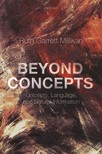
INTRODUCTION TO PART I

0.4 Unicepts and Unitrackers

'Neither the clusters in the world nor their properties are found at the sensory surfaces. The properties characterize distal objects and events. They are manifested in diverse and irregular ways through signs impinging on the sensory surfaces, energy patterns that are contingent on shifting intervening circumstances.' ...

'A unitracker is a mechanism or faculty for same-tracking something, for recognizing when incoming information concerns it, then linking and storing this information together as information about one and the same thing. Only then can it can be brought to bear together on inference and action. The link connecting stored information about the same thing together is a "unicept." The information is recognized, paradigmatically,by the initiation or strengthening of an intentional attitude of credence, which we tentatively model as a temporary or enduring connection between the unicept and unicepts for other things.'

'Both unicepts and unitrackers are particulars. You and I do not have any of the same unicepts or unitrackers. What we have in common is unicepts and unitrackers for many of the same things.' ...

'Unitrackers are same-trackers used for collecting knowledge about their targets.' pp.7-8.

Millikan, Ruth Garrett, Beyond Concepts: Unicepts, Language, and Natural Information (Oxford, 2017; online edn, Oxford Academic, 19 Oct. 2017), https://doi.org/10.1093/oso/9780198717195.001.0001, accessed 16 Feb. 2026.

Sunday, August 14, 2022

Shining a light on Dark Patterns

 INDIVIDUAL
|
 INTERPERSONAL    :     SCIENCES               
HUMANISTIC --------------------------------------  MECHANISTIC      
SOCIOLOGY  :   POLITICAL 
|
GROUP

PERSONAL DATA^


PERSONAL
DATA


DATA, DESIGN
BIOMETRICS^


PERSONAL
DATA


 DARK 
 PATTERNS 


PERSONAL DATA*


CONTROL
TECH GIANTS
TRANSPARENCY
LAW
CONSUMER PROTECTION
...


*And the data of family members.
^Data that is specific to an individual, organic, can include fingerprint, facial images, DNA, behaviours (including keyboard use, online).


Prompt: Mention of 'dark patterns' on BBC World Service promoting their tech coverage.

Previously: 'interface(s)'

Friday, August 09, 2019

Targeting poverty (in Hodges' model) c/o The Economist

"Indian politicians are promising more cash for the poor. They should be less selective. "

[ by the quarter - make progress ...? ]


individual - self
|
INTERPERSONAL : SCIENCES
humanistic ----------------------------------------------- mechanistic
SOCIOLOGY : POLITICAL
|
group- population

"Targeting welfare is costly and difficult in a country like India.


If it looks for signs such as straw roofs, it will almost certainly miss many poor people, especially in the cities.


How is the state supposed to identify the poorest 50m households in a country where income and spending are so hard to track?


The political economy of targeted schemes is also tricky. In countries with minimal welfare states, schemes with few beneficiaries also have few supporters, and therefore risk being quietly wound down or diminished by inflation. And any formula used to target the bottom 20% is likely to be so opaque that people will never know whether they should have been included or not, so cannot fight for their entitlements."


"Two years ago a government report suggested a bold new approach. Instead of a universal basic income - an idea doing the rounds in rich countries - create a nearly universal scheme from which you exclude the richest quarter of the population."


Source: Leaders. Welfare in India: The beauty of breadth. The Economist, April 6, 2019, p.14.
Print edition.
https://www.economist.com/leaders/2019/04/06/a-better-anti-poverty-plan-for-india