Hodges' Model: Welcome to the QUAD: representation

Hodges' model is a conceptual framework to support reflection and critical thinking. Situated, the model can help integrate all disciplines (academic and professional). Amid news items, are posts that illustrate the scope and application of the model. A bibliography and A4 template are provided in the sidebar. Welcome to the QUAD ...

Showing posts with label representation. Show all posts

Saturday, September 05, 2026

UN votes to adopt new world map to reflect Africa's true size | BBC News

UN tells the world: Stop making Africa look small

'By 164 votes to one, Member States on Friday endorsed a resolution promoting map projections that more accurately reflect the true size of continents – the culmination of an African-led campaign against the 16th-century Mercator projection, still the most widely used map in the world. 

The United States cast the sole vote against, dismissing the initiative as part of a “radical ideological project.” 

Six countries – Estonia, Georgia, Lithuania, Moldova, Serbia and Ukraine – abstained. 

The resolution does not ban the Mercator projection or impose a replacement. Instead, it encourages governments, schools, international organizations and technology companies to use the Equal Earth projection and other so-called equal-area maps when relative size matters, and to teach the limitations of any flat map in representing a spherical planet.'

Continued ... UN


Previously: 'cartography'

Wednesday, April 01, 2026

Information Design and Sense-Making c/o Dervin

'Information Design: Something New, Something Old

... I want in this chapter to challenge the central idea that information design is a new idea. Reducing the issues briefly to a polarity, it is useful to start by considering two ways to conceptualize information. One way, implicit in the above assumptions, is that information is something that describes an ordered reality and has some knowable, or at least idealized, isomorphic relationship to that reality (i.e., it represents in an identical way the form and content of reality). In short, information instructs us, this assumption says, about the nature of the world we live in: its history, its future, its functioning, our place in it, our possible
actions, and the potential consequences of those actions.' p.35.

[My emphasis.]

Brenda Dervin. Chaos, Order, and Sense-Making: A Proposed Theory for Information Design (chapter 3) In R. Jacobson (Ed.), Information Design (pp. 35-57). Cambridge, MA: The MIT Press

Previously: Information design: Tufte & Raskin 

Friday, July 04, 2025

Diagrams - AMO/OMA at Prada Foundation Venice

"There is no such thing as an innocent map, observes Philippe Rekacewicz in his catalogue essay that accompanies Diagrams, a new exhibition at the Prada Foundation in Venice.

A renowned cartographer, the Paris-born Rekacewicz is well aware of his medium's capacity to transform narratives for good and ill. His own work includes maps that illustrate the deaths of migrants as they bid for new lives in Europe. "A map," Rekacewicz continues, "is above all a social and political act - and therefore inherently subjective."' p.5.

Individual
|
      INTERPERSONAL    :     SCIENCES               
HUMANISTIC  --------------------------------------  MECHANISTIC      
 SOCIOLOGY  :    POLITICAL 
|
Group
Am I Free?

My history ...
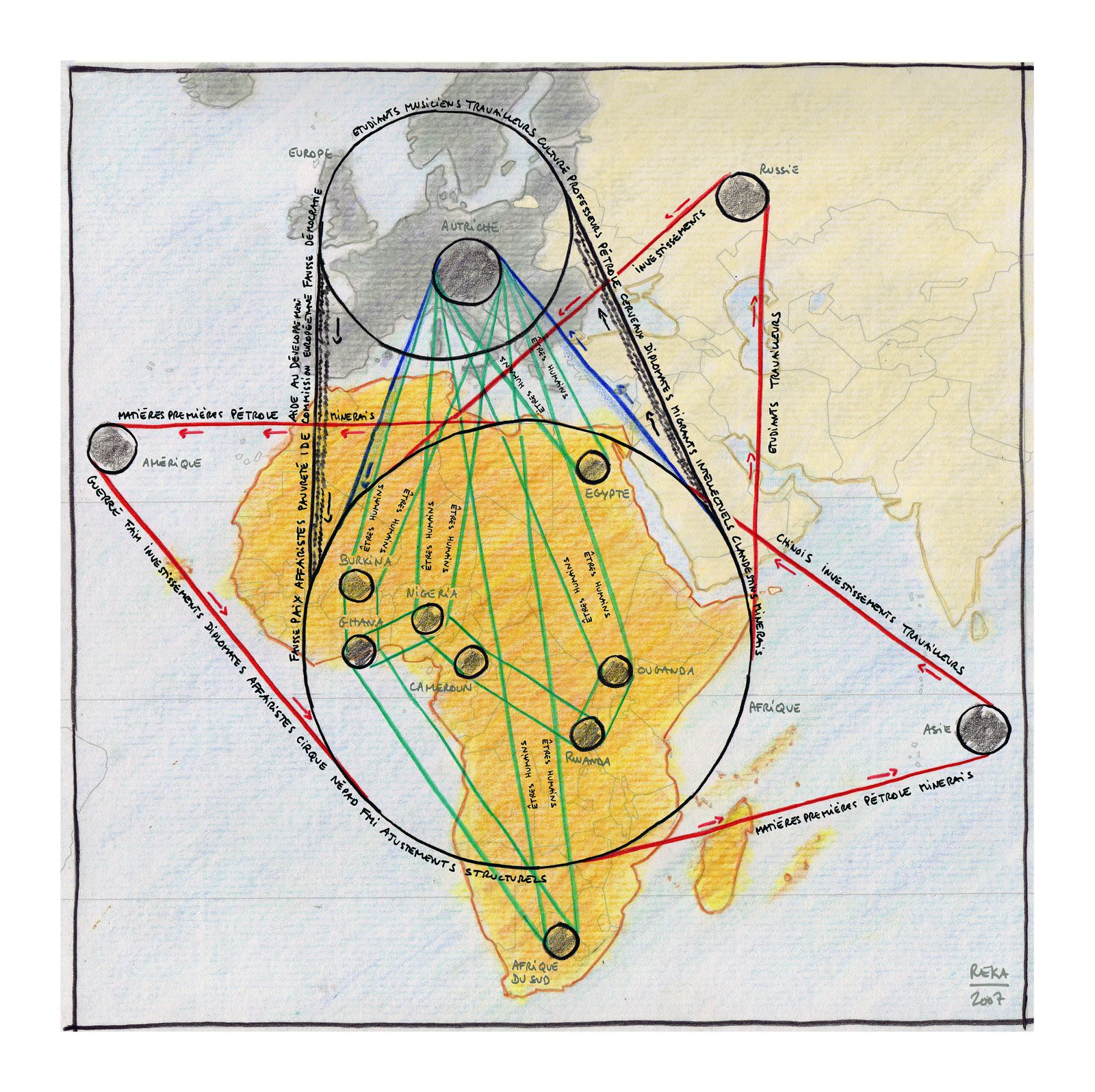
Philippe Rekacewicz / The African big wheel, 2007
The wheel symbolizes permanence and continuity in the context of a profoundly unequal exchange, drawing, color pencil and ink, exhibition copy.
Courtesy Philippe Rekacewicz
(Image credit: Philippe Rekacewicz)

SOCIETY

... is our history ...

Freedom

National & International Law

Justice


'Other pictures are equally revealing for what they conceal. Consider the diagram entitled "Universal commercial history", a visual analysis drawn up by the Scottish engineer William Playfair in 1805 which traces the rise and fall of global wealth since 1500 BC against what he terms "Remarkable Events Relative to Commerce". Playfair, who is said to have invented the pie chart, includes moments such as "Rome founded" "Mahomet's Flight" and "America discovered". He never mentions slavery.

With such a broad-brush approach, lacunae are inevitable. It is a shame that the work of Viennese social scientist Otto Neurath - who, along with his wife Marie and colleague Gerd Arntz, invented the Isotype (International System of Typographic Picture Education) - is not on show. Based on pictograms, Neurath's Isotypes are an lmportant forerunner to the digital vernacular (from emojis to icons) so familiar to us today. Nor does the exhibition include maps of the devastation of Gaza since October 2023, such as those made by investigative research agency Forensic Architecture, which are proving among the most critical diagrams of our time.' p.5.

Philippe Rekacewicz - https://www.grida.no/resources/10988

My source:
Rachel Spence. Hidden truths in the best laid plans. Diagrams | What charts, maps and graphics can - and can't - tell us. Collecting, FTWeekend. 26-27 April 2025. p.5. 
With many thanks acknowledging length of quotation.

Image source:
https://www.wallpaper.com/architecture/oma-amo-diagrams-prada-foundation-venice

See also: 'icon' : 'symbols' : 'diagram' : 'map' : 'Forensic Architecture'

Archived listing Links II Sciences - inc. 'Diagrams' & 'Visualization I' and 'II': 

Wednesday, October 02, 2024

It's not that I want a copy ...

... I just want to know what it means to you?

individual
|
INTERPERSONAL : SCIENCES
humanistic ------------------------------- mechanistic
SOCIOLOGY : POLITICAL
|
group
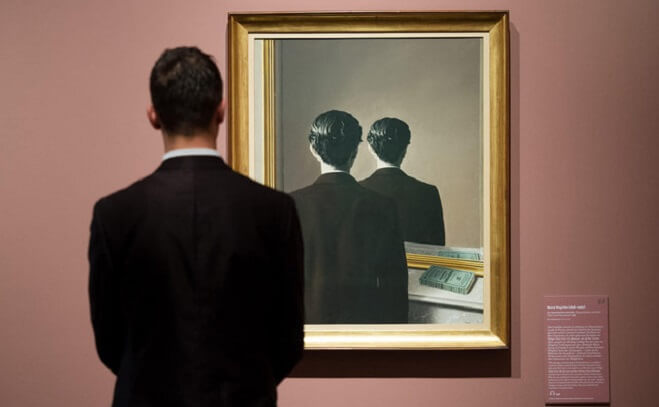
Not to Be Reproduced, 1937 by Rene Magritte


Image: https://www.renemagritte.org/not-to-be-reproduced.jsp

Saturday, September 28, 2024

'It takes a village ...

individual
|
INTERPERSONAL : SCIENCES
humanistic ------------------------------- mechanistic
SOCIOLOGY : POLITICAL
|
group

... to raise a child.'

"The artist returned to this subject almost  twenty years after he had drawn his red chalk  studies of children walking and standing,  shown nearby. As was typical in Rembrandt's  later works, facial expressions and gestures  are indicated with sparse and abbreviated  lines. It is remarkable that with such economy  the artist conveys an encouraging atmosphere  from the figures who surround the child, as it  takes its first steps. The British artist David  Hockney described this as 'a perfect drawing' in an interview in 2016."

1912,0416.2'


Rembrandt van Rijn (1606-1669)
A child being taught to walk, around 1656
 
Pen and brown ink on grey-brown paper.


The British Museum, Room 90. 28th September 2024.
https://www.britishmuseum.org/exhibitions/new-life-rembrandt-and-children


Saturday, July 20, 2024

Frayn - on maths

"Pure arithmetic is not about particular things but about particular relations between things. Algebra preserves an even loftier detachment from the world. It is not about relations between things - it about relations between relations. Numbers are variables that can be quantified in the physical world. Algebraic terms are variables that can be quantified in the world of numbers." pp.154-155.


Frayn, Michael (2006). The human touch: our part in the creation of a universe. 'Fingerhold', Chapter 5. London: Faber & Faber. pp.139-170.

individual
|
INTERPERSONAL : SCIENCES
humanistic ------------------------------- mechanistic
SOCIOLOGY : POLITICAL
|
group

human


TOUCH


... human human  human  human human ...


Don't you dare!
Yes, please do!


Wednesday, May 15, 2024

Yves Klein 'Anthropométrie sans titre'

Individual
|
      INTERPERSONAL    :     SCIENCES               
HUMANISTIC  --------------------------------------  MECHANISTIC      
 SOCIOLOGY  :    POLITICAL 
|
Group


Anthropométrie sans titre (ANT 43),
c1960 © Courtesy of Lévy Gorvy Dayan


My source: Rotraut to Baya Simons. My husband, Yves Klein, FT Weekend, HTSI, 11 May 2024. pp.23-24.

Yves Klein and the Tangible World is at Lévy Gorvy Dayan until 25 May, levygorvydayan.com

Wednesday, August 23, 2023

"Coal Fired Computers" c/o MUTE


"Graham Harwood and Matsuko Yokokoji (YoHa) build
contraptions that expose and collapse down the productive
chains linking telecommunications media to some of the
raw materials that constitute them.
In this interview with 
ANTONY ILES, however,
Harwood rejects theoretical discourses
of resistance in favour of a more direct and technical
method of 'action research' which skirts art and politics." p.159.


INDIVIDUAL
|
     INTERPERSONAL    :     SCIENCES               
HUMANISTIC --------------------------------------  MECHANISTIC      
SOCIOLOGY  :   POLITICAL 
|
GROUP


Poster image for YoHa's Coal Fired Computers exhibition, AV Festival, Newcastle 2010

"AI: Though these projects do not work solely within a logic of 'representation' they do, almost as a side effect, produce awful images. I am thinking in particular of the film still from Aluminium and the blackened lung hooked up to a coal fired computer. If the 'contraptions' you make can be thought of as diagrams of socio-technical relations, what are the qualities of the images they produce? To what extent are these images necessary by-products of the processes.

GH: We can see the images arising out of the forces that threaten to break the machine, or assemblages arising out of its in-betweenness. Its unfinished nature always requires the imagination of the participant/viewer to finish the job, fill in the details. This is a powerful strategy." p.164.


Source: Iles, A. (2011) Double Negative Feedback. In the mud and blood of networks: an interview with Graham Harwood, MUTE. Spring/Summer, Vol. 3, #1, pp.158-171. 

Image: http://yoha.co.uk/cfc

https://www.metamute.org/editorial/magazine/mute-vol.-3-no.-1-double-negative-feedback

Note 'Anti-disciplinary' in this issue too:
https://www.metamute.org/editorial/articles/anti-disciplinary-feedback-and-will-to-effect

Will investigate anti-disciplinary, as this appears to strike a discordant note in nursing in Hodges' model promulgating genericism. A quick check was encouraging leading to MIT Lab, but then disappointing in terms of personnel and resignations - but a lead for the future (inter- multi- transdisciplinary and Hodges' model).

(Yes, second post from this issue of MUTE, a random yet informative purchase. It cost £12.00. Still clearing, boxing, moving ...).

Friday, April 28, 2023

Cognitive apprenticeship . . .


INDIVIDUAL
|

 INTERPERSONAL    :     SCIENCES               
HUMANISTIC --------------------------------------  MECHANISTIC      
SOCIOLOGY  :   POLITICAL 
|
GROUP

"The learner builds an internal representation of knowledge or personal interpretation of experience. This representation is open to change as its structure and interconnections form the foundation upon which other knowledge structures can be scaffolded. Successive modes of representation are developed as a person's expertise increases, and the building block for this development is the accumulation of individual cases (Boshuizen, 2013).  . . . The constructivist theory of learning does not accept the premise that different types of learning can be identified independent of the context and content of learning. . . . Cognitive apprenticeship, which reflects the collaboration between real-world problem solving and using appropriate strategies in problem-solving situations, is the key to construvist learn (Brown, Collins and Duguid, 1989; Resnick, 1987)." p.96.

'Cumulative experience'

TI:ME

"Conceptual growth comes from sharing multiple perspectives and simultaneously changing our internal representations in response to those perspectives as well as through cumulative experience." p.96.

Practice hours requirement


Zwozdiak-Myers, Paula. (2012). The Teacher's Reflective Practice Handbook: Becoming an Extended Professional through Capturing Evidence-Informed Practice. Abingdon, Oxon: Routledge. 

https://www.routledge.com/The-Teachers-Reflective-Practice-Handbook-Becoming-an-Extended-Professional/Zwozdiak-Myers/p/book/9780415597586

Wednesday, November 23, 2022

Communication - "See what I mean?"

"Lasswell (1948) claimed that an act of communication was adequately explained only when every aspect of his famous question had been answered:

who - says what - in which channel - to whom - with what effect?"

Lasswell, H.D. (1948) The Structure and Function of Communication in Society. In Bryson, (ed.), The Communication of Ideas, Harper & Brs.


 INDIVIDUAL
|

INTERPERSONAL
   :     SCIENCES             

HUMANISTIC --------------------------------------  MECHANISTIC     

SOCIOLOGY
  :   POLITICAL
|
GROUP


who

says what
in which channel

to whom

with what effect?


My source: 

Morgan, John. & Welton, Peter.  (1992).  See what I mean? An introduction to visual communication. London :  Edward Arnold. pp.2-3.  http://www.loc.gov/catdir/enhancements/fy0638/92229403-t.html


See also - the concept of information remains an interest here:

Jones, P. (1996) Humans, Information, and Science, Journal of Advanced Nursing, 24(3),591-598.

Jones, P. (1996) An overarching theory of health communication? Health Informatics Journal,2,1,28-34.

Thursday, August 25, 2022

Agile Visualization with Pharo: Normalizers

 INDIVIDUAL
|
 INTERPERSONAL    :     SCIENCES               
HUMANISTIC --------------------------------------  MECHANISTIC      
SOCIOLOGY  :   POLITICAL 
|
GROUP

shapes?


normalization
SHAPES


shapes?
normalization

shapes?


Agile Visualization
with Pharo

"Normalizers: Shapes may be shaped and colored in a meaningful way to represent attributes and properties of the objects represented by the shapes." p.49.


Bergel, A. (2022). Overview of Roassal. In: Agile Visualization with Pharo. Apress, Berkeley, CA. https://doi.org/10.1007/978-1-4842-7161-2_5

Monday, May 09, 2022

Global opportunity for midwives & nurse-midwives to contribute to 'Midwives in Focus' research

Dear Colleagues,

In partnership with Coventry University and Jhpiego (with support from the Nursing Now Challenge) we are hosting the 'Midwives in Focus' programme.

We need to recruit 1000's of midwives and nurse-midwives from around the world to participate in our global survey exploring professional identity, midwifery leadership and the representation of midwives around the world.

Survey link here - please complete and share

Survey Link: https://bit.ly/3uERMmZ

Please complete this and share with colleagues.

Thank you

Dr Sally Pezaro 

My source: GANM (Global Alliance for Nursing and Midwifery).


Friday, April 29, 2022

The cognitive map ...

"... in infra-humans should be viewed as a spatial map in which representations of objects experienced in the environment are ordered within a framework generating a unitary space. However, the central property of the locale system is its ability to order representations in a structured context. We hope to show, in this final section of the book, that mapping structures can represent verbal, as well as non-verbal, information. For both of these forms the locale system will be shown to be central to a particular form of memory: that concerned with the representation of experiences within a specific context. We shall argue that memory comes in two basic varieties: (1) memory for items, independent of the time or place of their occurrence; (2) memory for items or events within a spatio-temporal context." p.380-381.

John O'Keefe and Lynn Nadel. (1978) The Hippocampus as a Cognitive Map. Chapter 14, An extension of the theory to humans. Oxford: Clarendon Press. pp.380-410.

The Hippocampus as a
Cognitive Map
(with a dedication)
TO
E. C. TOLMAN
Who first dreamed of cognitive maps in rats and men
D. O. HEBB
Who taught us to look for those maps in the brain
AND
A. BLACK
Who insisted that we pursue our route with rigour


Source: my notes mid-1990s.

Book cover: https://www.goodreads.com/book/show/2645838-the-hippocampus-as-a-cognitive-map

Thursday, April 21, 2022

Adapting Gärdenfors' - 'event boards' figure

Further to the post:

c/o Gärdenfors: "Events and Causal Mappings Modeled in Conceptual Spaces" 

[ re. Gärdenfors (2020) ]

A related work (Gärdenfors et al., 2019) includes 'figure 1' copied here:


Fig. 1. The components of the holistic AI architecture
Gärdenfors et al., 2019


I've never been diagnosed with ADHD, but am left to wonder. I say this in all seriousness, having come across individuals who need formal assessment (autism too) and hence referral. Listening to others, it seems many people have 'unfinished' writing projects. One here (>40k words) still proves helpful, with notes on Gärdenfors' work and trying to relate this to the Health Career Model.

With some notes, I have copied the tables below from Gärdenfors (2000) and you can see the development in figure 1 above.

Cognitive Science

Goals

explanation and construction

constraint

problem of representation

Solution

SYMBOLIC

ASSOCIATIVISM

CONCEPTUAL

Table 6 Cognitive Science as explanation and construction 


These solutions to the problem of representation have been applied and their respective strengths identified in the construction of ANNs as per table 4.


Levels of Representation p.253

SYMBOLIC:

Searching, matching and rule following

CONCEPTUAL:

Vector calculations, coordinate transformations and other geometrical operations

SUBCONCEPTUAL:

Pattern recognition, pattern transformation and dynamic adaptation of values

Table 7 Levels of Representation

When presented with evidence in support of my project, I must utilise it. So, quoting Gärdenfors again:

"In this way, simulations can provide the robotic system the power
to imagine events that is needed to understand the physical, social
and, eventually, the emotional world we live in." Gärdenfors (2020)

Here, Gärdenfors' reference to: physical, social, and emotional I read as:

physical - SCIENCES domain

social - SOCIOLOGY domain

emotional - INTRA- INTERPERSONAL domain

Of course, Gärdenfors defines domain* and other terms (quality dimensions), and domain differs within Hodges' Health Career Model.

Students and artificial intelligence [AI] have something in common in that we want to enroll student nurses who have an aptitude and attitude that equips them with basic nursing skills and knowledge. This knowledge is nuanced, and would draw upon the plethora of proposed literacies, emotional, social and spiritual in this instance. Even before lectures begin, and the curriculum begins its march, the point is the need for common sense, general intelligence and ability to problem solve and reason.

Englemore, Robert; Morgan, Tony (1988).
Blackboard Systems. Addison-Wesley.
ISBN 978-0-201-17431-1.


In Englemore and Morgan's Blackboard Systems, Chapter 12, AGE: (Attempt to GEneralize) A Knowledge-Based Program for Building Knowledge-Based Programs (Nii and Aiello), there are two levels of irony.

H2cm is a long-term project and the journey here covers aspects of knowledge engineering, information processing to arrive at a care architecture and care assurance.


Below I've re-created figure 1, retaining 'symbolic' and 'conceptual' capabilities. The conceptual capability extends beyond conceptual spaces, to include threshold concepts, a concept-based curricula, semantic networks and more. The 'symbolic capability' is retained as I still maintain that h2cm can be represented within a computer program. The 'sub-conceptual level' has in a way been reversed - 'exploded' to take-in the primary focus and purposes for h2cm: the student, the patient, the public. 


H2CM: The components of a holistic care architecture -
See also: Gärdenfors et al., 2019

Our 'event board' is Nursing, Health and Social care situated using h2cm. Simulation is retained, its central location does not imply importance - quite the contrary. Theory combines lectures, research, the evidence-base, self-study, models and theories of nursing. Placements brings in clinical encounters with patients, carers and the public; plus mentors and the scope of learning opportunities. I have kept peers separate with the process of professional socialisation - which (should) span all.

*I will revisit this and my notes (definitions) at some point.


Gärdenfors P (2020) Events and Causal Mappings Modeled in Conceptual Spaces. Front. Psychol. 11:630. doi: 10.3389/fpsyg.2020.00630

Gärdenfors, P., Williams, M.-A., Johnston, B., Billingsley, R., Vitale, J., Peppas, P., et al. (2019). “Event boards as tools for holistic AI,” in Proceedings of the 6th International Workshop on Artificial Intelligence and Cognition, CEUR Workshop Proceedings, Vol. 2418, eds A. Chella, I. Infantino, and A. Lieto (Palermo: University of Technology Sydney), 1–10.

Gärdenfors, P. (2000). Conceptual Spaces, MIT Press, Cambridge.
Wednesday, April 13, 2022

c/o Gärdenfors: "Events and Causal Mappings Modeled in Conceptual Spaces"

Personal circumstances mean that over the past decade I've given up on several memberships and hence the benefits that were to be had. The British Computer Society was invaluable, and I'm sure still is even at the 'Associate' level. In addition to the Nursing Specialist Group, the Expert Systems Group, Medical Informatics, SocioTechnical and a Methods group have proved an engrossing distraction and a more remote source of ongoing interest. I'm not sure if this is persistence, or stubbornness, but it surely qualifies as sustainable - as I hope this blog demonstrates.

Following the workshops in 2012, and 2016 on Conceptual Spaces I checked online for developments. Amongst the results a paper (added to Zotero):

"Another field of learning that is required for robotic reasoning
about causation and for communicating, for example in a
planning situation, is action categorization. Representations of
actions in terms of conceptual spaces, such as those proposed
by, for example, Chella et al. (2001), Gärdenfors (2014), and
Gharaee et al. (2017a,b), provide a potentially fruitful method for
implementations. Simulating an action and then using the event
mapping that has been learned to predict a result vector, can then
be used to generate plans and to reason about complex situations.
In this way, simulations can provide the robotic system the power
to imagine events that is needed to understand the physical, social
and, eventually, the emotional world we live in.

The event structure has not yet been implemented in any
concrete system. However, a cognitively motivated architecture
for holistic AI systems, including robotic ones, that integrates
machine learning and knowledge representation has been
proposed in Gärdenfors et al. (2019). The central idea of the
proposal is to use ‘event boards’ representing components of
events as an analogy to blackboards that formed the backbone
in some earlier AI systems." p.8. [with my emphasis].


For years - ever since learning and applying Hodges' model I've been carrying a requirement - a project. As Prof. Gärdenfors notes blackboards were an approach artificial intelligence systems, plus frames, cases, neural networks and others. The Health Career Model can be viewed as a series of boards, frames, conceptual spaces and compound threshold concepts. With so many purported forms of informatics and literacy, h2cm can ultimately represent the general state of affairs. It is situated (previously):

h2cm = 'GI - General Intelligence'?

'general problem'

Englemore, Robert; Morgan, Tony (1988). Blackboard Systems.
Addison-Wesley. ISBN 978-0-201-17431-1.
McCord Nelson, Marilyn / W.T. Illingworth
(1990) A Practical Guide to Neural Nets.
Addison-Wesley, ISBN 10: 0201523760.

Over the years, I've been asked about the number of books on shelves and boxed. This week on BBC Radio 4 or Times Radio(?), I caught a snippet of how we hold on to books and why. Your library: can be part of your identity. 

Knowing the life story of a resident in a nursing home, they may be comforted carrying a book; if staff can manage their anxiety about its potential use as a weapon in the event of an altercation. Having several books on a window sill [they do have a window?], can help. The light damage to the book pales in contrast to the reduced anxiety.

I realise what books mean to me - on 'display' even though nobody else sees them and even as I try to reduce the count. I still hold on to some cherished titles, and will return to those above. Originally, I picked up the Health Career Model and created the now archived website, so it would not gather dust on the shelf. Without action now though - there isn't much difference.

Gärdenfors P (2020) Events and Causal Mappings Modeled in Conceptual Spaces. Front. Psychol. 11:630. doi: 10.3389/fpsyg.2020.00630


Saturday, August 21, 2021

"Mapping Beyond Cartography" - to Situated Cognitive Maps

"... the ‘spatial turn’ in the humanities has been partially overtaken by an ‘object turn’ in which relations between things are not primarily considered in spatial terms." pp. 53-54.


Individual
|

INTERPERSONAL : SCIENCES
humanistic ------------------------------------- mechanistic
SOCIOLOGY : POLITICAL
|
Group

"Tuters (2010), for example, calls for ‘post-locative practices’ that move beyond a ‘mannerist situationism’ to emphasize ‘situated’ rather than located media. This requires replacing ‘the concept of geographic location as the core concept of locativity, with the more relational notion of proximity, not only in relation to place but also in relation to matters-of-concern’ (2012: 275). This shift is advantageous in that it allows that locative media (or some successor form of it) might address relations and phenomena that are not fixed to terra firma, but it also suggests that space has become completely irrelevant, that geographic maps might, as Tuters suggests, be replaced by cognitive maps (2012: 274). p.63.


"... even in a world without the surefooted sense of grip that cartography once provided, I want to suggest that there are other ways by which to find some sense of orientation. In unfamiliar territory and without a map, the wayfarer draws on the tales of travellers who have gone before, surveys the shape of the landscape with an eye for landmarks, builds cairns where there are none, and eventually learns how to triangulate between them and make some kind of map –whether cognitive, sketched or plotted. In a situation in which the maps we increasingly inhabit subject us to a form of colonization, there seems no alternative but to ‘map or be mapped’." p.383.

"For Edward Tufte, computer-generated visualizations of data are simply the latest iteration of a brand of ‘cognitive arts’ that includes maps, alongside mathematical projects, scientific charts and diagrams, and even MRI scans (1990: 40)." P.173.

"Indeed, for Fredric Jameson, post-modernity’s ‘un-map-ability’ is its key defining characteristic: ‘this latest mutation in space—postmodern hyperspace—has finally succeeded in transcending the capacities of the individual human body to locate itself, to organize its immediate surroundings perceptually, and cognitively to map its position in a mappable external world (1991: 83). This crisis of representation in cartography calls for new kinds of maps; for Jameson, a form of ‘cognitive mapping’ that might allow the individual to locate themselves not just spatially, but economically, culturally and politically." p.82.

Daniel James Frodsham, April 2015. Mapping Beyond Cartography:The Experimental Maps of Artists Working with Locative Media. PhD thesis. University of Exeter. https://ore.exeter.ac.uk/repository/bitstream/handle/10871/19185/FrodshamD_TPC.pdf


Monday, August 02, 2021

(Incidental - Accidental) Erasure

individual
|
INTERPERSONAL : SCIENCES
humanistic ------------------------------------------- mechanistic  
SOCIOLOGY : POLITICAL
|
group
Angelina Jolie and Bees
"Do Not Erase"


Angelina Jolie and Bees (and beekeepers) 

https://en.unesco.org/themes/biodiversity/women-for-bees

https://www.nationalgeographic.com/environment/article/bee-conservation-women-entrepreneurs-angelina-jolie

"Do Not Erase". Amie Wilkinson, of the University of Chicago, at the Institut Henri Poincaré in Paris. Images courtesy of Jessica Wynne

Jessica Wynne photograph: https://www.thisiscolossal.com/2019/10/mathematicians-chalkboards-by-jessica-wynne/

https://jessicawynne.com/

My sources:
Snapshot, "Do Not Erase" by Jessica Wynne, Life&Arts, FTWeekend, 19-20 June, 2021, p.16.

Jolie adds to buzz at UN beekeeping programme, The Times, July 23, 2021, p.37.


Saturday, June 26, 2021

Petition "Protect the title Nurse in UK law"

individual
|
INTERPERSONAL : SCIENCES
humanistic ----------------------------------------------- mechanistic
SOCIOLOGY : POLITICAL
|
group


"The term nurse can be used by anyone in the UK. They can use this term to offer professional advice and services even if they have no nursing qualifications, experience or have been struck off a professional register."


More details

My source (and signed):

Thursday, February 25, 2021

The mechanics of Empire (or Not) c/o Yinka Shonibare

INDIVIDUAL
|
INTERPERSONAL : SCIENCES
HUMANISTIC----------------------------------------------- MECHANISTIC
SOCIOLOGY : POLITICAL
|
  GROUP


Yinka Shonibare MBE – End of Empire, 2016, Turner Contemporary


"The Salzberg show, at the Museum der Moderne in Monchsberg, will show works going back to the mid-1990s, and though still in development, its title - End of Empire - is secured. This refers to a work Shonibare created for the 14-18 Now project, which commemorated the 100 years since the end of the first world war: two figures with globes for heads sit either end of a moving see-saw, their precarious balance representing the fragile conditions of conflict. 'It's this idea that the arguments are shifting constantly; I didn't want it to be didactic or simplistic,' he says."


Yinka Shonibare

Image: https://publicdelivery.org/yinka-shonibare-end-of-empire/

My source: Roux, C. All a question of power, Life&Arts, FTWeekend. 20-21 February, 2021. p.13.


Thursday, February 11, 2021

Identity Politics by Charles Gaines

INDIVIDUAL
|
INTERPERSONAL : SCIENCES
HUMANISTIC----------------------------------------------- MECHANISTIC
SOCIOLOGY : POLITICAL
|
GROUP - COMMUNITY - POPULATION

subjective representation
numbers , mapping , faces , contour
plotting , trees
culture
race
multi-racial


My source: Griffin, J. Layers of complexity, FTWeekend, Life&Arts, 23-24 January, 2021. p.13.

 n.b. Yes, there is bias in terms of sources on this blog, but the FTWeekend is not cheap.