Hodges' Model: Welcome to the QUAD: geography

Hodges' model is a conceptual framework to support reflection and critical thinking. Situated, the model can help integrate all disciplines (academic and professional). Amid news items, are posts that illustrate the scope and application of the model. A bibliography and A4 template are provided in the sidebar. Welcome to the QUAD ...

Showing posts with label geography. Show all posts

Friday, October 16, 2026

Mental Health and Physical Activity

You know you're on the right (running) track when there is a journal that seeks to address the fundamentals of parity of esteem that is mental and physical health:

Robertson, R., Robertson, A., Jepson, R., and Maxwell, M. (2012) Walking for depression or depressive symptoms: A systematic review and meta-analysis, Mental Health and Physical Activity, 5, 1, 66-75. ISSN 1755-2966 https://doi.org/10.1016/j.mhpa.2012.03.002.

Sometimes, geography matters too in terms of intervention choices and the population of a study:

Moran, R., Sperandei, S., Peel, N., Gray, T., and Reis, A. (2024) The long-term effect of surf therapy on posttraumatic stress, depression, and anxiety symptomology among current and former Australian defence force members - A nonrandomised controlled longitudinal study in a community setting. Mental Health and Physical Activity, 27, 100629, ISSN 1755-2966. https://doi.org/10.1016/j.mhpa.2024.100629.

While researchers seek an holistic view -

Ciaccioni, S. et al. (2026) Modifiable determinants of adolescents’ physical activity and sedentary behaviour in school, home and mixed settings: A DE-PASS systematic review and meta-analysis of self-reported data with a holistic analysis. Mental Health and Physical Activity, 31. 100803,
ISSN 1755-2966, https://doi.org/10.1016/j.mhpa.2026.100803.

- and the above journal 'Supports open access', I do not believe my individual circumstances would qualify for differential treatment of fees:
'Article Publishing Charge (APC): USD 3,190 (excluding taxes). Actual APCs may differ based on individual author circumstances.'

This is a pity, as surprisingly thus far, the journal does not appear to have explicitly referred to 'parity of esteem'? Clearly a soapbox for me, there is plenty of room for others to join in the debate. To acknowledge, however, severe mental illness is well represented.

Given the holistic scope of Hodges' model the lack of inclusion in such literature is a shame. 

Acutely so, as Hodges' model begs (demands!?) consideration of holistic bandwidth. The matter of exercise and activity as a therapeutic option in mental health care quickly gets intense and heated (even if the interlocutors are recumbent). Social prescribing seems well established. On social media ['X' still for me] voicing the benefits of exercise does not always go down well. 

Fabiano N, Puder D, Stubbs B. Could not prescribing exercise for depression be psychiatric malpractice?

Ironically given the limitations of the bio-psycho-social model, the 'barricades' don't go up they are a permanent feature. As soon as we need to consider the political dimensions of health care, legal and professional accountability, policy, funding, accessibility, the minutiae of human rights (individual instances). Plus, in the UK the welfare benefits bill, the struggles of young adults not in employment, education or training; then division and oppositions are all that is. And, what can be individual and collective opportunities are missed.

My source:  https://x.com/NTFabiano/status/2103876655366521278?s=20

Friday, March 06, 2026

The land speaks through Bears & Peoples: Together

Figure 2

ABSTRACT

Landscape genetic analyses of wildlife populations can exclude variation in a broad suite of potential spatiotemporal correlates, including consideration of how such variation might have similarly influenced people over time. Grizzly bear (Ursus arctos) populations in what is now known as coastal British Columbia, Canada, provide an opportunity to examine the possible effects of a complex set of landscape and human influences on genetic structure. In this collaboration among the Nuxalk, Haíɫzaqv, Kitasoo/Xai’xais, Gitga’at, and Wuikinuxv First Nations and conservation scientists, we characterized patterns of genetic differentiation in the grizzly bear, a species of high cultural value, by genotyping 22 microsatellite loci from noninvasively collected hair samples over a 23,500 km² area. We identified three well-differentiated groups. Resistance surfaces, which incorporated past and present human use, settlement, and landscape resistant features, could not explain this pattern of genetic variation. Notably, however, we detected spatial alignment between Indigenous language families and grizzly bear genetic groups. Grizzly bears sampled within an area represented by a given language family were significantly similar to those sampled within that language family (P = 0.001) and significantly divergent to those sampled outside the language family (P = 0.001). This spatial co-occurrence suggests that grizzly bear and human groups have been shaped by the landscape in similar ways, creating a convergence of grizzly bear genetic and human linguistic diversity. Additionally, grizzly bear management units designated by the provincial government currently divide an otherwise continuous group and exclude recently colonized island populations that are genetically continuous with adjacent mainland groups. This work provides not only insight into how ecological and geographic conditions can similarly shape the distribution of people and wildlife but also new genetic evidence to support renewed, locally led management of grizzly bears into the future.

INDIVIDUAL
|
    INTERPERSONAL    :     SCIENCES               
HUMANISTIC --------------------------------------  MECHANISTIC      
SOCIOLOGY  :   POLITICAL 
|
GROUP
'This work is dedicated to the late Nuaqawa (Evelyn Windsor), who taught us that people learned their language and way of life from the bears.'

Geographic distance

Spatial overlap

Grizzly bear (Ursus arctos)

Population genetic structure

Landscape genetics


Biocultural diversity

Indigenous language families

Human linguistic diversity

Awareness - Respect


 [What price the future? pj]


Henson, L. H., N. Balkenhol, R. Gustas, M. Adams, J. Walkus, W. G. Housty, A. V. Stronen, J. Moody, C. Service, D. Reece, B. M. vonHoldt, I. McKechnie, B. F. Koop, and C. T. Darimont. 2021. Convergent geographic patterns between grizzly bear population genetic structure and Indigenous language groups in coastal British Columbia, Canada. Ecology and Society 26(3):7.
https://doi.org/10.5751/ES-12443-260307

My source:
Roman Goergen. Grizzly spoken here! Resurgence & Ecologist, July/August2023: 339: pp.10-11.

See also: https://iaac-aeic.gc.ca/050/documents/p21799/85674E.pdf

Previously: 'landscape' : 'ecology'

Saturday, September 13, 2025

On Care, Papers, Distance, Pressure, Academia and Falls

In my student nursing days late 1970s there was a big-stick of motivation. It wasn't management, and yet it was. There was a stigma attached to a patient developing a pressure sore - decubitus ulcers. The NHS then had many psychogeriatric wards, but that care is now with nursing homes. Despite the best efforts some patients did, especially on the mental health infirmary, which was staffed by 'general'  trained nurses too. Using aseptic technique wounds had to be packed (stage 3-4?). Some of the treatments, were not exactly 'evidence-based'. There is a historical account of previous treatments provided on 'Asylum Years'.

In the 1990s I was working on a 'book' about health, nursing and informatics (it was simpler then?). Submitting the project as a book proposal, a letter from one publisher reads: 'thanks but no thanks'. Although unsuccessful, that exercise accounts for the range of interests I still maintain today, and the scope of posts here on W2tQ. Continuing to clear and sort notes, one is for the 'book':

Abbott, P., & Payne, G. (Eds.). (1990). New Directions in the Sociology of Health (1st ed.). Routledge. https://doi.org/10.4324/9781351141727

From the above book, I've a page of notes headed "For chapter 2" drawing on a brilliant chapter 4:

Distance Decay and Information Deprivation: Health Implications for People in Rural Isolation

By George G. Giarchi

Abstract

Deprivation is frequently associated with the lives of inner city dwellers in old densely packed terraced housing, or with the residents in high-rise city slums and concrete council houses. In substantive socio-economic terms the deprivation of both the urban and the rural setting are the effects of the same structural dysfunctions, as aptly demonstrated by Townsend's 1968 classic study of poverty. On the basis of empirical studies rural deprivation affects the standards of health of many people in the countrysides of the UK particularly the most vulnerable dependent populations, such as younger children and older adults at the lower end of the social scale. The houses which are 'unfit' are damp, poorly lit, badly ventilated or lack healthy sanitation: clothes are rotten with mildew. Leschinsky's nationwide survey of rural health services indicates that centralization of health provision is a major reason for health disparities in rural areas.


I looked up the author, guessing that they were possibly still in academia, emeritus, or more likely (then, a decade or more in their career) retired by now. The search did not take long, but filled me with sadness and anger:

'A coroner has said there were "missed opportunities" to prevent the death of a hospital patient who died after developing a bedsore.

George Giacinto Giarchi, 86, died in November 2017 at Plymouth's Mount Gould Hospital after being treated for weeks at Derriford Hospital after a fall.

At Plymouth Crown Court coroner Ian Arrow said Mr Giarchi died of multi-organ failure from the pressure ulcer.

His family urged ministers to ensure hospitals had adequate staffing levels.

The former Plymouth University professor was admitted to Derriford Hospital after falling and fracturing his arm at home on 25 September 2017.

He was later transferred to Mount Gould where the lesion was first noticed.'

Pressure ulcers, known as bed sores, are injuries caused by pressure on the skin often seen in bedridden patients.'

https://www.bbc.co.uk/news/uk-england-devon-48798285

 Thank you and bless you Prof. George G. Giarchi RIP.

Jones, P. (2012). Exploring several dimensions of local, global and glocal using the generic conceptual framework Hodges's model. The Journal Of Community Informatics. 8(3). Retrieved from https://www.academia.edu/3794699/Reflecting_on_the_glocal_through_the_conceptual_framework_of_Hodges_s_model

Friday, July 04, 2025

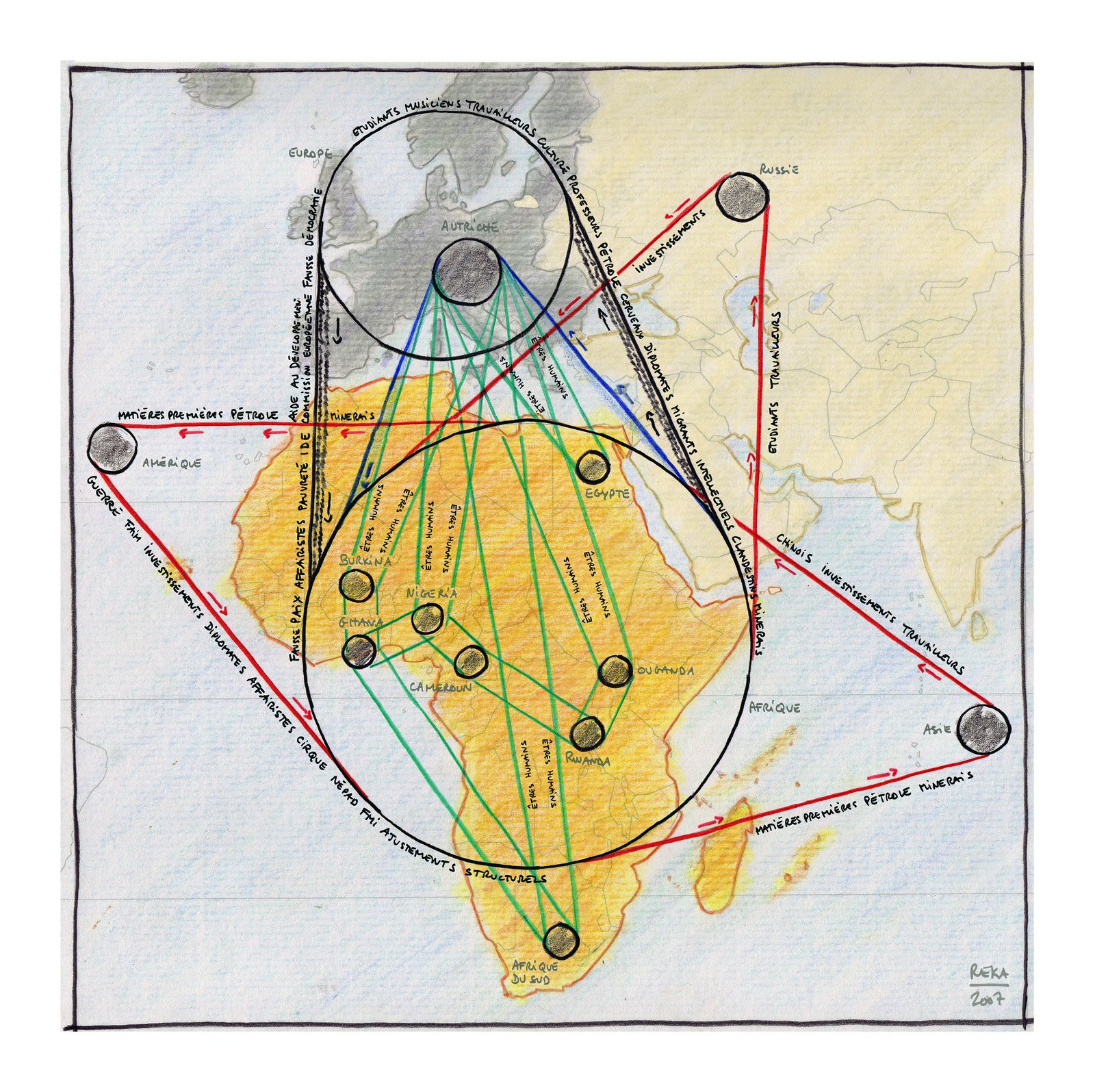
Diagrams - AMO/OMA at Prada Foundation Venice

"There is no such thing as an innocent map, observes Philippe Rekacewicz in his catalogue essay that accompanies Diagrams, a new exhibition at the Prada Foundation in Venice.

A renowned cartographer, the Paris-born Rekacewicz is well aware of his medium's capacity to transform narratives for good and ill. His own work includes maps that illustrate the deaths of migrants as they bid for new lives in Europe. "A map," Rekacewicz continues, "is above all a social and political act - and therefore inherently subjective."' p.5.

Individual
|
      INTERPERSONAL    :     SCIENCES               
HUMANISTIC  --------------------------------------  MECHANISTIC      
 SOCIOLOGY  :    POLITICAL 
|
Group
Am I Free?

My history ...
Philippe Rekacewicz / The African big wheel, 2007
The wheel symbolizes permanence and continuity in the context of a profoundly unequal exchange, drawing, color pencil and ink, exhibition copy.
Courtesy Philippe Rekacewicz
(Image credit: Philippe Rekacewicz)

SOCIETY

... is our history ...

Freedom

National & International Law

Justice


'Other pictures are equally revealing for what they conceal. Consider the diagram entitled "Universal commercial history", a visual analysis drawn up by the Scottish engineer William Playfair in 1805 which traces the rise and fall of global wealth since 1500 BC against what he terms "Remarkable Events Relative to Commerce". Playfair, who is said to have invented the pie chart, includes moments such as "Rome founded" "Mahomet's Flight" and "America discovered". He never mentions slavery.

With such a broad-brush approach, lacunae are inevitable. It is a shame that the work of Viennese social scientist Otto Neurath - who, along with his wife Marie and colleague Gerd Arntz, invented the Isotype (International System of Typographic Picture Education) - is not on show. Based on pictograms, Neurath's Isotypes are an lmportant forerunner to the digital vernacular (from emojis to icons) so familiar to us today. Nor does the exhibition include maps of the devastation of Gaza since October 2023, such as those made by investigative research agency Forensic Architecture, which are proving among the most critical diagrams of our time.' p.5.

Philippe Rekacewicz - https://www.grida.no/resources/10988

My source:
Rachel Spence. Hidden truths in the best laid plans. Diagrams | What charts, maps and graphics can - and can't - tell us. Collecting, FTWeekend. 26-27 April 2025. p.5. 
With many thanks acknowledging length of quotation.

Image source:
https://www.wallpaper.com/architecture/oma-amo-diagrams-prada-foundation-venice

See also: 'icon' : 'symbols' : 'diagram' : 'map' : 'Forensic Architecture'

Archived listing Links II Sciences - inc. 'Diagrams' & 'Visualization I' and 'II': 

Thursday, June 26, 2025

You say Hodges' model is a map. What's the scale?

"That's another thing we've learned from your Nation," said Mein Herr, "map-making. But we've carried it much further than you. What do you consider the largest map that would be really useful?"

"About six inches to the mile."

""Only six inches!"exclaimed Mein Herr. "We very soon got to six yards to the mile. Then we tried a hundred yards to the mile. And then came the grandest idea of all! We actually made a map of the country, on the scale of a mile to the mile!"

"Have you used it much?" I enquired.

"It has never been spread out, yet," said Mein Herr: "the farmers objected: they said it would cover the whole country, and shut out the sunlight! So we now use the country itself, as its own map, and I assure you it does nearly as well."
        Lewis Carroll - The Complete Illustrated Works. Gramercy Books, New York (1982). Page 727.


My source
Text: https://people.duke.edu/~ng46/topics/lewis-carroll.htm

Plus a letter in FTWeekend: by Prof. R.T. Harrison. 'Country as its own map served as well' https://www.ft.com/content/2ad8ea16-d27d-11e1-abe7-00144feabdc0 1 Sept. 2012.

Sunday, April 27, 2025

Citation of Hodges' model: 'Sustainable Health Model: Increasing Universal Access to Health Services in Remote Areas'

News received of another citation to add to the bibliography. It's just a sentence, but always welcome.

Noting the journal's title, Hodges' model incorporates a person's, family's, population's health career which is invariably impacted by a cascade of life chances. H2cm can also be applied temporally, longitudinally; taking in the past, current situation and future.

Good to see researchers discovering Hodges' model and considering it in respect of global health and sustainability also. If your purpose is to identify gaps, seek to reduce them, critique and evaluate change then again Hodges' model with the bridges it affords is an effective resource.

It's disappointing to see the journal - JoWFMHN list only the first author of referenced work. I must look at open access in the future, and remain grateful to Dr Wirnitzer - co-author in the cited paper - for assistance with writing and final publication, whose work includes:

The NURMI-Study (NURMI – Nutrition and Running high Mileage)
https://www.nurmi-study.com/en

Science 2 School: Nachhaltig gesund – bewegt & veggie
https://www.science2.school/

Abstract

Access to healthcare services in remote areas remains a significant global challenge, with many populations experiencing disparities in healthcare availability, quality, and affordability. Sustainable health models that ensure universal access to health services are essential for improving public health outcomes in underserved areas. This study investigates the potential for sustainable health models to increase healthcare access in remote regions, focusing on the role of telemedicine, mobile health clinics, and community health workers. The research employs a mixed-methods approach, combining qualitative interviews with healthcare professionals and quantitative data on healthcare access and outcomes in remote communities. The findings indicate that telemedicine platforms have improved healthcare delivery by 40%, while mobile health clinics and trained community health workers have expanded service reach, particularly in geographically isolated areas. Furthermore, community-based health interventions have led to a 30% reduction in preventable diseases in these regions. The study concludes that integrating technology with community-based solutions offers a scalable and effective approach to achieving universal health access in remote areas. However, challenges such as technology infrastructure, resource allocation, and healthcare workforce training need to be addressed to ensure the sustainability of these models.

Ardenny Ardenny, Le Hoang Nam, Pham Anh Tu (2025). Sustainable Health Model: Increasing Universal Access to Health Services in Remote Areas. Journal of World Future Medicine, Health and Nursing. 3. DOI:10.70177/health.v3i1.1907

Wednesday, May 29, 2024

Point Nemo: 48°52.6′S 123°23.6′W

The oceanic pole of inaccessibility

Individual
|
      INTERPERSONAL    :     SCIENCES               
HUMANISTIC  --------------------------------------  MECHANISTIC      
 SOCIOLOGY  :    POLITICAL 
|
Group


Point Nemo: 48°52.6′S 123°23.6′W
                 
Social care


Al-Othman, H. Notes from the remotest place on Earth: father and son voyage to Point Nemo. The Sunday Times, 31 March 2024. p.11.

https://brown.co.uk/expeditions/point-nemo

Image: https://oceanservice.noaa.gov/facts/nemo.html

Tuesday, November 14, 2023

'Humanistic geography' - goes full circle

INDIVIDUAL
|
     INTERPERSONAL    :     SCIENCES               
HUMANISTIC --------------------------------------  MECHANISTIC      
SOCIOLOGY  :   POLITICAL 
|
GROUP

"Alongside Euclidean geometry non-Euclidean geometries were invented. Alongside the old Aristotelian logic and the law of the excluded middle, new forms of logic with, for example, multiple values were developed. This type of work, far from remaining purely speculative, proved indispensable to the progress of physical theories. Consequently epistemological research was no longer seen as fundamentally inductive. It was no longer content to follow the movement of science: it undertook to precede science by indicating which tools should be used to make the best progress. This was the atmosphere which characterised neo-positivism: some concern was already apparent, therefore, but epistemology was still only partially critical. Its role was still more prescriptive." p.227.


"Tuan states that 'humanistic geography' is 'not an earth science' and that with its purpose as the better understanding of man and his condition, humanistic geography properly belongs to the humanities. (Tuan, 1976, 266). For Tuan humanistic geography is 'event-centred'; it is the study of articulated geographical ideas such as 'place', 'territory', 'crowding', 'privacy' and religion and it is particularly concerned with describing the quality of the emotion experienced in specific settings, e.g. the study of place as a centre of meaning for an individual rather than place as described by its geographical coordinates." pp.116-7.


Now we need to think of 'biospheric geography' within which humanity plays a pivotal and critical part.

https://science.nasa.gov/resource/the-story-behind-apollo-8s-famous-earthrise-photo/

https://www.nasa.gov/news-release/nasa-administrator-honors-life-of-apollo-astronaut-frank-borman/

Rose, C., Wilhelm Dilthey's Philosophy of Historical Understanding: a Neglected Heritage of Contemporary Humanistic Geography, p.99-131; Claval, P., Epistemology and the History of Geographical Thought, p.227-239. In. Stoddart, D.R., editor (1981) Geography, Ideology & Social Concern. Oxford: Basil Blackwell Publisher Ltd.

More books - gone; btw I'm not finding a post in each one - honest!

Wednesday, February 22, 2023

"In all flat maps (and I am one)" - Donne

'Discordia concors' - 'Concordia discors' ... plus ... 'Site map'*

"Drawing both on the medieval Mappae mundi and the Ptolemaic tradition revived in the Renaissance, the recurrent cartographic motif in John Donne’s poetry well reflects the preoccupations of a revolutionary period in the history of Western cartography. Yet, for all its cosmic magnitude, Donne’s poems, both holy and secular, are turned, not so much towards an exploration of the world as towards an exploration of the Self as the ultimate object of reflection." [Abstract].


Ladan Niayesh, ““All flat maps, and I am one”: Cartographic References in the Poems of John Donne”, Études Épistémè [Online], 10 | 2006, Online since 01 October 2006, connection on 22 February 2023. URL: http://journals.openedition.org/episteme/955; DOI: https://doi.org/10.4000/episteme.955

 INDIVIDUAL
|
 INTERPERSONAL    :     SCIENCES               
HUMANISTIC --------------------------------------  MECHANISTIC   
SOCIOLOGY  :   POLITICAL 
|
GROUP

"Let us take as a first example one of the last poems written by Donne, "Hymn to God my God, in my Sickness", composed either during one of the poet’s serious illnesses in 1623 or alternatively shortly before his death in 1631 ..."


"... Here the poet compares himself, as he lies on his sick-bed, or possibly his death bed, to a flat geographical map studied by his physicians who are compared to cartographers: "my physicians by their love are grown / Cosmographers, and I their map, who lie / Flat on this bed" (ll. 6-8), and later "In all flat maps (and I am one)" (ll. 14)."

The global
Psycho-Social-Geo-Political
legacies and future?


"Yet for all its symbolic Noachid and Christian background, Donne’s cartographic imagery has room for the latest scientific contributions. Newly discovered territories are directly named here: "is the Pacific Sea my home?" (l. 16), "Anyan, and Magellan, and Gibraltar" (l. 18). And if this metaphorical map is a flat one — "In all flat maps (and I am one)" — it is solely for the sake of commodity, as this flat shape actually stands for an acknowledged and accepted spherical reality: "west and east / In all flat maps (...) are one" (ll. 13-14)."


*I found some irony in 'site map' being the final map on the journal's webpage.

Sources:
 
London July 2022 Foyles, Waterstones and other bookshops:
Super-Infinite: The Transformations of John Donne (Hardback)
https://www.faber.co.uk/product/9780571345915-super-infinite/

BBC Radio 4 Super-Infinite by Katherine Rundell [Episode 3]

Previously on W2tQ: 'maps'

Tuesday, January 18, 2022

Call for Short Essays - Interfaces: Essays and Reviews in Computing and Culture

Dear Colleagues,

Interfaces hope some of you will consider publishing with us, please forward to others who might be interested.  Many thanks!

Interfaces; Essays and Review in Computing and Culture publishes short essay articles and essay reviews connecting the history of computing/IT studies with contemporary social, cultural, political, economic, or environmental issues. It seeks to be an interface between disciplines, and between academics and broader audiences. It is very much interdisciplinary and past essays published have been from scholars and doctoral students from sociology, media studies, communication, information studies, history, history of sci/tech, science and tech studies,etc.  Essays are generally 2,000 to 3,500 words (a few go up to 4,000 which is fine if you wanted a longer essay, but 2,000 to 3,000 or 3,500 the norm).

Some possibilities, but not limited to...
  • Think piece on some aspect of the sociology, geography, anthropology, history, or other social or cultural study of the digital world
  • addressing a contemporary issue that in part contextualizes looking back at change over time
  • An essay that provides a short, popular version that promotes a larger work (draws from and promotes a full-length article or a book, could announce pre-publication or point to post publication of larger work)
  • Reflections on a body of literature (including an essay review on two or more books, essay on digital exhibit on computing/digital world)
  • Other types of short essays on computing and culture

Essays go through editorial review (myself and my colleague Amanda Wick, co-editors), which is usually short and straightforward and leads to publication in about a month from original submission.

I hope you will consider submitting an essay to us! If I can answer any questions, please let me know.

Best, Jeff
"Injustice wears the same harsh face wherever it shows itself."-Ralph Ellison

Jeffrey R. Yost, Ph.D.
Director, Charles Babbage Institute
Research Professor, History of Science, Technology, and Medicine
222  21st Avenue South
University of Minnesota
Minneapolis, MN 55455
 
<>
 
Previously on W2tQ:
 
My source: SOCIOTECH list
https://www.jiscmail.ac.uk/cgi-bin/webadmin?A0=SOCIOTECH

Friday, August 06, 2021

Book: "Systems convening"

A crucial form of leadership for the 21st century


"Social learning across complex landscapes requires a certain kind of leadership, which we have called systems convening. Many people do this kind of work without any label, often unrecognized, and sometimes not even particularly aware that they are doing it. 

A systems convener or systems convening team sets up spaces for new types of conversations between people who often live on different sides of a boundary. For example, a geographic, cultural, disciplinary, political, class, social boundary. These conveners see a social landscape with all its separate and related practices through a wide-angle lens: they spot opportunities for creating new learning spaces and partnership that will bring different and often unlikely people together to engage in learning across boundaries. A systems convener takes a “landscape view” of wherever they are and what they need to do to increase the learning capability of that entire landscape – rather than simply the capability of the space they are standing in. Importantly, a systems convener is someone who has enough legitimacy in different worlds to be able to convene people in those different worlds into a joint conversation."


My source:

https://twitter.com/WengerTrayner/status/1423577543152656384?s=20

Previously on W2tQ: 'landscape'

Wednesday, June 09, 2021

Cognitive Cartography Is ...

individual
|
 
 INTERPERSONAL : SCIENCES
humanistic ----------------------------------------------- mechanistic
SOCIOLOGY : POLITICAL
|
group
Cognitive Cartography is ..


Physical


and Social.


https://www.scientificamerican.com/article/in-search-of-the-brains-social-road-maps/

Schafer, M., Schiller, D., The Brain's Social Road Maps, Scientific American, 322: 2, FEB 2020. pp.22-27.

https://www.scientificamerican.com/article/in-search-of-the-brains-social-road-maps/

Previously:

https://hodges-model.blogspot.com/2009/07/cogeographic-or-cogneographic-concepts.html

Saturday, August 01, 2020

Cate Blanchett: What is statelessness? | #iBelong UNHCR

individual
|
INTERPERSONAL : SCIENCES
humanistic ----------------------------------------------- mechanistic
SOCIOLOGY : POLITICAL
|
group - population
My mental health


I
Geography

Maps of Identity - Maps of States
Borders


Location of parent's birth; my birth


My physical health
Belong

families

social inclusion / exclusion

relationships

SOCIO-economics

SOCIAL capital

Quality of Lfe

Cultural background / heritage


My source:
https://twitter.com/Refugees/status/1289470924865933313?s=20

Friday, November 01, 2019

Here is the News: another "Brilliant Map"

Or, to be more precise -

"Brilliant Maps"

An Atlas for Curious Minds – 100 New Ways to See the World

A new book released 5 November 2019:
Brilliant Maps - Book
"Which nations have North Korean embassies? How many countries have bigger economies than California? Who drives on the “wrong” side of the road? And where can you find lions in the wild?
In Brilliant Maps for Curious Minds, you’ll learn all this and much more. One hundred visually arresting maps strike a balance between sobering analysis (number of executions by state) and whimsical insight (the countries of the world where there aren’t any McDonald’s).
Thought-provoking and flat-out fun, this one-of-a-kind atlas—compiled by the editor of the popular Brilliant Maps website—makes surprising connections that illuminate the contours of culture, history, and politics. Brilliant Maps for Curious Minds will change the way you see the world—and your place in it".

See also:

https://www.infographic.ly/


My source:
Wright, I. The World as you've Never Seen It, The Sunday Times Magazine, 27 October 2019, pp.26-31.
 

Sunday, August 04, 2019

Pandemic Bonds: Beware perverse incentives and instruments?

individual - self
|
INTERPERSONAL : SCIENCES
humanistic ----------------------------------------------- mechanistic
SOCIOLOGY : POLITICAL
|
group- population


Geography
Number of Countries
Number of fatalities
Instruments: Legal, Science, Social, Policy, Financial ... ?


"On Wednesday [24 July], the World bank said it  would give $300m in grants and loans to DRC to step up its aid response.

But funding connected to the World Bank's pandemic bonds, issued in 2017 have been less forthcoming. One relatively small slice - the so-called "cash" element - has delivered $31.4m to help with the crisis."

Ebola's latest resurgence in central Africa has led to more than 1,700 fatalities. But for the insurance element of the bonds to pay out, the disease must cross an international border and there must be at least 20 fatalities in the second country.

The total possible insurance payout for Ebola is $150m and comes in three tranches: when 250, 750 and 2,500 people have died across at least two countries, $45m, $45m and $60m, respectively, will be disbursed."


Pandemic Bonds

World Bank:
Pandemic Emergency Financing Facility

DRC - Rwanda border


My source: Asgari, N. (2019) World Bank pandemic bonds spark Ebola anger, FT Weekend, 27-28 July, p.17.

Photograph - adapted from original by The Independent.

Thursday, May 30, 2019

[4-5 page...?] Book: "Homage to Humanity"

SELF - individual
|
INTERPERSONAL : SCIENCES
humanistic ----------------------------------------------- mechanistic
SOCIOLOGY : POLITICAL
|
group - POPULATION

You speak ...
I do not understand...
But that is a wonder...
I do see you...
 and the great happening
of the place and way you live ...
And, now I understand...


Geography


Homage to Humanity by Jimmy Nelson


GeoPolitics
@GeoPsychiatry


My source: LUXX, The Times, p.39; book cover Blackwell's

Sunday, May 12, 2019

Forgotten in a Crisis: Addressing dementia in humanitarian response

SELF - individual
|
INTERPERSONAL : SCIENCES
humanistic ----------------------------------------------- mechanistic
SOCIOLOGY : POLITICAL
|
group - POPULATION

Difficulty in Understanding


Natural Disasters
Conflict
War Crimes
Refugee Crises


Difficulty in being Understood


Forgotten in a Crisis: Report


ADI, GADAA and Alzheimer's Pakistan launch report on Dementia in Humanitarian Settings


My source: Several - inc Channel 4 News 12 May 2019.

Thursday, February 08, 2018

Grid Corrections at a Crossroads


or Grid Care Corrections at a Crossroads?


GERCO DE RUIJTER

My source:
https://twitter.com/Rainmaker1973/status/961542009193402368

Thursday, December 07, 2017

Film: Human Flow

individual
|
INTERPERSONAL : SCIENCES
humanistic --------------------------------------- mechanistic
SOCIOLOGY : POLITICAL
|
group
h       u m  an f   l   o      w
h  u m   a      n
f l            o   w


Human Flow - Film

Saturday, November 11, 2017

Happiness! Happiness! ...

individual
|
INTERPERSONAL : SCIENCES
humanistic --------------------------------------- mechanistic
SOCIOLOGY : POLITICAL
|
group

Purpose 
(One of the 4P's in Hodges' model)
Joy
Satisfaction

The Blue Zone


Quality of Life -
4 All?

World Happiness Report 2017