Hodges' Model: Welcome to the QUAD: open access

Hodges' model is a conceptual framework to support reflection and critical thinking. Situated, the model can help integrate all disciplines (academic and professional). Amid news items, are posts that illustrate the scope and application of the model. A bibliography and A4 template are provided in the sidebar. Welcome to the QUAD ...

Showing posts with label open access. Show all posts

Wednesday, March 25, 2026

Call for Submissions: Reimagining the Frontline - The Evolving Roles of Community Health Workers (CHWs) in a Changing World

Dear HIFA Colleagues,

Are you a researcher operating in the community health space?

Sage Health Service Insight Journal, a JCR-ranked, peer-reviewed, fully Open Access journal with an Impact Factor of 2.5. launched a Special Collection focused titled:

Reimagining the Frontline:

The Evolving Roles of Community Health Workers (CHWs) in a Changing World
 https://journals.sagepub.com/topic/collections-his/002164/hisa

Your perspective would be invaluable to this collection, especially at a time when CHWs are at a pivotal crossroad. From navigating funding pressures and the health impacts of climate change to harnessing AI and digital tools, their roles are evolving faster than ever. This collection seeks to capture that transformation through rigorous, forward-looking research.

We welcome research articles and review articles on these topics: 
  • Sustainable financing and economic models in a constrained landscape 
  • Digital transformation: AI, mHealth, and data equity
  • Adapting to emerging health threats and new health conditions 
  • CHW resilience and wellbeing
Submission deadline: 13 July 2026

Additionally, authors may be eligible for APC discount through: Please note that only the highest applicable discount would apply to the standard publication fee, as authors would be unable to stack the discounts.

We deeply appreciate your consideration and would be delighted to feature your work in this Special Collection. Please feel free to reach out if you have any further questions.

Should you have any questions about the Special Collection, please do not hesitate to reach out to the Guest Editors directly: Abimbola.Olaniran AT outlook.com and Roosa.Sofia.Tikkanen AT fhi.no. For journal-related queries, please contact: Katalin.Orosz AT sagepub.co.uk

Thank you so much for considering this invitation. I truly look forward to the possibility of featuring your work.

Best regards,

Drs Abimbola Olaniran & Roosa Sofia Tikkanen Guest Editors, Health Services Insights Special Collection

HIFA profile: Abimbola A. Olaniran (MB;BS, PhD, EMBA) is a physician, researcher, and digital health entrepreneur with over twenty years of experience at the intersection of clinical care, health systems research, and policy in Africa. He continues to collaborate with local and international partners as well as national governments across Africa on health policy, workforce planning, and implementation research. His mission is to ensure that the AI revolution serves the most underserved, building from the continent, for the continent. Abimbola.Olaniran AT outlook.com
 
🔷 

Just to add: In addition, if I can support any CHW's and team colleagues and managers in a contribution using Hodges' model, I would be pleased to do so.

My source: HIFA list

Thursday, February 26, 2026

New Journal Alert - Philosophy and Urban Affairs

Dear Philosophers,

I'm pleased to announce that Philosophy and Urban Affairs is now operational. Below is a description.

Philosophy and Urban Affairs is a peer-reviewed journal that explores the ethical, political, epistemological, metaphysical, and social dimensions of cities. Articles may be theoretical, applied, or both, provided they illustrate how philosophical investigation can elucidate, critique, or inform city living.
Unsolicited manuscripts are not accepted. Instead, the journal solicits submissions through public calls on emerging topics or through invitations to scholars working on specific themes. On occasion, a focus article will be published to prompt response papers and foster sustained scholarly dialogue.
Philosophy and Urban Affairs is fully open access and charges no fees of any kind.
Check out the first CFPPhilosophical Perspectives on Coastal and Island Cities

All the best - Shane

Associate Professor of Philosophy
Missouri University of Science and Technology

Shane Epting, in Creating Future Cities, insightfully analyzes complex normative challenges in urban planning and design—from organizing urban residents' political power to building for resilience—and passionately argues that citizens of cities must fight for their cities and their futures. - Ronald R. Sundstrom, University of San FranciscoUSA

My source:

Philos-L "The Liverpool List" is run by the Department of Philosophy, University of Liverpool https://www.liverpool.ac.uk/philosophy/philos-l/ Messages to the list are archived at http://listserv.liv.ac.uk/archives/philos-l.html. Recent posts can also be read in a Facebook group: https://www.facebook.com/PhilosL/ Follow the list on Twitter @PhilosL. Follow the Department of Philosophy @LiverpoolPhilos 

Friday, February 20, 2026

Presentation: 'An example of open research sharing Hodges’ Health Career Model'

From: Ulster University Open Research Conference 2026 

Simms, V., Jacobs, N., Magee, J., De Ornellas, K., Mollik, E., Kernohan, W. G., Leacock, J., Akter, J., Sempey, C., Beech, S. E., Naz Asif, R., Yap, L. K., & Miller, K. (2026, Jan 16). Ulster University Open Research Conference 2026: Conference Speaker Abstracts. Ulster University. Advance online publication. https://doi.org/10.21251/0d7780ce-ce97-468f-b5d5-69201ca90b20

Speaker: Professor George Kernohan 

School or Department: School of Nursing and Paramedic Science Ulster University 

Email: wg.kernohan AT ulster.ac.uk 

The area(s) of open research talk relates to: 
  Practice as research; Open data/ Open code 

Talk Title: An example of open research sharing Hodges’ Health Career Model 

Abstract

This paper examines a blog post [see below, pj], “Thinking about a comprehensive framework for dementia,” as a case study illustrating the integration of open research practices within dementia palliative care research. The post introduces the Hodges’ Health Career Model— a four-domain conceptual framework encompassing biomedical, psychological, social, and policy perspectives— to articulate the multidimensional nature of dementia and inform care planning. As an openly accessible research communication, the blog contributes to transparent and inclusive knowledge exchange beyond traditional academic channels. 

The blog exemplifies practice-as-research, translating conceptual development from theory into a form of scholarly exposition that invites engagement from practitioners, policymakers, carers, and people living with dementia. It forms part of a wider programme of work in which the research team openly documents methods, emerging findings, and reflections across scoping reviews, surveys, and service case studies hosted on the same platform. These materials complement peer-reviewed open access outputs, including open publications. 

The project demonstrates alignment with open research principles through prospective protocol registration: the scoping review protocol is publicly available on PROSPERO. The team’s prior work on blogging as a mechanism for knowledge mobilisation strengthens the methodological coherence of using this medium to disseminate conceptual frameworks and preliminary insights.

Although the blog does not itself provide underlying datasets or analytic code, it outlines methodological approaches that could facilitate future open data practices, particularly in qualitative and mixed-methods research. Overall, the case illustrates a pragmatic and pluralistic adoption of open research methods across dissemination, protocol transparency, and public engagement, offering a model for enhancing accessibility and reproducibility in dementia palliative care research.

.

Title: “Thinking about a comprehensive framework for dementia”

Author: Professor George Kernohan

Date: 7 November 2019

Link: https://pallcare4dementia.com/thinking-about-a-comprehensive-framework-for-dementia/

Friday, December 12, 2025

Sociology: Open access resources and course materials - BUP

As an introduction to our publishing in Sociology -

 https://bristoluniversitypressdigital.com/subject/SOC-Taster-Collection 
 
- we curated a collection of free and open access books and chapters that we think will contribute to your reading lists. Our growing list has a global outlook featuring high-quality research across emerging and established areas in the field, such as migration, gender, education, ageing, science and technology, death and culture, activism and organizing, race and ethnicity, decolonization, public sociology and children and families.

Highlights from the collection include:
Please feel free to share this collection with your network and your students. Chapters that are not perpetually open access will be free to download until end of March 2026

Our aim is to ensure that the vital work of our authors reaches the lecturers, researchers and policymakers who can use it to drive meaningful, real-world change.

You can request access to our full Sociology Collection
https://bristoluniversitypressdigital.com/subject/SOC-Collection?utm_source=listserv&utm_medium=email&utm_campaign=Sociology-2026 - via your institution’s library. 

We offer tiered pricing on our collections tailored to smaller organisations and their libraries. For more details, institutions can contact our team at bup-digital AT bristol.ac.uk.

Publish with us: If you are writing in this field, consider publishing your work with an ethical university press. To discuss your publishing projects, please contact our editor emily.ross AT bristol.ac.uk.

Looking forward to hearing your thoughts and please don’t hesitate to reach out if you have any questions.

Kind regards,
Bahar Celik Muller - Senior Marketing Executive
Bahar Muller - Senior Marketing Executive

New books

Liberation and Corruption: Why Freedom Movements Fail

Reckoning: Creating Positive Change Through Radical Empathy

Mind the Inclusion Gap: How Allies Can Bridge the Divide Between Talking Diversity and Taking Action

White Privilege: The myth of a post-racial society

 
My source: https://www.jiscmail.ac.uk/cgi-bin/webadmin?A0=EUROPEAN-SOCIOLOGIST

Sunday, October 12, 2025

Paper: The spatiotemporal distribution of human pathogens in ancient Eurasia

 Abstract

Infectious diseases have had devastating effects on human populations throughout history, but important questions about their origins and past dynamics remain1. To create an archaeogenetic-based spatiotemporal map of human pathogens, we screened shotgun-sequencing data from 1,313 ancient humans covering 37,000 years of Eurasian history. We demonstrate the widespread presence of ancient bacterial, viral and parasite DNA, identifying 5,486 individual hits against 492 species from 136 genera. Among those hits, 3,384 involve known human pathogens2, many of which had not previously been identified in ancient human remains. Grouping the ancient microbial species according to their likely reservoir and type of transmission, we find that most groups are identified throughout the entire sampling period. Zoonotic pathogens are only detected from around 6,500 years ago, peaking roughly 5,000 years ago, coinciding with the widespread domestication of livestock3. Our findings provide direct evidence that this lifestyle change resulted in an increased infectious disease burden. They also indicate that the spread of these pathogens increased substantially during subsequent millennia, coinciding with the pastoralist migrations from the Eurasian Steppe4,5.

Sikora, M., Canteri, E., Fernandez-Guerra, A. et al. The spatiotemporal distribution of human pathogens in ancient Eurasia. Nature 643, 1011–1019 (2025). https://doi.org/10.1038/s41586-025-09192-8

My source: Carl Zimmer. What has ailed us over time, The New York Times International Edition, July 30th 2025. p.12.

Saturday, October 04, 2025

Argumentation - Journal: Informal Logic

Early evening (UK) yesterday, I joined a further webinar on argumentation. Through the speaker, and discussion, I was led to a journal

INFORMAL LOGIC

It is in informal logic that I see a role for Hodges' model. The model's structure providing a universal foundation of knowledge domains to be applied in practice. The bonus of this journal, is its being open access, a search revealed the following paper:

Mark Weinstein. Towards a Research Agenda for Informal Logic and Critical Thinking. XII.3, Fall 1990.
https://ojs.uwindsor.ca/index.php/informal_logic/article/view/2609

'This paper recommends that the recent concern with informal logic and critical thinking be redirected from its general philosophical focus and towards a greater appreciation of the particulars of practice in the various domains of human understanding. The redirection recommended is prompted by the central role that critical thinking and informal logic can be seen to play in meaningful educational reform, especially at the undergraduate level.' 

'Critical thinking, similarly, should be redirected from concerns typical of philosophers and towards issues and approaches more representative of critical thinking both within and across the wide range of disciplines represented by the course of undergraduate studies.' p.121.

'The sense that there is an internal relationship between arguments, argumentation and domains of knowledge persists despite attempts to show relevant and useful notions of critical thinking that are generally available for instruction and neutral in respect of the disciplines. The resolution of the issues generated by these competing views, requires that reflective practitioners of the disciplines, students of the history of ideas, methodologists and specialists in teaching increasingly engage in the task of generating and organizing the data upon which an informed and adequate notion of critical thinking across the disciplines must be based.' p.125.

I believe that the structure of Hodges' model provides a basis for Weinstein's ordinary argumentation and stylized argumentation.

For me (at present) ordinary argumentation, is 'open' argumentation. That is, without differentiation in (using) Hodges' model. I might (well, I would) have Hodges' model in mind, but choose not to apply it. As per the paper, stylized argumentation is using Hodges' model and doing so in a multidisciplinary manner - within my discipline. 

The problem and challenge for nurses and other health professionals is the need, if:

  • person/patient-centred;
  • integrated;
  • and holistic - having regard for parity of esteem (mind - body)

- not to stray, extend the disciplinary scope, while working within one's professional scope.

In highly effective multidiscioplinary teams that touch on being transdisciplinary (hybrid?), can experienced team members have insight into the stylized argumentation of their colleagues?

Ack. ​Argumentation network of the AMERICAS - https://www.argnet.org/ethics-of-arg.html

Previously: 'critical thinking'

Sunday, September 21, 2025

Book: 'Non-Western Approaches in Environmental Humanities'

Individual
|
      INTERPERSONAL    :     SCIENCES               
HUMANISTIC  --------------------------------------  MECHANISTIC      
 SOCIOLOGY  :    POLITICAL 
|
Group

attitude, mindset, approach, perspective, framework, philosophy, world-view, paradigm, method, -ism

'Man'
------------------------------------------
Nature - Biosphere - Planetary Health


distance: local, glocal, global
environment
physical space
urban, rural, remote

posthuman
'Non-Western Approaches in Environmental Humanities'

Policy
Politics
Economics
Priorities
Capital
Power
Postcolonialism
Decolonial
Postcolonial


Gabriela Jarzebowska, Aleksandra Ross, and Krzysztof Skonieczny (eds). (2025) Non-Western Approaches in Environmental Humanities. Göttingen: V&R unipress | Brill Deutschland GmbH.

My source: https://x.com/Plant_Init/status/1964274903504281966

See also: 'humanities' : 'environment'

Thursday, July 24, 2025

Book - open access: 'Planetary Politics'

Individual
|
      INTERPERSONAL    :     SCIENCES               
HUMANISTIC  --------------------------------------  MECHANISTIC      
 SOCIOLOGY  :    POLITICAL 
|
Group


My source: Email EUP.

Lucy Benjamin (2025) Planetary Politics - Arendt, Anarchy and the Climate Crisis. Edinburgh University Press. https://edinburghuniversitypress.com/book-planetary-politics.html

Saturday, May 31, 2025

Globally - seeking the ink of scholars

The Ink of the Scholars:
Reflections on Philosophy in Africa


Since the late 1980s, in trying to understand Hodges' model, especially its political dimensions beyond nurses as advocates, the mental health act, choice and self-determination. To be followed by consent, then informed consent, mental capacity, human rights, equality, protected characteristics, safeguarding, equity, social in-justice; I've then questioned my assumed neutrality of the model. 

Allied to this is the fact that Hodges' model is one of many models and frameworks, largely created in the developed world. What alternative viewpointsof nursing, care and philosophies are there? Do these challenge Hodges' model? Or, can Hodges' model also encompass them, in a complementary manner?

Serendipity, or ADHD, seems to follow me around. In addition determined to extract value from my purchase and reading of the weekend FT, I learned of potential key read:


Prempeh, C. THE AESTHETE. Koyo Kouoh, The curator of 2026 Venice Biennale talks whisky sours, working from bed and being the "high priestess of the okra church". HTSI, FTWeekend, 3 May 2025,pp.21-22.

'THE BEST BOOK I'VE READ IN THE PAST YEAR is a book on African philosophers, The Ink of the Scholars: Reflections on Philosophy in Africa, by Souleymane Bachir Diagne, one of our most brilliant thinkers. He challenges the idea that there isn't a philosophical framework to African societies. There are ideas around Africans being the great architects of hospitality and Diagne reflects on what the African approach to humanity is. What does it mean to be careful, mindful and caring? It's not just about welcoming people to your home or feeding them. Hospitality is carrying people, making people feel comfortable in your environment - it's intellectual and emotional. Everyone should read Diagne, full stop.' p.21. 
 

Shocked: I have just read of Koyo Kouoh's passing - RIP. 

Souleymane Bachir Diagne, & Jonathan Adjemian. (2016, May 23). The Ink of the Scholars: Reflections on Philosophy in Africa. CODESRIA Books Publication System. CODESRIA
https://publication.codesria.org/index.php/pub/catalog/book/40

See also: 'hospitality'

Sunday, April 27, 2025

Citation of Hodges' model: 'Sustainable Health Model: Increasing Universal Access to Health Services in Remote Areas'

News received of another citation to add to the bibliography. It's just a sentence, but always welcome.

Noting the journal's title, Hodges' model incorporates a person's, family's, population's health career which is invariably impacted by a cascade of life chances. H2cm can also be applied temporally, longitudinally; taking in the past, current situation and future.

Good to see researchers discovering Hodges' model and considering it in respect of global health and sustainability also. If your purpose is to identify gaps, seek to reduce them, critique and evaluate change then again Hodges' model with the bridges it affords is an effective resource.

It's disappointing to see the journal - JoWFMHN list only the first author of referenced work. I must look at open access in the future, and remain grateful to Dr Wirnitzer - co-author in the cited paper - for assistance with writing and final publication, whose work includes:

The NURMI-Study (NURMI – Nutrition and Running high Mileage)
https://www.nurmi-study.com/en

Science 2 School: Nachhaltig gesund – bewegt & veggie
https://www.science2.school/

Abstract

Access to healthcare services in remote areas remains a significant global challenge, with many populations experiencing disparities in healthcare availability, quality, and affordability. Sustainable health models that ensure universal access to health services are essential for improving public health outcomes in underserved areas. This study investigates the potential for sustainable health models to increase healthcare access in remote regions, focusing on the role of telemedicine, mobile health clinics, and community health workers. The research employs a mixed-methods approach, combining qualitative interviews with healthcare professionals and quantitative data on healthcare access and outcomes in remote communities. The findings indicate that telemedicine platforms have improved healthcare delivery by 40%, while mobile health clinics and trained community health workers have expanded service reach, particularly in geographically isolated areas. Furthermore, community-based health interventions have led to a 30% reduction in preventable diseases in these regions. The study concludes that integrating technology with community-based solutions offers a scalable and effective approach to achieving universal health access in remote areas. However, challenges such as technology infrastructure, resource allocation, and healthcare workforce training need to be addressed to ensure the sustainability of these models.

Ardenny Ardenny, Le Hoang Nam, Pham Anh Tu (2025). Sustainable Health Model: Increasing Universal Access to Health Services in Remote Areas. Journal of World Future Medicine, Health and Nursing. 3. DOI: 10.70177/health.v3i1.1907

Saturday, January 25, 2025

20th anniversary special issue of The Journal of Community Informatics

Dear CI (Community Informatics) colleagues,

I am thrilled to announce that Peter Johnson and I just published the 20th anniversary special issue of  
The Journal of Community Informatics:


As we explain in our editorial, the first issue of The Journal of Community Informatics was published by Michael Gurstein on October 1, 2004. Since then the journal has continued to remain the open access peer reviewed journal featuring contributions at the intersection of community informatics research, practice, and policy.  We are excited to feature nine essays in this special issue from many of the leaders in our field.

We invite you to read the full special issue in its entirety here:


Cheers!
Colin
---
Colin Rhinesmith, Ph.D. (he/him)
Founder and Director, Digital Equity Research Center
Metropolitan New York Library Council

------------------------

Listed in the blog's bibliography:

Jones, P. (2012). Exploring several dimensions of local, global and glocal using the generic conceptual framework Hodges's model. The Journal Of Community Informatics. 8(3). Available at: https://openjournals.uwaterloo.ca/index.php/JoCI/article/view/3034

Friday, December 27, 2024

Living document - "Semantic Web: Past, Present, and Future"

Dear Semantic Web community

As the year ends, the question remains: How will the Semantic Web look in 2025?

Together with Katja Hose, Maria-Esther Vidal, Gerd Groener, and Petr Å koda, we contributed this year an article titled "Semantic Web: Past, Present, and Future", see

https://drops.dagstuhl.de/entities/document/10.4230/TGDK.2.1.3 to the new Diamond Open Access journal on Transactions on Graph Data and Knowledge (TGDK, https://tgdk.org/). This primer has been a living document for 13 years; see the link for details!

As many of us cannot resist checking emails over the break, I ask you to consider the question:
What is our future in 2025?

Many "classical" Semantic Web researchers have witnessed the rise of Linked Open Data, Freebase being bought by Google (largely seen as a big win), and the beginning and success of the Knowledge Graph era. Many of us have moved on to or added topics like graph representation learning, graph neural networks, language models, etc., to our research portfolio. So, how much of the classical topics are left? How much will come back? Should we work more on knowledge graph embeddings obeying OWL axioms? Shall we have federated queries not only over multiple data sources but also include hybrid queries using similarities in graph embeddings?

In the current 2024 version of the primer, we include the latest W3C standards developed by the Semantic Web community. But we also explain the journey from the famous Linked Data principles via Knowledge Graphs to the hot topic of machine learning on graphs!

*The article linked above is an invitation to contribute. Contact me if you are interested!* 

It will be updated from time to time. We like to receive your feedback, and perhaps you would like to contribute to a future version.

Best wishes and happy holidays,

Ansgar

PS: For 2025, there is a plan to update the German version of the article in an introductory textbook on artificial intelligence. It will add Shallow Graph Embeddings, Graph Neural Networks, and the interplay of Knowledge Graphs and Language Models. Once ready, I plan to ping this back to the English version.

My source:
Ansgar Scherp
From:mail AT ansgarscherp.net
To:semantic-web AT w3.org
4.3   3-12
'Domain Ontologies represent knowledge specific to a particular domain [48, 109]. Domain ontologies are used as external sources of background knowledge [48]. They can be built on foundational ontologies [110] or core ontologies [131], which provide precise structuring to the domain ontology and thus improve interoperability between different domain ontologies. Domain ontologies can be simple such as the FOAF ontology or the event ontology mentioned above, or very complex and extensive, having been developed by domain experts, such as the SNOMED medical ontology.' ...

3-13

'Foundational Ontologies have a very wide scope and can be reused in a wide variety of modeling scenarios [24]. They are therefore used for reference purposes [109] and aim to model the most general and generic concepts and relations that can be used to describe almost any aspect of our world [24, 109], such as objects and events. An example is the Descriptive Ontology for Linguistic and Cognitive Engineering (DOLCE) [24]. Such basic ontologies have a rich axiomatization that is important at the developmental stage of ontologies. They help ontology engineers to have a formal and internally consistent conceptualization of the world, which can be modeled and checked for consistency. For the use of foundational ontologies in a concrete application, i.e., during the runtime of an application, the rich axiomatization can often be removed and replaced by a more lightweight version of the foundational ontology.
 In contrast, domain ontologies are built specifically to allow automatic reasoning at runtime. Therefore, when designing and developing ontologies, completeness and complexity on the one hand must always be balanced with the efficiency of reasoning mechanisms on the other. In order to represent structured knowledge, such as the scenario depicted in Figure 1, interconnected ontologies are needed, which are spanned in a network over the Internet. For this purpose, the ontologies used must match and be aligned with each other.'
Health - See also 4.2 (A post in 2025 ...re. SKOS?).

Monday, September 16, 2024

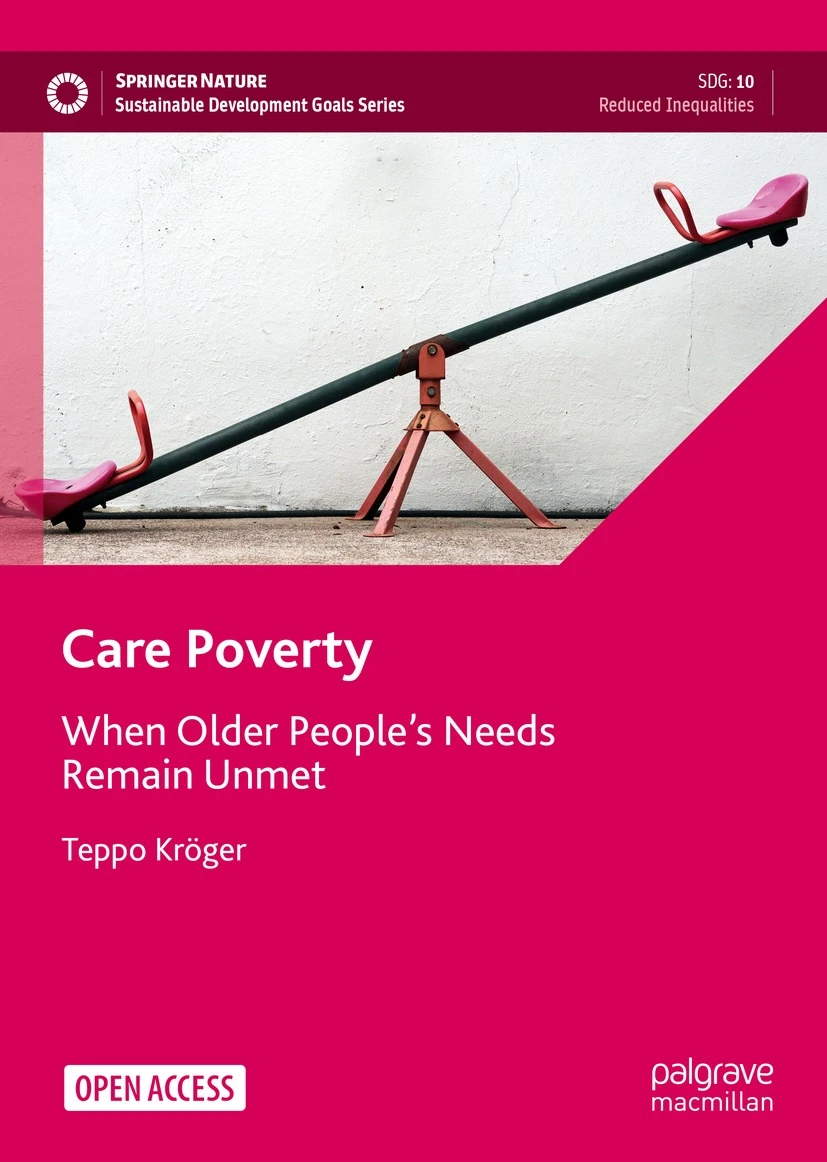
Book: Care Poverty - When Older People’s Needs Remain Unmet

CARE POVERTY
'This open access book turns the research attention of social policy scholars and long-term care researchers from comparative descriptions of care systems, focusing mostly on expenditures and volumes of long-term care services, to outcomes, and in particular to the question whether older people really receive the support that they need. Without knowledge about which needs and which social groups are currently inadequately covered, it is impossible to guide policy development.

The book puts forward a novel theoretical framework to guide future research work and public discussion on the issue of unmet long-term care needs, by broadening the current discussion so that inadequate care is seen in its societal and policy contexts, taking structural issues and policy designs into account. Kröger outlines three different domains of care poverty (personal care poverty, practical care poverty and socio-emotional care poverty) and differentiates between main methods how unmet needs are measured.' [my emphasis]

In psychiatry and psychiatric nursing, a person may be assessed to display poverty of thought, ideas or speech. As an exercise it may be useful to invert the rendering below in Hodges' model, and  consider Kröger's forms of poverty and possibly others that arise from your critique, reflections and life experience to date. Clearly, another book to add to the list!
 
individual
|
INTERPERSONAL : SCIENCES
humanistic ------------------------------- mechanistic
SOCIOLOGY : POLITICAL
|
group

CARE


CARE

CARE

POVERTY


Previously on W2tQ - (unmet) 'needs'

Kröger, T. (2022) Care Poverty - When Older People’s Needs Remain Unmet. Cham: Palgrave Macmillanhttps://link.springer.com/book/10.1007/978-3-030-97243-1#about-this-book

Will check on a related title too.

Thursday, April 18, 2024

Book: Digital Disinformation in Africa: Hashtag Politics, Power and Propaganda

Individual
|
   INTERPERSONAL   :     SCIENCES               
HUMANISTIC  --------------------------------------  MECHANISTIC      
 SOCIOLOGY  :    POLITICAL 
|
Group


Digital Disinformation in Africa


#Politics #Power #Propaganda


Source: Twi/X

Friday, March 15, 2024

Book (i): Mental Patient - Psychiatric Ethics from a Patient's Perspective

- by Abigail Gosselin


Individual
|
      INTERPERSONAL    :     SCIENCES               
HUMANISTIC  --------------------------------------  MECHANISTIC      
 SOCIOLOGY  :    POLITICAL 
|
Group
Book: Mental Patient
Do we say 

"PHYSICAL PATIENT"?

What is (still) heard here?

What is still heard here?


Gosselin, A. (2022). Mental Patient: Psychiatric Ethics from a Patient’s Perspective. The MIT Press.
https://doi.org/10.7551/mitpress/14589.001.0001

My source: 
https://x.com/AnneMarieGagnJ1/status/1767948059957227719?s=20


Tuesday, March 12, 2024

Landscapes, Maths, Line of Sight c/o Penteado & Skovsmose Eds. (2022)


The care / knowledge domains of
Hodges' model as landscapes:
as 'initial sketches'?

'Line of sight/thought?'


Individual
|
      INTERPERSONAL    :     SCIENCES               
HUMANISTIC  --------------------------------------  MECHANISTIC      
 SOCIOLOGY  :    POLITICAL 
|
Group

reflection

critical reflection

cognitive/conceptual landscapes


maths and sciences =

hard subjects ?


"We understand that mathematics is especially relevant in knowledge processing, and operates in the process of globalisation,4 i.e., it interferes in several aspects that integrate with society. We admit that globalisation refers to all aspects of life and that, depending on how it is questioned and operationalised, it may or may not be beneficial. Therefore, globalisation “has to do with the construction, codification, and distribution of knowledge that turns into goods for sale” (Skovsmose, 2014, p. 130). This way, mathematical knowledge is involved as part of the foundations of society, making it necessary to question its position in this laborious civilising equation (Civiero and Bazzo, 2020). In this context we delegate some power to critical mathematics education (CME) by considering that it can contribute to the formation of critical individuals by promoting reflection on this process. Bazzo (2019) considers us to experience a civilising equation whose variables need to be discussed in schools." pp.296-297.

"The word citizenship, a contested concept, emerges in different discourses that can hide contrasting interests. Differences in its meanings are enhanced with the changes in society through history. This chapter presents a discussion about mathematics education for citizenship and its outcomes. School presents itself as a stage of dispute and a space for expressing different ideologies that can configure ways of thinking and structuring an education on the topic of citizenship. Mathematics education is shown to be supportive of different citizenship discourses. In a globalised world with deep inequalities, a type of mathematics education for citizenship that matches with inclusion and diversity is required; one which considers global issues. The proposed landscape of investigation Global Visibility Matters is a possible support aid for mathematics classes, based on enabling students to develop global citizenship. By reading and interpreting a social situation as being open to change, it becomes possible for the students to be recognised as—and to act as—global citizens." p.133.


Chapter 8 Global Citizenship, Manuella Carrijo, pp. 133-147.

Chapter 18 Critical Mathematics Education in Action:  To Be or Not to Be. Paula Andrea Grawieski Civiero and  Fátima Peres Zago de Oliveira. pp. 295-321.

Penteado, M. & Skovsmose, O., editor. (2022) Landscapes of Investigation: Contributions to Critical Mathematics Education. Cambridge, UK: Open Book Publishers. [Pdf] Retrieved from the Library of Congress, https://www.loc.gov/item/2021385926/

landscape
https://hodges-model.blogspot.com/search?q=landscape

sketch
https://hodges-model.blogspot.com/search?q=sketch

'line of sight'
https://hodges-model.blogspot.com/search?q=line+of+sight

Thursday, March 07, 2024

Book: Landscapes of Investigation [open access]

"Creating landscapes of investigation is a primary concern of critical mathematics education. It enables us to organise educational processes so that students and teachers are able to get involved in explorations guided by dialogical interactions. It attempts to address explicit or implicit forms of social injustice by means of mathematics, and also to promote a critical conception of mathematics, challenging the assumption that the subject represents objectivity and neutrality. Landscapes of Investigation provides many illustrations of how this can be done in primary, secondary, and university education. It also illustrates how exploring landscapes of investigation can contribute to mathematics teacher education programmes. 

This edited volume is the result of a collaboration established through the Colloquium in Research in Critical Mathematics Education, which took place in 2016, 2018, and 2019 in Brazil. Its twenty-eight contributors are young researchers from Brazil, Chile, Colombia, India, Mexico and the USA, who are dedicated to the further development of critical mathematics education. 

Organised in eighteen chapters, the volume presents examples of engaging students from a diversity of social and economic backgrounds, age ranges, and abilities across different countries. The chapters present original findings on the social aspects of all levels of mathematics education. Landscapes of Investigation is of particular relevance to those with an interest in the potential of mathematics education to challenge social injustices."

Penteado, M. & Skovsmose, O., editor. (2022) Landscapes of Investigation: Contributions to Critical Mathematics Education. Cambridge, UK: Open Book Publishers. [Pdf] Retrieved from the Library of Congress, https://www.loc.gov/item/2021385926/

Review:

David M. Bowers
"Book Review: Landscapes of Investigation: Contributions to Critical Mathematics Education (2022) (M. G. Penteado & O. Skovsmose, Eds.)". Journal for Theoretical & Marginal Mathematics Education, vol. 2, no. 1, 2023. doi:10.5281/zenodo.10440243

My source:
https://x.com/dylanwiliam/status/1602776823225540610?s=20

Previously
https://hodges-model.blogspot.com/search?q=mathemacy

Monday, February 19, 2024

South Sudan Medical Journal: 'Stroke' Vol 17 No 1 Feb. 2024

Dear reader,

The February 2024 issue is online here


It includes several items on ‘Stroke’ edited by Dr Eluzai Abe Hakim, Founder and Associate Editor of SSMJ. Note our new ‘Notice Board’ on the back page. The full contents are listed below.

We are pleased to announce that our articles are now indexed by Scopus, in addition to  African Journals Online (AJOL) and the Directory of Open Access Journals (DOAJ) as well as on our website. SSMJ is included in the EBSCO scientific research collection.

Please share this issue with your colleagues
and promote it through social media.

For example: “See the South Sudan Medical Journal’s February issue for articles related to stroke in Africa here @SSMedJournal #SouthSudan #SSOT” or retweet from @SSMedJournal.


Editorial

Articles
  • Reference intervals for serum creatinine and urea in the adult western Sudanese population Muaath Ahmed Mohammed, Ibrahim Abdelrahim Ali, Abdarahiem Alborai Abeadalla, and Omer Abdelaziz Musa
  • Prevalence and perceptions of voluntary medical male circumcision among University of Juba students, South Sudan Kon Alier, Akway Cham, Jonathan Majok, Kenneth Sube Achan Nyang, Ezbon Wapary, James Malek, John Makuei, Jok Malith, Lual Mayuol and Yak Adim
  • Paranasal sinuses in patients with chronic rhinosinusitis, Tanzania Enica R.Massawe, Happy E Somboi, Asterius Muganyizi, and Petra Joseph
  • Hepatocellular carcinoma and aflatoxin in Sudan: The way forward Moawia Mohammed Ali Elhassan
Stroke Series ArticlesShort Communications
  • QUIZ: Unenhanced Brain Computerised Axial Tomographic (CAT) scan quiz
  • Obituary: Dr Asia Dawud Kuek
  • Obituary: Dr Lou Joseph Bosco
  • Obituary: Mr Gideon Wurube Kara

Notice Board (Back Cover): Advertise in the South Sudan Medical Journal

Front Cover Image: Brain CAT scan of a stroke patient showing acute right non-haemorrhagic infarct in posterior middle cerebral artery territory as well as right basal ganglia with mass effect. (Credit: Eluzai Hakim)

The SSMJ team
Email: southsudanmedicaljournal AT gmail.com
Website: http://www.southsudanmedicaljournal.com
Follow us on Twitter/X @SSMedJournal and our Facebook Group