Hodges' Model: Welcome to the QUAD: proxy

Hodges' model is a conceptual framework to support reflection and critical thinking. Situated, the model can help integrate all disciplines (academic and professional). Amid news items, are posts that illustrate the scope and application of the model. A bibliography and A4 template are provided in the sidebar. Welcome to the QUAD ...

Showing posts with label proxy. Show all posts

Monday, September 16, 2024

Book: Care Poverty - When Older People’s Needs Remain Unmet
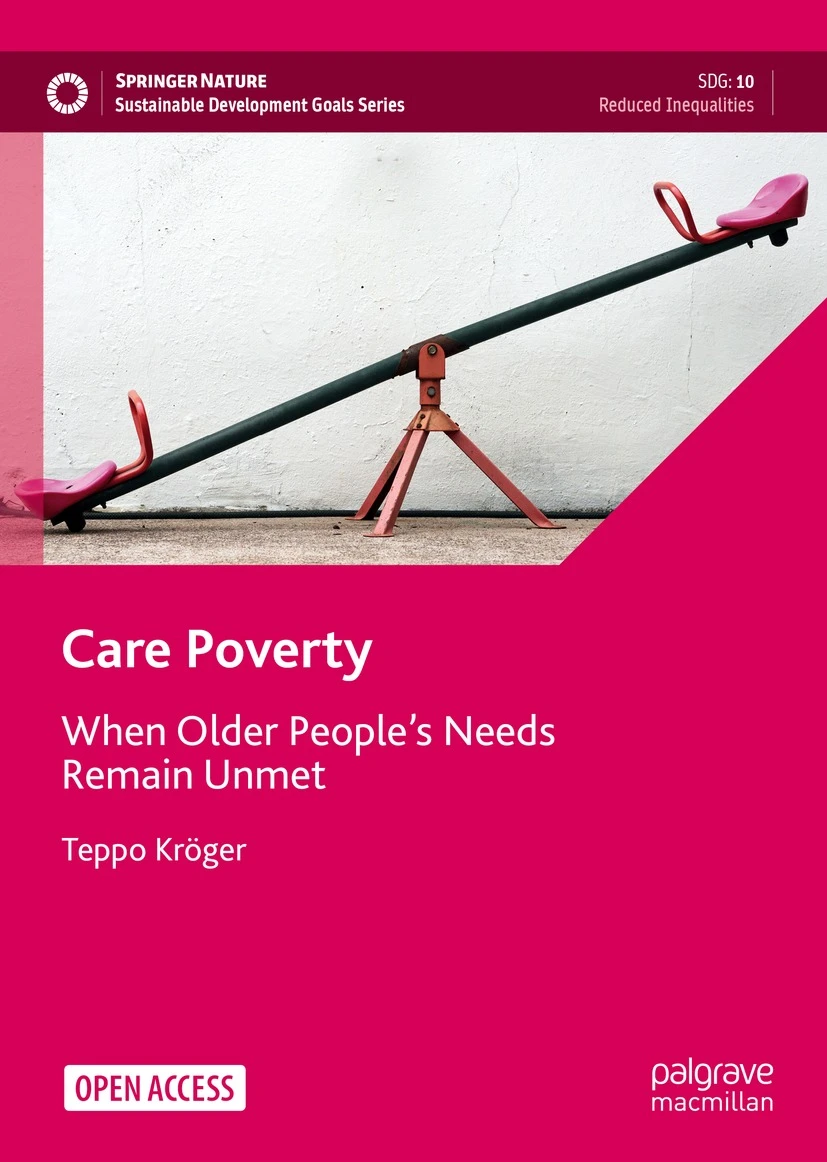
CARE POVERTY
'This open access book turns the research attention of social policy scholars and long-term care researchers from comparative descriptions of care systems, focusing mostly on expenditures and volumes of long-term care services, to outcomes, and in particular to the question whether older people really receive the support that they need. Without knowledge about which needs and which social groups are currently inadequately covered, it is impossible to guide policy development.

The book puts forward a novel theoretical framework to guide future research work and public discussion on the issue of unmet long-term care needs, by broadening the current discussion so that inadequate care is seen in its societal and policy contexts, taking structural issues and policy designs into account. Kröger outlines three different domains of care poverty (personal care poverty, practical care poverty and socio-emotional care poverty) and differentiates between main methods how unmet needs are measured.' [my emphasis]

In psychiatry and psychiatric nursing, a person may be assessed to display poverty of thought, ideas or speech. As an exercise it may be useful to invert the rendering below in Hodges' model, and  consider Kröger's forms of poverty and possibly others that arise from your critique, reflections and life experience to date. Clearly, another book to add to the list!
 
individual
|
INTERPERSONAL : SCIENCES
humanistic ------------------------------- mechanistic
SOCIOLOGY : POLITICAL
|
group

CARE


CARE

CARE

POVERTY


Previously on W2tQ - (unmet) 'needs'

Kröger, T. (2022) Care Poverty - When Older People’s Needs Remain Unmet. Cham: Palgrave Macmillan. https://link.springer.com/book/10.1007/978-3-030-97243-1#about-this-book

Will check on a related title too.

Saturday, October 23, 2021

COVID: Logic is the patient - again...

Hodges' model is evidence seeking, what logic might apply? 
 
Logic was once the 'patient':
“Yet, by 1530, formal logic was a dying branch of studies, and by the seventeenth century it had been completely forgotten. Why? No one to my knowledge has provided a satisfactory answer. Prantl, one of the earliest scholars to take notice of medieval logic, merely relied on the prejudice of four hundred years in depicting the universities as nursing; the sick but obstinate patient (dialectics), until 'the healthy spirit of antiquity conquered the scholastic pedantry'. Bochenski is not concerned with the mechanics of historical change. Ong gives the cause of death as an inherent weakness in medieval logic itself: 'Scholastic logic was dying of the frustration attendant upon its failure to develop a symbolic system adequate to its ambition and the promise of its initial development.' Even if medieval logic could not overcome this weakness, it had nevertheless hobbled along for three hundred fifty years with the malady! Even if the universities artificially prolonged its life, how exactly did the 'healthy spirit of antiquity' do away with the old warrior?” (Heath, 1971, p.47).
 
Individual
|

INTERPERSONAL : SCIENCES
humanistic ------------------------------------------ mechanistic
SOCIOLOGY : POLITICAL
|
Group

logic


LOGIC

logic

logic

Heath, Terrence. “Logical Grammar, Grammatical Logic, and Humanism in Three German Universities.” Studies in the Renaissance 18 (1971): 9–64. https://doi.org/10.2307/2857078.

Saturday, April 28, 2012

Personal Health Records: Part II - revisiting Kim and Johnson 2002

Part I continued ...

What Kim and Johnson reveal is a level of transience that can be quite scary in this context. True, electronic health records can be archived and printed, but the latter surely defeats the purpose of the 'e'. Printing undermines the credentials. The virtual landscape presented in part I by checking the current status of these domains highlights the issue of ownership of data in a way that has provoked much debate in social media and the transferability of a person's data - information. If I want to move to another vendor, system, company (however the 'entity' is described) there needs to be standards and a degree of interoperability to facilitate this. 

Next, we have to bow to the notion of a year on the internet compared with 'real time'. M-health was a dream a decade ago. Here is another pressure on the PHR and its family members. A public-facing health record, whatever its nomenclature, must not only be responsive to the public and professional users and the 'total stakeholder community'. Now the record must be responsive according to device: from desktop, to tablet through to mobile phone.

In 2002 the PHR project was set to run and run. It had a slow, strong pulse with speedy recovery after exertion. The PHR looked fit for Olympic* endeavors.

But then the algorithms set to change personal health care (to fuse ill-health and well-being) suffered a major arrhythmia. The fate of those who became the new PHR frontrunners, the heavyweights no less: NHS's Healthspace, the initiatives of Google and Microsoft suffered the same fate. This post is from 2009:

Self-care in e-space and the need to Impress

Given the changes since Kim and Johnson you have to wonder what the next decade will bring. Whatever there will still be fog, but that just adds to the excitement as we climb the trees. Then we realise that to all of the users of health information systems (remember the user and stakeholders?), whichever TLA is employed, they are all X-HRs by proxy.
Kim MI, Johnson KB. Personal Health Records: Evaluation of Functionality and Utility. Journal of the American Medical Informatics Association. 2002. Mar-Apr; 9(2):171-180. Selected for inclusion in the IMIA 2003 Yearbook of Medical Informatics. 

 *All trademarks acknowledged.
