Hodges' Model: Welcome to the QUAD: symbols

Hodges' model is a conceptual framework to support reflection and critical thinking. Situated, the model can help integrate all disciplines (academic and professional). Amid news items, are posts that illustrate the scope and application of the model. A bibliography and A4 template are provided in the sidebar. Welcome to the QUAD ...

Showing posts with label symbols. Show all posts

Saturday, May 23, 2026

The alchemy of terminology, symbols, and signs ...

Or, 'What is a nurse doing … in a chemistry class?' [Ack. See Estrada]

In reading, I was reminded that chemistry adopted mathematical symbols for its own use. Not only that, but as a core science (with physics and biology, emerging from natural philosophy) there is a historical development from the time of alchemy:

Please see (with a graphical abstract):

C.Wentrup, The Transition from Alchemical to Modern Chemical Symbolism: from Bergman and Guiton de Morveau to Hassenfratz and Adet, Higgins, Richter, Dalton, and Berzelius. ChemPlusChem. 2024, 89, e202400033. https://doi.org/10.1002/cplu.202400033

This journey matters today as the use of symbols, in mathematics or other fields can be a barrier to learning and hence personal and disciplinary progress:

Ollie Hunter. Lost in translation: Demystify scientific symbolic language to help your chemistry students overcome any potential learning barriers. Royal Society of Chemistry, 23 May 2022.

As acknowledged many times, it is easy to take a word, or concept from one discipline and 'fit' it to - or in another. Or is it? Estrada concludes:

The complexities of modern science and modern society have created a need for scientific generalists, for men trained in many fields of science.” This is a paradigm of science in the XXI century, where the advent of such fields like the study of complex systems requires multidisciplinary approaches. But the previous phrase was not written in the XXI century. It is the starting sentence in The education of a scientific generalist” published in Science in 1949 (Bode et al. 1949).' p.161. 

'Mathematics has been defined as the science of patterns. Thus, mathematicians search for “numerical patterns, patterns of shape, patterns of motion, patterns of behavior, voting patterns in a population, patterns of repeating chance events, and so on” (Byers 2010). Once a pattern is identified either in chemistry or in mathematics, the researcher can proceed to the clarification of the systematic rule which is behind that pattern. This is evident in the analogy used here between code-breaking and structure elucidation. This attachment to patterns makes both chemists and mathematicians very prone to the use of pictures. An organic chemist hardly can say anything about the chemical reactivity (or any physical or chemical property) of a molecule from its exact quantum-mechanical Hamiltonian. However, she will construct a complete narrative about the physical and chemical properties of a molecular structure drawn in a piece of paper, even if such a molecule is completely imagined. The power of pictures in mathematics is discussed in the book Mathematics and the Unexpected by Ivar Ekeland (1990) where its value is recognized as fundamental in the early stages of the development of mathematical ideas. This also introduces a very important analogy among chemists and mathematicians. Namely, that they use a proper language in their respective fields. While physicists use the mathematical language in their investigations, chemists use the sophisticated language of chemical formulas and specific symbols to represent charges, rearrangements, partial equilibria, etc. These “invented” languages mainly appear only in Chemistry and in Mathematics, making them unique intellectual activities.' p.162.

With thanks to the author, Ernesto Estrada IFISC for additional thoughts and insights:

Estrada, E. What is a mathematician doing…in a chemistry class?. Found Chem 26, 141–166 (2024). https://doi.org/10.1007/s10698-023-09497-4

Friday, April 17, 2026

Ann Hutchinson Guest (Obit.), 'Authority on dance notation ... '

'Although there are many forms of dance notation going back to Pierre Beauchamp's system for Baroque dance in the 1680s, Nijinsky had developed his own cryptic version. Ann Hutchinson Guest first tried to reconstruct his work in 1956 after the choreogapher's widow, Romola, gave her his notes. "I spent years trying to work it out," she said, adding with a laugh: And I'm supposed to be the leading authority on dance notation in the world. She told how Nijinsky had revised his notes many times, often contradicting himself. 'We couldn't get anywhere. Romolo was furious. She said it was taking much too long."
    Hutchinson Guest studied dozens of different dance notation systems, translating many of them into Labanotation, a system developed in the 1920s by Rudolf von Laban who was a central figure in European modern dance. According to a  press report in 1954: "The printed Labanotation page looks like a combination of hieroglyphs, pictographs, Morse dots-and-dashes, đoodles, and a musie score turned on edge" 
    It was not until 1980 that she and Claudia Jeschke, a dance historian, succeeded in cracking Nijinsky's code after finding a copy of his annotated score in the British Library.'
Register, The Times.

My source: Ann Hutchinson Guest (Obit.), 'Authority on dance notation known for reconstructing Vaslav Nijinsky's scandalous ballet, L'Après-midi d'un faune'. Register, The Times. 20 April, 2022, p.48.
https://www.thetimes.com/uk/obituaries/article/ann-hutchinson-guest-obituary-hkw8z88ns


INDIVIDUAL
|
     INTERPERSONAL    :     SCIENCES               
HUMANISTIC --------------------------------------  MECHANISTIC      
SOCIOLOGY  :   POLITICAL 
|
GROUP
abstraction
representation
interpretation
observation - translation
code - formalism

body (bodies)
symbols - forms
dance
choreography
movement - 4D - time

group
ensemble
'anthropological composition?'
'diagnostic grouping'?
social - cultural category . . .

'collective power & attention 
evinced as time'
'The stage: the space for health'^

Hutchinson Guest in 1956
 Source: The Times.


'Dance has been called moving architecture, a truth which the complexities of contemporary choreography may mask. Not only does the dancer's body form shapes and groups of dancers form moving or static designs, but also group arrangements carve up the stage space, establishing areas of open as well as enclosed space which are significant in their changes and contrasting effects.

While the rccording of movement on paper-dance notation-does not look like movement (disregarding primitive stick figure drawings), there is an "architecture" in the sequence of graphic symbols used to record dance patterns. Over the centuries many different devices have been used to capture dance steps on paper. What are the elements that have to be represented?

The process of dance notation requires reducing four-dimensional movement (time being the fourth dimension) to a two-dimensional surface. The parts of the body in action have to be defined, as does the form of movement involved (flexion, extension, rotation, directional placement) and the duration of each in relation to the overall time structure. In group dances the relationship of dancers to one another must be determined and recorded, as well as their location on stage and their paths of travel. In a dance score each performer is like a small orchestra-arms, legs, head, torso, etc. in motion-this is then multiplied by the number of dancers who are performing individual sequences.'


Guest, A. H. (1990). Dance Notation. Perspecta, 26, 203–214. https://doi.org/10.2307/1567163

^Health is always performed in the political domain, make no mistake (excuses, or exceptions). It is not:
  1. Acknowledged, masked - covered by the 'set design' (see #2 below);
  2. Implied in the medical, biomedical, bio-psycho-social model;
  3. The intermission is neither the time, or place, to reflect upon and critique the political in health :: health in politics.

Previously: 'dance' : 'architecture' : 'movement
 : 'notation'

Monday, September 29, 2025

Raven Chacon - graphical musical scores

Individual
|
      INTERPERSONAL    :     SCIENCES               
HUMANISTIC  --------------------------------------  MECHANISTIC      
 SOCIOLOGY  :    POLITICAL 
|
Group
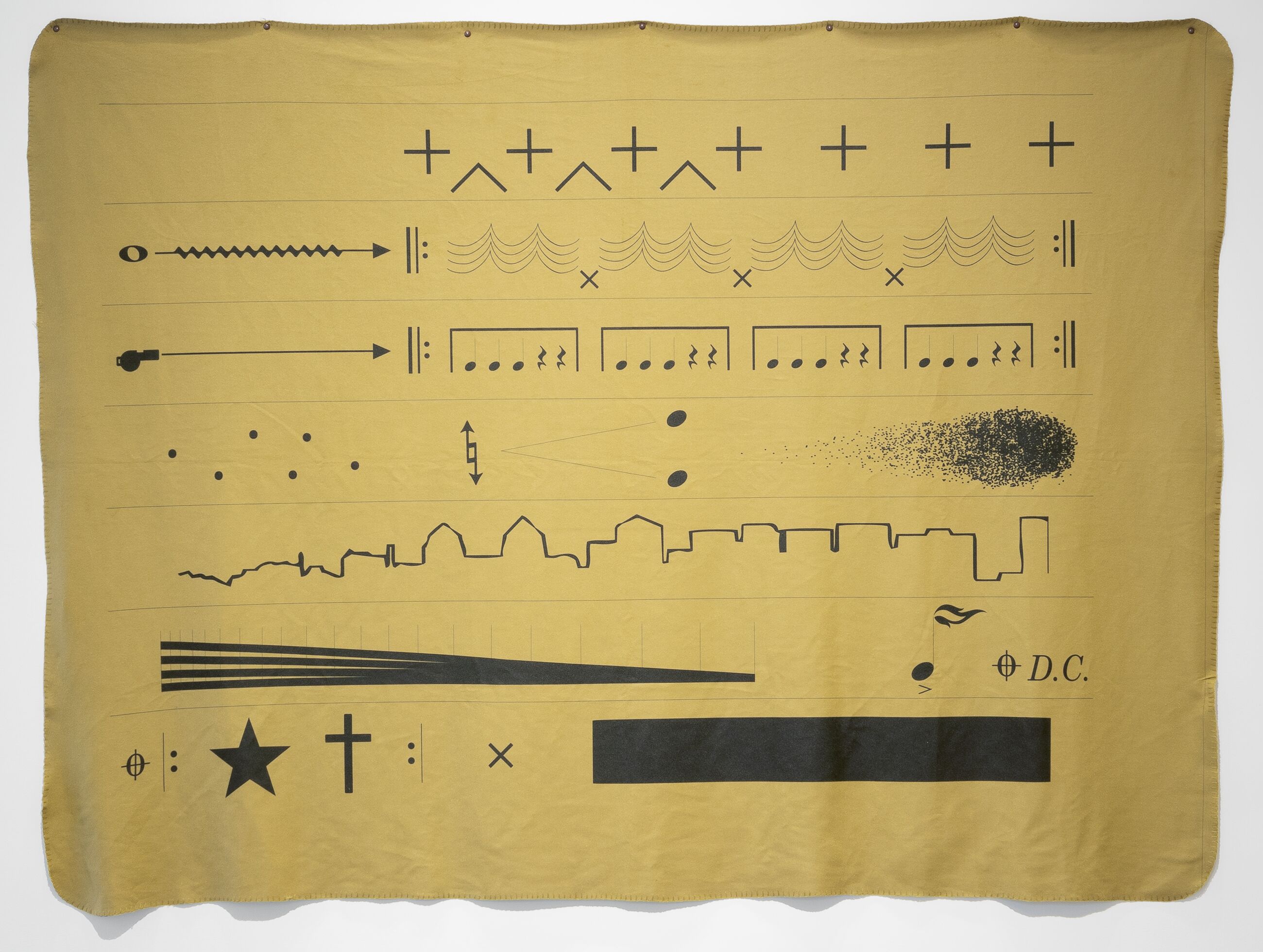
'The artist and composer Raven Chacon, 46, who grew up in Albuquerque and now divides his time between the city and upstate New York, used to explore these lava fields as a youngster, ingesting psychoactive plants such as jimson weed and searching for petroglyphs on the sides of rocks. Some - spirals, zigzags and dotted lines, for example - have found their way into the graphic musical scores for which he is now known. When I visited him in Albuquerque, he drove me out to see them.'
Raven Chacon, American Ledger No. 1 (Army Blanket), 2020. Graphic score


My source: Griffin, J. Sound of a different music. Life&Arts. FT Weekend. 24/25 February 2024. p.17.

Image: ECHOES OF A PLACE - Raven Chacon on transforming land, memory and political resistance into sound: https://www.hauserwirth.com/ursula/echoes-of-a-place-raven-chacon/

See also: RAVEN CHACON - https://spiderwebsinthesky.com/

https://en.wikipedia.org/wiki/Raven_Chacon

Previously: 'music'

Sunday, August 24, 2025

Nothing new under the Sun . . .

"The quadrangle is the token of a new humanity. The square is to us what the cross was to the early Christians". 

Theo van Doesburg

Tate Liverpool visit 13th June 2008.

Friday, November 15, 2024

'Emperor' - Aphasia

individual
|
INTERPERSONAL : SCIENCES              
humanistic ------------------------------- mechanistic
SOCIOLOGY : POLITICAL   
|
group
'Physical
Reality'

Social Reality

'Political
Reality'?!

See also:
Mammary Mountain

Impulse

Faber, T. Lessons in empathy, Life&Arts, FT Weekend, October 5-6, 2024, p.13.

Wednesday, September 11, 2024

THE GRID by Eli Payne Mandel

individual
|
INTERPERSONAL : SCIENCES
humanistic ------------------------------- mechanistic
SOCIOLOGY : POLITICAL
|
group

[125]
'Therefore, a mathematician babbles when he refers to cutting a given line in two. The actual line that he shows to us on the abacus has length and width. But the line he has in mind is a stroke with length and no width. What is drawn on the abacus cannot be such a stroke, and he who goes about cutting it cuts not the line that is but the line that is not.'

(Sextus Empiricus, Against the Mathematicians 9.282)
(n.b. The above is printed upside-down on the page.)

Scatter the trace of the vessel from the ash. Pythagoras here is riddling about confusion and mental cloudiness, for if one wants to do philosophy one must pass over physical and sensible demonstration in favor of abstract argumentation. The ash is analogous to the dust on the abacus in which diagrams are delimited and proofs brought to an end. 

(Iamblichus, Exhortation to Philosophy 34)' p.55


'[1] In ancient Greek, an abacus is a sand table. 'The abacist draws lines and maybe moves pebbles around the lines. When done, she wipes the sand blank. 


[2] A board or slab for drawing, computation, games; a cutting board. Technical term, likely to be a loanword, but conjectured origin in Hebrew abãq "dust" remains unproven. --  Pierre Chantraine, Dictionnaire etymologique de la langue greque.' p.10.

'[122] The abacus computes and it erases. It tells a life. Then gambles it away. Achilles and Ajax sit down to play a game of dice. They have hung up their shields. They lean on their spears. They are tired. The Anatolian air is cold off the water. Attendants wrap them each in wool cloaks thick with eight-pointed stars. The stars wander along eddies and meanders. The only straight lines are servants of error. Their fingers are on the abacus, but Achilles and Ajax do not play, do not speak, lost in the maze of their cloaks.

[124] The first reference in Western literature to written language is in the Iliad. An unsuspecting  man in a story is carrying semata lygra / grapsas en pinaki ptukto thymophthora polla: baleful signs written on a folded tablet, utterly soul-  destroying. The words, which some scholars conjecture to be Linear B, spell out the man's death, and the reader murders  the unreading man. After the murder, Death Wipes the tablet  blank and folds it back again.' p.54.

'[3] Because dust blows away and only the slab remains, an abacus is also the part of a column in immediate contact with what it supports. If that structure no longer survives, the abacus upholds the edifice of the sky.' p.10.


THE GRID by Eli Payne Mandel, Carcanet Press. 2023.

https://www.elipmandel.com/

Previously on W2tQ (with overlap):

arts :: drama :: poetry :: literature :: narrative

Tuesday, July 16, 2024

Honouring 'Wheatfield: a Confrontation' by Agnes Denes

"In the summer of 1982, two acres of wheat were planted and harvested by artist Agnes Denes, two blocks from Wall Street and the World Trade Center and facing the Statue of Liberty.

Planting and harvesting a field of wheat on land worth $4.5 billion created a powerful paradox. Wheatfield was a symbol, a universal concept; it represented food, energy, commerce, world trade, and economics. It referred to mismanagement, waste, world hunger and ecological concerns. It called attention to our misplaced priorities.

The harvested grain traveled to twenty-eight cities around the world in an exhibition called “The International Art Show for the End of World Hunger”, organized by the Minnesota Museum of Art (1987-90). The seeds were carried away by people who planted them in many parts of the globe." twistedsifter

Individual
|
         INTERPERSONAL    :     SCIENCES                   
HUMANISTIC  --------------------------------------  MECHANISTIC      
 SOCIOLOGY  :    POLITICAL 
|

http://agnesdenesstudio.com/

'Honouring Wheatfield: a Confrontation' - ArtBasel from June 10:
https://www.artbasel.com/stories/ecology-pioneer-american-artist-agnes-denes-basel-messeplatz-wheat-field-climate-change-awareness

Images: 

In 1982, An Artist Harvested Two Acres of Wheat on Land Worth $4.5 Billion by TwistedSifter

https://twistedsifter.com/2018/03/new-york-city-wheat-field-by-agnes-denes/

Roux, C. Reaping what you sow, Collecting, FTWeekend, 8-9 June 2024, p.4.
https://www.ft.com/content/346ad7e8-9ddf-4802-9658-053d1c5758a8

Sunday, May 19, 2024

health - Human - LIFE: Career

As highlighted previously, the full title of Hodges' model was originally The Health Career Model.


Reference to 'career' in there, caused many visitors to the first website, and presumably readers of Brian's book chapter:

Hodges, B.E. (1989) The Health Career Model, IN, Hinchcliffe, S.M. (et al.) 1989 Nursing Practice and Health Care, 1st Edition only, London, Edward Arnold.

- to assume the model concerned professional careers, jobs, and employment.

For this reason after some discussion 'care domains' was added:

Hodges' Health Career - Care Domains - Model

A bit ungainly, but it is important that 'health career' was retained. After 5-10 years since first encountering and applying the model in a case study (1987-88), a key appeal of the model for me was its seeming increase in relevance. This may be a function of familiarity, preoccupation, (growing) obsession but the book below by Goldschmidt is confirmation for me.

Goldschmidt describes the 'Career and the Life Cycle' identifying several stages:
  • Infantile preadaptation
  • Training
  • Career launching
  • Career establishment
  • Career maintenance (pp.113-114).
The first, infantile preadaptation appears associate strongly with the idea of life chances. 

Goldschmidt begins: 
"Career is a lifetime process. The word process here is important. If the English language did not render it too awkward, it would be preferable to make a verb out of it: careering. The major phases in the process relate to the physiological changes as the individual moves from infancy toward his ultimate death." p.113.
"The pursuit of career is not merely a social phenomenon in the sense that the values and purposes are socially derived and hence attainment is reflexive of community attitudes, but because career performance always involves two highly social orientations: collaboration and identification. It is a social performance. No person achieves satisfaction going it alone; he must collaborate with diverse others, usually socially structured groups - family or household, clan, age-mates, work associates, or whatever." p.117.
We need to understand that life chances are often determined before life.


   Individual - Self         
|
      INTERPERSONAL    :     SCIENCES                   
HUMANISTIC  --------------------------------------  MECHANISTIC      
 SOCIOLOGY  :    POLITICAL 
|
   Dyad - Group - Culture - Population 
Identity

Work, roles, activity
 for all.

"The activities of the motivated individual can be conceptualized as his or her career. By career I mean that trajectory through life which each person undergoes, the activities he or she engages in to satisfy physical needs and wants and the even more important social needs and wants. The career, then, is activated in the service of both the physical being and the symbolic self."p.107.


The HUMAN CAREER

Policy
Politics

The health career and human career
of future generations
and all life.

Artificial Intelligence -
Future 'careers'?


Today, the health career entails consideration of the life cycle of all life as we not only contemplate planetary health, but seek to assure the biosphere.


Goldschmidt, W. (1990). The human career: The self in the symbolic world. Oxford: Basil Blackwell.

Book cover: https://biblio.co.nz/walter-goldschmidt/author/99497


Sunday, April 30, 2023

Simplicity in Complexity (and vice-versa): c/o Fiona Banner aka The Vanity Press and Frith Street Gallery

INDIVIDUAL
|

 INTERPERSONAL    :     SCIENCES               
HUMANISTIC --------------------------------------  MECHANISTIC      
SOCIOLOGY  :   POLITICAL 
|
GROUP

© Courtesy of Fiona Banner aka The Vanity Press and Frith Street Gallery | Simpleton, Simpleton, Simpleton (Ellipsis), 2021
by Fiona Banner aka The Vanity Press


In nursing you must be aware and sensitive to words, their use and meaning. Recognition of the power of words (in-and-out of context), is hopefully also reflected in society; but sadly emotional, social and spiritual intelligence are often found lacking. Long carrying a sense of being a mathematical simpleton, gullible in over-thinking things, and all too easily distracted; the currents of education, life chances (health career), and clinical experience have brought me to a place I shouldn't tread - whether terra firma, or water.

While socially, words become archaic, replaced by others, words can and do also reverse their meaning over time. Although manufacturing is now also 'additive' and not necessarily a subtractive process, the meaning of these symbols in mathematics remains constant: as per their function.

Simple in appearance, Hodges' model can hide complexity: the complexity of care, in all its scope and scales. And yet with the potential to be inclusive in its relational scope. Symbols and model's - conceptual frameworks can be extended in their purposes and functions, as long as we are consistent in how we do (propose) this.

I will learn how well, temperature permitting, I can 'tread' water, while sign-posting for others. . . .

Ellipsis - indeed.


My source: (print version):

FT.com. Something in the water – the rise of aquatic art

Many thanks to and courtesy of Fiona Banner aka The Vanity Press and Frith Street Gallery | Simpleton, Simpleton, Simpleton (Ellipsis), 2021, by Fiona Banner


Gavin, F. (2022). THE SHAPE OF WATER, How To Spend It, FT Weekend, pp.44-47.

Sunday, October 30, 2022

An observational record and learning from 30,000 years ago

"A fascinating example is the shoulder blade of an ox unearthed in the 1980s (Figure 1) by archaeologists investigating a stone age encampment in the south of France. Carbon dating showed this to be approximately 30,000 years old. The bone was marked with inscriptions that the archaeologist couldn't decipher. It was clear they were neither a tally, nor a pattern, nor any recognisable form of writing. Late one night one of the archaeologists noticed the moon, and something in its shape caught his curiosity.

Aurignacian Lunar Calendar / diagram, drawing after Marshack, A. 1970; Notation dans les Gravures du Paléolithique Supérieur, Bordeaux, Delmas / Don’s Maps
Figure 1 my source: https://sservi.nasa.gov/articles/oldest-lunar-calendars/

Then it struck him. Here, on this fragment of bone, was a lunar calendar complete with 72 observations ... something like 1,600 generations ago. One of our common ancestors (statistically, all of us can claim a relationship to this thoughtful person) 30,000 years ago had the intellectual curiosity to watch the moon, night after night, and then transcribe these movements, at scale, onto the stone age equivalent of the back of an envelope, as he (or she) attempted to "think it through". What makes us human is our ability to think, learn and adapt to our changing environment. The story of the stone age learner gets even better when you imagine a small community of people (adults, adolescents, children on their laps) sitting around a campfire every night working out the meaning of the lunar phases together." pp.72-73.

Abbott, J. & Ryan, T. (2000). Chapter 4, How mass education eclipsed apprenticeship, The Unfinished Revolution: Learning, Human Behavior, Community, and Political Paradox, Stafford, UK: Network Educational Press. (The figure in the book does not include the bone.)

Previously: 'diagrams' , 'archaeology'

[I am also still trying to clear papers and books, as some posts will suggest.]

Monday, May 09, 2022

Social care ...

INDIVIDUAL
|
 INTERPERSONAL    :     SCIENCES               
HUMANISTIC --------------------------------------  MECHANISTIC      
SOCIOLOGY  :   POLITICAL 
|
GROUP


A monument for Taras Shevchenko is symbolically protected by bandages in Borodyanka, northwest of Kyiv.

Nickolai Hammar / NPR


My source: Schama, S. "Who controls the past?", FT Weekend, Life&Arts, 7 May 2022, p.1.

Photo: https://www.opb.org/article/2022/04/09/this-is-what-a-ukraine-town-looks-like-after-russian-troops-withdraw/


Thursday, March 17, 2022

Spheres of influence and integration

Ack:

International Open Seminar on Semiotics

a Tribute to John Deely on the Fifth Anniversary of His Passing

 
INDIVIDUAL
|
 INTERPERSONAL    :     SCIENCES               
HUMANISTIC --------------------------------------  MECHANISTIC      
SOCIOLOGY  :   POLITICAL 
|
GROUP


BIOSPHERE


SEMIOSPHERE


My source via Philos-L "The Liverpool List":

⚘A Holistic Approach to Semiotics: Juri Lotman ☀ Marek Tamm


Universe of the Mind
A Semiotic Theory of Culture
Yuri M. Lotman
Introduction by Umberto Eco

 
I actually had hold of a copy of this book in Hay-on-Wye last month, but back-on-the-shelf it had to go. Must now buy a copy. The title and the introduction by Eco caught my eye initially. Lotman's thought and its fluidity - individual-collective; whole-part ... has much to offer in studying Hodges' model. 
 
 
[Next visit to Hay-on-Wye as advised, I will email in advance, so if needed books ( just one or two ;-) ] can be brought from the warehouse to Green Ink.]

Book image: Indiana University Press

Saturday, October 23, 2021

COVID: Logic is the patient - again...

Hodges' model is evidence seeking, what logic might apply? 
 
Logic was once the 'patient':
“Yet, by 1530, formal logic was a dying branch of studies, and by the seventeenth century it had been completely forgotten. Why? No one to my knowledge has provided a satisfactory answer. Prantl, one of the earliest scholars to take notice of medieval logic, merely relied on the prejudice of four hundred years in depicting the universities as nursing; the sick but obstinate patient (dialectics), until 'the healthy spirit of antiquity conquered the scholastic pedantry'. Bochenski is not concerned with the mechanics of historical change. Ong gives the cause of death as an inherent weakness in medieval logic itself: 'Scholastic logic was dying of the frustration attendant upon its failure to develop a symbolic system adequate to its ambition and the promise of its initial development.' Even if medieval logic could not overcome this weakness, it had nevertheless hobbled along for three hundred fifty years with the malady! Even if the universities artificially prolonged its life, how exactly did the 'healthy spirit of antiquity' do away with the old warrior?” (Heath, 1971, p.47).
 
Individual
|

INTERPERSONAL : SCIENCES
humanistic ------------------------------------------ mechanistic
SOCIOLOGY : POLITICAL
|
Group

logic


LOGIC

logic

logic

Heath, Terrence. “Logical Grammar, Grammatical Logic, and Humanism in Three German Universities.” Studies in the Renaissance 18 (1971): 9–64. https://doi.org/10.2307/2857078.

Sunday, November 10, 2019

Psyche: Amid the Mind and Stars

INDIVIDUAL
|
INTRA- INTER-PERSONAL : SCIENCES
HUMANISTIC -------------------------------------------------- MECHANISTIC
SOCIOLOGY : POLITICAL
|
GROUP
"The Greek origin of the word psyche (breath) is well known but psyche also referred to life as action or as soul, some special force or spirit which entered living creatures. ... It was natural that when psychology and and medical psychology became established with institutions, they would wish for armorial bearings and it was logical that some representation of psyche should be incorporated. ... Some psychiatrists would consider mind to be an epiphenomenon of brain function, many of whose mysteries will eventually yield to scientific and clinical investigation and most would consider the emergent subjective experiences as important in determining behaviour. The current motto "Let Wisdom Guide" is certainly suitable whatever interpretation or meaning is given to Psyche and whatever direction psychiatry may take in the future." p.429,431.

James, F.E. (July 1991). "Psyche". Psychiatric Bulletin. 15 (7): 429–31. doi:10.1192/pb.15.7.429


Artist's concept of the asteroid 16 Psyche
which is thought to be a stripped planetary core.
Image credit: Maxar/ASU/P. Rubin/NASA/JPL-Caltech


Psyche Revived by Cupid’s Kiss
 Antonio CANOVA (1757 – 1822)
Marble - H. 1.55 m; L. 1.68 m; D. 1.01 mMR 1777
Paris, Musée du Louvre

© 2010 Musée du Louvre / Raphaël Chipault
Political mythology:
Government pronouncements on psyche?

Saturday, January 12, 2019

Book: Making of Byrne’s Euclid

individual
|
INTERPERSONAL : SCIENCES
humanistic ----------------------------------------------- mechanistic
SOCIOLOGY : POLITICAL
|
group

My source: Twitter @dr_tj @defilippovale @rougeux

https://twitter.com/defilippovale/status/1074436950663278592

Thursday, July 12, 2018

Yes, Nursing is both an Art and Science but ...

... we don't want facsimile care


individual
|
INTERPERSONAL : SCIENCES
humanistic -- NURSING AS ART & SCIENCE -- mechanistic
SOCIOLOGY : POLITICAL
|
group


iterate, iterate
process, process
repeat, repeat
recurse

Pedro Paricio - 'The Duel'
Halcyon Gallery, 1 July 2018


See also:

Pedro Paricio
[Dear Sir, Thank you for your amazing work and to Halcyon Gallery for the opportunity to view and photograph the above. Just a suggestion - the text on your site e.g. 'biography' is small and not very readable against the background.]

BBC News: NHS still reliant on 'archaic' fax machines

Friday, March 30, 2018

When a Double-Page Spread is not Enough ...

individual
|
INTERPERSONAL : SCIENCES
humanistic ---------------- the HEALTH RECORD --------------- mechanistic
SOCIOLOGY : POLITICAL
|
group

VA ".. how important is the notion of the book or the page to your research and outcomes?"

AGV "They are fundamental to my research.


I explore the double-page spread as a material support and a discursive space for visual ideas within an exhibition context. ...


The double-page spread is for me an extended space, a place to develop a site-specific practice.


... My intention is to generate meaning through symbolic signification, enhancing its material qualities through mirroring, folds, reflections and echoes."


Source: In Conversation, PRINTMAKING TODAY, Spring 2018, Cello Press Ltd. Volume 27, No. 1 Issue 105, p.4. Victoria Ahrens talks to Altea Grau Vidal about her PhD research and the format of the double-page spread as an opening for all her work.

Saturday, November 04, 2017

Book: (more than) Skin Deep ...?

individual
|
INTERPERSONAL : SCIENCES
humanistic --------------------------------------- mechanistic
SOCIOLOGY : POLITICAL
|
group


"For decades now tattoos have been potent symbols of the Los Angeles gang-life scene. The black and white tattoos with recognizable gang symbols appear on members’ faces, necks and all over their bodies, making their gang affiliation immediately clear to whomever crosses their path. This can mean the difference between life and death on he streets, and just as often, in prison. ..." 

My source: Sandhu, S. Crime ink: lifting the layers of prejudice, 20 October, i news, pp.30-31.

Photos: http://www.powerhousebooks.com/books/skin-deep-looking-beyond-the-tattoos/

Thursday, June 08, 2017

The Care Domains: Where numbers count...

INDIVIDUAL
|
INTERPERSONAL : SCIENCES
humanistic ----------------------------------------- mechanistic
SOCIOLOGY : POLITICAL
|
POPULATION
1:1
Intra- Interpersonal Skills


"All the monoliths, though they vary greatly in size, were fashioned to the exact proportions of 1:4:9, the squares of the integers 1, 2, and 3."


"The rise of capitalism in China resulted in the demise of the "iron rice bowl", under which the state-owned industries provided pensions. Retirees now have to fend largely for themselves or rely on their children, but the collapsing fertility rate has led to the infamous "1-2-4" problem in which a single working-age adult will eventually have to support two parents and four grandparents." p.219.

"2 for 1 offer"
Naylor Report


So let's listen to the wisdom of the four elders...

Sources:
2001: A Space Odyssey Wiki

Ford. M. (2015) Rise of the Robots: Technology and the Threat of a Jobless Future, London: Oneworld Publications. p.219.

Thursday, March 10, 2016

The Scope of Nursing::And other things

individual
|
INTERPERSONAL : SCIENCES
humanistic ---------------------------------------  mechanistic
SOCIOLOGY : POLITICAL
|
group

"Scope Resolution Operator (::) 
The Scope Resolution Operator (also called Paamayim Nekudotayim) or in simpler terms, the double colon, is a token that allows access to static, constant, and overridden properties or methods of a class.
When referencing these items from outside the class definition, use the name of the class.
As of PHP 5.3.0, it's possible to reference the class using a variable. The variable's value can not be a keyword (e.g. self, parent and static). 
Paamayim Nekudotayim would, at first, seem like a strange choice for naming a double-colon. However, while writing the Zend Engine 0.5 (which powers PHP 3), that's what the Zend team decided to call it. It actually does mean double-colon - in Hebrew!"
Source: http://php.net/manual/en/language.oop5.paamayim-nekudotayim.php 

Scope of Nursing: (Interpersonal, Sciences, Sociology, Political & Spiritual)  actions, procedures, responsibility, accountability, governance, whistle-blowing, transparency, competency, candour, quality, safety....

Self-care?

Spot image: http://iridia.ulb.ac.be/~cpinciroli/extra/h-414/one_spot.png
