Showing posts with label reflection. Show all posts
Showing posts with label reflection. Show all posts
Monday, August 31, 2026
Thursday, August 13, 2026
Call for Papers: Bioethics and Philosophical Health - JECP
Submission Deadline: Thursday, 31 December 2026
Contemporary bioethics has developed sophisticated tools for ethical decision-making. Yet it often operates within assumptions that reduce life to physiological viability. Ethical questions are frequently treated as matters of procedure and consent. Meanwhile, patients and clinicians face questions that exceed these frameworks. What makes a life worth living? How does illness disrupt or reveal meaning? What forms of care support not just survival but existential coherence? These questions call for a deeper engagement between bioethics and the philosophy of existence.
Despite growing interest in person-centred care, conceptual tools for clinical evaluation remain limited. Frameworks for assessing philosophical sense-making and existential orientation are underdeveloped. The Philosophical Health perspective addresses this gap by going beyond physical and psychological health. It asks how we cultivate meaningful lives through bodily experience, self-understanding, relational belonging, engagement with possibility, purposeful action, and philosophical reflection. The concept draws on the ancient tradition of bios philosophikos. It proposes that healthcare should attend not only to pathology but to the philosophical dimensions of human existence.
This special issue creates space for exploring how philosophical health can deepen bioethical inquiry as an embodied ethics of the good life. It challenges reductive assumptions and fosters practices that support purpose and meaning in lives, even when disrupted by health challenges. We welcome transdisciplinary contributions from philosophers, bioethicists, clinicians, medical humanists, and social scientists. Topics include how philosophical frameworks enrich clinical practice, how healthcare shapes existential experience, how the 4E cognitive approach may inform bioethical theory, and how dialogical methodologies can be integrated into institutional contexts. The issue aims to rediscover bioethics as a genuinely philosophical and existential enterprise, that is as bios ethikos.
Topics of interest for this call for papers include but are not restricted to:
- Philosophical frameworks for enriching or transforming bioethical practice and clinical evaluation;
- Philosophical dimensions of clinical encounters: embodiment, selfhood, temporality, and meaning-making;
- Critiques of the reduction of ethical deliberation to procedure, regulation, or risk management;
- How healthcare practices shape or constrain the philosophical dimensions of human existence;
- The 4E cognitive approach (embodied, extended, enactive, embedded) applied to bioethical theory and practice;
- Integration of philosophical inquiry and dialogical methods into clinical or institutional contexts;
- Empirical and conceptual engagement with the Philosophical Health methodology, including SMILE_PH;
- Cross-cultural and planetary perspectives on philosophical health and the good life;
- Methodological innovations in clinical philosophy, philosophical counselling, and reflective practice.
More details here: https://onlinelibrary.wiley.com/page/journal/13652753/call-for-papers/si-2026-000772
_______
Dr Luis de Miranda
Associate Professor (Docent) in Bioethics, Uppsala University
Marie Skłodowska-Curie Fellow, Turku Institute for Advanced Studies
Associated Researcher, Centre for Research Ethics and Bioethics,
Associated Researcher, Centre for Research Ethics and Bioethics,
Department of Public Health and Caring Sciences, Uppsala University
https://www.luisdemiranda.com/
My source: Philos-L "The Liverpool List" is run by the Department of Philosophy, University of Liverpool https://www.liverpool.ac.uk/philosophy/philos-l/ Messages to the list are archived at http://listserv.liv.ac.uk/archives/philos-l.html. Follow the list on Twitter @PhilosL. Follow the Department of Philosophy @LiverpoolPhilos
Tuesday, August 11, 2026
Philosophical Counselling - Reading group: Taylor 2002 'Central Value of Philosophical Counseling'
In addition to Kantian Desert (this p.m.) it is proving helpful to join a reading group on Philosophical Counselling. Being able to combine clinical and therapy experience* with philosophy is a welcome and rather overdue development. The reading for tomorrow (online for me I hope) is:
Taylor J.S. (2002) The Central Value of Philosophical Counseling. International Journal of Philosophical Practice. 1 (2):1-9.
ABSTRACT: The title of this paper is deliberately ambiguous. It could refer either to the central value that philosophical counseling has for philosophy in general, or else it could refer to something (such as personal autonomy, or personal well-being) that philosophical counselors believe to be of value, and that they are able to help their clients pursue. In fact, this paper will be addressing both of these topics in order to demonstrate
the links that hold between them, and, in so doing, will attempt to further elucidate the nature of philosophical counseling itself.
Taylor (and related papers) also joins the dot (object?) that is Hodges' model, for example (with my emphasis):
'In this vein philosophical counseling is viewed as a Socratic drawing out of the knowledge that the client already possess, and that may be revealed through the careful questioning of a well-trained practitioner of the elenchic method.' pp.1-2.
I've long used guided discovery, by which the students (usually)/audience co-produce the model through a discussion.
'However, the difference between Socrates as a seeker after truth and the philosophical counselor as a professional who helps his or her client map out his or her own world-view in order to address particular problems that he or she is concerned with should not be overstated.' p.2.
'Furthermore—and perhaps most galling of all to philosophical counselors—academic philosophers often seem to view philosophical counseling as not being “real” philosophy at all, but more perhaps a species of social work, or an unsophisticated variant ofpsychotherapy.' p.4.
'Again, this information may be used by the counselor to help the client reflect more acutely upon her own views concerning the morality of abortion.' p.6.
'Given these two senses of “autonomy” it appears that the philosophical counselor is most concerned with enhancing autonomy in the second, Millian, sense of this concept. This is because philosophical counselors often try to aid persons in making decisions (or discoveries) about what it is that they really want to do, what their personal value-system or world-view really consists of.' p.11.
(A contribution to person-centredness? Critical thinking is also noted by Taylor.)
See also: https://www.igpp.org/english
*Including, counselling, family, cognitive and behavioral therapies, plus psychosocial intervention.
Thursday, August 06, 2026
Writing - next project - parts 1 & 2 in search of titles
Currently, I'm pulling together what have become two drafts, that consider Hodges' model as a mathematical object. Part 1, put-down in the new year, and picked-up now; a good start as there is more than I thought. There's a cost of that, of course? Part 2 is a gathering of tatters. Well, it is an effort.
As I don't work in academia where connections may more readily follow, can I claim that Hodges' model also does work? That the model can help in finding potential collaborators and co-authors? Once the fundamentals are understood, and again - it's not rocket science - for some people thankfully, something clicks. It clicks absolutely where it is should.
The model can be quite addictive in a positive way, as one of many among the vast array of assessment, evaluation and other tools. It is complementary.
So, with much needed support to follow, including from previous publication (please see the bibliography in the sidebar), plus April's WCCS26 conference, I'm working away to share them in 12 days or so. Then the work really begins as I benefit from collegial input, new perspectives, views, critique and the reward of constructive debate, experience and knowledge of others. I hope the drafts reward the curiosity that's been displayed. It is still quite exciting. Hoping too that students and early career researchers might pick this up ...
Tuesday, August 04, 2026
Brief introduction to Hodges' model
Hodges’ model is a conceptual framework of universal value in theoretical work, practice, policy and care management. While this model is a product of the health-education sector, it is global in scope, taking in the current situation, history and future as complicated by scientific, socio-political, technology and climate change. Practice-based, Hodges’ model is a tool simple in form and yet powerful in terms of how it can help users frame the problems and opportunities of the 21st century. The model was originally taught in studies for the post-registration certificate of care of the mentally ill in the community and other courses. Student assessment included the completion of a case study (vignette), demonstrating competence in application of the model and its embedded (implicit) values.
Access to education, especially early years, is emphasised as foundational for personal and community growth and development. For individuals this can set the course for lifelong learning and an ability to contribute to society and the economy. Given this primary challenge, global institutions and policy makers point to the need for curricula that are relevant. In turn employers and industry leaders need a (global) workforce who are:
- reflective practitioners;
- critical thinkers;
- able to see the ‘big-picture’; and focus on detail and priorities when needed (risk and triage);
- decompose a problem, but also integrate (care);
- work as team-members;
- and extend across several literacies.
Saturday, July 18, 2026
Hodges' conceptual framework: A model for Narrative Medicine ...
AbstractThe effective practice of medicine requires narrative competence, that is, the ability to acknowledge, absorb, interpret, and act on the stories and plights of others. Medicine practiced with narrative competence, called narrative medicine, is proposed as a model for humane and effective medical practice. Adopting methods such as close reading of literature and reflective writing allows narrative medicine to examine and illuminate 4 of medicine's central narrative situations: physician and patient, physician and self, physician and colleagues, and physicians and society. With narrative competence, physicians can reach and join their patients in illness, recognize their own personal journeys through medicine, acknowledge kinship with and duties toward other health care professionals, and inaugurate consequential discourse with the public about health care. By bridging the divides that separate physicians from patients, themselves, colleagues, and society, narrative medicine offers fresh opportunities for respectful, empathic, and nourishing medical care. ...
Charon R. Narrative Medicine: A Model for Empathy, Reflection, Profession, and Trust. JAMA. 2001;286(15):1897–1902. doi:10.1001/jama.286.15.1897
With my emphasis.
#Identity #Group #Individual #Collective #Mind #Body #TheOdysseyHasBegun
Thursday, July 09, 2026
Leapspace? Why not ...?
Referred to a paper in an email: https://doi.org/10.1016/j.jclinepi.2026.112401.
- I noticed an invitation to try Leapspace.
So I leapt (with much editing - for formatting here). ...

Copilot steps
Creating a plan to respond to your queryPerforming search for foundational documents
Performing keyword search
Using data from Scopus
("Hodges' model" OR "Hodges model" OR "Hodges' health career model" OR "health career model" OR "care domains model") AND (nursing OR healthcare OR "health care" OR education) AND (domain* OR component* OR framework OR concept* OR definition*)
Performing natural language search
Using data from Scopus
What are the conceptual definitions, domains, and components of Hodges' model in nursing and healthcare education?
Performing keyword search
Using data from Full text
("Hodges' model" OR "Hodges model" OR "care domains") AND (diagram* OR figure* OR visual* OR schema) AND (teach* OR education OR curriculum OR learning) AND (critique OR adaptation* OR application*) AND (method* OR framework OR discussion)
Performing natural language search
Using data from Full text
How is Hodges' model represented, taught, and adapted in nursing or healthcare education, including diagrams and critiques?
Performing keyword search
Using data from Scopus
("Hodges' model" OR "Hodges model" OR "care domains framework") AND (application* OR use OR implementation OR practice) AND (critique* OR limitation* OR adaptation* OR evaluation*) AND (nursing OR healthcare OR "health care")
Performing natural language search
Using data from Scopus
What applications and critiques of Hodges' care domains framework have been reported in nursing and healthcare practice?
Done
Generated by LeapSpace, Thu Jul 09 2026
Hodges' health career - care domains - model
Hodges’ Health Career – Care Domains – Model is a generic, practice-based conceptual framework for health and social care that organizes thinking into four knowledge/care domains: science, political, sociology, and interpersonal. It is presented as broadly applicable across healthcare contexts and is used to structure reflection, critical thinking, and care planning. [1] [2] [3]
Core domains
Domain |
What it covers |
How it is used |
|---|---|---|
Science |
Cause and effect, evidence, costs, benefits, and trade-offs |
Helps frame the “hard” evidence side of care and service decisions. [1] |
Political |
Policy, systems, and structural influences on care |
Helps connect care to wider health and social policy contexts. [1] [4] |
Sociology |
Social context, culture, stigma, and relationships |
Helps explain how social factors shape health and illness experiences. [1] [5] |
Interpersonal |
Therapeutic relationships, patient/carer engagement, and human interaction |
Supports person-centred and relational practice. [1] [2] [6] |
What the model is for
It is described as universal in structure and adaptable to many healthcare settings, including informatics, dementia/palliative care, forensic mental health, and oral health. [2] [3] [4] [7] [8]
It helps practitioners map concepts into domains, build a mind-map-like structure, and support reflective practice and critical thinking. [3] [9]
In forensic mental health nursing, it is proposed as a way to guide assessment, decision-making, and recovery-oriented practice. [2]
Bottom line
Hodges’ model is best understood as a four-domain lens for integrating clinical evidence, policy, social context, and relationships into one framework for care and reflection. Its main value is not in prescribing a single care process, but in helping users think more holistically and systematically about health problems and care systems. [1] [2] [3]
Confidence level: High — multiple sources consistently describe the model’s four domains, generic structure, and broad healthcare applications.
References
Fox, Siobhán, FitzGerald, Carol, Harrison Dening, Karen, (...), Timmons, Suzanne (2017) Better palliative care for people with a dementia: summary of interdisciplinary workshop highlighting current gaps and recommendations for future research. BMC Palliative Care. https://doi.org/10.1186/s12904-017-0221-0
Doyle, M., Jones, P. (2013) Hodges' Health Career Model and its role and potential application in forensic mental health nursing. Journal of Psychiatric and Mental Health Nursing. https://doi.org/10.1111/j.1365-2850.2012.01961.x
Jones, P., Wirnitzer, K. (2022) Hodges' model: The Sustainable Development Goals and public health - Universal health coverage demands a universal framework. BMJ Nutrition, Prevention and Health. https://doi.org/10.1136/bmjnph-2021-000254
Bettiol, S., Jones, P., Onyedikachi, H.A., Kernohan, W.G. (2026) Bridging Gaps in Oral Health Frameworks: Mapping With Hodges' Health Career - Care Domains - Model. Journal of Public Health Dentistry. https://doi.org/10.1111/jphd.70034
Jones, P. (2008) Exploring serres' atlas, Hodges' knowledge domains and the fusion of informatics and cultural horizons. Social Information Technology: Connecting Society and Cultural Issues. https://doi.org/10.4018/978-1-59904-774-4.ch007
Merritt, M.K., Procter, N. (2010) Conceptualising the functional role of mental health consultation-liaison nurse in multi-morbidity, using Peplau's nursing theory. Contemporary Nurse. https://doi.org/10.5172/conu.2010.34.2.158
Jones, P. (2009) Socio-technical structures, 4Ps and hodges' model. Nursing and Clinical Informatics: Socio-Technical Approaches. https://doi.org/10.4018/978-1-60566-234-3.ch011
Jones, P. (2011) Socio-technical structures, 4Ps and hodges' model. Clinical Technologies: Concepts, Methodologies, Tools and Applications. https://doi.org/10.4018/978-1-60960-561-2.ch215
Jones, P. (2025) A Generic Model and Conceptual Framework to Prime Curiosity Across Health and Social Care Disciplines to Facilitate Lifelong Learning. Journal of Evaluation in Clinical Practice. https://doi.org/10.1111/jep.70252
What are the key components of Hodges' health career care domains model?
How does Hodges' model apply to interdisciplinary health care practices?
What are the implications of Hodges' health career care domains model for patient-centered care?
Sunday, July 05, 2026
Degree Award in Reflective :: Reflexive Theory and Practice
Joint Hons. Running the Gauntlets in OverThinking
individual
|
INTERPERSONAL : SCIENCES
INTERPERSONAL : SCIENCES
humanistic ------------------------------- mechanistic
SOCIOLOGY : POLITICAL
|

My source: Somerset House - 1st July 2026 M.C. Escher The Exhibition
Saturday, July 04, 2026
Tricotyledons, systems and social problems: TAKE ii iii iv
Act I, Scene 3
'Thomasina What a faint-heart! We must work outward from the middle of the maze. We will start with something simple. (She picks up the apple leaf) I will plot this leaf and deduce its equation. You will be famous for being my tutor when Lord Byron is dead and forgotten.' p.31.
It appears that polycotyledon seed growth beyond tri-form is rare:
https://en.wikipedia.org/w/index.php?title=Cotyledon&oldid=1356872880
We must hope that the four-leaf clover is recognised and not just trampled underfoot.
One of the benefits of a four-leaf conceptual framework is that should you have the germ of an idea, you can reflect in (relative?) safety, exploring the conceptual ecosystem, its cognitive environs and nurture it to realisation.
n.b. In care making a difference, does not mean you have to be exceptional. ...
See post i: Tricotyledons, systems and social problems
https://hodges-model.blogspot.com/2026/07/tricotyledons-systems-humanities.html
Monday, June 22, 2026
Maker-field: More than just a point* on a map
Ashton-in-Makerfield has been in the news of late. With Andy Burnham MP championing the communities of the north; local issues, socio-economic gaps, needs and everyday lived experience up North.
But Makerfield holds much more as a veritable rabbit-hole supporting lifelong learning, character development, reflective practice and critical thought:
* - a political constituency.
Previously: 'map'
Saturday, June 06, 2026
"step inside" TO "think outside"

individual
|
INTERPERSONAL : SCIENCES
INTERPERSONAL : SCIENCES
humanistic ------------------------------- mechanistic
SOCIOLOGY : POLITICAL
|
group
c/o Somerset House, 6th June 2016.
Saturday, May 09, 2026
v WCCS26: World Conference on Complex Systems 20-22nd April
Day 2 Tuesday 21st April (Revisiting) Keynote Speaker: Abderrazak El Albani -
Emergence of Intercellular Cooperation: At the Origins of Eukaryotic Complexity
Session Chair: Khawla Tadist
This keynote was fasacinating. As I begin this post on the 100th birthday of Sir David Attenborough, who would have us all see life in the broadest terms, value life and diverse habits, and Earth as our collective and shared home.
Abderrazak El Albani explained the search for LUCA the last universal common ancestor - 3.8 billion years ago. Many dates in the emergence story of humanity, have been progressively pushed back. The first fire, art, languages, our co-habitation and intimate relationships with Neanderthals.
In healthcare, as a practitioner you have to be aware of your scope of practice. At WCCS, scale (as in iv) was ever present across research in complexity, and complex systems. Not just physical size nano-to-mega but temporal too, as we journeyed billions of years. Several of the slides are presented here:
https://www.synchrotron-soleil.fr/en/news/discovery-oldest-macroscopic-planktonic-eukaryotes-contribution-nanoscopium-beamline (with a reference).
There is a video (French): https://www.youtube.com/watch?v=bh3t26cU7xc
I asked a question, which may have been psychological preparation for own presentation to follow. Listening, I could see how the work Abderrazak El Albani and his team are doing, could be readily translated to the search for life on Mars. There has been a 'routine' interchange of planetary material between Earth and Mars over the aeons. Fitting surely that the sedimentary rocks sought lie in A key lesson, is that light helps us see, but not all lights are equal. Light sources brighter than the sun become incredible scientific instruments. The longevity of the dinosaurs was highlighted, at least 140 million years. There is no comparison with homo sapiens then, even as those dates have been pushed further back in time. Time defeated me as I tried to make the observation that even the dinosaurs did not make it to their first galactic birthday (c.250 million years - and what a carousel). I like the thought (slide) of 'Earth as Memory'.
What really counted was the expressed concern about what is happening now: in the Anthropocene.
The second keynote:
Nigel Gilbert - Policy in a Complex World: Towards Complexity-Aware Policymaking
Session Chair: Ali Idri
Was helpful to me, as the dated conundrum of benefits realisation from our technologies, and evidence-based policy still leaves a gap (for me) within the POLITICAL care/knowledge domain of Hodges' model. The illustration/graphic elements of Prof. Gilbert's slides were a brilliant complement to the content:
 |
| Prof. Nigel Gilbert - WCCS26 21st April |
I wonder if within policy the constant in the equation is continuity and as a quantity it is an unknown? This seems to the case in health policy, across successive governments. You may (also) find this chart informative: https://www.cecan.ac.uk/news/the-visual-representation-of-complexity/
Perhaps, a key factor in complexity is the fact that nothing stays the same, so continuity is nuanced? Michael Quinn Patton's book Developmental Evaluation was noted re. learning while doing. Now I wish I'd held on to Qualitative Research & Evaluation Methods (4th ed.). The discussion of 'obesity system map' and 'whole systems analysis' was appreciated here.*
Since Marrakech and WCCS, I've noticed acknowledgement in the literature that 'research' is currently flooded with AI tools. I'm sure PRSM - Participatory System Mapper is a welcome addition, (as noted in iv) tools to facilitate participation are much needed:
Collaborative Creativity
The Participatory System Mapper (PRSM) is an app that makes it easy to draw networks (or 'maps') of systems, working together collaboratively.'
I will definitely check this resource out; and CECAN. After Prof. Gilbert, the next Track included my contribution, which I will return to. Rather distracted, I have a somewhat blurred slide, with: 'The global tensor of educational research is' then headed 'Learning poverty. Being unable to read and understsand a simple text; with points 1-4.'. I'm not sure which presentation this was, but zeroed in on the literacy theme, and the word tensor. Another slide refers to '6. Topological substitution for Success'. I think it is (writing this is helping recall!):
Harvey Spencer Sánchez-Restrepo, Jorge Louçã, Martha Belén Carmona-Soto and Sofialeticia Morales-Garza
Topological Patterns of Academic Success: Insights from Complex Network Analysis
 |
| 'Always Label Your Axes' - Zazzle. |
Before that there was another model, as the next keynote speaker: Chris Bauch demonstrated during the conference wearing a t-shirt:
Critical Transitions in Coupled Human-and-Natural Systems and their Early Warning Signals
Session Chair: Mohamed Essaaidi
Previously: 'nexus'
*Jones P, Wirnitzer K. Hodges’ model: the Sustainable Development Goals and public health – universal health coverage demands a universal framework. BMJ Nutrition, Prevention & Health 2022;5: doi:10.1136/bmjnph-2021-000254
Wirnitzer, KC. et al. (2025) Toward a roadmap for addressing today's health dilemma – The 101-statement consensus report. Frontiers in Nutrition. Volume 12.
https://frontiersin.org/journals/nutrition/articles/10.3389/fnut.2025.1676080 DOI:10.3389/fnut.2025.1676080
S. Bettiol, P. Jones, H. A. Onyedikachi, and W. G. Kernohan, (2026) Bridging Gaps in Oral Health Frameworks: Mapping With Hodges' Health Career - Care Domains - Model, Journal of Public Health Dentistry. 1–14, https://doi.org/10.1111/jphd.70034
Friday, May 08, 2026
iv WCCS26: World Conference on Complex Systems 20-22nd April
Day 1: Panel 2 - Rethinking Knowledge in the Age of Complexity
- Helena Knyazeva - Dancing with Complexity: How the World Thinks Through Us
- Carlos Gershenson - The Implications of Complexity
- Leonardo Rodríguez Zoya - Can Statistics Think? Complexity, Future, and Freedom in the Age of Large Language Models
Panel Chair: Nigel Gilbert
Courage is one of the 6Cs in nursing, and was on display at WCCS26.
Carlos Gershon began by offering two references, the first:
De Domenico, et al., (2019). Complexity explained: A grassroot collaborative initiative to create a set of essential concepts of complex systems. https://complexityexplained.github.io
This is a brief 20 pages, larger text, and provides a helpful primer to complexity and related concepts covering:
Interactions
Emergence
Dynamics
Self-organization
Adaptation
Interdisciplinarity
Methods
For each concept, the authors explain:
Definition/Description
Examples
Relevant Concepts
References
Plus, secondly:
Gershenson, C. The Implications of Interactions for Science and Philosophy. Found Sci 18, 781–790 (2013). https://doi.org/10.1007/s10699-012-9305-8
I liked the practical feel here, the encouragement to think anew, and perhaps taste the "flavors of emergence": synchronic - space; diachronic - time, weak and strong feedback, transversal of scale - upwards and downwards.
There is further conference on complexity later this year (and also online!):
CCS 2026:
The 2026 Conference on Complex Systems
OCTOBER 9 - 16, 2026 BINGHAMTON, NY, USA & ONLINE
In my search I also found:
Carlos Gershenson; Complexity, Artificial Life, and Artificial Intelligence. Artif Life 2025; 31 (3): 289–303. doi:https://doi.org/10.1162/artl_a_00462
Gershenson, C. Self-organizing systems: what, how, and why?. npj Complex 2, 10 (2025). https://doi.org/10.1038/s44260-025-00031-5
Leonardo Rodríguez Zoya's presentation helpfully connected social practice, interdisciplinary bridges, statistical rationality, complex (human) rationality and the future(s): desirable, possible, latent and probable.
individual
|
INTERPERSONAL : SCIENCES
humanistic ------------------------------- mechanistic
SOCIOLOGY : POLITICAL
|
group
COMPLEX (HUMAN) RATIONALITY cognition | STATISTICAL RATIONALITY |
socio- | ELECTION - CAMPAIGN SPENDING PEACE NEGOTIATIONS ISLAND ECONOMY CRYPTOCURRENCY |
To answer the prompt -
"Give me a less likely but more fruitful interpretation of this [concept]*."
*Replace with a significant concept in your practice
*Replace with a significant concept in your practice
Would it might help to have a simple, and yet complexity (and simplicity!) primed conceptual framework to assist reflection, argumentation, and progress?
I missed the poster at the afternoon break, and followed track 1. I greatly enjoyed Julian Arevalo's - Adaptive Readiness: an Agent-Based Model of Peace Negotiations. Perhaps this accounts for my having no notes or photos for this track except for one. I realise now we did speak, sitting together for the conference dinner. I'm sure I remember Negotiation Lab 1.0 -
https://www.comses.net/codebases/1256dc74-9ae4-4f49-a235-1ec129be1930/releases/1.0.0/
https://www.comses.net/codebases/1256dc74-9ae4-4f49-a235-1ec129be1930/releases/1.0.0/
This past week I heard discussion (BBC Radio 4) of the 'income' Norway obtains from its expertise and engagement in peace negotiations.
Nicholas Roxburgh, and colleagues Rachel Creaney, Mindi Premarathne and Ruth Wilson through
Exploring Interdependencies in an Island Economy, reminded me of public engagement in research. Especially when it involves their community; and that community is somewhat rural, or remote.
Exploring Interdependencies in an Island Economy, reminded me of public engagement in research. Especially when it involves their community; and that community is somewhat rural, or remote.
Remah Dahdoul, with Jan Korbel and Stefan Thurner presented -
Campaign-Spending Driven Polarization Transition in a Double-Random Field Model of Elections. The following paper brings home the mathematics in complex systems. The reference is:
Jan Korbel and Remah Dahdoul and Stefan Thurner. (2026) Empirical validation of the polarization transition in a double-random field model of elections. arXiv. https://arxiv.org/abs/2510.00612. doi.org/10.1103/9gjj-1df6.
The paper by Saida Hachimi El Idrissi and Mohamed Nemiche is not open access, but the abstract follows.
S. H. El Idrissi and M. Nemiche, "Formation of Complex Societies: An Agent-Based Model Inspired by Freudian Theory," 2024 World Conference on Complex Systems (WCCS), Mohammedia, Morocco, 2024, pp.1-6, doi: 10.1109/WCCS62745.2024.10765573.
Abstract: The rise and emergence of complex societies in the Old World mark a pivotal chapter in human history, characterized by the transition from small, kin-based communities to large, hierarchical states. This transformation raises fundamental questions: How did human societies progress from small, cohesive groups characterized by face-to-face cooperation to the expansive, anonymous societies of today, often organized as states? What factors account for the significant variation in different human populations' capacity to construct stable and functional state structures? To address these questions, we developed an agent-based model grounded in Freud's hypothesis, which posits that civilization could neither emerge nor evolve without the repression of human desires. In the context of social evolution, this repression of desires can be interpreted as the repression of intra-societal competition, ultimately strengthening the society and facilitating the formation of complex social structures. We implemented this model within a realistic representation of the Afroeurasian landmass, incorporating various geographical factors. To validate our model, we compared our simulated results with historical data. The model-predicted pattern of expansion of complex societies demonstrated remarkable congruence with the observed historical patterns in the Old World. The emergence, growth, and distribution of large-scale societies predicted by our computational model showed remarkable consistency with the archaeological and historical record.
keywords: {Analytical models; Computational modeling; Predictive models; Data models; Agriculture; Rivers; History; Complex systems; component; Agent-based Modeling; Repression of satisfaction; cooperation; competition; Social Simulation},
URL: https://ieeexplore.ieee.org/stamp/stamp.jsp?tp=&arnumber=10765573&isnumber=10765499
Unless you are a microsurgeon (increasingly with robotic co-workers), is the word practice, more likely to manifest what is larger, the big picture, a sense of space, even at a societal or continental scale? In reading, I came across four forms of attractors. For me, how they fit into the question of scale makes this paper worthy of seeking out.
M. Nemiche was unable to attend the conference, and was greatly missed.
M. Nemiche was unable to attend the conference, and was greatly missed.
Monday, May 04, 2026
iii WCCS26: World Conference on Complex Systems 20-22nd April
 |
Chaos Making a New Science by James Gleick |
When I first learned of WCCS26, I saw a connection, an affinity across the conference themes. This was reinforced when I read the final program for WCCS. Here was a home for the model, a way-point for Hodges' model. For an independent scholar, it was quite a trip to Ben Guerir, to the north of Marrakech; 13 hours (brief by global standards). It was a place to wave wildly, making use of the opportunity to present Hodges' model, to say - "Dear All, can you do anything with this?".
It is almost 40 years since I read James Gleik's, Chaos: Making a New Science. That was in Cornwall I think? Now, something more than book - a complexity conference.
After the first two keynotes - two panels:
Panel 1 - Complexity, Society & Global Challenges
▪ Carlos Álvarez Pereira - No Limits to Hope: Escaping from the unreasonable effectiveness of Modernity
▪ David Chavalarias - The Artificialization of Cultural Evolution: the Impact of Very Large Digital Infrastructures on Individuals and Society
▪ Louis Klein - Noospheric Singularity and the Mirror of Tamkeen
Panel Chair: Karima Kadaoui
These confirmed I was in the right place. Well, it was bit late if I wasn't! I was reminded of the slow movement, and how in healthcare, specifically client-nurse intereactions you had time to manage your time, that is your caseload to deliver person-centred care. I don't mean time-wasting, as in social chat, tea and custard creams either. This is what being professional is about, truly trying to make a difference - that lasts. So we worked through: What is; (science) what we understand; and (tech and law) what should be. Ecologically, we often refer to the size of our footprints. Panel one considered this individually and collectively - institutionally. Fascinating to reflect upon these themes and how modernity is stamping about in a rather chaotic way? We are seemingly power-less to stop this.
 |
| c/o Carlos Álvarez Pereira No Limits to Hope: Escaping from the unreasonable effectiveness of Modernity |
Three reports to the Club of Rome were displayed, spanning 'NO LIMITS TO LEARNING - Bridging the human gap' 1979; 'Limits and Beyond' 2022; 'NO LIMITS TO HOPE - Liberate the potential for Collective Learning' 2026. Should we be troubled, worried even, that the latest followed after a mere four years? There are of course, many reports as per the link above.
David Chavalarias - The Artificialization of Cultural Evolution: the
Impact of Very Large Digital Infrastructures on Individuals and Society spoke about the beneficial and malign impacts of social media AI tools. Covid featured as might be expected. Within the sciences, what was worrying, was an innovation slowdown associated with AI, non-AI use, chartered around a central point (centroid). I believe the slide referred to:
Qianyue Hao & Fengli Xu & Yong Li & James Evans, 2026.
"Artificial intelligence tools expand scientists’ impact but contract science’s focus," Nature, vol. 649(8099), pages 1237-1243, January.
There was one slide:

Is this the demise of any efforts to achieve SOCIO-technical synergy? Even to the extent of realising benefits for the human in socio-technical systems? Did Covid not teach us anything about the informational difference technology can make? When so many technologies are muted by a virus? This is what we need: things to think about, question and critique.
There used to be a series of A3 step-by-step oil painting magazines in the 1970s. One presented a desert campfire, clearly set in the east. I did try it, though not sure were the result is now. ... Such a scenario was presented by Louis Kleinand the Noospheric Singularity and the Tamkeen Process - Regenerative Hermeneutics, with the following reference provided:
Klein, L., & Kadaoui, K. (2024). Realising metamorphic transformation in the mirror of Tamkeen: Growing a shared understanding from co-reflected lived experiences. Systems Research and Behavioral Science, 41(5), 738–749. https://doi.org/10.1002/sres.3058
There was much I could identify with. And, once again, I cannot continue at this pace. We have only covered (touched!) panel one. Hopefully you now have an idea of the depth of the conference programme. More however, will follow.
See also: thefifthelement.earth
Chaos - cover: https://www.goodreads.com/book/show/826080.Chaos
Friday, February 20, 2026
Presentation: 'An example of open research sharing Hodges’ Health Career Model'
From: Ulster University Open Research Conference 2026
Simms, V., Jacobs, N., Magee, J., De Ornellas, K., Mollik, E., Kernohan, W. G., Leacock, J., Akter, J., Sempey,
C., Beech, S. E., Naz Asif, R., Yap, L. K., & Miller, K. (2026, Jan 16). Ulster University Open Research
Conference 2026: Conference Speaker Abstracts. Ulster University. Advance online publication.
https://doi.org/10.21251/0d7780ce-ce97-468f-b5d5-69201ca90b20
Speaker: Professor George Kernohan
School or Department: School of Nursing and Paramedic Science Ulster University
Email: wg.kernohan AT ulster.ac.uk
The area(s) of open research talk relates to:
Practice as research; Open data/ Open code
Talk Title:
An example of open research sharing Hodges’ Health Career Model
Abstract:
This paper examines a blog post [see below, pj], “Thinking about a comprehensive framework for dementia,” as a case study illustrating the integration of open research practices within dementia palliative care research. The post introduces the Hodges’ Health Career Model— a four-domain conceptual framework encompassing biomedical, psychological, social, and policy perspectives— to articulate the multidimensional nature of dementia and inform care planning. As an openly accessible research communication, the blog contributes to transparent and inclusive knowledge exchange beyond traditional academic channels.
The blog exemplifies practice-as-research, translating conceptual development from theory into a form of scholarly exposition that invites engagement from practitioners, policymakers, carers, and people living with dementia. It forms part of a wider programme of work in which the research team openly documents methods, emerging findings, and reflections across scoping reviews, surveys, and service case studies hosted on the same platform. These materials complement peer-reviewed open access outputs, including open publications.
The project demonstrates alignment with open research principles through prospective protocol registration: the scoping review protocol is publicly available on PROSPERO. The team’s prior work on blogging as a mechanism for knowledge mobilisation strengthens the methodological coherence of using this medium to disseminate conceptual frameworks and preliminary insights.
Although the blog does not itself provide underlying datasets or analytic code, it outlines methodological approaches that could facilitate future open data practices, particularly in qualitative and mixed-methods research. Overall, the case illustrates a pragmatic and pluralistic adoption of open research methods across dissemination, protocol transparency, and public engagement, offering a model for enhancing accessibility and reproducibility in dementia palliative care research.
.
Title: “Thinking about a comprehensive framework for dementia”
Author: Professor George Kernohan
Date: 7 November 2019
Link: https://pallcare4dementia.com/thinking-about-a-comprehensive-framework-for-dementia/
Thursday, February 05, 2026
c/o Jayne Wilton: Reflex-ive :: Reflection - Breathe : DO - REPEAT - WHILE
INDIVIDUAL
|
INTERPERSONAL : SCIENCES
HUMANISTIC -------------------------------------- MECHANISTIC
SOCIOLOGY : POLITICAL
|
GROUP
'Many of us will have experienced playing with the interaction of our breath on shiny surfaces such as windows and mirrors, allowing us temporary fields of condensation in which to doodle thoughts or messages. In emergency situations a mirror or shiny surface is held in front of the mouth of a subject to confirm whether or not they are breathing. The Breathe series makes use of these dynamics. The breath of a series of individuals was captured on a shiny copper surface and then etched to create a negative of the breath where it sat on the copper plate. The result is a series of evocative landscapes. This work employs and yet subverts traditional printing processes. The inscription of spent breath onto precious metal immortalises a discharge and presents an alternative to portraiture.' Jayne | Reflection - Reflexive Resuscitation  mirror |
Wilton - is a visual artist who explores the breath as a unit of exchange between people and their environments. Her practice uses darkroom processes with drawing, photography, video and sound to capture the usually invisible trace of breath as it moves across a surface. www.jaynewilton.com |
My source and thanks to Jayne Wilton:
Jayne Wilton. Breathe, Artist's Statement. Resurgence & Ecologist, July/August2023: 339: p.47 & (p.49 image).
Previously: 'breathing' : 'reflex' : 'reflection' : 'art'
Tuesday, January 27, 2026
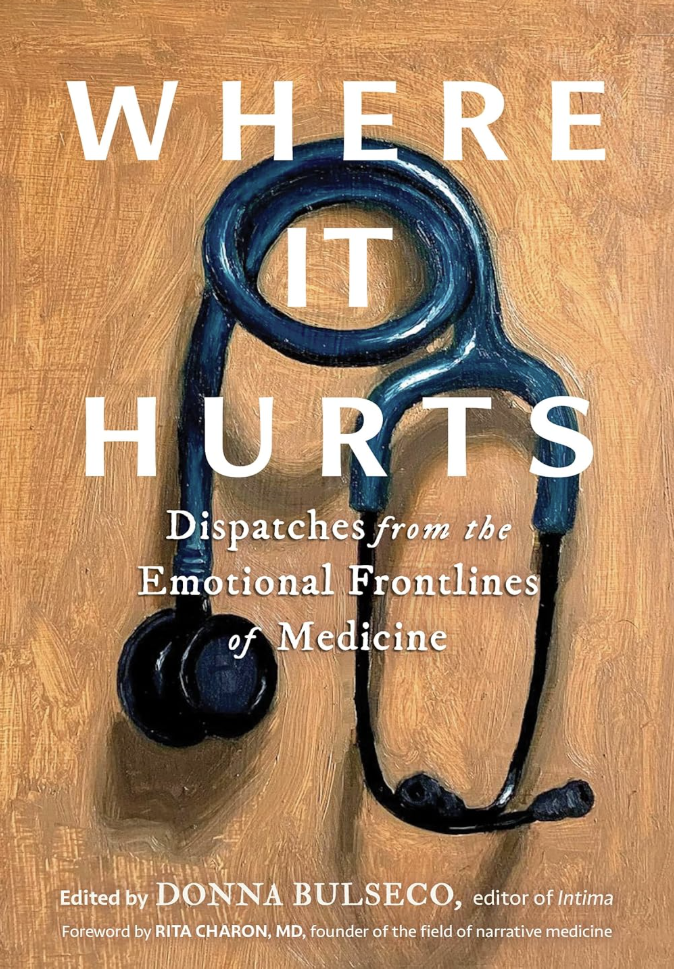
c/o Intima 'Reflect on the World' . . .
CARE/of Intima:
REFLECT ON THE WORLD WITH US EVERY FRIDAY AT NOON. |
No pressure, but we want to remind you that every Friday, around noon EST, we post a Crossroads blog—a short reflection that contributors from our current issue do on something from our archives. Think of “Friday at noon” as a blip in your busy life where you take time to yourself to reflect on our small part of the universe. Pause and spend 5 minutes reading one each Friday — it’s the equivalent of a deep-breathing exercise, a short yoga stretch, a tiny palate cleanser of lemon sorbet between the complex courses served up to us every day, or a moment stolen between patients or in a waiting room when you step out of your routine. Read the titles of recent ones below, then go and read a few. If you like what you read, set up a reminder alert. |
◇
INDIVIDUAL
|
INTERPERSONAL : SCIENCES
HUMANISTIC -------------------------------------- MECHANISTIC
SOCIOLOGY : POLITICAL
|
GROUP
 | |
 |
My source: Intima (and image) - mail list.
See also: 'reflect' : 'crossroads'
Saturday, November 01, 2025
ii On Sociology & Becoming a Nurse
Two final observations re.
Maclean, Una. (1974) Nursing in contemporary society. London: Routledge & Kegan Paul.
https://wellcomecollection.org/works/qhqc24fv
Firstly, there is a question for new student nurses:
'In the case of nursing, the Royal College of Nursing laid down the course of training and the final tests whilst the General Nursing Council held the solemn register to which aspiring professionals were ultimately to be admitted, and the aim of these two powerful proponents of the nurse's unique role was to limit he epithet 'nurse' to those who had successfully navigated the straight and narrow path to registration.' p.67.
Q. Above, Maclean refers to a solemn register. What do you believe may have shaped the author's writing at that time in 1974? Is the nurse register, towards which you now aspire still 'solemn'? 2000 words.
There has been much debate of late regards the title 'Nurse'. 'Doctor' also.
Secondly, Maclean was prescient in acknowledging the 'Patient's right to information'. pp.119-120.
Thursday, October 09, 2025
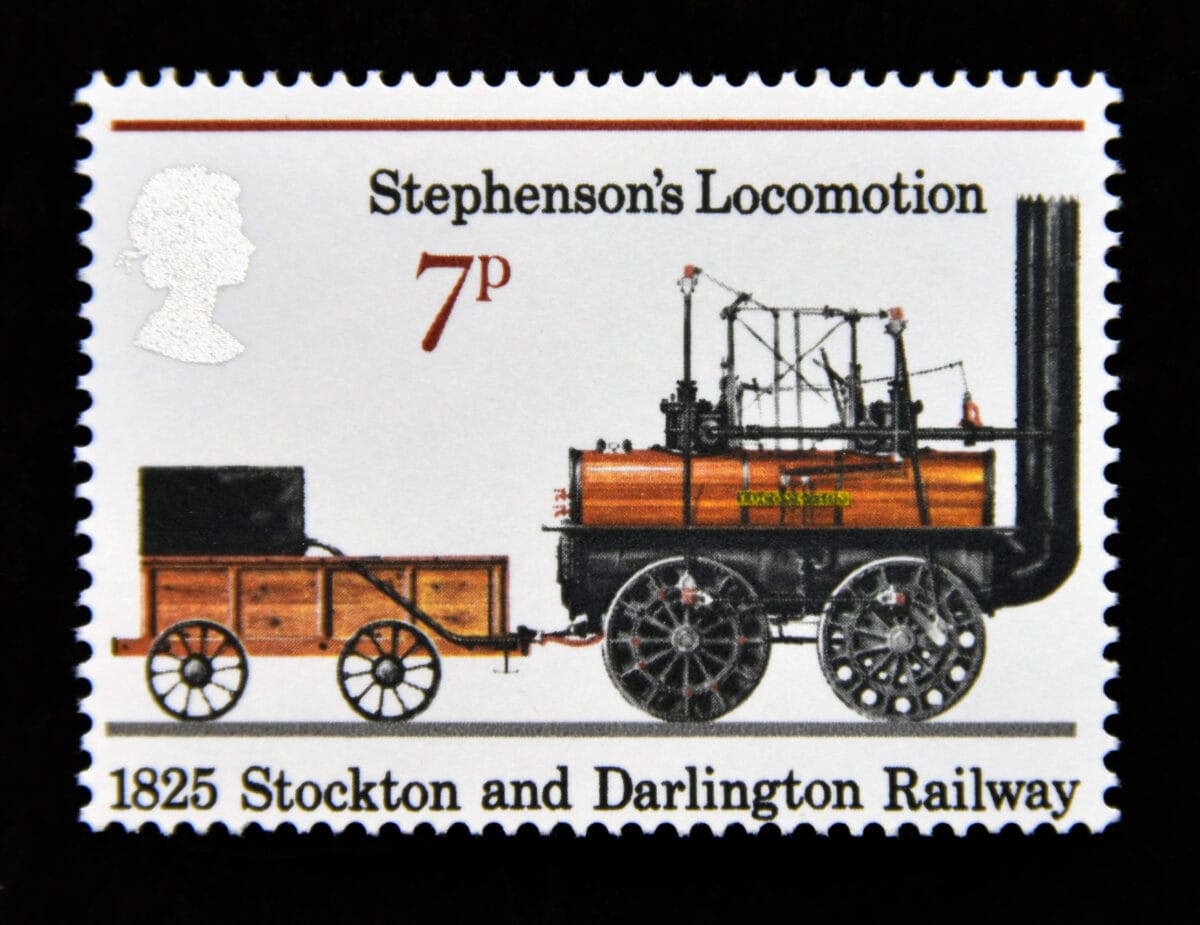
The creation of Hodges' model: "All aboard!" 200 years
 |
| 28th May 1997 |
I wish I could have been sat by him, to strike up a conversation. Although (among other points) I'm not sure how much he relied upon, or was chasing down the visual side of the model, with some skethces and drawings. So would I have noticed him thinking, drawing, crossing-out, and labelling? This I would have noticed, not that I have a habit of 'spying' and being nosey. Although nowadays, with the repeated announcements on the trains: ‘See it. Say it. Sorted’; perhaps I should?
In 1983 I was a general student nurse (SRN), and still over a decade away from becoming a community psychiatric nurse in 1985, and being (well) taught by Brian and colleagues in 1987.
I also enjoy a (reliable!) train journey, and used to read a lot travelling from the NW England through the London underground (Euston-Waterloo) to Plymoth, and later to Portsmouth in the 1970s. Happy days, then and today; with the railways reasserting their relevance. A quality shared with a certain little-big model I know.
Individual
|
INTERPERSONAL : SCIENCES
HUMANISTIC ========================= MECHANISTIC
SOCIOLOGY : POLITICAL
|
Group
| |||
Nationalised - Private Private - Nationalised Charity - CIC |
Saturday, October 04, 2025
Argumentation - Journal: Informal Logic
Early evening (UK) yesterday, I joined a further webinar on argumentation. Through the speaker, and discussion, I was led to a journal
It is in informal logic that I see a role for Hodges' model. The model's structure providing a universal foundation of knowledge domains to be applied in practice. The bonus of this journal, is its being open access, a search revealed the following paper:
Mark Weinstein. Towards a Research Agenda for Informal Logic and Critical Thinking. XII.3, Fall 1990.https://ojs.uwindsor.ca/index.php/informal_logic/article/view/2609
'This paper recommends that the recent concern with informal logic and critical thinking be redirected from its general philosophical focus and towards a greater appreciation of the particulars of practice in the various domains of human understanding. The redirection recommended is prompted by the central role that critical thinking and informal logic can be seen to play in meaningful educational reform, especially at the undergraduate level.'
'Critical thinking, similarly, should be redirected from concerns typical of philosophers and towards issues and approaches more representative of critical thinking both within and across the wide range of disciplines represented by the course of undergraduate studies.' p.121.
'The sense that there is an internal relationship between arguments, argumentation and domains of knowledge persists despite attempts to show relevant and useful notions of critical thinking that are generally available for instruction and neutral in respect of the disciplines. The resolution of the issues generated by these competing views, requires that reflective practitioners of the disciplines, students of the history of ideas, methodologists and specialists in teaching increasingly engage in the task of generating and organizing the data upon which an informed and adequate notion of critical thinking across the disciplines must be based.' p.125.
I believe that the structure of Hodges' model provides a basis for Weinstein's ordinary argumentation and stylized argumentation.
For me (at present) ordinary argumentation, is 'open' argumentation. That is, without differentiation in (using) Hodges' model. I might (well, I would) have Hodges' model in mind, but choose not to apply it. As per the paper, stylized argumentation is using Hodges' model and doing so in a multidisciplinary manner - within my discipline.
The problem and challenge for nurses and other health professionals is the need, if:
- person/patient-centred;
- integrated;
- and holistic - having regard for parity of esteem (mind - body)
- not to stray, extend the disciplinary scope, while working within one's professional scope.
In highly effective multidiscioplinary teams that touch on being transdisciplinary (hybrid?), can experienced team members have insight into the stylized argumentation of their colleagues?
Ack. Argumentation network of the AMERICAS - https://www.argnet.org/ethics-of-arg.html
Previously: 'critical thinking'
Subscribe to:


 orcid.org/0000-0002-0192-8965


