Hodges' Model: Welcome to the QUAD: oral health

Hodges' model is a conceptual framework to support reflection and critical thinking. Situated, the model can help integrate all disciplines (academic and professional). Amid news items, are posts that illustrate the scope and application of the model. A bibliography and A4 template are provided in the sidebar. Welcome to the QUAD ...

Showing posts with label oral health. Show all posts

Thursday, July 09, 2026

Leapspace? Why not ...?

Referred to a paper in an email: https://doi.org/10.1016/j.jclinepi.2026.112401.

- I noticed an invitation to try Leapspace. 

So I leapt (with much editing - for formatting here). ...


Copilot steps

Creating a plan to respond to your query

Performing search for foundational documents
Performing keyword search
Using data from Scopus
("Hodges' model" OR "Hodges model" OR "Hodges' health career model" OR "health career model" OR "care domains model") AND (nursing OR healthcare OR "health care" OR education) AND (domain* OR component* OR framework OR concept* OR definition*)

Performing natural language search
Using data from Scopus
What are the conceptual definitions, domains, and components of Hodges' model in nursing and healthcare education?

Performing keyword search
Using data from Full text
("Hodges' model" OR "Hodges model" OR "care domains") AND (diagram* OR figure* OR visual* OR schema) AND (teach* OR education OR curriculum OR learning) AND (critique OR adaptation* OR application*) AND (method* OR framework OR discussion)

Performing natural language search
Using data from Full text
How is Hodges' model represented, taught, and adapted in nursing or healthcare education, including diagrams and critiques?

Performing keyword search
Using data from Scopus
("Hodges' model" OR "Hodges model" OR "care domains framework") AND (application* OR use OR implementation OR practice) AND (critique* OR limitation* OR adaptation* OR evaluation*) AND (nursing OR healthcare OR "health care")

Performing natural language search
Using data from Scopus
What applications and critiques of Hodges' care domains framework have been reported in nursing and healthcare practice?

Done

Generated by LeapSpace, Thu Jul 09 2026

Hodges' health career - care domains - model

Hodges’ Health Career – Care Domains – Model is a generic, practice-based conceptual framework for health and social care that organizes thinking into four knowledge/care domains: science, political, sociology, and interpersonal. It is presented as broadly applicable across healthcare contexts and is used to structure reflection, critical thinking, and care planning. [1] [2] [3]

Core domains

Domain

What it covers

How it is used

Science

Cause and effect, evidence, costs, benefits, and trade-offs

Helps frame the “hard” evidence side of care and service decisions. [1]

Political

Policy, systems, and structural influences on care

Helps connect care to wider health and social policy contexts. [1] [4]

Sociology

Social context, culture, stigma, and relationships

Helps explain how social factors shape health and illness experiences. [1] [5]

Interpersonal

Therapeutic relationships, patient/carer engagement, and human interaction

Supports person-centred and relational practice. [1] [2] [6]

What the model is for

  • It is described as universal in structure and adaptable to many healthcare settings, including informatics, dementia/palliative care, forensic mental health, and oral health. [2] [3] [4] [7] [8]

  • It helps practitioners map concepts into domains, build a mind-map-like structure, and support reflective practice and critical thinking. [3] [9]

  • In forensic mental health nursing, it is proposed as a way to guide assessment, decision-making, and recovery-oriented practice. [2]

Bottom line

Hodges’ model is best understood as a four-domain lens for integrating clinical evidence, policy, social context, and relationships into one framework for care and reflection. Its main value is not in prescribing a single care process, but in helping users think more holistically and systematically about health problems and care systems. [1] [2] [3]

Confidence level: High — multiple sources consistently describe the model’s four domains, generic structure, and broad healthcare applications.

References

  1. Fox, Siobhán, FitzGerald, Carol, Harrison Dening, Karen, (...), Timmons, Suzanne (2017) Better palliative care for people with a dementia: summary of interdisciplinary workshop highlighting current gaps and recommendations for future research. BMC Palliative Care. https://doi.org/10.1186/s12904-017-0221-0

  2. Doyle, M., Jones, P. (2013) Hodges' Health Career Model and its role and potential application in forensic mental health nursing. Journal of Psychiatric and Mental Health Nursing. https://doi.org/10.1111/j.1365-2850.2012.01961.x

  3. Jones, P., Wirnitzer, K. (2022) Hodges' model: The Sustainable Development Goals and public health - Universal health coverage demands a universal framework. BMJ Nutrition, Prevention and Health. https://doi.org/10.1136/bmjnph-2021-000254

  4. Bettiol, S., Jones, P., Onyedikachi, H.A., Kernohan, W.G. (2026) Bridging Gaps in Oral Health Frameworks: Mapping With Hodges' Health Career - Care Domains - Model. Journal of Public Health Dentistry. https://doi.org/10.1111/jphd.70034

  5. Jones, P. (2008) Exploring serres' atlas, Hodges' knowledge domains and the fusion of informatics and cultural horizons. Social Information Technology: Connecting Society and Cultural Issues. https://doi.org/10.4018/978-1-59904-774-4.ch007

  6. Merritt, M.K., Procter, N. (2010) Conceptualising the functional role of mental health consultation-liaison nurse in multi-morbidity, using Peplau's nursing theory. Contemporary Nurse. https://doi.org/10.5172/conu.2010.34.2.158

  7. Jones, P. (2009) Socio-technical structures, 4Ps and hodges' model. Nursing and Clinical Informatics: Socio-Technical Approaches. https://doi.org/10.4018/978-1-60566-234-3.ch011

  8. Jones, P. (2011) Socio-technical structures, 4Ps and hodges' model. Clinical Technologies: Concepts, Methodologies, Tools and Applications. https://doi.org/10.4018/978-1-60960-561-2.ch215

  9. Jones, P. (2025) A Generic Model and Conceptual Framework to Prime Curiosity Across Health and Social Care Disciplines to Facilitate Lifelong Learning. Journal of Evaluation in Clinical Practice. https://doi.org/10.1111/jep.70252

Follow-up Suggestions 

What are the key components of Hodges' health career care domains model?

How does Hodges' model apply to interdisciplinary health care practices?

What are the implications of Hodges' health career care domains model for patient-centered care?

Tuesday, February 10, 2026

'Why is it so hard to find an NHS dentist?' BBC Radio 4 - Inside Health


'Dentistry is high on the public and political agenda. There have been dozens of headlines about access to NHS dentistry, with some people having to travel huge distances to find a dentist, or being put onto long waiting lists to get an NHS appointment.

In this episode of Inside Health, James Gallagher is joined by chairman of the British Dental Association Eddie Crouch, the Oral Health Foundation's Dr Rachael England, and consultant oral surgeon Tom Thayer. Together, they drill into the issues surrounding NHS dentistry. Along the way, they discuss possible solutions, whether contract reforms will help, and the potential future of dentistry in the UK.

Presenter: James Gallagher
Producers: Alice Lipscombe-Southwell and Thomas Hunt
Production coordinator: Stuart Laws
Content editor: Ilan Goodman'

Source & image: https://www.bbc.co.uk/programmes/m002r3nn

Latest paper re. Hodges' model:

S. Bettiol, P. Jones, H. A. Onyedikachi, and W. G. Kernohan, (2026) Bridging Gaps in Oral Health Frameworks: Mapping With Hodges' Health Career - Care Domains - Model, Journal of Public Health Dentistry. 1–14, https://doi.org/10.1111/jphd.70034

Monday, February 02, 2026

Bridging Gaps in Oral Health Frameworks: Mapping With Hodges' Health Career - Care Domains - Model

 ABSTRACT

Objectives

Despite decades of national and global strategies, persistent inequities in oral health outcomes, access, and service provision remain. Existing frameworks often fail to integrate clinical and behavioral factors with social, cultural, and political determinants. This study aimed to map and evaluate oral health frameworks using Hodges' Health Career—Care Domains-Model (HCM), a meta-framework that spans clinical, behavioral, sociological, and political domains. The goal was to identify conceptual gaps and opportunities for greater integration.

Methods

A structured scoping review was conducted using MEDLINE, CINAHL, EBSCO, and search engine Google Scholar (1995–2025) to identify oral health-related conceptual frameworks. Frameworks were eligible if they addressed oral health determinants, behaviors, policies, or interventions. Two reviewers independently screened records and analyzed full-text articles. Frameworks were categorized by theoretical orientation and mapped against the four HCM domains to identify patterns of emphasis or omission.

Results

Of 226 identified records, 21 frameworks met inclusion criteria. These were classified into three thematic groups: balanced (addressing all domains), clinically led (focused on clinical/behavioral aspects), and policy/public health-focused (emphasizing sociological/political factors). Seven cross cutting themes emerged, including health promotion, systems integration, social justice, and cultural safety. While many frameworks promoted equity and policy reform, few offered implementation guidance or had been empirically validated.

Conclusions

HCM proved useful for systematically comparing frameworks and revealed consistent underrepresentation of political and structural domains. It offers a practical tool for oral health professionals, educators, and policymakers developing integrated oral health models that align with equity, sustainability, and universal health coverage goals.

S. Bettiol, P. Jones, H. A. Onyedikachi, and W. G. Kernohan, “ Bridging Gaps in Oral Health Frameworks: Mapping With Hodges' Health Career - Care Domains - Model,” Journal of Public Health Dentistry (2026): 1–14, 
https://doi.org/10.1111/jphd.70034

Tuesday, September 30, 2025

Rachel Jones: Gated Canyons

As mentioned, with three co-authors, we're writing a paper on dental health, and policy frameworks viewed through the (quadratic?) lens of Hodges' model. The exhibition - 'Rachel Jones: Gated Canyons' ends on October 19 (with my next London visit 6-8 November*), so I won't be able to visit now. It's not as if there are key ideas to be found there that will now be missed, but it does sound and look interesting: and - who knows?

Individual
|
      INTERPERSONAL    :     SCIENCES               
HUMANISTIC  --------------------------------------  MECHANISTIC      
 SOCIOLOGY  :    POLITICAL 
|
Group


On the paper, we are now revising so fingers x'd. This exhibition has toured, so I will of course 'watch the spaces'.

My source: Durrant, N. first night. A tasty body of work. The Times. August 1 2025. p.10.

Thursday, August 21, 2025

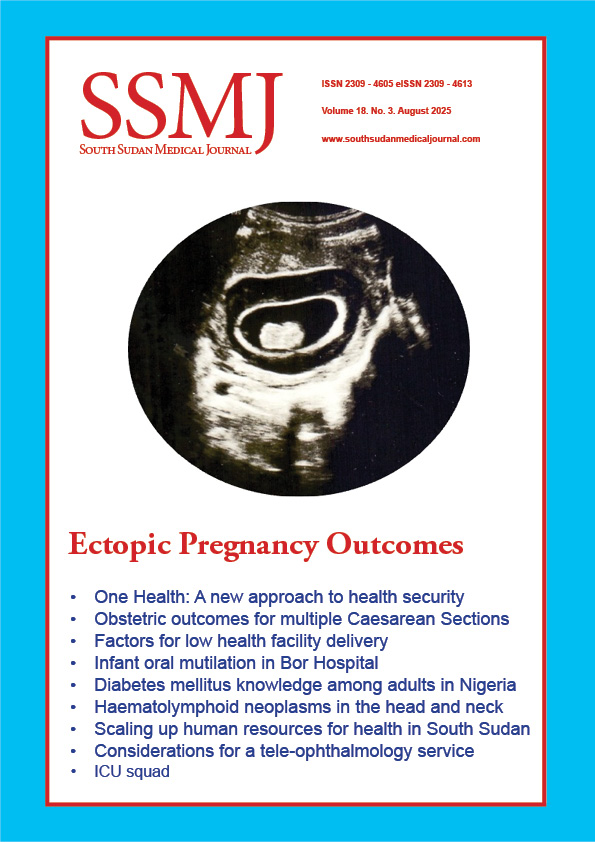
South Sudan Medical Journal. August 2025 18:3.

Dear Reader,

The full issue of our August 2025 issue is now available online here; the articles are listed below.

Also note that SSMJ is looking for a volunteer with time and interest in South Sudan, and experience in academic editing to join our Editorial team.

Editorial

Research Articles

Review Articles

  • A review of recent publications on haematolymphoid neoplasms in the head and neck region Karthik Shunmugavelu and Arun Vijaianandh A.
  • Scaling up human resources for health in South Sudan: A strategic imperative for achieving universal health coverage Gabriel Loi
  • Eyes in the sky: Considerations for a tele-ophthalmology service in South Sudan Garang M. Dut

Case Reports

  • Ectopic gestational-sac encapsulated in an ovarian cyst: A case report  Adam Moyosore Afodun, Alain Jabo, Mecthilde Mukangendo, Akeem Ayodeji Okesina, Olivier Mizero, Emmanuel Adeyemi Odumeru and Khadijah Kofoworola Quadri
  • Death due to ruptured tubal pregnancy: A case report P. Vinod Kumar 
  • ICU Squad: A possible solution for critical care service in low-resource areas Esraa Suliman Omer Abdelmageed and Ihab B Abdalrahman

Short Communications

  • The role of government in advancing private hospitals to improve healthcare services in South Sudan Jok Thikuiy Gang
  • 10th East African Health and Scientific Conference
  • Letter to the Editor: Self-medication Thomas Akuith Ngong 
  • Obituaries: Dr Baba Allan Ngachigoi Lanyanga and Dr Abdu Mohammed Abdudrbo Gilo
  • Call for Abstracts: Association of Surgeons of South Sudan First Scientific Conference

We thank the copyeditors and reviewers who helped prepare these papers. 

Articles in SSMJ are indexed by Scopus,  African Journals Online (AJOL), and the  Directory of Open Access Journals (DOAJ), and as well as being on our website. SSMJ is included in the EBSCO scientific research collection.
 
Thanks to everyone who supports SSMJ. Invite your colleagues to join our mailing list here.
 
The SSMJ team
Email: southsudanmedicaljournal AT gmail.com 
Website: http://www.southsudanmedicaljournal.com
Follow us on X  @SSMedJournal and our Facebook Group,

SSMJ is published by the Health and Social Science Research Institute of South Sudan (HSSRI-SS)
All links provided at - 
https://www.southsudanmedicaljournal.com/archive/august-2025/

Saturday, August 02, 2025

Maguire et al. - 'A systematic scoping review of the noma evidence landscape: current knowledge and gaps'

Abstract

Background Noma (cancrum oris) is a severe gangrenous disease of the mouth and oro-facial structures. Noma often affects young children living in extreme poverty, malnutrition and poor sanitation. Gaps remain in understanding its aetiology, pathogenesis, prevention and treatment.

Methods and findings We systematically searched databases for all primary research studies (clinical trials, cohort studies, case–control, cross-sectional, other observational studies, case studies/series) reporting noma patients of any age up to 7 December 2022. The 366 publications (published between 1839 and 2022) included in our scoping review describe 15 082 patients. Although 53 cohort and 29 cross-sectional studies were identified, enrolling 13 489 patients, interventional research remains extremely limited, with only six studies identified (101 patients, range: 7–26) and only one in the past decade, highlighting a critical gap in treatment evaluation. A total of 380 different treatment modalities were described, which underscores lack of a standardised practice. Disease aetiology remains unclear, with 117 microorganisms reported across 113 studies, yet none more consistently linked to noma development. Since 2000, 91.2% of cases have been reported in Sub-Saharan Africa, though occurrences outside the ‘noma belt’ and into Asia and the Americas suggest a broader risk. The 212 potential risk factors identified in 269 (73.5%) publications reflect substantial heterogeneity, complicating efforts to determine definitive causative factors. Additionally, the inconsistent definition and reporting of noma staging significantly hinder comparability across studies, with wide adoption of the WHO staging classification needed.

Conclusion This comprehensive review of the literature underscores the urgent need for robust, policy-driven research to address the vast knowledge gaps in the physiopathology of noma and the limited evidence currently available to guide therapeutic and preventive policies. Collective action and increased research investment are crucial, especially now that noma is officially recognised as a neglected tropical disease by the WHO.

Brittany J Maguire, Rujan Shrestha, Prabin Dahal, Roland Ngu, Lionel Nizigama, Sumayyah Rashan, Poojan Shrestha, Elinor Harriss, Paul Newton, Yuka Makino, Benoit Varenne, Philippe J Guerin - Systematic scoping review of the noma evidence landscape: current knowledge and gaps: BMJ Global Health 2025;10:e018023 https://gh.bmj.com/content/10/7/e018023


Individual
|
      INTERPERSONAL    :     SCIENCES               
HUMANISTIC  --------------------------------------  MECHANISTIC      
 SOCIOLOGY  :    POLITICAL 
|
Group
PSYCHOLOGICAL IMPACT
mental & emotional complications
WITHDRAWAL
LOST EDUCATION & LIFE CHANCES
DEPRESSION
PSYCHO-
malnutrition and poor sanitation
PHYSICAL IMPACT
LIMITED EVIDENCE - DISEASE KNOWLEDGE GAPS - AETIOLOGY
 knowledge gaps in the physiopathology of noma
-SOCIAL MANAGEMENT
SOCIAL IMPACT - LIFE CHANCES
STIGMA
SOCIAL EXCLUSION
extreme poverty, infrastructure
NEED FOR POLICY-DRIVEN RESEARCH
THERAPEUTIC - PREVENTIVE POLICIES
RECOGNITION

Previously: 'neglected' : 'noma'

My source: https://x.com/benoit_varenne/status/1950955812915982487

Sunday, March 16, 2025

Caring for babies and young children - what can older children do?

Dear All

I'm delighted to tell you that we have successfully raised funding for the completion of the Children for Health ten poster series.

On completion we will have many more posters than ten as we have other posters linked to projects on Diabetes and Eye Health, Oral Health and Life Skills.

All our posters feature 10 messages for young adolescents to learn and share (on the front) and lots of ideas on how to use the posters and additional activities to get children mobilised on the back. If you haven't seen our posters PLEASE take a look here. They are being used in so many ways!

www.childrenforhealth.org/resources

...and any feedback is always welcome.
Please also share with your networks.

I am looking for specialists in early years to help us revise our existing set of 10 messages on the topic of 'Caring for Babies and Young Children' for the new poster. It is a voluntary role. The process lasts about 3 months as we involve practitioners too and work with schools to get children reviewing the messages. It's usually about 3 rounds of review and then an art work review. I'd be very pleased to hear from those who feel they have the time and expertise to help.

Meanwhile take a look at our posters. We have three new ones!

WASH: https://www.childrenforhealth.org/WASHposter

Coughs and Pneumonia: https://www.childrenforhealth.org/CoughsPoster

Intestinal Worms: https://www.childrenforhealth.org/WormsPoster

HIFA profile: Clare Hanbury is director of Children for Health. She qualified as a teacher in the UK and then worked in schools in Kenya and Hong Kong. After an MA in Education in Developing Countries and for many years, Clare worked for The Child-to-Child Trust based at the University of London's Institute of Education where, alongside Hugh Hawes and Professor David Morley she worked to help embed the Child-to-Child ideas of children's participation in health – into government and non-government cchild health and education programmes in numerous countries. Clare has worked with these ideas alongside vulnerable groups of children such as refugees and street children. Since her MSc in International Maternal and Child Health, Clare focused on helping government and non-government programmes to design and deliver child-centered health and education programmes where children are active participants. Clare has worked in many countries in East and Southern Africa and in Pakistan, Cambodia and the Yemen. In July 2013, Clare founded the NGO, Children for Health and develops health education materials and and works on health education programmes alongside partners all over the world.

https://www.hifa.org/support/members/clare clare AT childrenforhealth.org

Monday, April 01, 2024

"Reforming oral health policy to contain noma"

"In a landmark decision in December 2023, the World Health Organisation designated noma as a neglected tropical disease, shedding light on a condition that often lurks in the shadows of poverty-stricken communities across sub-Saharan Africa, Latin America, and Asia. Noma is a severe rapidly progressing disease of the mouth and face mostly affecting children between the ages of two and six years suffering from malnutrition, infectious diseases, or living in extreme poverty with poor oral health or weakened immune systems like HIV and other diseases, which can lead to death due to complications such as sepsis. In 2012, the UN Human Rights Council acknowledged that neglecting noma is affected may amount to a violation of basic child rights."

Oluwaseyi Atoyebi. Reforming oral health policy to contain noma, 15th March 2024
https://punchng.com/reforming-oral-health-policy-to-contain-noma/ 


Individual
|
      INTERPERSONAL    :     SCIENCES               
HUMANISTIC  --------------------------------------  MECHANISTIC      
 SOCIOLOGY  :    POLITICAL 
|
Group

Psychological impacts

Social impacts - life chances

(neglected) neglected tropical disease


Previously:
From - https://hodges-model.blogspot.com/search?q=noma

Ioana Cismas (York) - What's in a Frame? A Human Rights Approach to Neglected Tropical Diseases - https://www.york.ac.uk/cahr/events/2022/justice-in-global-health-workshop/

Concept Note in Support of the Inclusion of Noma (Cancrum Oris) on the World Health Organization List of Neglected Tropical Diseases (Commissioned by the Government of Namibia, 2016), 6 pp. (with Marie-Solène Adamou Moussa-Pham).

Srour, M. L., & Baratti-Mayer, D. (2020). Why is noma a neglected-neglected tropical disease?. PLoS neglected tropical diseases, 14(8), e0008435. https://doi.org/10.1371/journal.pntd.0008435