Hodges' Model: Welcome to the QUAD: diabetes

Hodges' model is a conceptual framework to support reflection and critical thinking. Situated, the model can help integrate all disciplines (academic and professional). Amid news items, are posts that illustrate the scope and application of the model. A bibliography and A4 template are provided in the sidebar. Welcome to the QUAD ...

Showing posts with label diabetes. Show all posts

Thursday, November 20, 2025

South Sudan Medical Journal - November 2025
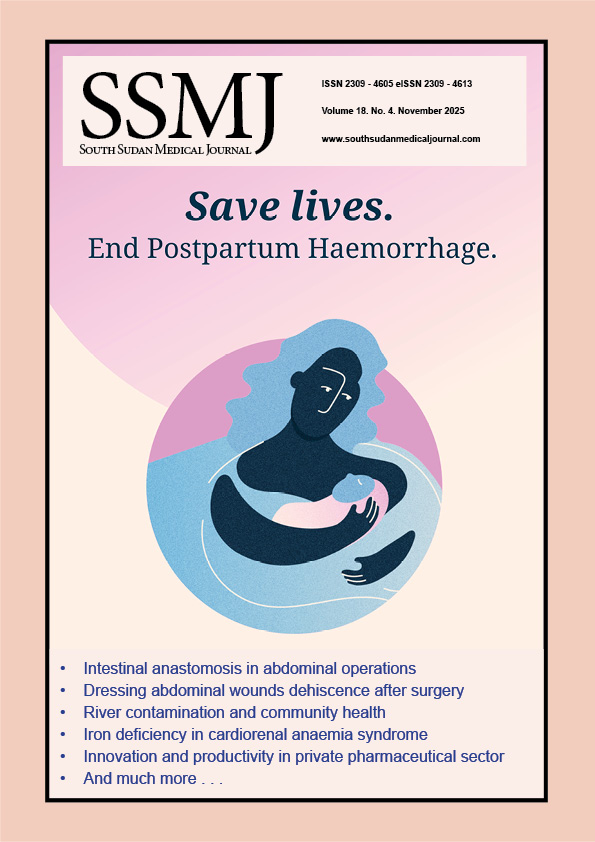
SSMJ Vol 18 No 4 November 2025

 Dear reader,

The full issue of our November 2025 issue is now online; this is a bumper issue featuring 14 full articles and other news items, listed below. We thank the copyeditors and reviewers who helped prepare these papers. Let us know if you would like to join the Editorial team. We need you if you have time and editing skills.
 
Editorial

Research Articles

  • Comparative study between classical two-layer and one-layer extra-mucosal intestinal anastomosis in elective and emergency abdominal operations. John Chol Ajack, Galal Abouelnagah, Haytham Fayed
  • Comparison of improvised negative pressure wound therapy and conventional wound dressing in abdominal wounds dehiscence after surgery. Nasra Lichika, Edward Ketson Msokwa, Alphonce Chandika
  • River contamination and community health: mining impacts in rural central Kalimantan, Indonesia. Nawan, Septi Handayani, Agnes I. Toemon, Hepryandi L. D. Usup, Seth Miko, Joni Rusmanto
  • Iron deficiency in cardiorenal anaemia syndrome in Dodoma, Tanzania Gidion Edwin
  • Guerrilla investors: Firm-level innovation and productivity in South Sudan’s private pharmaceutical sector Garang M. Dut
  • Paediatric deaths at Al-Sabbah Children’s Hospital, Juba, South Sudan – an audit Zechariah J. Malel, Garang Dakjur Lueth, Mary Poni Jackson, Nicolas Kazimiro Sasa
  • Prevalence of anaemia among pregnant women attending the antenatal clinic at Bor State Referral Hospital. Mark Kuoi Jongkuch Kuoi and Shalini Ninan Cherian
  • The impact of dietary compliance on diabetic foot ulcer healing: A cross-sectional study. Dadi Santoso, Rajesh Kumar Muniandy, Putra Agina Widyaswara Suwaryo

Review Articles

  • Personal determinants of gender-based violence: a review of intimate partner violence in South Sudan. Nyinypiu Adong
  • Misdiagnosing Muslims: The hidden risk of using the CAGE questionnaire in some Islamic contexts. Anas Ibn Auf and Sayed Halaly
  • Impact of healthcare worker training on paediatric tuberculosis detection and reporting: A systematic review. Suryanti Chan, Hamzah Hamzah, Miftahul Falah

Case Reports

  • Lupus nephritis overlap syndrome in a male with albinism: A case report. Adam Gidion Edwin, Baraka Alphonce, Sabina Mmbali, Alfred Meremo
  • Rare isolation of Pseudomonas mendocina from a postoperative wound in a diabetic patient: A case report. Vimal Kumar Karnaker, Asem Ali Ashraf, Bhadra Jyothikumar

Short Communications

  • News: Physicians Association of South Sudan and Association of Gynecologists and Obstetricians of South Sudan. Sudan

Back Page: Supporting Wet Nursing During Emergencies
 
Articles in SSMJ are indexed by Scopus, African Journals Online (AJOL), and the Directory of Open Access Journals (DOAJ), and as well as being on our website. SSMJ is included in the EBSCO scientific research collection.
 
Thanks to everyone who supports SSMJ. Tell your colleagues they can join our mailing list here.
 
The SSMJ team
Email: southsudanmedicaljournal AT gmail.com
Website: http://www.southsudanmedicaljournal.com
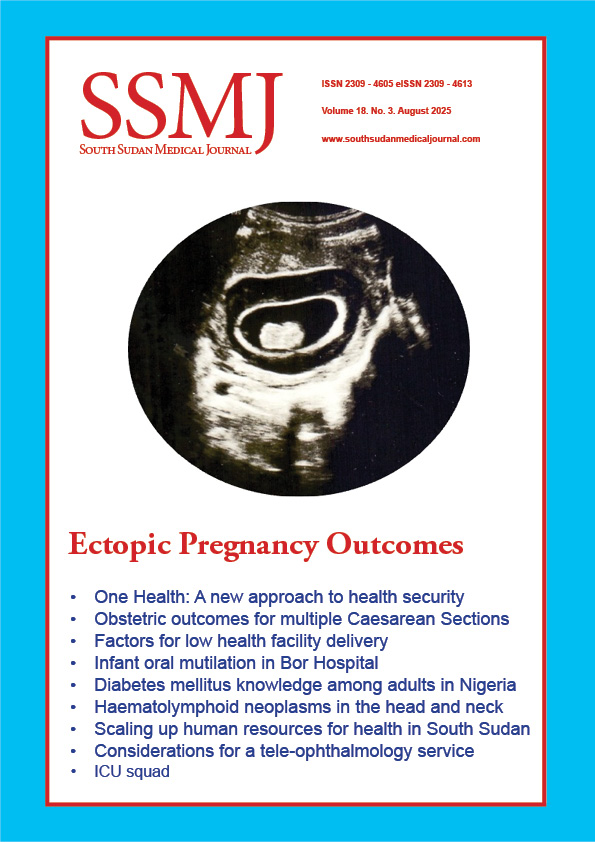
Thursday, August 21, 2025

South Sudan Medical Journal. August 2025 18:3.

Dear Reader,

The full issue of our August 2025 issue is now available online here; the articles are listed below.

Also note that SSMJ is looking for a volunteer with time and interest in South Sudan, and experience in academic editing to join our Editorial team.

Editorial

Research Articles

Review Articles

  • A review of recent publications on haematolymphoid neoplasms in the head and neck region Karthik Shunmugavelu and Arun Vijaianandh A.
  • Scaling up human resources for health in South Sudan: A strategic imperative for achieving universal health coverage Gabriel Loi
  • Eyes in the sky: Considerations for a tele-ophthalmology service in South Sudan Garang M. Dut

Case Reports

  • Ectopic gestational-sac encapsulated in an ovarian cyst: A case report  Adam Moyosore Afodun, Alain Jabo, Mecthilde Mukangendo, Akeem Ayodeji Okesina, Olivier Mizero, Emmanuel Adeyemi Odumeru and Khadijah Kofoworola Quadri
  • Death due to ruptured tubal pregnancy: A case report P. Vinod Kumar 
  • ICU Squad: A possible solution for critical care service in low-resource areas Esraa Suliman Omer Abdelmageed and Ihab B Abdalrahman

Short Communications

  • The role of government in advancing private hospitals to improve healthcare services in South Sudan Jok Thikuiy Gang
  • 10th East African Health and Scientific Conference
  • Letter to the Editor: Self-medication Thomas Akuith Ngong 
  • Obituaries: Dr Baba Allan Ngachigoi Lanyanga and Dr Abdu Mohammed Abdudrbo Gilo
  • Call for Abstracts: Association of Surgeons of South Sudan First Scientific Conference

We thank the copyeditors and reviewers who helped prepare these papers. 

Articles in SSMJ are indexed by Scopus,  African Journals Online (AJOL), and the  Directory of Open Access Journals (DOAJ), and as well as being on our website. SSMJ is included in the EBSCO scientific research collection.
 
Thanks to everyone who supports SSMJ. Invite your colleagues to join our mailing list here.
 
The SSMJ team
Email: southsudanmedicaljournal AT gmail.com 
Website: http://www.southsudanmedicaljournal.com
Follow us on X  @SSMedJournal and our Facebook Group,

SSMJ is published by the Health and Social Science Research Institute of South Sudan (HSSRI-SS)
All links provided at - 
https://www.southsudanmedicaljournal.com/archive/august-2025/

Sunday, March 16, 2025

Caring for babies and young children - what can older children do?

Dear All

I'm delighted to tell you that we have successfully raised funding for the completion of the Children for Health ten poster series.

On completion we will have many more posters than ten as we have other posters linked to projects on Diabetes and Eye Health, Oral Health and Life Skills.

All our posters feature 10 messages for young adolescents to learn and share (on the front) and lots of ideas on how to use the posters and additional activities to get children mobilised on the back. If you haven't seen our posters PLEASE take a look here. They are being used in so many ways!

www.childrenforhealth.org/resources

...and any feedback is always welcome.
Please also share with your networks.

I am looking for specialists in early years to help us revise our existing set of 10 messages on the topic of 'Caring for Babies and Young Children' for the new poster. It is a voluntary role. The process lasts about 3 months as we involve practitioners too and work with schools to get children reviewing the messages. It's usually about 3 rounds of review and then an art work review. I'd be very pleased to hear from those who feel they have the time and expertise to help.

Meanwhile take a look at our posters. We have three new ones!

WASH: https://www.childrenforhealth.org/WASHposter

Coughs and Pneumonia: https://www.childrenforhealth.org/CoughsPoster

Intestinal Worms: https://www.childrenforhealth.org/WormsPoster

HIFA profile: Clare Hanbury is director of Children for Health. She qualified as a teacher in the UK and then worked in schools in Kenya and Hong Kong. After an MA in Education in Developing Countries and for many years, Clare worked for The Child-to-Child Trust based at the University of London's Institute of Education where, alongside Hugh Hawes and Professor David Morley she worked to help embed the Child-to-Child ideas of children's participation in health – into government and non-government cchild health and education programmes in numerous countries. Clare has worked with these ideas alongside vulnerable groups of children such as refugees and street children. Since her MSc in International Maternal and Child Health, Clare focused on helping government and non-government programmes to design and deliver child-centered health and education programmes where children are active participants. Clare has worked in many countries in East and Southern Africa and in Pakistan, Cambodia and the Yemen. In July 2013, Clare founded the NGO, Children for Health and develops health education materials and and works on health education programmes alongside partners all over the world.

https://www.hifa.org/support/members/clare clare AT childrenforhealth.org

Sunday, March 14, 2021

Paper: Models of care for patients with hypertension and diabetes in humanitarian crises: a systematic review

individual
|
INTERPERSONAL : SCIENCES
humanistic ----------------------------------------------- mechanistic
SOCIOLOGY : POLITICAL
|
group

"Implementing NCD care in humanitarian crises requires the development of a context-adapted approach or ‘model of care’. A model of care may be characterized as a conceptual and pragmatic framework that describes how services are delivered within a health system (Davidson et al., 2006; Agency for Clinical Innovation, 2013)."

Models of care

"We found that there was no single unifying model of care for HTN/DM care in humanitarian crises, and the variance in care models included in this review was highly dependent on context. In order to descriptively synthesize the diverse models presented in the included studies, we created a typology based on the type of crisis, region and integration with the health system, since these factors likely influenced model design"
 
patient’s expectations

hypertension and diabetes (HTN/DM)

Crisis type and Region
Natural: Hurricane, Flood, Earthquake

Palestine, Lebanon, Jordan,  China, Pakistan,  India, Philippines, Syria, Iraq, Turkey, Nepal

Camp, Non-Camp; Rural, Urban

Location of services - Location of people in need, transport, travel time, distance

Refugee population - Local population

forced displacement, disruption of treatment and support, interrupted health services, movement and attrition of health care workers (HCWs), insecurity, destruction of infrastructure,  breakdown in supply chains and data processes

"The domains of access — availability, affordability, accessibility, accommodation, and acceptability — were derived from previously described measures of coverage (Penchansky and Thomas, 1981; Hernández-Quevedo and Papnicolas, 2013; Levesque et al., 2013)."

Refugees and Host Communities

Humanitarian crises

"Responsiveness has been defined as the ability of health services meet a patient’s holistic needs; in this framework, it also encompassed a model of care’s ability to respond to changing patient needs in a volatile context (.Hernández-Quevedo and Papnicolas, 2013; Kruk et al., 2018). Integration described the linkage between different levels and sites of care, such as facility-based care and community-based support as well as coordination between providers and institutions, while continuity of care referred to uninterrupted care throughout the patient’s disease and life course."

Formal health system and community-based formal or informal systems

Non-governmental organisations


Crisis type and Region
Political: Conflict, Disaster

Affordability, income, worth of service

Accommodation

Person :: Service
centrednesss


"Availability was defined as the volume and type of existing services and whether this was adequate for the volume and needs of service users. Affordability constituted the patient’s capacity to use financial resources to obtain care balanced against their income and the perceived worth of the service. Accessibility addressed the match between the location of services vs the location of people in need, including transport, travel time, distance, and cost. The accommodation was defined as the organization of service delivery, such as opening times and ability of service users to accommodate to this. Acceptability was considered as the relationship between the services and the patient’s expectations of appropriate care."
(My emphasis)

NCD  - Non-communicable disease

My source: HIFA list

CITATION: Models of care for patients with hypertension and diabetes in humanitarian crises: a systematic review, Michael S Jaung, Ruth Willis, Piyu Sharma, Sigiriya Aebischer Perone, Signe Frederiksen, Claudia Truppa, Bayard Roberts, Pablo Perel, Karl Blanchet, Éimhín Ansbro
Health Policy and Planning, https://doi.org/10.1093/heapol/czab007

Tuesday, November 19, 2019

South Sudan Medical Journal - November 2019

http://www.southsudanmedicaljournal.com/assets/files/Journals/vol_12_iss_4_nov_19/Full%20Draft%20Final.pdf
South Sudan Medical Journal


The November 2019 issue is now online here and includes items on Diabetes management, FGM and perineal injuries, Nutrition surveys, Gestational choriocarcinoma, Laryngeal trauma, Tympanic membrane perforation, Acute malnutrition and Overuse of antibiotics.  See details below.


Please send us your feedback on this issue, submit your manuscripts (which we can help you prepare), encourage colleagues to join the mailing list here, follow us on twitter @SSMedJournal and our Facebook Group, and find previous SSMJ articles at African Journals Online (AJOL) and the Directory of Open Access Journals (DOAJ).


EDITORIAL
  • Bringing diabetes mellitus into focus on World Diabetes Day Edward Eremugo Kenyi
ORIGINAL RESEARCH
  • The effect of Female Genital Mutilation on perineal injuries among women in labour in Dodoma Region, Tanzania Janeth Dickson Sichone, Athanase Lilungulu, Secilia K. Ngwashemi and Agatha Ngowi
  • Analysis of trends in SMART Nutrition Survey data from South Sudan between 2004 and 2016 Ciara Hogan, Kate Golden, Regine Kopplow and Elaine Ferguson
  • Pattern and causes of tympanic membrane perforation at a private hospital in Dar es Salaam, Tanzania Zephania Saitabau Abraham, Aveline Aloyce Kahinga, Kassim Babu Mapondella, Enica Richard Massawe, Emmanuel Ole Lengine and Daudi Ntunaguzi
  • Nurses’ knowledge of the management of diabetic patients at Juba Teaching Hospital Abuk Mayen Deng, Lucia Buyanza and Fekadu M. Alemu
  • Abstracts from the Juba College of Nursing and Midwifery: Management of 3rd stage of labour Deborah Akon Akech; Danger signs of obstetric complications Kiden Harriet Oliver
CASE REPORTS
  • Gestational choriocarcinoma at Juba Medical Complex and Juba Teaching Hospital: five case reports Kizza Paul, Kuma Chuol Biel, Anthony Lupai, Changkel Banak, Mirghany Abdallah and Paula Nuer
  • Laryngeal trauma at Juba Teaching Hospital, South Sudan Justin Rubena Lumaya, Jino David and Natali Tong
NEWS
  • South Sudanese recipients of grants from the Gordon Memorial College Trust Fund (GMCTF) in 2019
  • Continuum of care for acute malnutrition in South Sudan
  • Public health resources
BACK COVER

Kind regards
The SSMJ team

Copyright © 2019 Southern Sudan Medical Journal, All rights reserved.

Wednesday, October 30, 2019

The Rosamund Snow Scholarship for Patient-Led Research

INDIVIDUAL
|
INTERPERSONAL : SCIENCES
HUMANISTIC ----------------------------------------------- MECHANISTIC
SOCIOLOGY : POLITICAL
|
GROUP
(real) Subjective?

Rosamund

Patient / Carer's experience


(real) Qualitative?
Subjective ------ Research ------ Objective

Disciplinary - Professional
 language and jargon

Change

Qualitative ------ Research ------- Quantitative
Snow, PhD

"The Sociology of health and illness"

Patient-Led Research

Co-Production of Research

'What happens when patients know more than their doctor?'

Medical sociology

Unequal power dynamics
of the
clinical consultation

The politics of self-management

Challenges of advocacy

Scholarship

Funding

The Rosamund Snow Scholarship for Patient-Led Research
"Rosamund Snow, who died in February 2017, had type 1 diabetes. After completing a Master’s degree in Social Sciences at King’s College London, she went on to study for a PhD in the patient experience of diabetes. She became a respected academic at the University of Oxford, undertaking research and teaching medical students about the importance of the patient perspective. She believed passionately in patients working alongside clinicians to produce research and teaching that is informed by the (often under-valued) expertise in what it is like to live with an illness. She used her own expertise from experience to question and challenge norms of medical practice, always striving to improve patient care. After her death, Rosamund’s family generously donated funding to Green Templeton College at the University of Oxford, to allow others to be trained to continue the work she started." [ Source: #RSSPLR ]

My source: with thanks @trishagreenhalgh

Tuesday, May 14, 2019

Southern Sudan Medical Journal: May 2019 issue on Primary Health Care

Dear SSMJ Reader,
 
http://www.southsudanmedicaljournal.com/archive/may-2019/
The special May 2019 issue on Primary Health Care is now online here and includes items on support for PHC in refugee camps, approaches and strategies for PHC, charging for health care, literacy and health, community screening for diabetic retinopathy, vaccination coverage and CHWs treating malnutrition.  See details below.

Send us your feedback, your manuscripts (which we can help you prepare), encourage colleagues to join the mailing list here, follow us on twitter: @SSMedJournal and our Facebook Group, and find previous SSMJ articles at African Journals Online (AJOL) and the Directory of Open Access Journals (DOAJ).
 
The SSMJ Editorial team
admin AT southernsudanmedicaljournal.com.

In the May 2019 issue:

EDITORIAL
  • Forty years of primary health care programming and its future in South Sudan Dr Ayat Jervase 
ORIGINAL RESEARCH
  • Using livelihoods to support primary health care for South Sudanese refugees in Kiryandongo, Uganda Dominic Odwa Atari and Kevin McKague 
MAIN ARTICLES
  • Integrated Primary Health Care (iPHC) for developing countries: a practical approach in South Sudan Victor Vuni Joseph and Eluzai Hakim 
  • Addressing high vaccination coverage in primary health care setting: challenges and best practices Bobby Paul and Indranil Saha 
  • Preventing blindness from diabetic retinopathy through community screening Wani G Mena 
  • UK-South Sudan Alliance: a strategy for increasing capacity and access to primary care and public health Rich Bregazzi 
  • What is the best way for healthcare systems to charge sick patients? Alfred Lumala, Lucien Wasingya-Kasereka, Martin Opio, Jenard Ntacyo, Samuel Mugisha, John Kellett 
  • How can we bridge the gap between literacy and health in South Sudan? China Mayol Kuot 
SHORT ITEMS
  • The Evidence for Contraceptive Options and HIV Outcomes (ECHO)
  • Performance of low-literate community health workers treating severe acute malnutrition in South Sudan Elburg Van Boetzelaer, Annie Zhou, Casie Tesfai, and Naoko Kozuki 
  • Martha Primary Health Care Centre: how resilience and international collaboration is transforming a community Poppy Spens 
  • Point Of Care Ultrasound (POCUS) is saving lives Achai Bulabek 
  • Juba College of Nursing and Midwifery milestones in 2018 Anna Modong Alex 
  • Obituary: Dr Joy Theophilus and Dr Emmanuel Kenyi
LETTER TO THE EDITOR
  • What South Sudan must do to reduce high maternal and infant deaths? Janet Mugo and Munawwar Said 
BACK COVER
  • The Ten Steps to Successful Breastfeeding WHO
We thank all the authors, reviewers and editors who helped to produce this special issue.

Sunday, December 09, 2018

BREXIT: On the Border

individual
|
INTERPERSONAL : SCIENCES
humanistic ----------------------------------------------- mechanistic
SOCIOLOGY : POLITICAL
|
group - population


Medicines, Medical products
Time - Logistics


"Border Delivery Group"


import - export
checks

BREXIT
DEAL :: NO DEAL
REFERENDUM #2
ELECTION
(crunch) Commons Vote (deferred)
 ?


Source: Hughes, L. (2018) NHS faces risk of reduced drug access for six months, FT Weekend, 8-9 December, p.2.

Saturday, November 10, 2018

South Sudan Medical Journal - November 2018

 http://www.southsudanmedicaljournal.com/

Dear SSMJ Reader,

The November 2018 issue of the South Sudan Medical Journal is now on online and includes articles on Ebola, Caesarean Section and Obstetric fistula. You can download the complete issue as a pdf here or the individual articles listed below.

Please share this notice with your colleagues.

EDITORIAL
Keeping an eye on Ebola Virus Disease Edward Eremugo Kenyi
Between June and November 1976, the medical world was baffled by an outbreak of a ferocious haemorrhagic disease in Nzara, South Sudan (then part of Sudan). This became known as Ebola Virus Disease (EVD). The West African outbreak in Guinea, Liberia and Sierra Leone in 2014 was devastating.  A new outbreak in DR Congo in 2018 is a warning to South Sudan to be on high alert.

ORIGINAL RESEARCH
Knowledge of type 2 diabetes mellitus and adherence to management guidelines: a cross-sectional study in Juba, South Sudan Alexandre Ali M. Bili and Longying Zha
Inadequate education and the lack of efficient diabetes care centres compounded by high costs are common barriers for diabetes care. This study assesses the level of knowledge and adherence to guidelines for management of type 2 diabetes in South Sudan.

Knowledge, attitude and willingness to accept Caesarean Section among women in Ogbomoso, southwest Nigeria Olumuyiwa A Ogunlaja, Idowu P Ogunlaja, Samuel E Akinola, Olufemi O Aworinde
Caesarean Section (CS) is a common procedure in obstetrics and has contributed immensely to improving maternal and foetal outcome. The study which seeks to assess the level of knowledge, attitude and acceptance of women about CS in Ogbomoso, Nigeria, concludes that mothers should be educated on the process involved in Caesarean delivery.

Obstetric fistulae, birth outcomes, and surgical repair outcomes: a retrospective analysis of hospital-based data in Dodoma, Tanzania Athanase Lilungulua, Balthazar Gumodokab, Mzee Nassoroc, Patrice Sokac and Kibusi Stephen
Obstetric Fistula (OF) among pregnant women remains a widespread condition with devastating consequences and poses a significant challenge in a community as well as globally. The study concludes that timely fistula repair by experienced fistula surgeons will improve outcomes and limit the clinical insult and distress that OF invariably causes.

CLINICAL GUIDANCE
How to repair a vesico-vaginal fistula Brian Hancock
Most fistulae are caused by ischaemic necrosis of the genital tract and adjacent organs through prolonged obstructed labour. This article provides a brief overview and refers the reader to resources that cover the practical aspects of the surgery and holistic care of the patient.

MAIN ARTICLES
Ebola Virus Disease: epidemiology, management, prevention and control Gasim Abd-Elfarag
Ebola Virus Disease (EVD) is part of the group of illnesses known as viral haemorrhagic fevers, and was previously known as Ebola haemorrhagic fever. Infection with EVD is acute, severe and often fatal in humans. The paper provides an outline of what is known about EVD.

Ebola on our doorstep: Ebola Virus Disease preparedness in South Sudan Richard Lako and Otim Patrick Cossy Ramadan
South Sudan has previously experienced three EVD outbreaks in 1976, 1979 and 2004. With recent outbreaks in DR Congo, it is possible that a sporadic outbreak can happen in South Sudan, and so the country is always at risk. Preparedness is key.

COMMENTARIES
Internship training in South Sudan: the challenges and way forward Jessry Pasquali Oboya
The House Officer is the professional whom the patient meets most often when entering hospital and will remember for a long time. The extraordinary commitment and work load of the House Officers at Juba Teaching Hospital has received little recognition by the authorities despite the challenges they face in the course of their training.

The current crisis of human resource for health in Africa Brian Madison
Brain drain has been a source of despair for developing countries, and the healthcare sector arguably bears the biggest brunt imposed by this growing problem. The author argues that if Africa is to counter the healthcare human resources crisis, member states may need to adopt radical reforms in the healthcare sector.

SHORT ITEMS
Caesarean Section acceptability and rate in South Sudan
Call for submissions
Obituaries

BACK COVER
Neonatal resuscitation chart
This chart is designed with the ‘Helping Babies Breath’ training in mind. However, it incorporates external cardiac massage, which can be effective in some cases.

All previous issues of the journal are in the Archive section, and you can ‘search’ for particular articles.

Please support the journal by submitting items for future issues. We are interested in articles on your research, case reports, and clinical guidance, as well as news of projects, and relevant photographs. We can help you prepare these for publication (see our ‘Authors’ Guidelines’). We welcome letters to the editor and questions. Send your contributions to the Editor-in-Chief, Dr Edward Luka admin@southernsudanmedicaljournal.com. 

If you are not already a member, join our Facebook Group and share your news and experiences and ideas.

You can follow us on twitter: @SSMedJournal. Other people can be added to our mailing list by clicking here.

SSMJ is a member of African Journals Online – see who is downloading SSMJ abstracts and articles here. We are listed in the Directory of Open Access Journals (DOAJ), you can find and search DOAJ for SSMJ articles here.

Kind regards
The SSMJ team
