Hodges' Model: Welcome to the QUAD: HIV

Hodges' model is a conceptual framework to support reflection and critical thinking. Situated, the model can help integrate all disciplines (academic and professional). Amid news items, are posts that illustrate the scope and application of the model. A bibliography and A4 template are provided in the sidebar. Welcome to the QUAD ...

Showing posts with label HIV. Show all posts

Wednesday, August 26, 2026

South Sudan Medical Journal - August 2026


Dear Reader,

The August 2026 issue is online here; we thank all the copyeditors and reviewers who helped prepare these papers. If you are submitting a manuscript, remember to read our Author’s Guidelines first.

We are looking for volunteers to join the Editorial team. Email us if you have time and editing skills.

Editorial

Can the Ebola Zaire vaccine stop Bundigunyo virus? Edward Kenyi


RESEARCH ARTICLES
Assessment of airborne fungi in the emergency and traumatology departments of University Hospital Centre, Sidi Bel-Abbes, Algeria Derouicha Matmour, Samia Merad, Yassine Merad, Achwak Bendouida, Zoubir Belmokhtar, Zakaria Merad, Mohamed Amine Boumelik, Benali Beghdadli, Othmane Ghomari 

Maternal and nutritional factors associated with early childhood development in rural Indonesia Hadi Ashar, Mohammad Zen Rahfiludin, Sri Achadi Nugraheni, Dwi Hapsari Tjandrarini

Observed outcomes and costs of laparoscopic versus open cholecystectomy in Juba, South Sudan Mayen Achiek, Jingo Faride, Mohamed Ibrahim, Abraham Mafair Kezekia, Chep C. Chep, Garang D. Nyuol, Ajak M. Dhel, George Lefteri

Stakeholders’ perspectives on determinants of health financing in South Sudan: a qualitative assessment Jonathan Majok, Gabriel Loi, Solomon Dut, Aluel Ayom, Thiey Kuethpiny, David Ngor, Sarah Nyannyot

Predictors of unsuccessful treatment outcomes among adults with pulmonary tuberculosis in a resource-limited setting Tri Agus Yuarsa, Malehah Mohd Noh, Richard Avoi, Meryl Grace Lansing, Putra Agina Widyaswara Suwaryo 

Assessment of the understanding of evidence-based medicine among undergraduate medical students in Gadarif University, Sudan Khalid Mohammed Ali, Ozaz Yagoub, Inshirah Mustafa, Tarig Fadelelmoula
 
Environmental health risks associated with open dumping practices in Central Kalimantan, Indonesia: an observational study Nawan, Septi Handayani 

Assessing the quality of health facilities providing antenatal care services in Bor, South Sudan John Thon Pandak Kuot, Shalini Ninan Cherian

Prostate cancer awareness and factors influencing screening among men at St. Francis Referral Hospital, Tanzania Theresia A. Karuhanga, Zeinabu Awardh Sharif, Antony Magoda, Philbert Madoshi 

CASE REPORTS 
Long-standing aspirated foreign body in a child complicated by pneumothorax and empyema Gawar Gel, Juma Deng, Justin Rubena

Clinical rabies in an HIV-positive pregnant mother with surviving newborn Ayol Mac Ayol

BACKCOVER: WHO: Guidelines for the management of pregnant and breastfeeding women in the context of Ebola virus disease

FRONT COVER IMAGE: The grown fungal colonies on SDA media collected from different types of samples. (Article on page 149)

Thanks to everyone who supports SSMJ. Tell your colleagues they can join our mailing list here.

The SSMJ team

Email: southsudanmedicaljournal AT gmail.com
Website: http://www.southsudanmedicaljournal.com
Follow us on X: @SSMedJournal and our Facebook Group.

Our mailing address is:

South Sudan Medical Journal
Health and Social Sciences Research Institute, Juba
South Sudan
Copyright (C) 2026 South Sudan Medical Journal All rights reserved.
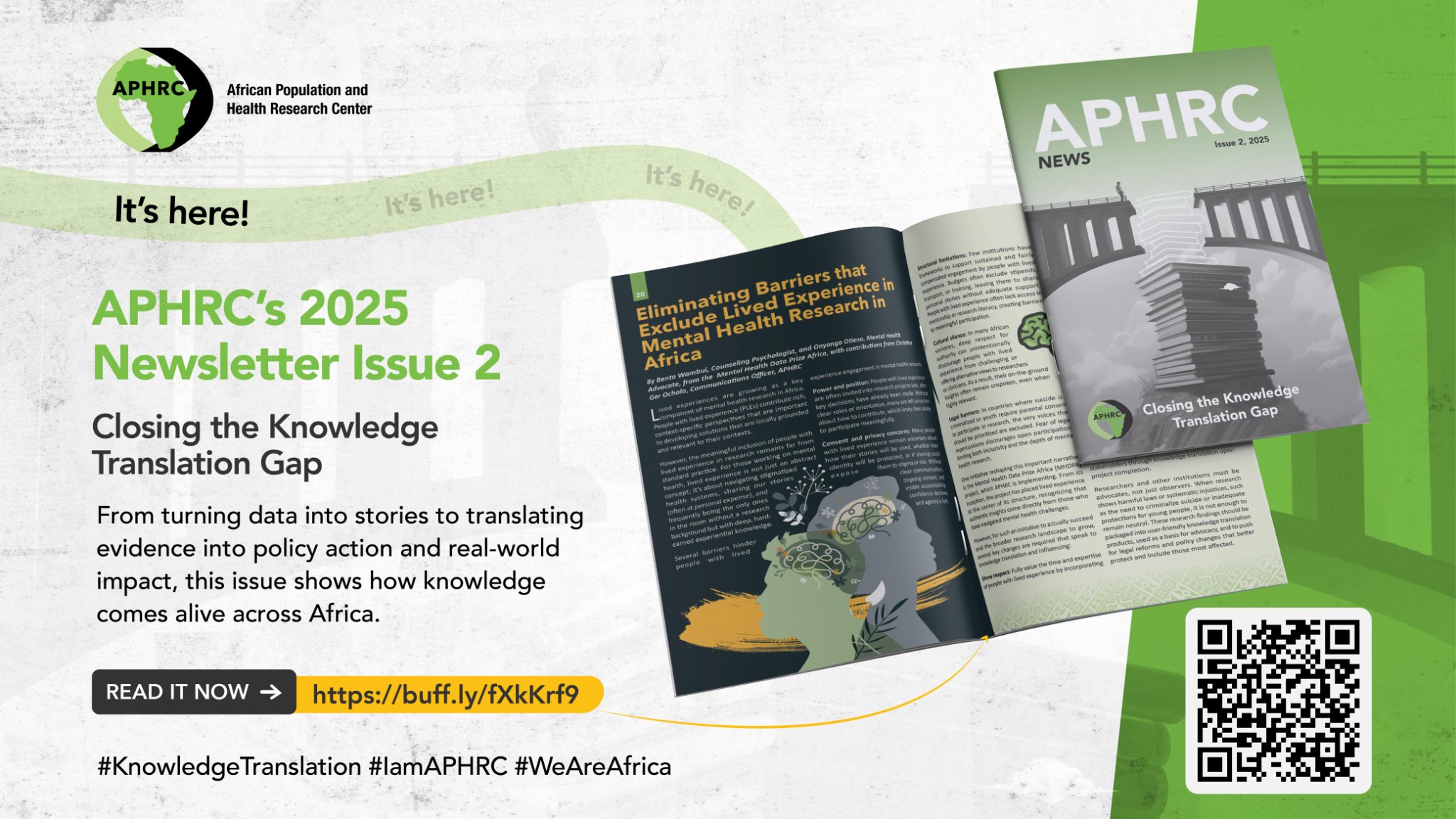
Monday, November 03, 2025

Newsletter: African Population and Health Research Center

APHRC News – Issue 2, 2025

  •  31/10/2025
Welcome to APHRC’s second 2025 newsletter issue! This edition explores how the Center is closing the Knowledge Translation Gap, making research accessible, relatable, and transformative. Dive in to discover stories of change, from climate and health innovations to inclusive education and mental health breakthroughs across Africa.


Monday, May 20, 2024

NHS Contaminated Blood Scandal UK

UK  - World

Why we need always to acknowledge 
the political in health and health in politics

Individual
|
      INTERPERSONAL    :     SCIENCES               
HUMANISTIC  --------------------------------------  MECHANISTIC      
 SOCIOLOGY  :    POLITICAL 
|
Group

"In an interim report, the inquiry chair, Sir Brian Langstaff, said 'wrongs were done at individual, collective and systemic levels'."

                                                                    (UP)
contaminated       blood                             
blood            donors     'dying for 

COVER
 UP


scandal            paid          justice'    
(screening?)


My source: Various - over several decades.

Photograph: Daily Express
https://www.express.co.uk/news/politics/1795449/rishi-sunak-infected-blood-inquiry-heckled-booed

Wednesday, August 31, 2022

Southern Sudan Medical Journal: Vol 15 No 3

Dear reader,

The August issue is online here. See details below.
 
SSMJ is now included in the EBSCO scientific research collection. Our articles are also listed in  African Journals Online (AJOL) and the Directory of Open Access Journals (DOAJ) as well as on our website.
 
Questions:
Could you contribute to SSMJ by:

  • Sending items for future issues: e.g., research, case studies, news, photos, and/or letters?
  • Helping to edit or peer review articles?
  • Suggesting topics relevant to health professionals in South Sudan?
  • Sharing SSMJ with colleagues and sending us their feedback?

Write to us at southsudanmedicaljournal@gmail.com
 
Thanks to everyone who supports SSMJ - authors, editors, and especially our peer reviewers.

In this issue

EDITORIAL

  • Eye care in South Sudan Kenneth Lado Lino Sube
 
RESEARCH ARTICLES
  • Prevalence of glaucoma among patients attending Buluk Eye Centre, Juba, South Sudan: a one-year study Kenneth Lado Sube et al
  • Social demographic determinants of male participation in antenatal care in Nyamagana District, Tanzania Sarah M. Chamos, Alen Kinyina, and Harrieth Mtae
  • Prevalence of HIV among pregnant mothers receiving antenatal care at Kator Primary Health Care Centre, Juba, South Sudan Kon Paul Alier et al
  • A survey of tonsillectomy care patterns in Tanzania Daudi Ntunaguzi et al
  • Musculoskeletal disorders among patients during a one-day outreach at Juba Military Hospital Mapuor M.M. Areu et al
 
MAIN ARTICLE
  • How to use experience to improve teaching practice Rich Bregazzi
 
CASE REPORT
  • Lower back musculoskeletal hydatid cyst: a rare presentation in a South Sudanese patient Lodu Swokiri N Kuju et al

SHORT COMMUNICATIONS
  • “How-to” Teaching Videos–inspired by work in South Sudan Deborah Van Dyke
  • Role of the community pharmacy in the control of pandemics in South Sudan Oliver Batista Ugoro
  • Profile of the Department of Paediatrics and Child Health, Al-Sabbah Children’s Hospital, Juba, South Sudan Amanda Billy Berto Madison

OBITUARY: Dr Frederick Khamis Tawad
BACK COVER: WHO: Recovering from Monkeypox at home
 

The SSMJ team
Email: southsudanmedicaljournal@gmail.com
Website: http://www.southsudanmedicaljournal.com
Follow us on Twitter@SSMedJournal and Facebook

Tuesday, May 14, 2019

Southern Sudan Medical Journal: May 2019 issue on Primary Health Care

Dear SSMJ Reader,
 
http://www.southsudanmedicaljournal.com/archive/may-2019/
The special May 2019 issue on Primary Health Care is now online here and includes items on support for PHC in refugee camps, approaches and strategies for PHC, charging for health care, literacy and health, community screening for diabetic retinopathy, vaccination coverage and CHWs treating malnutrition.  See details below.

Send us your feedback, your manuscripts (which we can help you prepare), encourage colleagues to join the mailing list here, follow us on twitter: @SSMedJournal and our Facebook Group, and find previous SSMJ articles at African Journals Online (AJOL) and the Directory of Open Access Journals (DOAJ).
 
The SSMJ Editorial team
admin AT southernsudanmedicaljournal.com.

In the May 2019 issue:

EDITORIAL
  • Forty years of primary health care programming and its future in South Sudan Dr Ayat Jervase 
ORIGINAL RESEARCH
  • Using livelihoods to support primary health care for South Sudanese refugees in Kiryandongo, Uganda Dominic Odwa Atari and Kevin McKague 
MAIN ARTICLES
  • Integrated Primary Health Care (iPHC) for developing countries: a practical approach in South Sudan Victor Vuni Joseph and Eluzai Hakim 
  • Addressing high vaccination coverage in primary health care setting: challenges and best practices Bobby Paul and Indranil Saha 
  • Preventing blindness from diabetic retinopathy through community screening Wani G Mena 
  • UK-South Sudan Alliance: a strategy for increasing capacity and access to primary care and public health Rich Bregazzi 
  • What is the best way for healthcare systems to charge sick patients? Alfred Lumala, Lucien Wasingya-Kasereka, Martin Opio, Jenard Ntacyo, Samuel Mugisha, John Kellett 
  • How can we bridge the gap between literacy and health in South Sudan? China Mayol Kuot 
SHORT ITEMS
  • The Evidence for Contraceptive Options and HIV Outcomes (ECHO)
  • Performance of low-literate community health workers treating severe acute malnutrition in South Sudan Elburg Van Boetzelaer, Annie Zhou, Casie Tesfai, and Naoko Kozuki 
  • Martha Primary Health Care Centre: how resilience and international collaboration is transforming a community Poppy Spens 
  • Point Of Care Ultrasound (POCUS) is saving lives Achai Bulabek 
  • Juba College of Nursing and Midwifery milestones in 2018 Anna Modong Alex 
  • Obituary: Dr Joy Theophilus and Dr Emmanuel Kenyi
LETTER TO THE EDITOR
  • What South Sudan must do to reduce high maternal and infant deaths? Janet Mugo and Munawwar Said 
BACK COVER
  • The Ten Steps to Successful Breastfeeding WHO
We thank all the authors, reviewers and editors who helped to produce this special issue.

Monday, October 31, 2011

What's the difference between 6 and 7? About 11 years ...

Gradually over the past few months I've checked the care domain links. Deleting those where the domain is now "For Sale", broken, or the content is plain out of date. The final domain was the SCIENCES. It's the largest still and while the links are monsters, it is interesting working through them occasionally.

One change caught my eye last month in the 'Environment, Sustainability, Ecology & EcoSystem Health' listing (now former h2cm website). I clicked on Six Billion and Beyond and duly found that it has been retired from pbs.org. A few weeks ago I'd shared with students and have included on the CARDI conference poster the fact that today it is believed that the Earth's human population reaches 7 billion.

Looking back Six Billion and Beyond aired in 1999. So in 11-12 years there are an extra billion souls. You have to ask:

  • What will we all drink and eat?
  • Will we all have a (dry) home?
  • Will we all read? (Have access to information and info technology)
  • What will this latest generation believe in?
  • Whose beliefs will they be?
  • Can the 7 Billionth human being of Earth be a true citizen?
  • Before that - for how long will they be allowed to be a child?
  • Will they pray? Who to and why - choice?
  • Will they have to fight (in a uniform)?
  • What will their sense of quality of life be?
  •  Will that 7 Billionth person and their family have access to:
    • health information?
    • basic health care?
    • education?
  • What space is there for their human rights?
  • Can technology finally deliver Socially?
Checking the links this time around proved quite a lesson in global demographics - how long till the next...?

Additional links:

https://www.worldometers.info/world-population/

The world is home to 7 billion people but how far has it come?
The population milestone is a reminder that there is much work to do on sexual and reproductive health and HIV if we are to meet the millennium development goals by 2015, The Guardian, Monday 31 October.

Saturday, October 15, 2011

The International Health Protection Initiative (IHPI) - Resolution Sign-up


The International Health Protection Initiative believes that health care MUST be protected during armed conflict.

The International Health Protection Initiative (IHPI) is a collective movement of individuals, organisations, institutions and charities (including non-Governmental Organisations-NGOs) who have agreed to help to lobby the United Nations to act to uphold the Geneva Conventions, especially as regards safe-guarding health facilities/equipment/transport, and workers.  The Resolution was agreed following a meeting of the International Child Health Group held in November 2010.

Your support is urgently needed for an international resolution to protect healthcare during armed conflict

The resolution will ultimately be submitted to the United Nations (General Assembly, Security Council, and World Health Organization).

In order to achieve the objectives outlined in the resolution, we need the majority of the world’s healthcare organisations, institutions, NGOs and civil society, especially those in conflict afflicted countries to sign up to this important resolution.

We know that you are aware of the urgent need to protect healthcare during armed conflict, that is, to uphold the Geneva Conventions and we would be most grateful for your support.

Once you have read the resolution we respectfully urge you to sign up to it online, as an individual, or preferably, on behalf of your government, institution, or medical organisation. We also encourage you to state your reasons for supporting this resolution in the appropriate box.

So please Sign up now!

Many thanks for your time and attention and we look forward to working with you to help make this life-saving resolution a reality

The IHPI Team
info AT ihpi.org

"War... is when some adults who don't know what good is and what love is, are throwing dangerous war toys which injure innocent people" 

Tamara aged 10 years during the war in Bosnia and Herzegovena.

My source: Prof. David Southall via HIFA2015

My thoughts upon signing up:
This resolution saddens me: that we should need it in the 21st century after millennia of human conflict.

The resolution is an essential course of action that I will help to publicize. Resources by way of legal enforcement, financial and personnel as declared in the resolution to protect basic human rights and health care provision must be assured and enforced globally. As per #5 the trend of pursuing those who commit crimes against humanity should be escalated as the means to record and furnish evidence also increases. This is imperative as a deterrent to those who supposedly 'lead' and those who invariably follow. In this sense 'education for all' is also crucial to help prevent indoctrination - with the additional health dividend that education affords.

Wednesday, December 01, 2010

Rhinos, evidence based medicine and 'out-reach'

It would be be marvellous to be able to introduce h2cm to the nursing, health and social care communities in Asia, including China of course.

Working in health we are surely aware of the need to base what we do on evidence. Although nurses are not necessarily independent as the patient advocate. Advocacy is still an important part of the nursing role and one requiring specific advice in some instances.

Earlier this month a Guardian article related the ever more precarious position of the South African rhino and how claims about the curative properties of rhino horn as a medicine fuels poaching. The UK is nowhere near South Africa or China so what gives? What gives is the Planet, the tiger too and the biosphere in general. Apparently rhino horn is just compacted keratin and has no medicinal properties.

Nurses tend to be a green, ecologically minded group and the best source of change comes from within. It is never easy to change the beliefs of others, especially when your culture venerates its elders. Belief also remains a powerful factor in health. Despite this do nurses not have a duty to challenge beliefs that are wrong, to educate their communities even while taking tradition into account?

What price true literacy: spiritual, 3Rs, ICT, health, environmental and cultural ...?

There must be a way for nurses to unite on this - 
across cultures, borders, traditions, animal welfare standards,
digital barricades, politics, beliefs ...

As nurses there is always the question of dignity and respect and being non-judgemental and sensitive to cultural attitudes and practices that differ from our own. A 'truth' here is that you do not have to travel far for your own values and opinions to be challenged.

As we make a difference individually with patients and carers ... collectively can we extend our reach to other communities too? While there's still time - and we try not to bite our nails.

Friday, July 09, 2010

HIV/AIDS and Rights - Social Networking - The Vienna World AIDS Conference

To: Members of The CI Community Interested in HIV/AIDS and Communication
From: Warren Feek

Peter - Please Join: "HIV/AIDS Future Strategy" network at
http://groups.comminit.com/node/306528 - if you have not done so already.

Many best wishes.

I am writing in advance of the Vienna World AIDS Conference (July 18-23 2010) - an event summarised on The CI website - http://www.comminit.com/en/node/310758/347 - with an invitation to participate in dialogue on the themes of this important conference...whether you will be in Vienna or not!


The CI's Development Network Group called "HIV/AIDS Strategy: Future Directions" - http://groups.comminit.com/node/306528 - is the hub for our communication and media focused networking pertaining to the conference. This group presently has 489 members. This is complemented by the relevant HIV/AIDS Rights Knowledge within the HIV/AIDS theme site at ...

If you are not already one of them, please join the conversation! You can register here - http://groups.comminit.com/user/register - or, if already registered, join the group by going here - http://groups.comminit.com/node/306528 - and clicking on the red words "Request membership".

Thanks - it will be excellent to have you engaged.

To view communication- and media-related events happening at the Conference, please visit the HIV/AIDS Strategy: Future Directions Group's July calendar: ...

Click on each event's name to read a description of what will be happening, where, and when. (Please note also the hyperlinked word "more"...click there to see the entire list of C4D-related events taking place each day). And please do add your own event description: Once logged in, just click on "Submit an Event" in the box on the right-hand side of the screen.

You can learn, for example, about:

* "Is AIDS Activism Dead?" (Monday July 19 2010, from 11:00-12:30, in Global Village Session Room 1)

* "Distance Based Learning Technologies: E-Health and Social Media for Clinical HIV" (Monday July 19 2010, from 14:30-18:00, in Mini Room 8)

* "'I Want My Rights Now" - A Toolkit for Young People to Advocate Successfully" (Monday July 19 2010, from 11:00-12:30, in Mini Room 3)

* and many more...

Thursday, July 08, 2010

Born HIV Free campaign announces 11 million views for "Baby in the Sky" creative film

Dear Writer and Blogger,

In our series of news related to the 6-month Born HIV Free campaign, we are delighted to send you a press release focussing on the specially created film "Baby in the Sky" created by Les Bonzoms for this campaign.

The film has attracted a great deal of attention through YouTube and other broadcasts, helping to make people aware about the campaign.

Thanks as ever for your support,

Brendan
Ogilvy Public Relations Worldwide France, Paris


“Baby in the sky”: a stunning new film made by Les Bonzoms specially for the Born HIV Free campaign attracts more than 11 million viewers on dedicated YouTube channel

Geneva, 6 July 2010 – The YouTube channel dedicated to The Global Fund’s Born HIV Free campaign which was launched seven weeks ago, has already been seen by more than 11 million viewers. The channel features an exceptional animation film called “Baby in the Sky”, created by the design team Les Bonzoms and with music of Amy Winehouse. Euronews, the international news channel, joins the campaign by also featuring the video until October.

“The purpose of the Born HIV Free campaign is to encourage millions of people to support The Global Fund so we can finally put an end to the tragedy of 430,000 babies being born HIV-positive every year, when we have the means and the expertise to prevent this.” says Carla Bruni-Sarkozy, Global Ambassador for the protection of mothers and children against AIDS. Hopefully this beautiful film will reach a wide audience because of its creative ingenuity, and inspire millions of people to support The Global Fund so we can finally put an end to this terrible injustice.”

“Baby in the Sky” is a highly creative and imaginative animated film that conveys the beauty of life ahead for an unborn child. The film artistically portrays an imaginary journey in a world full of adventurous landscapes and fantastic creatures. It ends with a call from Carla Bruni-Sarkozy for an HIV-free generation in which she says “Life is a beautiful journey. Don’t let AIDS kill it.”
The film owes its powerful soundtrack to multi-award winning and singer/songwriter artist Amy Winehouse, who offered the pro-bono use of her “Back to Black” song for the film.
“It was a question of finding a true resonance with the images in the film created by Bonzoms”, says musician / producer Julien Civange, who conceived the Born HIV Free campaign, about the use of Winehouse’s music. “We wanted to find a piece that was modern but also well known, something that carried the same sensibility as the film. The magic came with the soundtrack by Amy Winehouse, an artist that Carla considers one of the greatest and most talented of her generation and who was generous enough to participate in the campaign.”
The animation can be viewed on the Born HIV Free YouTube channel and will also be distributed through various social and mass media platforms during the course of the campaign.

Since June 20, Euronews, the international news channel, has been broadcasting “Baby in the Sky” on its network in 155 countries. The film is shown in 90-second slots an average of three times a day for the first month and then once a day thereafter. Broadcasting of the film will continue until 5 October 2010.

"All of us at Euronews are very proud to be associated with this initiative, which is supported by an incredible positive animated film" said Philippe Cayla, Chairman of the Executive Board of Euronews. "We are glad to open Euronews' influential and far-reaching network to such professionals and experts fighting to eradicate HIV transmission during pregnancy. We are mobilized to make a success of this campaign and we strongly believe that Euronews' viewers will be deeply moved and will want to participate in the Born HIV Free campaign," Mr Cayla added.
CNBC has also been broadcasting the video on its network in Europe, Middle East and Africa since the launch of the campaign.

Speaking about the distinctive nature of the “Baby in the Sky” project, Jack-Antoine Charlot, a designer from Les Bonzoms said: “It was necessary to stop playing with the notion of guilt as an incentive for people to act and instead to reinforce a sense of wanting to share and take part in something. In the case of mother-to-child HIV transmission, the medications already exist to stop it. The problem is one of mobilization.”

After the film, viewers are invited to show their support by signing their name on the campaign’s “virtual wall of support”, on the www.bornhivfree.org website. The campaign asks people - by the simple act of clicking a button - to register their support for the work of The Global Fund and for the elimination of mother to child transmission of HIV by 2015.
Watch the videos on: www.youtube.com/bornhivfree
