Hodges' Model: Welcome to the QUAD: childbirth

Hodges' model is a conceptual framework to support reflection and critical thinking. Situated, the model can help integrate all disciplines (academic and professional). Amid news items, are posts that illustrate the scope and application of the model. A bibliography and A4 template are provided in the sidebar. Welcome to the QUAD ...

Showing posts with label childbirth. Show all posts

Monday, February 24, 2025

SSMJ February 2025 - South Sudan Medical Journal
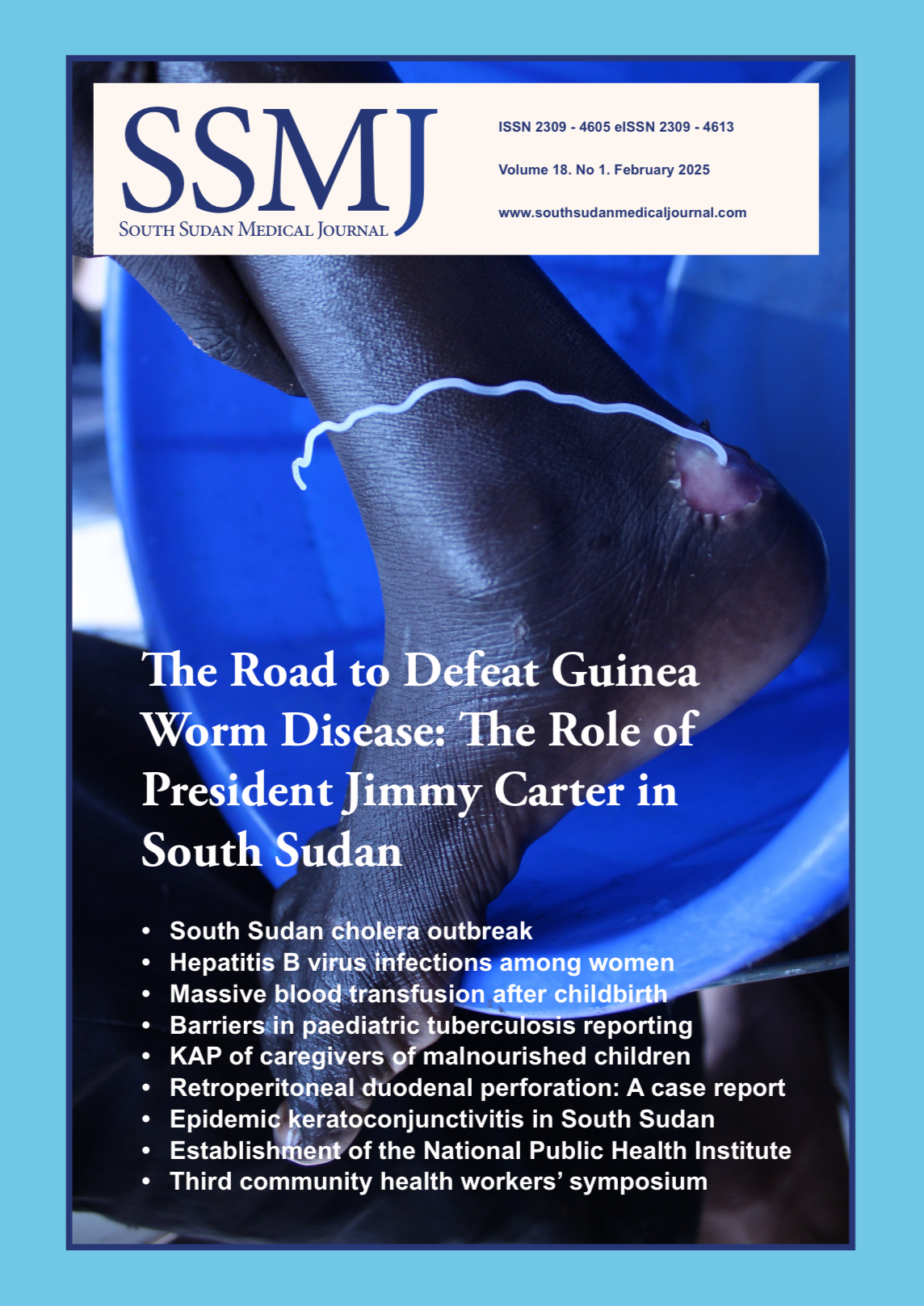
Dear Reader,

The full issue of our February 2025 issue is online here; the articles are listed below. 

Editorial 
  • South Sudan cholera outbreak: A call to improve sanitation Ruot Garjiek Teny 
Research Articles 
  • Prevalence and associated risk factors of hepatitis B virus infections among women of reproductive age in Juba, South Sudan Ezbon WApary, Akway M. Cham, Oromo F. Seriano 
  • Management and outcome of women requiring massive blood transfusion after childbirth: A cross-sectional study at Muhimbili National Hospital, Tanzania Wangwe Peter Joseph, Sawe Eshi-Fisha Linda, Meda Elineema Robson 
  • Addressing barriers in paediatric tuberculosis reporting: A qualitative study of private healthcare providers’ perspectives Suryanti Chan, Idris Adewale Ahmed, Hamzah Hamzah 
  • Knowledge, attitudes, and practices of caregivers of malnourished children at the Al Sabbah Children’s Hospital, Juba, South Sudan Francis Beek Akook, Nyok Daniel Ngor 
Case Report 
  • Evaluation and surgical repair of retroperitoneal duodenal perforation following blunt trauma: A case report Rashmi Ranjan Sahoo, Abhinav Voona, Nalini Naik, and Jyotirmay Jena 
Main Articles 
  • Epidemic keratoconjunctivitis (Pink Eye) in South Sudan: A review Wani Mena The Establishment of the National Public Health Institute (NPHI) in South Sudan Nyinypiu Tong, Anthony Garang, Joseph Lako 
  • The third community health workers’ symposium, Liberia, 2023: What are the implications for South Sudan’s Boma Health Initiative? Kon Alier, Solomon Anguei, William Kuon, Christopher Ajumara 
Short Communications 
  • South Sudan’s journey to defeat Guinea Worm Disease: The role of President Jimmy Carter and the Carter Center Makoy Samuel Yibi Logora 
  • Letter to the Editor: President Jimmy Carter deserves a special recognition for his work to eradicate Guinea worm in South Sudan. Victor Vuni Joseph 
  • Letter to the Editor: Simulation-based education amid conflict: The Sudanese American Medical Association experience in Sudan Mohamed Almahal, Mohamed Ahmed, Omer Gomaa, Salaheldin Abusin, Ihab Abdalrahman
  • Obituary: Maj. Dr Santino Kuot Maluil 
  • Obituary: Dr Benjamin Peter Oduk 
See the back page for instructions on how to prepare and submit manuscripts for publishing in SSMJ.

Thanks to everyone who supports SSMJ - authors, editors, and, especially, our peer reviewers.

The SSMJ team
Email: southsudanmedicaljournal AT gmail.com
Website: http://www.southsudanmedicaljournal.com
Follow us on Twitter@SSMedJournal and our Facebook Group,

SSMJ is published by the Health and Social Science Research Institute of South Sudan (HSSRI-SS)

Copyright © 2025 South Sudan Medical Journal, All rights reserved

Previously on W2tQ:

Wednesday, December 11, 2019

12.12.2019 International Universal Health Coverage Day

https://universalhealthcoverageday.org/

Every person—no matter who they are or where they live—should be able to get the quality health services they need without facing financial hardship. Three months after the historic UN High-Level Meeting on Universal Health Coverage, join us on 12 December to tell leaders to Keep the Promise of health for all.

Ask your government leaders to Keep the Promise by sending a tweet or an advocacy letter A toolkit is available: https://universalhealthcoverageday.org/toolkit/

  • Primary Hashtags: #HealthForAll #UHCDay
  • Secondary Hashtag: #KeepThePromise
  • Handles: @UN @UHC2030 @CSOs4UHC @WHO @UHC_Day

To learn about specific Regional Initiatives check out the Pan American Health Organization's (PAHO/WHO) website:
https://www.paho.org/hq/index.php?option=com_content&view=article&id=14856:universal-health-day&Itemid=42091&lang=en


My source:

GANM (Global Alliance for Nursing and Midwifery)
https://knowledge-gateway.org/ganm

Tuesday, November 19, 2019

South Sudan Medical Journal - November 2019

http://www.southsudanmedicaljournal.com/assets/files/Journals/vol_12_iss_4_nov_19/Full%20Draft%20Final.pdf
South Sudan Medical Journal


The November 2019 issue is now online here and includes items on Diabetes management, FGM and perineal injuries, Nutrition surveys, Gestational choriocarcinoma, Laryngeal trauma, Tympanic membrane perforation, Acute malnutrition and Overuse of antibiotics.  See details below.


Please send us your feedback on this issue, submit your manuscripts (which we can help you prepare), encourage colleagues to join the mailing list here, follow us on twitter @SSMedJournal and our Facebook Group, and find previous SSMJ articles at African Journals Online (AJOL) and the Directory of Open Access Journals (DOAJ).


EDITORIAL
  • Bringing diabetes mellitus into focus on World Diabetes Day Edward Eremugo Kenyi
ORIGINAL RESEARCH
  • The effect of Female Genital Mutilation on perineal injuries among women in labour in Dodoma Region, Tanzania Janeth Dickson Sichone, Athanase Lilungulu, Secilia K. Ngwashemi and Agatha Ngowi
  • Analysis of trends in SMART Nutrition Survey data from South Sudan between 2004 and 2016 Ciara Hogan, Kate Golden, Regine Kopplow and Elaine Ferguson
  • Pattern and causes of tympanic membrane perforation at a private hospital in Dar es Salaam, Tanzania Zephania Saitabau Abraham, Aveline Aloyce Kahinga, Kassim Babu Mapondella, Enica Richard Massawe, Emmanuel Ole Lengine and Daudi Ntunaguzi
  • Nurses’ knowledge of the management of diabetic patients at Juba Teaching Hospital Abuk Mayen Deng, Lucia Buyanza and Fekadu M. Alemu
  • Abstracts from the Juba College of Nursing and Midwifery: Management of 3rd stage of labour Deborah Akon Akech; Danger signs of obstetric complications Kiden Harriet Oliver
CASE REPORTS
  • Gestational choriocarcinoma at Juba Medical Complex and Juba Teaching Hospital: five case reports Kizza Paul, Kuma Chuol Biel, Anthony Lupai, Changkel Banak, Mirghany Abdallah and Paula Nuer
  • Laryngeal trauma at Juba Teaching Hospital, South Sudan Justin Rubena Lumaya, Jino David and Natali Tong
NEWS
  • South Sudanese recipients of grants from the Gordon Memorial College Trust Fund (GMCTF) in 2019
  • Continuum of care for acute malnutrition in South Sudan
  • Public health resources
BACK COVER

Kind regards
The SSMJ team

Copyright © 2019 Southern Sudan Medical Journal, All rights reserved.

Wednesday, December 28, 2011

[HIFA2015] Women and Children First

As we draw towards the end of the year, Ros Davies, executive director of
Women and Children First (www.wcf-uk.org) reminds us:

'This Christmas Day, 1000 women will die in childbirth.
1000 women will die this way on Boxing Day too.
In fact 1000 women die every day whilst pregnant or giving birth.

... the vast majority of these deaths could be prevented by the provision of simple information and equipment which many of us take for granted.'

http://hosted.verticalresponse.com/786283/74890f4030/1470640645/8fd055e22b/

My source:
HIFA2015: Healthcare Information For All by 2015: www.hifa2015.org

Thursday, July 08, 2010

Born HIV Free campaign announces 11 million views for "Baby in the Sky" creative film

Dear Writer and Blogger,

In our series of news related to the 6-month Born HIV Free campaign, we are delighted to send you a press release focussing on the specially created film "Baby in the Sky" created by Les Bonzoms for this campaign.

The film has attracted a great deal of attention through YouTube and other broadcasts, helping to make people aware about the campaign.

Thanks as ever for your support,

Brendan
Ogilvy Public Relations Worldwide France, Paris


“Baby in the sky”: a stunning new film made by Les Bonzoms specially for the Born HIV Free campaign attracts more than 11 million viewers on dedicated YouTube channel

Geneva, 6 July 2010 – The YouTube channel dedicated to The Global Fund’s Born HIV Free campaign which was launched seven weeks ago, has already been seen by more than 11 million viewers. The channel features an exceptional animation film called “Baby in the Sky”, created by the design team Les Bonzoms and with music of Amy Winehouse. Euronews, the international news channel, joins the campaign by also featuring the video until October.

“The purpose of the Born HIV Free campaign is to encourage millions of people to support The Global Fund so we can finally put an end to the tragedy of 430,000 babies being born HIV-positive every year, when we have the means and the expertise to prevent this.” says Carla Bruni-Sarkozy, Global Ambassador for the protection of mothers and children against AIDS. Hopefully this beautiful film will reach a wide audience because of its creative ingenuity, and inspire millions of people to support The Global Fund so we can finally put an end to this terrible injustice.”

“Baby in the Sky” is a highly creative and imaginative animated film that conveys the beauty of life ahead for an unborn child. The film artistically portrays an imaginary journey in a world full of adventurous landscapes and fantastic creatures. It ends with a call from Carla Bruni-Sarkozy for an HIV-free generation in which she says “Life is a beautiful journey. Don’t let AIDS kill it.”
The film owes its powerful soundtrack to multi-award winning and singer/songwriter artist Amy Winehouse, who offered the pro-bono use of her “Back to Black” song for the film.
“It was a question of finding a true resonance with the images in the film created by Bonzoms”, says musician / producer Julien Civange, who conceived the Born HIV Free campaign, about the use of Winehouse’s music. “We wanted to find a piece that was modern but also well known, something that carried the same sensibility as the film. The magic came with the soundtrack by Amy Winehouse, an artist that Carla considers one of the greatest and most talented of her generation and who was generous enough to participate in the campaign.”
The animation can be viewed on the Born HIV Free YouTube channel and will also be distributed through various social and mass media platforms during the course of the campaign.

Since June 20, Euronews, the international news channel, has been broadcasting “Baby in the Sky” on its network in 155 countries. The film is shown in 90-second slots an average of three times a day for the first month and then once a day thereafter. Broadcasting of the film will continue until 5 October 2010.

"All of us at Euronews are very proud to be associated with this initiative, which is supported by an incredible positive animated film" said Philippe Cayla, Chairman of the Executive Board of Euronews. "We are glad to open Euronews' influential and far-reaching network to such professionals and experts fighting to eradicate HIV transmission during pregnancy. We are mobilized to make a success of this campaign and we strongly believe that Euronews' viewers will be deeply moved and will want to participate in the Born HIV Free campaign," Mr Cayla added.
CNBC has also been broadcasting the video on its network in Europe, Middle East and Africa since the launch of the campaign.

Speaking about the distinctive nature of the “Baby in the Sky” project, Jack-Antoine Charlot, a designer from Les Bonzoms said: “It was necessary to stop playing with the notion of guilt as an incentive for people to act and instead to reinforce a sense of wanting to share and take part in something. In the case of mother-to-child HIV transmission, the medications already exist to stop it. The problem is one of mobilization.”

After the film, viewers are invited to show their support by signing their name on the campaign’s “virtual wall of support”, on the www.bornhivfree.org website. The campaign asks people - by the simple act of clicking a button - to register their support for the work of The Global Fund and for the elimination of mother to child transmission of HIV by 2015.
Watch the videos on: www.youtube.com/bornhivfree

Monday, October 06, 2008

Death in Birth By Vivienne Walt/Freetown Thursday, Sep. 18, 2008

An excerpt from an article in TIME magazine is posted below by Patti Abbott, Co-Director of the PAHO/WHO Collaborating Center for Nursing Knowledge, Information Management and Sharing (KIMS), Johns Hopkins University School of Nursing.

The entire article can be found at: http://content.time.com/time/magazine/article/0,9171,1842278,00.html

“In a hospital ward in Freetown, the capital of Sierra Leone, Fatmata Conteh, 26, lay on a bed, having just given birth to her second child. She had started bleeding from a tear in her cervix, the blood forming a pool on the floor below. Two doctors ran in and stitched her up, relatives found blood supplies, and nurses struggled to connect a generator to the oxygen tank. One nurse jammed an intravenous needle into Conteh's arm, while another hooked a bag of blood to a rusted stand, and a third slapped an oxygen mask over her face. In the corner of the room, a tiny baby--3 hours old--lay on a bed, wailing, swaddled in bright-colored African fabric. "Listen! You must feel happy to hear your baby cry," said a nurse, pleading with Conteh to find strength. Three visiting members of a neighborhood church began chanting over Conteh: "Jesus, put blood into this woman! Thank you, Lord!" But as their chants grew louder, the nurses stepped back from the bed. Conteh was dead.
Some version of that scene is repeated around the world about once a minute. Death in childbirth is not just something you find in a Victorian novel. Every year, about 536,000 women die giving birth. In some poor nations, dying in childbirth is so common that almost everyone has known a victim. Take Sierra Leone, a West African nation with just 6.3 million people: women there have a 1 in 8 chance of dying in childbirth during their lifetime. The same miserable odds apply in Afghanistan. In the U.S., by contrast, the lifetime chance that a woman will die in childbirth is about 1 in 4,800; in Britain, 1 in 8,200; and in Sweden, 1 in 17,400. Deaths are heavily weighted to the poorest and most isolated in each country, which means that many politicians remain largely ignorant of the scale of the tragedy. "Often the people in the cities do not know what is happening in their own rural areas," says Sarah Brown, wife of British Prime Minister Gordon Brown and patron of the White Ribbon Alliance, a global advocacy organization that works with governments to lower maternal mortality rates. Brown--who lost a baby 10 days after giving birth in 2001--says that when she tells heads of state and their spouses how many women die in childbirth, "they are aghast."

The Gains Not Made
They have reason to be. For here is the truly ghastly reality of maternal mortality: in 20 years--two decades that have seen spectacular medical breakthroughs--the ratio of maternal deaths to babies born has barely budged in poor countries. To be sure, maternal health has seen advances, with new drugs to treat deadly postpartum bleeding and pregnancy-related anemia. But in many places, such gains are dwarfed by a multitude of problems: scattershot care, low pay for health workers and a scarcity of midwives and doctors. In Mozambique, where women have a 1 in 45 lifetime chance of dying in childbirth, there are just 3 doctors per 100,000 people; in all of Sierra Leone, there are 64 government doctors, only five of whom are gynecologists. Millions of families have never seen a doctor or nurse and give birth at home with traditional birthing helpers, while those who make it to a clinic--some being carried on bicycles or in hammocks--often find patchy electricity, dirty water and few drugs or nurses. Explaining the task of reducing maternal deaths, Sierra Leone's Minister of Health, Saccoh Alex Kabia, who returned home last year after decades of working as a surgeon in Atlanta, says, "The whole health sector is in a shambles."

The article goes on to say:
“When world leaders gather in New York City this month to take stock of the MDGS, their speeches are likely to tout the many achievements since 2000: millions more African children now attend school and sleep under mosquito nets; thousands of new water wells have been dug. Yet though maternal health care underpins many other development goals (healthy mothers are more likely to ensure that their children are well fed and educated), the total number of women dying in childbirth has remained virtually unchanged in eight years. Why? Health officials are clear in their answers. Aside from lack of money and political will, they also face entrenched traditions and fatalistic attitudes to maternal mortality, especially in very poor communities. "People think that dying in childbirth is not preventable," says Nadira Hayat, Afghanistan's Deputy Minister of Health. "They say it is up to God."
~~~~~~~~~~~~~~~~~~~~~~~~~~~~~~~~~~

I think they need knowledge, a nurse, a midwife.

Patti
Patricia A. Abbott, PhD, RN, FAAN
Co-Director of the PAHO/WHO Collaborating Center for Nursing Knowledge, Information Management and Sharing (KIMS), Johns Hopkins University School of Nursing
___________________
Visit web site:
http://my.ibpinitiative.org/GANM/NMmakingpregnancysafer/

My source: posted by Jody Lori: [Nursing and Midwifery for Making Pregnancy Safer: Discussion] link to article in Time Magazine.

Additional links:

http://www.unicef.org/infobycountry/sierraleone.html

http://www.unicef.org/infobycountry/sierraleone_statistics.html
