Hodges' Model: Welcome to the QUAD: risk

Hodges' model is a conceptual framework to support reflection and critical thinking. Situated, the model can help integrate all disciplines (academic and professional). Amid news items, are posts that illustrate the scope and application of the model. A bibliography and A4 template are provided in the sidebar. Welcome to the QUAD ...

Showing posts with label risk. Show all posts

Wednesday, October 21, 2026

Aberfan - 60 years

As for many children (one hopes) my future education, motivation and aspirations were framed by my parents. Pivotal was my father, and having the opportunity. Growing up in mid-Wales he had been surrounded by mines and quarries. My grandfather had worked in a slate mine, walking there and back to the village and home. 

There was a real fear that I'd end up down working down the mine. Value judgements, courage and community aside, my father witnessed some of the realities of pit/quarry life. So for me, and a brother and sister who followed, it was school, school, school (perhaps you can tell?).

There were many reminders: records of Welsh choirs; films such as How Green Was My Valley. In my early teens this theme was there in English classes, as we read and discussed D.H. Lawrence's, Sons and Lovers. Living near Wigan, we in turn were surrounded by mines, many already closed. Golborne colliery was an exception. There was an accident there in 1979 after we had left school. 

Perhaps also it was a sign of a future career pathway, as I noticed the impact of the Aberfan disaster now 60 sixty years ago on my father. I was a similar age to the children who lost their lives. In the news this week it is remarkable, salutary and shaming the similarity with more recent major incidents with loss of life, here in the UK. The lack of regard for accountability, and social justice.

Tuesday, August 04, 2026

Brief introduction to Hodges' model

Hodges’ model is a conceptual framework of universal value in theoretical work, practice, policy and care management. While this model is a product of the health-education sector, it is global in scope, taking in the current situation, history and future as complicated by scientific, socio-political, technology and climate change. Practice-based, Hodges’ model is a tool simple in form and yet powerful in terms of how it can help users frame the problems and opportunities of the 21st century. The model was originally taught in studies for the post-registration certificate of care of the mentally ill in the community and other courses. Student assessment included the completion of a case study (vignette), demonstrating competence in application of the model and its embedded (implicit) values.

Access to education, especially early years, is emphasised as foundational for personal and community growth and development. For individuals this can set the course for lifelong learning and an ability to contribute to society and the economy. Given this primary challenge, global institutions and policy makers point to the need for curricula that are relevant. In turn employers and industry leaders need a (global) workforce who are: 

  • reflective practitioners;
  • critical thinkers;
  • able to see the ‘big-picture’; and focus on detail and priorities when needed (risk and triage);
  • decompose a problem, but also integrate (care);
  • work as team-members;
  • and extend across several literacies.
These challenges are ongoing for education (being health literate, so as to address personal, social, health and economic education, and the sustainable development goals), and increasingly climate impacts.

Friday, July 31, 2026

10 years of Money and Mental Health

An update from Helen Undy OBE - Chief Executive of Money and Mental Health.

Marking a full decade since we were founded, we've put together a short film summarising who we are, what we do, how we put lived experience at the heart of our work and our impact so far. We're particularly grateful to the members of our Research Community - Suzanne, Rob and Catherine - for giving up their time to appear in this film. If you're interested, please watch below. And please do feel free to share with friends or colleagues who might be interested in learning more about our work.


Sometimes the most basic of formulations speaks volumes and distances ...


individual
|
INTERPERSONAL
: SCIENCES             
humanistic ------------------------------- mechanistic
SOCIOLOGY : POLITICAL   
|
group

Mental health


Money

Tuesday, July 07, 2026

Choose to Treat appeal, 7–14 July 2026


Donate here between 7–14 July and your donation will be doubled! 

'Water is scarce in Mauritania and people have little choice but to bathe, wash clothes, care for their animals, and cool off in the same pools. But the water that brings relief also carries schistosomiasis, a parasitic disease that silently damages the kidneys, stunts growth, impairs learning, and steals futures.

Through our collaboration with the Ministry of Health, Amadou (pictured*) received treatment, and he recovered. But many children in Mauritania still require it. Without continued access to treatment, Amadou and thousands like him remain at risk every time they enter the water.

When people cannot avoid exposure, access to safe, effective treatment is their best protection. A single donation can help protect children like Amadou and support their health at a critical stage in their childhood.' ... 'Choose to Treat appeal'


Previous related posts: 'neglected tropical diseases' : 'SDGs'

Sunday, June 07, 2026

Book: "The Elements of Power"

individual
|
INTERPERSONAL
: SCIENCES             
humanistic ------------------------------- mechanistic
SOCIOLOGY : POLITICAL   
|
group
logicical OR
 

the periodic table
|
mining
|
elements
COBALT


the 'table' ...

family

communities


CHILD LABOUR
 
power 


“A tale of rapacious colonialism, Cold War spy games, dazzling technical innovation, big business rivalry, big power geopolitics . . . Niarchos has produced an unflinching, landmark work on the nature of extractive capitalism.” —Patrick Radden Keefe, New York Times best-selling author of Empire of Pain and Say Nothing

Epic, shocking, and deeply reported, The Elements of Power tells the story of the war for the global supply of battery metals—essential for the decarbonization of our economies—and the terrible, bloody human cost of this badly misunderstood industry


'Congo is rich. Swaths of the war-torn African country lack basic infrastructure, and, after many decades of colonial occupation, its people are officially among the poorest in the world. But hidden beneath the soil are vast quantities of cobalt, lithium, copper, tin, tantalum, tungsten, and other treasures. Recently, this veritable periodic table of resources has become extremely valuable because these metals are essential for the global “energy transition”—the plan for wealthy nations to wean themselves off fossil fuels by shifting to sustainable forms of energy, such as solar and wind. The race to electrify the world’s economy has begun, and China has a considerable head start. From Indonesia to South America to Central Africa, Beijing has invested in mines and infrastructure for decades. But the U.S. has begun fighting back with massive investments of its own, as well as sanctions and disruptive tariffs. ...'

https://www.penguinrandomhouse.com/books/709025/the-elements-of-power-by-nicolas-niarchos/

My source: James McConnachie, The dirty truth behind our 'clean energy' cars, saturday review, The Times, 17 January 2026, p.13.

Previously: 'mining' : 'corruption' : 'Africa' 

Sunday, May 24, 2026

South Sudan Medical Journal Vol 19 No 2 May 2026


Dear Reader,

The May 2026 issue is online here; we thank all the copyeditors and reviewers who helped prepare these papers. SSMJ is indexed by African Journals Online (AJOL) – go here to see who reads us.


Editorial 

  • Ebola: The Bundibugyo virus is back Edward Eremugo Kenyi

RESEARCH ARTICLES

  • Risk factors in glaucoma: Insights from a prospective case–control study, Belagavi, India Asawari Kabure, Bhushan Kulkarni, Shilpa Kodkany, Murigendra Hiremath
  • OV16 antibody seropositivity reveals persistent onchocerciasis transmission and cross-border risk in Magwi County, South Sudan: a population-based survey Ezbon WApary, Yak Yak, Benson Ojara, Wilson Ladu, David Oguttu, Ian Hennessee, Pita Jane, Johan Willems, Thok Chol, Kamulete Horasio, Okot William, Amanya Jacob
  • Prevalence of urinary schistosomiasis in communities along the River Niger Basin areas, North-Central Nigeria Nyamngee Amase, Ikpe Raphael Terlumun, Kayode Yusuf Abel, Sulaiman Mariam Kehinde, Akanbi II Aliu Ajibola
  • Developing a communicable and infectious diseases research agenda in South Sudan: A multi-stakeholder prioritisation approach Amanya Jacob, Ezbon WApary, Dhieu Daniel, Atemthi Dau, Matur T. Tieng, John Rumunu, Cicilia Konga, Bol Atem, Betty Eyobo, Robert Napoleon, Joseph Panyuon, Kenneth L Sube, Kon Alier, Joseph Lako, John Suraj, Abuelguasim M. Hassan, Mapuor Areu, Lazarus Atem, Aja Kuol, Pizzi Wilson, Achcer Adup Mou
  • Determinants of disaster preparedness among public health facilities in Juba City, South Sudan Dumba Samuel Kenyi, Muthoni Mwangi Eunice, Musa Olouch
  • Evaluating the role of the health information system infrastructure in enhancing data quality in Central Equatoria State, South Sudan Matur T. Tieng, Karani Magutah, Joseph Muchiri
  • Impact of developmental stimulation education on maternal knowledge and caregiving practices in stunting: a longitudinal study Ning Iswati, Azizan Omar, Sukhbeer Kaur Darsin Singh, Putra Agina Widyaswara Suwaryo 
  • Holding the line: lived experiences of mental health, moral injury, and organizational support among public-health professionals in the Rohingya Camp, Bangladesh — phenomenological study Md. Ruhul Amin
CASE REPORTS 
  • Endoscopic endonasal repair of post-traumatic sphenoid sinus cerebrospinal fluid leak with encephalocele Justin Rubena, Khalid Coco, Francis Swaka, Othwonh Twong 
  • A rare pathological feature of portal vein thrombosis complicated by portal hypertension and haematemesis Hamidine Illa, Ganiou Tidjani Kabirou, Amadou Magagi Mahamane Ibrahim, Maman Brah Moustapha, Soumaila Abdou, Habou Garba Abdoul Malik, Adamou Harissou

REVIEW ARTICLE

  • Interpersonal and community-level factors influencing intimate partner violence in South Sudan: a literature review Nyinypiu Tong Chol Adong 

SHORT COMMUNICATIONS

  • Letter to the Editor J. Clarke McIntosh
  • Letter to the Editor Eluzai A. Hakim
  • News from the Gordon Memorial College Trust Fund Eluzai A. Hakim

BACKCOVER: CDC Poster: Flu or Ebola? 

Thanks to everyone who supports SSMJ. Tell your colleagues they can join our mailing list here.

The SSMJ team
Email: southsudanmedicaljournal AT gmail.com
Website: http://www.southsudanmedicaljournal.com
Follow us on X: @SSMedJournal and our Facebook Group,

Monday, May 11, 2026

BCS Third Faculty of Health and Care Conference 2026 - London 30th June

Overview

Join us for an exciting and informative day with a mix of keynotes, debates, panels, and practical workshops.

Speakers

Please visit the Faculty of Health and Care Conference 2026 web page for a list of our speakers and speaker biographies.

Synopsis

Please join our third annual conference featuring keynote addresses, panel sessions, scientific abstracts and posters, and practical workshops.

Our theme this year is 'Collaborate, Learn and Professionalise'.

Hear from national and international speakers in a CPD awarded programme.

Join us after the event for networking in an informal drinks reception.

Further details are available here:

Faculty of Health and Care: Conferences | BCS and Faculty of Health and Care Conference 2026 | BCS.

Ticket costs

(Prices stated are inclusive of VAT and fees)

  • Venue Attendance - BCS Members - £25
  • Venue Attendance - Non-BCS Members - £35
  • Online Attendance - BCS Members - £12
  • Online Attendance - Non-BCS Members - £15

Refunds/cancellations

A refund, excluding fees, will be issued if a cancellation request is received within 14 days of the booking date or by noon on Tuesday 16th June 2026, otherwise, name substitutions will be allowed after this date.

Our events are for adults aged 16 years and over.

This meeting is conducted in accordance with the BCS Code of Conduct for Meetings.

Join BCS today

If you are attending in person, please familiarise yourself with the Visitor Instructions for the BCS London Office.

Please note, if you have any accessibility needs, please let us know via 
groups AT bcs.uk and we’ll work with you to make suitable arrangements.

This event is brought to you by:

Faculty of Health and Care | BCS

n.b. Attending in-person. PJ

Monday, March 23, 2026

Good - Bad AI? c/o FT Magazine et al.

My source: Tim Harford, How can we tell good AI from bad? FT Magazine. 21 March 2026. #1168: pp.9-10.

    'Two new working papers address the tricky issue of verifying quality. In "Some Simple Economics of AGI", Christian Catalini, xiang Hui and Jane Wu (assisted, sometimes gratingly, by generative AI) propose the inevitable 2x2 matrix in which economic activity can be easy to automate, easy to verify, both or neither. Automatable, verifiable output is the stuff that computers do for us. The non-automatable stuff remains reassuringly artisanal.
    The difficult quadrant is where tasks seem easy to complete but are hard to check. Catalini, Hui and Wu call this the "runaway risk zone". It is not a reassuring label and it is not meant to be.
...
    In the second paper, "A model of Artificial Jagged Intelligence", Joshua Gans offers an analogy in which asking AI to perform task is like trying to cross a river over a network of planks supported by occasional pylons. The jagged frontier is represented by the fact that some planks are long and wobbly, while others are short and sturdy. Problem one: even if the planks are typically sturdy, the wobbly planks will require most of your time and attention. Problem two: if you can't predict in advance which planks will let you down, you may quite sensibly prefer to eschew the AI entirely and row yourself across the old-fashioned way.'

Catalini, C., Hui, X., & Wu, J. (2026). Some Simple Economics of AGI. arXiv preprint arXiv:2602.20946.

Joshua S. Gans, 2026. "A Model of Artificial Jagged Intelligence," NBER Working Papers 34712, National Bureau of Economic Research, Inc.


Previously: 'safety' : 'ai' : 'domain' : 'matrix'

Wednesday, November 19, 2025

Diagnostic Overshadowing

Diagnostic overshadowing

People with mental health problems experience diagnostic overshadowing. This is reports of physical ill health being viewed as part of the mental health problem or learning disability and therefore not investigated or treated.  Undertaking a full physical health check for patients with SMI helps identify opportunities for evidence-based interventions which can reduce people’s risk of death, avoidable ill health and reduce health inequalities.

Source: https://primarycare.lancashireandsouthcumbria.nhs.uk/wp-content/uploads/2025/05/20250527-A-practical-guide-to-delivering-physical-health-checks-for-people-with-SMI.pdf?x23654

individual
|
INTERPERSONAL : SCIENCES
humanistic -------------------------------------------  mechanistic
SOCIOLOGY : POLITICAL
|
group-population

MIND
Surely, it's the mind -
 

not the body?


Friday, September 12, 2025

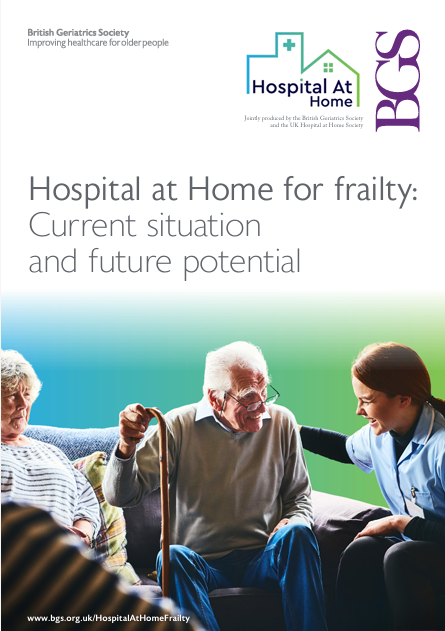
Report: Hospital at Home for frailty ...

 .... Current situation and future potential

Report: Hospital at Home for frailty
The BGS has produced report on Hospital at Home services for older people. This explains how they are currently provided and how they might develop in the future as a key part of community-based healthcare. The report is endorsed by the UK Hospital at Home Society.

Hospital at Home is a safe and effective alternative to acute hospital bedded care for people who are sick enough to be in hospital.

Hospital-level care provided at home means people living with frailty are not exposed to some of the risks arising from long stays in hospital, such as infections and deconditioning.

There is mounting evidence for the effectiveness of Hospital at Home services, which are greatly valued by those who use them. With 35,000 people a year benefiting from this alternative to hospital in England, further development of Hospital at Home should be encouraged as a key part of the Government’s ‘left shift’ from hospital to community.

continued ...

My source:
https://x.com/GeriSoc/status/1965676874111037547

Wednesday, July 09, 2025

'Thinking outside the box: alternatives to standard inpatient mental health care' by Amber Jarvis

c/o The Mental Elf on 'X' I came across a blog post by Amber Jarvis:

Thinking outside the box: alternatives to standard inpatient mental health care

Amber's post considers a study by:

Griffiths, J. L., Baldwin, H., Vasikaran, J., Jarvis, R., Pillutla, R., Saunders, K. R., … & Johnson, S. (2025). Alternative approaches to standard inpatient mental health care: development of a typology of service models. International Journal of Mental Health Systems, 19(1), 1-13: https://pubmed.ncbi.nlm.nih.gov/40247283/

At an online meeting this evening, near the close the discussion loosened and alighted on AI. The ability of AI to summarise a large text file, a *.pdf and create discrete web HTML pages. The racial bias 'built-in' by human coders, reflected in outputs; that point to structural racism. 

Finding this paper on X, boxes are the bread and butter of Hodges' model. Not just thinking outside a box, or inside one, but several and with a final twist - to follow. Amber begins:

'Inpatient mental health care involves staying in a hospital or specialised facility to receive intensive, round-the-clock support for serious mental health needs (Staniszewska et al., 2019). Whereas acute inpatient services typically respond to immediate crises, longer-term wards support individuals with more complex needs and a higher level of ongoing risk.

Inpatient services are a core component of our mental health system — whether someone stays for a night, weeks, or even several years. However, inpatient care has recently come under growing scrutiny – and for good reason.'

A Community Mental Health Nurse since 1985, my in-patient experience is a tad misty, but not misty-eyed. As the wards: psychogeriatrics, long-stay, female acute admission were simultaneously challenging, rewarding - in the sense of being able to make a positive difference, changing what were institutionalised practices, no personal clothes, lockers, tea urn, no banking, few visitors (admission wards excepted). It was all very quotidian: check the bath book. Then tell, confirm, assure the patient, 'yes!'. It is your bath day. I've posted previously about critical mental health. You do (should?) quickly learn you are part of a system, a machine; and the distinction between person- patient-centred and service-centred care. The need to do my 'general' quickly emerged too. 

As ever, two words, across Amber's post and Griffith et al's title, stand out; 'map' and 'typology'. I must revisit and post about:

Macduff C. (2007). Typologies in nursing: a review of the literature. Nurse researcher, 14(2), 40–50. https://doi.org/10.7748/nr2007.01.14.2.40.c6020

Part-time work since 2020, in two adult CMHTs and a recovery team, has provided an update. The first as COVID emerged, was a bit of a shock in terms of diagnoses, caseness, the proximity to the law and forensic psychiatry, thresholds for referral, changes to mental health law (that were now more practical) and the management of patient's finances. 

So, to return to last night's brief online discussion, the observation of how racism is ongoing, brought up the fact of racism being structural and institutional (Dean & Thorpe, 2022). The change needed is an intergenerational break, which doesn't bear thinking about. The National HEALTH Service faces the same challenges in the shift to prevention, and addressing racism. Where is the workforce, going to come from, to help recovery, health and related literacies (media, emotional, financial)?

It is easy in boxes like Hodges' model (and others) to be idealistic. Ideally as I learned of Community Psychiatric Nurses being recruited, six of us, we all should have asked:

What is the plan?
What is the model of care?
What characterises 'care in the community'?
How do we prevent relapse, readmission?
Is there a 'halfway house'*?

We did, to an extent. There was great enthusiasm, motivation, idealism, co-ordination, collaboration  (Tyrer & Gelder, 1990) and leadership. 'We' had an association,^ and a journal. Back then the Royal College of Psychiatry produced a report on CPNs. Is there a message in this? Progress was and has been made, but the promise has not been delivered. With care in the community having regressed, an incomplete 'project'.

I will read more and revise this post, or more likely add another: with less 'history' ...

Individual
|
      INTERPERSONAL    :     SCIENCES               
HUMANISTIC  --------------------------------------  MECHANISTIC      
 SOCIOLOGY  :    POLITICAL 
|
Group
Model of Care

Model of care

Model of Care
Care in Community
Children - Schools - Education

Model of care
'Care Leavers'


*'Cross-settings' in Griffith et al.

^https://www.unitetheunion.org/what-we-do/unite-in-your-sector/health-sector/mental-health-nurses-association

Lorraine T Dean, Roland J Thorpe, What Structural Racism Is (or Is Not) and How to Measure It: Clarity for Public Health and Medical Researchers, American Journal of Epidemiology, Volume 191, Issue 9, September 2022, Pages 1521–1526, https://doi.org/10.1093/aje/kwac112

Tyrer P, Gelder M. The future of community psychiatric nursing: some research findings. Psychiatric Bulletin. 1990;14(9):550-551. doi:10.1192/pb.14.9.550

Sunday, April 20, 2025

Safety testing time - evaluations - for users of Hodges' model to be extended

The time to test Hodges' model* is to be extended (in my dreams...).

Or. Do not underestimate 'simple' models.

The time to evaluate Hodges' model:

  • for individual users
  • cross-curricula
  • professional groups (e.g. registered mental health; and general nurses)
  • within multidisciplinary / skilled teams / venues (Nursing home, Community Mental Health Team)
Given the universal, multicontextual scope of the model for public and patient safety it was decided to extend the time for testing by a further month to two quarters [ 😉] - six whole calendar months.

When applied it is important that checkpoints are agreed:

  • Data gathering - initial interview
  • initial formulation / care plan
  • care review / evaluation
  • discharge - staying well 
There is no agreed standard for testing a generic model in healthcare. Is there?
  • Not for the medical / bio-medical model
  • Nor, for the biopsychosocial model?
What chance then for a biopsychosociopolitical model?

*Per user and group of users of course.

My source: 
Christina Criddle, Concerns raised after OpenAI slashes time taken to test potential risks of latest models, FTWeekend, 12-13 April, 2025, p.14. (italicised terms discussed).

See also:
Radhika Rajkumar, Editor. OpenAI used to test its AI models for months - now it's days. Why that matters, ZDNET.

https://www.zdnet.com/article/openai-used-to-test-its-ai-models-for-months-now-its-days-why-that-matters/

Friday, April 11, 2025

The 'animal' in Hodges' model i

The New York Review of Books


'The fact that a horse has his eyes on the sides of his head identifies horses as animals of flight rather than fight, in contrast with animals like tigers, who have their eyes in the front.' p.17.


Hodges' model has two pairs of 'eyes'.

Can you see them?


Hodges' model: Axes & Domains
Structure AND Content :: Fight OR Flight

Doniger, Wendy. The Rise and Fall of Warhorses. The New York Review of Books. April 10, 2025. Volume LXXII, Number 6. pp.17-19. https://www.nybooks.com/issues/2025/04/10/

Tuesday, September 10, 2024

Suicide Postvention in the Workplace - new SOM resource

https://www.som.org.uk/suicide-postvention-workplace-new-som-resource

Posted by Ann Caluori | Mon, 09/09/2024 - 08:52

The term 'suicide postvention' refers to the actions taken by an organisation to provide effective support in a sensitive manner after a death by suicide. It aims to promote recovery and prevent further adverse outcomes.

This new SOM resource, authored by Professor Gail Kinman and Professor Neil Greenberg, provides evidence-informed guidance and recommendations for organisations to respond to the death by suicide of a colleague, or the unexpected death of a colleague from other causes. The guidance draws on high-quality sources from research and practice and was developed through consultation with experts from various fields. It aims to help organisations navigate the complexities and sensitivities involved in such tragic events, ensuring they provide the support required to maintain a healthy and compassionate workplace.

The resource should be useful for occupational health practitioners, wellbeing leads, HR professionals, managers, and policy makers. It addresses several important issues in the aftermath of a workplace death by suicide, such as immediate response approaches, communication protocols, support mechanisms for affected individuals, and long-term considerations for fostering a supportive work environment.

Download the guidance here.

This resource has been launched ahead of World Suicide Prevention Day 2024.

My source: TwiX @somceo

See also: 
World Suicide Prevention Day 2024 #WorldSuicidePreventionDay

Saturday, August 24, 2024

"In HIFA - let's save a space to make sense of mountains of data"

Dear All, (HIFA mail list)

While rather expansive in scope not just reaching to the arts but also referencing nature and mountains, the following blog post may be of interest:

"Health & Care results in mountains of data: c/o Burke & Cao 2024"

https://hodges-model.blogspot.com/2024/08/nan-shepherd-.html

While the focus and purposes for HIFA are clear, in practice 'information' (data, facts, knowledge, wisdom) must always be contextualised, situated, and (potentially) justified.

In addition to relying on the sciences, medicine, nursing and healing practices are also characterised as arts.

See also, the digital humanities and more specifically - 'Intima: A Journal of Narrative Medicine' https://www.theintima.org/

There have been many posts about records recently, but of course it what goes into the record that is critical.

Salience, what we pay attention to is key.*

The record is critical if something goes wrong and a professional finds themselves in a Coroner's court, and/or disciplinary hearing. The previous posts also discuss the patient's access to their medical record.

I'm not sure if the point has been made but even before 'health literacy' is taken into account, given access a patient may identify many mistakes/errors within the record on many details including demographics and procedures, treatments, diagnoses applied. (There are studies confirming the same - a benefit of IT systems.)

In mental health service - England the care programme approach (CPA) has ended - been retired. Some argue this has been done 'quietly'.

While the emphasis on documentation since 1990s has been onerous for some practitioners in the need for a 'comprehensive' record, the principles of CPA are well-based in practice: Patients (families) are entitled to - 1. A care assessment 2. A care plan 3. A named care-coordinator - keyworker 4. A review 6 monthly; annually as a minimum

For more than a year 1995.., I worked full and p/t as CPA co-ordinator for Chorley and South Ribble Health Authority; and produced a report highlighting the potential benefits of information technology in data gathering and processing and information reporting. (A conference was also organised with 60+ delegates, and 10 software vendors demonstrating their wares.)

The news drove the development and introduction of CPA during the late 1980s, with often stigmatising headlines for many people affected with mental illness - including psychosis it must be added. Recent events are troubling for society and services now, and in terms of history repeating itself:

"On average over a hundred people in Britain a year are killed by someone with serious mental illness. On the day the NHS is Nottingham is found to have missed opportunities to stop Valdo Calocane killing 3 people we ask why lessons aren’t being learned." 'X' https://x.com/BeckyJohnsonSky/status/1823459379846271002

"Between May 2020 and February 2022, eight risk assessments were completed for Calocane by the trust, which the CQC said appear to have been carried out for each of his admissions to hospital and updated at other times during his care. The regulator said that while some risks were highlighted, other assessments “minimised or omitted key details”. https://careappointments.com/care-news/england/211213/cqc-review-of-nottingham-killers-care-finds-key-risk-details-minimised-or-omitted/

The state of mental health services in the UK is much debated and here too 'information' is critical, especially 'seeing' the person and the nuances of interpersonal communication skills. These are often encountered through non-verbal communication and 'clinical intuition' which must be related to professional experience.

So information must simultaneously be recognised as a mechanistic and humanistic melange of processes, purposes, practices and policies (4P's in Hodges' model).

As highlighted before we can also contrast HIFA's and practitioners efforts to combat the severe implications and risks of 'information disorder'. And yet, also recognise how the arts, innovation and creativity also contribute to interpersonal engagement, therapeutic goals, case formulation, health and other literacies using *metaphor* and *analogies* - as per Nan Shepherd's musings explored in the blog post by -

Burke, R., Cao, E. To Care for a Mountain - What medical practitioners can learn from Nan Shepherd. Oxford Review of Books, Summer 2024, Volume 8, Issue 2. p.14. In association with Stanford. (open access)

Patient, public and practitioner safety is always the aim & objective.

Further reading & notes: https://www.cqc.org.uk/publications/nottinghamshire-healthcare-nhsft-special-review-part2/risk-assessment

Whiting, D., Gulati, G., Geddes, J.R., Dean, K. and Fazel, S. (2024), Violence in schizophrenia: triangulating the evidence on perpetration risk. World Psychiatry, 23: 158-160. https://doi.org/10.1002/wps.21171

*I hope to contribute to a 'philosophy of attention' research project, my contribution will draw on clinical experience above and apply Hodges' model to explore and debate ... 'attention', starting in 2025 to c.2030.

Regards to all, Peter Jones

Wednesday, August 14, 2024

There is this thing - 'universal construction'

The problem of bugs in software is an ongoing problem across all IT industries. For application that are safety critical we are still reminded of the risk implications and consequences if bugs are software is not tested and bugs - errors identified and corrected.

Back in the 90s during BA(Joint Hons. Philosophy & Computing) studies, I was introduced to the formal specification language 'Z'. It was designed for definition, and modelling of computer software, working from specification to implementation, as per these images:

https://personalpages.bradley.edu/~young/CS592M120_OLD/handoutZed.pdf

https://personalpages.bradley.edu/~young/CS592M120_OLD/handoutZed.pdf

To be clear I've never worked as part of a software project and my 'tinkering' - Drupal, Pharo, online groups, hosting platform - reveals how the development stack and work processes have developed apace. The challenge is keeping up. Simultaneously, there is the sense of being on the bank of deep water; or, a vertiginous cliff:

A little learning is a dang’rous thing;
Drink deep, or taste not the Pierian spring:
There shallow draughts intoxicate the brain,
And drinking largely sobers us again.
Fir’d at first sight with what the Muse imparts,
In fearless youth we tempt the heights of arts,
While from the bounded level of our mind,
Short views we take, nor see the lengths behind,
But more advanc’d, behold with strange surprise
New, distant scenes of endless science rise! 
Pope. https://interestingliterature.com/2021/09/a-little-learning-is-a-dangerous-thing-meaning-analysis-origin/

 Acknowledging the need for an 'evidence-base' and theoretical underpinning the effort to 'push' Hodges' model forward is ongoing. Maths remains an alien territory to me, but the 'secret garden' is as tantalizing as ever. Over the years I have posted - with much overlap about:

  • maths
  • relation
  • logic
- and more recently:
  • isomorphism
  • category theory
  • and as previously posted - laws of form.
In an effort to get to grips with the above, I'm following various online videos, books and papers. Bartosz Milewski's videos, blog and publications are aimed at programmers, but are very interesting nonetheless. The first video provides an introduction to the motivation and philosophy of category theory. In another, Milewski refers to 'universal construction' on YouTube and in a blog post about 'Function Types'.

The 'universal' figures in healthcare too: universal health access, and universal health coverage appear to over-shadow 'universal health care'. The quality of 'universal' also creeps into assessment. Data gathering is not merely complete, it is comprehensive. It has to be, to contribute not just to a care plan, for one that is (supposedly) person-centred, with risks identified, strengths, weaknesses - needs, history, social network, and much more. The care plan informs and orchestrates the interventions; then evaluation follows. Are we delivering? What is the patient's (client's, carer's) level of satisfaction. Have care stages and actions been completed as per policy (in time!)? (More on this to follow later this year in light of UK mental health/illness news.)

So as I consider (wrestle with...) initial, and terminal objects, sets and categories … I can hopefully, especially with help, extend the number of posts tagged 'universal' here on W2tQ. In this vein, is Hodges' model a universal construction? There may not be a universal truth to reveal, but it will prove a marvellous learning journey.

Thursday, July 25, 2024

World Drowning Prevention Day 25th July 2024

Every year, an estimated 236,000 people drown, making drowning a major public health problem worldwide. Drowning is one of the leading causes of death globally for children and young people aged 1-24 years. Drowning is the 3rd leading cause of unintentional injury death, accounting for 7% of all injury-related deaths.

The global burden of death from drowning is felt in all economies and regions, however:
  • low- and middle-income countries account for over 90% of unintentional drowning deaths; 
  • over half of the world's drowning occurs in the WHO Western Pacific Region and WHO South-East Asia Region; 
  • drowning death rates are highest in the WHO Western Pacific Region, and are 27-32 times higher than those seen in the United Kingdom or Germany, respectively.

World Drowning Prevention Day

World Drowning Prevention Day, declared in April 2021 by General Assembly resolution A/RES/75/273 <https://undocs.org/en/A/RES/75/273>, is held annually on 25 July. This global advocacy event serves as an opportunity to highlight the tragic and profound impact of drowning on families and communities and to offer life-saving solutions to prevent it.


Find more information in the following link: 
https://www.un.org/en/observances/drowning-prevention-day 

In your country, are there any initiatives to prevent drowning?

Here are some of the measures shared at the United Nations web site.
  • installing barriers controlling access to water;
  • providing safe places away from water such as crèches for pre-school children with capable childcare;
  • teaching swimming, water safety and safe rescue skills;
  • training bystanders in safe rescue and resuscitation;
  • setting and enforcing safe boating, shipping and ferry regulations;
  • improving flood risk management.

My source (with video added above and Hodges' model below):

Jackeline. HIFA-Spanish Moderator

HIFA profile: Jackeline Alger, MD, PhD, is a parasitologist associated to the Department of Clinical Laboratory of the University Hospital; Executive Director of the Antonio Vidal Institute for Infectious Diseases and Parasitology; Tegucigalpa, Honduras. HIFA Country Representative of the Year for the years 2015 and 2018. Email jackelinealger AT gmail.com

The bullet points above mapped to Hodges' model, with additions (italics).

individual
|
INTERPERSONAL : SCIENCES
humanistic ------------------------------- mechanistic
SOCIOLOGY : POLITICAL
|
group

teaching swimming, water safety and safe rescue skills
training bystanders in safe rescue and resuscitation
awareness of risk situations
confidence to learn to swim

installing barriers controlling access to water
providing safe places away from water such as crèches for pre-school children with capable childcare
improving flood risk management


teaching swimming, water safety and safe rescue skills
training bystanders in safe rescue and resuscitation

family and community impacts

SOCIO-
funding - prioritisation
setting and enforcing safe boating, shipping and ferry regulations

improving flood risk management
facilities for safe & effective teaching

-ECONOMIC   LMICs

Previously 2022

Wednesday, April 24, 2024

'The Deepest Breath'

Individual
|
      INTERPERSONAL    :     SCIENCES               
HUMANISTIC  --------------------------------------  MECHANISTIC      
 SOCIOLOGY  :    POLITICAL 
|
Group


"Netflix has collaborated with A24, Motive Films, Ventureland and Raw on this gripping look at the undeniable connection forged between two athletes as they navigate the vigorous and competitive world of freediving. The Deepest Breath will have its world premiere at the Sundance Film Festival in January 2023.
Logline: A champion freediver trains to break a world record with the help of an expert safety diver, and the two form an emotional bond that feels like fate. This heart-stopping film follows the paths they took to meet at the pinnacle of the freediving world, documenting the thrilling rewards – and inescapable risks – of chasing a dream through the silent depths of the ocean."


Image: c/o Netflix

Wednesday, April 03, 2024

Exceptional Events . . . . . . .

Individual
|
      INTERPERSONAL    :     SCIENCES               
HUMANISTIC  --------------------------------------  MECHANISTIC      
 SOCIOLOGY  :    POLITICAL 
|
Group

Exceptional person(s)

C/o AP - Aol

"The exception to the rule."

"... avoid civilian casualties
as no other army in history ..."

deconfliction


Previously:
From - https://hodges-model.blogspot.com/search?q=Palestine

BBC Today and PM, 3 April 2024.

Images:
https://www.aol.com/news/aid-organizations-suspend-operations-gaza-190605787.html

https://cdn-01.media-brady.com/store/sifr/media/catalog/product/s/i/sifr_cx3a_1_std.lang.all.gif

Wednesday, March 13, 2024

UK Higher Education Survey of Carers

From: Marie Moreau <marie_moreau AT HOTMAIL.COM>
Subject: UK HE survey of carers

Dear Colleagues

I am sharing this final call as we will be closing our survey of carers in UK HE at the end of the month.

Many thanks to those of you who have replied.

To be eligible, you need to be employed by a UK-based university and to be a carer (broadly understood, including as a parent, for a friend, a relative etc.). Here’s the link:

https://angliaruskin.onlinesurveys.ac.uk/national-carers-survey-uk

The outcomes will help us to better understand the experiences of carers in higher education and to provide recommendations to the sector.

We have received ethical approval for this project and are happy to address any question.

Warm wishes

Marie-Pierre Moreau
ARU, Cambridge, UK


My source (with some editing):
This message was issued to members of www.jiscmail.ac.uk/FREEDOM-OF-INFORMATION, a mailing list hosted by www.jiscmail.ac.uk, terms & conditions are available at https://www.jiscmail.ac.uk/policyandsecurity/