Hodges' Model: Welcome to the QUAD: frailty

Hodges' model is a conceptual framework to support reflection and critical thinking. Situated, the model can help integrate all disciplines (academic and professional). Amid news items, are posts that illustrate the scope and application of the model. A bibliography and A4 template are provided in the sidebar. Welcome to the QUAD ...

Showing posts with label frailty. Show all posts

Tuesday, November 11, 2025

RCN Older People's Forum “Frailty & Falls – A holistic approach to safer mobility and reablement"

Dear Colleagues,

The Royal College of Nursing Older People's Forum is hosting an online webinar, “Frailty & Falls – A holistic approach to safer mobility and reablement,” on 12th November 2025, 12:30–14:00.

This webinar explores frailty, ageing, and falls from a multidisciplinary perspective, with speakers from occupational therapy, older-people nursing, and orthopaedic care. It’s a great opportunity to update knowledge and share good practice in fall prevention and reablement.

You can find full details and register here:
https://www.rcn.org.uk/news-and-events/events/frailty-and-falls


Kind regards,

Steph Craig
RCN OPF Chair


Apologies for short-notice. PJ
Friday, September 12, 2025

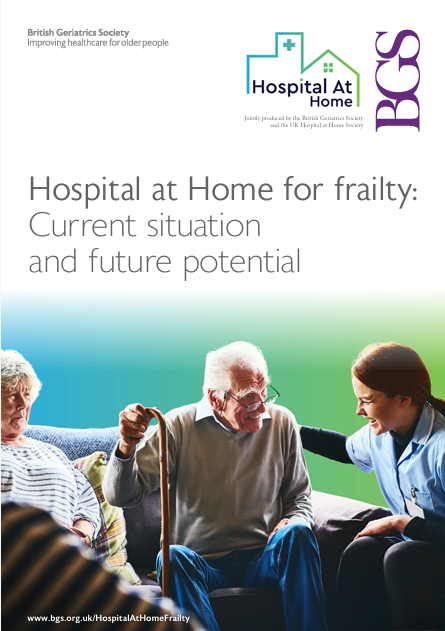
Report: Hospital at Home for frailty ...

 .... Current situation and future potential

Report: Hospital at Home for frailty
The BGS has produced report on Hospital at Home services for older people. This explains how they are currently provided and how they might develop in the future as a key part of community-based healthcare. The report is endorsed by the UK Hospital at Home Society.

Hospital at Home is a safe and effective alternative to acute hospital bedded care for people who are sick enough to be in hospital.

Hospital-level care provided at home means people living with frailty are not exposed to some of the risks arising from long stays in hospital, such as infections and deconditioning.

There is mounting evidence for the effectiveness of Hospital at Home services, which are greatly valued by those who use them. With 35,000 people a year benefiting from this alternative to hospital in England, further development of Hospital at Home should be encouraged as a key part of the Government’s ‘left shift’ from hospital to community.

continued ...

My source:
https://x.com/GeriSoc/status/1965676874111037547

Sunday, January 05, 2025

Be proactive: Evidence supporting proactive care for older people with frailty


'These BGS publications outline evidence and delivery recommendations for proactive care and support for older adults with moderate to severe frailty. 

We set out how to deliver proactive care against core components and key enablers, with recommendations for success of a proactive care service. Building on NHS England's proactive care guidance, Proactive care: providing care and support for people living at home with moderate or severe frailty, we also outline key recommendations for the successful implementation of proactive care services across the UK. 

We hope that users will be able to use all three documents when designing proactive care services, with the NHS England guidance document acting as key framework and starting point, BGS’s Be proactive: Evidence supporting proactive care for older people with frailty as a business case, and Be proactive: Delivering proactive care for older people with frailty  as a roadmap for implementing the NHS England framework and delivering services. ...'

https://www.bgs.org.uk/ProactiveCare


[All best Charlie (on your Christening Day), Casper and Jamie]. #hope #love #future #action #HealthCareer #LifeChances

Sunday, May 26, 2024

Reablement, Rehabilitation, Recovery: Everyone’s business c/o BGS


In March 2023, we published Joining the dots: A blueprint for preventing and managing frailty in older people. This set out seven touchpoints of care that should be available to older people, as and when they need them and 12 recommendations to systems. One of the recommendations is specifically around the provision of rehabilitation and one of the touchpoints is ‘Integrated urgent community response, reablement, rehabilitation and intermediate care.’  

In this new document, we take a deep dive into this Blueprint recommendation, looking at the evidence behind the provision of rehabilitation for older people and highlighting examples of best practice from across the UK and internationally. We argue that rehabilitation should be a component of virtually all care for older people, across all care settings, and that there is no such thing as ‘no rehabilitation potential.’ 

This document has been led by Professor Anne Hendry, Honorary Professor at the University of the West of Scotland and Senior Associate at the International Foundation for Integrated Care and a group of BGS members from across the UK and across disciplines have contributed to drafting the document. We hope that BGS members, commissioners and system leaders will find it useful in planning rehabilitation services for older people in their communities. 

More information - full report.

Friday, April 03, 2020

Inverse Care Law ... at Social Care's Door

Since 2015 I've had four 'conversations' with the doctors at A&E upon mum's attendance and subsequent admission on a couple of occasions. Initially, I was surprised if not shocked by the speed with which the 'conversation' followed on treatment, the extent of this and the question of resus. The further interactions were still emotionally jarring, even when expected and telegraphed. I also understand: to an extent. Repeated chest infection or urine infection had resulted in confusion, delirium that varied. on one occasion, at the nursing home there was also suddenly talk of a diagnosis of dementia, which prompted social services to wonder, like family and staff, where exactly this diagnosis had come from and investigate. (Another post?)

Mum has been very poorly, most recently in November. What surprised and shocked was the 'conversation' at the end of the bed when I knew mum - with mental capacity at that time was most likely listening. The primacy of person-centredness seemed to be by-passed. I suggested the doctor ask mum since once hydrated she would be fine. There has been a sense of a script being followed with some pressure - urgency behind it, if not a 'prescription'. I empathised with the doctors, often FY1 FY2; such matters are never easy. Now amid COVID-19 there is alarm as social care are challenged with taking on a new role, for which they are ill-equipped. 

In health care you are always conscious of the inverse care law, it seems there is another care law in operation that gives cause to worry for those who cannot advocate for themselves or have no independent advocate. Perhaps there is another inverse law that runs concurrently concerning ethics. Triage, is real. Objectively, as a nurse you think "Am I being selfish?". But, as eldest son - absolutely not. These conversations, and the future aside, the doctors and team as a whole have worked (absolute) wonders for which mum and the family will always be grateful.

Be Well, Be Safe All.
 
individual
|
INTERPERSONAL : SCIENCES
humanistic ----------------------------------------------- mechanistic
SOCIOLOGY : POLITICAL
|
group - population

"There should be no wrong door and every 
service should reverse the ...


... Inverse Care Law, which simply states those people in need of health and social care the most 
get them the least."


https://www.smithsltd.co.uk/doors/composite


By MrPanyGoff - Own work, CC BY-SA 3.0, https://commons.wikimedia.org/w/index.php?curid=19702555


A comment at The King’s Fund, by Lord Victor Adebowale.

Partnership Working, Time to Talk, Drink and Drugs News, October 2018, pp.10-11
https://drinkanddrugsnews.com/wp-content/uploads/2018/10/DDN-October-2018.pdf

If anyone has a photo of a red door at a care or nursing home that I can display above please let me know.

Monday, September 09, 2019

Paper: "Comprehensive Geriatric Assessment (CGA) in Healthcare of older people in UK care homes"

When something is described as 'comprehensive' this might suggest the need for an aide-mémoire?

"Rubenstein et al defined CGA as a ’multidisciplinary diagnostic process intended to determine a frail older person’s medical, psychosocial and functional capabilities and limitations in order to develop an overall plan for treatment and long-term follow-up’. CGA has been shown to improve outcomes for older people in hospital and community settings. It encompasses health and social care needs and facilitates multidisciplinary working. However, evidence regarding its effectiveness in care homes is limited, and there are limited data describing what needs to be in place for uptake and sustained implementation in this setting."

individual
|
INTERPERSONAL : SCIENCES
humanistic ----------------------------------------------- mechanistic
SOCIOLOGY : POLITICAL
|
group - population
Care home
(Lived experience?)
PURPOSEs
 (synergy across the multidisciplinary team,
consistency - communication)
Resident access to expertise

Ethics - PEACH project

Individual reasoning

[ What about the "Health Career" of residents?
FROM: date of admission TO: date now.
Residents who can perceive 'continuity of care' more likely to be assessed as having mental capacity. What of others? ]

Care home
425 000 people live in care homes
Comprehensive assessment
Realism, The situation, Context as it is
(and across all the domains; e.g. all health care currently conducted amid Brexit uncertainty).
Context-Mechanism-Outcome (CMO) configurations
Coding NVIVO - reasoning & resource components
Health-related Quality of Life (HRQoL)
Programme theory (development)
Frail
Basic and personal care needs
PROCESS
Causes, Synthesis
.Physical access

Care Homes
PRACTICE
Patient Public Involvement
Proxy, Next of Kin

Care plan
Group reasoning

"Mechanism reasoning developing a unified view and shared aims and goals for the resident."

Care Homes

"Mechanism reasoning: delegation from the multidisciplinary team to care home staff provides authority to deliver care according to the care plan."

POLICY
Outcomes: Quality, Safety
(Do see Conclusion of Paper)


The review sought papers on "multi-domain assessment".

"The practices and processes of assessment inform the whole CGA ... . Assessment of many domains of health status and impairments was represented as crucial in building a picture of an individual’s complex needs and views about their personal priorities and goals. Unlike discipline-specific needs assessment that may focus on a particular syndrome or care pathway, structured comprehensive assessment requires an overview of all domains."

Figure 2: Nested arrangement of  Context-Mechanism-Outcome (CMO) configurations


Ref.
Chadborn NH, Goodman C, Zubair M, et al Role of comprehensive geriatric assessment in healthcare of older people in UK care homes: realist review BMJ Open 2019;9:e026921. doi: 10.1136/bmjopen-2018-026921