Hodges' Model: Welcome to the QUAD: reflective practice

Hodges' model is a conceptual framework to support reflection and critical thinking. Situated, the model can help integrate all disciplines (academic and professional). Amid news items, are posts that illustrate the scope and application of the model. A bibliography and A4 template are provided in the sidebar. Welcome to the QUAD ...

Showing posts with label reflective practice. Show all posts

Saturday, October 10, 2026

Laws, Rules, Promises & Campaigns

They are not all represented on W2tQ, but many have been posted over the years. Campaigns launched in the aftermath of avoidable deaths within NHS delivered care. The initiatives seek to translate grief into positive affirmative action by making a difference to patient safety, the quality of professional care, policy and funding in some instances. At least drawing attention to the latter.

It is staggering that staff need to be 'reminded' of what should be professional, practice-based, and philosophical (personal - team, ethics and ethos, and values integral to nursing, and healthcare interaction that should be integral and ingrained. 

I thought "What's my motivation?" was a theatrical cliché?

Poppy's Promise is a commitment to making every healthcare experience more compassionate, respectful and person-centred. It supports staff to work in partnership with patients, families and carers, ensuring every voice is heard and every person feels valued.

Oliver's Campaign: The Oliver McGowan Mandatory Training on Learning Disability and Autism is named after Oliver McGowan, whose death shone a light on the need for health and social care staff to have better training. The Health and Care Act 2022 introduced a statutory requirement that CQC-registered providers must ensure their staff receive learning disability and autism training appropriate to their role.  

Jess’s Rule makes sure GPs take a ‘fresh eyes’ approach with patients, making them think again to diagnose and catch serious illnesses earlier. Jess’s Rule – Three Strikes and we Rethink - was launched in England on the 23rd September 2025 by Department of Health and NHS England and in The Isle of Man on the 31st March 2026 by Manx Care. It is endorsed by the Royal College of General Practitioners.

Martha’s Rule helps us notice early signs that someone may be deteriorating and gives you the right to request a rapid review if you’re worried that your or your loved one’s condition is getting worse. This may include a review by the Critical Care Team. Sometimes small changes happen before they show in tests. These can be early warning signs. Martha’s Rule makes sure we listen to concerns and act on them.

Nobody should be separated from the people they love and who care for them. John's Campaign works for the right of people with dementia (and other disabilities or individual needs) to be supported by their family carers — in hospitals, in care homes, and wherever care happens.

Dáithí's Law: Dáithí Mac Gabhann was born in October 2016 with a condition called Hypoplastic Left Heart Syndrome, which basically means that Dáithí was born with half a working heart with the left side not forming correctly in the womb. More information on HLHS can be found here. Dáithí has now been waiting for the gift of a new heart for over 7 years.

Activism is not restricted to patients, parents or guardians but key campaigns have followed through staff efforts:

A message from Kate about the campaign…
“Hello, my name is Dr Kate Granger MBE and I’m the wife of Chris and the co-founder of the #hellomynameis campaign”

⃟ 

The initial website for Hodges' model 1998-2015 and now archived, featured four pages of links to resources associated with the domain they represented. The SOCIOLOGY links included:

Patients, Carers & Self-Care

individual
|
INTERPERSONAL
: SCIENCES             
humanistic ------------------------------- mechanistic
SOCIOLOGY : POLITICAL   
|
group
Patient - Nurse ...


Patient - Nurse ...


Guardian - Parent

Family

Carer


Government

Funding

Policy makers


In Hodges' model, if neglect, accidents, untoward - serious - never incidents, what is complex, complicated, preventable signify anything; it is the collapse of a situation to the individual-group axis.

For the people involved they will simultaneously hear and feel a catastrophe.

Armed with Hodges' model, plus early insights into informatics, the oscillation between the person on your caseload, and not just beyond the spouse, partner and family but out to the political-zone of aggregation that is your caseload, the local and national population and statistical reports has always been fascinating.

Viewed theoretically, or practically the vertical axis of Hodges' model appears simple, and yet holds great power. A gift of abstraction and dramatic effect - for actor and audience alike. As an 'actor' we can see  our practice and its character humanistic - mechanistic played-out literally through the horizontal axis. Before we act, we can reflect upon the quality and humanity of our care. The audience, peers, families, managers, community, commissioners can also follow the 'narrative', (or lack of it!). Is there a paradox here in these virtual-digital times that the what is really material in care and caring is missing? We must hope the coroner does not need to attend [the play], being able to concentrate on other matters.

Previously: 'compassion' : 'communication' : 'safety' : 'listen' : 'motivation'

Monday, July 14, 2025

Reflective equilibrium and equipoise

I can't believe, or don't want to, that it's nearly 15 years since I posted - 

h2cm and clinical equipoise in 2010. 

The post didn't try to be 'technical', but perhaps demonstrates the journey here.

In a post to follow, in London 4-7th July I came across a book by Edouard Machery and upon return up north, found a paper which refers to reflective equilibrium. This, one again technical or not, is a purpose of Hodges' model.

Machery, Edouard, Philosophy Within Its Proper Bounds (Oxford, 2017; online edn, Oxford Academic, 24 Aug. 2017), https://doi.org/10.1093/oso/9780198807520.001.0001, accessed 24 June 2025.

Reflective equilibrium has an entry in the The Stanford Encyclopedia of Philosophy:

'If you believe that conduct in some case is right or wrong, you have a moral judgment or intuition. Perhaps you have many such judgments about different cases. You might, nevertheless, consider that judgments alone do not justify the moral views they express. You and your moral interlocutors might be concerned that “what we actually accept is fraught with idiosyncrasy and vulnerable to vagaries of history and personality” (Elgin 1996: 108) or displays “irregularities and distortions” (Rawls 1971: 48).

John Rawls proposed to address these concerns through the method of reflective equilibrium.We first ensure that our judgments are considered, being made in circumstances appropriate for moral deliberation. We are then to consider general principles that might accommodate our set of considered judgments—and more than that, explain and extend them. On the standard wide reflective equilibrium, we are to consider

all possible descriptions to which one might plausibly conform one’s judgments together with all relevant philosophical arguments for them. (Rawls 1971: 49)

This requires that we reflect on a wide range of principles, arguments, and theories. Equilibrium is reached where principles and judgments have been revised such that they agree with each other. In short, the method of reflective equilibrium is the mutual adjustment of principles and judgments in the light of relevant argument and theory.'

The encyclopaedia entry is informative for studies here. I will revisit clinical equipoise in the near future; and bring in the idea of 'holistic bandwidth'.

Knight, Carl, "Reflective Equilibrium", The Stanford Encyclopedia of Philosophy (Spring 2025 Edition), Edward N. Zalta & Uri Nodelman (eds.), URL = <https://plato.stanford.edu/archives/spr2025/entries/reflective-equilibrium/>.

Rawls, John, 1971, A Theory of Justice, Cambridge, MA: Belknap Press of Harvard University Press.

Tuesday, April 15, 2025

The 'animal' in Hodges' model ii

The two pairs of eyes in Hodges' model are provided through the model's two axes

HORIZONTALLY: the humanistic and mechanistic.

VERTICALLY: the individual and the group.

Hodges' model: Axes & Domains
Structure AND Content :: Fight OR Flight

Before delving into this though, let's revisit the model as a template.

Structure aside, Hodges' model acts as a conceptual blank sheet. Overall, the model is also an aide-mémoire. It can prompt us to 'where' we've been, where we need to go in our data gathering, assessment, planning, interventions, evaluations: personal history, family, work and leisure. In an interview how does the patient, client, carer, student ... negotiate the domains of Hodges' model? The model can guide us in what is said, what is omitted - for whatever reason, what is significant within all this; AI-assisted or not.

These two 'horizontal' eyes prompt us to attend to safety, your own, the patient / client and other people in the vicinity. In terms of responding to 'fight', obviously this does not mean you are looking for a fight, but of course you have to be able to defend yourself. Metaphorically, Hodges' model can represent the sword and shield. We are in a fight for justice to secure health services for individuals, families, and the population.

On the side - vision for flight, what is humanistic and mechanistic.

Then, in the vertical axis, there is vision for fighting, for the individual, and the group - population.

In this interplay of person and collective, I'm reminded of Odysseus and the shout "Nobody did it!" (with other sources). It never ceases to amaze, the frequency of this conclusion throughout local, national and global politics?

The individual nightmare of Cyclops; and collective nightmare of the Panopticon.

In mental health nursing you quickly learn about the anatomy^, physiology and psychology of anxiety. Not necessarily simultaneously, but the jig-saw is there to be completed, at least as far as you can as a 1st year student - whatever your health discipline. The pieces that matter (literal keys to action) are provided by the patient, client, carer. ...

In a way it is too late when people are referred to mental health services. Too late for prevention, but given the incoherence between:

  • health systems (as usually found & founded)
  • government policy -
    • state of nutrition - food
    • advertising of foods, beverages
    • life style choices
    • education - health literacy
      • individual
      • family
      • community
      • national (curricula)
  • NHS? National Health Illness/Disease Service
- this isn't a surprise.

Whatever an individual's sensory capacities and abilities we need to do better. With tools to facilitate situational awareness, and realise an individual's and community's potential to learn and prosper.

^Anatomy? How many of us take for granted our limbs are 'there': ready to react?

Previously: The 'animal' in Hodges' model i

Original source - prompt:
Doniger, Wendy. The Rise and Fall of Warhorses. The New York Review of Books. April 10, 2025. Volume LXXII, Number 6. pp.17-19.

Monday, December 09, 2024

Baseball: One of the games people play ... Fisher (2001) ii

Returning to Fisher's excellent book I mentioned an analogy from basket ball in discussion about Richard Paul's definition of critical thinking and 'thinking about your thinking'.
'Critical thinking is that mode of thinking - about any subject, content or problem - in which the thinker improves the quality of his or her thinking by skilfully taking charge of the structures inherent in thinking and imposing intellectual standards upon them. (Paul, Fisher and Nosich,1993, p. 4).' pp.4-5.
Fisher's daughter aged eleven wanted to learn how to play basket ball and attended coaching sessions. At the first the raw recruits were divided into two teams and with simplified rules set to play. Initially, getting the ball and in a position to score: shoot.

After the chaos, the coach had them practice shooting after he demonstrated how they had been playing. He explained and pointed out the basics of technique and 'drew attention to how he held the ball, where he looked, how he stood and so on.' p.5. Acknowledging their efforts, they subsequently moved on to passing, then guarding, or marking - practising each skill. 

This is a great analogy and can be applied to health, social care, medicine, nursing and other novices. Hodges' model is the basket ball, tennis, squash court, football, hockey pitch. You might move to a position to obtain an advantageous point of view. In reflective, critical thinking terms, additional data to support or negate a line of thought.

The axes of Hodges' model, serve as a scaffold to help structure our 'game player', and possibly better co-ordinate a group or team's efforts. The domains of Hodges' model cover the knowledge or subject bases that will relate to any context. Hodges' model is situated. If there is need to consider spiritual matters - experiences, then a conceptual journey ... at least, as befits an individual's or group's beliefs and purpose can be made. So forms if intelligence (emotional, cultural, spiritual ...) can also be factored in, as necessary.
 
Are there relational, logical, even mathematical standards that can be applied (formally, in theory) to our thinking? Does 'subject, content or problem' equate with 'situated'? Another book to pass on.

Fisher, A. (2001) Critical Thinking: An Introduction. Cambridge University Press, Cambridge, England. PB. 


Post: ... 'anyone for tennis'.

Sunday, December 08, 2024

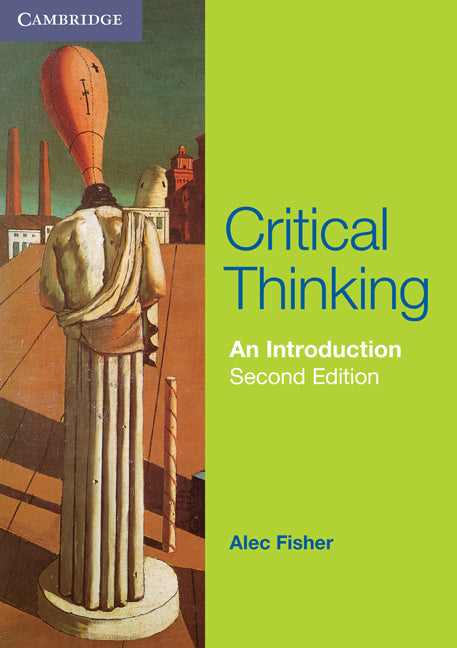
Critical thinking: several definitions

Critical Thinking 
2nd Ed. Cover


An original purpose of Hodges' model was to facilitate reflection, and so help to develop practitioners who were also competent reflective practitioners, and critical thinkers.

Continuing to clear books, I've arrived at:

Fisher, A. (2001) Critical Thinking: An Introduction. Cambridge University Press, Cambridge, England. PB. 

Now in a 2nd edition (2011), my copy has several definitions of 'critical thinking' quoted below, with my emphasis.

There is a pdf of this 1st edition online which may be useful. The reward of the book, however, is in the discussion about each definition and how more recent work has built upon Dewey's legacy.  There is also a baseball analogy, which I will return to soon, or append here. I have omitted a definition by Richard Paul, which is nonetheless important to me, as it draws on meta-cognitive qualities:
"1.1.1 John Dewey and 'reflective thinking' ...

In fact, people have been thinking about critical thinking and have been researching how to teach it for about a hundred years In a way, Socrates began this approach to learning over 2,000 years ago, but John Dewey, the American philosopher, psychologist and educator, is widely regarded as the 'father' of the modern critical thinking tradition. He called it 'reflective thinking' and defined it as: 
"Active, persistent, and careful consideration of a belief or supposed form of knowledge in the light of the grounds which support it and the further conclusions to which it tends. (Dewey, 1909, p. 9)."' p.2.
 'Glaser defined critical thinking as:
(1) an attitude of being disposed to consider in a thoughtful way problems and subjects that come within range of one's experience; (2) knowledge of the methods of logical enquiry and reasoning; and (3) some skill in applying those methods. Critical thinking calls for a persistent effort to examine any belief or supposed form of knowledge in the light of the evidence that supports it and the further conclusions to which it tends. (Glaser, 1941, p.5).' p.3.
1.1.3 Robert Ennis - a widely used definition ...
'Critical thinking is reasonable, reflective thinking that is focused on deciding what to believe or do. (Cf. Norris and Ennis, 1989).' p.4.
Notice the emphasis on being 'reasonable' and 'reflective', which picks up on earlier definitions, but notice also that Ennis speaks of 'deciding what to do', which was not explicitly mentioned earlier; so decision making is part of critical thinking in Ennis's conception. Unlike Dewey's definition, this definition needs no further explanation

A final definition of critical thinking 
One last definition is worth reviewing. Michael Scriven has recently argued that critical thinking is 'an academic competency akin to defines it thus: reading and writing' and is of similarly fundamental importance. He defines it thus:
'Critical thinking is skilled and active interpretation and evaluation of observations and communications, information and argumentation. (Fisher and Scriven, 1997, p. 21).' p.10."

Friday, May 05, 2023

"There are no tools stored in this van overnight"

. . . but there is a tool
with great potential
available here 24/7/365 . . .


INDIVIDUAL
|

 INTERPERSONAL    :     SCIENCES               
HUMANISTIC --------------------------------------  MECHANISTIC      
SOCIOLOGY  :   POLITICAL 
|
GROUP
Identity morphism


Images: 
 
https://krossovochkin.com/posts/2020_04_26_category_theory/
 
https://cdn.shopify.com/s/files/1/0044/4701/0919/products/no-tools-stored-in-this-vehicle-overnight-sign-646188.png?v=1680276776

Friday, April 28, 2023

Cognitive apprenticeship . . .


INDIVIDUAL
|

 INTERPERSONAL    :     SCIENCES               
HUMANISTIC --------------------------------------  MECHANISTIC      
SOCIOLOGY  :   POLITICAL 
|
GROUP

"The learner builds an internal representation of knowledge or personal interpretation of experience. This representation is open to change as its structure and interconnections form the foundation upon which other knowledge structures can be scaffolded. Successive modes of representation are developed as a person's expertise increases, and the building block for this development is the accumulation of individual cases (Boshuizen, 2013).  . . . The constructivist theory of learning does not accept the premise that different types of learning can be identified independent of the context and content of learning. . . . Cognitive apprenticeship, which reflects the collaboration between real-world problem solving and using appropriate strategies in problem-solving situations, is the key to construvist learn (Brown, Collins and Duguid, 1989; Resnick, 1987)." p.96.

'Cumulative experience'

TI:ME

"Conceptual growth comes from sharing multiple perspectives and simultaneously changing our internal representations in response to those perspectives as well as through cumulative experience." p.96.

Practice hours requirement


Zwozdiak-Myers, Paula. (2012). The Teacher's Reflective Practice Handbook: Becoming an Extended Professional through Capturing Evidence-Informed Practice. Abingdon, Oxon: Routledge. 

https://www.routledge.com/The-Teachers-Reflective-Practice-Handbook-Becoming-an-Extended-Professional/Zwozdiak-Myers/p/book/9780415597586

Wednesday, October 26, 2022

Reflection = 'navel gazing'?

Individual and Collective reflection ...

THE NEED FOR HOLISTIC BANDWIDTH


 INDIVIDUAL
|
 INTERPERSONAL    :     SCIENCES               
HUMANISTIC --------------------------------------  MECHANISTIC      
SOCIOLOGY  :   POLITICAL 
|
GROUP

Reflection

Critique of reflective practice

Risk of navel gazing


"GLOBAL BRITAIN"

'Rules-based order' in the 21st C?

Government - Governance

Preoccupation with COVID-19, Brexit ...

"We have not had enough bandwidth to deal
with International issues to use our position on the security council and in the G7 ..."
Jeremy Bowen

Risk of navel gazing*


BBC Radio 4, Today, 25 October 2022 c.0816. Jeremy Bowen, International Editor.


Related:

Horta, H., Veloso, F., & Grediaga, R. (2010). Navel gazing: Academic inbreeding and scientific productivity. Management Science, 56(3), 41.

Ronald J. Pelias. (2009). Pledging Personal Allegiance to Qualitative Inquiry. International Review of Qualitative Research, 2(3), 351–356. http://www.jstor.org/stable/10.1525/irqr.2009.2.3.351

*A constant consideration here.


Monday, August 08, 2022

Back to basics ...

The "Health Career - Care Domains - Model" created by Brian Hodges' provides:

  • a 'springboard' for reflection and critical thinking;
  • a generic conceptual framework for researchers;
  • a model of care for clinicians;
  • a generic model / conceptual framework for your local / global research initiative;
  • and an individual & collective aide-mémoire.

Please see lower sidebar for a bibliography. 

peter.jones AT h2cm.info

Friday, August 05, 2022

"Your metacognitive fingerprint"

 INDIVIDUAL
|
 INTERPERSONAL    :     SCIENCES               
HUMANISTIC --------------------------------------  MECHANISTIC      
SOCIOLOGY  :   POLITICAL 
|
GROUP

"Why are some people more self-aware than others? Studies show that metacognition is a relatively stable trait, so if you tested your metacognition today, it is likely to be similar if you do the same test again tomorrow. Strikingly, it also seems that metacognition is independent of IQ and general cognitive ability: your metacognition can still be in good form as long as you recognise you are performing badly at a task.
We still don't understand the origins of these individual differences, but one promising idea is that "explicit" metacognition is something we learn, based on feedback from our parents, teachers and social group.
A genetic "starter kit" may establish forms of self-monitoring early in life and then our parents and teachers finish the job. But even in adulthood, these things aren't totally fixed (see main story), so this is one kind of fingerprint you can change." p.38.

finger

p r i n t


- with my emphasis.

Fleming, Stephen. The power of self-reflection, New Scientist, 250,3333, 36-40. 8 May. 2021.
https://www.sciencedirect.com/science/article/abs/pii/S0262407921007946

I heard Stephen Fleming on the radio when the associated book was released last year - must buy a copy.

Still reading and enjoying 'Human Landscapes' with posts to follow.

See also: meta- meta- meta- +!

Wednesday, February 24, 2021

'Design Thinking' in and out of four boxes...

In 2019 Charles Orton-Jones gave a brief (single page) account of design thinking in sales, with a description of its five components:

Empathise

Define the problem

Ideate

Prototype

Testing

Below, I've mapped each to Hodges' model (and in parallel):

INDIVIDUAL
|
INTERPERSONAL : SCIENCES
HUMANISTIC----------------------------------------------- MECHANISTIC
SOCIOLOGY : POLITICAL
|
  GROUP
Empathise
Ideate
Define the Problem
Prototype

Define the Problem
Prototype
Testing

Empathise
Ideate
Define the Problem
Prototype
Testing

Empathise
Ideate
Define the Problem
Prototype
Testing


There is often conceptual overlap and relationships when considering the most mundane, taken-for-granted of phenomena and events. This overlap increases rapidly with more complicated situations. This applies in the case of 'design thinking'. Ideate I take as a mental activity, but it is the flow and interplay of ideas: communication that counts. Empathy is imbued individually, but it is delivered and is realised in the social domain - as empathise suggests. Hopefully, from empathy with group rapport, trust, dignity and respect coherence will follow.

Politically, funding, team constraints, leadership may all influence defining the problem, prototyping and testing. Ideation is 'political' too. We forget this at our peril. Are we sure the protected characteristics have been factored in? You might also test the prototype against the original idea(s): thereby bringing in values. While this application is commercial sales, you are in personalised and specialised 'sales' in healthcare. 

While the above looks like duplication, the parallel approach can help assure the design thinking process as a whole. There is an open question here, but I'm sure despite the duplication and 'travel' to-and-fro within the model the structure helps instill some discipline with efficiency - economy of effort? The model acts as a marshalling (classification) yard.

As an example, this was brought home today on twitter, with a question about dealing with people who have a fear of needles. This may be children, a percentage of the general population and people with a learning disability. We see then how this overlap can be important. By default then working with the above design thinking + h2cm approach to achieve (variously) individualised, integrated, collaborative care then you might also be doing co-design and co-creation. Now that is sales ...!

My source: Orton-Jones, C. Design thinking is making an impact, Raconteur, 20.6.19. p.18.


Tuesday, January 12, 2021

Book: The Fourfold Remedy

individual
|
INTERPERSONAL : SCIENCES
humanistic ----------------------------------------------- mechanistic
SOCIOLOGY : POLITICAL
|
group - population


My source:

O'Grady, J. (2021) Think yourself better, Reviews. The Daily Telegraph, 9 January. pp.12-13.

Sellars, J. The Fourfold Remedy, London: Allen Lane / Penguin.


Sunday, November 01, 2020

'Reflection' c/o Evelyn Sinclair

individual
|
INTERPERSONAL : SCIENCES
humanistic ----------------------------------------------- mechanistic
SOCIOLOGY : POLITICAL
|
group - population


From the book 'Through the Locking Glass' exploring Cumbrian artists' responses to the (first) Covid-19 Lockdown.

With thanks to E. Sinclair.

Saturday, October 31, 2020

The Competence Framework for Mental Health Peer Support Workers

"This document sits alongside The Competence Framework for Mental Health Peer Support Workers – Full Listing of the Competences (referred to as ‘the Competence Framework for MH PSWs’). It includes the story of peer support and its evolution from a ‘grass roots’ social movement to the present time. Today, we know that people who bring their own experience of mental health difficulties to supporting other people facing similar challenges have a unique and important contribution to make in statutory services.1,2 While the relational basis of the work remains at its core, we also know that peer support work continues to develop and is not static, and that it will keep changing and progressing."p.1.
"The other domains of the framework are:

the working knowledge that MH PSWs require

core relational skills, which include:
  • drawing on and sharing lived experience of mental health difficulties
  • communicating well and fostering mutual trust and respect
supporting people as MH PSWs, including being able to support people’s self-management (that is, the actions people can do to take care of themselves and gain control over their own lives)

working with teams and promoting people’s rights

self-care and support, which includes being able to make effective use of supervision

meta-competences, which involve judgement, decision-making or self-reflection, and so guide peer support work

organisational competences, which describe how services employ, support and supervise MH PSWs, and so enable them to do their work." p.8

"The more that services and teams embrace a culture of reflective practice and openness to change, the more effectively they will be able to establish MH PSWs within their workforce." p.17.


The Competence Framework for Mental Health Peer Support Workers. Part 1: Supporting document, Health Education England, et al. October 2020.

Saturday, August 29, 2020

Reflecting in the Garden: c/o Anish Kapoor

individual
|
INTERPERSONAL : SCIENCES
humanistic ----------------------------------------------- mechanistic
SOCIOLOGY : POLITICAL
|
group - population
Anish Kapoor, Installation view, 2020
Houghton Hall, Norfolk, UK


See also: https://hodges-model.blogspot.com/search?q=kapoor

 My sources:

Campbell-Johnston, R. (2020) As maddening as it is mesmerising, The Times, Visual Art, Friday, July 10, p.10. 

Revely-Calder, C. (2020) The pomposity's still there, but so are the moments of magic, The Daily Telegraph, Friday, July 10, p.25.


Tuesday, August 04, 2020

a Paper: Hodges' model and mental health nursing in bushfire-affected communities

An email from ResearchGate informed me that a co-authored paper:

Doyle, M., Jones, P. (2013). Hodges’ Health Career Model and its role and potential application in forensic mental health nursing. Journal of Psychiatric and Mental Health Nursing. 20, 7, 631-640.
http://onlinelibrary.wiley.com/doi/10.1111/j.1365-2850.2012.01961.x/abstract

- had been cited in another publication. A check was rewarded. It always feels good to be able to add a  study to the bibliography listing (please see the sidebar). This is an early view, by Brent Hayward in Australia:

Hayward, B.A. (2020), Mental health nursing in bushfire‐affected communities: An autoethnographic insight. Int J Mental Health Nurs. DOI: 10.1111/inm.12765

What stands out to me are Hayward's profession of mental health nursing within a public educational service and disaster response. I'm not sure how many times I have referred to the generic nature of Hodges' model, but this shift from reading a forensic paper to applying h2cm in disaster response is encouraging. While the immediacy of today's media brings home the catastrophic scale and tragedy of bushfires - work like this also reveals the humanistic side.

The research method of autoethnography has definite currency. Since the MRES at Lancaster, I have wondered if there is any autoethnographic merit in this blog? Hayward has clearly seen the value of the model with regard to reflection and self-reflection. Over the past few years - Brexit, climate change, the bushfires (and California) the importance and relevance of the political domain within Hodges' model continues to increase. (The content of many posts should provide evidence of this.)

It also appears that Hodges' model can draw out the distinction between intrapersonal and interpersonal relations and reflexivity. It could be argued that the humanistic-mechanistic axis also demarcates what is intrapersonal and what interpersonal. The latter standing for the (overt) skills so essential to effective mental health nurses. Hence, what are labelled the interpersonal and sociological domains. The combination of autoethnography, gestalt and use of a visual prompt for reflection is also informative and as Hayward notes could provide an avenue for the work of others. ...

"My unsuccessful attempt to locate literature about mental health nursing in bushfire-affected communities caused me to look towards nursing models more broadly. I was drawn to Doyle and Jones’ (2013) paper on the application of Hodges’ Health Career Model in forensic mental health nursing because of its deliberate consideration of political issues. This resonated with me as a public sector employee. Hodges’ model was originally developed in 1983 but has received little attention in the literature. Doyle and Jones’ paper was in response to this deficit, and in this frame, the present study continues this legacy. Hodges’ model is appealing here because of its attention to reflective practice and the theory-practice gap–two purposes which are of particular relevance in the present study." pp.2-3.
"Second is the use of a nursing theory or model to interpret findings. Only Gardner and Lane (2010) used a model, and this was one for clinical supervision rather than mental health nursing practice per se. Mental health nurses who are considering autoethnographic approaches should consider these methodological elements for both rigour and practical purposes. This study has also contributed the second published clinical application of Hodges’ model and its effectiveness here suggests that further exploration of its application would be useful." p.6.
I would like to express my sincere thanks to Brent for not only recognising the potential of Hodges' model, but actually applying it in research* and in such a vital context.

Hopefully I can reflect more on what is clearly for Hodges model and the concepts of health career, life chances and global health - a very significant paper.

*See also:

Friday, January 17, 2020

Science and Critical Thinking: c/o New Scientist 2015*

individual
|
INTERPERSONAL : SCIENCES
humanistic ----------------------------------------------- mechanistic
SOCIOLOGY : POLITICAL
|
group - population
4. "That works for some, but all too often the reaction is: "I'll never need to use this once I've left school. That is being taken up by the Programme for International Student Assessment."

"critical thinking toolkits"

3. "... the desired combination of scientific literacy and critical thinking remains rare in public discourse. Perhaps that is because we hope that children will learn to evaluate claims rationally if we teach them science. ...

But mastery of the [scientific] facts alone is not enough for the internet age. Much of the copious online rhetoric is more viral than factual, so it is just as important that we know how to evaluate sources of information., and how to tell correlation from causation, and opinion from fact - in matters both obviously scientific and otherwise. "


1. "Here's a game to play next time you catch the news headlines. Count how many would dissolve away or be markedly different if the people writing them had evaluated the evidence more critically. Your count will probably be alarmingly high."

5. "But our societies still have a long way to go when it comes to reading between the headlines - or rewriting them."
2. "We have a long tradition of allowing civic affairs to be settled by persuasive rhetoric. That is inadequate for our modern society."

"a reflective citizen"

public understanding of
 terrorism, vaccination, climate change, chemical pollution ..


PISA is the OECD's Programme for International Student Assessment. PISA measures 15-year-olds’ ability to use their reading, mathematics and science knowledge and skills to meet real-life challenges.

My source:
Leader, Critical thinking, New Scientist, 12 December. 2015, 228: 3051. p.5.

*Yes, still also sorting magazines, papers, notes...
Blue (paper) bin repeatedly quite full.

Thursday, January 02, 2020

"Nurses' ability to reflect on their practice is vital to the profession" Is it?

I beg to differ with the title of this editorial, as I wonder how vital reflection really is; and not just to nursing, but to the profession. I wonder from the rather detached perspectives of:

  • Wigan Pier - and the parochial view this engenders (#globalhealth - where on Earth do I think I am?);
  • As a 'local' nurse practising in Bolton;
  • As a mental health nurse practising in the community within the NHS
  • As a champion of a pivotal* resource for reflection and critical thinking (where is everyone?);
  • and several others ...
Nursing Management
Quinn notes how "Nursing continues to develop to meet the needs of the society in which it operates." Plus: "A core part of revalidation is the ability to reflect on, and learn from, our interactions with others." My reading of Kinchin (and others over the years) suggests that reflection needs to be more a practice and revalidation based. I understand this is not what Quinn is saying in this issue on "Reflection as part of revalidation". Reflection using Hodges' model can be preemptive and anticipatory. We need to get beyond introspection and the retrospective important as this is.

As to where people are, it seems they are elsewhere, maybe reflecting in the sciences domain seeking theories and evidence. Perhaps, current teaching and exposure to models and theories of nursing and healthcare has them reaching for 'pure' models of reflection - Boud, Gibbs et al. when necessary. As we talk about the legacy issue that is integrated care, in Hodges' model here is a tool - a 'freebie', a 'takeaway' yes an Ubercare, that can grow with students, newly qualified nurses and experienced staff as lifelong learners.

Now that is vital to me. When reflection is hard-wired**, a part of a practitioner's cognitive apparatus and their educational toolkit to share with the public explicitly or implicitly as the context and engagement demands.

*Pivotal? Yes, and of course in light of the above, I'd be pleased to explain and even argue the case. The irony here is the current (ongoing!) focus upon recruitment and retention. Hodges' model is 'just' a tool, I recognise this; but could the application of Hodges' model energise, inoculate and so prime students for their course of education and practice placements?

**soft-wired too - humanistic

Quinn, B. Nurses' ability to reflect on their practice is vital to the profession, Nursing Management, April 2019. 26:2, p.5.

Thursday, October 31, 2019

Lucian identity ii

INDIVIDUAL
|
INTRA- INTER-PERSONAL : SCIENCES
HUMANISTIC ----------------------------------------------- MECHANISTIC
SOCIOLOGY : POLITICAL
|
GROUP

Lucian Freud, Interior with Hand Mirror (Self-Portrait), 1967.
Oil on canvas. 25.5 x 17.8 cm. Private collection.
© The Lucian Freud Archive / Bridgeman Images.
Painting
as
Process


process
as
painting


See also:

Post: Lucian identity i

Lucian Freud Archive
http://lucianfreud.com/index.html

Royal Academy Lucian Freud: The Self-portraits
https://www.royalacademy.org.uk/exhibition/lucian-freud-self-portraits

My source:
Campbell-Johnston, R. The secrets that still lie in the paint-strewn lair of Lucian Freud, The Times, Saturday Review, October 19 2019, pp.4-5.

Monday, May 06, 2019

The adjacent possible

"The adjacent possible is a kind of shadow future, hovering on the edges of the present state of things, a map of all the ways in which the present can reinvent itself." p.31.

SELF - individual
|
INTERPERSONAL : SCIENCES
humanistic ----------------------------------------------- mechanistic
SOCIOLOGY : POLITICAL
|
group - POPULATION


"The strange and beautiful truth about the adjacent possible is that its boundaries grow as you explore those boundaries. Each new combination ushers new combinations into the adjacent possible. Think of it as a house that magically expands with each door you open. You begin in a room with four doors, each leading to a new room that you haven't visited yet. Those four rooms are the adjacent possible. But once you open one of those doors and stroll into that room, three new doors appear, each leading to a brand-new room that you couldn't have reached from your original starting point. Keep opening the doors and eventually you'll have built a palace." p.31.

Johnson, Steven (2010) Where Good Ideas Come From, London: Allen Lane.