Hodges' Model: Welcome to the QUAD: laws

Hodges' model is a conceptual framework to support reflection and critical thinking. Situated, the model can help integrate all disciplines (academic and professional). Amid news items, are posts that illustrate the scope and application of the model. A bibliography and A4 template are provided in the sidebar. Welcome to the QUAD ...

Showing posts with label laws. Show all posts

Saturday, October 10, 2026

Laws, Rules, Promises & Campaigns

They are not all represented on W2tQ, but many have been posted over the years. Campaigns launched in the aftermath of avoidable deaths within NHS delivered care. The initiatives seek to translate grief into positive affirmative action by making a difference to patient safety, the quality of professional care, policy and funding in some instances. At least drawing attention to the latter.

It is staggering that staff need to be 'reminded' of what should be professional, practice-based, and philosophical (personal - team, ethics and ethos, and values integral to nursing, and healthcare interaction that should be integral and ingrained. 

I thought "What's my motivation?" was a theatrical cliché?

Poppy's Promise is a commitment to making every healthcare experience more compassionate, respectful and person-centred. It supports staff to work in partnership with patients, families and carers, ensuring every voice is heard and every person feels valued.

Oliver's Campaign: The Oliver McGowan Mandatory Training on Learning Disability and Autism is named after Oliver McGowan, whose death shone a light on the need for health and social care staff to have better training. The Health and Care Act 2022 introduced a statutory requirement that CQC-registered providers must ensure their staff receive learning disability and autism training appropriate to their role.  

Jess’s Rule makes sure GPs take a ‘fresh eyes’ approach with patients, making them think again to diagnose and catch serious illnesses earlier. Jess’s Rule – Three Strikes and we Rethink - was launched in England on the 23rd September 2025 by Department of Health and NHS England and in The Isle of Man on the 31st March 2026 by Manx Care. It is endorsed by the Royal College of General Practitioners.

Martha’s Rule helps us notice early signs that someone may be deteriorating and gives you the right to request a rapid review if you’re worried that your or your loved one’s condition is getting worse. This may include a review by the Critical Care Team. Sometimes small changes happen before they show in tests. These can be early warning signs. Martha’s Rule makes sure we listen to concerns and act on them.

Nobody should be separated from the people they love and who care for them. John's Campaign works for the right of people with dementia (and other disabilities or individual needs) to be supported by their family carers — in hospitals, in care homes, and wherever care happens.

Dáithí's Law: Dáithí Mac Gabhann was born in October 2016 with a condition called Hypoplastic Left Heart Syndrome, which basically means that Dáithí was born with half a working heart with the left side not forming correctly in the womb. More information on HLHS can be found here. Dáithí has now been waiting for the gift of a new heart for over 7 years.

Activism is not restricted to patients, parents or guardians but key campaigns have followed through staff efforts:

A message from Kate about the campaign…
“Hello, my name is Dr Kate Granger MBE and I’m the wife of Chris and the co-founder of the #hellomynameis campaign”

⃟ 

The initial website for Hodges' model 1998-2015 and now archived, featured four pages of links to resources associated with the domain they represented. The SOCIOLOGY links included:

Patients, Carers & Self-Care

individual
|
INTERPERSONAL
: SCIENCES             
humanistic ------------------------------- mechanistic
SOCIOLOGY : POLITICAL   
|
group
Patient - Nurse ...


Patient - Nurse ...


Guardian - Parent

Family

Carer


Government

Funding

Policy makers


In Hodges' model, if neglect, accidents, untoward - serious - never incidents, what is complex, complicated, preventable signify anything; it is the collapse of a situation to the individual-group axis.

For the people involved they will simultaneously hear and feel a catastrophe.

Armed with Hodges' model, plus early insights into informatics, the oscillation between the person on your caseload, and not just beyond the spouse, partner and family but out to the political-zone of aggregation that is your caseload, the local and national population and statistical reports has always been fascinating.

Viewed theoretically, or practically the vertical axis of Hodges' model appears simple, and yet holds great power. A gift of abstraction and dramatic effect - for actor and audience alike. As an 'actor' we can see  our practice and its character humanistic - mechanistic played-out literally through the horizontal axis. Before we act, we can reflect upon the quality and humanity of our care. The audience, peers, families, managers, community, commissioners can also follow the 'narrative', (or lack of it!). Is there a paradox here in these virtual-digital times that the what is really material in care and caring is missing? We must hope the coroner does not need to attend [the play], being able to concentrate on other matters.

Previously: 'compassion' : 'communication' : 'safety' : 'listen' : 'motivation'
Tuesday, March 17, 2026

Be careful - the laws you wish for ...

INDIVIDUAL
|
    INTERPERSONAL    :     SCIENCES               
HUMANISTIC --------------------------------------  MECHANISTIC      
SOCIOLOGY  :   POLITICAL 
|
GROUP


LETHAL AUTONOMOUS 
WEAPON SYSTEMS


laws


Reminder: The FT View, Iran and the rising perils of AI in warfare, FTWeekend, 14-15 March, 2026, p.10.

Sunday, November 30, 2025

Interesting ... 'Incidence structure(s)'

Unsurprising, in studying 'Hodges' model, I've been aware of Wilfrid Hodges and model theory for many years.


Now, trying to look at (Brian) Hodges' model using maths, I've wondered about possible connections with Wilfred Hodges' work.

Dr W. Hodges was listed in searches on lines, axes, and structure:
'Algebraists and geometers like to classify structures by the laws which they obey. A typical law for incidence structures reads:

"For any two different lines L and M, there is exactly one point which lies on both L and M."'
My imagination may be getting the better of me, but there seems something profound in the intersection of the model's two axes and the care - knowledge domains that are created (proposed - adopted..)?

So, is Hodges' model a form of 'incidence structure', or does it contain several incidence structures? 

Hodges, W. (1985). Truth in a Structure. Proceedings of the Aristotelian Society, 86, 135–151. http://www.jstor.org/stable/4545041

Sunday, September 14, 2025

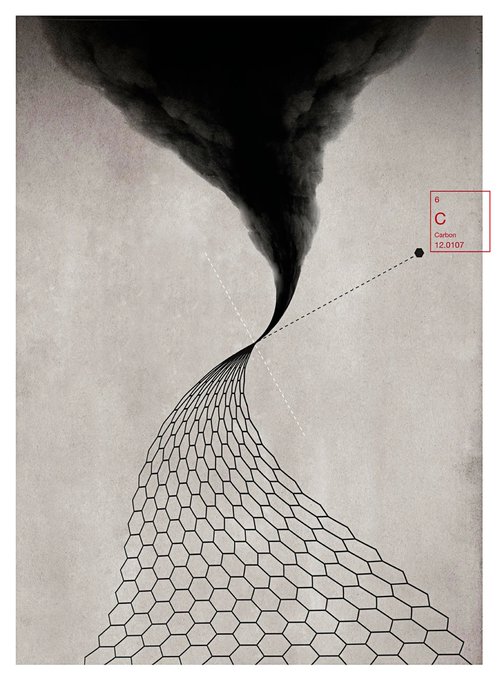
Graphene just broke a fundamental law of physics

Graphene just broke a fundamental law of physics.

Its electrons just did something physicists thought was impossible. For nearly 200 years, metals have obeyed the Wiedemann-Franz law – the rule that electrical conductivity and thermal conductivity always rise and fall together. 

But in ultra-clean graphene, researchers at the Indian Institute of Science found the opposite. As electrical conductivity increased, thermal conductivity dropped, shattering a principle taught in every physics textbook. 

The key lies at the “Dirac point,” a strange electronic tipping point where graphene is neither a metal nor an insulator. Here, electrons stop behaving like individual particles. Instead, they flow collectively as a nearly perfect fluid – a state called a “Dirac fluid.” 

This discovery doesn’t just rewrite the rules for graphene. It provides a tabletop window into extreme physics usually reserved for black holes and high-energy colliders. Scientists say this behavior could help probe mysteries of quantum entanglement, black hole thermodynamics, and the very fabric of matter itself.

 ["Universality in quantum critical flow of charge and heat in ultraclean graphene." Nature Physics, 2025] ...
Individual
|
      INTERPERSONAL    :     SCIENCES               
HUMANISTIC  --------------------------------------  MECHANISTIC      
 SOCIOLOGY  :    POLITICAL 
|
Group
While I can't fully understand this paper (even the abstract!), I realise that it is taking what seems a long time^ for industry and business to understand and realise the potential of graphene in industrial and technological applications. 


Hopefully, applications will emerge, that are beneficial to all. Reducing energy use, improving efficiency, removing pollutants even more effectively, imcreasing the durability and hence lifetime of materials and products, and more.

Also, marvellous to see global collaboration at work, as science continues to asks questions.

^I could have written exploitation there, but could we put the collective and planetary first?


Majumdar, Aniket and Chadha, Nisarg and Pal, Pritam and Gugnani, Akash and Ghawri, Bhaskar and Watanabe, Kenji and Taniguchi, Takashi and Mukerjee, Subroto and Ghosh, Arindam. (2025) Universality in quantum critical flow of charge and heat in ultraclean graphene, Nature Physics. http://dx.doi.org/10.1038/s41567-025-02972-z

My source: https://x.com/Rainmaker1973/status/1966896966316474505

Which includes a video 5m 'Quantum Critical Flow in Graphene: Charge & Heat Dynamics'

https://www.youtube.com/watch?v=LrImy9PAHGk

See also on W2tQ: 'physics : 'women'

Tuesday, April 05, 2022

Holism, evidence, theory and justification ...

or, measuring the temperature of our concepts ...

 
INDIVIDUAL
|
 INTERPERSONAL    :     SCIENCES               
HUMANISTIC --------------------------------------  MECHANISTIC      
SOCIOLOGY  :   POLITICAL 
|
GROUP

... "Quine bases his “confirmation holism” upon observations of Pierre Duhem (1914 [1954]), who drew attention to the myriad ways in which theories are supported by evidence, and the fact that an hypothesis is not (dis)confirmed merely by some specific experiment considered in isolation from an immense amount of surrounding theory. ...


... Thus, a thermometer will be a good indication of ambient temperature only if it’s made of the right materials, calibrated appropriately, and there aren’t any other forces at work that might disturb the measurement—and, of course, only if the background laws of physics and other beliefs that have informed the design of the measurement are sufficiently correct. A failure of the thermometer to measure the temperature could be due to a failure of any of these other conditions, which is, of course, why experimenters spend so much time and money constructing experiments to “control” for them. Moreover, with a small change in our theories or background beliefs, or just in our understanding of the conditions for measurement, we might change the tests on which we rely, but often without changing the meaning of the sentences whose truth we might be trying to establish (which, as Putnam 1965 [1975] pointed out, is precisely what practicing scientists regularly do)." ...


3.4 Verification and Confirmation Holism, In -

Rey, Georges, "The Analytic/Synthetic Distinction", The Stanford Encyclopedia of Philosophy (Summer 2022 Edition), Edward N. Zalta (ed.), forthcoming URL = <https://plato.stanford.edu/archives/sum2022/entries/analytic-synthetic/>. 


Tuesday, November 09, 2021

Law 'in' Hodges' model (Discuss?)

individual
|
INTERPERSONAL : SCIENCES
humanistic ----------------------------------------------- mechanistic
SOCIOLOGY : POLITICAL
|
group - population


SUPPLY


DEMAND

unfair
competition

environmental
 

consumer
protection


competition

In demand and supply also consider this within the sociological and interpersonal domains in the context of COVID? 

If people 'behave' themselves*, i.e. do not 'raid' the shelves there will (should) be sufficient supply for all. 

In political terms, what happens when a government raises the prospect (the dichotomy) of supply chain problems and potential shortages?

The 4Ps are relevant here:

intra- interpersonal - PURPOSES

sciences - PROCESS (mechanistic)

sociology - PRACTICE (gone awry)

political - POLICY (discipline in communications)

*UK context - acknowledging the global audience.


Thanks to:

Malinauskaite, Jurgita, and Fatih Buğra Erdem. 2021. “Planned Obsolescence in the Context of a Holistic Legal Sphere and the Circular Economy.” Oxford Journal of Legal Studies 41 (3): 719–49. https://doi.org/10.1093/ojls/gqaa061.

See also:

Myers-Briggs 'in' Hodges' model (Discuss?) 


Thursday, July 15, 2021

Of Bodies and Persons

individual
|
INTERPERSONAL : SCIENCES
humanistic ----------------------------------------------- mechanistic
SOCIOLOGY : POLITICAL
|
group


Three-body problem


Three-Person problem


https://www.britannica.com/science/three-body-problem


Friday, June 18, 2021

Eroom's Law

Stephanie F. Scholtz
 
individual
|
INTERPERSONAL : SCIENCES
humanistic ----------------------------------------------- mechanistic
SOCIOLOGY : POLITICAL
|
group
digital literacy
health literacy
...


social justice
'laws' translated
social capital


*This is not to underestimate the economic impacts of Moore's law, or in both instances the question of access to digital technology and health care.

Kill or Cure? Technology Quarterly - Personalised Medicine, The Economist, 434: 9185; 14-20 March 2020. pp.9-11.

https://www.stephanie-f-scholz.com/
