Hodges' Model: Welcome to the QUAD: states

Hodges' model is a conceptual framework to support reflection and critical thinking. Situated, the model can help integrate all disciplines (academic and professional). Amid news items, are posts that illustrate the scope and application of the model. A bibliography and A4 template are provided in the sidebar. Welcome to the QUAD ...

Showing posts with label states. Show all posts

Thursday, April 30, 2026

ii WCCS26: World Conference on Complex Systems 20-22nd April

Day 1

Plenary Talk: Reda Benkirane - Lost in Complexity: Welcome to the Real World

A first slide considered Abraham Maslow's book The Psychology of Science and his thought on the "law of the instrument". Maslow's hierarchy of needs is a key primer for new students to many disciplines, including nursing, and psychology. The purpose of Benikrane's focus on instruments concerns the emergence of civilisation and roles of agriculture, and war in the rise of community at several scales from village, to cities, states and nations. In terms of flow the slides highlighted the next speaker Peter Turchin's END TIMES, and two books by Johann Chapoutot, LES IRRESPONSABLES, and FREE TO OBEY.

In response to the slide with Einstein's -

"We cannot solve our problems with the same thinking we used when we created them":

- may I please class 'health - care' as a world? The thought that the medical, bio-medical, and bio-psycho-social encourages, sees enacted, and sustained a : is this fit for the problems of the 21st century. I like the slide's heading 'Beyond Complexity'. Such is the pace of change, which is labelled 'progress' that each one of us wakes up momentarily stupified and lost in complexity.

Keynote Speaker: Peter Turchin - The Great Holocene
Transformation: What Complexity Science Tells Us About The Evolution of Complex Societies

Turchin's keynote reminded me of Jared Diamond's book Guns, Germs and Steel. Reading GGS I realised there is more to 'axes' than I thought, especially from the individual to collective scales. It appears that whichever label - academia, research or education - you would like to apply, they all need a conceptual framework. Just as, individually, we all need a model of self, others and the world. This was a marvellous journey, through millennia of humanities' evolution, social, and political development, all realised through complexity. While attractors are to the fore, architecture and archaeology are regular distractors for me. Reading Holocene then had me hooked. 

A fellow delegate and speaker I dined with a few times encouraged me to read 'END TIMES'. I will seek it out later this year, (the next Hay-on-Wye visit?). Turchin is seeking to account for how human societies have reached their current state of organisation. The role of self-protection, seeking food, shelter, co-operation are all factors, with the emergence of religions, and agriculture. Several theories to date were covered [including, cultural multilevel selection, see Wilson et al. (2023)], plus a major project on cultural evolution: The Seshat: Global History Databank. For all the current loss and misery, conflict has paid a major role in cultural and political development. The prefix 'macro' features here. There was a social scale (people): FROM 10s - in foraging bands through TO 100,000,000s large nation-states. Mention of levels of scale, took me back to the work of Mario Bunge. The application of the Hertzsprung-Russell 'main sequence' (H-R) diagram is a great idea. I think Olaf Stapleton, author of Star Maker would have approved. 

This itself, for me, is reason enough to read Turchin. There is evolutionary biochemistry too, which is required in terms of a systems account. Is there a reflection of a main sequence construct between the SOCIOLOGICAL and SCIENCES domain of Hodges' model? 

 It is incredible the way new findings are regularly pushing even further the dates of human milestones stepping-stones. Perhaps we should always view progress in this way, and enjoy the 'moment'. There is still the puzzle of ultrasociality, and how to explain it? Turchin is seeking a mathematical history, with a journal Cliodynamics. There is another SF reference here, in Asimov's psychohistory in the Foundation books, but with less emphasis upon maths. This is encouraging for Hodges' model, and the inevitable transdisciplinary approach these questions demand.

More to follow ...

D.S. Wilson, G. Madhavan, M.J. Gelfand, S.C. Hayes, P.W.B. Atkins, & R.R. Colwell, Multilevel cultural evolution: From new theory to practical applications, Proc. Natl. Acad. Sci. U.S.A. 120 (16) e2218222120, https://doi.org/10.1073/pnas.2218222120 (2023).

Sunday, September 14, 2025

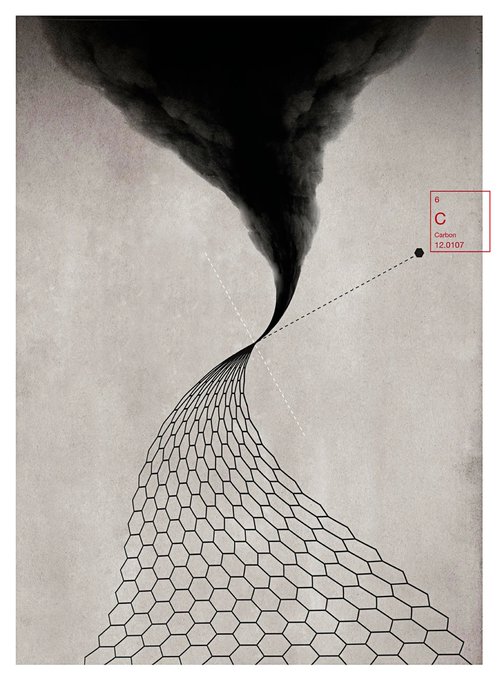
Graphene just broke a fundamental law of physics

Graphene just broke a fundamental law of physics.

Its electrons just did something physicists thought was impossible. For nearly 200 years, metals have obeyed the Wiedemann-Franz law – the rule that electrical conductivity and thermal conductivity always rise and fall together. 

But in ultra-clean graphene, researchers at the Indian Institute of Science found the opposite. As electrical conductivity increased, thermal conductivity dropped, shattering a principle taught in every physics textbook. 

The key lies at the “Dirac point,” a strange electronic tipping point where graphene is neither a metal nor an insulator. Here, electrons stop behaving like individual particles. Instead, they flow collectively as a nearly perfect fluid – a state called a “Dirac fluid.” 

This discovery doesn’t just rewrite the rules for graphene. It provides a tabletop window into extreme physics usually reserved for black holes and high-energy colliders. Scientists say this behavior could help probe mysteries of quantum entanglement, black hole thermodynamics, and the very fabric of matter itself.

 ["Universality in quantum critical flow of charge and heat in ultraclean graphene." Nature Physics, 2025] ...
Individual
|
      INTERPERSONAL    :     SCIENCES               
HUMANISTIC  --------------------------------------  MECHANISTIC      
 SOCIOLOGY  :    POLITICAL 
|
Group
While I can't fully understand this paper (even the abstract!), I realise that it is taking what seems a long time^ for industry and business to understand and realise the potential of graphene in industrial and technological applications. 


Hopefully, applications will emerge, that are beneficial to all. Reducing energy use, improving efficiency, removing pollutants even more effectively, imcreasing the durability and hence lifetime of materials and products, and more.

Also, marvellous to see global collaboration at work, as science continues to asks questions.

^I could have written exploitation there, but could we put the collective and planetary first?


Majumdar, Aniket and Chadha, Nisarg and Pal, Pritam and Gugnani, Akash and Ghawri, Bhaskar and Watanabe, Kenji and Taniguchi, Takashi and Mukerjee, Subroto and Ghosh, Arindam. (2025) Universality in quantum critical flow of charge and heat in ultraclean graphene, Nature Physics. http://dx.doi.org/10.1038/s41567-025-02972-z

My source: https://x.com/Rainmaker1973/status/1966896966316474505

Which includes a video 5m 'Quantum Critical Flow in Graphene: Charge & Heat Dynamics'

https://www.youtube.com/watch?v=LrImy9PAHGk

See also on W2tQ: 'physics : 'women'

Monday, March 17, 2025

1st Seminar Series: "Violence, Memory, Networks" - Interdisciplinary Connections

Dear colleagues,

The first session of the seminar "Violence, Memory, Networks" will take place on 19th March, 2025, at 2.30 pm (GMT), exclusively online.

In this session, Caroline Elkins (Harvard University, USA) will speak about "Legalized Lawlessness: Violence and the End of the British Empire" and Max Silverman (University of Leeds, UK) will bring us a communication on "Concentrationary violence and the everyday: the Zone of Interest (Jonathan Glazer, 2023)".

Registration is free but mandatory: https://forms.gle/brgNcR6hk6dxf7gu7

Event website: https://www.uc.pt/fluc/seminarvmn/

We would be very grateful if you could publicise the event through your channels.

Looking forward to see you soon,

The organising committee.

My source: https://www.uc.pt/fluc/ief/

Friday, April 05, 2024

CALL FOR PAPERS i - Lagoonscapes 4 | 2 | 2024

Special Issue's Title: Ecologies of Life and Death in the Anthropocene

Guest editors: Professor Peggy Karpouzou, National and Kapodistrian University of Athens, Greece & Dr. Nikoleta Zampaki, National and Kapodistrian University of Athens, Greece

Both life and death are natural states of humans and non-humans, coexisting and at the same time in an implicit ‘conflict’. The perception and mostly the experiences of death have varied through different local communities historically, often aiming to explain death through philosophical or religious interpretations of human and non-humans’ afterlife (e.g. Merchant 1979).

In the present condition of a precarious planetary time when environmental crises, wars, violence and pandemics are before us, entire ecosystems are annihilated or even destroyed. Human and more-than-human world’s vulnerabilities get amplified as death and loss become urgent environmental concerns, manifested in many cultural connotations, e.g. literary, artistic, philosophical etc., seeking to explore and explain death matter in nature as well as the consequences of death on species’ behavior and psychology. “It is about recognizing our shared vulnerabilities to human and non-human bodies, and embracing our complicity in the death of these other bodies- however painful that process may be” (Cunsolo 2017, 3-4).

Writers and artists have explored the representations of death matters beyond the human, the mourning for past, present and future ecological loss (Barnett 2022), while attempting to visualize and express ecological grief, mourning and melancholia, carve out memorial spaces and also imagine practices of the afterlife. For example, in literature, the poetic subgenre of elegy found as (anti-)pastoral elegy, eco-elegy or “ecological lament” (Morton 2009) is built on the poet’s acceptance of “death as natural […], in line with the season pattern and rebirth” (Twiddy 2012). Here death is not only synonymous with a biological end, but a rebirth, a state of a new being. However, the loss of nature itself, turning it into a ‘mirror’ of human loss, redefines the traditional elegy’s search for consolation (Sacks 1987).

Grounded in the theoretical framework of death studies, this special issue explores life and death eco-imaginaries and engagements, as they are interwoven through the study of the human and more-than-human world. It is there where an ontology of ecologies of life and death is being exposed and where the ethical territories of eco-grief and eco-mourning unfold. Therefore, the possibility of studying the ecology of life and death is questioned: How do we come up with death issues in nature? Is nature grievable? How do we mourn for it? How about the circular and linear way between life and death in nature’s spatiality and time? How about writers and artists’ perception of ecologies of life and death and how are they represented in texts and artworks? How do ecologies of life and death affect the way of writing or artistic outcome? How about the posthuman perspective on dead bodies and afterlife issues? What will it mean to live and die in the Anthropocene? (e.g., Scranton, 2016; Stiegler 2018).

While the ecologies of life and death give way to ‘decentralize’, even ‘deconstruct’ concepts like melancholy, grief and mourning, also ‘view’ the last ones as an approach of resilience and symbiosis between them, even a ‘spur’ to act. In this sense, there is a need to re-organize what is holding humanity back, such as the fear of humans' destructive power, and take action to achieve life’s preservation in order to build sustainable futures. We particularly welcome submissions that revolve around, but are not limited to, the following axes and concepts:

  • ecologies of life and death in ecocriticism, ecopsychology, eco/bio-philosophies, bioethics, plant humanities, animal studies, etc.
  • eco-anxiety, eco-grief, eco-mourning, solastalgia, toxic environments, extinction studies, political ecology of death
  • ecologies of life and death in -cene, e.g., Anthropocene, Neganthropocene, Necrocene, Symbiocene etc.
  • the genre of elegy (e.g., eco-elegy, “ecological lament”, (anti-)pastoral elegy etc.
  • ecologies of life and death in continental philosophy
  • ecologies of life and death in posthumanities (e.g., posthumanism, transhumanism, a-humanism, meta-humanism, anti-humanism, super-humanism etc.)
  • ecologies of life and death in medical humanities (e.g., pandemics, epidemics, plagues, biotechnology etc.)
  • ecologies of life and death in religious studies and anthropology
  • postcolonial narrations of death
  • “necropolitics” (Mbembe), “bare life” (Agamben), “slow death” (Berlant)
  • ecologies of life and death in indigenous studies
  • human and more-than-human world in queer death studies and gothic studies
  • ecologies of life and death in disability studies
  • ecologies of life and death in arts and aesthetics / ars moriendi
  • ecologies of life and death in visual studies, media studies, film studies
  • memorials, ways of remembering, rituals of eco-mourning
  • images, tools and practices of the afterlife in literature, philosophy and arts (e.g., mummification, cryonics, end-of-life applications, 3D printing for facial reconstruction etc.)

Deadline for full articles’ submissions: Kindly submit a full article of no more than 50,000 characters (spaces and references included), an abstract of no more than 650 characters spaces included, and at least five keywords by 31 of July 2024 at the latest.

Should your article be accepted for inclusion in the upcoming December issue, you will receive an email containing instructions on how to upload your final version within 15 days from receipt. Such articles must be suitable for blind peer review.

Please make sure to obtain the necessary reproduction rights documentation if you need to include photos in your text.

Articles must be written in English. In case you have further queries, you are welcome to send an e-mail to the Editors’ e-mails: pkarpouzou@phil.uoa.gr and nikzamp@phil.uoa.gr.


Best regards, 
on behalf of the Editors

Nikoleta
--
Dr. Nikoleta Zampaki
Postdoctoral Researcher
Faculty of Philology, National and Kapodistrian University of Athens, Greece
E-mail: nikzamp@phil.uoa.gr

Series co-Editor of "Posthumanities and Citizenship Futures" at Rowman & Littlefield: https://rowman.com/Action/Series/_/LEXPCF
Assistant and Managing Editor of “Brill Research Perspectives in Critical Theory”: https://brill.com/display/serial/RPCTS?contents=about