Hodges' Model: Welcome to the QUAD: discovery

Hodges' model is a conceptual framework to support reflection and critical thinking. Situated, the model can help integrate all disciplines (academic and professional). Amid news items, are posts that illustrate the scope and application of the model. A bibliography and A4 template are provided in the sidebar. Welcome to the QUAD ...

Showing posts with label discovery. Show all posts

Sunday, September 14, 2025

Graphene just broke a fundamental law of physics

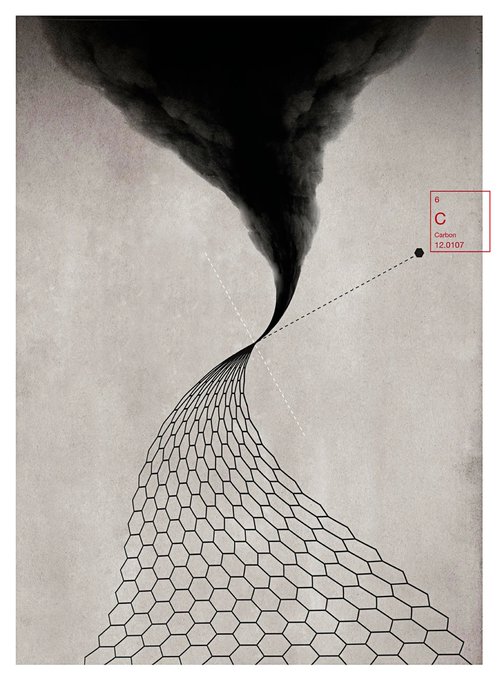
Graphene just broke a fundamental law of physics.

Its electrons just did something physicists thought was impossible. For nearly 200 years, metals have obeyed the Wiedemann-Franz law – the rule that electrical conductivity and thermal conductivity always rise and fall together. 

But in ultra-clean graphene, researchers at the Indian Institute of Science found the opposite. As electrical conductivity increased, thermal conductivity dropped, shattering a principle taught in every physics textbook. 

The key lies at the “Dirac point,” a strange electronic tipping point where graphene is neither a metal nor an insulator. Here, electrons stop behaving like individual particles. Instead, they flow collectively as a nearly perfect fluid – a state called a “Dirac fluid.” 

This discovery doesn’t just rewrite the rules for graphene. It provides a tabletop window into extreme physics usually reserved for black holes and high-energy colliders. Scientists say this behavior could help probe mysteries of quantum entanglement, black hole thermodynamics, and the very fabric of matter itself.

 ["Universality in quantum critical flow of charge and heat in ultraclean graphene." Nature Physics, 2025] ...
Individual
|
      INTERPERSONAL    :     SCIENCES               
HUMANISTIC  --------------------------------------  MECHANISTIC      
 SOCIOLOGY  :    POLITICAL 
|
Group
While I can't fully understand this paper (even the abstract!), I realise that it is taking what seems a long time^ for industry and business to understand and realise the potential of graphene in industrial and technological applications. 


Hopefully, applications will emerge, that are beneficial to all. Reducing energy use, improving efficiency, removing pollutants even more effectively, imcreasing the durability and hence lifetime of materials and products, and more.

Also, marvellous to see global collaboration at work, as science continues to asks questions.

^I could have written exploitation there, but could we put the collective and planetary first?


Majumdar, Aniket and Chadha, Nisarg and Pal, Pritam and Gugnani, Akash and Ghawri, Bhaskar and Watanabe, Kenji and Taniguchi, Takashi and Mukerjee, Subroto and Ghosh, Arindam. (2025) Universality in quantum critical flow of charge and heat in ultraclean graphene, Nature Physics. http://dx.doi.org/10.1038/s41567-025-02972-z

My source: https://x.com/Rainmaker1973/status/1966896966316474505

Which includes a video 5m 'Quantum Critical Flow in Graphene: Charge & Heat Dynamics'

https://www.youtube.com/watch?v=LrImy9PAHGk

See also on W2tQ: 'physics : 'women'

Friday, April 19, 2024

Call - Special issue: Learning from Multiple Data Sources for Decision Making in Health Care

The increasing availability of digital data, along with recent developments in Artificial Intelligence, especially in the Machine Learning and Deep Learning fields, led the scientific community to debate whether data alone is sufficient for decision making and scientific exploration. We focus the attention on the healthcare domain, where peculiar issues affect data: indeed, data are usually collected under heterogeneous conditions (i.e., different populations, regimes, and sampling methods), suffer missingness – very often not at random – and their use is strongly constrained by privacy issues. In such a complex setting, this special issue challenges computer scientists to contribute to the above debate by designing and developing innovative methodological approaches, for solving complex decision-making problems in health care, leveraging on observational data.

Topics of interest include, but are not limited to, the following with an emphasis on novel generalizable methods applied to the healthcare domain:

  • Causal discovery from multiple data sets.
  • Federated causal discovery.
  • Causal discovery from heterogeneous data sets.
  • Transportability of causal models and inference.
  • Neuro-symbolic approaches to learn from heterogeneous data sources.
  • Continual learning on streams from multiple data sources.
  • Computational intelligent strategies to support causal inference.
  • Edge computing for decision making in healthcare.
  • Integrative AI methodologies.
  • Distributed inference methods.
  • Continual Learning.
  • Knowledge Discovery and Integration.
  • Combination of deductive approaches with ML models.
  • Combination of ontologies and/or knowledge-bases with ML to support decision making.

Peer Review Process:

All submitted papers will undergo a rigorous peer-review process featuring at least two reviewers. All submissions should follow the guidelines for authors available at the Journal of Biomedical Informatics website (http://www.elsevier.com/locate/yjbin). JBI’s editorial policy outlined on that page will be strictly enforced by special issue reviewers.

Note that JBI emphasizes the publication of papers that introduce innovative and generalizable methods of interest to the informatics community. Specific applications can be described to motivate the methodology being introduced, but papers that focus solely on a specific application are not suitable. A few examples of papers focused on methods previously published in JBI include: Kyrimi, et al. [1], Huang, et al. [2], Kocbek et al. [3], Houston et al. [4], García Del Valle et al. [5], Graudenzi et al. [6] and Sims et al. [7].

In particular, the authors of [1] showed the relevance of causal models and expert knowledge to develop credible models, i.e., capable of achieving good predictive performances when transported from the study cohort to the target population. Furthermore, [2] tackles the relevant issue of partially overlapping variables when data are collected from multiple data sources. This problem is extremely relevant both in theoretical and practical terms for decision making in the healthcare sector.

The contribution provided in [3] stressed the importance of working in a multi-source context by demonstrating how the linking of different repositories can improve the overall understanding of patients' conditions. Similarly, in [4] the authors extended this concept by introducing a methodology to evaluate to audit the data quality of the sources exploited by healthcare information systems. Then, in [5] the multi-source concept is transferred within the multi-modal environment and the authors surveyed the importance of considering different modalities to obtain a better disease understanding.

The works in [6] and [7] focuses on the importance of data. In [6] a data integration framework is defined for characterizing the metabolic deregulations that distinguish cancer phenotypes, by projecting RNA-seq data onto metabolic networks without the need for metabolic measurements; in [7] a biomedical informatics method is introduced that uses multiple public health data sources to perform surveillance of methadone-related adverse drug events. Interestingly, even if patient data are not linked between different data sources, results show that the integration of multiple public data sources can capture more cases and provide more clinical details than individual data sources alone.

Key requirements for JBI ML papers in addition to presenting novel methods (not simply application of existing methods to a new healthcare domain) are as follows: 1) projects must have clinicians involved in research question/problem formulation, defining input data, and assessing the results. 2) An explanation (with clinicians) of how the proposed method would fit into the clinical workflow is expected. It must be translational to practice. 3) Data sets should preferably be collected from hospitals after the research question was formulated, thus avoiding the use of available data (MIMIC) to define a very wide research problem that could potentially be answered with available open datasets (as an example: detecting if someone has COVID from Chest X-Rays would not be acceptable, as the gold standard test is the laboratory test). 4) As for explainability, SHAP values and related diagrams would not be enough: the paper should clearly describe and explain how clinicians use the visualization to make decisions. For further details please refer to https://www.sciencedirect.com/journal/journal-of-biomedical-informatics/publish/guide-for-authors.
Submission process, Questions, and References 

My source: 
https://aixia.it/en/gruppi/hc/

Wednesday, September 11, 2019

The LONG Now - in Research

individual
|
INTERPERSONAL : SCIENCES
humanistic ----------------------------------------------- mechanistic
SOCIOLOGY : POLITICAL
|
group - population


*I have placed Broadbalk here as agriculture was a key driver for social and community development.

See also:
https://www.nationalgeographic.com/news/2013/7/130719-tar-pitch-longest-running-experiments-science/

Good genes are nice, but joy is better, The Harvard Gazette.
https://news.harvard.edu/gazette/story/2017/04/over-nearly-80-years-harvard-study-has-been-showing-how-to-live-a-healthy-and-happy-life/

World's largest evidence review: Nutritional supplements for mental health
https://www.eurekalert.org/pub_releases/2019-09/nhri-wle090619.php

The Long Now Foundation
http://longnow.org/clock/


My source:
Whipple, T. (2019) News, Bacteria study has just 495 years to go, The Times, February 2, p.37.

Sunday, August 25, 2019

Book: "Range: How Generalists Triumph in a Specialised World"

individual
|
INTERPERSONAL : SCIENCES
humanistic ----------------------------------------------- mechanistic
SOCIOLOGY : POLITICAL
|
other - group - population


In searching for a book cover image above I came across this one:

http://www.game-changer.net/tag/generalists/

This Venn diagram is interesting in itself, but please reflect upon it across the 'range' of Hodges' model? What stands out to me is how corporations and health care still grapple with this question.

It appears they struggle to find the 'magic' - let alone multiply it.


Book cover - Amazon UK

My source: Derbyshire, J., Don't be outfoxed in a wicked world, FT Weekend, Life&Arts, 3-4 Augist, 2019. p.9.


Friday, August 16, 2019

"Finishing It" - Poems No Pills or poems On pills?


individual - self
|
INTERPERSONAL : SCIENCES
humanistic ----------------------------------------------- mechanistic
SOCIOLOGY : POLITICAL
|
group- population

First work as Poet Laureate


Poet


Laureate


Simon Armitage


My sources:
Laureate's poem on a pill aims to tackle cancer, News, The Times, 14 August, 2019, p.14.

Singh, A., A pill with cancer's name on it is Poet Laureate's first work, The Daily Telegraph, 14 August, 2019, p.9.

Image source:
Sutton and Croydon Guardian
https://www.yourlocalguardian.co.uk/news/17835799.poem-paying-tribute-sutton-cancer-research-micro-engraved-onto-tiny-pill/

Sunday, July 14, 2019

2 + Everyone Else -1: Thank you Michael

individual
|
INTERPERSONAL : SCIENCES
humanistic ----------------------------------- mechanistic
SOCIOLOGY : POLITICAL
|
group
Michael
All of humanity in one picture except for Michael Collins. Apollo 11, July 1969
Collins

"We choose ..."


Photo:
https://www.reddit.com/r/spaceporn/comments/63ztoy/all_of_humanity_in_one_picture_except_for_michael/

Monday, March 28, 2016

Unconscious Patient (Sense of Smell)

individual
|
INTERPERSONAL : SCIENCES
humanistic ---------------------------------------  mechanistic
SOCIOLOGY : POLITICAL
|
group

The Unconscious Patient (Sense of Smell), dated at around 1624-25, is part of Rembrandt's series depicting the five senses. It shows a woman holding a handkerchief, presumably containing smelling salts, under the nose of a young man who has fainted after a surgeon has performed a blood-letting. (Galerie Talabardon & Gautier/Associated Press)


My source: Adam, G. (2016) Lighting up the territory, Collecting, Financial Times, 19-20 March. p.6.

Image source: 'New' Rembrandt, The Unconscious Patient, debuts at Dutch art fair

Saturday, October 17, 2009

Boyer's model, Hodges' model, scholarship, future website and Drupal

Ack: This blog post draws on a brief but informative two page text by Marta Nibert, Educational Consultant for Occupational Therapy, University of Idaho.

Models abound of course (not only on catwalks where other career choices are displayed), but in nurse education and the sciences. The review of Curriculum Development In Nursing Education reminded me of Boyer's model of scholarship. I have maintained a link to this for many years, the book review prompted me to read more. Boyer is a gift for this scholar of Hodges' model and any others, a gift not just in that off-the-shelf sense, but in a constructive advisory sense.

The table below highlights Boyer's types of scholarship, purposes and measures of performance. The focus of Boyer's model is the quality of professorial activities, in the same way highly skilled and experiences nurses can be removed from the front-line, so to can specialist faculty be distanced from teaching.

Type of ScholarshipPurposeMeasures of Performance
DiscoveryBuild new knowledge through traditional research.• Publishing in peer-reviewed forums.
• Producing and/or performing creative work within established field.
• Creating infrastructure for future studies.
IntegrationInterpret the use of knowledge across disciplines.• Preparing a comprehensive literature review
• Writing a textbook for use in multiple disciplines.
• Collaborating with colleagues to design and deliver a core course.
ApplicationAid society and professions in addressing problems.• Serving industry or government as an external consultant.
• Assuming leadership roles in professional organizations.
• Advising student leaders, thereby fostering their professional growth.
TeachingStudy teaching models and practices to achieve optimal learning.• Advancing learning theory through classroom research.
• Developing and testing instructional materials
• Mentoring graduate students.
• Designing and implementing a program level assessment system.

What I will try to do here is briefly suggest how Boyer can inform consideration of scholarship in Hodges' model and a future website. This is not just a one-way dialogue I believe Hodges' model can also inform Boyer's model. For example according to Nibert, Boyer proposes using 'creativity contracts'. The creative utility of Hodges' model is surely demonstrated in the posts and archive on W2tQ spanning nursing, education and health care? Since the publication of Boyer's paper in 1997 it could be argued there are new forms of scholarship that cast light and shadows on traditional academia and forms of research. More specifically though we can take Boyer's measures of performance and apply them in turn to h2cm. Even though the purposes differ (I am neither quality faculty nor professor) the reflection is helpful:

DISCOVERY

Publishing in peer-reviewed forums.
  • There is a limited bibliography listed here on W2tQ.
Producing and/or performing creative work within established field.
  • The bibliography and website constitute a mixture of formal and rather ad-hoc creative works in nursing. Much more needs to be done.
Creating infrastructure for future studies.
  • As noted in the book review I am fascinated by this word infrastructure. I recognise the need for a 21st century home for Hodges' model; the limitations of a static website and the need to benefit from the stimulus and energy that a community of users would provide. Drupal is the future (for me), a means to provide an infrastructure out of which a community may grow and inform.
INTEGRATION

Preparing a comprehensive literature review.
  • Hodges' model deserves a comprehensive literature review, one that spans education, nursing, global health, informatics and cognitive science.
Writing a textbook for use in multiple disciplines.
  • 'Book' is an established content type within Drupal and this is a worthy objective, as Hodges' model is the ideal academic Swiss Army knife.
Collaborating with colleagues to design and deliver a core course.
  • This is so dependent upon infrastructure and it seems my actively engaging with academics in curricula design and course planning. Drupal is being adopted in education so the scope to engage from an external position is a possibility.

APPLICATION

Serving industry or government as an external consultant.
  • Is professorship a pre-requisite for consultancy work? No. Do we just leave this to the professors? No.
Assuming leadership roles in professional organizations.
  • Being in the North West of England, a full-time nurse and with many meetings down South this is a barrier to adopting such roles. For the future should there be any opportunities these must be tried - only that way can they be tested.
Advising student leaders, thereby fostering their professional growth.
  • As a mentor in clinical practice with the chance to develop local educational links there is scope here; and possibly others?
TEACHING

Advancing learning theory through classroom research.
  • As noted above it would be marvellous to be presented with the task of producing lesson plans to encourage research into Hodges' model.
Developing and testing instructional materials.
  • As far as the classroom is concerned this is very much a bullet point for the future. Using Drupal however a future site can incorporate some instructional materials.
Mentoring graduate students.
  • Ongoing, but would like to engage more in this - and whilst h2cm is on my agenda I do understand models represent a small part of student learning.
Designing and implementing a program level assessment system.
  • Another point for a future departure; how do you demonstrate competency in Hodges' model? There are means of assessment, which were applied in the 1980's, case studies, essays and discussion. ...
More to follow...

Additional link:
Instructional Design Review (ID Review) checklist at Schema Performs