Hodges' Model: Welcome to the QUAD: Netherlands

Hodges' model is a conceptual framework to support reflection and critical thinking. Situated, the model can help integrate all disciplines (academic and professional). Amid news items, are posts that illustrate the scope and application of the model. A bibliography and A4 template are provided in the sidebar. Welcome to the QUAD ...

Showing posts with label Netherlands. Show all posts

Tuesday, March 04, 2025

Postdoc “Citizen Science” (V25.0121) at Univ of Groningen

We're hiring:

Postdoc in Citizen Science at the University of Groningen

Are you passionate about public engagement with science and citizen science? Do you want to develop and work on projects that connect academia with society and make a real impact? We have an exciting Postdoc position available in our Citizen Science team!
Please note: You should be able to speak Dutch...

📅 Apply by March 23, 2025
🔗 Learn more & apply here: https://lnkd.in/emsFzdgJ

Feel free to share in your network.

Cheers,
Henk

Dr. Henk A.J. Mulder
Master Science Education and Communication &
Bèta Wetenschapswinkel (Science Shop @ Science LinX),
Rijksuniversiteit Groningen (University of Groningen)
Dr. Henk A.J. Mulder
Energy Academy/IREES
kamer/room 5158.0222
Nijenborgh 6
9747 AG Groningen
The Netherlands
h.a.j.mulder AT rug.nl
http://www.rug.nl/staff/h.a.j.mulder/
http://www.rug.nl/society-business/science-shops/
http://www.rug.nl/masters/educatie-en-communicatie-in-de-wiskunde-en-natuurwetenschappen/

Individual
|
      INTERPERSONAL    :     SCIENCES               
HUMANISTIC  --------------------------------------  MECHANISTIC      
 SOCIOLOGY  :    POLITICAL 
|
Group

my ACADEMIC CAREER
my LANGUAGE SKILLS
my LIFE EXPERIENCE
my PASSIONS


SCIENCES - ENGINEERING
'LIVED EXPERIENCE'
Enthusiast-Expert [patient, swimmer, x,y,z ...]
local, regional, national, international


PUBLIC UNDERSTANDING OF SCIENCE
PUBLIC ENGAGEMENT
COMMUNITY ISSUES/AWARENESS
COMMUNICATION

CITIZENS
EVIDENCE-BASED POLICY
PUBLIC PRIORITIES
POLICY PRIORITIES

n.b. No endorsement of Hodges' model should be construed from inclusion of #h2cm above.

Sunday, December 18, 2022

CLOSE(D) CARE: Group climate in a secure forensic setting for individuals with mild intellectual disability

This morning ResearchGate alerted me to a new paper/thesis citing Hodges' model. 

I will add this to the bibliography and post again in the new year, relating selected conceptual content of Elien's thesis to Hodges' model.

Background

CLOSE(D) CARE
CLOSE(D) CARE
This study examines associations between group climate, aggressive incidents and coercive measures in adults with mild intellectual disability or borderline intellectual functioning (MID‐BIF) of a secure forensic setting.

Method Participants (N = 248) were interviewed about their perception of group climate utilizing the Group Climate Instrument. Data on aggressive incidents and coercive measures were retrieved from the facilities’ electronic database. A multilevel structural equation model was fitted in which variability in perception of group climate within and between living groups was examined.

Results An open and therapeutic group climate was associated with lower levels of aggression within and between groups. A higher number of aggressive incidents were significantly associated with a higher number of coercive measures.

Conclusions The findings have implications for the understanding of how group climate may play a role in reducing aggressive incidents at the living group in treatment of individuals with MID‐BIF in secure forensic settings.


Elien G Neimeijer (2021) "CLOSE(D) CARE: Group climate in a secure forensic setting for individuals with mild intellectual disability." Radboud University, ISBN: 978-94-6416-713-9
https://www.trajectum.nl/sites/default/files/proefschrift_e._neimeijer_pdf.pdf

Sunday, October 01, 2017

"Loving Vincent"

individual
|
INTERPERSONAL : SCIENCES
humanistic --------------------------------------- mechanistic
SOCIOLOGY : POLITICAL
|
group


My source: various...

Thursday, March 23, 2017

Witness the Land and the Location of Truth

individual
|
INTERPERSONAL : SCIENCES
humanistic --------------------------------------- mechanistic
SOCIOLOGY : POLITICAL
|
group


Lockerbie Witness Box (Exhibition Version), 2003
Nathan Coley, b.1967
Rosewood, laminates, aluminium, steel, carpet, plywood, electrical components and chair


"This work consists of an exact replica of the witness box used at the Lockerbie bombing trial alongside eight of a series of 12 drawings representing evidence presented during the trial. The trial was held in the Netherlands, but for 36 weeks the small area of land where the court stood was temporarily legally Scottish. Coley challenges what we take as 'real', by looking at the arbitrary rules that enable a country to 'appear' somewhere else and the assumption that a person is telling the truth because they are sitting in a certain place." 


My source: Gallery of Modern Art, Royal Exchange Square, Glasgow G1 3AH visited 28 November 2015.

Monday, May 30, 2016

Book: Secret diaries - span the generations...

http://www.meulenhoffboekerij.nl/

Dutch Bestseller, 'The Secret Diary of Hendrik Groen'


Hodges' model can span the generations through 'life chances' and the 'health career'...


Book cover image: Publishers Weekly

My source: Paxman, J. (2016) Diary, FT Weekend, Life & Arts, 28-29 May. p.2.

Monday, March 28, 2016

Unconscious Patient (Sense of Smell)

individual
|
INTERPERSONAL : SCIENCES
humanistic ---------------------------------------  mechanistic
SOCIOLOGY : POLITICAL
|
group

The Unconscious Patient (Sense of Smell), dated at around 1624-25, is part of Rembrandt's series depicting the five senses. It shows a woman holding a handkerchief, presumably containing smelling salts, under the nose of a young man who has fainted after a surgeon has performed a blood-letting. (Galerie Talabardon & Gautier/Associated Press)


My source: Adam, G. (2016) Lighting up the territory, Collecting, Financial Times, 19-20 March. p.6.

Image source: 'New' Rembrandt, The Unconscious Patient, debuts at Dutch art fair

Saturday, March 07, 2015

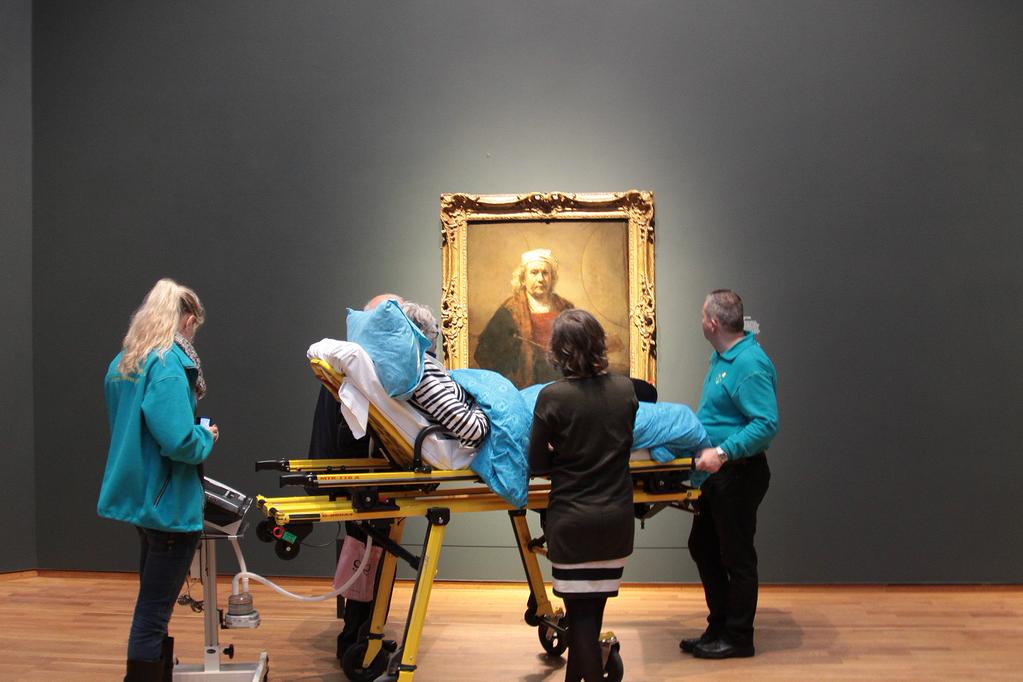
When does art prompt 'total internal reflection' ?

individual
INTERPERSONAL : SCIENCES
humanistic ------------------------------------------- mechanistic
SOCIOLOGY : POLITICAL
group


Stichting Ambulance Wens


Related posts:
Woman says goodbye to beloved horse from hospital bed hours before she dies

Rijksmuseum Amsterdam - health in art : art in health

My source:
The Times, 7 March 2015, 71450: pp.38-39.

Photo source:
http://www.openculture.com/2015/03/terminally-ill-patients-visit-rembrandt-paintings.html

Thursday, January 01, 2015

The mining of meaning - across the domains and years

individual
INTERPERSONAL : SCIENCES
humanistic ------------------------------------------- mechanistic
SOCIOLOGY : POLITICAL
group


In September 2014 I visited Amsterdam to attend Drupalcon and arriving early spent a day at the Stedelijk Museum. Exhibitions included a project within On The Move by Witho Worms and Hans Gremmen
Witho Worms (Amersfoort, NL, 1959) is a photographer who lives and works in Amsterdam. Hans Gremmen (Langenboom, NL, 1976) is a graphic designer who works and lives in Amsterdam.  - See more at: http://www.stedelijk.nl/en/exhibitions/on-the-move/witho-worms-and-hans-gremmen#sthash.2lKS8S6r.dpuf

Around Wigan there were many spoil or slag heaps from the coal industry that once thrived across Lancashire. There is a leisure area known as The Three Sisters reclaimed land from the mining industry. Slag heaps can have a very physical presence over towns and villages.

For some communities these man-made mountains hold memories of a hard family life, of many loves and joys and disaster.

The exhibition of photographs and their book revealed how the coal mining spoil heaps are universal. They look the same and represent the same toil and graft. Whatever the country - risk is risk : dust is dust. In these modern pyramids we see mining as a global phenomenon not just coal and a happenstance of geology and local history. The process of production of the book's prints is fascinating too, saying far more than the images alone as with the socio-politics of this industry.
Stedelijk Museum
Stedelijk Museum
Stedelijk Museum
Stedelijk Museum

Cette Montagne, C’est Moi / This Mountain That’s Me (2006-2011)
http://www.alternativephotography.com/cette-montagne-cest-moi-this-mountain-thats-me-2006-2011/

and Happy New Year to all!

Wednesday, October 01, 2014

Bits of information a-cross the centuries - Bad Tidings & The Love Letter

As noted previously on W2tQ the significance of information practically and as a concept is very obvious in health and social care. Not just the debate about assuring privacy and confidentiality of clinical records and professional disclosure, but the meaning of information to an individual. This is assuming that the person concerned has the mental capacity to recognise what a particular circumstance, event, item of news means; and not just this morning, but tomorrow...

A diagnosis, lab result, a date for this procedure or that operation all can be a major source of anxiety and stress.

This week's visit to Amsterdam also included a visit to the Stedelijk Museum, where I saw Jobstijding (Bad Tidings), 1932 / Carel Willink (1900-1983). On Saturday I marvelled at Vermeer's The Love Letter and many other great works at the Rijksmuseum. ...

Through art and these works in particular we can contrast the social impact of information, of news - its meaning past and present with our ongoing preoccupation with binary representation and the information age.

Snail mail may be less common and yet the impact of decisions, news, life events ... remains.

individual
INTERPERSONAL : SCIENCES
humanistic ------------------------------------------- mechanistic
SOCIOLOGY : POLITICAL
group

https://www.rijksmuseum.nl/en/collection/SK-A-1595
Vermeer - The Love Letter
1 0
0 1
http://www.stedelijk.nl/en/artwork/3872-de-jobstijding
Carel Willink - Jobstijding (Bad Tidings)

0 1
1 0

Image sources:
The Love Letter, Vermeer
http://www.sai.msu.su/wm/paint/auth/vermeer/vermeer.love-letter.jpg

Jobstijding (Bad Tidings), 1932, Carel Willink (1900-1983) Stedelijk Museum, Amsterdam, The Netherlands

http://www.pinterest.com/pin/567383253025365412/

Saturday, September 27, 2014

Rijksmuseum Amsterdam - health in art : art in health

I arrived in Amsterdam last night and spent today, 8 hours in the Rijksmuseum. It is an amazing experience, even to just scratch the surface. Early on it was not busy! Entering the building, is as publicised, to discover a remarkable series of spaces.

There are so many highlights of a rewarding day. One must be within the final hour 1610 finding one of Van Gogh's self portraits. Van Gogh finds himself placed in the interpersonal domain not just by virtue of this self portrait, but his struggle with mental health and  hospitalisations.

individual
INTERPERSONAL : SCIENCES
humanistic ------------------------------------------- mechanistic
SOCIOLOGY : POLITICAL
group
http://www.vangoghmuseum.nl/en


The Anemic Woman
Samuel Dirksz van Hoogstraten [Public domain], via Wikimedia Commons
There were many other (ill-)health related examples (and many that are also bright and humorous).

The sick child. The Sick Woman....

When initially viewing Visiting the Sick you have some searching to do. The sick individual themselves and the doctor are rather lost in the background. The painting stresses the sociological, domestic aspects of health past and present.

In Visiting the Sick and The Anemic Woman we get a view of the way outside (possibly of spiritual significance?) and another room through doorways. From TV, reading and my visit today, this is a common device within Dutch genre painting. If we have a diagnosis now in the 21st century, we still need to look through the windows and doors that relate to the individual and their social situation. In the age of the interface and partitions we still need to negotiate themDoorways, windows and portals as changes in knowledge content, can in the form of care domains illuminate the boundary of what is objective and subjective. This is central in health and social care.


Van Gogh self portrait source:
http://historiek.net/chinezen-zeer-geinteresseerd-in-van-gogh/13217/#.VCb5mRbivTo

The Anemic Woman image source:
http://commons.wikimedia.org/wiki/File:Samuel_van_Hoogstraten_-_The_Anaemic_Lady_-_WGA11719.jpg

Thursday, September 11, 2014

Technologies for Development: Project - founding ideas

Reading the website of this project I noticed that their founding ideas can be mapped to Hodges' model. As depicted below some are pretty obvious, notably the POLITICAL domain and the SOCIOLOGICAL.

Their first founding idea is placed in the interpersonal domain. This is very subjective exercise - literally playing with words - but here I am prioritizing individual cognitive access above physical access. I am thinking of individual participants and how a person even as part of cohorts, communities and groups can be marginalised. Mental health, also 'found' in this domain is a key example. As Nanotechnologies for Development state the first idea also focuses on countries - the group. So maybe I am wrong, if there is a wrong when using models - idealisations - in this way?

Staying with the group, access and participation are also a crucial matter of human rights - education, health information, health and social care, employment, freedoms, and security - freedom from violence, unlawful imprisonment...

These founding ideas clearly denote underpinning values, note in-particular the way risks and benefits are included at the individual and the group level.

In the SCIENCES domain from the beginning acknowledges time, process, project management. Nanotechnology needs to be understood in terms of the environments we inhabit. Not just us, now; but grandchildren... too. Not just the physical environment, but that embodied under and within this other divide: skin.

Within the mechanistic domains how will consultation about benefits and risks be negotiated and communicated to the humanistic domains?

How will the individual - group : community - commercial enterprise and innovation be squared?
 
This individual-group distinction is becoming ever more significant - of which more to follow.

individual
INTERPERSONAL : SCIENCES
humanistic ------------------------------------------- mechanistic
SOCIOLOGY : POLITICAL
group
The first founding idea of this project is that developing countries should not be denied participation in advanced modern technologies.The third core idea is that such developments entail risks and benefits that need to be addressed from the beginning.
The second that they should do that in their own culturally-specific ways. Our approach rejects any a priori distinction between traditional and modern technologies, but rather seeks innovative ways to connect indigenous and globalized knowledge and practices.
The fourth founding idea is that choices about those benefits and risks need to be made in a democratic way.

Source: Technologies for Development: Project Founding ideas

Sunday, August 12, 2007

Assen NL + Northern England CHE group Oct 13 Rivington Park Arts, Horwich

Sunday 0500 last week arrived home from Assen, Netherlands with Matt and Lawrence my son's friend having attended the Assen cycle Tour. It really was an international field and they really flew. Some unfortunately more than others.... The first race Matt came off!! - scaphoid # so we got to see the Dutch health service at work and very impressive too. Thanks to the staff at Wilhelmina Hospital - great job (I notice the TT circuit also keeps them busy). Closing my eyes while waiting for the Radiographer (like you do) Wilhelmina did not 'sound' like a hospital. Excellent attention to the 'hospital' environment - the colour, some nice curves, the signage was spot on too.

At the close of the holiday-cycle tour the sunset at Calais was beautiful.

Returning to the human ecology thread, I can confirm that the next Northern England CHE group event will be on Saturday 13th October 11-3pm at Rivington Park Arts. The group would like to thank David Ruaux for providing us with a room and facilities.

The theme for the meeting is well-being and I'll post more details nearer the time. Leave a comment or e-mail me h2cmng AT yahoo.co.uk and we will add you to the mail list.

Well I'm getting to know my ready-made case-load. It really does not feel like I've been away some 2.5 years. This is what Hodges' model was born for and it's great to get the therapeutic juices flowing again. I've not yet stabbed anyone (injections!), but that won't be long. Actually, I think a delay here is positive evidence that injections and medications are used much more carefully now; especially with older adults and they are reviewed regularly. A trend that has been in train for many years.

Speaking of trains - wonder if it will be clear tonight and in the early hours...?