Hodges' Model: Welcome to the QUAD: outcomes

Hodges' model is a conceptual framework to support reflection and critical thinking. Situated, the model can help integrate all disciplines (academic and professional). Amid news items, are posts that illustrate the scope and application of the model. A bibliography and A4 template are provided in the sidebar. Welcome to the QUAD ...

Showing posts with label outcomes. Show all posts

Wednesday, August 26, 2026

South Sudan Medical Journal - August 2026


Dear Reader,

The August 2026 issue is online here; we thank all the copyeditors and reviewers who helped prepare these papers. If you are submitting a manuscript, remember to read our Author’s Guidelines first.

We are looking for volunteers to join the Editorial team. Email us if you have time and editing skills.

Editorial

Can the Ebola Zaire vaccine stop Bundigunyo virus? Edward Kenyi


RESEARCH ARTICLES
Assessment of airborne fungi in the emergency and traumatology departments of University Hospital Centre, Sidi Bel-Abbes, Algeria Derouicha Matmour, Samia Merad, Yassine Merad, Achwak Bendouida, Zoubir Belmokhtar, Zakaria Merad, Mohamed Amine Boumelik, Benali Beghdadli, Othmane Ghomari 

Maternal and nutritional factors associated with early childhood development in rural Indonesia Hadi Ashar, Mohammad Zen Rahfiludin, Sri Achadi Nugraheni, Dwi Hapsari Tjandrarini

Observed outcomes and costs of laparoscopic versus open cholecystectomy in Juba, South Sudan Mayen Achiek, Jingo Faride, Mohamed Ibrahim, Abraham Mafair Kezekia, Chep C. Chep, Garang D. Nyuol, Ajak M. Dhel, George Lefteri

Stakeholders’ perspectives on determinants of health financing in South Sudan: a qualitative assessment Jonathan Majok, Gabriel Loi, Solomon Dut, Aluel Ayom, Thiey Kuethpiny, David Ngor, Sarah Nyannyot

Predictors of unsuccessful treatment outcomes among adults with pulmonary tuberculosis in a resource-limited setting Tri Agus Yuarsa, Malehah Mohd Noh, Richard Avoi, Meryl Grace Lansing, Putra Agina Widyaswara Suwaryo 

Assessment of the understanding of evidence-based medicine among undergraduate medical students in Gadarif University, Sudan Khalid Mohammed Ali, Ozaz Yagoub, Inshirah Mustafa, Tarig Fadelelmoula
 
Environmental health risks associated with open dumping practices in Central Kalimantan, Indonesia: an observational study Nawan, Septi Handayani 

Assessing the quality of health facilities providing antenatal care services in Bor, South Sudan John Thon Pandak Kuot, Shalini Ninan Cherian

Prostate cancer awareness and factors influencing screening among men at St. Francis Referral Hospital, Tanzania Theresia A. Karuhanga, Zeinabu Awardh Sharif, Antony Magoda, Philbert Madoshi 

CASE REPORTS 
Long-standing aspirated foreign body in a child complicated by pneumothorax and empyema Gawar Gel, Juma Deng, Justin Rubena

Clinical rabies in an HIV-positive pregnant mother with surviving newborn Ayol Mac Ayol

BACKCOVER: WHO: Guidelines for the management of pregnant and breastfeeding women in the context of Ebola virus disease

FRONT COVER IMAGE: The grown fungal colonies on SDA media collected from different types of samples. (Article on page 149)

Thanks to everyone who supports SSMJ. Tell your colleagues they can join our mailing list here.

The SSMJ team

Email: southsudanmedicaljournal AT gmail.com
Website: http://www.southsudanmedicaljournal.com
Follow us on X: @SSMedJournal and our Facebook Group.

Our mailing address is:

South Sudan Medical Journal
Health and Social Sciences Research Institute, Juba
South Sudan
Copyright (C) 2026 South Sudan Medical Journal All rights reserved.

Friday, July 24, 2026

WHO’s Self-Care Month (June 24th – July 24th) and International Self-Care Day July 24th


The Global Self-Care Federation (GSCF) is putting the spotlight on the benefits of self-care ahead of and beyond WHO’s Self-Care Month (June 24th – July 24th) and International Self-Care Day July 24th – two key annual advocacy milestones. 
 
GSCF’s 2022 International Self-Care Day campaign builds on the #SelfCarePromise theme, encouraging everyone to make and share their personal commitment to embrace a specific self-care action. This year, we are specifically focusing on the topic of resilience.  

Self-care is any action that an individual takes to look after their own health, based on the knowledge and information available to them. This practice can also occur in collaboration with healthcare professionals when needed. Actively managing your own health and well-being through self-care has numerous benefits, including better choice between healthcare options, better care for individual wellbeing and better value for governments and health systems worldwide.

Continued ...
 

individual
|
INTERPERSONAL
: SCIENCES             
humanistic ------------------------------- mechanistic
SOCIOLOGY : POLITICAL   
|
group

SELF-CARE
Mental health 
self-care & wellbeing
Individual Health literacy
(- and other literacies!)

Self Advocacy

Physical self-care
Personal resilience
Evidence-based interventions
Disease prevention
Diagnostics, Drugs, Devices, 
Integrated into Care


Health Promotion & Education
Community Empowerment
Community Resilience
Community Advocacy
Social cohesion
Rehabilitation, Recovery
& Reablement


Knowledge & Information Access
Learning opportunities
 
Universal Health Coverage
Approp. Policy frameworks
Improved care outcomes
Advocacy representation
WHO and agencies


See also:WHO - Self-care for health and well-being

Monday, May 11, 2026

BCS Third Faculty of Health and Care Conference 2026 - London 30th June

Overview

Join us for an exciting and informative day with a mix of keynotes, debates, panels, and practical workshops.

Speakers

Please visit the Faculty of Health and Care Conference 2026 web page for a list of our speakers and speaker biographies.

Synopsis

Please join our third annual conference featuring keynote addresses, panel sessions, scientific abstracts and posters, and practical workshops.

Our theme this year is 'Collaborate, Learn and Professionalise'.

Hear from national and international speakers in a CPD awarded programme.

Join us after the event for networking in an informal drinks reception.

Further details are available here:

Faculty of Health and Care: Conferences | BCS and Faculty of Health and Care Conference 2026 | BCS.

Ticket costs

(Prices stated are inclusive of VAT and fees)

  • Venue Attendance - BCS Members - £25
  • Venue Attendance - Non-BCS Members - £35
  • Online Attendance - BCS Members - £12
  • Online Attendance - Non-BCS Members - £15

Refunds/cancellations

A refund, excluding fees, will be issued if a cancellation request is received within 14 days of the booking date or by noon on Tuesday 16th June 2026, otherwise, name substitutions will be allowed after this date.

Our events are for adults aged 16 years and over.

This meeting is conducted in accordance with the BCS Code of Conduct for Meetings.

Join BCS today

If you are attending in person, please familiarise yourself with the Visitor Instructions for the BCS London Office.

Please note, if you have any accessibility needs, please let us know via 
groups AT bcs.uk and we’ll work with you to make suitable arrangements.

This event is brought to you by:

Faculty of Health and Care | BCS

n.b. Attending in-person. PJ

Wednesday, February 25, 2026

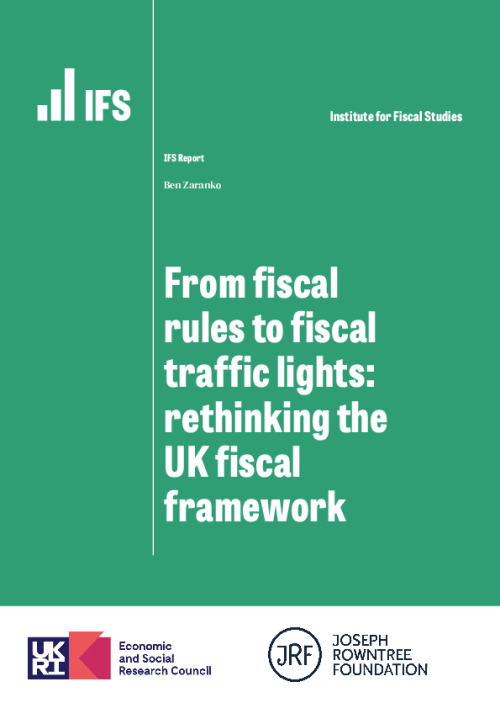
IFS Report: 'From fiscal rules to fiscal traffic lights: rethinking the UK fiscal framework'

'In other words, the current framework means that macroeconomic volatility is mainlined into policy volatility, which adds unnecessarily to economic uncertainty and makes good policymaking less likely. There is also a problem of asymmetry: when the forecast improves, any additional ‘headroom’ is typically treated as free money and happily spent. Yet when the forecast worsens, the rules tend to get changed or ‘gamed’: Chancellors of all political stripes have proved adept at promising future tax rises or spending cuts which are unlikely to be delivered, but which allow them to meet the letter of their rolling fiscal targets. 

All this is to say, the current framework is not delivering good outcomes. It is not achieving sustainable public finances, it has limited credibility with financial markets, and it is not creating the conditions for good policymaking or for a high-quality public debate about the important issues at play. It seems likely that any framework, left in place for long enough, will start to create problems in practice, as unhelpful norms emerge and actors find ways to game the system. Just as the tendency of HM Treasury to fudge its forecasts in the 2000s was one reason for the creation of the OBR as a corrective mechanism, the dysfunction around the current framework necessitates a change in thinking and approach.'

INDIVIDUAL
|
    INTERPERSONAL    :     SCIENCES               
HUMANISTIC --------------------------------------  MECHANISTIC      
SOCIOLOGY  :   POLITICAL 
|
GROUP
'Fixation upon -

lived
[ equilibrium ]
experience


'RAG'
assessment of patients in mental health services - caseload management


 fiscal headroom'
GOOD - BAD
PASS - FAIL
Equilibrium
Outcomes 
Public Policy
 
Interviews
 
sustainable public finances
 
good policymaking
(here)

high-quality public debate

Cost of Living


Report: IFS

Policy
Office for Budget Responsibility


My source: Valentina Romei, IFS urges end to fixation on fiscal 'headroom', Financial Times, 19 February, 2026, p.3.

Images: IFS

Monday, January 26, 2026

'Drama classes help GPs handle difficult patients' c/o BBC

'Hull Truck Theatre has just won the Innovation prize at the Stage Awards for their new training scheme for GPs. Associate Director Tom Saunders and GP Dr Eman Shamsaee discuss why drama classes are helping doctors treat patients.' 

BBC Radio 4 'Front Row' https://www.bbc.co.uk/sounds/play/m002q2jz (15 mins ...)

◇

Holly Phillips, East Yorkshire and Lincolnshire and Ian Youngs, Culture Reporter

Published - 21 January 2026

'A theatre company is using drama training to help doctors deal with challenging patients.

Hull Truck Theatre's classes feature actors performing difficult GP consultations, with GPs giving feedback before taking over the consultation themselves.

The theatre recently won the Innovation Award at the Stage Awards for the programme.

Dr Eman Shamsaee, who has taken part in the training scheme, described it as a "really creative way of doing GP training".'

BBC News:  Drama classes help GPs handle difficult patients

INDIVIDUAL
|
 INTERPERSONAL    :     SCIENCES               
HUMANISTIC --------------------------------------  MECHANISTIC      
SOCIOLOGY  :   POLITICAL 
|
GROUP


The training programme has completed its pilot stage and is now in the delivery phase


A reminder of co-working to deliver STORM training with a Clinical Psychologist colleague. 

See also: 'communication' : 'primary care' : 'GP' : 'drama'

Tuesday, September 02, 2025

12TH ANNUAL TANZANIA HEALTH SUMMIT 2025 (reminder)

THEME: "Harnessing Data Utilization and Technologies to Accelerate Universal Health Coverage"

INTRODUCTION 

Healthcare systems are evolving worldwide through the integration of health data and technologies. This integration is crucial for advancing Universal Health Coverage (UHC), particularly in developing nations. Data forms the foundation, encompassing patient information, treatments, and outcomes. Technologies on the other hand serve as tools like cloud storage, IoT devices, and blockchain that enable efficient data collection and processing. AI, a subset of digital technologies, then transforms this data into actionable insights through machine learning and predictive analytics, improving healthcare delivery and decision-making. The healthcare AI market's projected growth of 36.8% CAGR from 2025 to 2030 (Matsukatov, 2024) reflects its potential to revolutionize healthcare delivery, from diagnosis to resource allocation. Tanzania exemplifies how this integration impacts developing healthcare systems - with its UHC service coverage index expected to exceed 48% by 2025, the country is working to bridge healthcare access and quality gaps (WHO, 2025). The upcoming 12th Tanzania Health Summit will address how these components work together in low-resource settings. The focus will be on practical applications: health technology platforms for data management, technology infrastructure for connectivity, and AI-driven analysis for disease prediction. This integrated approach shows how developing nations can leverage technologies to accelerate progress toward comprehensive healthcare coverage despite the current resource constraints. 

CONTEXT 

Tanzania's healthcare system exemplifies both the challenges and opportunities in leveraging digital technology to achieve Universal Health Coverage in sub-Saharan Africa. With a doctor-to-patient ratio of 1.3:10,000 (against WHO's recommended 1:1,000), the country has strategically embraced digital innovation to bridge critical healthcare gaps (WHO, 2025). The Tanzania Digital Health Strategy (2019-2024) serves as the blueprint for this digital transformation, focusing on three key areas: health information systems, electronic medical records (EMRs), and data-driven decision-making (Ministry of Health, Tanzania Digital Health Strategy; 2019-2024). This initiative has shown measurable progress, with EMR deployment reaching 66.57% of healthcare facilities nationwide (PORALG, 2025). The implementation of DHIS2 (District Health Information System 2) has enhanced national health data collection and analysis, notably improving disease outbreak response capabilities.

Conference details 
Text: Concept note

Thursday, August 21, 2025

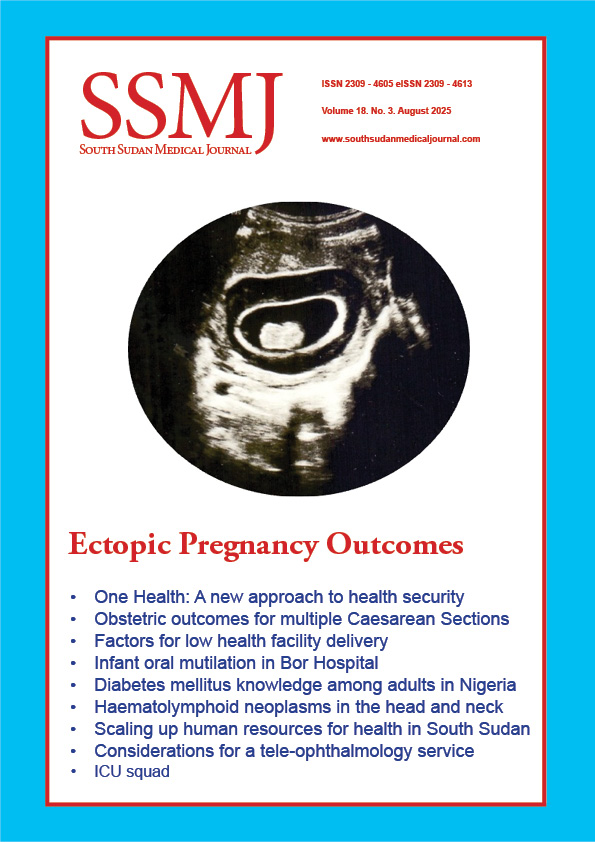
South Sudan Medical Journal. August 2025 18:3.

Dear Reader,

The full issue of our August 2025 issue is now available online here; the articles are listed below.

Also note that SSMJ is looking for a volunteer with time and interest in South Sudan, and experience in academic editing to join our Editorial team.

Editorial

Research Articles

Review Articles

  • A review of recent publications on haematolymphoid neoplasms in the head and neck region Karthik Shunmugavelu and Arun Vijaianandh A.
  • Scaling up human resources for health in South Sudan: A strategic imperative for achieving universal health coverage Gabriel Loi
  • Eyes in the sky: Considerations for a tele-ophthalmology service in South Sudan Garang M. Dut

Case Reports

  • Ectopic gestational-sac encapsulated in an ovarian cyst: A case report  Adam Moyosore Afodun, Alain Jabo, Mecthilde Mukangendo, Akeem Ayodeji Okesina, Olivier Mizero, Emmanuel Adeyemi Odumeru and Khadijah Kofoworola Quadri
  • Death due to ruptured tubal pregnancy: A case report P. Vinod Kumar 
  • ICU Squad: A possible solution for critical care service in low-resource areas Esraa Suliman Omer Abdelmageed and Ihab B Abdalrahman

Short Communications

  • The role of government in advancing private hospitals to improve healthcare services in South Sudan Jok Thikuiy Gang
  • 10th East African Health and Scientific Conference
  • Letter to the Editor: Self-medication Thomas Akuith Ngong 
  • Obituaries: Dr Baba Allan Ngachigoi Lanyanga and Dr Abdu Mohammed Abdudrbo Gilo
  • Call for Abstracts: Association of Surgeons of South Sudan First Scientific Conference

We thank the copyeditors and reviewers who helped prepare these papers. 

Articles in SSMJ are indexed by Scopus,  African Journals Online (AJOL), and the  Directory of Open Access Journals (DOAJ), and as well as being on our website. SSMJ is included in the EBSCO scientific research collection.
 
Thanks to everyone who supports SSMJ. Invite your colleagues to join our mailing list here.
 
The SSMJ team
Email: southsudanmedicaljournal AT gmail.com 
Website: http://www.southsudanmedicaljournal.com
Follow us on X  @SSMedJournal and our Facebook Group,

SSMJ is published by the Health and Social Science Research Institute of South Sudan (HSSRI-SS)
All links provided at - 
https://www.southsudanmedicaljournal.com/archive/august-2025/

Wednesday, June 18, 2025

FINAL CALL: Have your say about evidence-based implementation! c/o HIFA

PARTICIPATE TO WIN PRIZES

View this email in your browser <https://mailchi.mp/nest360/improve-health-worldwide-complete-this-short-survey-10147215?e=f1722a9293>

LAST CHANCE TO INPUT - CLOSING ON 27TH JUNE!

Do you work on improving health and equity in low-and middle-income countries (LMICs)?

Have YOUR chance to: -Democratise research and evidence for implementation! -Ensure your setting is represented! -Win a £50 voucher in the prize draw!

Palestine, Uganda, and Peru shared the most replies so far!

BETTER HEALTH WORLDWIDE!

Complete this 10 minute survey about evidence-based implementation

You could win a £50 voucher!

Click here <https://newborntoolkit.us5.list-manage.com/track/click?u=7a4ba8643fabeb1b06801b973&id=99accaa2ac&e=f1722a9293> and submit for a chance to win!

[content removed as not supported by HIFA]

English Do you work on improving health outcomes around the world?

Have your say! Why? To accelerate evidence-based implementation, with equity, for better health worldwide.

Who? People involved in any aspect of health service implementation and strengthening at any level of the system (e.g. health care provider, data analyst, policy maker).

How? Click here<https://newborntoolkit.us5.list-manage.com/track/click?u=7a4ba8643fabeb1b06801b973&id=a29ce2fd65&e=f1722a9293> to have your say!

What? Participant information<https://newborntoolkit.us5.list-manage.com/track/click?u=7a4ba8643fabeb1b06801b973&id=7579d3a077&e=f1722a9293> is attached to this message.

Evidence-based Implementation: Many life-saving interventions are not implemented effectively, with wide gaps between what is known and what is done, especially in low- and middle-income countries.

We are keen to hear perspectives and realities from implementers in all low- and middle-income contexts. 

We are seeking your insights to help close the gap from evidence to implementation!

We hope you will take a few minutes to complete this brief survey.<https://newborntoolkit.us5.list-manage.com/track/click?u=7a4ba8643fabeb1b06801b973&id=422f1a8283&e=f1722a9293>

Answers can be anonymous and there is no requirement to provide identifying information.


This survey is being conducted as part of the Lancet Commission on Evidence-Based Implementation in Global Health<https://newborntoolkit.us5.list-manage.com/track/click?u=7a4ba8643fabeb1b06801b973&id=ef480cd254&e=f1722a9293>. This study was funded by the Children’s Investment Fund Foundation.

A member of the study team can be contacted via ImplementersVoices AT gmail.com

Please share across your networks!! Let’s begin, click here!<https://newborntoolkit.us5.list-manage.com/track/click?u=7a4ba8643fabeb1b06801b973&id=63a8e4c758&e=f1722a9293>

[content removed as not supported by HIFA - and my source.]

From Harriet Ruysen - Harriet.Ruysen AT lshtm.ac.uk

Wednesday, May 07, 2025

Conference: Safety and Quality in Mental Health: Improvement - Led Care c/o RSM

'This event will explore successful strategies for enhancing patient safety and driving quality improvement in mental health services.

This timely event addresses the critical issues highlighted by recent high-profile incidents in mental health care. Keynote speakers, including Adrian James, the National Clinical Director of Mental Health, and Shubulade Smith, President of the Royal College of Psychiatrists, will share their experiences of leading organisations through challenging situations. Jonathan Warren, co-author of the Edenfield report, will also provide unique insights.

Key Themes:

  • Supporting staff through traumatic incidents
  • Amplifying patient and family voices
  • Service redesign for safer care
  • Innovative use of data for improved outcomes
  • Learning from significant events to prevent recurrence
  • Balancing human rights with public protection ...'
at: Royal Society of Medicine, 
1 Wimpole St, 
Marylebone, 
London, 
W1G 0AE, United Kingdom

Monday, February 17, 2025

Harnessing the Power of Artificial Intelligence to Improve Outcomes for Patients with for Long-Term Health Conditions

 Dear Colleagues and Friends,

We are organising a Special Session: Harnessing the Power of Artificial Intelligence to Improve Outcomes for Patients with for Long-Term Health Conditions

(https://aiih.cc/lthc/) in the International Conference on AI in Healthcare (AIiH), 8-10 September 2025, Jesus College, University of Cambridge.

We would like to accept both full length papers (12 pages plus references) and short abstracts (up to 5 pages including references) for special sessions. Submission guideline can be found here, including paper templates in both Word and LaTeX: https://aiih.cc/paper-submission/

The accepted full papers and abstracts will be published in the Springer LNCS volumes.

Full Paper submission deadline:            Friday 11 April 2025

Abstract submission deadline:               Monday 30 June 2024

We are looking forward to meeting you.

Best wishes

Shang-Ming Zhou

Professor in e-Health | Faculty of Health | University of Plymouth | PL4 8AA | UK.

Email :  shangming.zhou AT plymouth.ac.uk; smzhou AT ieee.org

https://www.plymouth.ac.uk/staff/shang-ming-zhou

https://www.plymouth.ac.uk/research/centre-for-health-technology

Tuesday, September 10, 2024

Suicide Postvention in the Workplace - new SOM resource

https://www.som.org.uk/suicide-postvention-workplace-new-som-resource

Posted by Ann Caluori | Mon, 09/09/2024 - 08:52

The term 'suicide postvention' refers to the actions taken by an organisation to provide effective support in a sensitive manner after a death by suicide. It aims to promote recovery and prevent further adverse outcomes.

This new SOM resource, authored by Professor Gail Kinman and Professor Neil Greenberg, provides evidence-informed guidance and recommendations for organisations to respond to the death by suicide of a colleague, or the unexpected death of a colleague from other causes. The guidance draws on high-quality sources from research and practice and was developed through consultation with experts from various fields. It aims to help organisations navigate the complexities and sensitivities involved in such tragic events, ensuring they provide the support required to maintain a healthy and compassionate workplace.

The resource should be useful for occupational health practitioners, wellbeing leads, HR professionals, managers, and policy makers. It addresses several important issues in the aftermath of a workplace death by suicide, such as immediate response approaches, communication protocols, support mechanisms for affected individuals, and long-term considerations for fostering a supportive work environment.

Download the guidance here.

This resource has been launched ahead of World Suicide Prevention Day 2024.

My source: TwiX @somceo

See also: 
World Suicide Prevention Day 2024 #WorldSuicidePreventionDay

Sunday, March 17, 2024

Geneva Health Forum and AXA Launch €50,000 Grand Jet d’Or de Genève Award to Address Pollution's Impact on Human Health

Since 2006, the Geneva Health Forum (GHF) has been uniting stakeholders to address critical global health issues every two years. By amplifying the voices of field experts and facilitating connections with influential policymakers, the forum provides a platform for showcasing innovative, accessible, and sustainable practices, as well as significant initiatives. Through its editions, the GHF has emerged as a pivotal event in addressing global health challenges.

For its 10th edition, from May 27 – 29, 2024, the GHF will address crucial issues for our future under the theme “Health, A Common Good!” The GHF transcends the boundaries of the healthcare system, considering the social and environmental determinants of health, with a specific focus on how environmental degradation is profoundly impacting human health.

As part of its mission to advance academic research on key societal challenges and contribute to human progress, the AXA Research Fund (https://axa-research.org/) AXA Group’s global science philanthropy launched in 2008, is teaming up with the GHF in this endeavor.

In light of this collaboration, the Geneva Health Forum (GHF) is introducing a new call for the Grand Jet d’Or de Genève Award, in partnership with the AXA Research Fund: Health & medical solutions to address the adverse effects of pollution on humans.

The World Health Organization estimates that exposure to air pollution is responsible for about 7 million premature deaths worldwide each year. Addressing pollution-related health issues is crucial, as underscored on May 24, 2023, by the World Health Assembly's resolution “WHA76.17 - The impacts of chemicals, waste, and pollution on human health.” The resolution calls upon Member States to work on human health impacts associated with plastics, act on linkages between chemicals, waste, pollution and other health priorities, as well as to prepare a proposal for a science-policy panel to contribute to the sound management of chemicals and waste.

Pollution is a major global health issue, affecting human health by causing respiratory diseases, heart problems, and cancer due to exposure to pollutants in the air, water, and soil. Specific attention has been given to pollutants such as per- and polyfluoroalkyl substances (PFAS), which are linked to cancer, thyroid disease, and developmental issues. Other pollutants such as heavy metals, volatile organic compounds (VOCs), particulate matter, persistent organic pollutants (POPs), and indoor air pollutants, present serious health risks, including neurological damage, reproductive disorders, and respiratory illnesses, highlighting the broad impact of pollution on human wellbeing.

Building on this international momentum, the Grand Jet d’Or de Genève 2024 will focus on the nexus of pollution and its health impacts.

The objective of the Grand Jet d’Or de Genève Award is to support an research team engaged in researching or implementing research-based projects with a focus on health treatment, measurements, use of data, and community involvement in addressing pollution-related health issues. The proposed projects must demonstrate their potential to change health practices and improve health outcomes in relation to pollution of air, water and soil, including but not limited to PFAS. Multidisciplinary teams exploring innovative practices or tools will be favoured.

The projects should not only focus on preventive measures to reduce pollution in the environment, but also encompass a broader scope, including assessing existing pollution, removing pollutants from the body and environment, developing medical solutions for pollution-related diseases, and finding ways to enhance health despite existing pollution.

The call will be open from March 11 to April 21, 2024, midnight (CET). Applications must be submitted online in English.

The Scientific Committee will select the top seven applications, which will then be submitted to the Programme Committee for the final selection of the winner. The award- winning research group will be announced on Tuesday, May 27, 2024, after the first day of the Geneva Health Forum, in the presence of the winning team.

The Grand Jet d’Or de Genève Award carries a prize of €50,000, awarded by the AXA Research Fund.

To prepare your proposal, you can view the complete proposal form:
https://grandjetdor2024form.genevahealthforum.com

If you need more information: contact AT genevahealthforum.com

HIFA* Profile: Eric Comte is Executive Director, Geneva Health Forum, External Affairs Directorate, Geneva University Hospitals. Email: eric.comte AT unige.ch

*My source.

Friday, March 15, 2024

Book (i): Mental Patient - Psychiatric Ethics from a Patient's Perspective

- by Abigail Gosselin


Individual
|
      INTERPERSONAL    :     SCIENCES               
HUMANISTIC  --------------------------------------  MECHANISTIC      
 SOCIOLOGY  :    POLITICAL 
|
Group
Book: Mental Patient
Do we say 

"PHYSICAL PATIENT"?

What is (still) heard here?

What is still heard here?


Gosselin, A. (2022). Mental Patient: Psychiatric Ethics from a Patient’s Perspective. The MIT Press.
https://doi.org/10.7551/mitpress/14589.001.0001

My source: 
https://x.com/AnneMarieGagnJ1/status/1767948059957227719?s=20


Wednesday, March 13, 2024

UK Higher Education Survey of Carers

From: Marie Moreau <marie_moreau AT HOTMAIL.COM>
Subject: UK HE survey of carers

Dear Colleagues

I am sharing this final call as we will be closing our survey of carers in UK HE at the end of the month.

Many thanks to those of you who have replied.

To be eligible, you need to be employed by a UK-based university and to be a carer (broadly understood, including as a parent, for a friend, a relative etc.). Here’s the link:

https://angliaruskin.onlinesurveys.ac.uk/national-carers-survey-uk

The outcomes will help us to better understand the experiences of carers in higher education and to provide recommendations to the sector.

We have received ethical approval for this project and are happy to address any question.

Warm wishes

Marie-Pierre Moreau
ARU, Cambridge, UK


My source (with some editing):
This message was issued to members of www.jiscmail.ac.uk/FREEDOM-OF-INFORMATION, a mailing list hosted by www.jiscmail.ac.uk, terms & conditions are available at https://www.jiscmail.ac.uk/policyandsecurity/

Friday, January 12, 2024

Book: Rethinking Global Health - open access

Rethinking Global Health

INDIVIDUAL
  |
     INTERPERSONAL    :     SCIENCES               
HUMANISTIC --------------------------------------  MECHANISTIC      
SOCIOLOGY  :   POLITICAL 
|
GROUP

psy-disciplines: 
intra- interpersonal domains

subjectification - objectification 

learning

emotional labour
burnout

precarious researchers -
 acknowledgement of contributions

equity

personal truth

ebola, cholera, HIV/AIDS,
COVID-19, PTSD ...

'emergency', natural diasters

climate crises: geography
local - global - glocal
remote - rural - urban

(physical) systems

tarmac bias

data, information access (SDGs?)

digital  divide, epistemic justice

collective 'truth'

violence against the 'others' -
women, children ...

symbolic, structural and 

collaboration, cooperation, 
co-production, co-design, co-owned with communities

socialisation -
(into global health work)

civil society mobilisation

inclusion, empowerment

social/cultural/ethnic history

social - community - group:
 psychology

POWER, poverty

global -
mental health - physical health
(parity of health: determinants^)

institutional violence

co-ownership

paternalism, colonialism
humanitarianism

NGOs - WHO - Institutions

(political) systems

decision-making
(where, when, who, how ...?)
finance - resources
'development'

political history


^All of them...

Burgess, R.A. (2023). Rethinking Global Health: Frameworks of Power (1st ed.). Routledge. https://doi.org/10.4324/9781315623788

My source: Twitter

Please also note the inter- multi- transdisciplinary bridges provided by Hodges' model, including well established 'avenues' of psycho-social, socio-technical, psycho-political, geo-political, socio-economic and others.