Hodges' Model: Welcome to the QUAD: acting

Hodges' model is a conceptual framework to support reflection and critical thinking. Situated, the model can help integrate all disciplines (academic and professional). Amid news items, are posts that illustrate the scope and application of the model. A bibliography and A4 template are provided in the sidebar. Welcome to the QUAD ...

Showing posts with label acting. Show all posts

Monday, January 26, 2026

'Drama classes help GPs handle difficult patients' c/o BBC

'Hull Truck Theatre has just won the Innovation prize at the Stage Awards for their new training scheme for GPs. Associate Director Tom Saunders and GP Dr Eman Shamsaee discuss why drama classes are helping doctors treat patients.' 

BBC Radio 4 'Front Row' https://www.bbc.co.uk/sounds/play/m002q2jz (15 mins ...)

Holly Phillips, East Yorkshire and Lincolnshire and Ian Youngs, Culture Reporter

Published - 21 January 2026

'A theatre company is using drama training to help doctors deal with challenging patients.

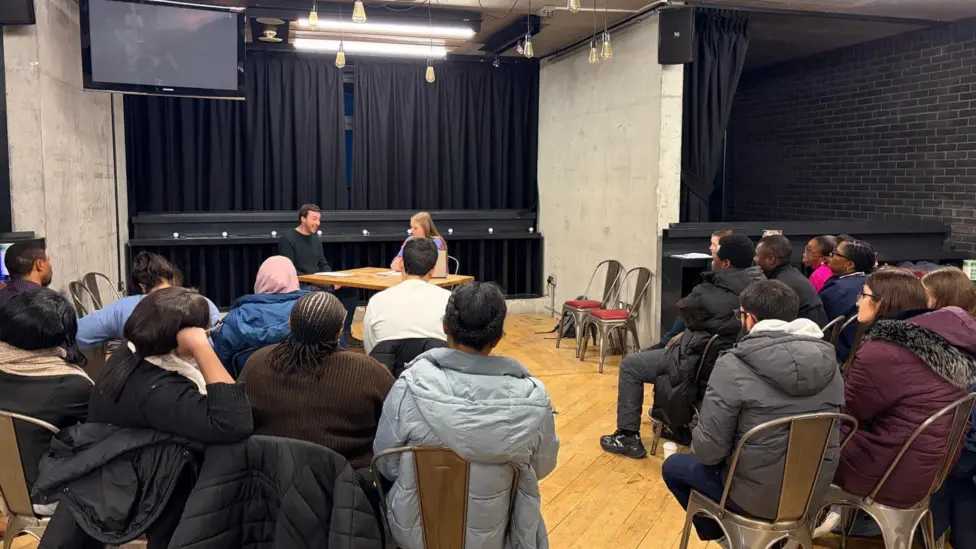
Hull Truck Theatre's classes feature actors performing difficult GP consultations, with GPs giving feedback before taking over the consultation themselves.

The theatre recently won the Innovation Award at the Stage Awards for the programme.

Dr Eman Shamsaee, who has taken part in the training scheme, described it as a "really creative way of doing GP training".'

BBC News:  Drama classes help GPs handle difficult patients

INDIVIDUAL
|
 INTERPERSONAL    :     SCIENCES               
HUMANISTIC --------------------------------------  MECHANISTIC      
SOCIOLOGY  :   POLITICAL 
|
GROUP


The training programme has completed its pilot stage and is now in the delivery phase


A reminder of co-working to deliver STORM training with a Clinical Psychologist colleague. 

See also: 'communication' : 'primary care' : 'GP' : 'drama'

Sunday, June 22, 2025

In Theatre, Silence is a genre, and therapeutic ally

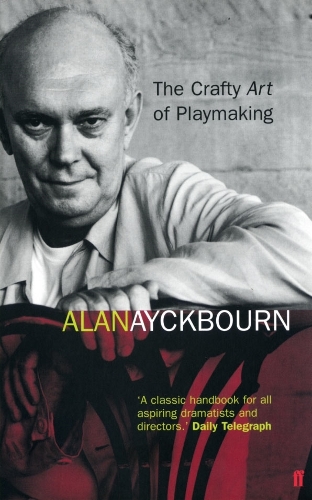
'As a playwright it may be your intention to build a vehicle to take us to the stars. But do make sure you have people aboard.' (p.9).^
Alan Ayckbourn in The Crafty Art of Playmaking.

Sound of silence in activism

Quite fitting in the two decades since publication, given the rise of AI and the impact upon the arts, specifically human imagination, creativity, and livelihoods. Meaning: silence as a tool for protest, and activism is also a genre and a can be a therapuetic ally. 

Going backwards - Sir Alan writes: 'Theatre for me has always been, in a way, a reflection of life writ somewhat smaller'. p.10.

While the point concerns the faith and trust placed in theatre directors by the company, there is an analogue in healthcare. The belief of the patient, in their doctor and the medical team. Or, at least the knowledge and skills they should, and appear to possess. For Ayckbourn '... the director looked as if he knew.' (p.10).

Obvious rule no. 4: 'Use the minimum number of characters that you need' (p.13).

What can I say? Society, has peeled back the patient - doctor (substitute health profession as needed) to the person whose monologue seeks confirmation of illness x,y, or z. Apparently here in the UK 1 in 4 adults have a mental health condition. The debate is ongoing as to what is going on. But the subject of Hodges' model as a possible crucible for a work of drama can certainly keep to character count down.

Not only that, but is this a book on counselling - interpersonal skills?

'An audience that doesn't care stops listening in the end. '. p.14. 

As part of -

'Obvious Rule no. 5: They need to care about your characters. (So you should too.)'

So, for both playwrights and carewrights, there is a duty of care (for all of course - despite the actions of so many governments).

In health the patient is the character study. There is, should be, must be - a plan of  care, a care plan. As a 'play', Hodges' model begins as a template of at least five acts [Spiritual (Four domains) ]. That is whether or not they are all 'written'. The attitude though should be unconditional positive regard.

There's no Waiting for Godot here, unless the character is social care?

Could it be that as organisational hierarchies have been flattened, the notion of character has been under siege? The onion that is our identity, personality, persona unpicked, skin-by-skin by social media, social change, and policy affecting education. Character building used to be a thing didn't it? No longer needed now is it?

Sir Alan, supports this hypothesis in his 'Obvious Rule No. 28:

People in general are reluctant to reveal themselves.' (p.65).

I still wonder about the potential of Hodges' model in secondary level education. More than ever, with all the talk about resilience, recovery, mental health issues, the rising UK welfare bill, may beg the question: What is character today? But, it is not defined by a stiff upper lip.

Not to sound 'ableist', but the 'crafty' in Ayckbourn's title, can be read in health terms; the disciplines drawing on science and the arts. Plus, they involve craft - use of the self, empathy and rapport. Not limited to, but in mental health care, it could be 'crafty' in the exercise of power, so frequently a theme central in drama and the human condition.

^A nice reminder too, of a Poul Anderson's SF classic Tau Zero (and a previous post).

The Crafty Art of Playmaking by Alan Ayckbourn. Faber, 2004, softcover, ISBN 0571215106.

https://www.concordtheatricals.co.uk/s/45898/the-crafty-art-of-playmaking

https://www.isthiswhatwewant.com/

Image: https://upload.wikimedia.org/wikipedia/commons/thumb/b/b0/Is_This_What_We_Want%3F.jpg/250px-Is_This_What_We_Want%3F.jpg

https://www.amazon.com/Zero-Coronet-Books-Poul-Anderson/dp/0340163364
Friday, June 20, 2025

Theatre in TI:ME

The Crafty Art of Playmaking
In health we're dealing with time in all its forms: cardinal; birth and death and all that happens in-between. Aka, 'life', illness, and palliative care. And, even if not recognised, chronological and pathological time, which policymakers should pay more attention to. The art of theatre, has its time (p.20): stage time, and real (theatre foyer) time. 

'At its most successful, theatre views things from a human standabout.' (p.9). 

I'd second that, especially allied with the notions (ideas!) of health career, and life chances

Since the publication of TCAoP in 2004 people seem to quite ready to dispense, disregard, downplay, demote the humanistic with the rise of AI and assisted dying for the terminally ill (of course).

Time recurs - as a frame. (p.25) with a touch of elective surgery. 'Think of your story as a piece of thread. Where you cut in is the point at which the lights come on in Act One. Where you cut out will be your final curtain. (There may be a knot or two in the middle to denote the intervals, too.)' p.25.

In the first post re. TCAoP I stressed the complexity, plethora of ideas that Hodges' model can create. Sir Alan provides a potential 'get of jail free card' (or as near as?) in his original rule no. 9. 

'If a play can be too simple, it can also be too complicated. If one element is particularly complicated, keep the rest of it simple.' (p.25).

Very useful advice! But achieving it when having and applying an idea is another matter.

What's this though? Step back to original rule no. 6:

'There is no hard and fast rule as to which constructional element comes first.' (p.20).

Butrint National Park Albania   

In the guided discovery exercise in students (audiences..) creating the model, there are two constructional elements, that also contribute to the one big idea.

It gets better! Original rule no. 14:

At least fifty per cent of your play is going to be visual. (p.33).

I must make sure I don't confuse concept/ual with visual/imagery.

More to follow.

The Crafty Art of Playmaking by Alan Ayckbourn. Faber, 2004, softcover, ISBN 0571215106.

https://www.concordtheatricals.co.uk/s/45898/the-crafty-art-of-playmaking

Tuesday, June 17, 2025

Theatre - which one?

The Crafty Art of Playmaking
Summer reading includes Ayckbourne's The Crafty Art of Playmaking published in 2004. Already half way through, writing has been covered, directing follows.

Looking at what I can learn in contrasting health and theatre, there is more than both laying claim to having a 'theatre'. Perhaps health got there first in a very primitive, existential, and fundamental sense. The 'theatre of war' covering battle, and the fight for food and survival. Even as civilisation emerged, on the battle field, triage was practised in a more deliberate way with skills that were built on emerging knowledge handed down orally - to become art.

So, no doubt there was a concurrency going on. Heroics in so many guises, shared around the fire. Plus, our individual dreams and nightmares that are framed collectively.

Ayckbourn offer pithy lessons learned over his career that began in 1959. There's an acting maxim:

'When playing a miser, stress his generosity.'

So can we restate the acting maxim as:

'When playing a patient, stress their strengths'?

Or. 'When playing a patient, stress their personhood'? . . .

If that is a challenge to the healthcare sector (even if unintended), then it is one that is actually long-standing. There are the three R's: rehabilitation, reablement and recovery.

Ayckbourn explains how the darker the subject the more a writer needs to find the light. And vice-versa. This suits me fine, and medicine is recognised as a great source of humour across several cultures.

The book lists a series of  'Obvious Rules' all numbered. 

Of No. 1: Born in Liverpool, I never would look down on comedy; and never as a poor cousin of drama.

After reading his obvious Rule No. 2, 'Never start a play without an idea'; I put my pants back on.

Do I have an idea? Oh my! Well Brian's at least.

In a way it's the other way around. The shout goes up - "Eratosthenes! Please pass me a sieve."

On having an idea, Ayckbourn writes: 'They assume, I think, that if they start the journey, maybe an idea will occur on the way. Perhaps a map of where they're going will blow in through the car window. In my experience this never happens.' p.6.

This is good advice, with the additional complication of having many maps, and yes, none: c/o Hodges' model. I need a theme, a situation and a thread. I'm writing a few ideas down. And helpfully Sir Alan advises not to throw ideas away. He describes, from experience how disparate things can come together.

Today (19th), I finished TCAoP here in Corfu. A great help for me, that is, the writing section pp.3-96; as I will try to explain in further posts. Sooner than expcted, I've started a book that will be a 'review'. 

A visit to Albania tomorrow - early start pick-up 0710.

The Crafty Art of Playmaking by Alan Ayckbourn. Faber, 2004, softcover, ISBN 0571215106.
https://www.concordtheatricals.co.uk/s/45898/the-crafty-art-of-playmaking

Friday, May 16, 2025

Theatre - the best way to learn ...

Pardon me, while I stay local - in Liverpool . . . 

I've always been interested in drama since school days (aged 13-14) and playing Francis Nurse in Arthur Miller's Crucible. Recent reading (inc. Theatre of the Absurd, The Shifting Point), see 'drama' - with more to follow) encouraged me to find out more. As a community mental health nurse on a visit, I've sometimes thought of this script being written as we engage with each other. Framed within  interpersonal skills and the society 'outside', there's a sense in which a screenplay is also writ large. 

The fact of whether the session is therapeutic, progressive, person-centred, structured, ethical, purposeful, has tea and custard creams ... is the drama of course.

In a way the creators of formal psychotherapies are playwrights - directors:

After all, they keep producing 'original' therapy manuals, don't they?


In the new year I noticed a community message about a theatre group Valley Theatre Group, planning a 'Living Newspaper' for a drama festival that took place last month. There is another performance next month in Liverpool, as per the edited message below:

People have been asking what’s going on and when for our Hope Street performances June 6-8th. So here’s the details.

W
e start each evening with the play about a 1930s Socialist Theatre group, “Unity”. (Cast: Peter Merrill, Ted Grant, Steve Donegan, Meggan Pye, Day Sheehan and Donna Lauder)

Then, on Friday 6 June, in the second half, we have our first Living Newspaper. This is the one that has most of the sketches submitted by outside writers and developed at the workshops. Then on Saturday 7th, second half, we have the Leverhulme group (The one that won the award at the festival) with their Living Newspaper. Finally, on Sunday 8th, in the second half, we have the last of the Living Newspapers, the one with slightly longer pieces like Scouse Man. This final one also has an original sketch from a 1930s Living Newspaper, the Munich Pact.

Tickets are on sale at the Hope Street Theatre website (link below) and from Ticket Quarter. Please come along and try to get other people along as well.  It'll be a good night's theatre! 

Thanks for all your support. The WTM team

Ticket link:  www.hopestreettheatre.com

Phone: 0344 561 0622

Monday, November 18, 2024

The mask ...

'I will speak from my experience with Balinese masks, but I have to go back one step before that. One of the first, knockout exercises that you can do with actors, which is used in lots of theatre schools where they use masks, is putting a plain, blank, white mask on someone. The moment you take someone's face away in that way, it's the most electrifying impression: suddenly to find oneself knowing that that thing one lives with, and which one knows is transmitting something all the time, is no longer there. It's the most extraordinary sense of liberation.

This is one of those great exercises that whoever does it for the first time counts as a great moment: suddenly to find oneself immediately for a certain time liberated from one's own subjectivity. And the awakening of a body awareness is immediately there with it, irresistibly; so that if you want to make an actor aware of his body, instead of explaining it to him and saying, "You have a body and you need to be aware of it," just put bit of white paper on his face and say, "Now look around." He can't fail to be instantly aware of everything he normally forgets, because all the attention has been released from this great magnet up top.' p.219
self
|
INTERPERSONAL : SCIENCES              
humanistic ------------------------------- mechanistic
SOCIOLOGY : POLITICAL   
|
other


Brook, P. (1989). The Shifting Point. London, UK: Methuen. pb.

Secondhand from Reid's, Mount Pleasant, Liverpool, this book was already 'musty'. On October 18th it got 'wet' in a downpour from Sorrento to Capri and back. It smelt even more historic afterwards. It still provided great reading though! I noticed in a new pb edition the images were not included.  https://reidofliverpool.co.uk/