Hodges' Model: Welcome to the QUAD: comedy

Hodges' model is a conceptual framework to support reflection and critical thinking. Situated, the model can help integrate all disciplines (academic and professional). Amid news items, are posts that illustrate the scope and application of the model. A bibliography and A4 template are provided in the sidebar. Welcome to the QUAD ...

Showing posts with label comedy. Show all posts

Sunday, August 30, 2026

Dear Editorial Office,

Dear Dr. Jones,

My name is Editorial Office, and I am writing on behalf of the selected journal. I came across your article, "A Conceptual Mapping Exercise of Deprivation of Liberty Safeguards in Residential & Community Care Using Hodges' Model and Threshold Concepts". Its focus on deprivation of liberty safeguards, Hodges' model, older adults caught our attention. I would like to invite you to consider a new and unpublished contribution to the selected journal.

For this invited contribution, we are pleased to offer a Full APC Waiver. Invited manuscripts receive priority editorial handling, and we aim to provide an initial editorial decision within one week. This invitation does not imply acceptance, and editorial standards remain unchanged.

If you are interested, a working title or short abstract is enough for an initial discussion. If your current work is not closely aligned with this journal, you are also welcome to share your present research topic and we can check whether another journal in our portfolio may be more suitable.

I would be glad to answer any questions and look forward to hearing from you.

Best regards,
Editorial Office
the selected journal


Dear Editorial Office,

Re. 'the selected journal: Invited Contribution – Full APC Waiver'

Thank you for your communication and recognition of my recent paper.

Unfortunately you have not specified the 'selected journal'. Without this detail it is difficult to proceed at all, or ascertain what benefit is provided by the 'full APC waiver'. 

I am more troubled, however by your name. Is it really 'Editorial Office'?

Again the specific journal matters here. If it is materials science, chemistry, or quantum physics or related this is (slightly?) less of a problem. Otherwise, I do worry that with Hodges' model being person-centred your being de-personalised does not sit very well with the purposes and values of Hodges' model.

It is however reassuring to learn that I should not take your invitation to suggest acceptance, and that accordingly your editorial standards remain intact - especially in these times.

Again, even if I were interested, I am at a loss to provide either a working title, or abstract.

I do hope you understand my difficulty? 

Although perhaps I ask too much.

Can it be - this IS in fact the journal?

'The Selected Journal'?

Yours Faithfully,

Mr^ P Jones

^'Conceptual Surgeon' 4th class

(and not sent.) 
Monday, June 23, 2025

Entry to the Theatre of Nursing & Space

I do understand that reading theatre related texts, joining a theatre group, my writing a play is still pi in the sky. It's the journey, that's all. In Hodges' model I've differentiated between structure and content. This is the center of the stage about which Hodges' model turns. In the guided discovery by which students and audiences can discover the model,  these are the bases to touch in turn.


Sir Alan's focus on construction in writing: is narrative, time, location, characters (p.12). The overall message for me is, the frequently uttered - less is more. I must take heed and listen. During Ayckbourn's career, he has encountered the full retinue of writers and directors young and 'experienced'. Reading this, it is nice to be both 'new old-er' -
'Then there is the new old playwright. Far more difficult to deal with. They have probably nursed this script for twenty-five years and they're damned if you're going to mess it up for them when they've waited so long. Especially someone your age who wasn't even born when their harrowing play about World War Two was still raging, dammit.' p.110. (My emphasis in bold.)
Thinking about 1959 and the start of Sir Alan's career, his reference to WWII, made me recall nursing assistant and student nurse studies and placements at Winwick Hospital in 1977. On the geriatric wards for entertainment it was WWI songs were often sung, or records played. Long players, indeed.

In health we are usually accustomed to stopping before the 'true' end, with the exception of palliative care, although even then the ending should be 'better' than what it would otherwise have been.

If I am nursing Hodges' model, I've been doing so ever since 1987-88. As Sir Alan also observes of writers, while passionate about the utility of the model - my project - not my model; I am filled with self-doubt. Is this an over-valued idea - in my hands (and mind!)?

In other reading - Stagecraft. The Complete Guide To Theatrical Practice, by Griffiths Trevor R. 1982, I came across the word 'proscenium'.

'Incidentally, when we came to stage [the play in question is 'Woman in Mind' PJ] the London proscenium version this was far more difficult to achieve. Proscenium theatres generally make scenic statements whether they want to or not; the round makes none unless called upon to do so.' p.32. 

There are many insights into sets, design, and the various pros and cons. In May and earlier this month, with three other cast members I performed a role 8-9mins in a Living Newspaper (40-50 mins in total). It was fascinating to watch the various aspects developing from the initial reading in January. With Hodges' model an idea, the question of set design is not straight forward. But as with over-valued ideas, I am probably over-thinking (as usual) making things more complicated than necessary.

One golden nugget of advice, is if you are the writer and write well, well you don't have to think the set design. That is a problem for someone else to solve. Hopefully you will be impressed by the interpretation and realisation (often in film credits) of your work.

That is, unless you're unlucky and find yourself on the receiving end of Obvious Rule No. 13:

Beware of competitive set designers, particularly those with a 'concept'.

The name Ayckbourn is synonomous with The Stephen Joseph Theatre, which is in the round:

'The Round provides a truly unique experience as the audience is seated all around the stage. Not only does the audience see the performance from every angle, it also brings the actor into the same space as the audience.'

"Let’s have the actors in the same room as the audience, let’s have four front rows, let’s get really excited about this acting business!"

Stephen Joseph, 1959 - https://sjt.uk.com/about-us

From the mid-1980s and 90s I used to visit Bolton's Octagon quite regularly. Performances were frequently in the round. Last month, Abigail's Party was too (the last night).

Whatever, the staging, set, I'd be interested to see the 'concept'. On directing:

'As regards interpretation. you may need to tread more warily. As I said earlier, many playwrights are not naturally theatre creatures - certainly they are rarely visual theatre creatures, I have seen them sit there and watch their play physically anfold with a look of total amazement. pordering sometimes on delight, sometimes on dismay. What was in their head has been made three-dimensional flesh.' p.111.

Space has been and remains fundamental to my thinking about Hodges' model. Even pushing the envelope to topology, this is well beyond my ken. But not other gifted researchers. Hodges' model provides inter- multi- transdisciplinary bridges: we need to Before the time of schools becoming fenced and patrolled sites, we used to play cricket, tennis and football. There was a large wall at front of a former school, great for tennis, but not return of serve. Now a projection shared in the round - so everyone sees the same thing (yes, another rule!) might hold potential. There's acknowledgement that technology moves on too (p.123). And room for comedy, Ayckbourn's starting point. 

'Designers, it has been said, even the best of them, sometimes get hold of the wrong end of the stick. ... Always get to look at drawings, ground plans and, most helpfully, scale models of what they intend.' p.120.

The Crafty Art of Playmaking by Alan Ayckbourn. Faber, 2004, softcover, ISBN 0571215106.

https://www.concordtheatricals.co.uk/s/45898/the-crafty-art-of-playmaking

Tuesday, June 17, 2025

Theatre - which one?

Summer reading includes Ayckbourne's The Crafty Art of Playmaking published in 2004. Already half way through, writing has been covered, directing follows.

Looking at what I can learn in contrasting health and theatre, there is more than both laying claim to having a 'theatre'. Perhaps health got there first in a very primitive, existential, and fundamental sense. The 'theatre of war' covering battle, and the fight for food and survival. Even as civilisation emerged, on the battle field, triage was practised in a more deliberate way with skills that were built on emerging knowledge handed down orally - to become art.

So, no doubt there was a concurrency going on. Heroics in so many guises, shared around the fire. Plus, our individual dreams and nightmares that are framed collectively.

Ayckbourn offer pithy lessons learned over his career that began in 1959. There's an acting maxim:

'When playing a miser, stress his generosity.'

So can we restate the acting maxim as:

'When playing a patient, stress their strengths'?

Or. 'When playing a patient, stress their personhood'? . . .

If that is a challenge to the healthcare sector (even if unintended), then it is one that is actually long-standing. There are the three R's: rehabilitation, reablement and recovery.

Ayckbourn explains how the darker the subject the more a writer needs to find the light. And vice-versa. This suits me fine, and medicine is recognised as a great source of humour across several cultures.

The book lists a series of  'Obvious Rules' all numbered. 

Of No. 1: Born in Liverpool, I never would look down on comedy; and never as a poor cousin of drama.

After reading his obvious Rule No. 2, 'Never start a play without an idea'; I put my pants back on.

Do I have an idea? Oh my! Well Brian's at least.

In a way it's the other way around. The shout goes up - "Eratosthenes! Please pass me a sieve."

On having an idea, Ayckbourn writes: 'They assume, I think, that if they start the journey, maybe an idea will occur on the way. Perhaps a map of where they're going will blow in through the car window. In my experience this never happens.' p.6.

This is good advice, with the additional complication of having many maps, and yes, none: c/o Hodges' model. I need a theme, a situation and a thread. I'm writing a few ideas down. And helpfully Sir Alan advises not to throw ideas away. He describes, from experience how disparate things can come together.

Today (19th), I finished TCAoP here in Corfu. A great help for me, that is, the writing section pp.3-96; as I will try to explain in further posts. Sooner than expcted, I've started a book that will be a 'review'. 

A visit to Albania tomorrow - early start pick-up 0710.

The Crafty Art of Playmaking by Alan Ayckbourn. Faber, 2004, softcover, ISBN 0571215106.
https://www.concordtheatricals.co.uk/s/45898/the-crafty-art-of-playmaking

Wednesday, September 04, 2024

Laughter and Medicine Conference

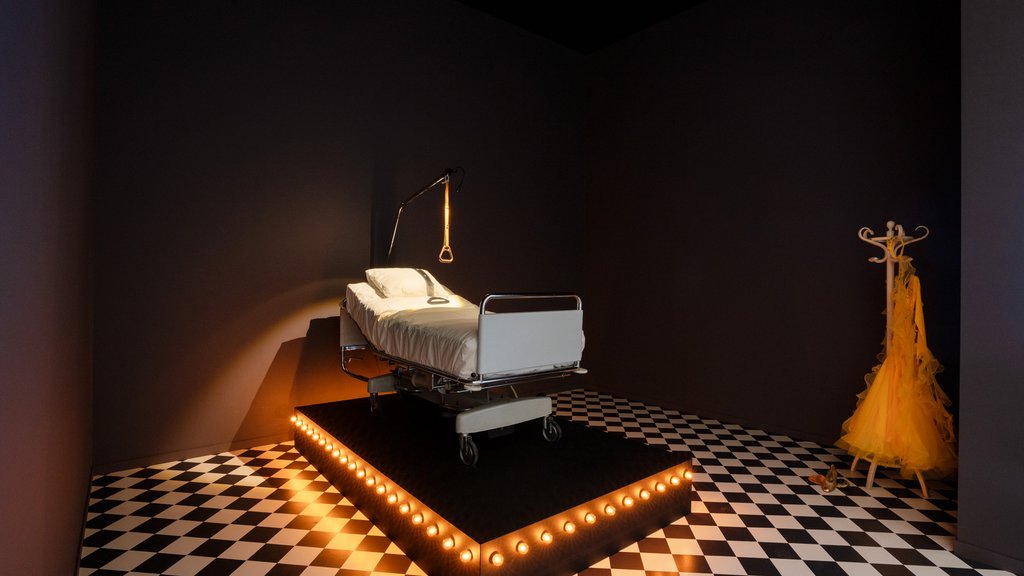
Manon, Laughing Gas, 2019, installation, Kunsthaus Zürich
photographer: Franca Candrian, 2022.

British Academy/Wellcome Trust Conferences bring together scholars and specialists from around the world to explore themes related to health and wellbeing.

'Connecting knowledge across the disciplines, this conference will put practicing doctors in direct dialogue with researchers in the humanities – especially scholars of literature, cinema and cultural history. Together, they will seek to understand the social, diagnostic, therapeutic and physiological implications of laughter, inside and outside the clinic. Laughter is not always the 'best medicine', nor is it linked only to comedy and enjoyment. 'Healing laughter' differs markedly from pathological laughter, hysterical laughter, forced or bitter laughter, laughter aimed at mitigating awkwardness in unsuccessful communication, laughter intended to deceive, or laughter signifying fear, discomfort or aggression. Irony and other double-coded signifiers that abound in comic and parodic representations of medical practitioners and their patients often reveal medicine’s paradoxical place in various cultural imaginaries and in individual and collective experience.

This conference will study the diverse forms of laughter occurring around medicine in particular eras and cultural environments alongside comparative analysis of patterns and problematics over the long history of Western medicine and its representations.'

         https://www.thebritishacademy.ac.uk/events/british-academy-conferences/laughter-and-medicine/

individual
|
INTERPERSONAL : SCIENCES
humanistic ------------------------------- mechanistic
SOCIOLOGY : POLITICAL
|
group

I don't find this funny!


 I laughed so much it hurt! 


"All the world's a stage"

Politics is a running joke - that's never funny.

The human epic of triumph and tragedy.

Previously (with overlap):

arts :: drama :: poetry :: literature :: narrative

Wednesday, August 07, 2019

One Hundred and Eleven [vertebrae]

individual - self
|
INTERPERSONAL : SCIENCES
humanistic ----------------------------------------------- mechanistic
SOCIOLOGY : POLITICAL
|
group- population


111 + Self-Care = Sustainable Health Care System ?

Wednesday, August 15, 2018

The NHS at 70 or on the Fringe(s)?

individual
|
INTERPERSONAL : SCIENCES
humanistic ----------------------------------------------- mechanistic
SOCIOLOGY : POLITICAL
|
group
A Fortunate Man
fringe


fringe
fringe


fringe
After the Cuts


See also: Edinburgh Fringe: A round-up of the NHS themed shows reflecting the chaos of ordinary people's lives

My source: Foyles, London, The Fringe, Free

Sunday, November 08, 2015

The Divided Laing by Patrick Marmion

individual
|
INTERPERSONAL : SCIENCES
humanistic --------------------------------------- mechanistic
SOCIOLOGY : POLITICAL
|
group
Divided Laing: Arcola Theatre


Image: Arcola Theatre
My source: The Sunday Times, Culture, 01.11.15

Monday, November 24, 2014

Big Hero 6 - clip (Healthcare is never 'Frozen')

individual
INTERPERSONAL : SCIENCES
humanistic ------------------------------------------- mechanistic
SOCIOLOGY : POLITICAL
group


My source:
Educate the Young - Disney and Pixar Understand Patient-Centered Care
