Hodges' Model: Welcome to the QUAD: diagram

Hodges' model is a conceptual framework to support reflection and critical thinking. Situated, the model can help integrate all disciplines (academic and professional). Amid news items, are posts that illustrate the scope and application of the model. A bibliography and A4 template are provided in the sidebar. Welcome to the QUAD ...

Showing posts with label diagram. Show all posts

Saturday, November 29, 2025

If "mechanism-based approach to theorizing offers an encompassing way ...

... to think about social and ecological phenomena":

What if there was a model that could encompass 
mechanism-based and humanistic-based theorising?

'A core challenge of studying ecosystems and societies as one system is integrating social and ecological theorizing. Although the social and the ecological intertwine in multiple ways, much traditional theory focuses on one or the other (Schlüter et al. 2022). Despite good intentions, attempts for integration are often only partially successful. One reason for this is the apparent incommensurability of methodological and theoretical approaches. However, the mechanism-based approach to theorizing offers an encompassing way to think about social and ecological phenomena by framing them in terms of entities and their interactions. Mechanism-based theorizing has been gaining popularity in science philosophy (Machamer et al. 2000, Craver 2007, Glennan and Illari 2017), including social sciences philosophy (Elster 1989, Hedström and Swedberg 1998, Hedström and Ylikoski 2010) and philosophy of ecology (Pâslaru 2017, González del Solar et al. 2019). It has helped to resolve many traditional problems related to scientific explanation and it is consistent with the way in which social and natural scientists talk about theorizing, causation, and explanation.'


Fig. 1. The social-ecological expansion of Coleman’s diagram.


Martínez-Peña, R., & Ylikoski, P. (2024). Coupling social and ecological mechanisms with the Coleman boat. Ecology and Society, 29(4). https://doi.org/10.5751/ES-15209-290406

See also: 'micro' : 'macro' : 'Bunge'

Monday, October 06, 2025

On the 'front' - or behind the line(s)?

In many sources on socio-economics, politics, health policy ... I still note the challenge to represent the INDIVIDUAL and COLLECTIVE within a figure. Of course the author's subject, purpose, the context all influence the final depiction and the message to be conveyed. 

I wonder if Hodges' model can provide a starting point to explore relationships, oppositions, arguments and synergies?

Hodges' model provides an 
expansive and potentially powerful 'front' 
through its horizontal axis 
[ HUMANISTIC ↔ MECHANISTIC ].

This axis - drawn across and through the model vertically, may make it easier(?) to analyse and synthesize the relations at work and produce a diagram?

Individual
|
      INTERPERSONAL    :     SCIENCES               
HUMANISTIC =========================  MECHANISTIC      
 SOCIOLOGY  :    POLITICAL 
|
Group
INDIVIDUAL

INDIVIDUAL

GROUP - POPULATION

GROUP - POPULATION


Friday, July 04, 2025

Diagrams - AMO/OMA at Prada Foundation Venice

"There is no such thing as an innocent map, observes Philippe Rekacewicz in his catalogue essay that accompanies Diagrams, a new exhibition at the Prada Foundation in Venice.

A renowned cartographer, the Paris-born Rekacewicz is well aware of his medium's capacity to transform narratives for good and ill. His own work includes maps that illustrate the deaths of migrants as they bid for new lives in Europe. "A map," Rekacewicz continues, "is above all a social and political act - and therefore inherently subjective."' p.5.

Individual
|
      INTERPERSONAL    :     SCIENCES               
HUMANISTIC  --------------------------------------  MECHANISTIC      
 SOCIOLOGY  :    POLITICAL 
|
Group
Am I Free?

My history ...
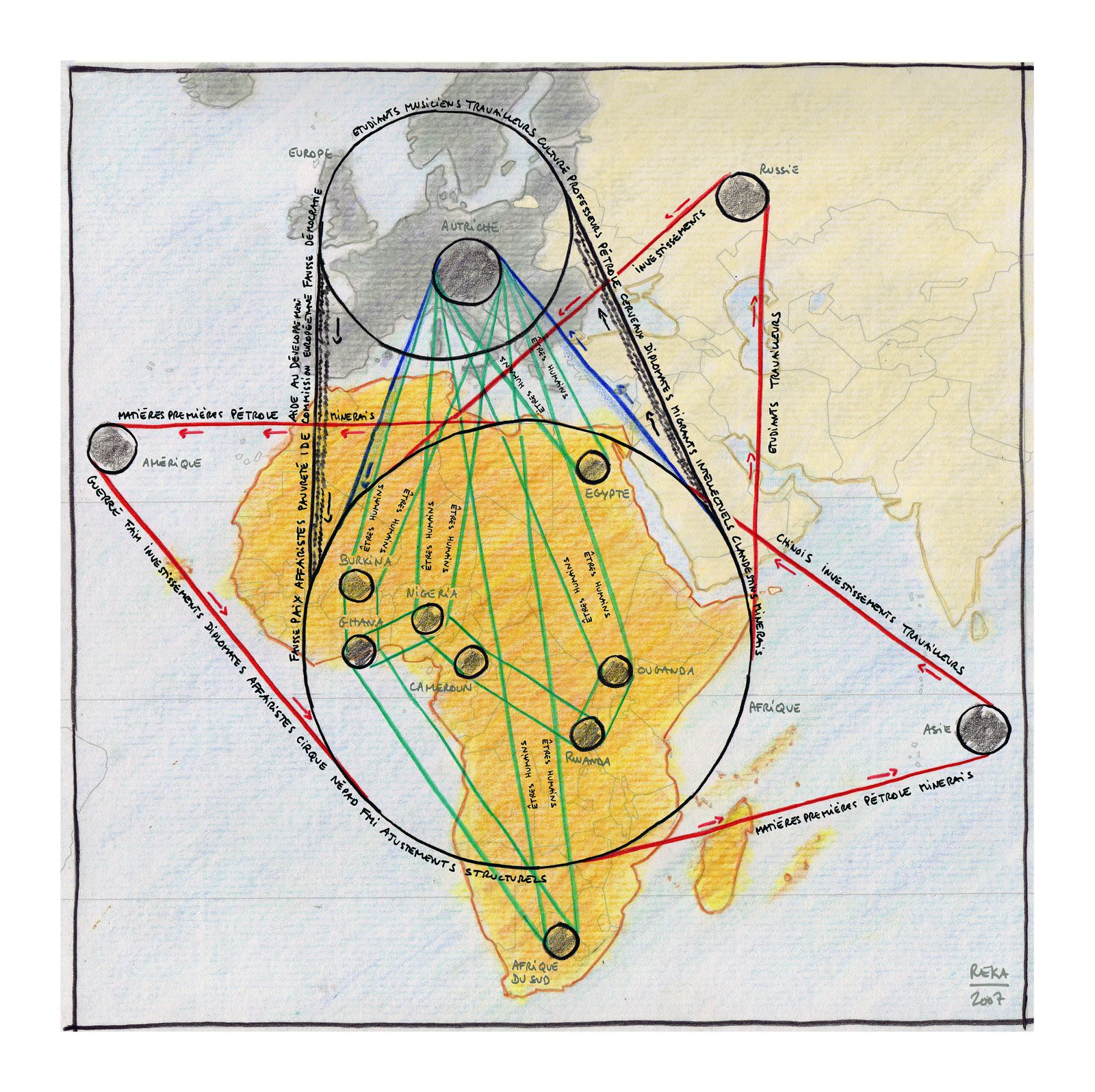
Philippe Rekacewicz / The African big wheel, 2007
The wheel symbolizes permanence and continuity in the context of a profoundly unequal exchange, drawing, color pencil and ink, exhibition copy.
Courtesy Philippe Rekacewicz
(Image credit: Philippe Rekacewicz)

SOCIETY

... is our history ...

Freedom

National & International Law

Justice


'Other pictures are equally revealing for what they conceal. Consider the diagram entitled "Universal commercial history", a visual analysis drawn up by the Scottish engineer William Playfair in 1805 which traces the rise and fall of global wealth since 1500 BC against what he terms "Remarkable Events Relative to Commerce". Playfair, who is said to have invented the pie chart, includes moments such as "Rome founded" "Mahomet's Flight" and "America discovered". He never mentions slavery.

With such a broad-brush approach, lacunae are inevitable. It is a shame that the work of Viennese social scientist Otto Neurath - who, along with his wife Marie and colleague Gerd Arntz, invented the Isotype (International System of Typographic Picture Education) - is not on show. Based on pictograms, Neurath's Isotypes are an lmportant forerunner to the digital vernacular (from emojis to icons) so familiar to us today. Nor does the exhibition include maps of the devastation of Gaza since October 2023, such as those made by investigative research agency Forensic Architecture, which are proving among the most critical diagrams of our time.' p.5.

Philippe Rekacewicz - https://www.grida.no/resources/10988

My source:
Rachel Spence. Hidden truths in the best laid plans. Diagrams | What charts, maps and graphics can - and can't - tell us. Collecting, FTWeekend. 26-27 April 2025. p.5. 
With many thanks acknowledging length of quotation.

Image source:
https://www.wallpaper.com/architecture/oma-amo-diagrams-prada-foundation-venice

See also: 'icon' : 'symbols' : 'diagram' : 'map' : 'Forensic Architecture'

Archived listing Links II Sciences - inc. 'Diagrams' & 'Visualization I' and 'II': 

Monday, November 25, 2024

The naïve approach

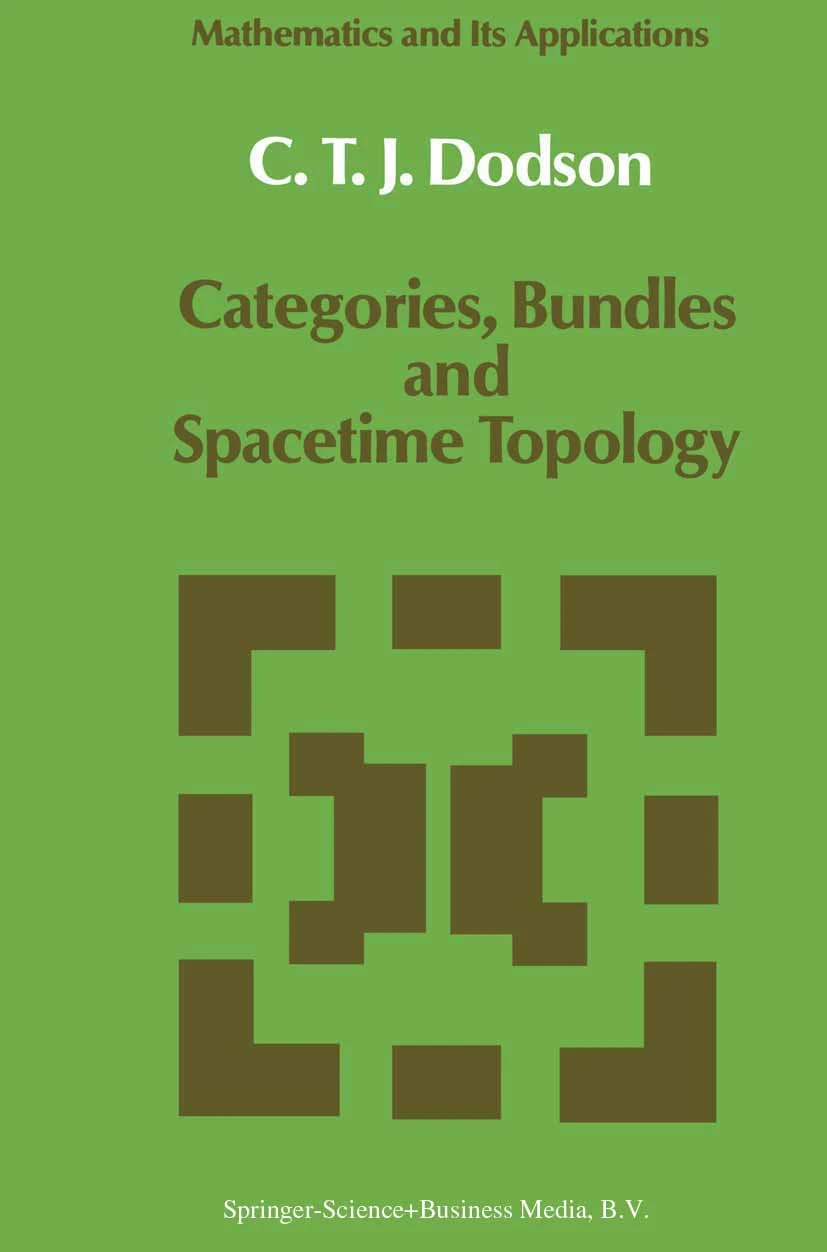
Categories, Bundles and
Spacetime Topology 
 

'First steps' are by their nature plagued by uncertainty of intent and direction, ungainliness, missteps, stumbles and ('finally') possibly falls.

Finding a starting point can be difficult.

Where to find a hand-hold, place one's foot, or other anchor?

At Lancaster University library I came across this book, first published in 1980. The cover displayed is from the 1988 edition.

In order of appeal I read:

applications, categories, spacetime and topology.

Section I starts with Preliminaries: Notation and Abbreviations; always useful (reminder).

The next, Section II Naïve Category Theory, had my immediate attention. We often speak of learners as being naïve. As lifelong learners we all meet this descriptor. I keep revisiting this word, concept - 'naïve'.

Naivety is a starting point for practitioners in health and social care too. Hence the need for supervision, mentors, the tokens of probationary (driver) and 'newly qualified'. 

Many posts on W2tQ stress the diagrammatic quality of Hodges' model. It is visibly a 2x2 matrix, (once again..) beloved of management consultants, psychologists and change agents. In Section II Dodson recognizes the London Underground map as a graph. A small example is developed, explained and illustrated on p.6. 

Graph example, drawing on the London Underground. p.6.

Section II may be a small part of the overall book but it is invaluable to me. As the photo above suggests, the book is old, especially as 1st edition. I will try to access the 2nd edition. If this work is a project with which you can (more ably!) assist, I would greatly appreciate your input. The aim is to signpost Hodges' model as a potential focus for all researchers. Especially researchers interested in trying to conjoin the sciences and humanities and develop visualization in the latter. 

C.T.J. Dodson. Categories, Bundles and Spacetime Topology. 1st Edition, Shiva, Kent. 1980.

Previously: 'math'

'Diagram' resources listed on former, now archived website.

Sunday, October 30, 2022

An observational record and learning from 30,000 years ago

"A fascinating example is the shoulder blade of an ox unearthed in the 1980s (Figure 1) by archaeologists investigating a stone age encampment in the south of France. Carbon dating showed this to be approximately 30,000 years old. The bone was marked with inscriptions that the archaeologist couldn't decipher. It was clear they were neither a tally, nor a pattern, nor any recognisable form of writing. Late one night one of the archaeologists noticed the moon, and something in its shape caught his curiosity.

Aurignacian Lunar Calendar / diagram, drawing after Marshack, A. 1970; Notation dans les Gravures du Paléolithique Supérieur, Bordeaux, Delmas / Don’s Maps
Figure 1 my source: https://sservi.nasa.gov/articles/oldest-lunar-calendars/

Then it struck him. Here, on this fragment of bone, was a lunar calendar complete with 72 observations ... something like 1,600 generations ago. One of our common ancestors (statistically, all of us can claim a relationship to this thoughtful person) 30,000 years ago had the intellectual curiosity to watch the moon, night after night, and then transcribe these movements, at scale, onto the stone age equivalent of the back of an envelope, as he (or she) attempted to "think it through". What makes us human is our ability to think, learn and adapt to our changing environment. The story of the stone age learner gets even better when you imagine a small community of people (adults, adolescents, children on their laps) sitting around a campfire every night working out the meaning of the lunar phases together." pp.72-73.

Abbott, J. & Ryan, T. (2000). Chapter 4, How mass education eclipsed apprenticeship, The Unfinished Revolution: Learning, Human Behavior, Community, and Political Paradox, Stafford, UK: Network Educational Press. (The figure in the book does not include the bone.)

Previously: 'diagrams' , 'archaeology'

[I am also still trying to clear papers and books, as some posts will suggest.]

Saturday, May 14, 2022

New book: "Talking with a Map"

- A Cognitive Analytic Approach
to Everyday Conversational Awareness

 INDIVIDUAL
|

   INTERPERSONAL    :     SCIENCES               
HUMANISTIC --------------------------------------  MECHANISTIC      
SOCIOLOGY  :   POLITICAL 
|
GROUP

MENTAL MAPS

PSYCHO-THERAPIES


MAPS

PHYSICAL-THERAPIES


META-COGNITION


Fingers-crossed please! 

I've contacted Pavilion Publishing and Media Ltd with a review copy request of this new book - available for pre-order:

"Talking with a Map takes cutting-edge techniques for structuring and navigating conversations out of the therapy room and into everyday life, describing a versatile method that anyone can use to develop better skills, interactions and relationships."

Working with two co-authors three papers will hopefully (yes - cross them again) be complete soon. Then I can resurrect the piece on case formulation, diagrams and Hodges' model. 

If anyone is interested please get in touch:

peter.jones AT h2cm.info

Previously on W2tQ:

map :: therapy

Wednesday, December 06, 2006

What are you - mathematician, book-reader or book-reading clock-watcher?

Sometimes you don't realise you are on a long-term cherry-picking escapade. I say escapade because this captures the rather haphazard, accidental and part-time nature of my fruit gathering.

In 1992 in the Engineering Computing Newsletter [SERC] Science and Engineering Research Council's EASE programme #38 p.4-5 Michael McCabe asked readers How would you label the quadrants of this diagram? - "How would you label the quadrants of this diagram?"


I cannot find the brief article "Human Factors Aspects of User Interfaces Design" on the web, but I kept the original. It obviously meant something to me, McCabe shows why...

As a mathematician you might choose - from top left clockwise 2,1,4,3

A clock-watcher - from top left 4,1,2,3


from top left 1,2,4,3 - for a book-reader.

And a book-reading clockwatcher - from top left 1,2,3,4

So, how would you label Hodges' model and does this say anything about how you would populate and read the model?