Hodges' Model: Welcome to the QUAD: applied

Hodges' model is a conceptual framework to support reflection and critical thinking. Situated, the model can help integrate all disciplines (academic and professional). Amid news items, are posts that illustrate the scope and application of the model. A bibliography and A4 template are provided in the sidebar. Welcome to the QUAD ...

Showing posts with label applied. Show all posts

Monday, July 20, 2026

CfA Fully Funded Research Sabbaticals - via BCS-SGAI

Time, focus and community for your research on the societal impact of digital transformation


A fellowship at the Center for Advanced Internet Studies (CAIS) provides the freedom to dedicate yourself to your research and the opportunity to join a vibrant interdisciplinary community. Step away from daily work routines to gain new perspectives and build lasting connections.


As a fellow, you can spend either six or three months in Bochum, Germany. During this time, we will cover your sabbatical leave from work through financial compensation (e.g. for a teaching substitute) or provide grants of up to 2.000 € per month. In addition, we will provide a fully furnished apartment free of charge. You can invite guests for collaboration and receive financial support for research expenses. Private offices and meeting rooms with modern facilities offer optimal working conditions.


The funding program is open to excellent scholars and practitioners, to all career stages, disciplines and areas of investigation, as well as to pure research and to projects that are more applied in orientation.


You can apply for our regular open call, or for our special call “Futures of Work”.


The next deadline for applications is 31 August 2026. The earliest possible starting date for new fellowships is October 2027. Please use the application form on our website.


Find out more: https://cais-research.de/en/cais-college/fellowships/


Further questions? Please contact esther.laufer AT cais-research.de


My source: https://www.jiscmail.ac.uk/cgi-bin/wa-jisc.exe?A0=AI-SGES

Friday, March 07, 2025

'Critical Notes on the Nature of Sociology as a Science'

4Ps

As a model of care (education, management, safety, systems, ...)*, or a conceptual model, conceptual framework, or however described, Hodges' model, as with its many peers is idealised.

You quickly 'see' that the 4Ps I've associated with the knowledge - care domains of Hodges' model are far specific, or limited to that domain alone.

In our dialogues, media and literature it becomes obvious that in addition to physical, sequential, and  natural (scientific) processes, there are also political,  sociological, and psychological, or mental  (interpersonal) processes.


I've always been drawn to the diagonal distances between the interpersonal-political domains; and that between the sociological-scientific. The latter I think about often as it makes the news regularly, when education is raised, literacy, the state of our schools, colleges, universities and (globally) the public's understanding of the sciences. So finding a paper heading for its centennial birthday caught my attention. Not just that, but the journal - Social Forces is (very much!) still with us aged 103 this year. Unsurprisingly, I like the way Woodard contrasts the mechanistic and humanistic:


Hodges' model
'For there is a further distinction to be made among evaluations of functional appropriateness. I may analyze the functional appropriateness of the gears and pulleys of a machine. That is applied mechanics, not the pure science of mechanics. For the function of the machine is tacked on to it arbitrarily and does not emerge from the data of the science of mechanics. But the same may not be said of hearts and lungs, of mental and emotional processes, or of social structures, functions, and processes. Here the functions are not extraneously tacked onto an arbitrarily assembled collation. They are inescapable emergents from the process of scientific analysis and are warp and woof of our data as it confronts us, in situ, in the natural universe. They are not in any sense superimposed.' p.32.

Interesting point regarding 'hearts and lungs' - to possibly return to? Also, as a template Hodges' model provides a 'warp and woof' for data gathering - a foundation.

Woodard, J. W. (1932). Critical Notes on the Nature of Sociology as a Science. Social Forces, 11(1), 28–43. https://doi.org/10.2307/2569615 

*Please give it a try whatever your field, and let me know your thoughts. ... h2cmng AT yahoo.co.uk

Tuesday, November 26, 2024

The naïve approach ii - Seeking / Avoiding a Catastrophe

In addition to Dodson's book I borrowed:

Zeeman, E.C. (1977) Catastrophe Theory-Selected Papers 1972–1977, Reading, MA: Addison-Wesley.

From the mid-1970s I remember catastrophe theory rather bursting on to the science scene. Articles in New Scientist (in a box somewhere?), Scientific American plus a BBC TV episode of Horizon (seeking details - originally aired July 28, 1975, 60 minutes 'Happy Catastrophe')*, that highlighted potential for new insights into the behaviour inside prisons. and other applications in the social sciences.

The CONTENTS reads:
GENERAL INTRODUCTORY PAPERS 

1. Catastrophe theory : Draft for a Scientific American article 1
2. Levels of structure in catastrophe theory 65

 BIOLOGICAL SCIENCES 80

3. Differential equations for the heartbeat and nerve impulse 81 
4. Primary and secondary waves in developmental biology 141 
5. A clock and wavefront model for the control of repeated structures during animal morphogenesis (with J.Cooke) 235
6. Gastrulation and formation of somites in amphibia and birds (Addendum by R. Bellairs.) 257 
7. Dialogue between a Biologist and a Mathematician 267 
8. Brain modelling 287 
9. Duffing's equation in brain modelling 293

 SOCIAL SCIENCES 302

10. Some models in the social sciences (with C.A.Isnard) 303 
11. On the unstable behaviour of stock exchanges 361 
12. Conflicting judgements caused by stress 373 
13. A model for institutional disturbances (with C.S.Hall, P.J.Harrison, G.H.Marriage, P.H.Shapland) 387
14. Prison disturbances 403 

PHYSICAL SCIENCES 408 

15. A catastrophe machine 409
16. Euler buckling 417 
17. Stability of ships 441

MATHEMATICS 496

18. The classification of elementary catastrophes of codimension <= 5 (with D.J.A.Trotman) 497
19. The umbilic bracelet and the double-cusp catastrophe 563 

DISCUSSION 604

20. Research ancient and modern 605 
21. Catastrophe theory : its present state and future perspectives (with R.Thom) 615
22. Afterthought 651 
As an area of contention the subject of catastrophe theory (CT) possibly presents(?) a dual-cusp of contention. Firstly, CT brought with it controversy within academia and mathematics. The book was reviewed by T. W. Barrett, Department of Physiology and Biophysics, University of Tennessee Center for the Health Sciences, Memphis, TN 38163: 
'Catastrophe theory (CT), as a new field in mathematics with many possible ramifications for both the physical and biological sciences, has recently been the subject of much controversy (see [1]-[5]). This controversy, in this reviewer's opinion, has served a valuable purpose insofar as it has stimulated the theory's proponents to refine and delineate their concepts more clearly. Catastrophe theory was developed by the Field prize winner, Rene Thom; but much work has been accomplished by E. C. Zeeman and his group, especially with respect to applications.' pp.609-610. IEEE TRANSACTIONS ON SYSTEMS, MAN, AND CYBERNETICS, VOL. SMC-9, NO. 9, SEPTEMBER 1979. https://ieeexplore.ieee.org/stamp/stamp.jsp?arnumber=4310286 
Stephen Smale also reviewed Zeeman's book; BULLETIN OF THE AMERICAN MATHEMATICAL SOCIETY Volume 84, Number 6, November 1978. 1360-1368. 
https://www.ams.org/journals/bull/1978-84-06/S0002-9904-1978-14580-7/S0002-9904-1978-14580-7.pdf
'To write a review in this environment has a very personal side for me. On one hand my own work on dynamical systems is closely connected to the origins of CT. I have had a long and close personal and professional relationship with both Thorn and Zeeman. More than 20 years ago I was discussing singularities of maps, transversality, and immersions with René Thom. Thom tried to interest me in an early draft of chapters of his book Structural stability and morphogenesis in 1966.

On the other hand I have remained skeptical and aloof from CT, perhaps due to my conservatism in science. While my colleagues and students were showing enthusiasm for CT, I gave critical lectures, one at the University of Chicago in 1974, one at the Aspen Institute of Physics in 1975. More recently I have been quoted negatively in the "Science" and New York Times references above. This is the first time I have written on the subject, and I should warn the reader of this negative bias, far from shared by many of my fellow mathematicians.' p.1360.

Some defenders of CT may accuse me of discussing very special examples not characteristic of the literature of the subject. I feel that the problem of lack of justification discussed above, is also found in Zeeman's other models. Furthermore Thorn's models are even less specific and less developed. On the other hand, Thorn's work in CT covers many subjects; in this connection Zeeman writes in his Scientific American article, April 1976, p. 65: "The method has the potential for describing the evolution of form in all aspects of nature, and hence it embodies a theory of great generality."' p.1366.
The book's introductory papers are somewhat confusing in content, as drawn to 'SOCIAL SCIENCES' it is the introductory section (and Part Two) that includes  'Anorexia nervosa', Example 9 pp.33-52. 

This is the second 'cusp' as the assessment, diagnosis, intervention, outcomes, skilled staff, access to specialised mental health services remains contentious to this day. As a charge nurse on a female acute admission mental health ward in the early 1980s, eating disorders have always presented a 'clinical' challenge. Often within a staff group and for individual staff members too.

Twitter/X is hardly an objective record but it appears today, that people and families affected by eating disorder continue to advocate for appropriate service provision, treatment and recognition. Recognition that can also develop evidence-based interventions. As discussed by Dr. Agnes Ayton, consultant psychiatrist and others in the video below:


A related paper:

Ibrahim, A., Ryan, S., Viljoen, D. et al. Integrated enhanced cognitive behavioural (I-CBTE) therapy significantly improves effectiveness of inpatient treatment of anorexia nervosa in real life settings. J Eat Disord 10, 98 (2022). https://doi.org/10.1186/s40337-022-00620-y [ My source: @AgnesAyton ]

The Zeeman chapter on anorexia nervosa is interesting graphically and conceptually ...

Page 42. Figure 20. The effect of the butterfly factor, d>0.
(Sorry for the image quality)

- but is of course 'from another time' and is clearly not person-centred. Eating disorders affect many people in the UK and are a cause of trauma, distress, disrupted life-chances and mortality. Referring to Hodges' model, such graphics, reinforce the idea that 'solutions' are to be found in the mechanistic and quantitative domains of the sciences and politics (choice, power, services, safety..). Here, maths and theories (seemingly) provide an explanation for people who are ill, and need treatment. As a teenager for most of the 1970s, Hodges' model was not yet a reality. As I have found since 1987-8 looking at the POLITICAL care/knowledge domain, the model's relevance has increased since the start of my nursing career in 1977. Consider for example, the politics of:
  • the global phenomena of famine
  • - whether or not associated with economic crisis, drought, other natural disaster, or conflict, political crisis
  • ultra-processed foods
  • obesity pandemic
  • weight loss drugs
  • appetite stimulants
  • appetite suppressants
  • eating disorder (anorexia and bulimia) across care sectors - primary, secondary, specialist
    • community / in-patient care
    • person-centred care
    • user involvement in service design
  • the availability of treatment modalities - psychotherapy (as in the video)
  • the impact on family relationships and peer group (estranged - loss of friends)
  • diagnostic blurring - psychosis, borderline personality disorder - the rise of 'anti-psychiatry'
Here then is the purpose of this post, what potential is there to look at nutrition from a situated individual and collective (global) perspective? This could be focussed on nutrition, or eating disorder; or alternately take a collective stance to encompass the global food supply and the industry. Discovering the diffeomorphism, I wonder if there are others, and their respective properties and character? 

INDIVIDUAL
|
INTERPERSONAL : SCIENCES              
humanistic ------------------------------- mechanistic
SOCIOLOGY : POLITICAL   
|
GROUP
COGNITIVE THERAPY
EMPATHY&RAPPORT
LISTENING - MUTUAL ENGAGEMENT
MENTAL HEALTH
DIAGNOSIS
TRAINED / SKILLED STAFF
EVIDENCE-BASED INTERVENTIONS*
MOTIVATION
MOOD
MULTIMORBIDITY

RESEARCH
EATING
DIET
NUTRITION
NUTRITIONAL VALUE
WEIGHT
BMI
IN-PATIENT UNIT
place of safety


PUBLIC HEALTH
SOCIETY
FAMILY
CARERS


Developed nations
are collectively and increasingly
'eating disordered'
and exporting this 'lifestyle'.


Before I return the book, I will revisit the discussion section.

See also:
Jones P, Wirnitzer K. Hodges’ model: the Sustainable Development Goals and public health – universal health coverage demands a universal framework. BMJ Nutrition, Prevention & Health 2022;5:doi: 10.1136/bmjnph-2021-000254

*I could not find on BBC website. I have contacted the Open University. I did find - 'In this Horizon episode, Rene Thom's mathematical discovery of the catastrophe theory is investigated.' at  https://thetvdb.com/series/horizon/episodes/1385431

Monday, November 25, 2024

The naïve approach

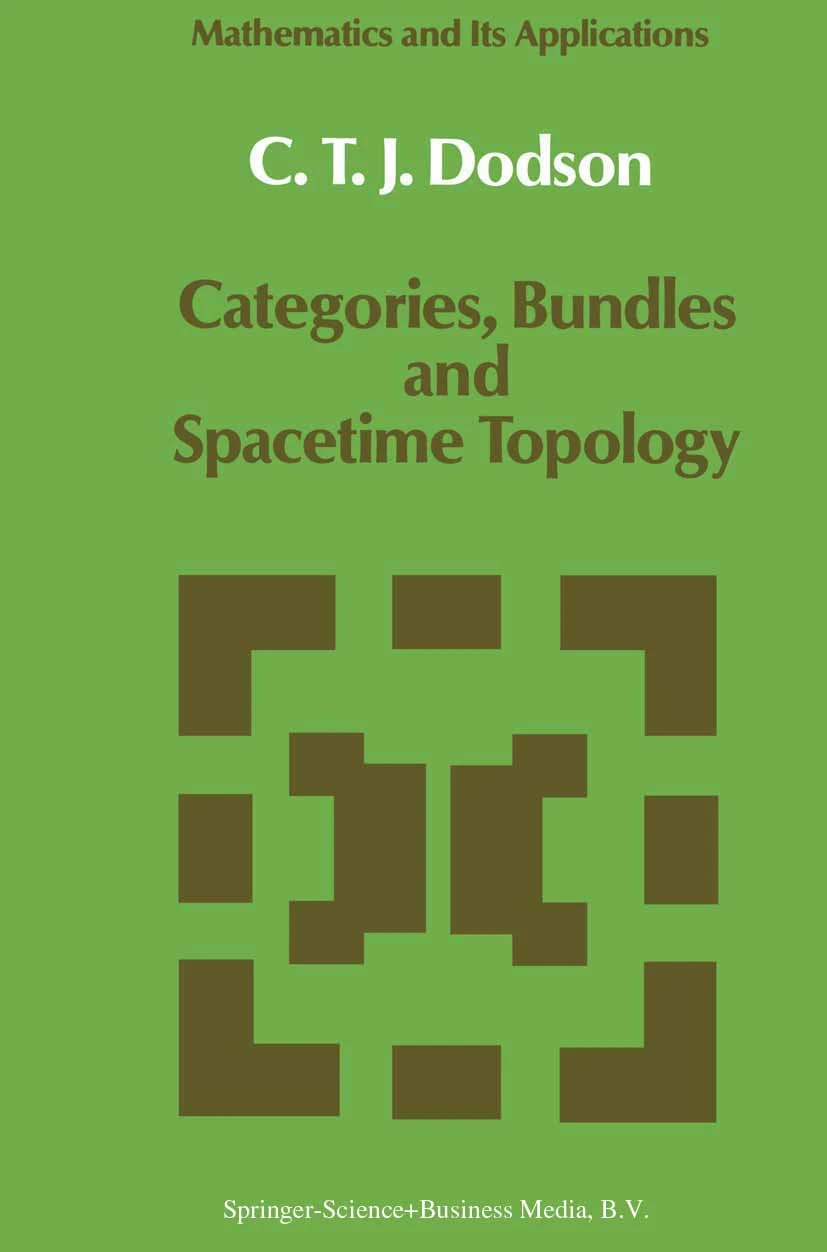
Categories, Bundles and
Spacetime Topology 
 

'First steps' are by their nature plagued by uncertainty of intent and direction, ungainliness, missteps, stumbles and ('finally') possibly falls.

Finding a starting point can be difficult.

Where to find a hand-hold, place one's foot, or other anchor?

At Lancaster University library I came across this book, first published in 1980. The cover displayed is from the 1988 edition.

In order of appeal I read:

applications, categories, spacetime and topology.

Section I starts with Preliminaries: Notation and Abbreviations; always useful (reminder).

The next, Section II Naïve Category Theory, had my immediate attention. We often speak of learners as being naïve. As lifelong learners we all meet this descriptor. I keep revisiting this word, concept - 'naïve'.

Naivety is a starting point for practitioners in health and social care too. Hence the need for supervision, mentors, the tokens of probationary (driver) and 'newly qualified'. 

Many posts on W2tQ stress the diagrammatic quality of Hodges' model. It is visibly a 2x2 matrix, (once again..) beloved of management consultants, psychologists and change agents. In Section II Dodson recognizes the London Underground map as a graph. A small example is developed, explained and illustrated on p.6. 

Graph example, drawing on the London Underground. p.6.

Section II may be a small part of the overall book but it is invaluable to me. As the photo above suggests, the book is old, especially as 1st edition. I will try to access the 2nd edition. If this work is a project with which you can (more ably!) assist, I would greatly appreciate your input. The aim is to signpost Hodges' model as a potential focus for all researchers. Especially researchers interested in trying to conjoin the sciences and humanities and develop visualization in the latter. 

C.T.J. Dodson. Categories, Bundles and Spacetime Topology. 1st Edition, Shiva, Kent. 1980.

Previously: 'math'

'Diagram' resources listed on former, now archived website.

Saturday, September 14, 2024

Hardy (1940) A Mathematician's Apology


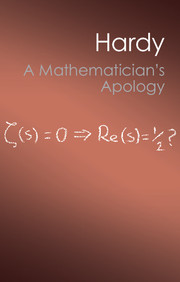
In Liverpool I came across G.H. Hardy's short book A Mathematician's Apology. At £2.00 - a pristine bargain and a  marvellous read, especially the latter sections.

From being taught and applying Hodges' model in a case study in 1987 through to online work since 1998; I have to ask myself. Do I need to write:

'A Nurse's Apology'?

Aware of Hardy in the history of mathematics, and having read his apology, I'm no Hardy. My antics are a lesson in addition, but this is more 'Laurel and Hardy' - with apologies to comic genius of course. 


By their nature professions seek to maintain, and assure their continuity. A professional body can point to a definable body of theory, practice (curricula), that carries social and political status, if not patronage. There is national agreement that the NHS needs reform; radical reform no-less. The new Labour government is drawing lines to negotiate with the BMA, other professional bodies and unions. Specificity, specialisation is key. In healthcare people have suggested to me that Hodges' model invites genericism. Any suggestion of genericism is to be shunned. There seems an almost allergic reaction such is the threat to professional identity; unless, of course, you are a 'General Nurse', or General Practitioner - GP family doctor). Even Hardy warns:
"'GENERALITY' is an ambiguous and rather dangerous word, and we must be careful not to allow it to dominate our discussion too much." p.105.

This also applies to the quality and solidity of professional agencies and bodies whose role is to provide governance and set standards. The NMC has stumbled? Life and death is made up of details AND big pictures. How do you provide for - balance both? Curricula are another concern. Is the future of mental health nursing guaranteed as a profession? 

https://hodges-model.blogspot.com/2016/08/future-of-mental-health-nurse-training.html

The instrumental potential of Hodges' model is obvious. It invites a checkbox approach. One-to-one clinical encounters and interactions reduced to a tick-box exercise. This reduces any sense of specialist knowledge, training and education needed to assess, plan, deliver and evaluate high quality, effective, sustainable healthcare.

'THE second quality which I demanded in a significant idea was depth, and this is still more difficult to define. It has something to do with difficulty; the deeper? ideas are usually the harder to grasp: but it is not at all the same.' p.109.

Hardy's thoughts (and no doubt similarly expressed by other mathematicians and logicians) can be 'found' in Hodges' model; with an addition. Depth and difficulty rests on the uniqueness of  the 'one'. 

Here, Hardy is comparing between 'real mathematics' and chess:

'A chess problem also has unexpectedness, and a certain economy ; it is essential that the moves should be surprising, and that every piece on the board should play its part. But the aesthetic effect is cumulative. It is essential also (unless the problem is too simple to be really amusing) that the key-move should be followed by a good many variations, each requiring its own individual answer. 'If P-B5 then Kt-R6; if .... then if .... then ...., ....' - the effect would be spoilt if there were not a good many different replies. All this is quite genuine mathematics, and has its merits; but it is just that 'proof by enumeration of cases'  (and of cases which do not, at bottom, differ at all profoundly*) which a real mathematician tends to despise.' p.114.

*I believe it is now regarded as a merit in a problem that there should be many variations of the same type. (footnote)

While Kings, and Queens et al. undoubtedly have their own unique personalities, in healthcare effective clinicians make a concerted effort not to merely enumerate cases. The professional emphasis is (idealistically, professionally, purely and in application to) person-centredness; with the compassion, complexity, cussedness, and (sometimes literal) complications this brings. From 1-1 interaction, the clinical encounter, the therapeutic relationship, and alliance are the reason for practitioners achieving and sustaining intra- and interpersonal communication skills. Our attitudes towards knowledge, what is thoughts affects what we feel individually and collectively. Science should be neutral. It might be concluded that this question is for the philosophers and ethicists to wrestle with. In healthcare ethics are central: 'Do no harm'. Whether the practitioner, theorist, manager, policy maker is a nurse, scientist or mathematician such questions impact upon the person. As they are social, cultural and political. Revisiting Bronowski's Ascent of Man, this question arose in Archive on 4.

'It seems that mathematical ideas are arranged somehow in strata, the ideas in each stratum being linked by a complex of relations both among themselves and with those above and below. The lower the stratum, the deeper (and in general the more difficult) the idea.' p.110.

(my emphasis)

individual
|
INTERPERSONAL : SCIENCES
humanistic ------------------------------- mechanistic
SOCIOLOGY : POLITICAL
|
group

logical & mathematical reasoning
depth of reasoning (memory)
mathematical aptitude
intelligence(s)
pure maths
identity

vector
relations
mathematics
logic
depth of analysis, complexity
Cricket!
pure - applied maths
"1" problem per visit

patient - health practitioner 
relationship
Watching cricket - conversation

reports - outcomes
enumeration of cases


Back-tracking to page 104, Hardy:

'The relations revealed by the proof should be such as connect many different mathematical ideas.'

Our proof is person-centredness, placing the person at the center (in this case - of Hodges' model). The proof can be quantitative and qualitive. There are a great many ideas at work. Critically, the ideas that might be called upon (even improvised) are not all health-related, but can extend beyond to encompass the four care (knowledge) domains of Hodges' model. In healthcare as in Hardy's life the spiritual is encountered. So, the determinants of health are ALL available to us - as required. Well not available as a resource might be, they are available in the hope they will be seen as factors. Hardy would approve I think of the direction of travel, not just as a vector, but a model of multidimensional vectors - reaching for relations.

Hardy, G.H. (1940) A Mathematician's Apology, Cambridge: Canto.
https://www.cambridge.org/core/books/mathematicians-apology/B90D81A8E28674119781863988A3E11B

Friday, May 10, 2024

Towards isomorphisms in Hodges' model

"The concept that best captures the process of homogenization is isomorphism. In Hawley's (1968) description, isomorphism is a constraining process that forces one unit in a population to resemble other units that face the same set of environmental conditions. At the population level, such an approach suggests that organizational characteristics are modified in the direction of increasing comparability with environmental characteristics; the number of organizations in a population is a function of environmental carrying capacity; and the diversity of organizational forms is isomorphic to environmental diversity." p.149.

"We identify three mechanisms through which institutional isomorphic change occurs, each with its own antecedents: 1) coercive isomorphism that stems from political influence and the problem of legitimacy; 2) mimetic isomorphism resulting from standard responses to uncertainty; and 3) normative isomorphism, associated with professionalization. This typology is an analytic one: the types are not always empirically distinct." p.150.

DiMaggio, P. J., & Powell, W. W. (1983). The Iron Cage Revisited: Institutional Isomorphism and Collective Rationality in Organizational Fields. American Sociological Review, 48(2), 147–160. https://doi.org/10.2307/2095101

"Some of them went further, using approaches based in political economy, world systems theory, and theories of neocolonialism and underdevelopment to show that economic imperatives on a global scale were a major force in shaping education worldwide. Others interpreted such change through an institutional lens, arguing that the convergence toward accepted models of modernity has resulted in a process of educational isomorphism within and across countries." p.1.

Carnoy, M., & Rhoten, D. (2002). What Does Globalization Mean for Educational Change? A Comparative Approach. Comparative Education Review, 46(1), 1–9. https://doi.org/10.1086/324053

"The movement is inspired by Rudolf Virchow (1821-1902), who coined the term zoonosis, arguing that there should be no dividing lines between animal and human medicine. This position has been gathering momentum in the last fifteen years. The One Health Initiative is a rather daring interdisciplinary alliance that unites physicians, osteopaths, veterinarians, dentists, nurses, and other scientific-health and environmentally related disciplines, on the basis of a simple hypothesis, which is the isomorphism of structures between humans and animals in immunology, bacteriology, and vaccine developments. This means that humans are both exposed and vulnerable to new diseases, like bird flu and other epidemics, which they share with animal species." p.16.

Rosi Braidotti. (2015). Yes, There Is No Crisis. Working Towards the Posthumanities. DiGeSt. Journal of Diversity and Gender Studies, 2(1–2), 9–20. https://doi.org/10.11116/jdivegendstud.2.1-2.0009

"The chapter begins by developing the logic of strategic voting in a single- member district system, thus won by whichever party or candidate gets the most votes (first past the post, or FPTP). This represents the simplest and easiest case for the logic of strategic voting, and similarities (and sometimes theoretical isomorphism) exist between strategic voting— sometimes called instrumental voting (or voting as an investment)— and expected- utility maximization." p.3.

Aldrich, J. H., Blais, A., & Stephenson, L. B. (2018). Strategic Voting and Political Institutions. In J. H. Aldrich, A. Blais, & L. B. Stephenson (Eds.), The Many Faces of Strategic Voting: Tactical Behavior in Electoral Systems Around the World (pp. 1–27). University of Michigan Press. http://www.jstor.org/stable/j.ctvh4zhzr.4 

"Let us take a closer look at this important topic: what might be termed the isomorphism between the realm of care and the realm of perception/oikeiôsis-allotriôsis." p.57.

Joaquim Braga & Mário Santiago de Carvalho (eds.) (2021). Philosophy of Care - New Approaches to Vulnerability, Otherness and Therapy. Cham: Springer Verlag.
https://link.springer.com/book/10.1007/978-3-030-75478-5

- will add here ... suggestions welcome h2cmng AT yahoo.co.uk

Wednesday, February 14, 2024

Distance: Shoulders and ships that pass ...

James Lovelock, 2005 (cropped).jpg
Lovelock in 2005: Wikipedia

Over the past 10-20 years I've become more aware of the distance from scholars and people whose work is relevant to Hodges' model. Distance in the sense of their concomitant 'celebrity', hence the issue of how to make contact; and the stage of their career and my discovery of their relevance. Three people come to mind ... 

I've long admired the work of James Lovelock, and when writing on ecological themes in -

Jones, P. (2008) Exploring Serres’ Atlas, Hodges’ Knowledge Domains and the Fusion of Informatics and Cultural Horizons, IN Kidd, T., Chen, I. (Eds.) Social Information Technology Connecting Society and Cultural Issues, Idea Group Publishing, Inc. Chap. 7, pp.96-109.
- I wondered about trying to contact Dr Lovelock. As the majority of people are aware his thought and books, especially the Gaia hypothesis with Lynn Margulis caught the public's imagination from first publication and through the 1970s. Was there a Horizon TV programme? James Lovelock's influence was not just in ecology, but also earth (planetary) sciences through work for NASA. In early 2021 I thought I would reach out, through his most recent book and publisher/agent. I passed a message, which was forwarded but I never heard anything more.

As a nurse - with experience in older adult community mental health, I was acutely aware that this senior gentleman - in every sense of the word - may not want to be mithered by a scouser*, now living near Wigan Pier. I stressed not wanting to disturb the Dr. I also thought, given Dr Lovelock being of independent mind - a maverick, he might on the contrary love to be disturbed. 

Sadly, I was too late, hearing the news of Dr Lovelock's death in 2022. Of course, I was seeking validation (and still am) for the project here. I can't help thinking though, that Dr Lovelock really would have 'got' Hodges' model.

James Lovelock: BBC Radio 4 The Life Scientific

<>

Philosophy has long been an interest B.A.(Joint Hons.) Comp./Phil.. In a way you have no choice as a nurse, especially trained in mental health and general nursing: the theory and practice invariably touch reality, consciousness, perception, subjectivity, objectivity, knowledge, being, perception, data, information, time and so on.

Once acquainted with Hodges' model, scale is the dimension that asserts itself. I wrote about this and referenced Mario Bunge in about 1998, on the old, now archived website:

https://web.archive.org/web/20100329050839/http://www.p-jones.demon.co.uk/infintro.htm

Scale is a constant and multicontextual focus, but interest was piqued once again as I try to look at Hodges' model mathematically (yes, who am I trying to kid!) - as an object and relationally. I was reminded of Prof. Bunge's work noting a paper that included 'isomorphic-ism':

Bunge, M. (1969). Corrections to “Foundations of Physics”: Correct and Incorrect. Synthese, 19(3/4), 443–452. http://www.jstor.org/stable/20114653

https://link.springer.com/article/10.1007/s10838-021-09553-7

Mahner, M. Mario Bunge (1919–2020): Conjoining Philosophy of Science and Scientific Philosophy. J Gen Philos Sci 52, 3–23 (2021). https://doi.org/10.1007/s10838-021-09553-7

There may be a brief email exchange with Prof. Bunge, a request for a paper or two. Any emails are now stored (CD-ROM and portable drive) in a Turnpike folder, an old email client. Last year I was disappointed again, to learn of Dr Bunge's passing in 2020. His focus on science, philosophy, and systems - hard / soft is also very informative.

<>

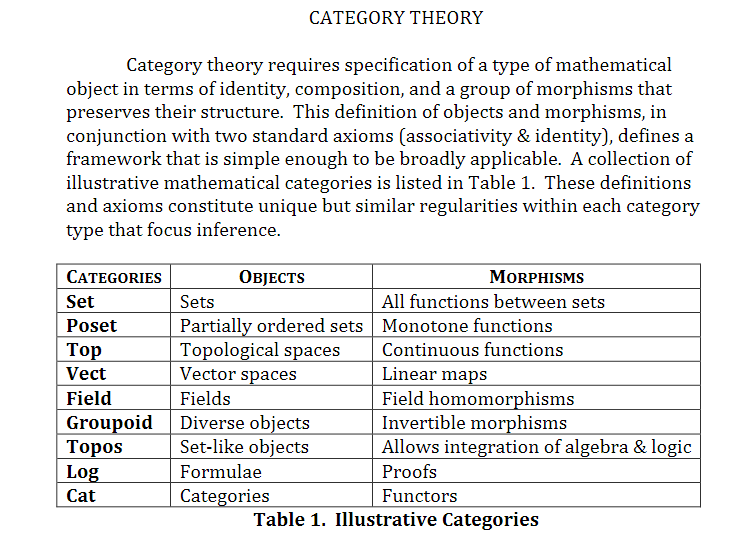
More recently, I came across the fascinating work of David Sallach, one paper (a conference from 2012) includes:


Sallach, D.L. Categorical Social Science: Theory, Methodology and Design. September 2012
Conference: Fourth World Congress on Social Simulation. Taipei, Taiwan.
https://www2.econ.iastate.edu/tesfatsi/Sallach2012CategoricalSoSci4.WCSS-SS.pdf

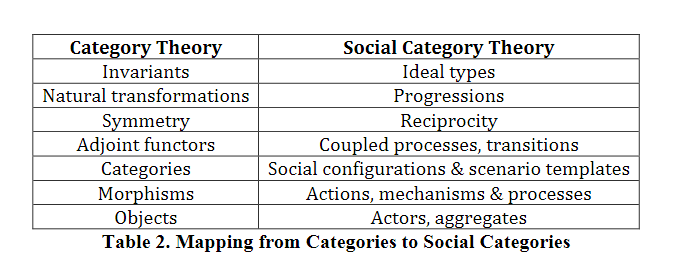
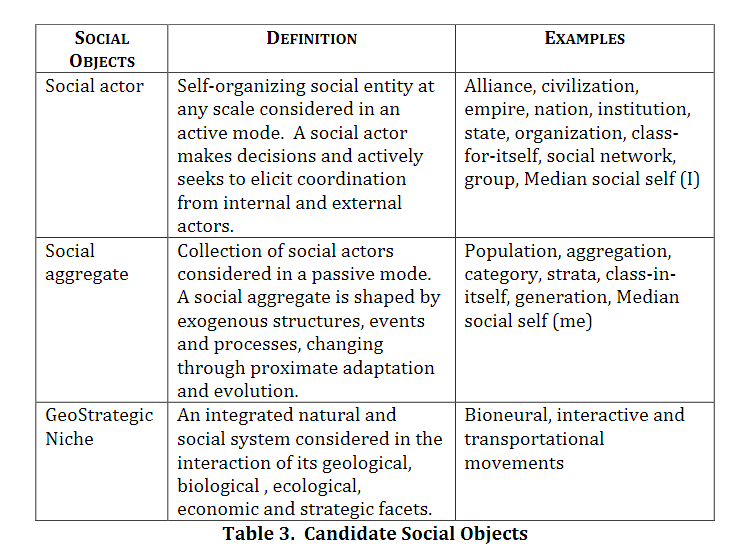
Plus, developed further in table 2:

If time permits as an exercise, please consider Sallach's table 3 below. It may be interesting to map this to the domains of Hodges' model(?) [template]:
:

If you can see the potential utility of Hodges' model, you may also appreciate why Sallach's paper  resonates. Having emailed Dr Sallach, without reply, I did some checking. More sad news followed.

I, and no doubt many people will continue to discover and appreciate the legacy left behind by the above and many other pioneers. 

<>

I must acknowledge - Enid Mumford - whose work on socio-technical systems continues to inform my study and application of Hodges' model. This includes recognition of the many x-disciplinary bridges (or, barricades?) that can be found within Hodges' model. 

Clearly, much reading still to do.
<>

Returning to Hodges' model as a mathematical object, the 'distance' above is suddenly interstellar (and yes, sudden, as in faster than light!). I'm following videos, papers, and specific work-streams by  universities (I won't mention presently...) seeking to apply category theory to the social sciences. This suggests, at least, I'm not (completely!) wasting my time. If you have thoughts yourself on Hodges' model, the journey from Sallach's tables 1 - 2 not just 3, I'd be delighted to hear from you. 

There is another approach I will share this (N) spring. This author - researcher I have been able to contact.

*Scouser - https://en.wikipedia.org/wiki/Scouse
(Re. Liverpool - further post to follow).

James Lovelock image:  Bruno Comby, CC BY-SA 1.0, via Wikimedia Commons.

Thursday, January 25, 2024

James's 'terrible algebra'

“You are right in your consciousness that we are all echoes and reverberations of the same, and you are noble when your interest and pity as to everything that surrounds you appears to have a sustaining and harmonizing power. Only don’t, I beseech you, generalize too much in these sympathies and tendernesses — remember that every life is a special problem which is not yours but another’s, and content yourself with the terrible algebra of your own. Don’t melt too much into the universe, but be as solid and dense and fixed as you can." 
Henry James.

Source - and in full: 
https://www.goodreads.com/quotes/1242340-you-are-right-in-your-consciousness-that-we-are-all

My source: Berwick, I. Over the limit, Life&Arts, FTWeekend, 20-21 January, 2024, p.10. (Review of "How We Break").

Why not a 'care algebra' - across the five domains?


 Individual
   |
      INTERPERSONAL    :     SCIENCES               
HUMANISTIC  --------------------------------------  MECHANISTIC      
 SOCIOLOGY  :   POLITICAL 
|
Group
reasoning

thought

James's ...

'terrible algebra'

THEORY
<gap>
PRACTICE

mathematics & logic

abstraction

algebra


PRACTICE
<gap>
THEORY

Applied Mathematics
in the Social Sciences


Equity, Equality,
Efficiency, Effectiveness, Efficacy
Difference, Comparison
Inclusion, Exclusion


My emphasis.

Tuesday, June 28, 2022

Nursing in the Digital Age survey

[and my source]

Nursing In the Digital Age 2022 (2) 

"Smart New World was published by the QNI in 2012 and again in 2016. Ten years later we think it is time to assess the level of progress and development in digital technology you use at work since the report was published. We are particularly interested in any effect (positive or negative) it has had on workloads. 

 We have created a survey to inform this work. It has 31 questions and should take around 8 minutes. Your contribution would be greatly appreciated. It contains no identifying information. Please address any queries to Alison Leary (alisonleary AT yahoo.com) or Dave Bushe dave.bushe AT qni.org.uk Thank you! SurveyMonkey is a third party provider. Please do not enter any patient identifiable or personal data other than your email address if you wish to share it with us at the end of the survey."

https://www.surveymonkey.co.uk/r/NITDASoMe

Monday, May 30, 2022

1+1=2

INDIVIDUAL
|
 INTERPERSONAL    :     SCIENCES               
HUMANISTIC --------------------------------------  MECHANISTIC      
SOCIOLOGY  :   POLITICAL 
|
GROUP

belief
my purpose


1+1=2

0,1 ...
society
social groups
social networks
1+1= ?

"When people talk about how math is or should be apolitical, because "1+1=2" does not depend on politics and neither does the Riemann hypothesis, it seems that the only math that they can think of is pure math. This line or argument completely falls apart for applied math."  @imathematicians [thread]


My source:

https://twitter.com/imathematicians/status/1530724466073952261?s=20&t=eF1XRD9HbkSJ2XWWbIk2qQ 

Previously: 'maths' ,  '2 + 2 = ?'

https://twitter.com/imathematicians/status/1530724466073952261?s=20&t=eF1XRD9HbkSJ2XWWbIk2qQ