Hodges' Model: Welcome to the QUAD: axioms

Hodges' model is a conceptual framework to support reflection and critical thinking. Situated, the model can help integrate all disciplines (academic and professional). Amid news items, are posts that illustrate the scope and application of the model. A bibliography and A4 template are provided in the sidebar. Welcome to the QUAD ...

Showing posts with label axioms. Show all posts

Wednesday, January 21, 2026

v Book: Bill Ross - 'Order and the Virtual'

'The Philosophy and Science of Deleuzian Cosmology'

Systemists will find much here: 'principle of least action', 'principle of least resistance', equilibrium, open / closed systems, and entropy. A useful question is posed: 'Is complexity increasing? Is that average complexity across the universe; or the complexity of the most complex object? Deleuzes's Difference and Repetition is quoted:

'The values of implication are centres of envelopment. These centres  are not the intensive individuating factors themselves, but they are their representatives within a complex whole in the process of explication. ...' (p.255-6)'

Reading this I immediately thought of Bohm, who followed shortly after (still in Chapter 1!). In chapter 1, 'Chaos' could be read as Cosmos, hence the term rolling them together - chaosmos. This is the tract from which existence and becoming arise (re-reading). Deleuze's awareness of physics and quantum theory and its influence on his work is discussed, with chapter 2 providing continuity reaching to Leibniz (and 'The Calculating God'), also contributing is 'the complete concept', 'principle of sufficient reason', 'intensive individuating factors' and 'principle of identity of indiscernibles', for example. Even while the context is metaphysics (and it is not!), (for me) this seemingly presages a comprehensive health assessment:

'The necessity in question is the necessary inclusion of all predicates pertaining to an individual in the complete concept of that individual.' p.24.

A reason to look up Lautman's philosophy is that it - 

'... entails a dialectic; a dialectic comprised of the movement of Ideas. While a given theory may achieve the desired tractability of the paradoxical element in question, this can only be the provisional resolution of the problem. This does not imply that the paradoxical element is in itself resolved; it retains its disruptive powers, its `remainder` within the explanatory framework, which will itself once again redistribute, redeploy, in an inevitable encounter with the next explanatory framework. In this sense (a sense which Deleuze embellishes), the 'problem' and the 'solution' are profoundly different in kind to question and answer. Whereas an answer might be understood to put a question to rest, the solution cannot resolve the problem finally.'


Plato's perpetual questioning wins the day and night (that is 24 hour care). This is why, for me Hodges' model is powerful - "Nursing: Be the difference"^ - and more relevant than ever:

INDIVIDUAL
|
 INTERPERSONAL    :     SCIENCES               
HUMANISTIC --------------------------------------  MECHANISTIC      
SOCIOLOGY  :   POLITICAL 
|
GROUP

Self-Knowledge/Care
Literacies
Reasoning*

KNOWLEDGE - FACTS ...
Self-Knowledge for
Self-care
Dialectic*
Guided discovery
Perpetual questioning

Education
Government provision
Access for all
Voice(s): being heard*


Ross explains that Deleuze is not limited to the realm of mathematics: 

and: 'By Ideas, we do not mean models whose mathematical entities would only be copies, but in the true Platonic Idea sense of the term, the structural schemas acccording to which effective theories are organised.'

Is the 'paradoxical agent' at work here, now a digitalized homonculus ready to preside acting as a superior dialectic that runs over the stream of conciousness? Hodges' model is a conceptual framework and ever-ready (we hope) aide-mémoire:

'Problems are always dialectical; the dialectic has no other sense, nor do problems have any other sense. What is mathematical (or physical, biological, psychical or sociological) are the solutions' (DR, 179).' (p.43).

In Hodges' model, the solutions are fixed in time, for what is (usually) an ongoing situation and context. Certain results in mathematics may be fixed, appear as a standing wave, but the flux, dyanamic remains. And, with it noise that is incessant and increasingly political.

This is a challenging, but rewarding read. 

^Have constant regard for representation, creation, being, becoming and how this affects and impacts (the) becoming.

Many thanks to Edinburgh University Press for my review copy.

More to follow here ...

Bill Ross (2024) Order and the Virtual: The Philosophy and Science of Deleuzian Cosmology. Edinburgh: Edinburgh University Press.
https://edinburghuniversitypress.com/book-order-and-the-virtual.html

Monday, January 19, 2026

iv Book: Bill Ross - 'Order and the Virtual'

'The Philosophy and Science of Deleuzian Cosmology'

Systemists will find much here: 'principle of least action', 'principle of least resistance', equilibrium, open / closed systems, and entropy. A useful question is posed: 'Is complexity increasing? Is that average complexity across the universe; or the complexity of the most complex object? Deleuzes's Difference and Repetition is quoted:

'The values of implication are centres of envelopment. These centres  are not the intensive individuating factors themselves, but they are their representatives within a complex whole in the process of explication. ...' (p.255-6)'

Reading this I immediately thought of Bohm, who followed shortly after (still in Chapter 1!). In chapter 1, 'Chaos' could be read as Cosmos, hence the term rolling them together - chaosmos. This is the tract from which existence and becoming arise (re-reading). Deleuze's awareness of physics and quantum theory and its influence on his work is discussed, with chapter 2 providing continuity reaching to Leibniz (and 'The Calculating God'), also contributing is 'the complete concept', 'principle of sufficient reason', 'intensive individuating factors' and 'principle of identity of indiscernibles', for example. Even while the context is metaphysics (and it is not!), (for me) this seemingly presages a comprehensive health assessment:

'The necessity in question is the necessary inclusion of all predicates pertaining to an individual in the complete concept of that individual.' p.24.

There are several 'completes' to be unwound, and so better understood. Ross provides a key. This isn't a book to read and pass-on to a student, second-hand bookshop. It really deserves re-reading, mandatory here - to get hold of the ideas and interplay of Deleuze, Ross's understanding and it must be said interpretation, that also calls upon Dan Smith's Essays on Deleuze, (EUP) and directly Leibniz's work. 

'The complete concept idea of predication is furnished to map faithfully onto these principles concerning the nature of things.' p.26.

The expanse of thought and literature from across the channel, 'French Theory' has long tempted, teased and taunted (not-quite as severely as mathematics!). At least here you can get a sense of the traffic in thought and ideas. Deleuze is difficult (in-/compossibilities, kuklos exothen ...), until you relate: becoming over being, difference over identity, and creation over representation. Order and the Virtual helps in this task. Delueze is 'embedded' in the mechanics of complexity, and mathematics, but Deleuze and Ross can see - across - to the humanities (virtual and actual). 

'Lastly, while mathematical concepts are frequently adopted to illuminate Deleuze's argument, they should not be taken as metaphorically representative of processes in the world; this would be to ignore the broadside and extended attack on representation as a mode of thinking as such which occupies so much of Difference and Repetition. Rather, they serve as a particularly direct example of the differential processes to which all phenomena - natural, social, psychological are subject. In an unambiguous sense, it is eminently possible for problems prompting a mathematical response to express themselves in altogether different domains - natural, social, etc. The problem is, so to speak, a common root of all domains.' p.39.

Still grappling, I noted integration, actualization, parity of esteem, maths - the linear and non-linear. It seems Deleuze was challenged by the question of integration. Leibniz's contribution of the calculus is acknowledged. History and even the present remain preoccupied with finding boxes. Ross explains how for Deleuze, we should not discount turbulent phenomena that cannot be simply integrated, written off as random disorder.

If we associate complication, with implication and explication, do we invite two-fold (as a minimal - keyhole) 'surgery': (re-)constructive and destructive? Thank you Mr Ross. I see now, how the (infinity →) continuum will not be exhausted. Exploring axioms for Hodges' model, and what is axiomatic, I must check Albert Lautman's model of dynamic structuration, especially when set (against / with?) the problematic mode:

'The two modes relate to each other dialectically - a period of exploration followed by the resulting period of axiomatisation. Deleuze recognises both modes and their respective utility, but for his philosophy the problematic mode is by far the more important.' p.41.

Do our boxes still have a purpose? To tame the situation - at hand/mind/virtual?

More to follow here ...

Bill Ross (2024) Order and the Virtual: The Philosophy and Science of Deleuzian Cosmology. Edinburgh: Edinburgh University Press. 
https://edinburghuniversitypress.com/book-order-and-the-virtual.html

Thursday, January 08, 2026

Hodges' model: An algebra for care - seeking axioms?

Although Oliver had been brought up by philosophers, he was not theoretically acquainted with the beautiful axiom that self-preservation is the first law of nature.
                                                                                    
- Charles Dickens, Oliver Twist

Coady, C. A. J. (1990). Hobbes and “The Beautiful Axiom.” Philosophy, 65(251), 5–17. 
http://www.jstor.org/stable/3751240

"It is an axiom in therapeutics that the more remedies there are proposed for a disease the less likely is any of them to be effective."

[- William Osler]

Mountin, J. W. (1943). Nursing: A Critical Analysis. The American Journal of Nursing, 43(1), 29–34. https://doi.org/10.2307/3416264

Individual
|
     INTERPERSONAL    :     SCIENCES               
HUMANISTIC  --------------------------------------  MECHANISTIC      
 SOCIOLOGY  :    POLITICAL 
|
Group
 
'One of the core tenets of pragmatism, despite its various formulations by William James, Jane Addams, John Dewey, and neo-pragmatists like Rorty, Habermas, and Putnam, is an epistemological axiom first formulated in 1868 by Charles Sanders Peirce. This maxim, often dubbed the pragmatic maxim, states that the meaning of our ideas is best expounded when we can spell out the implications or the effects of these ideas in real-world experience and practice (Peirce 1878).' pp.105-106.
(Racine, 2024).

physical - SELF - My body[?]


'The lack of consideration of downside risks applies to all COVID-19 countermeasures, including mass-masking (e.g. the social and psychological consequences of mask-wearing for all kinds of social interaction, most notably in educational and childcare settings) and to the accelerated approval of vaccines. The latter is particularly noteworthy because the need for rigorous testing of new medications to guard against the risk of side effects is a standard axiom of contemporary ethical medical practice. Given that the vaccines in question employed novel mechanisms, not testing them sufficiently to assure their longer term safety was stratospherically risky: it meant that the possibility that this vaccination programme would do more harm than good could not be excluded. Yet, the medical establishment stood foursquare behind it, insisting on the safety and efficacy of the vaccines and pillorying any, including those within it, who demurred.' p.55. (Kelly, 2023).


'“Never have we been so free. Never have we felt so powerless”: this, according to Bauman, is the paradox of our time. Verhaeghe writes with a variant: “Never before have we in the West had it so good, and never have we felt so bad.”33 Because neoliberal axioms determine the standards of what is healthy and normal, society sees those who do not want to participate as sick or abnormal.' pp.97-98. (Vanheste, 2023).
 

My emphasis

Racine, E. (2024). What Participatory Research and Methods Bring To Ethics: Insights From Pragmatism, Social Science, and Psychology. Kennedy Institute of Ethics Journal 34(1), 99-134. 
 https://dx.doi.org/10.1353/ken.2024.a943431.

Kelly, M.G.E. (2023). Securing the Pandemic: Biopolitics, Capital, and COVID-19. Foucault Studies 35, 46-69. https://muse.jhu.edu/article/940834.

Vanheste, J. (2023). Half a Century of Exhaustion and Madness: The Fiftieth Anniversary of Pink Floyd's The Dark Side of the Moon. Soundings: An Interdisciplinary Journal 106(1), 87-109. 
https://muse.jhu.edu/article/950363.

See also: 'axiom' : 'algebra' : 'pragmatism'

Person-centred care = care axiomatics at a collective and individual level?

The first rule (axiom?) of first aid is...?

Sunday, January 04, 2026

Biology, axioms, teleology and knowledge c/o Cox & Forshaw (2012)

'Teleological ideas generally have a rather bad reputation in science, and it's easy to see why. In biology, a teleological explanation for the emergence of complex creatures would be tantamount to an argument for the existence of a designer, whereas Darwin's theory of evolution by natural selection provides a simpler explanation that fits the available data beautifully. There is no teleological component to Darwin's theory - random mutations produce variations in organisms, and external pressures from the environment and other living thing determine which of these variations are passed on to the next generation. This process alone can account for the complexity we see in life on Earth today. In other words, there is no need for a grand plan and no gradual ascent of life towards some sort of perfection. Instead, the evolution of life is a random walk, generated by the imperfect copying of genes in a constantly shifting external environment. The Nobel-Prize-winning French biologist Jacques Monod went so far as to define a cornerstone of modern biology as "the systematic or axiomatic denial that scientific knowledge can be obtained on the basis of theories that involve, explicitly or not, a teleological principle".
As far as physics is concerned, there is no debate as to whether or not the least action principle actually works, for it allows calculations to be performed that correctly describe Nature and it is a cornerstone of physics. It can be argued that the least action principle is not teleological at all, but the debate is in any case neutralized once we have a grasp of Feynman's approach to quantum mechanics. The ball flying through the air 'knows' which path to choose because it actually, secretly, explores every possible path.' pp.52-53.


Cox, Brian, and Jeff Forshaw. (2012) Quantum Universe, the: Everything That Can Happen Does Happen. London: Penguin Books Ltd.

See also: 

Jacques Monod - https://www.informationphilosopher.com/solutions/scientists/monod/

Harrison, Peter. 2022. 'The History of Science and Theology', St Andrews Encyclopaedia of Theology. Edited by Brendan N. Wolfe et al. https://www.saet.ac.uk/Christianity/TheHistoryofScienceandTheology

Greslehner GP. "Molecular Biology"- Pleonasm or Denotation for a Discipline of Its Own? Reflections on the Origins of Molecular Biology and Its Situation Today. Biomolecules. 2023 Oct 12;13(10):1511. doi: 10.3390/biom13101511. PMID: 37892193; PMCID: PMC10605324.

Previously: 'axiom' : 'biology' : 'corner'

Saturday, July 05, 2025

'Axiomatic' - according to Simondon

Glossary:

Fifty Key Terms in the Works of Gilbert Simondon, pp.203-231.
Jean-Hugues Barthélémy, translated by Arne De Boever. 
In. De Boever A, Murray A, Roffe J, eds. Gilbert Simondon: Being and Technology. Edinburgh University Press; 2012.
'Axiomatic
In Simondon, this notion does not designate a formal system as in the case of logico-mathematical axiomatics, but simply a set of principles, or first propositions, that enable the linking fundamental concepts. It is in this sense that Simondon, in IPC in general and more specifically in FIP, struggles to work out a 'common axiomatic' (FIP, in IPC 35 or ILFI 533) for the human sciences - which enables the unification of psychology and sociology.' p.208.


Simondon holds hope for me (I think) in terms of the extent of formality I (and others) might seek for Hodges' model. Is there a set of principles - and simple at that? The structure of Hodges' model 'places' the knowledge (care) domains of psychology (intrapersonal & interpersonal) and sociology next to each other, as if to encourage unification. The bridge: psycho-social and a great many others, are there, to take walk and reflect on what we find there. If we choose to. ...

I'll check on the abbreviations. 

FIP : « Forme, information, potentiel » (conférence datant de 1960, ajoutée par l’éditeur), in Simondon, ILFI et IPC (voir ci-dessous).

ILFI : L’individuation à la lumière des notions de forme et d’information, Grenoble, Éditions Jérôme Millon, 2005 (Thèse principale de Simondon pour le Doctorat d’État, écrite de 1954 à 1958). 

IPC : L’individuation psychique et collective, Paris, Aubier, 1989 et 2007 (cet ouvrage contient le dernier tiers d’ILFI, ainsi que son Introduction et sa Conclusion).

https://journals.openedition.org/appareil/2253

Saturday, September 14, 2024

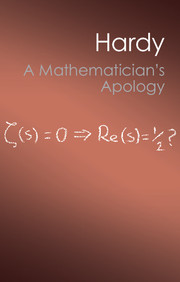
Hardy (1940) A Mathematician's Apology


In Liverpool I came across G.H. Hardy's short book A Mathematician's Apology. At £2.00 - a pristine bargain and a  marvellous read, especially the latter sections.

From being taught and applying Hodges' model in a case study in 1987 through to online work since 1998; I have to ask myself. Do I need to write:

'A Nurse's Apology'?

Aware of Hardy in the history of mathematics, and having read his apology, I'm no Hardy. My antics are a lesson in addition, but this is more 'Laurel and Hardy' - with apologies to comic genius of course. 


By their nature professions seek to maintain, and assure their continuity. A professional body can point to a definable body of theory, practice (curricula), that carries social and political status, if not patronage. There is national agreement that the NHS needs reform; radical reform no-less. The new Labour government is drawing lines to negotiate with the BMA, other professional bodies and unions. Specificity, specialisation is key. In healthcare people have suggested to me that Hodges' model invites genericism. Any suggestion of genericism is to be shunned. There seems an almost allergic reaction such is the threat to professional identity; unless, of course, you are a 'General Nurse', or General Practitioner - GP family doctor). Even Hardy warns:
"'GENERALITY' is an ambiguous and rather dangerous word, and we must be careful not to allow it to dominate our discussion too much." p.105.

This also applies to the quality and solidity of professional agencies and bodies whose role is to provide governance and set standards. The NMC has stumbled? Life and death is made up of details AND big pictures. How do you provide for - balance both? Curricula are another concern. Is the future of mental health nursing guaranteed as a profession? 

https://hodges-model.blogspot.com/2016/08/future-of-mental-health-nurse-training.html

The instrumental potential of Hodges' model is obvious. It invites a checkbox approach. One-to-one clinical encounters and interactions reduced to a tick-box exercise. This reduces any sense of specialist knowledge, training and education needed to assess, plan, deliver and evaluate high quality, effective, sustainable healthcare.

'THE second quality which I demanded in a significant idea was depth, and this is still more difficult to define. It has something to do with difficulty; the deeper? ideas are usually the harder to grasp: but it is not at all the same.' p.109.

Hardy's thoughts (and no doubt similarly expressed by other mathematicians and logicians) can be 'found' in Hodges' model; with an addition. Depth and difficulty rests on the uniqueness of  the 'one'. 

Here, Hardy is comparing between 'real mathematics' and chess:

'A chess problem also has unexpectedness, and a certain economy ; it is essential that the moves should be surprising, and that every piece on the board should play its part. But the aesthetic effect is cumulative. It is essential also (unless the problem is too simple to be really amusing) that the key-move should be followed by a good many variations, each requiring its own individual answer. 'If P-B5 then Kt-R6; if .... then if .... then ...., ....' - the effect would be spoilt if there were not a good many different replies. All this is quite genuine mathematics, and has its merits; but it is just that 'proof by enumeration of cases'  (and of cases which do not, at bottom, differ at all profoundly*) which a real mathematician tends to despise.' p.114.

*I believe it is now regarded as a merit in a problem that there should be many variations of the same type. (footnote)

While Kings, and Queens et al. undoubtedly have their own unique personalities, in healthcare effective clinicians make a concerted effort not to merely enumerate cases. The professional emphasis is (idealistically, professionally, purely and in application to) person-centredness; with the compassion, complexity, cussedness, and (sometimes literal) complications this brings. From 1-1 interaction, the clinical encounter, the therapeutic relationship, and alliance are the reason for practitioners achieving and sustaining intra- and interpersonal communication skills. Our attitudes towards knowledge, what is thoughts affects what we feel individually and collectively. Science should be neutral. It might be concluded that this question is for the philosophers and ethicists to wrestle with. In healthcare ethics are central: 'Do no harm'. Whether the practitioner, theorist, manager, policy maker is a nurse, scientist or mathematician such questions impact upon the person. As they are social, cultural and political. Revisiting Bronowski's Ascent of Man, this question arose in Archive on 4.

'It seems that mathematical ideas are arranged somehow in strata, the ideas in each stratum being linked by a complex of relations both among themselves and with those above and below. The lower the stratum, the deeper (and in general the more difficult) the idea.' p.110.

(my emphasis)

individual
|
INTERPERSONAL : SCIENCES
humanistic ------------------------------- mechanistic
SOCIOLOGY : POLITICAL
|
group

logical & mathematical reasoning
depth of reasoning (memory)
mathematical aptitude
intelligence(s)
pure maths
identity

vector
relations
mathematics
logic
depth of analysis, complexity
Cricket!
pure - applied maths
"1" problem per visit

patient - health practitioner 
relationship
Watching cricket - conversation

reports - outcomes
enumeration of cases


Back-tracking to page 104, Hardy:

'The relations revealed by the proof should be such as connect many different mathematical ideas.'

Our proof is person-centredness, placing the person at the center (in this case - of Hodges' model). The proof can be quantitative and qualitive. There are a great many ideas at work. Critically, the ideas that might be called upon (even improvised) are not all health-related, but can extend beyond to encompass the four care (knowledge) domains of Hodges' model. In healthcare as in Hardy's life the spiritual is encountered. So, the determinants of health are ALL available to us - as required. Well not available as a resource might be, they are available in the hope they will be seen as factors. Hardy would approve I think of the direction of travel, not just as a vector, but a model of multidimensional vectors - reaching for relations.

Hardy, G.H. (1940) A Mathematician's Apology, Cambridge: Canto.
https://www.cambridge.org/core/books/mathematicians-apology/B90D81A8E28674119781863988A3E11B

Monday, May 08, 2023

Safety first: Hard hats must be worn^


- this is a construction site.


INDIVIDUAL
|

 INTERPERSONAL    :     SCIENCES               
HUMANISTIC --------------------------------------  MECHANISTIC      
SOCIOLOGY  :   POLITICAL 
|
GROUP
This may be another distraction?

Before I examine and explain Hodges' model as a generic conceptual framework, model of care, (implicit theory?) . . .
I need to explain, provide an account for the model's construction.


Image: 

https://www.safetysign.com/products/5467/danger-hard-hats-must-be-worn-sign

^Safety boots, high viz vests ...
