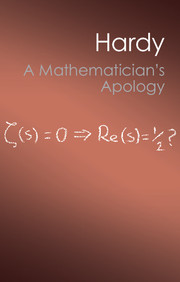
In Liverpool I came across G.H. Hardy's short book A Mathematician's Apology. At £2.00 - a pristine bargain and a marvellous read, especially the latter sections.
From being taught and applying Hodges' model in a case study in 1987 through to online work since 1998; I have to ask myself. Do I need to write:
'A Nurse's Apology'?
Aware of Hardy in the history of mathematics, and having read his apology, I'm no Hardy. My antics are a lesson in addition, but this is more 'Laurel and Hardy' - with apologies to comic genius of course.
By their nature professions seek to maintain, and assure their continuity. A professional body can point to a definable body of theory, practice (curricula), that carries social and political status, if not patronage. There is national agreement that the NHS needs reform; radical reform no-less. The new Labour government is drawing lines to negotiate with the BMA, other professional bodies and unions. Specificity, specialisation is key. In healthcare people have suggested to me that Hodges' model invites genericism. Any suggestion of genericism is to be shunned. There seems an almost allergic reaction such is the threat to professional identity; unless, of course, you are a 'General Nurse', or General Practitioner - GP family doctor). Even Hardy warns:
"'GENERALITY' is an ambiguous and rather dangerous word, and we must be careful not to allow it to dominate our discussion too much." p.105.
This also applies to the quality and solidity of professional agencies and bodies whose role is to provide governance and set standards. The NMC has stumbled? Life and death is made up of details AND big pictures. How do you provide for - balance both? Curricula are another concern. Is the future of mental health nursing guaranteed as a profession?
https://hodges-model.blogspot.com/2016/08/future-of-mental-health-nurse-training.html
The instrumental potential of Hodges' model is obvious. It invites a checkbox approach. One-to-one clinical encounters and interactions reduced to a tick-box exercise. This reduces any sense of specialist knowledge, training and education needed to assess, plan, deliver and evaluate high quality, effective, sustainable healthcare.
'THE second quality which I demanded in a significant idea was depth, and this is still more difficult to define. It has something to do with difficulty; the deeper? ideas are usually the harder to grasp: but it is not at all the same.' p.109.
Hardy's thoughts (and no doubt similarly expressed by other mathematicians and logicians) can be 'found' in Hodges' model; with an addition. Depth and difficulty rests on the uniqueness of the 'one'.
Here, Hardy is comparing between 'real mathematics' and chess:
'A chess problem also has unexpectedness, and a certain economy ; it is essential that the moves should be surprising, and that every piece on the board should play its part. But the aesthetic effect is cumulative. It is essential also (unless the problem is too simple to be really amusing) that the key-move should be followed by a good many variations, each requiring its own individual answer. 'If P-B5 then Kt-R6; if .... then if .... then ...., ....' - the effect would be spoilt if there were not a good many different replies. All this is quite genuine mathematics, and has its merits; but it is just that 'proof by enumeration of cases' (and of cases which do not, at bottom, differ at all profoundly*) which a real mathematician tends to despise.' p.114.
*I believe it is now regarded as a merit in a problem that there should be many variations of the same type. (footnote)
While Kings, and Queens et al. undoubtedly have their own unique personalities, in healthcare effective clinicians make a concerted effort not to merely enumerate cases. The professional emphasis is (idealistically, professionally, purely and in application to) person-centredness; with the compassion, complexity, cussedness, and (sometimes literal) complications this brings. From 1-1 interaction, the clinical encounter, the therapeutic relationship, and alliance are the reason for practitioners achieving and sustaining intra- and interpersonal communication skills. Our attitudes towards knowledge, what is thoughts affects what we feel individually and collectively. Science should be neutral. It might be concluded that this question is for the philosophers and ethicists to wrestle with. In healthcare ethics are central: 'Do no harm'. Whether the practitioner, theorist, manager, policy maker is a nurse, scientist or mathematician such questions impact upon the person. As they are social, cultural and political. Revisiting Bronowski's Ascent of Man, this question arose in Archive on 4.
'It seems that mathematical ideas are arranged somehow in strata, the ideas in each stratum being linked by a complex of relations both among themselves and with those above and below. The lower the stratum, the deeper (and in general the more difficult) the idea.' p.110.
(my emphasis)
individual
|
INTERPERSONAL : SCIENCES
humanistic ------------------------------- mechanistic
SOCIOLOGY : POLITICAL
|
group
logical & mathematical reasoning depth of reasoning (memory) mathematical aptitude intelligence(s) pure maths identity |
vector relations mathematics logic depth of analysis, complexity Cricket! pure - applied maths "1" problem per visit
|
patient - health practitioner relationship Watching cricket - conversation |
reports - outcomes
enumeration of cases
|
Back-tracking to page 104, Hardy:
'The relations revealed by the proof should be such as connect many different mathematical ideas.'
Our proof is person-centredness, placing the person at the center (in this case - of Hodges' model). The proof can be quantitative and qualitive. There are a great many ideas at work. Critically, the ideas that might be called upon (even improvised) are not all health-related, but can extend beyond to encompass the four care (knowledge) domains of Hodges' model. In healthcare as in Hardy's life the spiritual is encountered. So, the determinants of health are ALL available to us - as required. Well not available as a resource might be, they are available in the hope they will be seen as factors. Hardy would approve I think of the direction of travel, not just as a vector, but a model of multidimensional vectors - reaching for relations.
Hardy, G.H. (1940) A Mathematician's Apology, Cambridge: Canto.
https://www.cambridge.org/core/books/mathematicians-apology/B90D81A8E28674119781863988A3E11B


 orcid.org/0000-0002-0192-8965


